
Temple filler restores the hollow at the side of the forehead, above the cheekbone and in front of the hairline, using a gel placed deep against the bone. Temple fillers in Singapore are performed here by Dr Gerard Ee, MBBS (UK), MRCS (Edinburgh), PGDip Practical Dermatology (Cardiff), using a hyaluronic acid (HA) filler by default, with a polycaprolactone (PCL, 少女针) filler where you want something longer lasting.
At a glance
Filler Treatment Summary
| Item | Details |
|---|---|
| Filler Used | HA filler by default. PCL filler where a longer-lasting, collagen-stimulating option is preferred. |
| Price | HA filler $800 per syringe. PCL filler $1,400 per syringe. Both before GST, review appointment included. |
| Session | About 20 minutes |
| Volume Needed | 2 to 3 ml in total, divided between both sides. One syringe is 1 ml. |
| Sessions Needed | Usually one visit |
| Results | Visible immediately, settling over 1 to 2 weeks |
| Downtime | 3 to 5 days of swelling, sometimes bruising |
| Reversible | HA filler, yes, dissolved with hyaluronidase. PCL filler, no. |
What temple filler does

A full temple gives the upper face a continuous curve running from the brow, out to the side of the forehead and back to the hairline. When that area hollows, the curve breaks. The bony rim of the eye socket and the edge of the cheekbone start to show as ridges, the face narrows at the top and widens at the jaw, and the outer end of the eyebrow loses the tissue holding it up.
Filler placed deep in the hollow restores that curve. What people notice is that the upper face looks broader and less drawn, that the ridge at the outer eye socket stops casting a shadow, and that the tail of the brow sits a little higher without anything having been done to the brow itself. It is one of the few injections that changes the shape of the face rather than the surface of it.
Who it suits
Temple hollowing comes from three directions and they respond differently. Loss of fat and bone with age responds well. Significant weight loss produces the same hollow faster and also responds well, though it can need more than one syringe. Some people are simply built with narrow temples and have been since their twenties. Filler works there too, but the change is a change to your face rather than a restoration of it, which is a different decision to make.

It suits the person who is told they look tired or gaunt rather than old. It does not suit someone whose main concern is the lower face, because filling the temples of a face that is heavy at the jaw makes the imbalance more obvious. Where the whole upper face has deflated, the temples are usually treated alongside the cheeks, and this guide to treatment by decade sets out the usual sequence.
Which filler is used
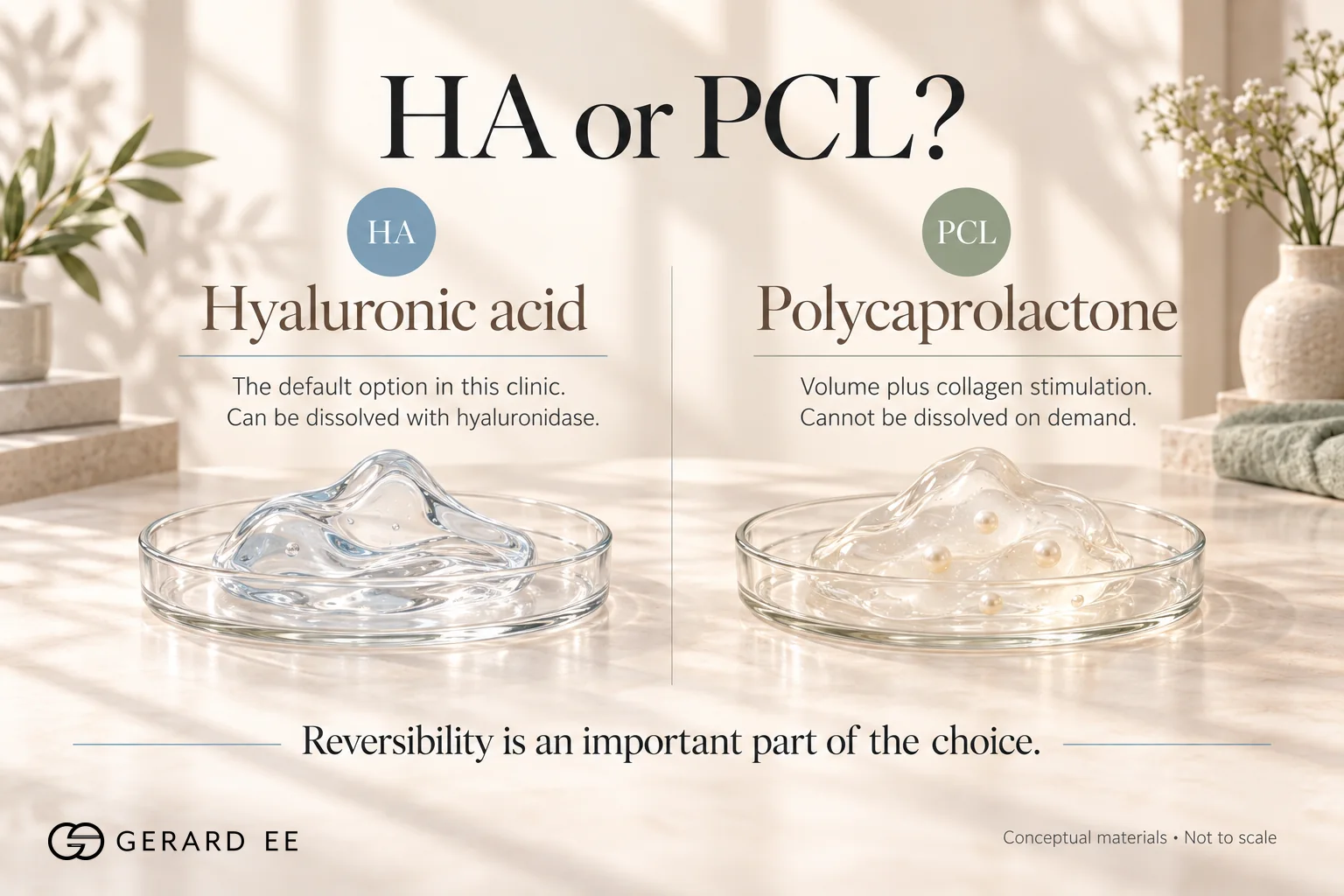
The default is a hyaluronic acid filler placed deep, down against the bone, where a firmer gel holds its volume without showing edges through skin that is thin here. It behaves predictably and can be dissolved with hyaluronidase if the result is not what you wanted. The same product family is used for lip fillers and nose fillers here.
Polycaprolactone, the PCL filler, also known as 少女针, is the alternative where you want something longer lasting, at $1,400 per syringe. It restores lost volume while stimulating your body’s own collagen production, giving both an immediate lift and longer-term skin rejuvenation, and PCL has been used in medicine for decades in sutures and implants.
The difference that matters is reversibility. An HA filler can be dissolved in an afternoon. A PCL filler cannot, because no enzyme removes it, and that applies to an unwanted result and to a vascular complication alike. Given the anatomy described below, that is a real part of the decision here rather than a footnote.
What temple fillers cost in Singapore
HA filler is $800 per syringe. PCL filler, the collagen stimulator, is $1,400 per syringe. Both figures are before GST and both include your review appointment.
These are fixed prices, not starting prices. Both temples together usually take two to three syringes. The consultation is charged separately and waived if you go ahead on the day.
How much filler will I need
The temple takes more material than most people expect, because it is a broad, shallow area rather than a single point. A typical treatment is 2 to 3ml in total, divided between the two sides.

One syringe is 1ml, so this is a two to three syringe treatment. Deep hollowing after significant weight loss sits at the upper end of that range. You are quoted the full figure at the consultation, before anything is injected, not after the first syringe has gone in.
What happens on the day
I look at how deep the hollow is on each side, because they are rarely equal, and check your brow position and the rest of the upper face before deciding whether filler is the right answer. If it is not, that is where it ends, and I will explain why rather than leave it as a no. If it is, numbing cream goes on and the filler is placed deep in the hollow, drawing back on the syringe before injecting and delivering a small amount slowly and at low pressure. The injection takes about twenty minutes.
Afterwards
Keep the area clean and leave it alone. No pressing or massaging for two weeks, and take care with spectacle arms and headphones that press on the temple. No strenuous exercise, alcohol or very hot environments for 24 to 48 hours. Sunscreen goes on daily. Swelling and any bruising settle over three to five days. The final shape reads at one to two weeks, which is when I review you.

Contact the clinic straight away, not at your review, if you develop increasing pain rather than settling discomfort, blanching or dusky discolouration of the skin, a severe headache, or any change in vision. These are uncommon, and they are treatable when treated early, which is why the call should not wait.
When it is not suitable
Filler is postponed or declined with an active skin infection over the area, in pregnancy or breastfeeding, with a known allergy to a component of the product, and where an autoimmune or connective tissue condition is active. Blood-thinning medication is not an absolute barrier but raises the bruising risk, and the temple bruises visibly.
Very thin skin over a very deep hollow needs the most caution, because the margin between too little and a visible edge is small, so the right answer there is a smaller amount placed slowly and reviewed before any more is added.
Why more is not better
An over-filled temple is convex rather than flat, which widens the upper face beyond what the rest of the face supports and reads as swollen rather than youthful. Because the area is broad and shallow, the difference between a good result and an obvious one is a fraction of a millilitre per side.
Filler here also lasts well, since the area barely moves. If you have had temple filler before and the upper face now looks wide or heavy, the answer is not another syringe. The first step is establishing how much of the previous material is still there.
Safety

The temple deserves a longer answer than most areas, because it is the one place on the face where what used to be considered the safe way to inject has turned out not to be.
For years the rule was to inject deep, down on the bone, on the basis that the risky blood vessels all run near the surface. That turns out not to be true. There are arteries deep in the temple as well, sitting right against the bone, and there is a route from them back to the blood supply of the eye. The vessels nearer the surface sit barely under the skin, and there is least tissue covering them in younger and slimmer patients.
So neither layer in the temple is automatically safe, and injecting deep is not a technique on its own. Before injecting I draw back on the syringe to check the needle is not sitting in a blood vessel, then use low pressure and small amounts delivered slowly, at the points known to be safest rather than wherever the hollow looks deepest. Hyaluronidase is kept in the room, and while it reverses an HA filler it does nothing for PCL, which is a further reason HA is the default here.
Who performs the treatment
Dr Gerard Ee, MBBS (UK), MRCS (Edinburgh), PGDip Practical Dermatology (Cardiff). He trained and practised in orthopaedic surgery at Singapore General Hospital and the National University Hospital before moving into aesthetic medicine, and is the author of sixteen peer-reviewed papers, thirteen of them indexed in PubMed.
More about the training is on the about page, and the published work is listed on the publications page.
Where to find us
50 Raffles Place, #01-01 Singapore Land Tower, Singapore 048623. Telephone 6532 2048. Raffles Place MRT is a two-minute walk.
Monday to Friday, 10am to 8pm. Saturday, 10am to 5pm.
Dr Gerard Ee consults and performs this treatment at The Clifford Clinic, 50 Raffles Place, Singapore.

Dr Gerard Ee, Aesthetic Doctor in Singapore
Dr Gerard Ee is an aesthetic doctor in Singapore and the Medical Director of his practice at 50 Raffles Place. He graduated from St George’s, University of London, trained in surgery at Singapore General Hospital and the National University Hospital, and holds the MRCS (Edinburgh) and a postgraduate diploma in practical dermatology from Cardiff University.
He has practised aesthetic medicine since 2012, is the author of sixteen peer-reviewed papers, and writes and medically reviews every article on this site. Read more about Dr Gerard Ee.

Book a consultation with Dr Gerard Ee at The Clifford Clinic
Dr Gerard Ee consults and performs temple filler treatment at The Clifford Clinic, 50 Raffles Place, Singapore. Consultations are by appointment. Message the clinic on WhatsApp, or call 6532 2048.
Common questions
How much do temple fillers cost in Singapore?
HA filler is $800 per syringe and PCL filler, the collagen stimulator, is $1,400 per syringe, both before GST and both including the review appointment. Both temples together usually take two to three syringes. These are fixed prices, not starting prices, and the consultation is charged separately and waived if you proceed on the day.
Are temple fillers worth it?
For hollow temples that make the upper face look drawn, yes. It is one of the few injections that changes the outline of the face rather than the surface, and one syringe usually does both sides. For someone whose real concern is the lower face, no, because filling the temples makes that imbalance more obvious.
How long do temple fillers last?
Temple filler lasts longer than filler in most areas, because the temple barely moves. An HA filler commonly gives twelve to eighteen months. PCL lasts longer, with the trade-off that it cannot be reversed.
Does the filler completely dissolve away?
An HA filler does, gradually, and what is left can be dissolved on purpose with hyaluronidase. It goes slowly here, because the temple barely moves. A PCL filler breaks down eventually but far more slowly, and there is no injection that removes it on demand.
Will temple filler lift my eyebrow?
It supports the outer end of the brow rather than lifting it. The outer third of the brow has no bone beneath it and rests on the very tissue the hollow has taken away, so restoring that tissue usually raises the brow tail a little, though it is a byproduct of the volume rather than a brow lift.
Is injecting the temple dangerous?
It carries a real risk of filler getting into a blood vessel, and that risk is better understood now than it used to be. There is a route from the arteries deep in the temple back to the blood supply of the eye, and those arteries sit right against the bone where filler is usually placed. It is an area for careful technique and small amounts, not one to treat as routine.
How many syringes will I need?
One syringe usually covers both sides. Deep hollowing after significant weight loss can need two, which is discussed and priced before anything is injected rather than after.
Can I have temple threads instead?
Threads and filler do different jobs. Filler restores volume, and threads reposition tissue. For a hollow the answer is volume. There is a separate use for threads in the temple, described in treating temple acne scars with a thread lift.
What are the side effects?
Swelling, bruising and tenderness for a few days are usual, and the temple bruises more visibly than most areas, because the skin there is thin and the blood vessels run close beneath it. Small lumps can occur and settle. The serious one is filler getting into a blood vessel, which is rare but can damage the skin or affect sight.
Do temple fillers hurt?
Numbing cream is applied first and left on until the skin is numb. Most patients describe deep pressure rather than sharp pain, because the gel is being placed against bone.