
PCL filler, short for polycaprolactone, widely known as 少女针, restores lost facial volume while prompting your own body to build collagen. It gives an immediate lift on the day and a second, slower change over the following months as that collagen arrives, so part of the final result is your own tissue rather than the product. PCL in Singapore is performed here by Dr Gerard Ee, MBBS (UK), MRCS (Edinburgh), PGDip Practical Dermatology (Cardiff), at $1,400 per syringe.

PCL at a glance
| What it is | Polycaprolactone (PCL) microspheres suspended in a gel carrier. A collagen stimulator, not a hyaluronic acid. |
| Also known as | PCL, 少女针 |
| Price | $1,400 per syringe, before GST. Review appointment included. |
| Formulation used | The two-year PCL formulation only |
| Areas treated here | Chin, cheek, temple, nasolabial fold. Not under the eye, not in the lips. |
| How long it lasts | About two years |
| Session | About 20 minutes |
| Results | Immediate volume on the day, then a second, slower change as collagen builds over 1 to 3 months |
| Downtime | 3 to 5 days of swelling, sometimes bruising |
| Reversible | No. There is no equivalent of hyaluronidase for PCL. |
What is PCL filler? PCL and 少女针 explained
Two names cause a good deal of confusion, so it is worth clearing up first. PCL is the material, polycaprolactone. 少女针 is the nickname most Chinese-speaking patients use, and it is what people search for when they have heard about the treatment from a friend rather than from a clinic. Both are the same treatment, and this page describes it. If you are weighing it against the hyaluronic acid option, the area pages set out what that costs and how long it lasts at each site.
PCL comes in more than one formulation, and they differ in how long they last rather than in what they are made of. Only one is used here, the two-year formulation, and that is a deliberate choice rather than a limitation of stock. Two years is long enough to be worth the trade-off you are making, and short enough that a result you are not happy with is not with you for good. The shorter formulation gives you roughly a year for the same price, and you still cannot undo it, which is a poor bargain. The longer ones tie you in well past the point where most people can predict what they will want their face to look like.
The name promises rather a lot. What the treatment actually does is add volume where volume has been lost and encourage your own collagen to build around the material over the following months. It does not tighten loose skin, it does not resurface, and it will not turn back the clock on skin quality by itself. If those are your concerns, filler of any kind is the wrong tool and I will say so.
How PCL works
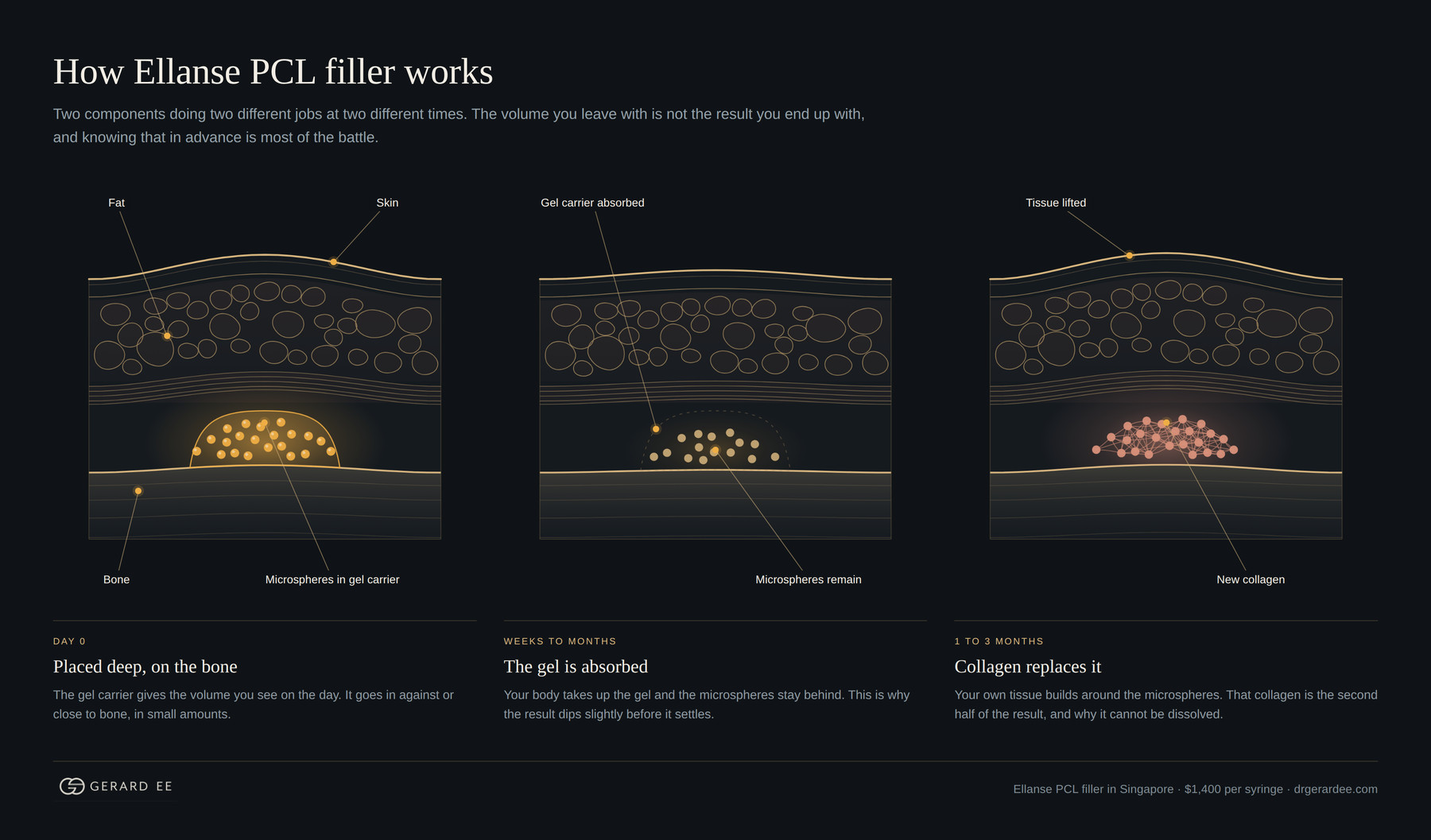
A PCL filler is made of tiny smooth spheres of polycaprolactone suspended in a soft gel that carries them, and the spheres are the smaller part of what is in the syringe. Both parts do a job, and they do it at different times.
The gel carrier gives the volume you see on the day. Over the following weeks to months your body absorbs that carrier, and if nothing else happened the result would simply fade. What happens instead is that the spheres, which stay behind, prompt your own tissue to lay down collagen around them. That collagen is the second half of the result, and it arrives gradually rather than immediately.
So the shape you leave with is not quite the shape you end up with. There is usually a slight dip as the gel is absorbed and a slow recovery as collagen replaces it. That is normal, it is not the filler failing, and it is the reason the review appointment sits where it does rather than at two weeks.
Polycaprolactone itself is not new or exotic. It has been used in medicine for decades in dissolvable sutures and implants, long before anyone injected it into a face.
PCL vs hyaluronic acid fillers
The two are not interchangeable, and the differences matter more than the similarities.
A hyaluronic acid filler is the volume. It works the day it goes in, it fades as your body breaks it down, and it can be dissolved on demand with an injection of hyaluronidase. That reversibility is why HA is the default here for most areas, and why it is the only material used under the eye.
A PCL filler is the volume plus a collagen response. It lasts considerably longer, part of the result is your own tissue, and it cannot be dissolved on demand. There is no enzyme that removes it the way hyaluronidase removes hyaluronic acid.
That single difference is the whole decision. You are trading the ability to undo the result for a result that lasts longer. Where a patient wants the longer duration and understands what they are giving up, PCL is a reasonable choice. Where there is any doubt, hyaluronic acid first is the sensible order, because you can always move to a stimulator later and you cannot easily go back the other way.
Who PCL suits
The clearest candidate is someone who has already had hyaluronic acid filler, liked the result, knows what they want, and is tired of repeating it every nine to eighteen months. You know what the outcome looks like on your own face, which removes most of the risk in choosing something you cannot undo.
It also suits a face that has genuinely lost volume rather than one that has loosened, where the loss is in a deep area with good cover over it, and where the person is willing to wait out the collagen window instead of judging the result at two weeks. Which of the two you are dealing with tends to change by decade, and this guide to treatment in your 30s, 40s and 50s sets out the usual sequence.
It suits you less well if this is your first filler, if the area you are worried about is thin or mobile, if you are unsure what you want, or if you have had a nodule from a stimulator before. None of those is a refusal, but each is a reason to start with hyaluronic acid instead.
PCL vs PLLA, CaHA and hyaluronic acid
| Works on the day | Hyaluronic acid, yes. PCL, yes, from its gel carrier. CaHA, yes. PLLA, the material sold as PLLA, barely, and the effect builds over a course of sessions. |
| How long it lasts | Hyaluronic acid 9 to 18 months depending on the area. PCL about two years. CaHA 12 to 18 months. PLLA around two years. |
| Sessions needed | Hyaluronic acid, one. PCL, one. CaHA, one. PLLA, usually a course of two or three, spaced over months. |
| Can it be dissolved | Hyaluronic acid, yes, with hyaluronidase, within hours. PCL, no. CaHA, no. PLLA, no. |
| Stimulates collagen | Hyaluronic acid, no, it is volume only. PCL, CaHA and PLLA all do, which is what makes them last. |
| Where it is used here | Hyaluronic acid everywhere including under the eye and lips. PCL and CaHA in deep areas only, with CaHA also used for nose fillers. PLLA is not offered here. |
| Price per syringe | Hyaluronic acid $800, or $1,200 under the eye. PCL $1,400. CaHA $1,400. |
The row that decides most of it is the fourth one. Everything else is a matter of degree, but reversibility is a matter of kind.
Where PCL should not be used
Most clinics list eight to eleven areas for this product. This page lists four, and the difference is a choice rather than an omission.
A material that cannot be dissolved belongs where there is depth, cover and little movement, and where a small error is not visible through the skin. That is the chin, cheek, temple and nasolabial fold. It does not belong under the eye, where the skin is the thinnest on the face and the margin is fractions of a millilitre, nor in the lips, which move constantly and where lumps show. Some clinics do offer it in those places. I would rather explain why I do not.
Four myths worth correcting
That it is a permanent filler. It is not. It is long-lasting, and the body breaks the material down in the end. What it cannot be is removed on demand, which is a different thing and the one that actually matters.
That it lifts sagging skin. It restores volume, and restoring volume in the right place can make a face read as lifted. It does not tighten loose skin, and if laxity is your main problem this is not the treatment for it. EMFACE, HIFU and thread lifting address that instead.
That collagen stimulation means it keeps improving indefinitely. The collagen response builds over roughly one to three months and then plateaus. What follows is a slow decline like any other filler, just from a higher point and over a longer period.
That because it is not hyaluronic acid, it carries no vascular risk. It carries the same vascular risk as any injectable, and rather less margin for error, because the emergency treatment for a blocked vessel is hyaluronidase and hyaluronidase does nothing to this material.
PCL treatment areas
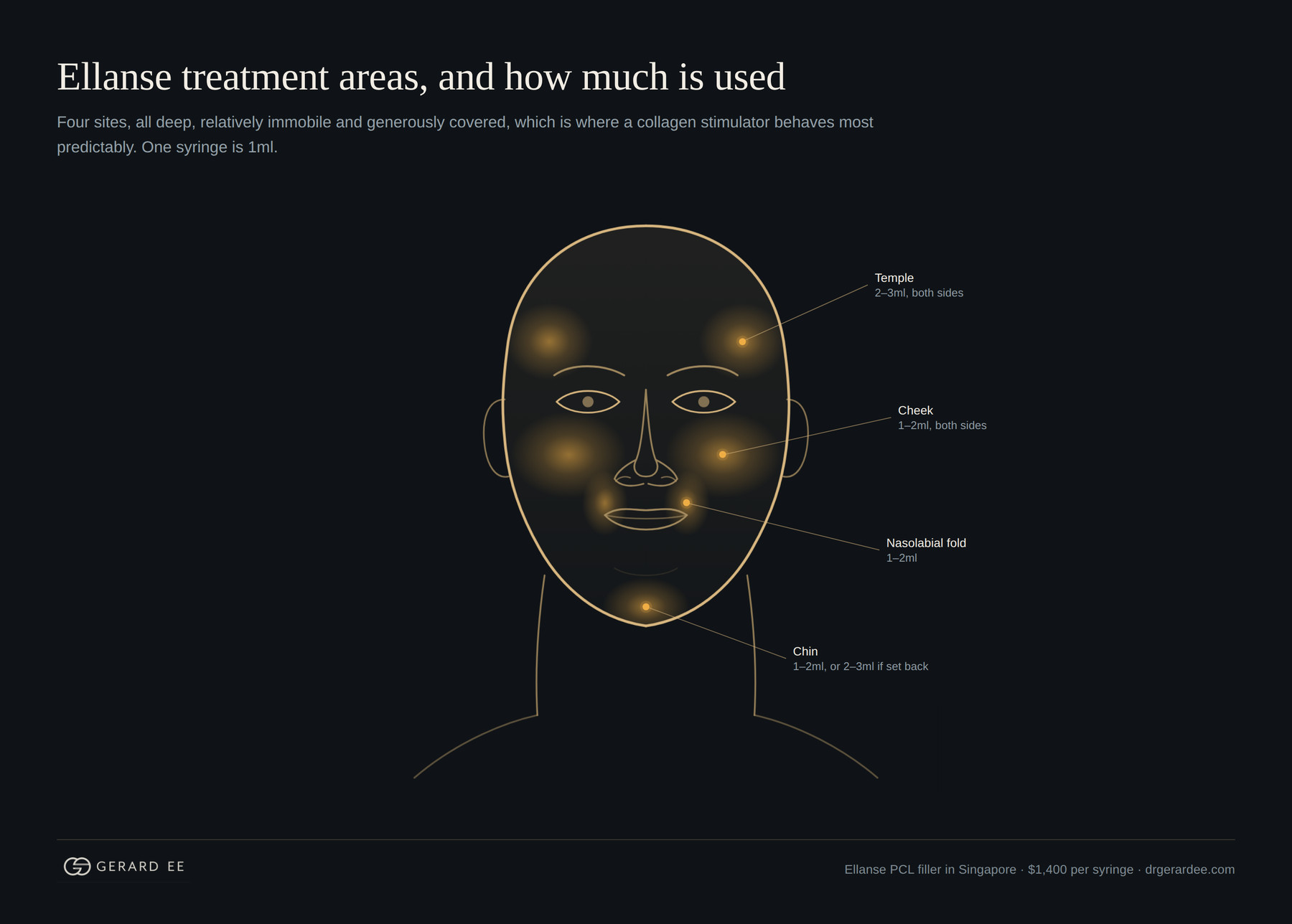
PCL is offered at four sites, all of them deep, relatively immobile and generously covered, which is where a stimulator behaves most predictably.
At the chin, for projection and for a chin that sits back. At the cheek, where it makes particular sense because the middle of the face is deep and moves little. At the temple, for hollowing that has broken the curve between brow and hairline. At the nasolabial fold, the line running from the side of the nose to the corner of the mouth, where it is placed deep and away from the crease itself rather than into it.
It is not used under the eye, and that is a deliberate exclusion rather than an oversight. The skin there is the thinnest on the face and the margin for error is measured in fractions of a millilitre, so giving up the ability to dissolve the product is not a trade worth making. It is not used in the lips either, for the same reason plus the movement.
PCL price in Singapore

PCL is $1,400 per syringe, before GST, and that includes your review appointment. Hyaluronic acid at the same sites is $800 per syringe.
This is a fixed price, not a starting price. The difference between the two reflects the product rather than the technique, and it buys you duration rather than a better result on the day.
How much PCL will I need
The volume is the same whichever material is used, so it depends on the area rather than on the choice of PCL.
Chin, 1 to 2ml for projection and 2 to 3ml where the chin is genuinely set back. Cheek, 1 to 2ml for both sides. Temple, 2 to 3ml in total across both sides. Nasolabial fold, 1 to 2ml.
One syringe is 1ml, so a 2 to 3ml treatment is two to three syringes at $1,400 each. You are quoted the full figure at the consultation, before anything is injected, not after the first syringe has gone in.
The PCL procedure, step by step
At the consultation I assess the area, tell you whether volume is the right answer at all, and if it is, whether PCL or hyaluronic acid suits you better. That conversation is where the reversibility question gets settled, and I would rather have it properly than sell you the longer-lasting option by default.
If we go ahead, numbing cream goes on and the filler is placed deep, against or close to the bone. Before injecting I draw back on the syringe to check the needle is not sitting in a blood vessel, then deliver small amounts slowly. The injection takes about twenty minutes.
PCL results and aftercare
If you came looking for PCL before and after photographs, this page does not carry any, and the reason is worth a sentence. A photograph shows you what the treatment did to somebody else’s face, under that clinic’s lighting, at a moment of their choosing. It tells you very little about what it would do to yours. What follows is the sequence you can actually expect.
Keep the area clean and leave it alone. No pressing or massaging for two weeks. No strenuous exercise, alcohol or very hot environments for 24 to 48 hours. Sunscreen goes on daily. Swelling and any bruising settle over three to five days.
The difference from a hyaluronic acid treatment is what happens next. Over the following one to three months your body absorbs the gel and collagen builds in its place, so the result changes slowly during that period rather than staying put. That is expected. Nothing should be added during it.
Contact the clinic straight away, not at your review, if you develop increasing pain rather than settling discomfort, blanching or dusky discolouration of the skin, or any change in vision. These are uncommon, and they are treatable when treated early, which is why the call should not wait.
When PCL is not suitable
PCL is postponed or declined with an active skin infection or inflamed acne over the area, in pregnancy or breastfeeding, with a known allergy to a component of the product, and where an autoimmune or connective tissue condition is active. Blood-thinning medication is not an absolute barrier but raises the bruising risk and needs discussing beforehand.
Beyond those, three situations make PCL specifically the wrong choice. The first is a thin, mobile or shallow area, because a material that cannot be dissolved does not belong where the margin for error is small. The second is a patient who has never had filler before and is not sure what they want, because a first treatment should be one you can undo. The third is anyone who has had a lump after a previous collagen stimulator, because that history tends to repeat.
Why more is not better
The trap with a collagen stimulator is different from the one with hyaluronic acid, and it catches people out.
With PCL, what you see at two weeks is not the finished result. Collagen is still building. Topping up at that point, before the second half of the effect has arrived, is how people end up over-filled three months later, when the material they added is sitting on top of a collagen response they had not yet seen. The rule here is to wait out the full one to three months before adding anything, and I will not top up inside that window.
Because it cannot be dissolved, an over-filled result with PCL is not an afternoon’s correction. It is something you live with while it slowly resolves.
PCL side effects and safety
Most of what goes wrong with PCL is ordinary and settles on its own. Swelling that lasts beyond a fortnight, bruising, and occasional temporary lumps are the usual complaints, and none of them lasts.
The one worth taking seriously is nodules, and I would rather set it out plainly than leave it in the small print. A nodule is a firm lump under the skin, and it is the characteristic problem with collagen stimulators as a class. It can appear months after treatment rather than in the first few days, and it is harder to deal with than a hyaluronic acid lump, because there is no antidote that removes this material. There are treatments for one, but they are slower and less certain than simply dissolving a hyaluronic acid filler.
The risk is managed the same way as with any filler. Before injecting I draw back on the syringe to check the needle is not sitting in a blood vessel, then place the material deep against bone in small amounts and at low pressure. What cannot be managed away is the reversibility. That is a fixed property of the material, and it is the reason I treat PCL as a considered choice rather than an upgrade.
What the published evidence on PCL shows
Only papers whose article title itself contains the requested brand name are included below. Product names mentioned only in the abstract, keywords or methods were excluded.
PCL is supported by expert consensus and review rather than by randomised trials. A multinational group of plastic surgeons and dermatologists published recommendations covering indications, treatment areas, procedures and injection technique for the polycaprolactone collagen stimulator, and a 2024 review set out its features and how to minimise complications. [1] [2]
Palpable nodules after PCL are uncommon but have been hard to reverse, which is one reason I keep to conservative volumes; a 2025 case series described dissolving ten PCL M nodules that had persisted for an average of two years using an injected collagenase mixture. [3]
Who performs the treatment
Dr Gerard Ee, MBBS (UK), MRCS (Edinburgh), PGDip Practical Dermatology (Cardiff). He trained and practised in orthopaedic surgery at Singapore General Hospital and the National University Hospital before moving into aesthetic medicine, and is the author of sixteen peer-reviewed papers, thirteen of them indexed in PubMed.
More about the training is on the about page, and the published work is listed on the publications page.
Where to find us
50 Raffles Place, #01-01 Singapore Land Tower, Singapore 048623. Telephone 6532 2048. Raffles Place MRT is a two-minute walk.
Monday to Friday, 10am to 8pm. Saturday, 10am to 5pm.
Dr Gerard Ee consults and performs this treatment at The Clifford Clinic, 50 Raffles Place, Singapore.
PCL FAQ
What is PCL 少女针?
It is the Chinese nickname for PCL, the polycaprolactone collagen stimulator this page describes. It restores lost volume and prompts your own collagen to build around the microspheres over the following months. The name is a nickname rather than a description of what the treatment does.
What are the problems with PCL filler after 2 years?
The one people ask about is nodules, firm lumps that can appear months or even a year or two after treatment rather than in the first weeks. They are the characteristic problem with this class of material and they are harder to deal with than a hyaluronic acid lump, because there is no antidote. If you have a lump from a stimulator placed elsewhere, come and be examined rather than waiting it out. There are options, they are just slower and less certain than dissolving hyaluronic acid.
What happens if PCL filler goes wrong?
It depends what went wrong. Over-filling is the common one, and because the material cannot be dissolved it resolves slowly rather than in an afternoon. Nodules are managed with a steroid injection, or with an enzyme treatment that is not yet routine. The rare serious event, filler entering a blood vessel, is an emergency and is treated as one. The honest summary is that things go wrong with PCL less often than people fear, and are harder to put right when they do.
PCL or PLLA?
Both are collagen stimulators and neither can be dissolved. The practical difference is that PCL gives you volume on the day from its gel carrier, where poly-L-lactic acid gives you very little immediately and builds almost entirely over the following months and sessions. PCL is usually one treatment, where the other is usually a course. Which suits you depends on whether you want to see something on the day.
PCL or a PDLLA skin booster?
Different job. A PDLLA skinbooster treats skin quality and fine texture across an area, placed superficially. PCL is a volumising filler placed deep against bone to rebuild contour. People sometimes have both, for different reasons, and confusing the two is the commonest reason a patient is disappointed by one of them.
How much does PCL cost in Singapore?
PCL is $1,400 per syringe, before GST, including the review appointment. Hyaluronic acid at the same sites is $800. It is a fixed price rather than a starting price, and the consultation is charged separately and waived if you proceed on the day.
How long does PCL last?
About two years with the formulation used here, which is considerably longer than hyaluronic acid. Part of the result is your own collagen rather than the product, which is both why it lasts and why it cannot be reversed.
Can PCL be dissolved?
Not on demand. Hyaluronidase dissolves hyaluronic acid and does nothing to PCL, and there is no equivalent antidote. There is an enzyme treatment for PCL lumps, but it is not yet routine. This is the single most important thing to understand before choosing it.
Is PCL filler better than hyaluronic acid?
It is not better, it is different. PCL lasts longer and adds a collagen response. Hyaluronic acid works immediately, fades predictably and can be dissolved if you dislike it. For a first treatment, or anywhere thin and mobile, hyaluronic acid is the sensible starting point.
How soon will I see PCL results?
Immediately, from the gel carrier. Then the result shifts over one to three months as that carrier resorbs and collagen builds in its place. The finished result is the one at three months, not the one at two weeks, which is why nothing should be topped up before then.
Can PCL be used under the eyes?
Not here. The skin under the eye is the thinnest on the face and the margin for error is smallest, so a material that cannot be dissolved is the wrong tool there. Under eye filler at this clinic is hyaluronic acid only.
What are the side effects of PCL?
Swelling, bruising and tenderness for a few days are usual, and swelling can occasionally last beyond a fortnight. The characteristic problem with this class of material is nodules, firm lumps that can appear months later and are harder to resolve than a hyaluronic acid lump, because there is no antidote.
Does PCL hurt?
Numbing cream is applied first and left on until the skin is numb. Most patients describe deep pressure rather than sharp pain, because the material is placed against bone.
Is PCL filler the same as a skin booster?
No. A skin booster treats skin quality across an area and does not restore contour. PCL is a volumising filler placed deep to rebuild structure. Different problems, different products, and they are sometimes done in the same course of treatment for different reasons. If skin quality is what is bothering you, start with hyaluronic acid skin boosters compared with PDRN instead.

Book a consultation with Dr Gerard Ee at The Clifford Clinic
Dr Gerard Ee consults and performs PCL filler treatment at The Clifford Clinic, 50 Raffles Place, Singapore. Consultations are by appointment. Message the clinic on WhatsApp, or call 6532 2048.
References
Show the 3 references
- de Melo F, Nicolau P, Piovano L, Lin SL, Baptista-Fernandes T, King MI, et al. Recommendations for volume augmentation and rejuvenation of the face and hands with the new generation polycaprolactone-based collagen stimulator (Ellansé®). Clin Cosmet Investig Dermatol. 2017;10:431-440. doi:10.2147/CCID.S145195. PMID 29184426.
- Chen Q, Wang Y. Ellansé: Advanced Technology and Advantageous Selection of New Collagen Stimulating Agents for Face Rejuvenation. Aesthetic Plast Surg. 2024;48(10):1977-1984. doi:10.1007/s00266-023-03761-w. PMID 38305923.
- Wu L. iCare Technique of Dissolving Ellanse M Nodules Using Collagenase: A Case Series and Experimental Study. J Cosmet Dermatol. 2025;24(5):e70201. doi:10.1111/jocd.70201. PMID 40296530.
This page is written from published research and from clinical experience in Singapore since 2012. It is for general education, not medical advice. Whether a treatment suits you, what it may achieve and what it may risk can only be established at a consultation. Dr Gerard Ee is the Medical Director of The Clifford Clinic, a private clinic in Singapore, and treatments discussed on this site are provided commercially.

