By Dr Gerard Ee, MBBS (UK), MRCS (Edinburgh), PGDip Practical Dermatology (Cardiff)
Dr Gerard Ee consults at The Clifford Clinic, 50 Raffles Place, Singapore.
Non-surgical eye bag removal is permanent for the fat that is treated and temporary for the appearance of the under-eye area as a whole. The fat destroyed by AGNES and Secret RF is cleared by the body and does not return. Ageing of the orbital septum and the lower eyelid skin continues, so the visible correction typically lasts 3 to 5 years before a new protrusion or skin laxity becomes apparent.
In my consultations, the question about permanence follows the question about price. Patients want to know whether they are paying for a lasting change or a short-lived improvement. The answers available online reduce to two positions, that the result is permanent or that non-surgical eye bag removal is temporary, and neither is accurate. A precise answer requires two separate statements. The fat destroyed during treatment does not return, and the reduction it produces is visible from 8 weeks. The tissues surrounding that fat continue to age, which is why the aesthetic result is quoted at 3 to 5 years rather than for life.
I have performed AGNES and Secret RF eye bag treatments for more than 10 years and have followed over 500 patients. The fat that is treated is genuinely destroyed rather than displaced, and it will not return. That component of the result is permanent and requires no maintenance. Treatment does not, however, arrest the ageing of the tissues that surround that fat. The distinction between a permanent reduction in the fat that was treated and a continuing change in the eyelid around it governs how long the result lasts, and it is the distinction that most published answers omit. In my experience treating over 500 eye bag patients, I have found that the patients who return dissatisfied at 3 years are rarely those whose fat has re-formed, and are almost always those who were told the treatment was permanent without being told which part of it was permanent.
Why the treated fat does not come back
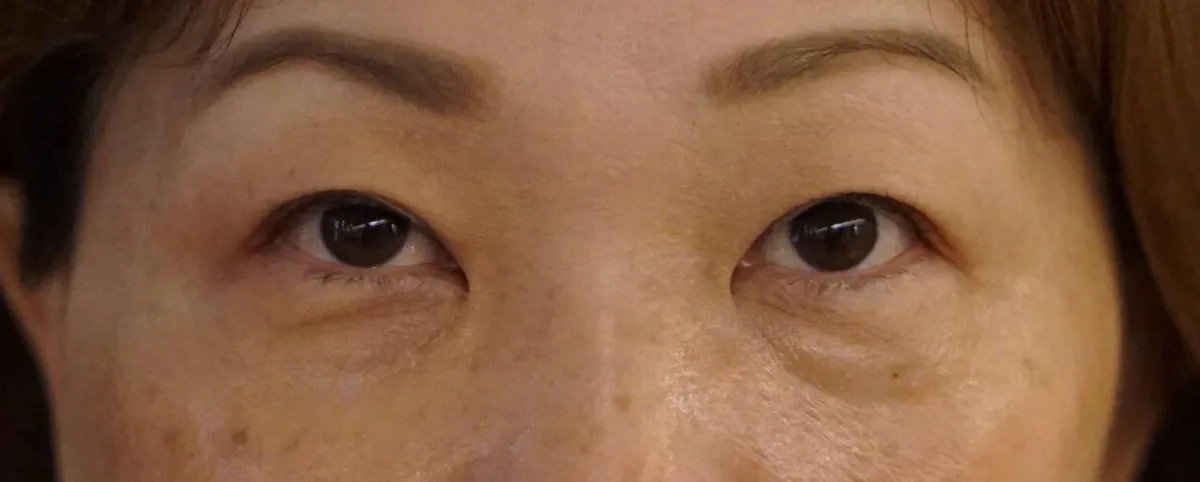
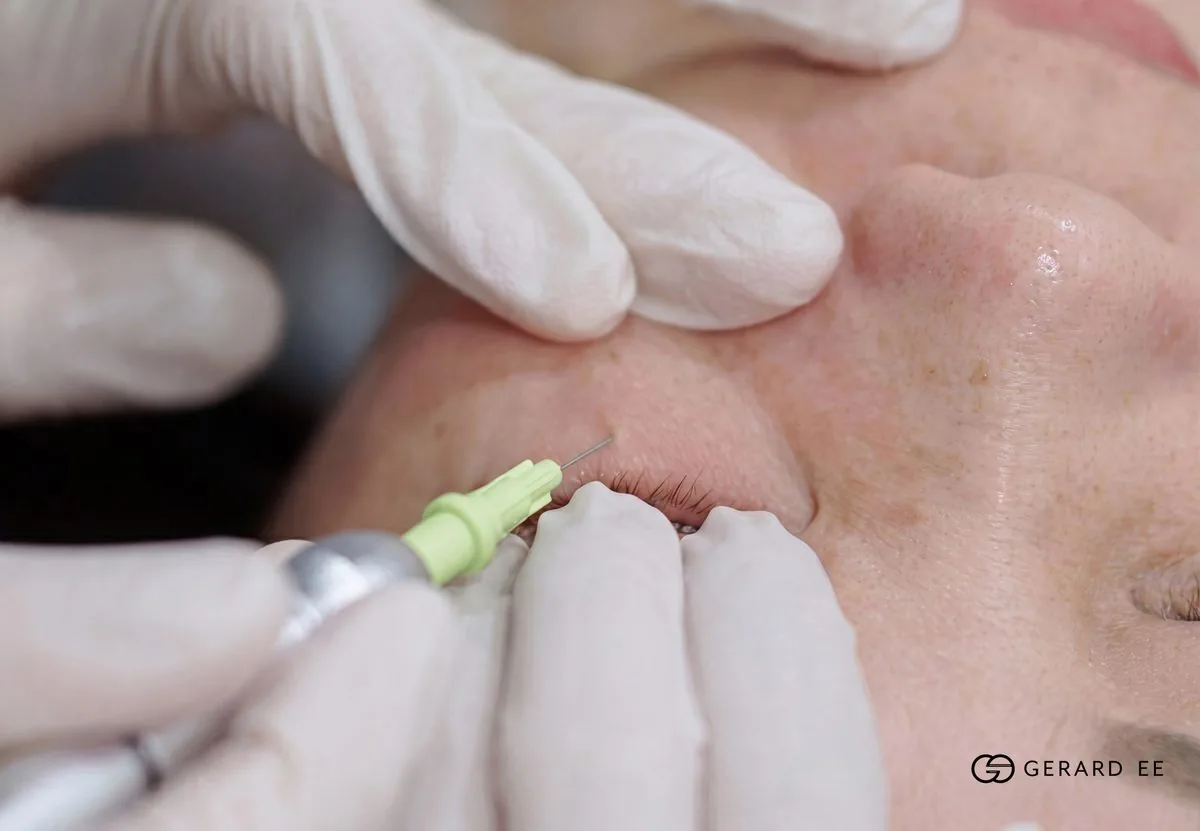
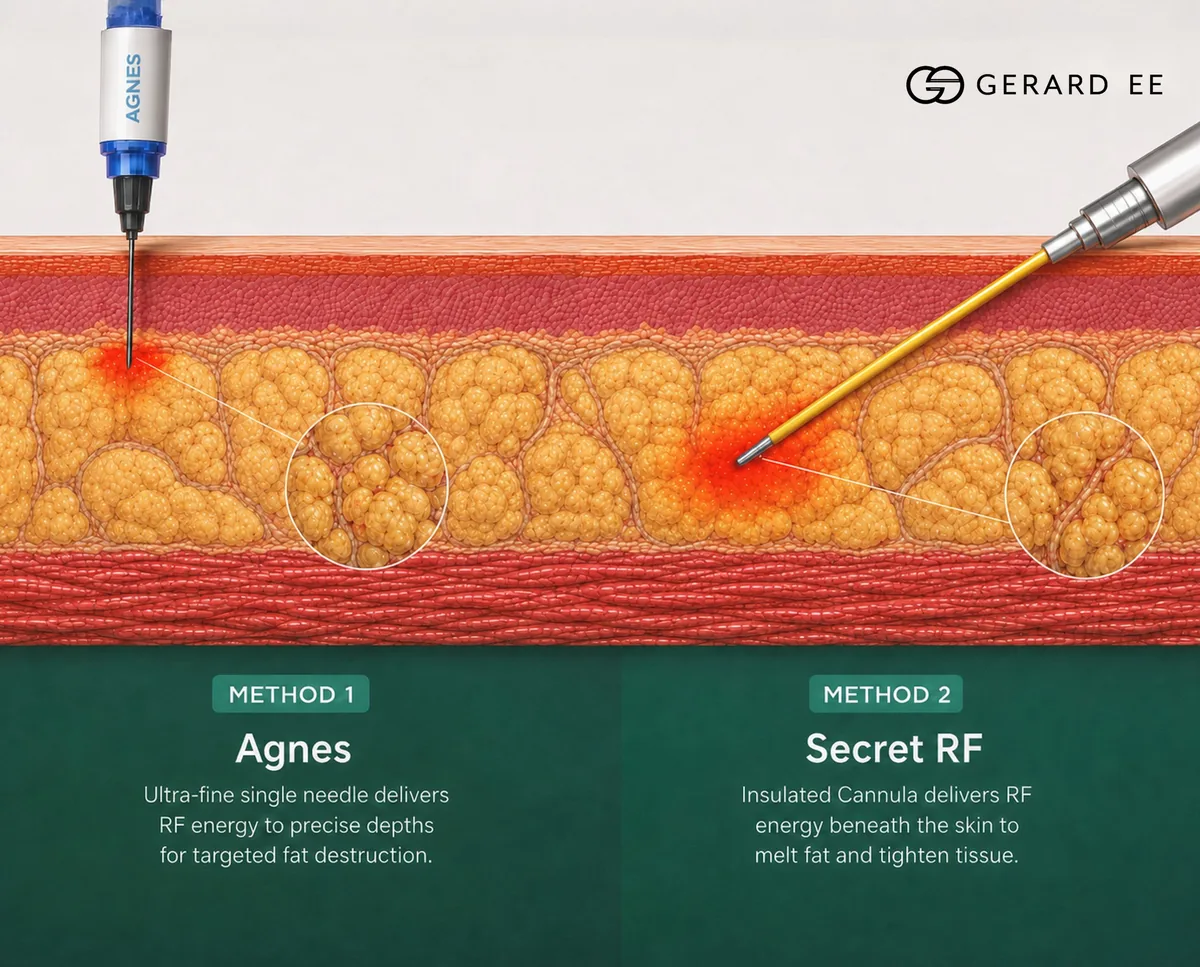
A true eye bag forms when the lower eyelid fat pads protrude through a weakened orbital septum. In a mild Grade 1 to 2 case, AGNES delivers radiofrequency energy through micro-insulated needles into the protruding fat compartment, melting the fat from the outside in, one compartment at a time. Secret RF then advances a single insulated cannula with a radiofrequency tip deeper into the same fat pad, ablating the portion that lies below the plane AGNES treats, and the heat it releases tightens the overlying skin so that it settles over the flatter contour. The destroyed fat cells are broken down and cleared by the body over the following weeks, which is why the contour change is visible from 8 weeks.
Once those fat cells have been destroyed and cleared, they are not replaced. Adult fat cells in a localised compartment do not divide to restore their own number in the way skin cells do, so the volume removed from that compartment stays removed unless substantial weight gain enlarges the fat cells that remain. The reduction is therefore permanent for the fat that was actually treated.
Permanent in that sentence describes the treated fat and nothing else, and it cannot honestly be extended to the septum, the skin or the position of the midface. That is not the question most patients are asking. What they want to know is whether the whole under-eye area will continue to look as it does 2 months after treatment, and that depends on tissues the procedure never touched.
In my experience treating patients who gain weight after treatment, I have found that the fat cells left behind in the compartment can enlarge sufficiently to restore part of the bulge, which is one of the few ways a treated eye bag can appear to come back without a single new fat cell forming.
Why a new protrusion can develop years later
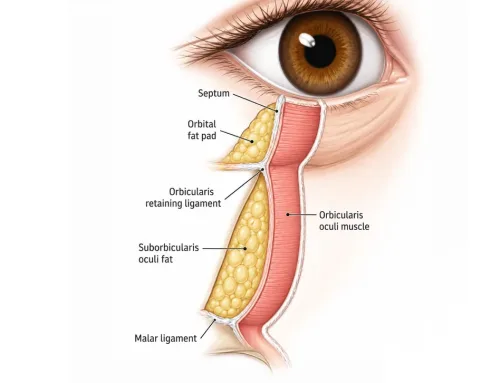
The orbital septum weakens with age, with heredity, or with both. Reducing the fat that has already moved forward does not restore the strength of that septum. Fat that remained behind it, or that sits deeper in the compartment, can therefore move forward in its turn, which is what typically occurs after 3 to 5 years. Support beneath the lower lid falls away over the same period as the midface soft tissue descends and the bony orbital rim loses volume, leaving the lid less structure to sit against. A bulge appearing at that stage is a new protrusion produced by continued ageing rather than a regrowth of the fat that was treated.
I therefore quote a result lasting 3 to 5 years, and a substantial proportion of patients hold it for longer. That figure comes from my own follow-up of treated cases rather than from a device manufacturer’s claim, and it is a clinical observation rather than a published long-term series, since no controlled trial has followed AGNES eye bag patients over that period.
Patients treated in their thirties with firm lower eyelid skin frequently retain the correction well beyond 5 years. Patients with a strong hereditary tendency, in whom the septum was already weak at presentation, sit at the lower end of that range. In my experience reviewing patients at 3 years and beyond, I have found that the strength of the septum at presentation predicts the duration of the result more reliably than the size of the original bulge does, and a minority of patients notice a change sooner than the quoted range suggests.
When skin laxity replaces fat as the problem
Reducing the bulge is only part of the aesthetic result, because the skin must also retract smoothly over the flatter contour. A patient treated at 38 with firm lower eyelid skin may find that by 48 the visible problem is loose, crepey skin rather than protruding fat, as the collagen and elastin that hold the lid taut decline and the skin no longer contracts to the reduced volume beneath it. Neither AGNES nor Secret RF removes excess skin, and the tightening produced by radiofrequency heat has a limit that a genuinely lax lid exceeds. A pinch blepharoplasty, which excises a fine strip of skin just below the lash line, is the appropriate procedure at that point.
The original fat reduction remains intact throughout, and what has changed is the tissue that now limits the result. In my experience treating patients who return about a decade after a good result, I have found that they describe the problem in the words they used the first time, although examination commonly shows flat fat pads beneath skin that no longer retracts, and a further radiofrequency course in that setting improves the surface texture without correcting the looseness.
Why puffiness returns when the fat pads are still flat
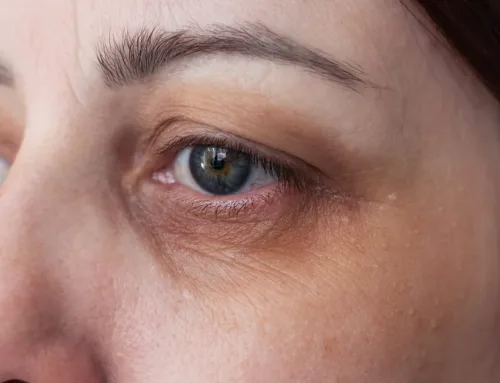
The under-eye area changes from day to day. Poor sleep, allergic rhinitis, alcohol, dietary salt and weight fluctuation all produce periorbital puffiness, because the skin here is the thinnest on the face and the tissue beneath it holds fluid readily and drains slowly after the head has been horizontal overnight. Patients occasionally attend convinced that their eye bags have returned, and examination shows flat fat pads with swelling that varies through the day. Fluid of that kind is worst on waking and settles by the afternoon, whereas a fat protrusion is constant, and the two are separated by examination rather than from a photograph.
Treating fluid retention as though it were protruding fat achieves nothing, whereas reducing dietary salt, treating the underlying allergy and correcting sleep will often resolve it. In my experience the patients most convinced that the eye bags have returned are those comparing a morning photograph with an afternoon one, and I have found that re-examining the same lid later in the day separates fluid from fat more reliably than any photograph does.
How long each treatment lasts and what it cannot prevent
Eye Bag Treatments: Fat Reduction and Longevity Compared
| Treatment | Effect on the Fat | Typical Longevity | What Can Still Change |
|---|---|---|---|
| AGNES with Secret RF | Targeted fat is destroyed and cleared | Full result at 1 to 2 months, then typically 3 to 5 years | Ageing can produce a new protrusion, and skin laxity may develop |
| Tear Trough Filler | None. Volume is added nearby | Roughly 9 to 18 months, sometimes longer | Filler degrades, may migrate or may attract water |
| Scarless Surgery | Fat removed or repositioned directly | Long term, and rarely repeated | Skin laxity still develops with age |
| Eye Creams and Home Remedies | None | Hours to days | Everything, as nothing structural is altered |
Surgery does not stop future change either. It removes or repositions the fat more directly and is rarely repeated, but the patient continues to age and the lower eyelid skin can still loosen. The comparison that matters is mechanical rather than semantic, namely what each of the eye bag treatments available in Singapore physically removes, how long that removal holds, and what the patient is likely to need next. None of them halts ageing, and a promise of permanence in the sense of an unchanging appearance is a commercial claim rather than a clinical one.
Which patients keep the result longest
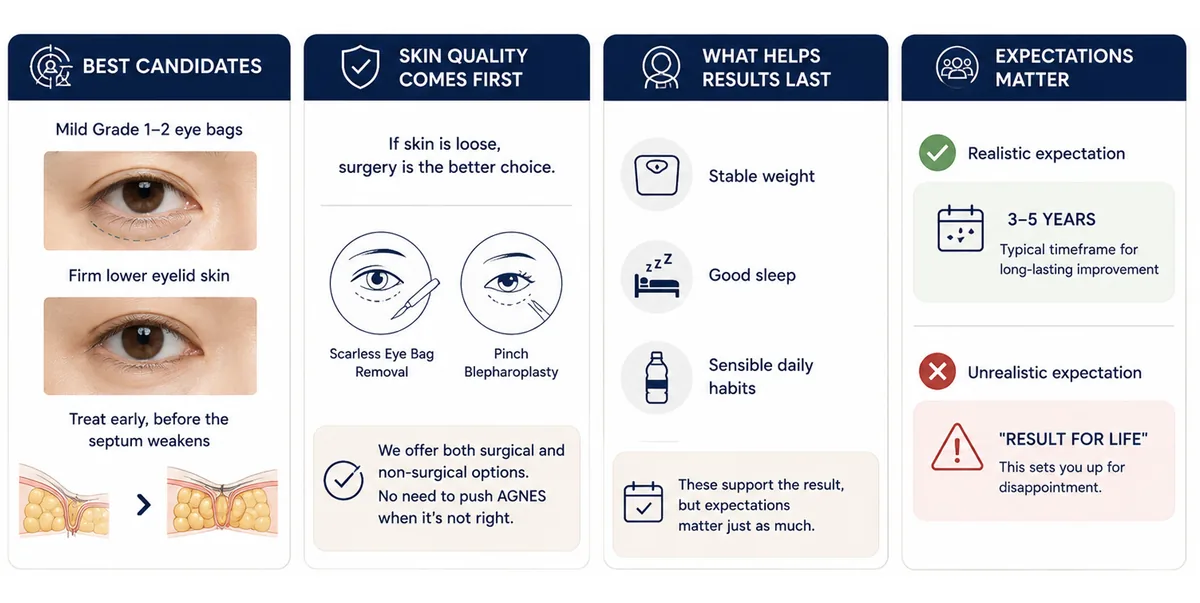
The pattern across more than 500 treated eye bag cases is consistent. The patients who hold the result longest present with mild Grade 1 to 2 eye bags and firm lower eyelid skin. Treating the eye bag before the orbital septum has weakened substantially also extends the result, since a septum that still restrains its remaining fat has less to release later.
Skin quality is not a variable I compromise on, and where the skin is already lax I recommend surgery rather than AGNES. The Clifford Clinic and The Clifford Surgery together are the only centre among the commonly compared aesthetic clinics offering both non-surgical and surgical eye bag removal, including scarless eye bag removal and pinch blepharoplasty, so the recommendation is determined by the anatomy rather than by the range of treatments available.
Stable weight and consistent daily habits extend the result, and accurate expectations matter as much as anatomy. Patients who understand that the correction lasts 3 to 5 years are satisfied with what the treatment delivers. Patients promised a result for life will read a normal outcome as a failure.
Who should not have non-surgical eye bag removal
Grade 3 to 4 eye bags, established lower eyelid laxity and skin that no longer retracts are reasons to decline this treatment rather than attempt it. Puffiness that varies through the day is fluid rather than fat and will not respond to it. A hollow tear trough is a volume deficit and is not improved by reducing fat. In my experience the patients who ask for AGNES by name are frequently those whose examination shows loose skin rather than a protruding fat pad, and in that group the treatment reduces a bulge that was never the main complaint. Requesting a treatment by name does not make it the clinically appropriate one, and I would rather decline the request than deliver a technically correct result that cannot satisfy the patient.
The result also has a ceiling. The treatment reduces the protruding fat and tightens the skin lying over it, and it may leave a residual contour that a second session is needed to improve. It does not remove excess eyelid skin, it does not strengthen the orbital septum, and it does not replace the volume lost from the bony orbital rim with age.
Published evidence for radiofrequency reduction of lower eyelid fat rests on small clinical series and operator experience rather than long-term controlled trials, so the durability quoted here should be read as what I observe at review rather than as an established figure. Outcomes vary, and neither the size of the fat pad nor the elasticity of the skin can be measured precisely before treatment.
What if the result changes later?
When a patient returns 3 to 5 years after treatment, the next step is decided by examination rather than by the interval alone. In many cases no further treatment is required, because the change is minor and the contour remains better than before the original procedure. Where a small new protrusion has developed and the skin is still firm, a maintenance AGNES and Secret RF session usually restores the contour. Subsequent sessions at The Clifford Clinic are priced at $1,800, against $2,500 for the first session.
Where the eye bags have progressed to Grade 3 or 4, or laxity of the skin has become the dominant problem, a further non-surgical session will correct neither problem. Scarless eye bag removal, with a pinch blepharoplasty where the skin requires it, is then the more effective option. In my experience most patients who return at 5 years need no further treatment at all, and I have found that comparing the lid against the photographs taken before the original procedure settles that question more often than a further session does.
Habits that extend the result
Ageing cannot be stopped, but several habits accelerate it in the lower eyelid. Repeated eye rubbing stretches the thinnest skin on the face and loads the orbital septum directly, so an underlying allergy should be diagnosed and treated rather than relieved by rubbing, and makeup should be removed without dragging the lid. Daily sun protection matters because ultraviolet exposure degrades the collagen and elastin that hold the lid taut, which is the same laxity that eventually limits a non-surgical result.
Keeping weight stable limits change in the facial fat compartments, since the fat cells remaining after treatment enlarge and shrink with body weight. Salt and alcohol worsen fluid puffiness, which can obscure an otherwise good structural result. Attending the scheduled reviews allows a small change to be managed while it can still be treated conservatively. None of these measures prevents the orbital septum from weakening, so they extend a result rather than preserve it indefinitely.
The same habits, and why some bags form regardless, are set out in my article on how to prevent eye bags.
What permanent means in eye bag treatment
AGNES and Secret RF reduce the protruding fat and improve the contour above it rather than concealing the bulge, and the fat they remove does not return. What cannot be promised is that the patient will never again notice a change beneath the eyes, because the face continues to age and skin that is firm at 40 may be lax at 55. Permanence therefore has two answers, depending on which structure is meant. Permanent here means that the fat cells destroyed during treatment are cleared and are not replaced, so the volume taken from that compartment is not restored. Permanent does not mean that the under-eye area is fixed at the appearance it holds 2 months after treatment, that the orbital septum has been strengthened, or that surgery will never become the more appropriate procedure. The reduction in the treated fat is permanent, whereas the appearance of the under-eye area as a whole will keep changing with age. A clinic that answers the question without first grading the fat pads and examining the skin is answering commercially rather than clinically.
Are eye bags permanent?
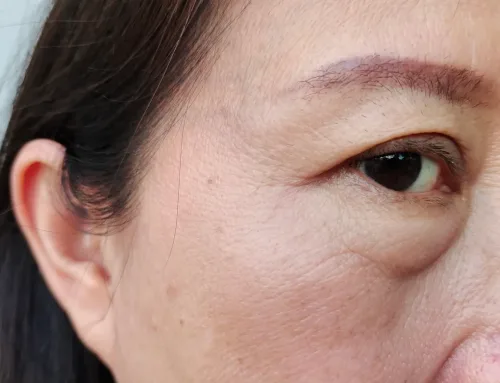
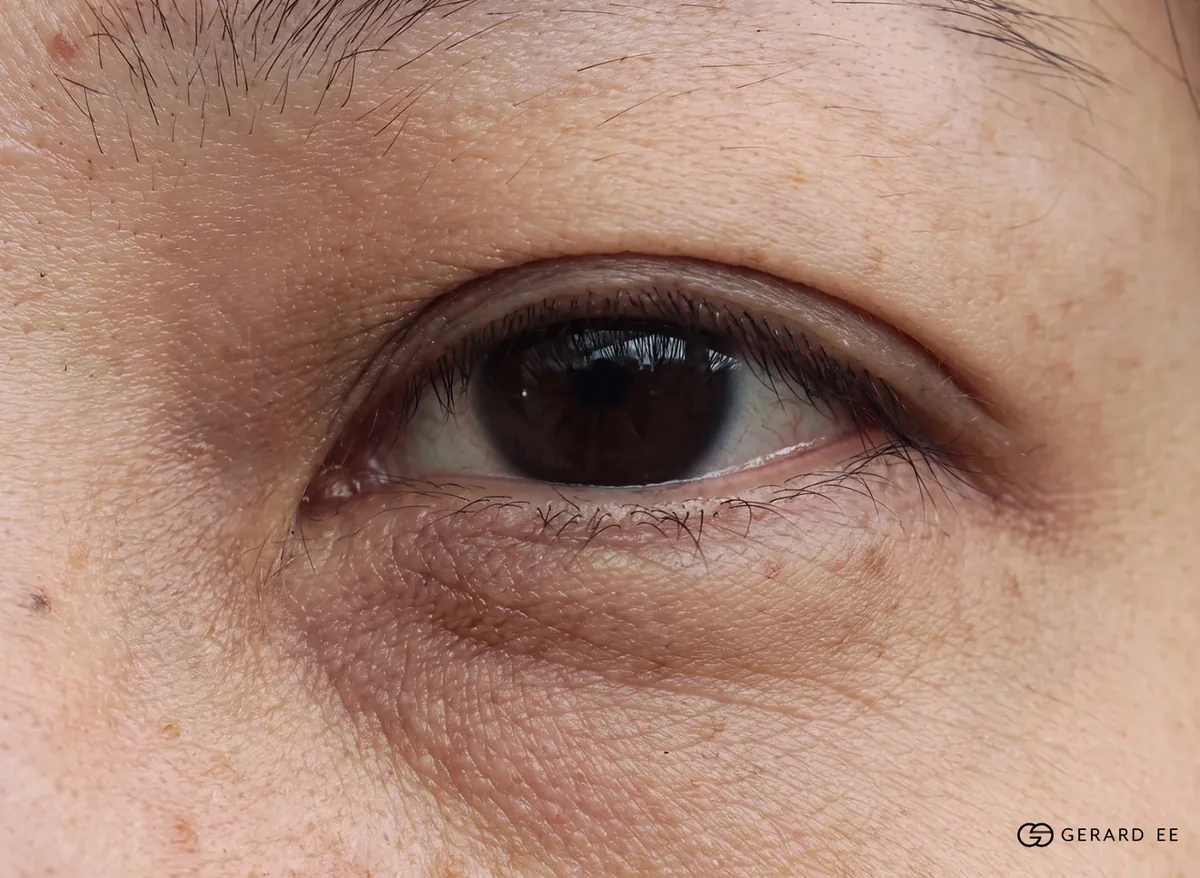
A true eye bag is permanent in the sense that it does not go away on its own. It is a pocket of orbital fat that has pushed forward through a weakened septum, and neither sleep, creams nor cold compresses move that fat back. What is not permanent is puffiness from fluid, which comes and goes with salt, alcohol, allergies and a poor night, and settles by mid-morning. The test is simple: a bag that is the same size at night as it was in the morning is fat, and only a procedure reduces it. Radiofrequency shrinks the fat pad through the skin and the result typically lasts three to five years; surgery removes or repositions the fat and lasts longer. Ageing continues either way, so a new bag can develop over time.
Related reading on eye bags and under-eye concerns
- Non-surgical eye bag removal: price, what happens and FAQ
- Which eye bag treatment is right for you
- Telling eye bags apart from tear troughs
- Non-surgical eye bag removal: what it can and cannot do
- Eye bag surgery in Singapore, and when it is the better answer
- Why tear trough fillers make true eye bags worse
- What home remedies for eye bags actually do
- Allergy-related dark eye circles
- Treatment options for dark eye circles
- Emface Eyes explained
- Eye bag removal cost in Singapore
- Scarless eye bag removal: procedure, recovery and fee

Dr Gerard Ee, Aesthetic Doctor in Singapore
Dr Gerard Ee is an aesthetic doctor in Singapore and the Medical Director of his practice at 50 Raffles Place. He graduated from St George’s, University of London, trained in surgery at Singapore General Hospital and the National University Hospital, and holds the MRCS (Edinburgh) and a postgraduate diploma in practical dermatology from Cardiff University.
He has practised aesthetic medicine since 2012, is the author of sixteen peer-reviewed papers, and writes and medically reviews every article on this site. Read more about Dr Gerard Ee.

Book a consultation with Dr Gerard Ee at The Clifford Clinic
Dr Gerard Ee consults at The Clifford Clinic, 50 Raffles Place, Singapore. Consultations are by appointment. Message the clinic on WhatsApp, or call 6532 2048.
Frequently asked questions
Do eye bags come back after AGNES treatment?
The fat treated by AGNES is destroyed and cleared, and it does not regrow. A new protrusion can form as the septum and the surrounding tissues continue to age, which is a different bulge rather than the return of the old one. Results commonly last 3 to 5 years, and longer in younger patients with firm skin, although that range describes what is seen at review rather than a guaranteed duration.
Is one session enough?
A single session is sufficient for most mild Grade 1 to 2 cases. A second session is added where the fat pad is larger or where the tissue response is incomplete, at $1,800 against $2,500 for the first session. I make that decision at the 8-week review, when the result is visible.
Does surgery last longer?
Surgery generally lasts longer, because it removes or repositions the fat directly and is rarely repeated. It does not stop ageing, and skin laxity can still develop afterwards, so the choice between the two rests on the grade of the eye bag and the quality of the skin rather than on durability alone.
My eye bags look as though they have returned after two years. What should I do?
Examination should precede any decision, because three different findings produce the same appearance. Fluid retention varies through the day and is worst on waking. A small new protrusion is constant and may respond to a maintenance session. Increasing skin laxity is also constant but will not respond to any reduction of fat. Each requires a different treatment, and the three cannot be separated from a photograph.
Can I keep repeating non-surgical treatment instead of having surgery?
Repetition works only while the anatomy remains suitable. Once the eye bag has progressed to Grade 3 or 4, or the skin has become lax, the volume of fat exceeds what radiofrequency can reduce and the skin will not retract, so further sessions produce diminishing returns. Surgery at that point is both more effective and better value.
Will the treated area age naturally?
The treated area ages naturally. AGNES reduces existing fat rather than adding material, so there is no implanted substance to migrate, dissolve or attract water as a filler does. The area continues to age at the same rate as the rest of the face.
Should I wait until the eye bags become worse?
Waiting is rarely an advantage. Mild Grade 1 to 2 eye bags with firm skin are the cases in which non-surgical treatment performs best, and that suitability is lost as the septum weakens further and the skin loses elasticity. A patient who waits may find that surgery has become the only option that will correct the contour.
Where can I have the problem assessed?
The Clifford Clinic provides doctor-led assessment and offers AGNES with Secret RF, scarless eye bag removal and pinch blepharoplasty within the same centre. The assessment grades the fat pads, examines the skin and establishes which of the two pathways applies, so the recommendation follows the anatomy rather than the single procedure a clinic happens to offer.

Dr Gerard Ee, MBBS (UK), MRCS (Edinburgh), PGDip Practical Dermatology (Cardiff) is the founder and medical director of The Clifford Clinic and The Clifford Surgery in Singapore. He has performed AGNES and Secret RF non-surgical eye bag treatments for more than 10 years, treating over 500 eye bag patients. His centre is the only one among the commonly compared aesthetic clinics to offer both non-surgical and surgical eye bag removal, including scarless eye bag removal and pinch blepharoplasty. This article reflects his clinical opinion, is intended as general information and does not replace a medical consultation.
This page is written from published research and from clinical experience in Singapore since 2012. It is for general education, not medical advice. Whether a treatment suits you, what it may achieve and what it may risk can only be established at a consultation. Dr Gerard Ee is the Medical Director of The Clifford Clinic, a private clinic in Singapore, and treatments discussed on this site are provided commercially.