
Pigmentation is the most common skin concern I see in Singapore, and the most commonly mistreated. Freckles, sun spots, melasma, post-acne marks and Hori’s naevus all present as brown patches, yet they sit at different depths, arise from different causes and respond to different treatments. A laser setting that clears a sun spot in a single session can aggravate melasma, so the diagnosis decides the device and the energy rather than the reverse. This page sets out how I distinguish them at consultation, which pigmentation treatment I use for each type, and what each costs.
Written by Dr Gerard Ee, MBBS (UK), MRCS (Edinburgh), Postgraduate Diploma in Practical Dermatology (Cardiff). Founder and Medical Director, The Clifford Clinic and The Clifford Surgery, Singapore. Last medically reviewed and updated September 2026.

Types of pigmentation I see in Singapore
| Type | What it looks like | Where the pigment sits | What drives it |
|---|---|---|---|
| Freckles and sun spots (solar lentigines) | Small, sharp-edged brown spots on the cheeks, temples and hands | Epidermis (surface) | Sun exposure over years |
| Melasma | Symmetrical brown or grey-brown patches on the cheeks, forehead, upper lip | Epidermis, dermis or both, with abnormal blood vessels beneath | Hormones, heat, visible light and UV, genetics |
| Post-inflammatory hyperpigmentation (PIH) | Flat brown marks left after acne, eczema or a procedure | Epidermis, or dermis if the inflammation was deep | Inflammation in skin that pigments easily |
| Hori’s naevus | Grey-blue speckles across both cheekbones, usually from the twenties | Dermis (deep) | Genetic, common in East Asian women |
| Dark eye circles (pigment type) | Brown shadow beneath the eyes | Epidermis and dermis | Allergy, rubbing, genetics |
Post-acne brown marks behave differently from melasma, and are covered separately in brown acne marks in Asian skin and in acne marks versus acne scars. Dark eye circles have their own page on laser for dark eye circles.
Why melasma is treated differently from freckles and sun spots
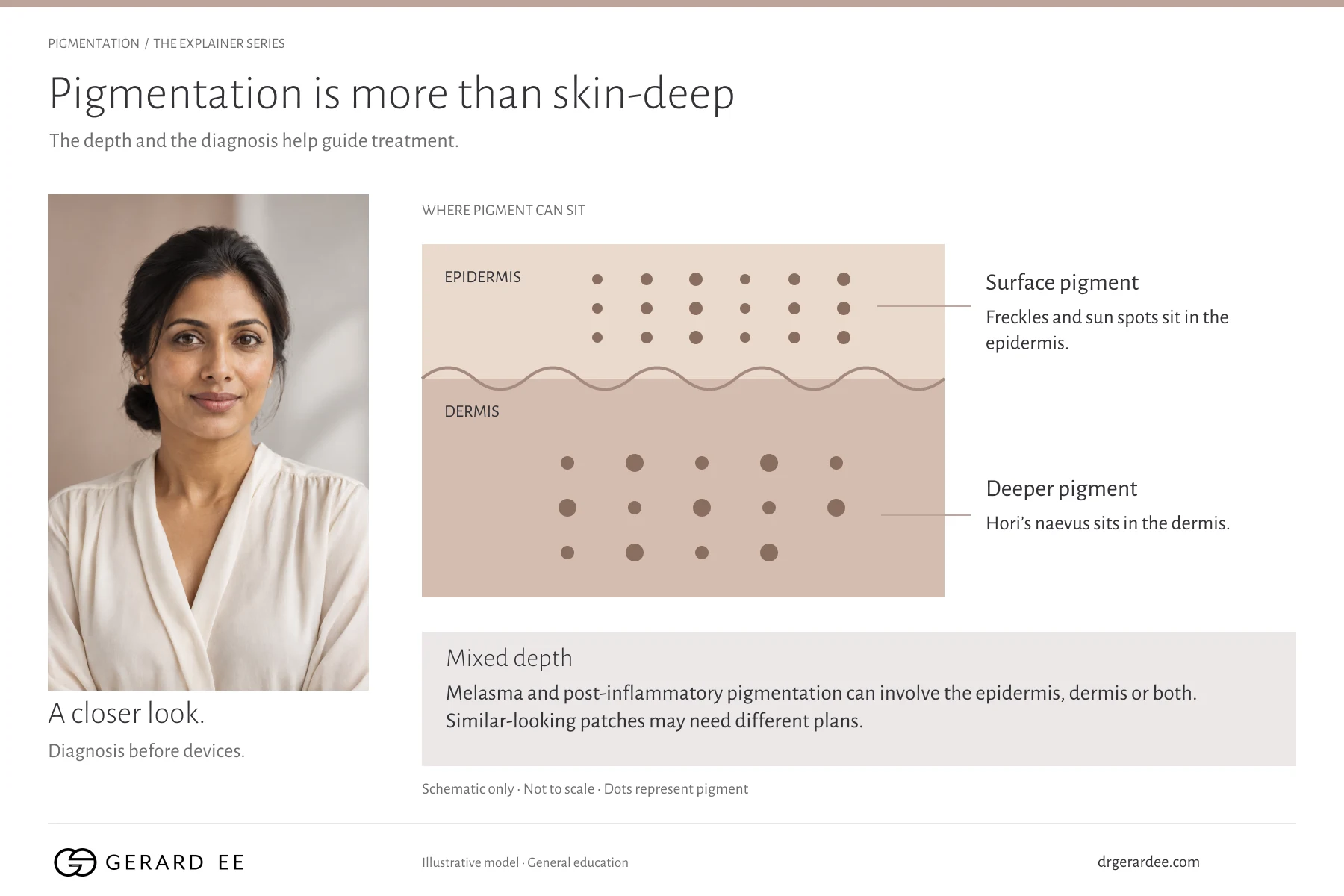
A freckle or sun spot is a stable deposit of pigment which a laser fragments into particles small enough for the body to clear. Melasma is not a deposit but an active process. The pigment cells are overstimulated by hormones, heat and light, and the skin beneath carries more blood vessels than normal. Both mechanisms respond to warmth, so melasma flares in Singapore’s sun and after a hot yoga class. Treated like a sun spot, with high laser energy, the overstimulated pigment cells respond by producing more pigment. This is the rebound patients describe as “the laser made it worse”. Melasma is controlled rather than cured. Treatment is built around daily photoprotection and topical therapy first, with low-energy laser added as one component rather than the mainstay.
Pigmentation treatments in Singapore, from creams and peels to lasers
Prescription creams and Cyspera
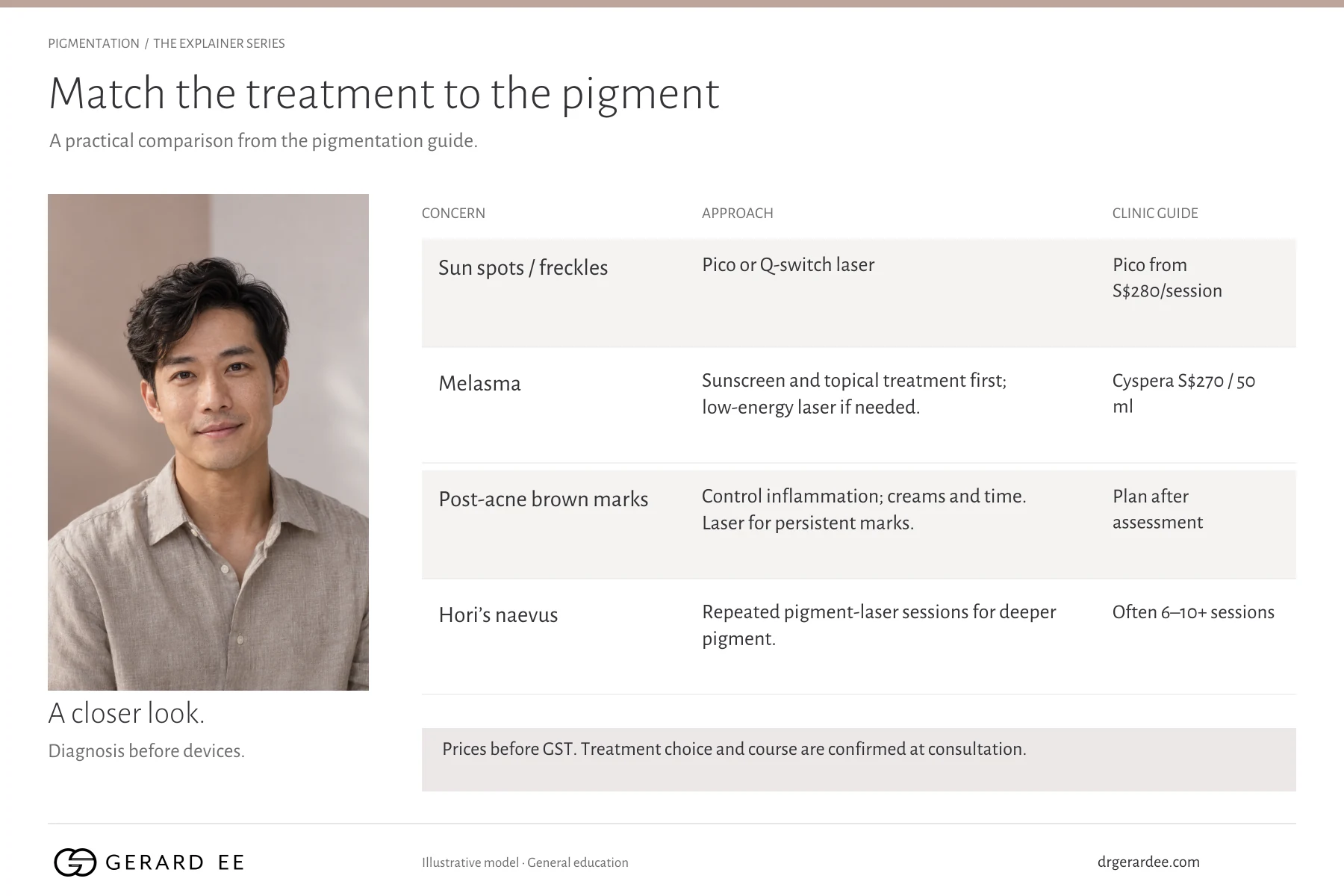
For melasma, triple-combination cream and hydroquinone remain the most effective and best-studied options, used as a supervised course rather than indefinitely. In Asian patients a fixed triple-combination cream achieved clear or near-clear skin in 64.2% at eight weeks, against 39.4% for hydroquinone alone. Cysteamine cream (Cyspera) is the hydroquinone-free alternative I use for the longer maintenance phase, applied for fifteen minutes a day for sixteen weeks, then twice a week, and safe to continue long term. In a randomised trial cysteamine 5% cream lowered the melasma area and severity index to 7.2 against 11.6 on placebo after four months. From experience it performs better combined with the pico or Q-switch laser than as monotherapy. It is not used in pregnancy. Tranexamic acid, topical or oral after screening, is added for resistant melasma. Retinoids and vitamin C support all of these. Cyspera is S$270 for a 50 ml bottle from the clinic. The preparation is covered in detail on my Cyspera page.
Tinted sunscreen
Visible light darkens melasma as much as UV does, and a clear sunscreen does not block visible light. A tinted SPF 50 PA++++ sunscreen containing iron oxides is part of every melasma plan I write. Adding iron-oxide cover to an SPF50+ sunscreen produced 15% greater improvement in melasma severity over eight weeks than UV protection alone. I would rather not start a laser or a peel where daily use cannot be sustained, because the result will not hold.
Chemical peels
A superficial salicylic or glycolic peel lifts surface pigment and evens tone, given as four to six sessions two to four weeks apart. On Asian skin I keep peels superficial, because a peel deep enough to injure the dermis provokes the inflammation that produces post-inflammatory hyperpigmentation, the very mark it was meant to lift. Peels are an adjunct for melasma, not the main treatment. The full detail is in my chemical peel guide.
Pico laser and Q-switch laser
Both target pigment with short pulses of light. The Q-switched Nd:YAG (1064 nm and 532 nm) uses nanosecond pulses, whereas the pico laser uses picosecond pulses that fragment pigment with less surrounding heat, which matters on darker skin. Freckles and sun spots usually clear in one to three sessions. Post-inflammatory hyperpigmentation requires three to six sessions. Hori’s naevus, which sits in the dermis, requires six to ten or more. For melasma, low-energy 1064 nm toning is used monthly alongside creams, then spaced as maintenance. Low-fluence toning is effective but not benign. In one Asian series, five weekly sessions gave 75.9% improvement in melasma severity, yet mottled hypopigmentation occurred in three of 22 patients, rebound hyperpigmentation in four, and melasma recurred in every patient, which is why toning is used sparingly and always alongside topical treatment. I compare the two in pico laser vs Q-switch laser, and the Q-switch laser page carries the protocol.
Fraxel
The Fraxel 1927 nm thulium laser refines diffuse sun damage and uneven tone once the darker spots are cleared, by ablating microscopic columns of pigmented epidermis which are replaced over the following weeks by evenly pigmented skin. Fraxel Dual has its own page.
Other pigmentation treatments I use, namely microneedle RF, Lorient Element and exosomes
Microneedle fractional radiofrequency
For resistant or mixed-depth melasma, microneedle fractional RF delivers heat into the dermis through insulated needles, so the epidermal pigment cells that rebound after a laser are spared, while the microchannels it opens carry a topical preparation past the barrier that normally limits its penetration. I combine it with pico laser for melasma that has plateaued on creams and toning.
Lorient Element skin booster
Lorient Element is a brightening solution of glutathione, vitamin C, hyaluronic acid, tranexamic acid and niacinamide, applied after a fractional laser, plasma or microneedle RF session so the actives reach the dermis rather than remaining on the surface. Tranexamic acid and niacinamide act on the signalling between pigment cells and the surrounding skin, whereas glutathione and vitamin C reduce the oxidative step in melanin formation. I use it as an adjunct for melasma, post-acne marks and uneven tone that have not responded fully to home skincare, as a course a few weeks apart and then as maintenance. It is not used in pregnancy, on broken or infected skin, or in the months after isotretinoin. Details are on the Lorient Element page.
Exosomes after laser
Exosome serum applied to the skin straight after a laser or microneedling session limits the inflammation that follows, which matters on Asian skin because that inflammation is the step which produces post-inflammatory hyperpigmentation. Published evidence for topical exosomes remains early, so I use it to shorten recovery and reduce the risk of post-inflammatory hyperpigmentation after pigment lasers, not as a pigment treatment in itself.
Melasma treatment in Singapore, in the order I follow
- Name the pigment first. A Wood’s lamp examination shows whether melasma is epidermal, dermal or mixed, and mixed melasma responds more slowly because the dermal component sits below the reach of topical treatment.
- Sunscreen and topical treatment for two to three months. Most patients obtain useful lightening with this alone, and the response establishes whether a device is needed at all.
- Low-energy laser toning added monthly if the response plateaus, never on tanned, inflamed or untreated active melasma.
- Maintenance: Cyspera or a lower-strength topical, tinted sunscreen, and toning every one to two months if needed.
- Stop and reassess if a treated patch keeps darkening beyond a week. Short-term darkening after a laser is expected. Spreading darkness is not.
Pigmentation treatment cost in Singapore
| Treatment | Price at this clinic | Usual course |
|---|---|---|
| Q-switch laser | From S$1,100 for 5 sessions, or from S$2,000 for 10 | 4 to 6 sessions, 2 to 5 weeks apart |
| Pico laser | From S$280 a session. Full face and melasma toning quoted after assessment | Freckles 1 to 3, PIH 3 to 6, Hori’s 6 to 10 or more, melasma 5 to 10 then maintenance |
| Fraxel Dual | From S$1,000 a session | 3 to 5 sessions, 2 to 4 weeks apart |
| Superficial chemical peel | S$200 a session, course S$800 to S$1,200 | 4 to 6 sessions |
| Cyspera cream | S$270 for 50 ml | 16-week intensive phase, then twice weekly |
| Microneedle fractional RF with pico | Quoted after assessment | Course, monthly |
| Lorient Element skin booster | Quoted after assessment | Course a few weeks apart, then maintenance |
| Exosome serum after laser | Quoted after assessment | Added to laser sessions |
| Prescription creams | Quoted at consultation | Course of up to 6 months for hydroquinone |
Prices are before GST. Across Singapore, laser pigmentation removal is advertised from about S$200 to S$600 a session. The difference between clinics is usually the number of sessions quoted and whether melasma is treated with low-fluence toning or with the high energies that provoke rebound.
Laser pigmentation removal on Asian and darker skin
Skin that tans easily also pigments easily after a laser. The safeguards I use are lower energy with more sessions, the 1064 nm wavelength for deeper pigment, cooling, a test spot where the skin type is uncertain, and consistent sunscreen for weeks before and after. Treated spots darken for three to seven days and then flake off over two to four weeks, which is the expected course. A patch that spreads or keeps darkening after one to four weeks is likely to be post-inflammatory hyperpigmentation, and requires a pause rather than another session. More on this in lasers on darker skin.
Pigmentation treatment FAQ
What is the most effective treatment for pigmentation in Singapore?
The answer depends on the type of pigment. Freckles and sun spots clear fastest with a pico or Q-switch laser. Melasma responds best to sunscreen plus a prescription cream, with low-energy laser toning added if needed. PIH usually fades with creams and time, with laser reserved for marks that have not faded in six months.
How much does pigmentation removal cost in Singapore?
At this clinic, from S$200 for a superficial peel, from S$280 a session for pico laser, from S$1,100 for a five-session Q-switch course, and from S$1,000 a session for Fraxel. Melasma is quoted after assessment because the course is longer.
Can melasma go away permanently?
Melasma is controlled rather than cured. It can be lightened to the point where it is not noticeable and kept there, but it recurs with sun, heat and hormonal change if maintenance stops.
What do Koreans do for melasma?
Korean protocols rely on frequent low-energy 1064 nm laser toning with a tranexamic acid programme and strict tinted sun protection, the same three elements I use here, with the toning spaced to the skin’s response rather than to a fixed weekly schedule.
Does pigmentation come back after laser?
Sun spots that are fully cleared usually stay cleared, though new ones form with new sun exposure. Melasma recurs without maintenance. Post-inflammatory hyperpigmentation does not recur unless the inflammation that caused it returns.
Is pico laser safe for dark skin?
Pico laser is safe on darker skin provided the wavelength and settings are correct. The shorter pulse deposits less heat in the surrounding skin than older lasers, and it is the pigment laser I prefer on skin types IV and V.

Book a consultation with Dr Gerard Ee at The Clifford Clinic
Dr Gerard Ee consults and performs pigmentation treatment at The Clifford Clinic, 50 Raffles Place, Singapore. Consultations are by appointment. Message the clinic on WhatsApp, or call 6532 2048.
Published evidence on pigmentation and melasma
Show the 8 references
- Masub N, Nguyen JK, Austin E, Jagdeo J. The Vascular Component of Melasma: A Systematic Review of Laboratory, Diagnostic, and Therapeutic Evidence. Dermatol Surg. 2020;46(12):1642-1650. doi:10.1097/DSS.0000000000002770. PMID 33252894. Systematic review of 34 studies found consistent laboratory/diagnostic evidence of increased vascularity in melasma lesions and promising evidence that antivascular agents (tranexamic acid, vascular laser/light) treat the vascular component.
- Castanedo-Cazares JP, Hernandez-Blanco D, Carlos-Ortega B, Fuentes-Ahumada C, Torres-Álvarez B. Near-visible light and UV photoprotection in the treatment of melasma: a double-blind randomized trial. Photodermatol Photoimmunol Photomed. 2014;30(1):35-42. doi:10.1111/phpp.12086. PMID 24313385. Adding iron-oxide visible-light protection to SPF50+ UV sunscreen (with hydroquinone 4%) gave 15% greater MASI improvement and 28% greater colorimetric improvement than UV-only sunscreen over 8 weeks.
- Chan R, Park KC, Lee MH, Lee ES, Chang SE, Leow YH et al. A randomized controlled trial of the efficacy and safety of a fixed triple combination (fluocinolone acetonide 0.01%, hydroquinone 4%, tretinoin 0.05%) compared with hydroquinone 4% cream in Asian patients with moderate to severe melasma. Br J Dermatol. 2008;159(3):697-703. doi:10.1111/j.1365-2133.2008.08717.x. PMID 18616780. In Asian patients, fixed triple-combination cream achieved ‘none/mild’ melasma severity in 64.2% at 8 weeks versus 39.4% with hydroquinone 4% alone (P<0.001), with more (mostly mild) adverse events (48.8% vs 13.7%).
- Del Rosario E, Florez-Pollack S, Zapata L, Hernandez K, Tovar-Garza A, Rodrigues M et al. Randomized, placebo-controlled, double-blind study of oral tranexamic acid in the treatment of moderate-to-severe melasma. J Am Acad Dermatol. 2018;78(2):363-369. doi:10.1016/j.jaad.2017.09.053. PMID 28987494. Oral tranexamic acid 250 mg twice daily for 3 months reduced mMASI by 49% versus 18% with placebo, with benefit partly lost (26% vs 19%) 3 months after stopping.
- Mansouri P, Farshi S, Hashemi Z, Kasraee B. Evaluation of the efficacy of cysteamine 5% cream in the treatment of epidermal melasma: a randomized double-blind placebo-controlled trial. Br J Dermatol. 2015;173(1):209-17. doi:10.1111/bjd.13424. PMID 25251767. Cysteamine 5% cream nightly for 4 months lowered MASI to 7.2 versus 11.6 with placebo (P=0.02) and roughly halved Mexameter pigmentation difference (75.2 to 26.2) versus little change with placebo.
- Wattanakrai P, Mornchan R, Eimpunth S. Low-fluence Q-switched neodymium-doped yttrium aluminum garnet (1,064 nm) laser for the treatment of facial melasma in Asians. Dermatol Surg. 2010;36(1):76-87. doi:10.1111/j.1524-4725.2009.01383.x. PMID 20298254. Five weekly low-fluence 1064-nm QS Nd:YAG sessions gave 75.9% mMASI improvement versus 24% on the topical-only side, but mottled hypopigmentation occurred in 3/22, rebound hyperpigmentation in 4/22, and melasma recurred in all patients.
- Wang YJ, Lin ET, Chen YT, Chiu PC, Lin BS, Chiang HM et al. Prospective randomized controlled trial comparing treatment efficacy and tolerance of picosecond alexandrite laser with a diffractive lens array and triple combination cream in female asian patients with melasma. J Eur Acad Dermatol Venereol. 2020;34(3):624-632. doi:10.1111/jdv.15934. PMID 31494973. Picosecond 755-nm alexandrite laser with diffractive lens array produced MASI improvement (53% after 3 sessions, 38% after 5) comparable to triple-combination cream (50%) at week 20, with only transient side effects.
- Chan HH, Manstein D, Yu CS, Shek S, Kono T, Wei WI. The prevalence and risk factors of post-inflammatory hyperpigmentation after fractional resurfacing in Asians. Lasers Surg Med. 2007;39(5):381-5. doi:10.1002/lsm.20512. PMID 17518354. Post-inflammatory hyperpigmentation after 1540-nm fractional resurfacing in Chinese patients occurred in 7.1% of high-energy/low-density sessions versus 12.4% of low-energy/high-density sessions, with treatment density and lack of cooling as key risk factors.
The clinic offers the treatments described here. No manufacturer funded this page. This page is general education, not medical advice. Assessment in person decides what treatment suits an individual patient.
Dr Gerard Ee consults and performs this treatment at The Clifford Clinic, 50 Raffles Place, Singapore.

