I read The Wall Street Journal’s portrait of Larry Connor this week. He is 76, a property billionaire and a former International Space Station crew member, and he has not celebrated a birthday since he turned 30. A team of about 15 professionals manages his health, and he will undergo 68 tests at the Mayo Clinic this year. A colleague says he likes to remark, “Hey, I might live forever.”
What I admire is not the money but a line in the middle of the story, where he says he cares about the quality of the years he has left, not only their number. That is how I approach longevity medicine, and the goal does not depend on wealth.
I read the article the way I review a patient’s list of supplements, separating what has evidence behind it from what I would set aside.
Dr Gerard Ee consults and performs Zone 2 lactate and VO2 max testing, and supervises hyperbaric oxygen therapy, at The Clifford Clinic, 50 Raffles Place, Singapore.
What I would set aside from a billionaire’s longevity routine
The article follows one group to a lodge in the Amazon, where guests received experimental gene therapy injections at around US$15,000 each. One of them told the reporter, “I’m kind of a lab rat doing this.”
I would not volunteer as a test subject, and I would not ask my patients to, because an unapproved gene therapy has no established long-term safety record and no evidence that it extends life. Professor S. Jay Olshansky, who has spent a career studying ageing, told the paper to “proceed with caution”. He also said that two of the most powerful ways to live longer, good food and exercise, cost almost nothing. I agree with him.
Diet and exercise for longevity, the foundation I build on
If I could keep only one sentence from the article, it would be Professor Olshansky’s advice to eat well and exercise. Every test and treatment I offer rests on those two habits, and none of them can substitute for either.
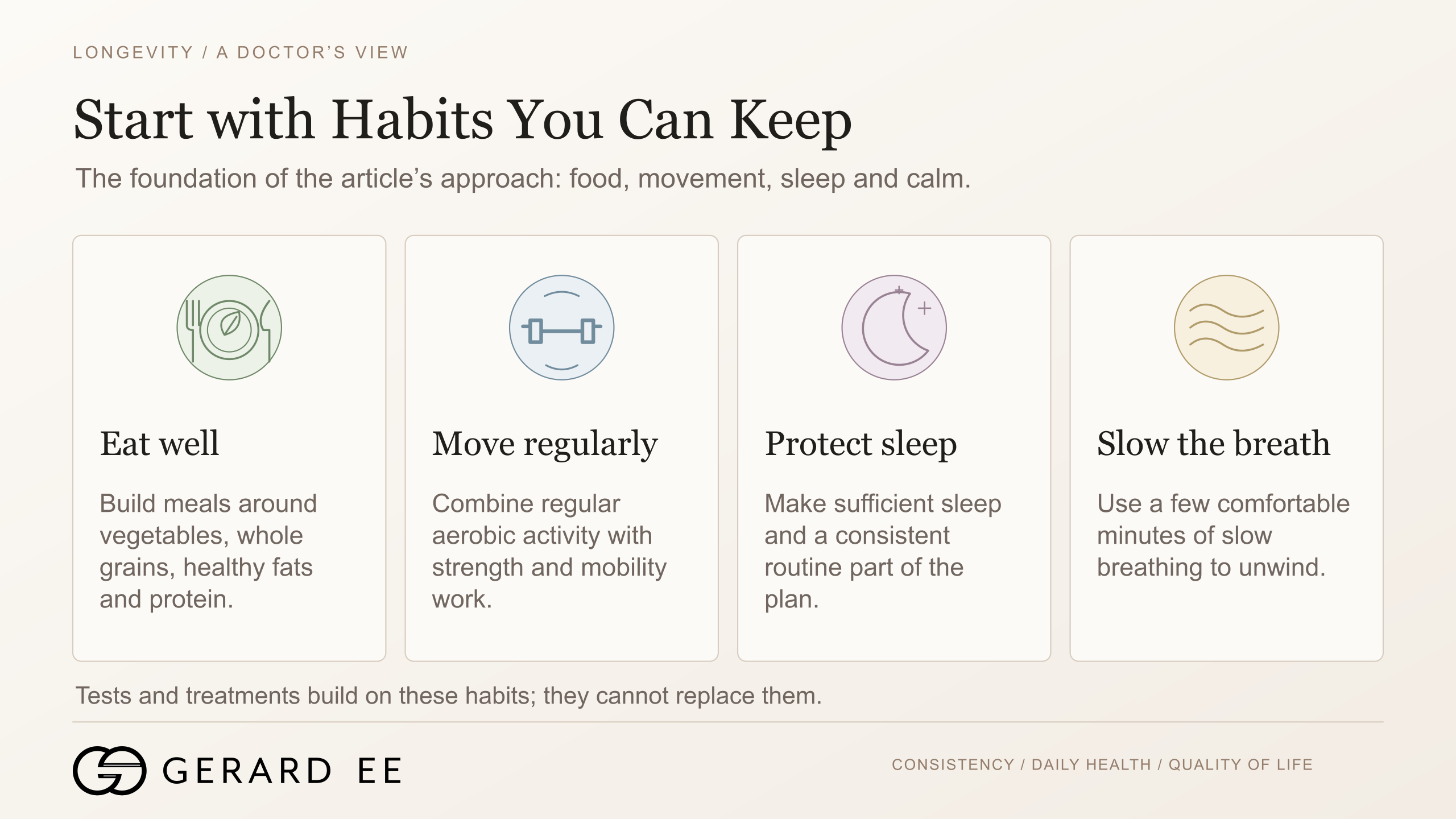
Mr Connor appears to follow the same principle. His days include squash, yoga and intense gym sessions. Another man in the story begins every morning with olive oil and lean protein, then walks on the beach for his daily steps. In one of the strongest diet trials available, 7,447 Spanish adults at high cardiovascular risk who ate a Mediterranean diet with added extra-virgin olive oil or nuts had about 30% fewer heart attacks, strokes and cardiovascular deaths combined than those on a reduced-fat diet. Fitness follows the same pattern. In a study of 122,007 adults who completed a treadmill test, the least fit had about five times the risk of death of the fittest.
Before any test or treatment, I therefore ask about diet, daily activity and the hours of sleep. The tests and treatments below are additions to those habits.
Hyperbaric oxygen therapy, the part of the routine I would keep
One detail caught my attention. About a fifth of the members of one private club for the very wealthy have installed a hyperbaric chamber at home.
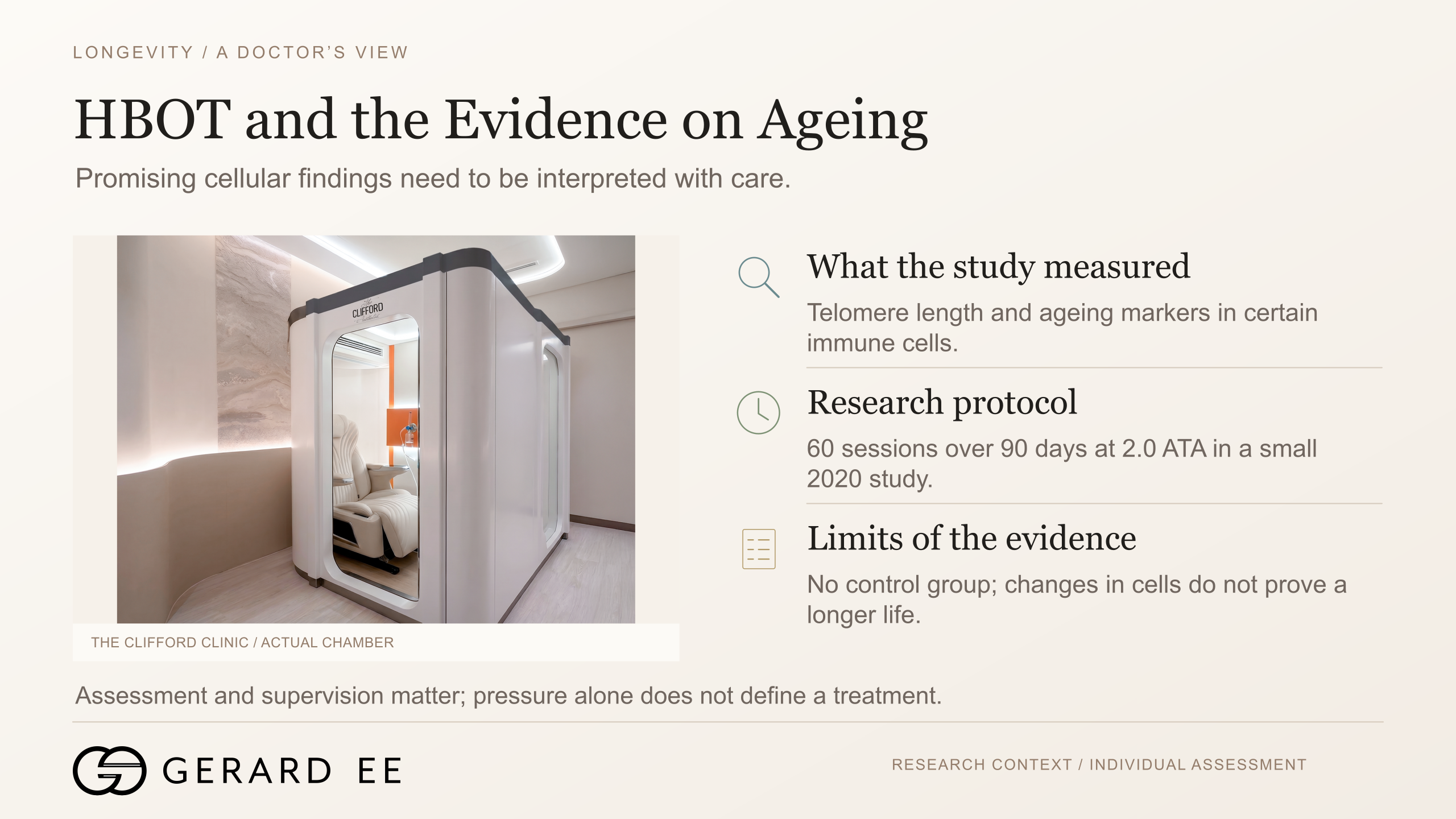
I understand why. In hyperbaric oxygen therapy (HBOT), the patient breathes oxygen at twice normal air pressure, so far more oxygen dissolves in the blood plasma and reaches tissue throughout the body. In a 2020 study of 35 healthy adults aged 64 and over, 60 sessions over 90 days lengthened telomeres, the protective caps on the ends of chromosomes, by more than 20% in several types of immune cell and reduced the number of senescent, or worn-out, immune cells that accumulate with age. The study was small and had no control group, and I tell every patient so. It is nonetheless among the most promising work I have read in longevity medicine.
My one caution concerns the chamber itself. Many home units are soft and typically reach about 1.3 atmospheres absolute (ATA), well below the 2.0 ATA used in the research. I chose a hard-shell chamber that reaches 2.0 ATA for that reason. My approach to hyperbaric oxygen therapy is described on its own page, and the clinic’s HBOT guide lists the prices.
Zone 2 training and VO2 max testing, how I make exercise count
Mr Connor finishes his day in the gym and then asks his trainer for an extra workout. Of everything in the story, exercise is the prescription with the longest record of evidence behind it.
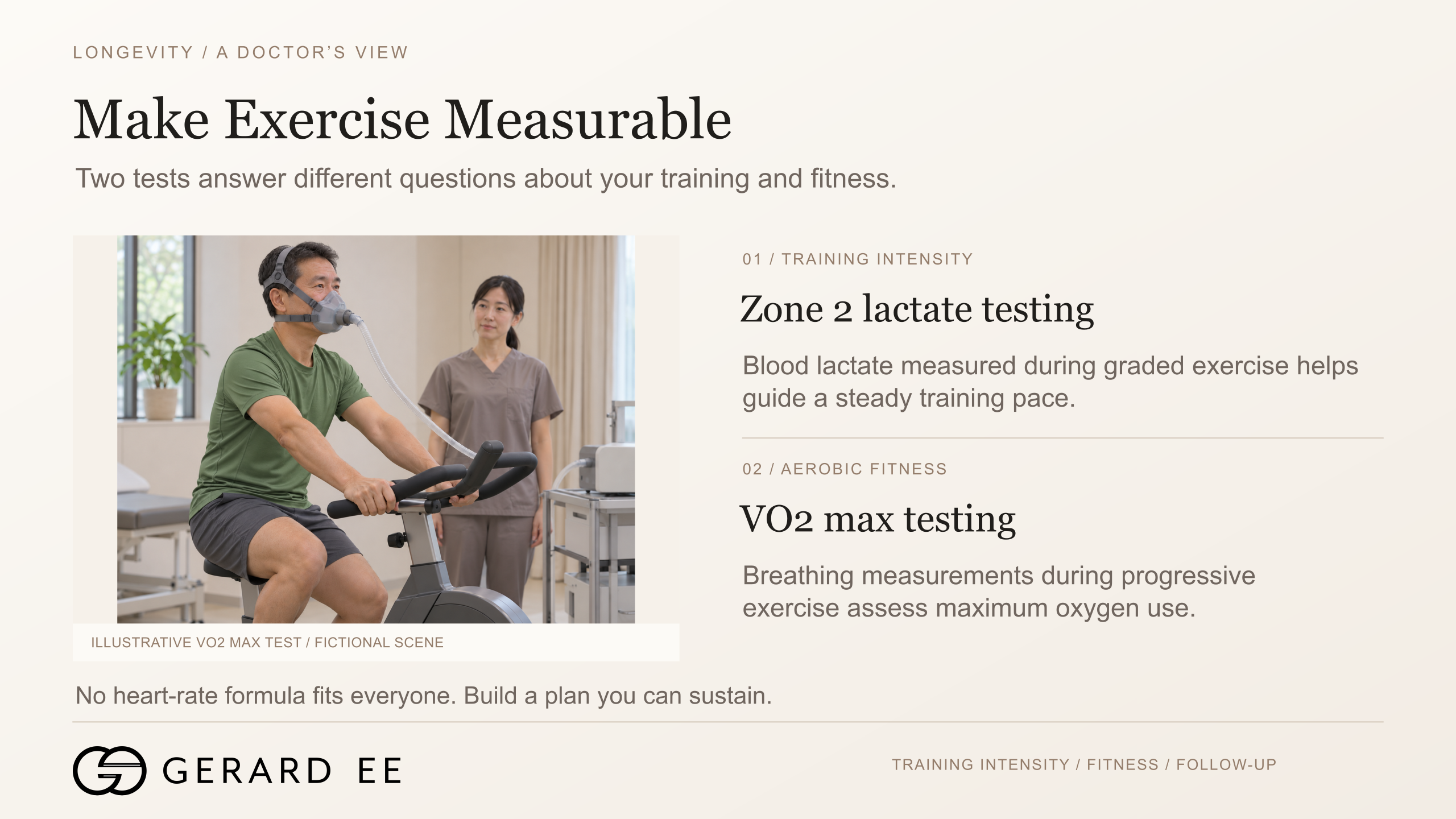
What I add is precise measurement of training intensity. Zone 2 is gentle, steady effort at a pace that still allows conversation. Sustained week after week, this effort prompts the muscles to build more mitochondria, the structures inside each cell that convert food and oxygen into energy. Healthy mitochondria are central to what I mean by ageing well, because they support stamina, blood sugar control and energy in later life.
Most people estimate their Zone 2 from a formula or a fitness watch, and the estimate is often wrong, so I measure it. During a Zone 2 lactate threshold test the patient walks or cycles while the effort rises in small steps, and a drop of blood from the fingertip at each step shows the heart rate at which lactate begins to rise, which marks the upper limit of Zone 2. I often pair it with a VO2 max test, which measures the maximum oxygen the body can use at full effort, because fitness is one of the strongest predictors of life expectancy. The lactate test is S$800, and the VO2 max test can be added for S$200.
Lipoprotein testing, what I would add to the cholesterol chart
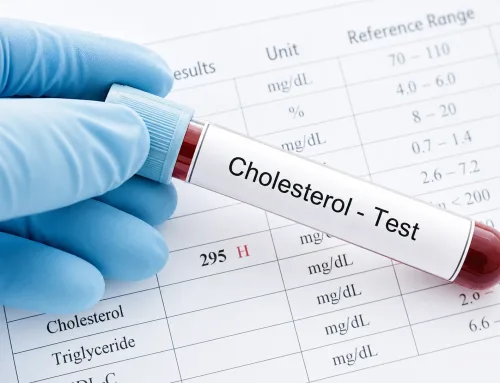
Mr Connor keeps a chart of his cholesterol falling steadily over ten years and shows it with pride, and long-term tracking of this kind is good practice. My one question for him would be whether anyone has counted the particles.
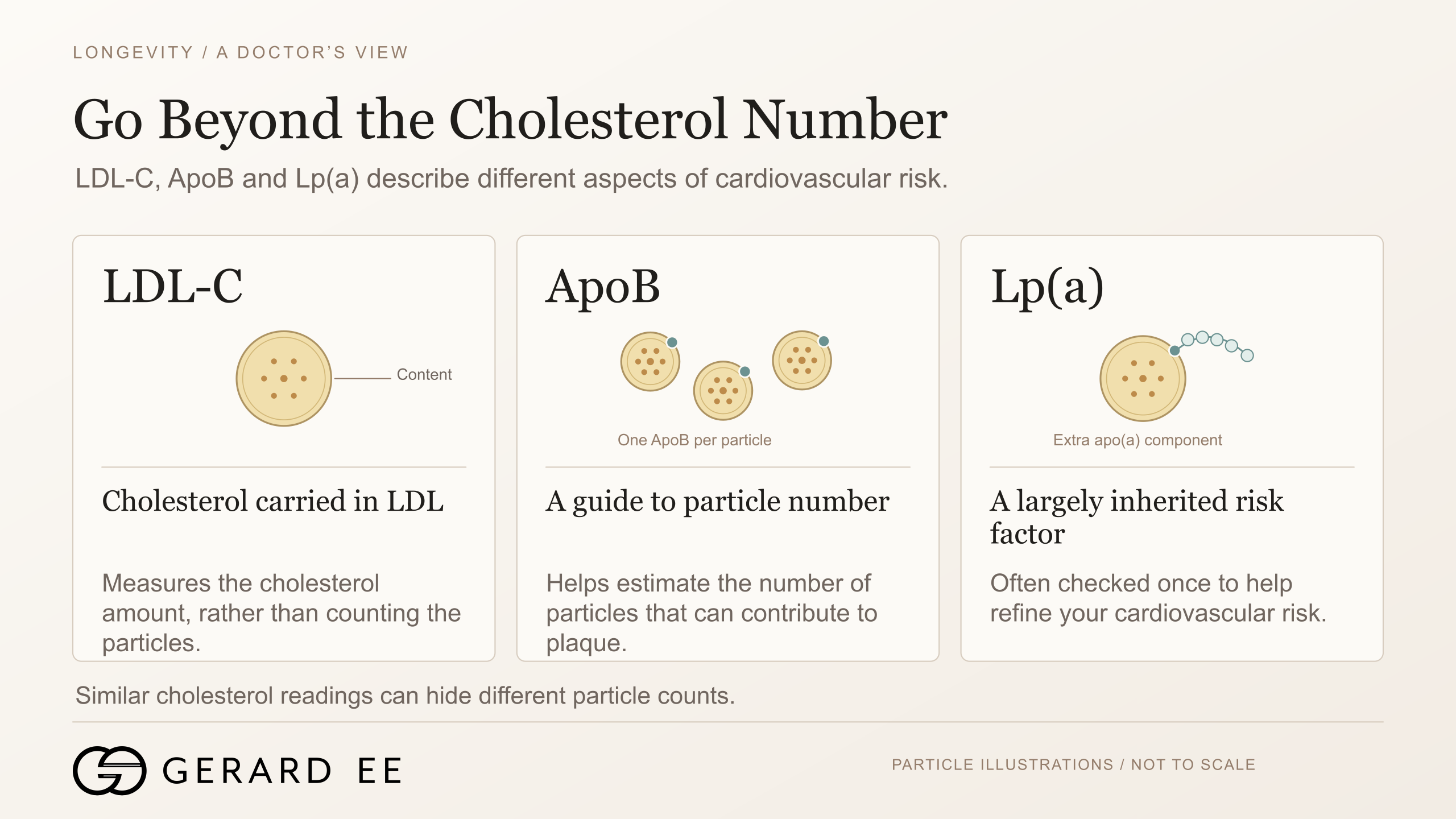
An ordinary cholesterol test measures how much cholesterol is in the blood. It does not show how many particles carry it, and it is the particles that enter the artery wall and build plaque. A lipoprotein test counts them, and I look at three measures. Apolipoprotein B (ApoB) is carried as one molecule per potentially harmful particle, so its level gives the particle count. Lipoprotein(a), or Lp(a), is an inherited particle whose level is set largely by genes, so most people need to check it only once. A detailed profile also shows the size and number of the particles themselves. Two people with the same cholesterol reading can therefore face very different cardiovascular risk. I have written more about why I look beyond a standard cholesterol blood test.
Breathwork for longevity, and why I would keep it
In the Amazon, one guest spent an hour on breathing exercises and came out saying he had reached a state he had never known. Of that retreat, the breathing is the part I would keep, and it requires no travel.
Slow, deliberate breathing is the gentlest intervention in this story. At fewer than 10 breaths a minute, it slows the heart rate and shifts the nervous system from its stress response towards its rest response, and a 2018 systematic review linked it with greater heart rate variability, lower anxiety and better mood. It requires a few minutes a day and costs nothing. Belly breathing, box breathing and the 4-7-8 breath are the techniques I suggest most often, and the clinic runs a breathwork and meditation workshop for patients who prefer guided instruction.
Multi-cancer blood test, the one test I would add to the 68
Sixty-eight tests a year is more than most people need, but the principle behind them is sound, because disease found early, while it is small, is usually easier to treat.
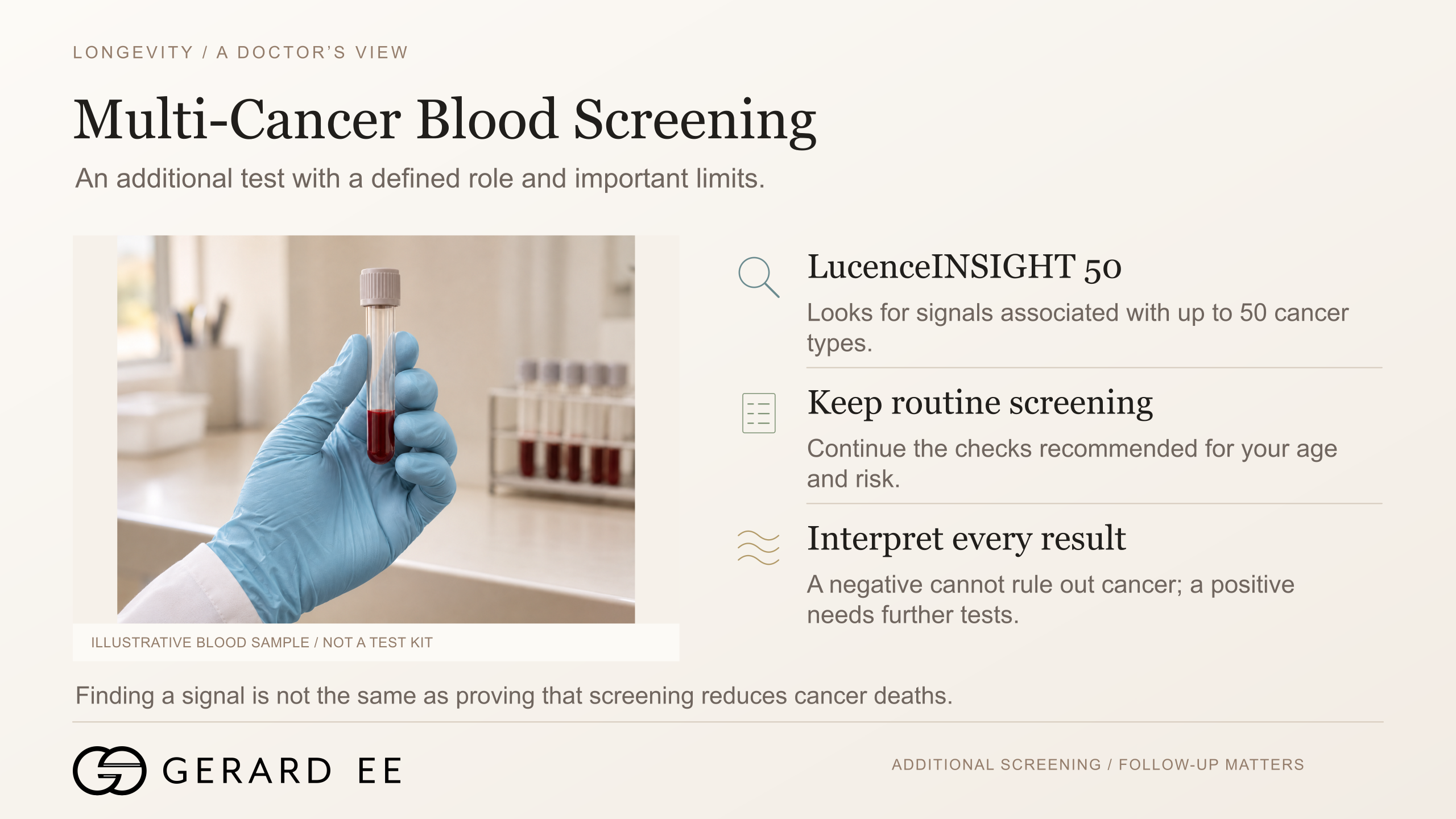
Cancer blood testing has advanced quickly. A multi-cancer early detection test looks for tiny fragments of DNA that tumours shed into the bloodstream, using a single blood sample. I use LucenceINSIGHT, from a company founded in Singapore, in the version that screens for up to 50 types of cancer. It sits alongside the usual checks such as a mammogram or a colonoscopy and does not replace them, because a negative result cannot rule out every cancer. I explain every result myself and arrange any further scan that is needed. The clinic’s cancer screening page describes the other tests I pair with it.
Ageing well in Singapore without a billionaire’s budget
Without the staff, the space flight and the six-figure bill, Mr Connor’s routine reduces to a handful of habits. These are a good diet, daily exercise at a measured intensity and knowledge of key numbers such as ApoB and VO2 max. Early cancer screening, slow breathing and, where appropriate, hyperbaric oxygen therapy complete the list. Each of those is within reach in Singapore. The clinic has published its own review of the routine and the parts worth copying.

Dr Gerard Ee, Aesthetic Doctor in Singapore
Dr Gerard Ee is an aesthetic doctor in Singapore and the Medical Director of his practice at 50 Raffles Place. He graduated from St George’s, University of London, trained in surgery at Singapore General Hospital and the National University Hospital, and holds the MRCS (Edinburgh) and a postgraduate diploma in practical dermatology from Cardiff University.
He has practised aesthetic medicine since 2012, is the author of sixteen peer-reviewed papers, and writes and medically reviews every article on this site. Read more about Dr Gerard Ee.

Book a consultation with Dr Gerard Ee at The Clifford Clinic
Dr Gerard Ee consults and performs Zone 2 lactate and VO2 max testing, and supervises hyperbaric oxygen therapy, at The Clifford Clinic, 50 Raffles Place, Singapore. Consultations are by appointment. Message the clinic on WhatsApp, or call 6532 2048.
References
- Banerji G. Meet the Real-Estate Billionaire Spending a Fortune to Slow Down Aging. The Wall Street Journal. 11 November 2026.
- Hachmo Y, Hadanny A, Abu Hamed R, et al. Hyperbaric oxygen therapy increases telomere length and decreases immunosenescence in isolated blood cells, a prospective trial. Aging (Albany NY). 2020;12(22):22445-22456.
- Mandsager K, Harb S, Cremer P, et al. Association of cardiorespiratory fitness with long-term mortality among adults undergoing exercise treadmill testing. JAMA Netw Open. 2018;1(6):e183605.
- Holloszy JO. Biochemical adaptations in muscle. J Biol Chem. 1967;242(9):2278-2282.
- Estruch R, Ros E, Salas-Salvadó J, et al. Primary prevention of cardiovascular disease with a Mediterranean diet supplemented with extra-virgin olive oil or nuts. N Engl J Med. 2018;378(25):e34.
- Sniderman AD, Thanassoulis G, Glavinovic T, et al. Apolipoprotein B particles and cardiovascular disease, a narrative review. JAMA Cardiol. 2019;4(12):1287-1295.
- Zaccaro A, Piarulli A, Laurino M, et al. How breath-control can change your life, a systematic review on psycho-physiological correlates of slow breathing. Front Hum Neurosci. 2018;12:353.
- Poh J, et al. LucenceINSIGHT multi-cancer early detection test. J Clin Oncol. 2024;42(16 suppl):e15042.
This page is written from published research and from clinical experience in Singapore since 2012. It is for general education, not medical advice. Whether a treatment suits you, what it may achieve and what it may risk can only be established at a consultation. Dr Gerard Ee is the Medical Director of The Clifford Clinic, a private clinic in Singapore, and treatments discussed on this site are provided commercially.