
Written by Dr Gerard Ee, MBBS (UK), MRCS (Edinburgh), Postgraduate Diploma in Practical Dermatology (Cardiff). Founder and Medical Director, The Clifford Clinic and The Clifford Surgery, Singapore. Last medically reviewed and updated 21 October 2026.
A skin tag is a small, soft, harmless growth that hangs from the skin on a thin stalk, known medically as an acrochordon. Most people have at least one by middle age. Tags collect where skin rubs on skin or on a collar, and they are neither contagious nor cancerous.
A crop of skin tags can, however, be a sign of raised insulin, which is the part most pages omit. I have removed skin tags since 2012. This review of skin tag removal in Singapore covers what skin tags are, why they appear, the link with weight and blood sugar, why the removal creams sold online cause harm, how I remove them, and how I distinguish a true tag from the growths that resemble one.

Key points
- Most skin tags are snipped off at the base under local anaesthetic in a few minutes, with no stitches and no time off work.
- Skin tag removal costs $150 per tag, or $1,600 for unlimited tags on the face or the neck, before GST. Several tags are removed in one visit for one fee.
- Four methods, snip excision, electrocautery, CO2 laser and cryotherapy, are chosen by the size and site of the tag.
- Every growth is examined under the dermatoscope first. A growth that is firm, pigmented, enlarging or bleeding is treated as a mole and assessed accordingly.
What is a skin tag, and what is it made of

A skin tag is a fold of normal skin wrapped around a soft core of loose connective tissue and a few tiny blood vessels. It has no roots, it does not grow into the skin, and it carries few nerve endings, which is why most people only notice one when it catches on a necklace. Tags range from a pinhead to the size of a grape and are skin-coloured or slightly darker. A tag that has twisted on its stalk can turn black overnight because the twist cuts off its blood supply and the tissue dies. The change looks alarming and is harmless.
Under the dermatoscope a true skin tag is featureless, and that absence of pattern is what confirms it. A growth that shows a pattern under the dermatoscope, such as a pigment network or branching vessels, is something else, and the growths mistaken for tags are covered below.
Skin tag causes, rubbing, age, weight and insulin

Friction is the trigger. Tags collect where skin folds rub, namely the sides of the neck, the armpits, the skin under the breasts, the groin and the eyelids, and they are more common in people who carry weight in those folds, because a deeper fold rubs more. They become more frequent from the forties onwards, and they run in families.
The cause with the greater medical significance is insulin. People with many skin tags are more likely to have raised insulin levels, and several studies have found diabetes and insulin resistance more often in people with many tags than in people without them. Insulin and the related insulin-like growth factor stimulate the skin cells and connective tissue that make up a tag, which is why tags often arrive in a crop when the waist grows. This does not apply to everyone. A single tag on a slim 35-year-old carries no significance. A crop of 20 new tags on the neck of someone whose weight has changed is a reason to check a fasting glucose, and I say so at the consultation.
Skin tags in pregnancy and in children
Pregnancy promotes skin tags, partly through weight gain and hormonal change and partly through the same insulin pathway, because insulin resistance rises in the second half of pregnancy. Tags are more common in women who develop diabetes in pregnancy. Tags that appear in pregnancy often shrink after delivery, so I usually leave them until then unless they catch or rub.
In children skin tags are uncommon, and their presence calls for a closer look. Children who develop them tend to be carrying extra weight, and the tags sit in the armpit as they do in adults. More importantly, there is a rare inherited condition, nevoid basal cell carcinoma syndrome, in which growths that resemble skin tags in a child are small basal cell carcinomas. A skin tag on a child is therefore removed and sent to the laboratory, not snipped and discarded.
Are skin tags caused by HPV, and are they contagious
The human papillomavirus (HPV), the wart virus, has been found inside skin tags in laboratory studies. The finding sounds alarming and is not. The types found are the low-risk ones, the virus is thought to play a small part in how a tag grows rather than to cause it, and skin tags do not spread from person to person or from one part of the body to another. A skin tag cannot be caught from a towel, and removing one does not cause others to appear. New tags after removal come from the same friction and insulin that produced the first ones.
Skin tag removal methods
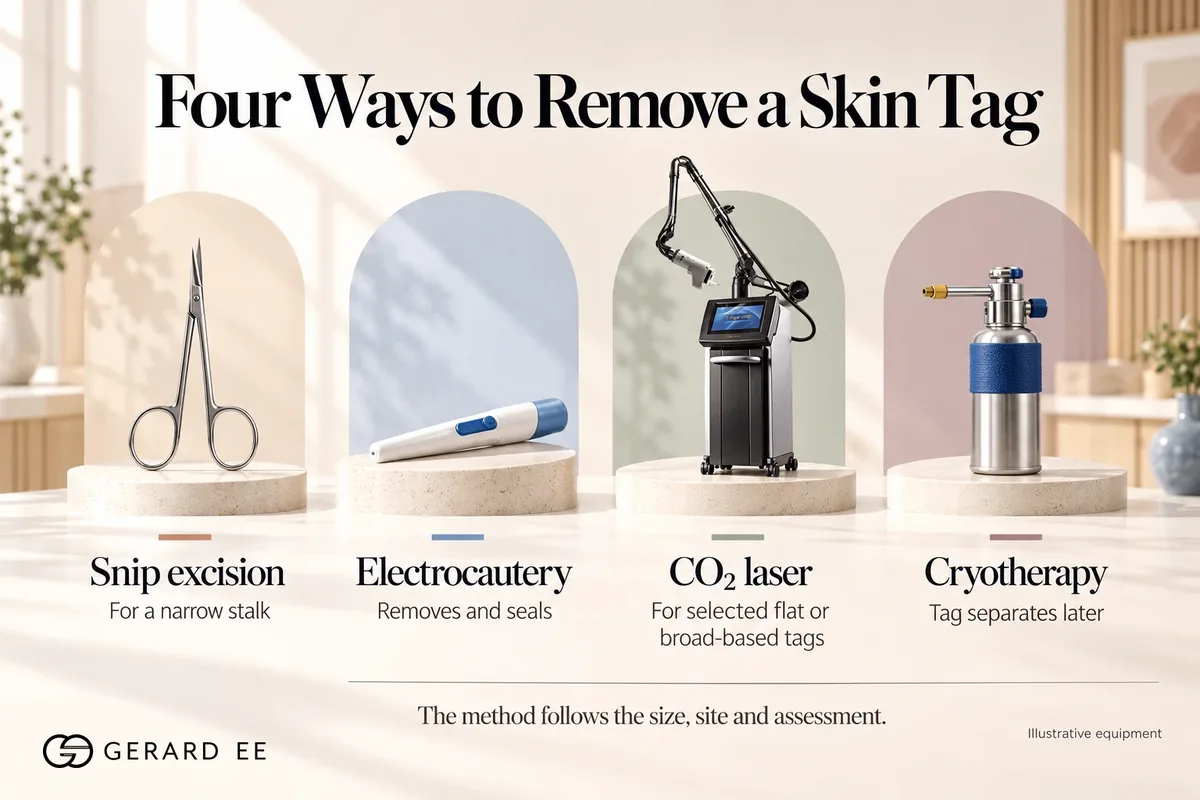
Snip excision
After the stalk is numbed with local anaesthetic, the tag is cut off at its base with fine surgical scissors or a blade. Snip excision is the quickest method, gives an immediate result and requires no stitches because the base is narrow, and it is the method I use for most tags.
Cryotherapy
Liquid nitrogen, at minus 196°C, freezes the tag, which darkens and drops off over one to two weeks. Cryotherapy is useful for several very small tags and for patients who prefer to avoid an injection. The tag is not removed on the day of treatment, and because pigment cells are damaged at temperatures that other skin cells survive, freezing can leave a pale mark on darker skin. I therefore use cryotherapy selectively.
Electrocautery
A fine electrically heated tip removes the tag and coagulates the small blood vessels in its base at the same time, so bleeding is minimal. Electrocautery is well suited to tags on the eyelid margin and to larger tags with a broad base.
CO2 laser
The CO2 laser vaporises a tag with very little bleeding, because the heat seals the vessels as it removes tissue, and suits flat or broad-based tags and small tags on the face, where a neat flat mark matters most. The four methods, the price for each and what happens on the day are set out on my skin tag removal price page.
Skin tag removal cost in Singapore
Skin tag removal costs $150 per tag, or $1,600 for unlimited tags on the face or on the neck in one visit, before GST. The full price table, what happens on the day and the aftercare are set out on my skin tag removal price page.
Skin tag removal on the eyelid and face
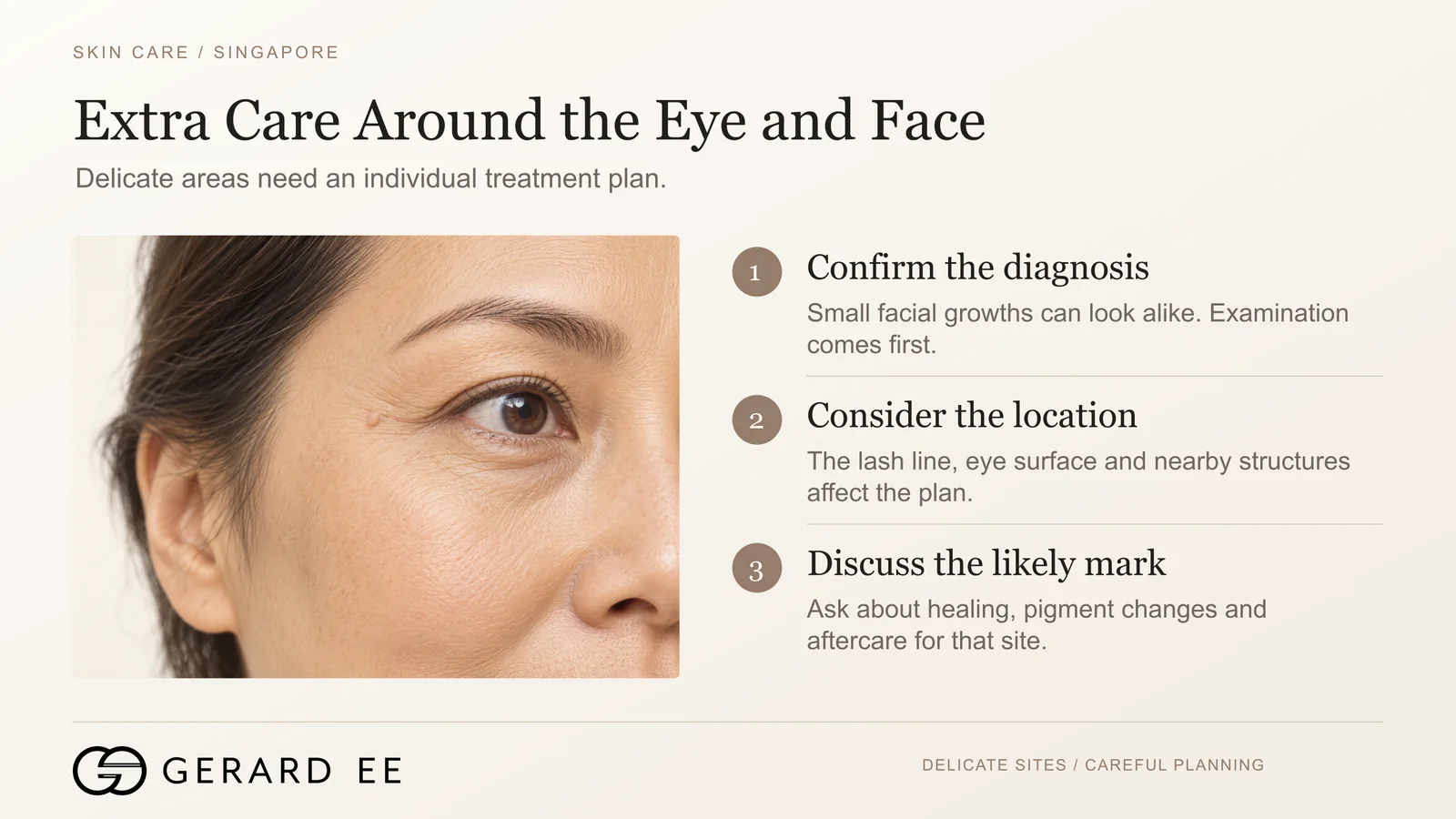
Tags on the eyelid margin are removed by cautery or snip excision after anaesthetic eye drops and a small local anaesthetic injection, with care taken to preserve the lash line. Freezing is avoided on the lid because it can leave a pale mark on the thin lid skin. Facial tags are removed by snip excision or the CO2 laser, which give an immediate result and leave a flat mark.
Tags on the neck, armpit, groin and around the anus are covered site by site on my skin tags on the neck, face, armpit and eyelid page.
Recovery after skin tag removal

A small scab forms and separates within 7 to 10 days, leaving a flat, pale mark that blends with the surrounding skin over a few weeks. Most sites need no dressing, and no time off work is required. A removed skin tag does not usually regrow at the same site, although new tags can form nearby over the years, particularly where friction or insulin resistance persists.
Skin tags and the growths mistaken for them

A growth that is firm, pigmented, enlarging or bleeding, or that has a broad base rather than a stalk, may not be a skin tag. I examine every growth under the dermatoscope before removal, and any growth without the appearance of a simple tag is assessed in the same way as a mole, described on my mole removal in Singapore page.
The risk of a growth labelled a skin tag proving to be a skin cancer is very low, and in a large laboratory review of growths submitted as skin tags by dermatologists, none was malignant. The risk sits in the growths that were never true tags. The ones I see mistaken for tags are a mole on a stalk, the waxy brown growth of middle age called a seborrhoeic keratosis, a soft neurofibroma, a wart with its rough surface, and rarely a pearly basal cell carcinoma with fine vessels on its surface. Any growth that is firm, pigmented, enlarging, bleeding or new in a child is not removed as a tag. It is removed by shave or excision and sent to the laboratory, with results in 2 to 3 weeks.
How to remove a skin tag, and why not at home

In clinic a skin tag is snipped at the base under local anaesthetic, sealed with a fine cautery tip or the laser, or frozen so that it drops off over one to two weeks. Each method takes a few minutes and none needs stitches.
I ask patients not to treat skin tags at home. Tying a thread around the stalk or cutting a tag with nail clippers bleeds more than expected, because every tag has a vessel in its stalk, is painful, and on the eyelid or face leaves a mark that a 2-minute snip in clinic would not. The creams and liquids sold online are worse. They contain strong acids or caustic plant extracts, and the injury reports collected by the US drug regulator include chemical burns, open ulcers and permanent scars, many on the face and some beside the eye. Those products remain on sale on the same online marketplaces in Singapore. A skin tag is harmless, whereas the chemical burn it is treated with is not.
Is it worth removing a skin tag
Medically, a skin tag never has to be removed. It is removed when it catches, bleeds, rubs under a collar or a strap, sits on the eyelid or face, or simply because the patient would rather it were gone, and that is reason enough. Removal is quick, the mark usually disappears within weeks, and every tag on the face or the neck is removed in one visit for one fee.
The three situations in which I advise against immediate removal are when the growth is not clearly a tag, when it is on a child, and when a patient has dozens of new tags with no explanation, because then the more useful appointment is the blood test, and the tags can be removed afterwards.
How I assess and remove a skin tag
I have removed skin tags since 2012 and see 2 or 3 skin tag patients a week alongside mole patients, because a patient who attends about one growth usually has several. Every growth is examined under the dermatoscope before anything is done to it. The examination takes seconds and it is the one step that separates a tag from a mole, a wart or the rare cancer that mimics one. A clear tag is snipped at the same visit. Any growth with a pattern under the dermatoscope is treated as a mole, removed by shave or excision and sent to the histology laboratory at Singapore General Hospital, with the result back in 2 to 3 weeks.
I trained in surgery before aesthetic medicine, hold the MRCS from the Royal College of Surgeons of Edinburgh and a Postgraduate Diploma in Practical Dermatology, and have authored 16 peer-reviewed papers. More is on the about page.
Frequently asked questions about skin tag removal
Does skin tag removal hurt?
Removal causes only a brief sting from the anaesthetic injection, after which the procedure is painless. Cryotherapy causes a short burning sensation instead and needs no injection.
Can I remove skin tags at home?
Removing skin tags at home is not advisable. Home kits and tying the tag with thread can cause infection, bleeding and scarring, and can remove lesions that were not skin tags, including skin cancers that then go undiagnosed. Removal in clinic takes a few minutes.
Will skin tag removal leave a scar?
Snip excision and electrocautery leave a flat mark that fades over a few weeks. Cryotherapy can leave a pale spot on darker skin, because freezing damages the pigment cells.
How many skin tags can be removed at once?
Every tag present can be removed in one session, and unlimited tags on the face or the neck are removed for one fee.
Is skin tag removal covered by insurance?
Skin tag removal is not covered by insurance or MediSave, because it is a cosmetic procedure.
What is a skin tag?
A skin tag is a small, soft growth of normal skin on a stalk, with a core of loose tissue and tiny vessels. It is harmless and very common, and the medical name is acrochordon.
What causes skin tags?
Skin tags are caused by friction in skin folds, age, family tendency, weight gain, pregnancy and raised insulin levels. People with many tags are more likely to have insulin resistance or diabetes.
Are skin tags a sign of diabetes?
Skin tags are not a sign of diabetes on their own. A large number of tags, especially new ones appearing with weight gain, is linked to higher blood sugar and insulin resistance, and is a reason to test rather than a diagnosis.
Are skin tags contagious?
Skin tags are not contagious. The wart virus has been found inside tags, but they do not spread between people or across the body, and removing one does not cause more.
Does removing a skin tag make more grow?
Removing a skin tag does not make more grow. New tags come from the same friction and insulin that produced the first ones.
Is it worth removing a skin tag?
For comfort or appearance, removal is worthwhile, since it takes a few minutes with no stitches. For health, removal is not required, unless the growth is not clearly a tag, in which case it is removed so that it can be examined.

Book a consultation with Dr Gerard Ee
Dr Gerard Ee consults and performs skin tag removal at his practice at 50 Raffles Place, Singapore. Consultations are by appointment. Message the clinic on WhatsApp, or call 6532 2048.
Selected References
- Vestergaard ME, Macaskill P, Holt PE, Menzies SW. Dermoscopy compared with naked eye examination for the diagnosis of primary melanoma, a meta-analysis of studies performed in a clinical setting. Br J Dermatol. 2008;159(3):669-76. PMID 18616769.
- Rasi A, Soltani-Arabshahi R, Shahbazi N. Skin tag as a cutaneous marker for impaired carbohydrate metabolism: a case-control study. Int J Dermatol. 2007;46(11):1155-1159. PMID 17988334.
- Shaheen MA, Abdel Fattah NSA, Sayed YAA, Saad AA. Assessment of serum leptin, insulin resistance and metabolic syndrome in patients with skin tags. J Eur Acad Dermatol Venereol. 2012;26(12):1552-1557. PMID 22188415.
- Singh SK, Agrawal NK, Vishwakarma AK, et al. Association of acanthosis nigricans and acrochordon with insulin resistance: a cross-sectional hospital-based study from North India. Indian J Dermatol. 2020;65(2):112-117. PMID 32180596.
- Köseoğlu HG, Bozca BC, Başsorgun Cİ, et al. The role of insulin-like growth factor in acrochordon etiopathology. BMC Dermatol. 2020;20(1):14. PMID 33143702.
- Uzuncakmak TK, Akdeniz N, Karadag AS. Cutaneous manifestations of obesity and the metabolic syndrome. Clin Dermatol. 2018;36(1):81-88. PMID 29241757.
- Ilatov E, Eshkoli T, Mashal A, et al. Acanthosis nigricans and acrochordons as clinical markers of metabolic disturbance during pregnancy: a prospective cohort study. Front Med. 2025;12:1607429. PMID 41020239.
- Greene RK, Gangidi S, Zhao R, et al. The relationship between acrochordons, obesity, and metabolic syndrome in the pediatric population: a retrospective cohort study. Pediatr Dermatol. 2024;41(4):660-666. PMID 38684337.
- Chiritescu E, Maloney ME. Acrochordons as a presenting sign of nevoid basal cell carcinoma syndrome. J Am Acad Dermatol. 2001;44(5):789-794. PMID 11312426.
- Dianzani C, Calvieri S, Pierangeli A, et al. The detection of human papillomavirus DNA in skin tags. Br J Dermatol. 1998;138(4):649-651. PMID 9640372.
- Dianzani C, Paolini F, Conforti C, et al. Human papillomavirus in skin tags: a case series. Dermatol Pract Concept. 2018;8(4):295-296. PMID 30479858.
- Eads TJ, Chuang TY, Fabré VC, Farmer ER, Hood AF. The utility of submitting fibroepithelial polyps for histological examination. Arch Dermatol. 1996;132(12):1459-1462. PMID 8961875.
- Konkel K, Reyes M, Diak I, Cao K, McCulley L. Serious skin injuries following exposure to unapproved mole and skin tag removers. J Clin Aesthet Dermatol. 2023;16(1):14-17. PMID 36743972.
- Shen-Wagner J, Amidon J, Carek S. Diagnosing common benign skin tumors. Am Fam Physician. 2024;110(4):353-361. PMID 39418568.
Dr Gerard Ee consults and performs skin tag removal at his practice at 50 Raffles Place, Singapore.
This page is written from published research and clinical experience in Singapore since 2012. It is for general education, not medical advice. Suitability, results, downtime and cost vary from person to person. Please arrange a consultation for advice specific to your skin.

