
A pico laser fires in pulses measured in trillionths of a second. Because the pulse is so short, pigment is broken up more by a photomechanical shock than by heat, and less heat spreading into the skin around the target is exactly what matters on Asian skin. That is the whole argument for the technology, and it is a real one. It is also narrower than the advertising suggests.
Written by Dr Gerard Ee, MBBS (UK), MRCS (Edinburgh), PGDip Practical Dermatology (Cardiff). Last medically reviewed and updated: September 2026.
This page sets out what I use a pico laser for, what I do not use it for, how the platform is chosen, what it costs at my clinic and how to read the promotional pricing that dominates the market. The wider plan, including creams and the treatments that come before any laser, is on my pigmentation treatment page.

What a pico laser does to pigment
Melanin absorbs the light and the pigment particle is shattered into fragments small enough for the body to clear over the following weeks. A nanosecond laser does the same job with a pulse about a thousand times longer, which deposits more heat in the surrounding tissue. In skin that responds to heat and inflammation by making more pigment, that difference is the point.
What follows from this is worth stating plainly. The pico laser is not a stronger laser. It is a faster one, and the benefit shows up mainly in the side effect profile rather than in how much pigment clears.
Depth decides almost everything. Freckles and sun spots sit in the epidermis and clear quickly. Hori’s naevus sits in the dermis and needs a longer wavelength across a much longer course. Melasma can involve both layers and behaves like neither. The same brown patch on two faces can need two different machines.
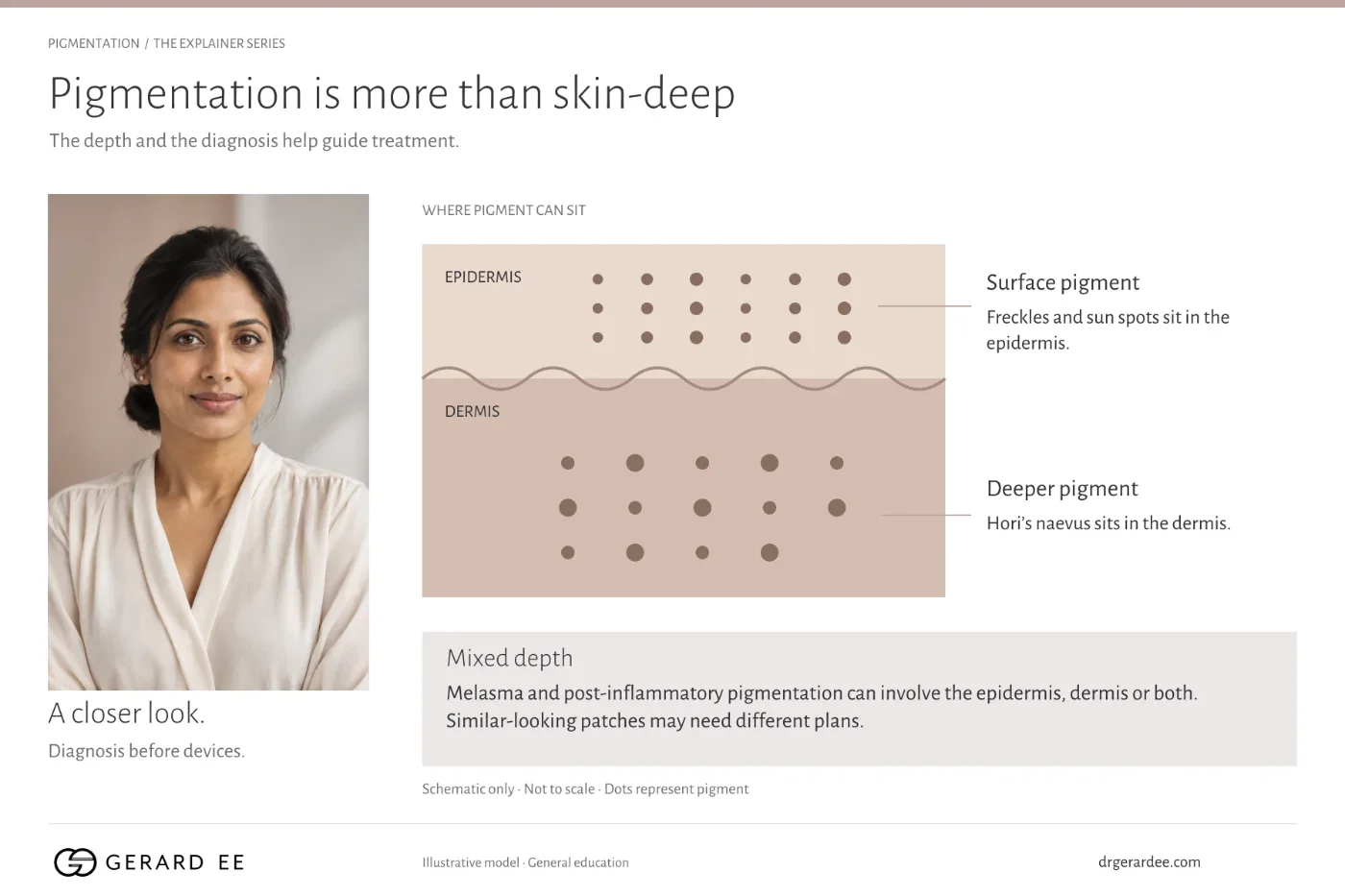
What pico laser treats, and what it does not treat
I use it for freckles and sun spots, for the brown marks left behind by acne once the acne itself is controlled, for dermal pigment such as Hori’s naevus, and at low energy as one component of a melasma plan. A fractional handpiece adds a resurfacing effect for shallow texture and pores.
| Concern | Does pico laser suit it? |
|---|---|
| Freckles and sun spots | Yes. Usually the fastest responding group. |
| Post-acne brown marks (PIH) | Yes, once the active acne is controlled. Treating marks while new spots keep forming simply produces more marks. |
| Hori’s naevus and dermal pigment | Yes, with a longer wavelength and an extended course. |
| Melasma | Only at low energy, and only alongside sun protection and topical treatment. Controlled rather than cured. |
| Red acne marks | No. These are vascular and need a vascular laser. |
| Raised growths such as seborrhoeic keratoses | No. Different method, after review. |
| Deep indented acne scars | No. These need fractional resurfacing rather than a pigment laser. |
| Any new, changing or undiagnosed pigmented spot | Examine first. Never treat an undiagnosed lesion cosmetically. |
That last line is not a formality. A pigmented lesion that is new, changing or asymmetrical is a diagnostic question before it is a cosmetic one, and a laser removes the evidence.
Which pico laser platform suits which pigment
Most clinics in Singapore run one pico laser and fit every patient to it. At my clinic there are three, plus a separate 755 nm picosecond alexandrite, and they are not interchangeable. Different wavelengths are absorbed differently and reach different depths, so the platform follows the diagnosis rather than the other way round.
| Platform | What I use it for |
|---|---|
| Picocare | The general workhorse. Surface pigment such as freckles and sun spots, deeper pigment, and melasma toning. |
| PicoPlus | Adds a ruby wavelength that melanin absorbs strongly, which helps with stubborn pigment that has not moved on other settings. |
| Helios 785 | A middle wavelength that suits mixed pigmentation and cases where a gentler approach is the safer one. |
| Picosecond alexandrite 755 nm | A separate machine used for selected indications, particularly dermal pigment. |
All of them can be fitted with a fractional handpiece, which is what I use when texture and pores are part of the complaint rather than pigment alone. The point of running several is not that more machines are better. It is that with one machine the question becomes whether your pigment can be treated, and with several it becomes which platform suits it. The Clifford Clinic pico laser page lists the platforms in full.
When you compare clinics, ask which machine they would use on your face and why. A clinic that cannot answer that is treating the machine it owns rather than the pigment you have.
Is a pico laser stronger than an older pigment laser?
This is the comparison patients ask about most, and the honest answer is not the one the marketing makes. A 2025 systematic review and meta-analysis pooled 21 studies and 971 patients comparing picosecond with nanosecond lasers. For pigmentation arising in the skin itself, clearance was comparable between the two (RR 1.06, 95% CI 0.85 to 1.31). Picosecond lasers caused less pain, and significantly less post-inflammatory hyperpigmentation and hypopigmentation. The authors also noted that adverse events were more pronounced in Asian than in European patients [1].
No. It is faster, not stronger, and the case for it is a safety case rather than an efficacy one. That case is strongest precisely where I practise. The full head-to-head, wavelength by wavelength and indication by indication, is a separate piece: pico laser vs Q-switch laser. The Q-switch laser page carries that protocol.
Pico laser for melasma, and why I keep the energy low
Melasma is the condition where lasers do the most damage when used confidently. It is an active process rather than a static deposit, and heat provokes it. My sequence is sun protection and topical treatment first for two to three months, then low-energy toning added monthly only if the response has plateaued, then maintenance. Never on tanned, inflamed or untreated skin.
The caution is evidence-based. A systematic review of 42 articles on low-fluence Q-switched Nd:YAG toning for melasma found it generally effective, but reported mottled hypopigmentation that can persist and appears related to high accumulated energy, hyperpigmentation when used aggressively in darker skin, and considerable recurrence within three months, with long-term follow-up largely absent [2].
On the picosecond side, a randomised split-face study of 30 melasma patients treated with low-fluence 1064 nm picosecond laser, with a micro-lens array on one side, found MASI reduced at every time point and lower recurrence at six months on the micro-lens side, one patient against six [3]. A randomised trial comparing picosecond alexandrite with a diffractive lens array against triple combination cream in Asian women found the laser comparable to the cream rather than superior to it [4]. A 2026 meta-analysis of randomised trials of the 755 nm picosecond alexandrite in melasma reached the same cautious position [5].
Read together, those say the same thing I tell patients across the desk. A laser is a component of melasma treatment, not the treatment. Cyspera and daily sun protection do more of the work than the machine does, and for melasma that has stalled I combine the laser with microneedle fractional radiofrequency rather than raising the energy.
Pico laser price in Singapore, and what an $88 promotion buys
Pico laser at my clinic is from S$280 a session before GST. Full face pigmentation, melasma toning and dermal pigment such as Hori’s naevus are quoted after assessment, because the number of sessions is the variable that decides the total and it cannot be known before the pigment is diagnosed.
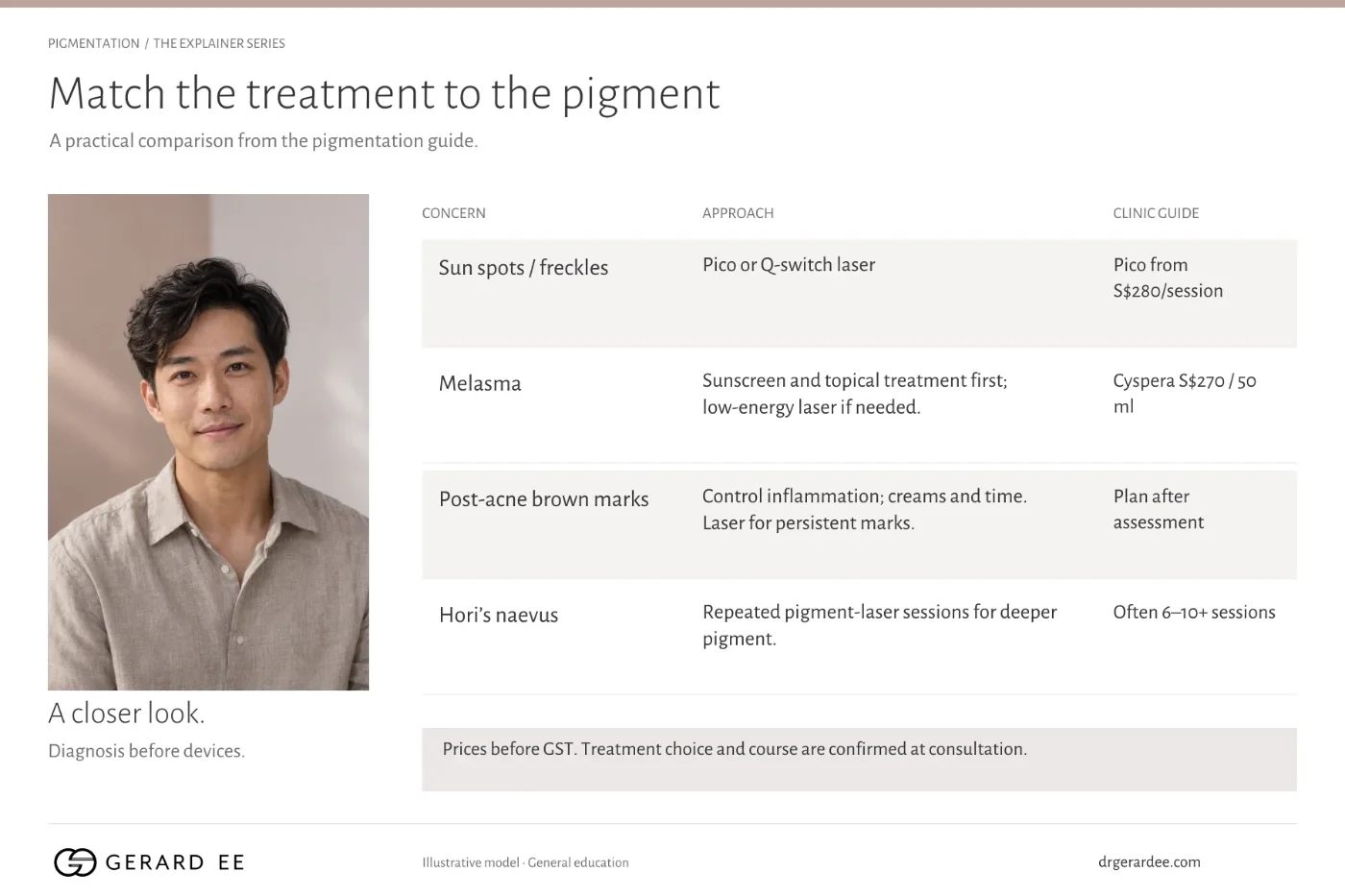
| Treatment | Price at this clinic | Usual course |
|---|---|---|
| Pico laser | From S$280 a session | Freckles 1 to 3, PIH 3 to 6, Hori’s 6 to 10 or more, melasma 5 to 10 then maintenance |
| Full face pigmentation | Quoted after assessment | Set at consultation |
| Melasma toning course | Quoted after assessment | Monthly, then spaced as maintenance |
| Q-switch laser | From S$1,100 for 5 sessions, or from S$2,000 for 10 | 4 to 6 sessions, 2 to 5 weeks apart |
| Fraxel Dual | From S$1,000 a session | 3 to 5 sessions, 2 to 4 weeks apart |
Singapore advertises pico laser from about S$48 to S$600 a session, and the spread is not explained by the machines. A very low trial price generally buys a single short pass at conservative settings over a small area. That is not dishonest in itself, and for a few freckles it may be all that is needed. The problem is what is left unsaid: how many sessions the diagnosis actually requires, whether the price holds after the first visit, and who decides the settings.
The questions that make two quotes comparable are the same six I would ask. Which exact machine and which wavelength. Which areas are included. How many sessions this diagnosis usually needs. Who assesses and who holds the handpiece. Whether consultation, review and aftercare are included. And what happens if the pigment darkens and does not settle.
How many pico laser sessions you need
The number follows the diagnosis, not the price list.
| Pigment | Typical course | Interval |
|---|---|---|
| Freckles and sun spots | 1 to 3 sessions | 3 to 4 weeks |
| Post-inflammatory hyperpigmentation | 3 to 6 sessions | 3 to 4 weeks |
| Melasma toning | 5 to 10, then maintenance | Monthly, then spaced |
| Dermal pigment such as Hori’s naevus | 6 to 10 or more | 6 to 8 weeks |
Sessions are spaced because the body needs time to clear fragmented pigment, and because treating too often is one of the ways rebound pigmentation is produced. Expect treated spots to darken and crust lightly in the first week before flaking. That is the treatment working. Pigment that keeps spreading and darkening past a week is not, and should be reviewed.
A randomised split-face trial of 84 Chinese patients treated for freckles with a single session of a 532 nm picosecond laser reported a response rate of 97.6%, but complete clearance in only about one in eight [6]. That gap between responding and clearing is the expectation worth setting before the first session.
Pico laser on Asian and darker skin
Skin that tans easily also pigments easily after a laser, and most of my patients have it. The safeguards are lower energy across more sessions, the longer wavelengths for deeper pigment, a test spot where the skin type or diagnosis is uncertain, and consistent sunscreen for weeks before and after rather than only afterwards.
The published work supports the direction. A pilot study of a 785 nm picosecond Nd:YAG with a diffractive lens array in 15 Asian women reported reduced melanin and erythema indices over five weekly treatments with no serious adverse effects, though 15 patients is a pilot and should be read as one [7]. A retrospective series of the 755 nm picosecond alexandrite for dermal pigment in Asian patients supports its use for that specific indication [8].
Post-inflammatory hyperpigmentation is the complication I am managing against throughout, and it is the reason I would rather treat a patient six times gently than twice hard. My page on brown acne marks in Asian skin covers that in more detail.

Book a pico laser consultation in Singapore
Dr Gerard Ee consults and performs pico laser treatment at The Clifford Clinic, 50 Raffles Place, Singapore. Consultations are by appointment. Message the clinic on WhatsApp, or call 6532 2048.
Book a consultation to have the pigment diagnosed before any laser is chosen. The assessment covers the type and depth of the pigment, your skin type, what has already been tried, and which platform and wavelength suit the finding, and you should leave with the expected number of sessions and the total cost rather than a price for one visit.
Frequently asked questions
How much does pico laser cost in Singapore?
At my clinic, from S$280 a session before GST, with full face pigmentation, melasma toning and dermal pigment quoted after assessment. Across Singapore, advertised prices run from under a hundred dollars for a promotional session to several hundred. The figure that matters is the cost of the whole course for your diagnosis, not the price of one session.
Which pico laser platform will I be treated with?
That is decided at the examination, not before it. Surface pigment such as freckles and sun spots usually goes to the Picocare. Stubborn pigment that has not moved on other settings may go to the PicoPlus for its ruby wavelength. Mixed pigmentation, or a case where a gentler approach is safer, may suit the Helios 785, and dermal pigment often calls for the 755 nm picosecond alexandrite. Ask any clinic which machine they would use on your face and why.
Is pico laser actually effective?
For correctly diagnosed surface pigment such as freckles, sun spots and post-acne marks, yes, and often quickly. Dermal pigment needs a longer course. Melasma is controlled rather than cleared. Effectiveness depends far more on whether the pigment was diagnosed correctly than on which machine was used.
What are the disadvantages of pico laser?
It does not treat red marks, raised growths or deep indented scars. Melasma recurs. Treated spots darken before they fade, which is expected but unwelcome before an event. Aggressive settings on melanin-rich skin can provoke rebound pigmentation, and mottled hypopigmentation from accumulated energy is difficult to reverse.
How long do pico laser results last?
Freckles and sun spots can stay clear for years with sun protection, although new spots form with new sun exposure. Post-inflammatory marks usually stay gone once the cause is controlled. Melasma returns without maintenance. Sunscreen determines the durability of the result more than the laser does.
Does pico laser help acne scars?
A fractional handpiece can improve shallow texture and pores, and the pigment component of acne marks responds well. Deep indented scars are a different problem and need subcision or fractional resurfacing rather than a pigment laser.
Is a cheap pico laser session safe?
Price is not a safety test in either direction. Safety comes from a correct diagnosis, an authentic and maintained device, appropriate wavelength and settings for your skin type, and a plan for managing pigment that darkens afterwards. A low price becomes a problem when it also buys a short consultation.
Dr Gerard Ee consults and performs this treatment at The Clifford Clinic, 50 Raffles Place, Singapore.
Show the 8 references
1. Wu W, Du Y, Zhang Y, Su Q, Wang F. Comparative appraisal with meta-analysis of picosecond versus nanosecond lasers for hyperpigmented disorders and tattoos. Lasers Med Sci. 2025;40(1):465. doi:10.1007/s10103-025-04721-3. PubMed 41184656
2. Lee YS, Lee YJ, Lee JM, Han TY, Lee JH, Choi JE. The Low-Fluence Q-Switched Nd:YAG Laser Treatment for Melasma: A Systematic Review. Medicina (Kaunas). 2022;58(7):936. doi:10.3390/medicina58070936. PubMed 35888655
3. Wu X, Wang X, Lin X, Shang Y, Cen Q, Zhang Z. Efficacy and safety of low-fluence 1064 nm picosecond laser with/without micro-lens arrays for melasma treatment: a randomized, split-face controlled study. Lasers Med Sci. 2025;40(1):387. doi:10.1007/s10103-025-04655-w. PubMed 41003821
4. Wang YJ, Lin ET, Chen YT, et al. Prospective randomized controlled trial comparing treatment efficacy and tolerance of picosecond alexandrite laser with a diffractive lens array and triple combination cream in female Asian patients with melasma. J Eur Acad Dermatol Venereol. 2020;34(3):624-632. doi:10.1111/jdv.15934. PubMed 31494973
5. Chua KR, Vankayalapati DK, Shami MZ, et al. Assessing the Safety and Efficacy of Picosecond Alexandrite Lasers in the Management of Melasma: A Systematic Review and Meta-Analysis of Randomised Control Trials. Australas J Dermatol. 2026;67(3):140-150. doi:10.1111/ajd.70051. PubMed 41589005
6. Zhou Y, Bao Y, Fu Y. Efficacy and safety of a novel 532-nm picosecond Nd:YAG laser for the treatment of freckles in Chinese patients: a randomized, split-face, multicenter, noninferiority trial. J Dermatolog Treat. 2026;37(1):2702775. doi:10.1080/09546634.2026.2702775. PubMed 42473883
7. Hong JY, Shin SH, Koh YG, Seok J, Park KY. Efficacy and safety of a novel 785 nm picosecond neodymium-doped yttrium aluminum garnet laser for the treatment of facial benign pigmented lesions in Asian skin: a pilot study. J Dermatolog Treat. 2024;35(1):2293640. doi:10.1080/09546634.2023.2293640. PubMed 38108131
8. Hu S, Yang CS, Chang SL, Huang YL, Lin YF, Lee MC. Efficacy and safety of the picosecond 755-nm alexandrite laser for treatment of dermal pigmentation in Asians: a retrospective study. Lasers Med Sci. 2020;35(6):1377-1383. doi:10.1007/s10103-020-02959-7. PubMed 31965352

