
Chin filler adds projection and length to the chin without surgery, using a gel placed on the bone at the point of the chin. Chin fillers in Singapore are performed here by Dr Gerard Ee, MBBS (UK), MRCS (Edinburgh), PGDip Practical Dermatology (Cardiff), using a hyaluronic acid (HA) filler by default, with a calcium hydroxylapatite (CaHA) filler or a polycaprolactone (PCL, 少女针) filler where you want something longer lasting.
At a glance
Chin Filler Treatment Summary
| Item | Details |
|---|---|
| Filler Used | HA filler by default. CaHA or PCL filler where a longer-lasting, collagen-stimulating option is preferred. |
| Price | HA filler $800 per syringe. CaHA or PCL filler $1,400 per syringe. Both before GST, review appointment included. |
| Session | About 20 minutes |
| Volume Needed | 1 to 2 ml for projection. 2 to 3 ml for a retruded chin. One syringe is 1 ml. |
| Sessions Needed | Usually one visit |
| Results | Visible immediately, settling over 1 to 2 weeks |
| Downtime | 3 to 5 days of swelling, sometimes bruising |
| Reversible | HA filler, yes, dissolved with hyaluronidase. CaHA and PCL fillers, no. |
What chin filler does
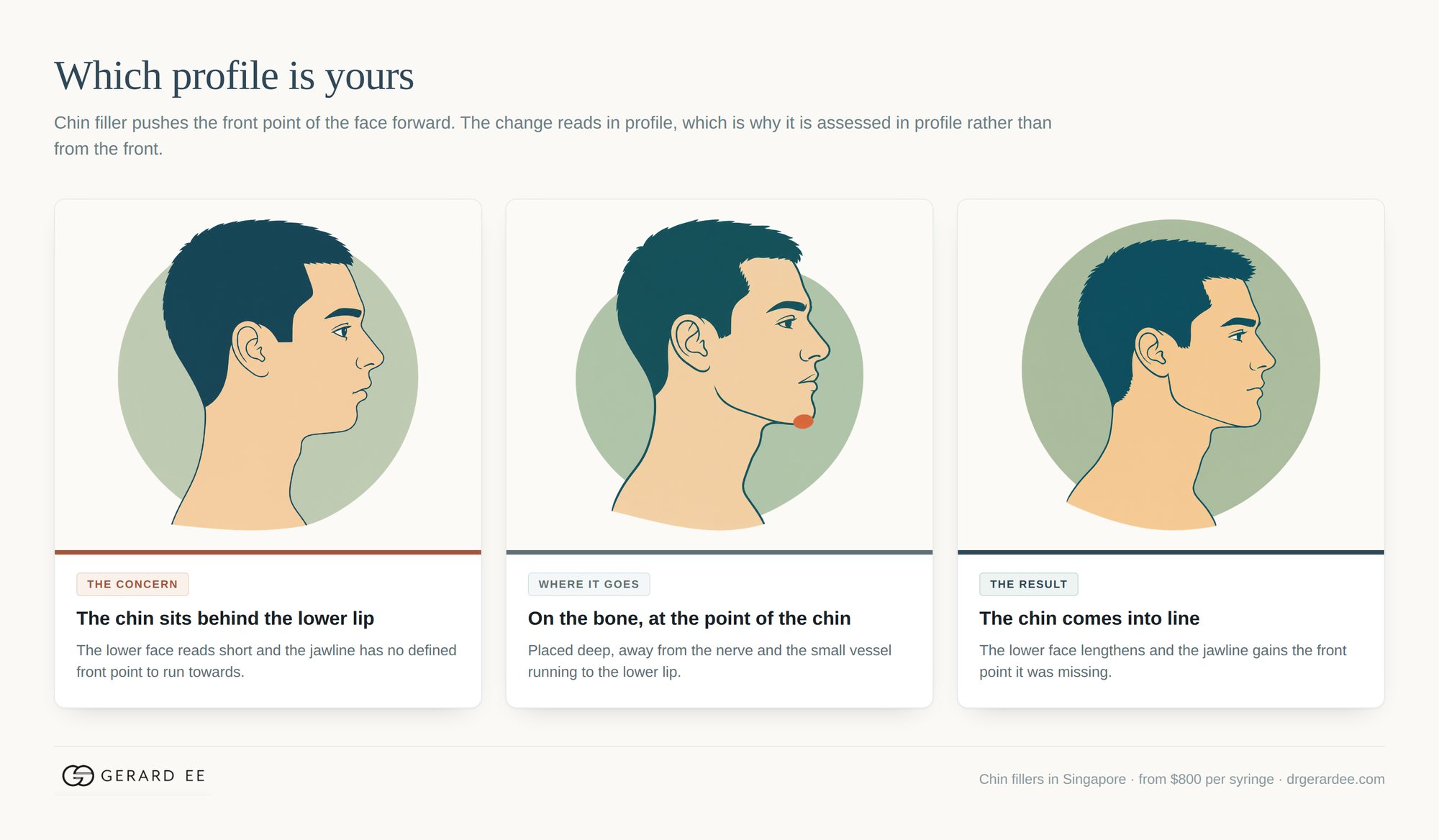
The chin is the front-most point of the lower face, so changing it changes your profile more than almost anything else you can inject. Gel placed on the bone at the point of the chin pushes that point forward, which lengthens the lower face, sharpens the jawline and shows most clearly in photographs. A chin that sits behind the lower lip when you look at yourself side-on is the usual reason people come in, because a balanced profile normally has the chin reaching at least as far forward as the lip.
It also lengthens a short chin downwards, softens a deep crease between the lower lip and the chin, and corrects a chin that points slightly to one side. It cannot make a chin smaller, because filler only adds. Nor does it help the dimpled, orange-peel look some people get on the chin, which comes from an overactive muscle in the chin itself and is treated with botulinum toxin instead, often at the same visit.
What it will not fix
A chin that sits back is sometimes down to the position of the jaw itself rather than a lack of soft tissue over it. Filler improves the profile but cannot move the jaw or change your bite, and past a certain point it starts to look like filler rather than like a chin. That is an orthodontic or a surgical question, and I would rather say so and point you towards the right person than sell you a syringe that will not deliver it.
If your concern is loose skin along the jaw rather than a weak chin, filler is not the right tool either. That is a lifting and tightening problem, and the options are set out in what to consider in your 30s, 40s and 50s and in thread lifting, and where the jaw itself has dropped, in HIFU.
Which filler is used
The default is a hyaluronic acid filler from the firmer end of the range, because the chin needs a gel that holds its shape against the pull of the muscle over it rather than spreading softly. It behaves predictably, it sits down on the bone where the body tolerates it well, and it can be dissolved with hyaluronidase if the result is not what you wanted. The same product family is used for lip fillers and nose fillers here.
Calcium hydroxylapatite, the CaHA filler, is the alternative where you want something longer lasting, at $1,400 per syringe. It is microspheres suspended in a gel carrier that provide immediate volume and stimulate long-term collagen production, so part of the result is your own tissue rather than the product. It outlasts HA and generally needs less material to do the same job.
Polycaprolactone, the PCL filler, also known as Ellanse or 少女针, is the third option, also $1,400 per syringe. It restores lost volume while stimulating your body’s own collagen production, giving both an immediate lift and longer-term skin rejuvenation. PCL has been used in medicine for decades in sutures and implants before it was used as a filler.
The difference that matters is reversibility. An HA filler can be dissolved in an afternoon. Neither CaHA nor PCL can be, because there is no equivalent antidote. That is the trade-off for the longer duration, and it is why I treat them as a considered choice rather than an upgrade.
What chin fillers cost in Singapore
HA filler is $800 per syringe. CaHA and PCL fillers, the two collagen stimulators, are $1,400 per syringe. Both figures are before GST and both include your review appointment.
These are fixed prices, not starting prices, so the figure does not move according to how much of the syringe is used. Most chins need one to two syringes, depending on which of the two jobs above applies. The consultation is charged separately and waived if you go ahead on the day.
The difference in price reflects the difference in product. The stimulators cost more, last longer and cannot be reversed, which is why the choice is made at the consultation rather than from a price list.
How much filler will I need
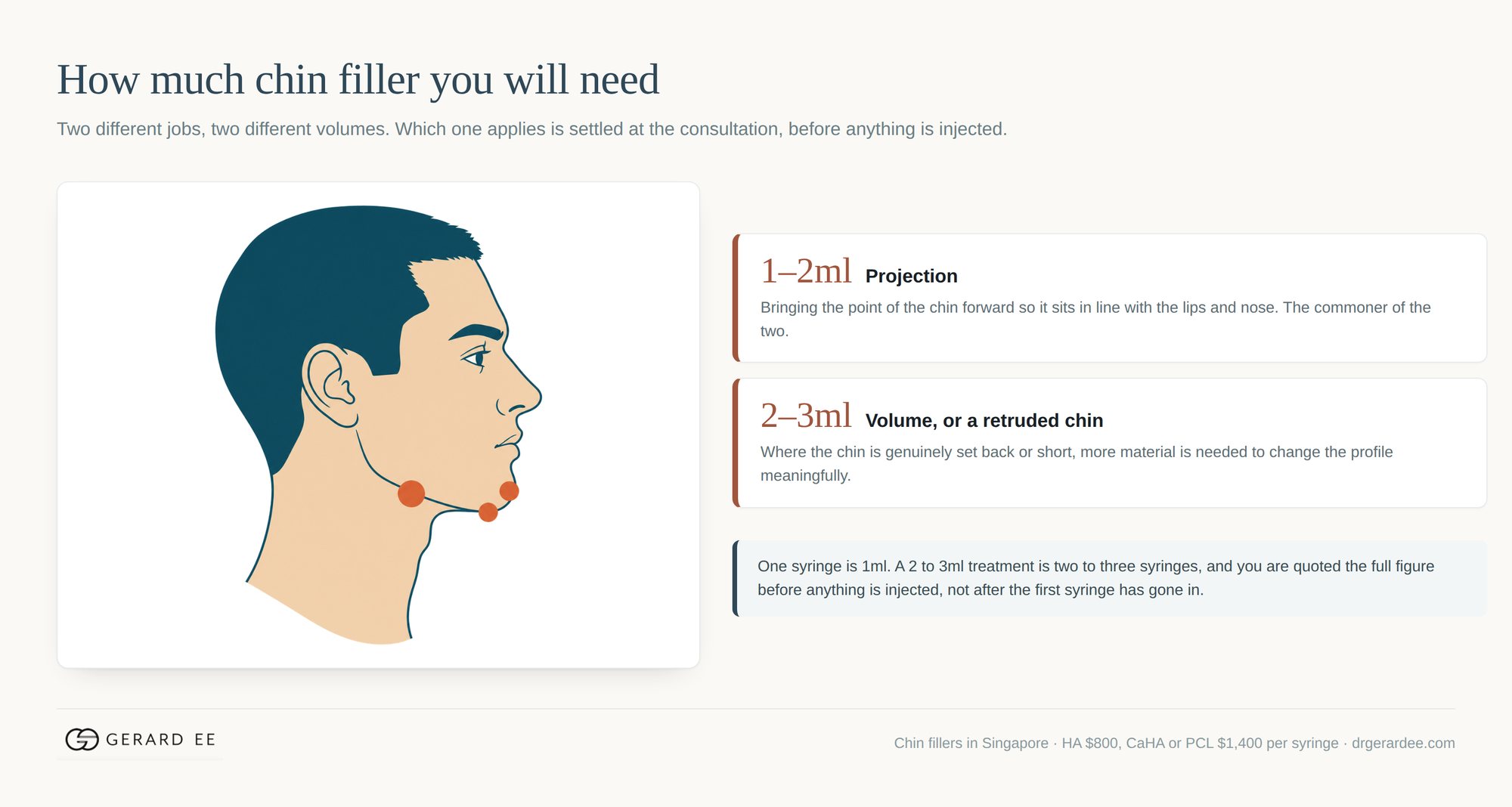
Two different jobs, two different volumes. Bringing the point of the chin forward usually takes 1 to 2ml. A chin that is genuinely set back or short needs more, 2 to 3ml, because there is more ground to make up before the profile changes.
One syringe is 1ml, so a 2 to 3ml treatment is two to three syringes rather than one. You are quoted the full figure at the consultation, before anything is injected, not after the first syringe has gone in.
What happens on the day
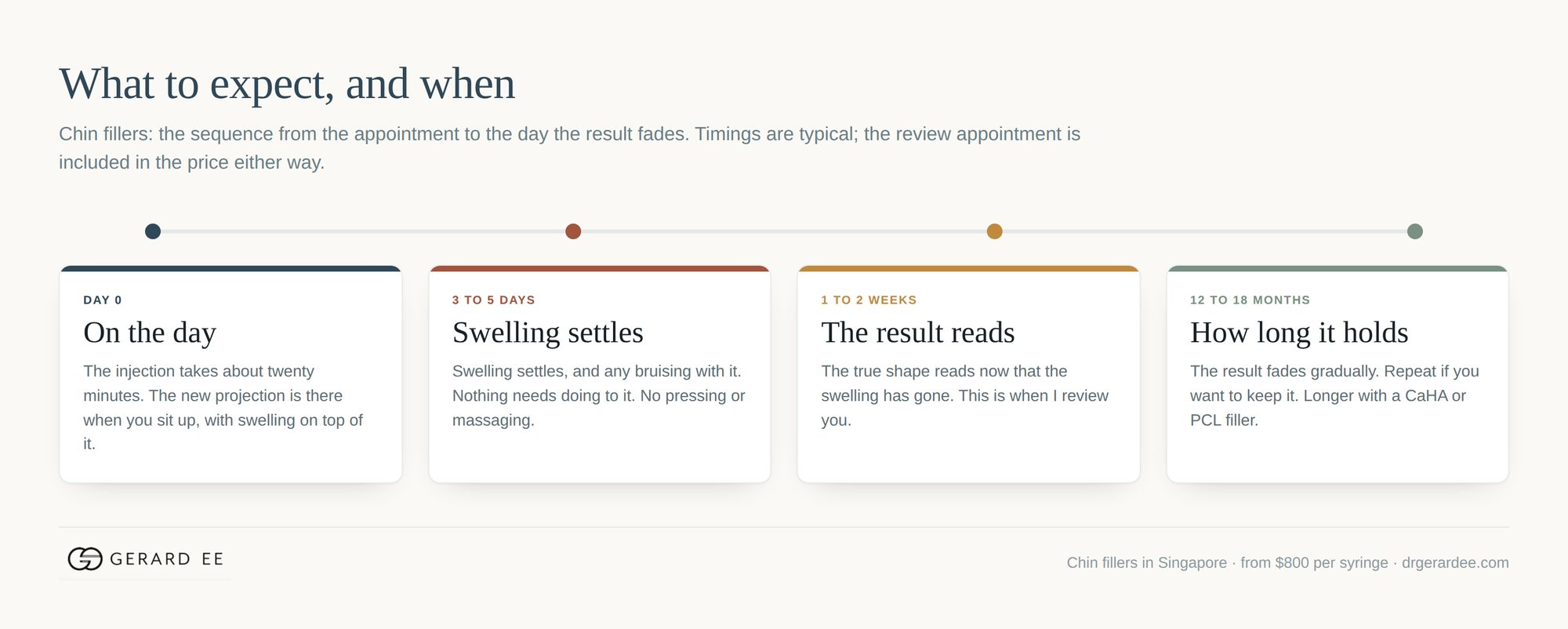
I examine the chin from the side as well as from the front, look at how it sits against your lower lip and your nose, and tell you whether filler is the right answer. If it is not, that is where it ends, and I will explain why rather than leave it as a no. If it is, numbing cream goes on and the filler is placed down on the bone at the point of the chin, away from the nerve and the small blood vessel that run to your lower lip. The injection takes about twenty minutes.
Afterwards
Keep the area clean and leave it alone. No pressing or massaging for two weeks. No strenuous exercise, alcohol or very hot environments for 24 to 48 hours. Sunscreen goes on daily. Swelling and any bruising settle over three to five days. The final shape reads at one to two weeks, which is when I review you.
Contact the clinic straight away, not at your review, if you develop increasing pain rather than settling discomfort, blanching or dusky discolouration of the skin over the chin or lower lip, or numbness that does not lift as the anaesthetic wears off. These are uncommon, and they are treatable when treated early, which is why the call should not wait.
When it is not suitable
Filler is postponed or declined with an active skin infection or inflamed acne over the chin, in pregnancy or breastfeeding, with a known allergy to a component of the product, and where an autoimmune or connective tissue condition is active. Blood-thinning medication is not an absolute barrier but raises the bruising risk and needs discussing beforehand.
A chin that already has a surgical implant is not a routine chin to inject, because the implant changes both the layer you are working in and the risk of an infection settling on a foreign body. It is not an automatic no, but it changes the calculation, and I will talk it through with you rather than treat it as a standard case.
Why more is not better
The chin is where over-treatment is obvious to everyone except the person who had it done, because the change happens in profile and most people judge their own face from the front. Too much projection reads as pointed and heavy, and because the gel sits under a muscle that contracts whenever you speak, excess material drifts downwards over months rather than staying put.
HA in the chin also breaks down slowly, since the area moves less than the lips. If you have had chin filler before and the lower face now looks longer or heavier than when you started, the answer is not another syringe. The first step is establishing how much of the old filler is still there.
Safety
The chin is one of the safer parts of the face for the most serious filler complication, which is filler getting into a blood vessel. The areas where that has caused loss of sight are higher up the face, around the nose, between the eyebrows, across the forehead and along the lines beside the mouth. The chin is not one of them, because its blood supply comes up from underneath rather than from the network around the eye, so there is no short route back to the eye.
That does not make it risk-free. A small artery runs close to where chin filler is placed, and filler getting into it damages the skin rather than affecting sight. Before injecting I draw back on the syringe to check the needle is not sitting in a blood vessel, then place the gel down on the bone in small amounts and at low pressure, away from where that vessel leaves the jaw. Hyaluronidase is kept in the room, and while it reverses an HA filler it does nothing for CaHA or PCL, which is a further reason HA is the default here.
Who performs the treatment

Dr Gerard Ee, MBBS (UK), MRCS (Edinburgh), PGDip Practical Dermatology (Cardiff). He trained and practised in orthopaedic surgery at Singapore General Hospital and the National University Hospital before moving into aesthetic medicine, and is the author of sixteen peer-reviewed papers, thirteen of them indexed in PubMed.
More about the training is on the about page, and the published work is listed on the publications page.
Where to find us

50 Raffles Place, #01-01 Singapore Land Tower, Singapore 048623. Telephone 6532 2048. Raffles Place MRT is a two-minute walk.
Monday to Friday, 10am to 8pm. Saturday, 10am to 5pm.
Dr Gerard Ee consults and performs this treatment at The Clifford Clinic, 50 Raffles Place, Singapore.
Common questions
How much do chin fillers cost in Singapore?
HA filler is $800 per syringe. The collagen stimulators, CaHA and PCL, are $1,400 per syringe. Both figures are before GST and both include the review appointment. These are fixed prices, not starting prices. The consultation is charged separately and waived if you proceed on the day.
Is chin filler worth it?
For a chin that sits behind the lower lip in profile, yes, it is. It changes the balance of the whole lower face for a fraction of the cost and the downtime of a chin implant, and an HA filler can be dissolved if you dislike it. For a chin set back because of the jaw position rather than the soft tissue, no, because it cannot deliver what you are asking for.
How long does chin filler last?
Chin filler lasts longer than filler in the lips, because the chin moves less. An HA filler commonly gives twelve to eighteen months. The collagen stimulators last longer still, and part of their effect is your own collagen rather than the product, which is why people choose them and also why they cannot be reversed.
Does the filler completely dissolve away?
An HA filler does, gradually, as your body breaks it down, and what is left can also be dissolved on purpose with hyaluronidase. CaHA and PCL fillers are different. They break down eventually, but far more slowly, and there is no injection that removes them on demand.
Chin filler or a chin implant?
Filler is reversible, takes twenty minutes and needs repeating. An implant is permanent, needs surgery and carries the risks that come with anything foreign placed in the body, mainly infection, movement out of position, and the possibility of needing it taken out again. Filler is the reasonable first step for most people, not least because it shows you what more projection actually looks like on your face before you commit to anything permanent.
Can chin filler fix a double chin?
No, chin filler does not treat a double chin. A double chin is fullness under the jaw, and filler adds volume rather than removing it, so injecting the chin will not improve it and can make the lower face look heavier. A double chin is treated by tightening and reducing what sits under the jaw, which is what HIFU does.
Will it help my jawline?
It gives the jawline a clear front point to run towards, which often makes the whole jaw look sharper even though nothing was placed along the jaw itself. If the middle of your face has also lost volume, cheek filler usually does more for the overall shape, since a jaw only looks defined against a midface that still has height above it.
Which filler do you use for the chin?
A firmer HA filler by default, because it holds a defined shape and can be dissolved, at $800 per syringe. CaHA or PCL fillers are available at $1,400 where you want something longer lasting, with the trade-off that neither can be reversed.
What are the side effects?
Swelling, bruising and tenderness for a few days are usual, and small lumps can occur and settle. Numbness of the lower lip can happen if the injection goes close to the nerve that supplies it, and it normally recovers over days to weeks. The serious one is filler getting into the small artery there, which is rare and damages the skin rather than affecting sight.
Does chin filler hurt?
Numbing cream is applied first and left on until the skin is numb. Most patients describe pressure rather than pain, because the gel is being placed against bone. It is one of the more comfortable areas of the face to inject.
Book a consultation with Dr Gerard Ee at The Clifford Clinic
Dr Gerard Ee consults and performs chin filler treatment at The Clifford Clinic, 50 Raffles Place, Singapore. Consultations are by appointment. Message the clinic on WhatsApp, or call 6532 2048.
This page is written from published research and from clinical experience in Singapore since 2012. It is for general education, not medical advice. Whether a treatment suits you, what it may achieve and what it may risk can only be established at a consultation. Dr Gerard Ee is the Medical Director of The Clifford Clinic, a private clinic in Singapore, and treatments discussed on this site are provided commercially.

