
Written by Dr Gerard Ee, MBBS (UK), MRCS (Edinburgh), PGDip Practical Dermatology (Cardiff). Founder and Medical Director, The Clifford Clinic and The Clifford Surgery, Singapore. Last medically reviewed and updated September 2026.
Skin cancer is one of the few cancers visible on the surface of the body, and it is among the most curable when detected early. This guide sets out how skin cancer presents in Singapore, who is at risk, and the pathway in my practice from screening to biopsy, excision, histology and follow-up.
I trained in surgery, am a Member of the Royal College of Surgeons of Edinburgh and hold a postgraduate diploma in practical dermatology. I examine suspicious lesions, remove them myself and follow each patient from the first examination to the histology result.
Skin cancer care with Dr Gerard Ee at a glance
- Every screening is a full-body skin examination under dermoscopy, with mole mapping and AI change detection for patients who have many or atypical moles.
- Suspicious lesions are excised by Dr Gerard Ee as a day surgery case in an MOH approved ambulatory surgery centre.
- Histology is reported by Singapore General Hospital within two to three weeks.
- Where a wide local excision is needed, Dr Gerard Ee refers the patient to his in-house plastic surgeon, who performs it as a day surgery case.
- The screening consultation is S$100 before GST, and excision is claimable under day surgery insurance, subject to your policy.
How common is skin cancer in Singapore?
The largest study of skin cancer in Singapore reviewed 12,692 cases recorded by the Singapore Cancer Registry between 1968 and 2016. Basal cell carcinoma made up 65.9%, squamous cell carcinoma 28.3% and melanoma 5.8%. The incidence of basal cell carcinoma among Chinese Singaporeans rose 2.5-fold over that period, from 2.7 to 6.9 per 100,000 person-years. Chinese Singaporeans also carried a higher risk of skin cancer than Malay and Indian Singaporeans.
Skin cancer is mainly a disease of later life. The average age at diagnosis was 67 for basal cell carcinoma, 73 for squamous cell carcinoma and 60 for melanoma. As Singapore’s population ages, the number of skin cancers diagnosed each year is expected to rise.
Skin cancer risk factors in Singapore
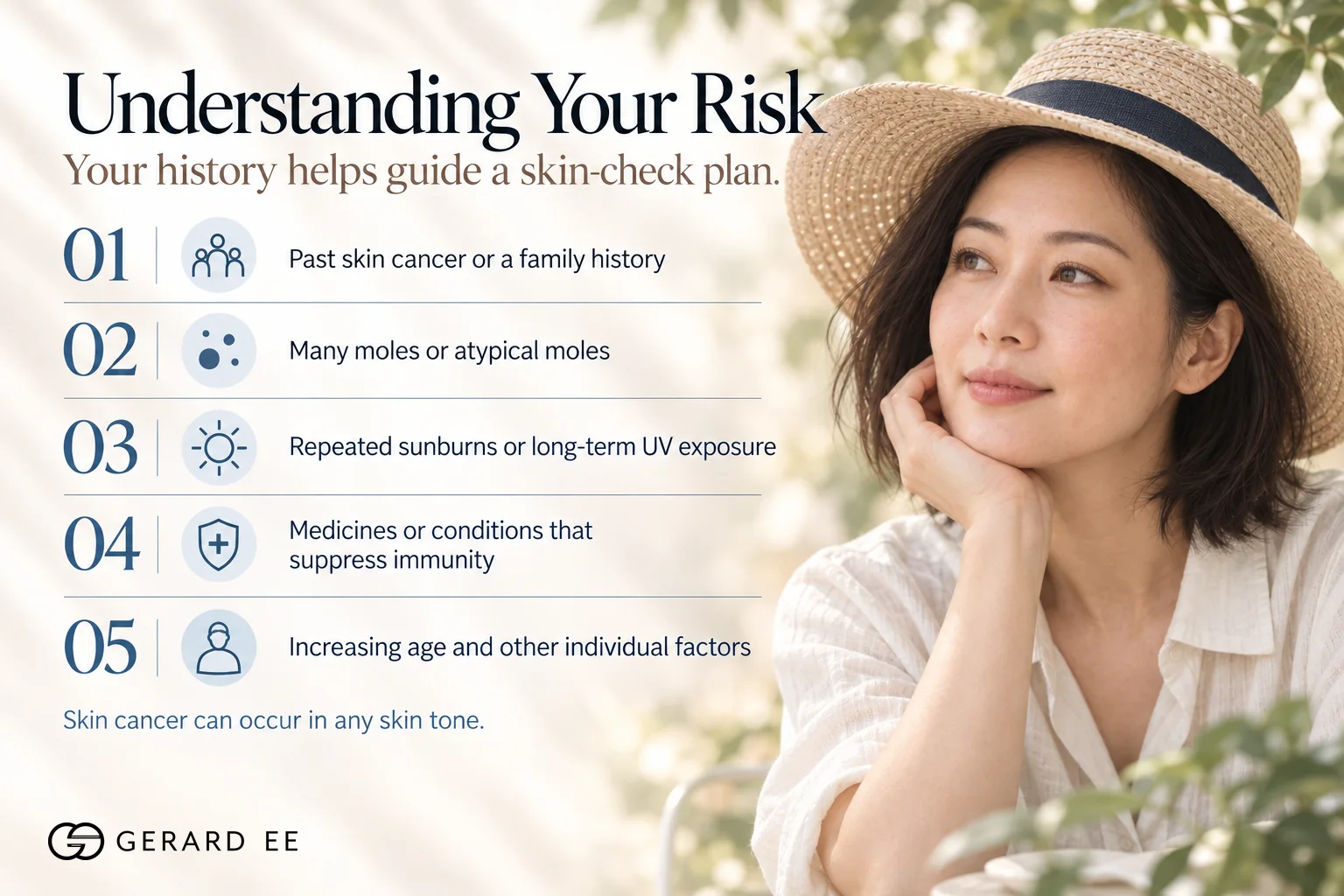
- Fair skin that burns easily, and a history of blistering sunburn.
- Years of outdoor work or sport under Singapore’s equatorial sun.
- A personal or family history of skin cancer.
- More than about fifty moles, or large or atypical moles.
- Long-term immunosuppression, for example after an organ transplant, which raises the risk of squamous cell carcinoma substantially.
- Older age, with an average age at diagnosis of sixty or over for all three main types.
Cumulative ultraviolet exposure damages the DNA of skin cells over many years and causes most basal cell and squamous cell carcinomas. These cancers are therefore found mainly on the face, ears and hands. Melanoma in Asian skin follows a different pattern, with most tumours arising on skin that receives little sun, including the palms, soles and nail beds. A mole that looks unusual is often an atypical mole rather than melanoma, and the difference is explained in atypical moles vs melanoma.
The three main types of skin cancer, BCC, SCC and melanoma
Basal cell carcinoma presents as a shiny, pearly or pigmented bump, or as a sore that does not heal, usually on the face. It very rarely spreads, but it invades the surrounding tissue if left untreated.
Squamous cell carcinoma presents as a firm, scaly lump or a crusted sore on sun-damaged skin. It grows faster than basal cell carcinoma, and a small proportion spread to the lymph nodes.
Malignant melanoma presents as a new or changing dark spot. It is the least common of the three types but the most likely to spread. About half of melanomas in Asian patients arise on the palms, soles and nail beds, and these are often diagnosed late.
The appearance of each type, and the features that distinguish them, are set out in types of skin cancer.
Skin cancer screening and mole mapping

A skin cancer screening is a full-body skin examination under a dermatoscope, a polarised-light magnifier that shows the pigment and vessel pattern beneath the skin surface. In a meta-analysis of studies performed in clinical settings, dermoscopy improved the accuracy of melanoma diagnosis over naked-eye examination, with a relative diagnostic odds ratio of 15.6.
For patients with many moles, mole mapping records every mole with photographs and dermoscopic images. At each subsequent visit, AI change detection compares the new images with that baseline and flags any mole that has grown or changed pattern. This surveillance allows melanoma to be detected early while sparing benign moles from unnecessary removal.
Skin cancer biopsy, excision and histology
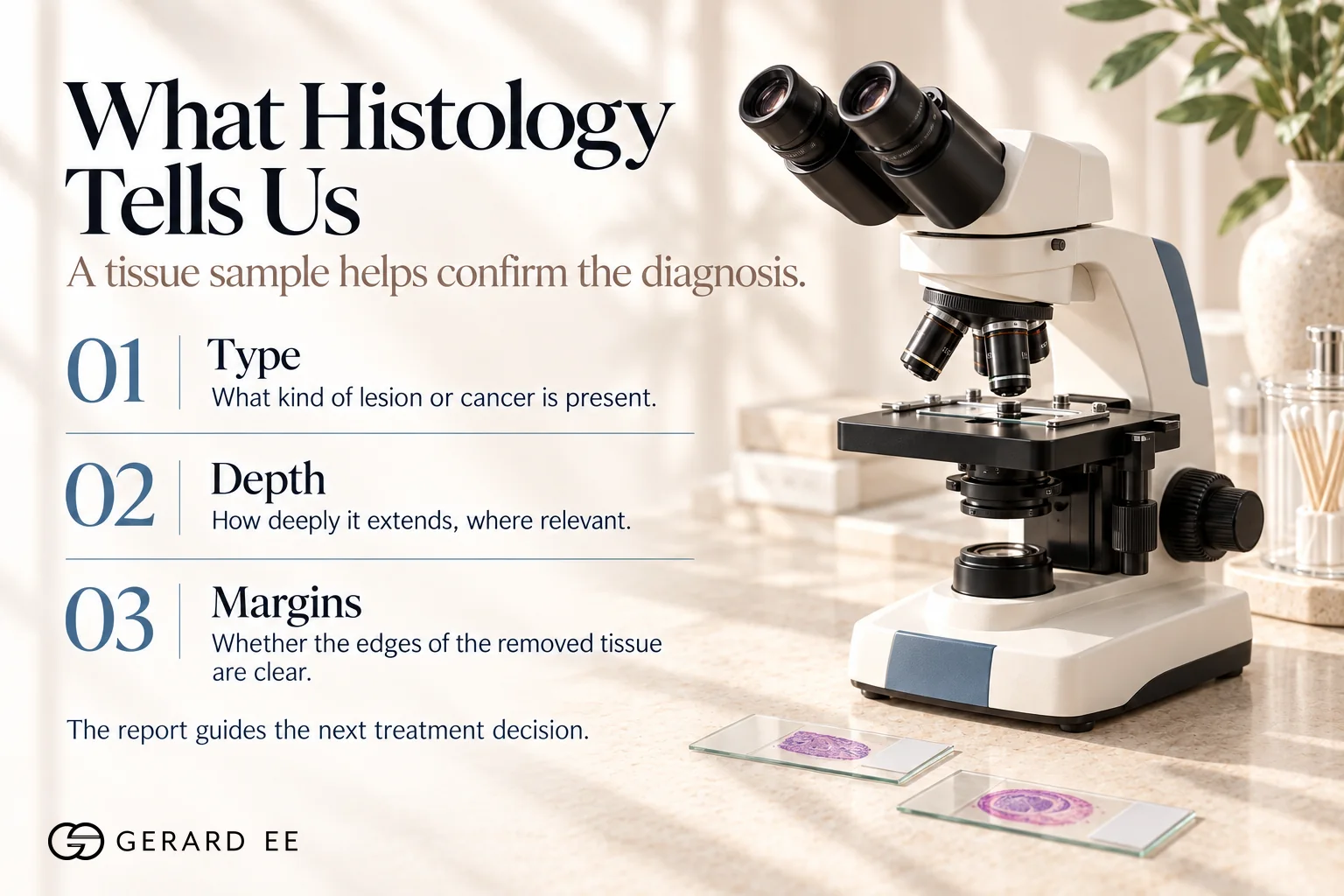
A suspicious lesion is usually removed by excision biopsy, in which the whole lesion is excised with a small margin of normal skin under local anaesthetic. A small biopsy is taken first when the lesion is large, or when it sits on the face and the diagnosis determines the extent of the operation.
Every specimen is sent to Singapore General Hospital for histology, and results take two to three weeks. The histology report states the diagnosis, the type and subtype of cancer, its thickness and whether the margins are clear. For melanoma, the thickness is reported in millimetres as the Breslow thickness, the strongest single predictor of outcome. Any further treatment is planned from this report.
Laser removal is reserved for moles assessed as benign, as laser vaporises the tissue and leaves no specimen for histology. The options for benign moles are covered on the mole removal page.
Skin cancer treatment, surgical excision and margins
Surgical excision is the first treatment for all three main types of skin cancer. The margin of normal skin removed around the tumour follows the published guidelines summarised below.
| Skin cancer | Recommended clinical margin |
|---|---|
| Basal cell carcinoma, low risk | 4 mm |
| Squamous cell carcinoma, low risk | 4 to 6 mm |
| Melanoma in situ | 0.5 to 1 cm |
| Melanoma up to 1 mm thick | 1 cm |
| Melanoma 1 to 2 mm thick | 1 to 2 cm |
| Melanoma over 2 mm thick | 2 cm |
Where histology shows that a wide local excision is needed, I refer the patient to our in-house plastic surgeon, who performs it as a day surgery case, with the closure planned to protect function and appearance on the face. Where a tumour requires Mohs micrographic surgery, radiotherapy or systemic treatment, I refer the patient onward with the histology report and clinical images. Mohs surgery removes the tumour in thin layers, each examined under the microscope during the operation, until the margins are clear.
The procedures, recovery and aftercare are described on the skin cancer treatment in Singapore page.
Follow-up after skin cancer treatment

One skin cancer raises the risk of another, so follow-up continues after the wound has healed. The follow-up interval depends on the type and stage of the cancer and is shortest in the first years after treatment. Each visit includes a full-body skin examination, a check of the scar and, for melanoma, an examination of the nearby lymph nodes.
Between visits, a monthly self-examination in good light, including the scalp, palms, soles and nails, helps detect new lesions early. After melanoma, published guidelines also recommend that patients are taught to examine their own lymph nodes.
Skin cancer treatment cost in Singapore
The skin cancer screening consultation is S$100 before GST. The cost of an excision depends on the size and site of the lesion and the method of wound closure, and it is quoted after the examination.
I perform the surgery as a day surgery case in an MOH approved ambulatory surgery centre, so it is claimable under day surgery insurance, subject to your policy. All prices are quoted before GST.
Skin cancer prevention in Singapore’s sun

Regular sunscreen use lowers the risk of skin cancer. In a randomised trial of 1,621 adults in Nambour, Queensland, those assigned to daily sunscreen application from 1992 to 1996 had developed 11 new melanomas by 2006, compared with 22 in the group that applied sunscreen at their own discretion. The reduction was greatest for invasive melanoma, at 73%.
- Apply a broad-spectrum sunscreen of SPF 30 or higher to exposed skin every morning, and reapply every two hours outdoors.
- Seek shade between late morning and mid-afternoon, when ultraviolet light is strongest.
- Wear a broad-brimmed hat and sunglasses for outdoor sport.
- Avoid tanning beds.
- Check your own skin once a month, and have any new or changing spot examined.
Skin cancer, frequently asked questions
Is skin cancer common in Singapore?
Skin cancer is less common in Singapore than in countries with mainly fair-skinned populations, but its incidence is rising. The incidence of basal cell carcinoma among Chinese Singaporeans rose 2.5-fold between 1968 and 2016, and Chinese Singaporeans carry the highest risk of the three main ethnic groups.
How is skin cancer diagnosed?
A suspicious lesion is assessed under dermoscopy and then removed or sampled for histology. The histology report confirms whether the lesion is cancerous and, if so, its type, its depth and whether the margins are clear.
How long do skin cancer biopsy results take?
Skin biopsy results take two to three weeks. Every specimen is reported by Singapore General Hospital, and the result is explained at a review consultation.
Is skin cancer surgery covered by insurance?
I perform the surgery as a day surgery case in an MOH approved ambulatory surgery centre, so it is claimable under day surgery insurance, subject to your policy. The screening consultation is usually self-funded.
Can skin cancer come back after treatment?
A completely excised basal cell or squamous cell carcinoma rarely recurs at the same site, but one skin cancer raises the risk of another elsewhere. Regular skin examinations after treatment allow any new lesion to be detected early.
Do I need a referral to have a spot checked?
A referral is not required. A skin cancer screening, or a consultation about a single spot, can be booked directly without a referral letter.

Book a consultation with Dr Gerard Ee
Dr Gerard Ee consults and treats skin cancer at his practice at 50 Raffles Place, Singapore. Consultations are by appointment. Message the clinic on WhatsApp, or call 6532 2048.
Selected References
- Oh CC, Jin A, Koh WP. Trends of cutaneous basal cell carcinoma, squamous cell carcinoma, and melanoma among the Chinese, Malays, and Indians in Singapore from 1968 to 2016. JAAD Int. 2021. PMID 34409390.
- Lee HY, Chay WY, Tang MB, Chio MT, Tan SH. Melanoma, differences between Asian and Caucasian patients. Ann Acad Med Singapore. 2012. PMID 22499476.
- Vestergaard ME, Macaskill P, Holt PE, Menzies SW. Dermoscopy compared with naked eye examination for the diagnosis of primary melanoma, a meta-analysis of studies performed in a clinical setting. Br J Dermatol. 2008. PMID 18616769.
- Work Group, Invited Reviewers, Kim JYS, et al. Guidelines of care for the management of basal cell carcinoma. J Am Acad Dermatol. 2018. PMID 29331385.
- Work Group, Invited Reviewers, Kim JYS, et al. Guidelines of care for the management of cutaneous squamous cell carcinoma. J Am Acad Dermatol. 2018. PMID 29331386.
- Swetter SM, Tsao H, Bichakjian CK, et al. Guidelines of care for the management of primary cutaneous melanoma. J Am Acad Dermatol. 2019. PMID 30392755.
- Green AC, Williams GM, Logan V, Strutton GM. Reduced melanoma after regular sunscreen use, randomized trial follow-up. J Clin Oncol. 2011. PMID 21135266.
Dr Gerard Ee performs skin cancer screening, mole mapping and skin cancer excision at his practice at 50 Raffles Place, Singapore.
This page is written from published research and clinical experience in Singapore since 2012. It is for general education, not medical advice. Suitability, results, downtime and cost vary from person to person. Please arrange a consultation for advice specific to your skin.

