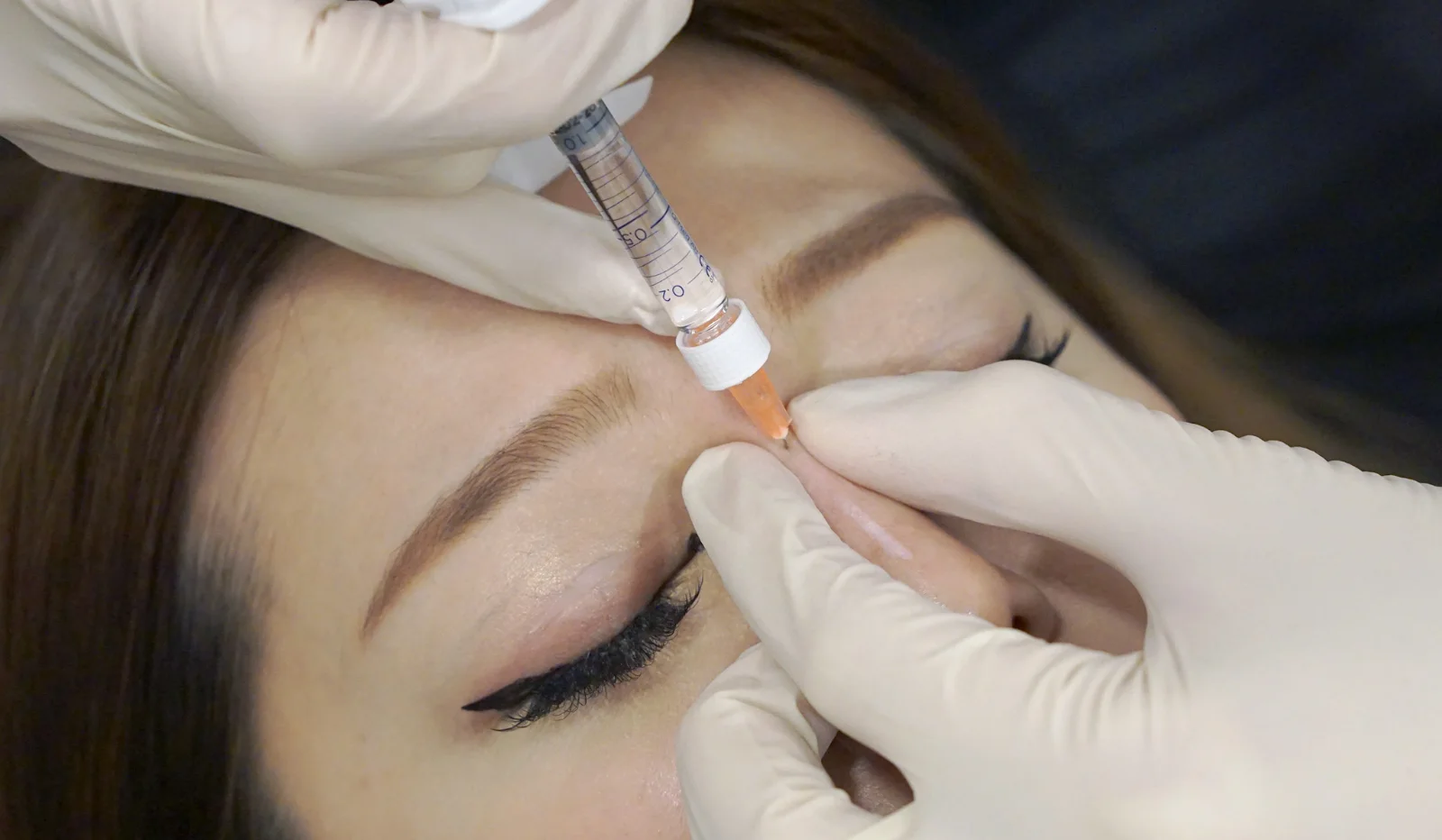
Nose filler is the most searched non-surgical nose treatment in Singapore and the one with the least margin for error, because the arteries of the nose communicate with the artery that supplies the eye. This review explains how a hyaluronic acid (HA) nose filler and a calcium hydroxylapatite (CaHA) nose filler such as Radiesse work, what the published data show about safety, how long the result lasts, what the side effects are and who should not have it.
It is the long read behind two shorter pages, the nose filler in Singapore treatment page, which covers price and what happens on the day, and the nose shape concerns page, which sets out the low bridge, dorsal hump, flat tip and curved nose one by one.

What nose filler can and cannot change
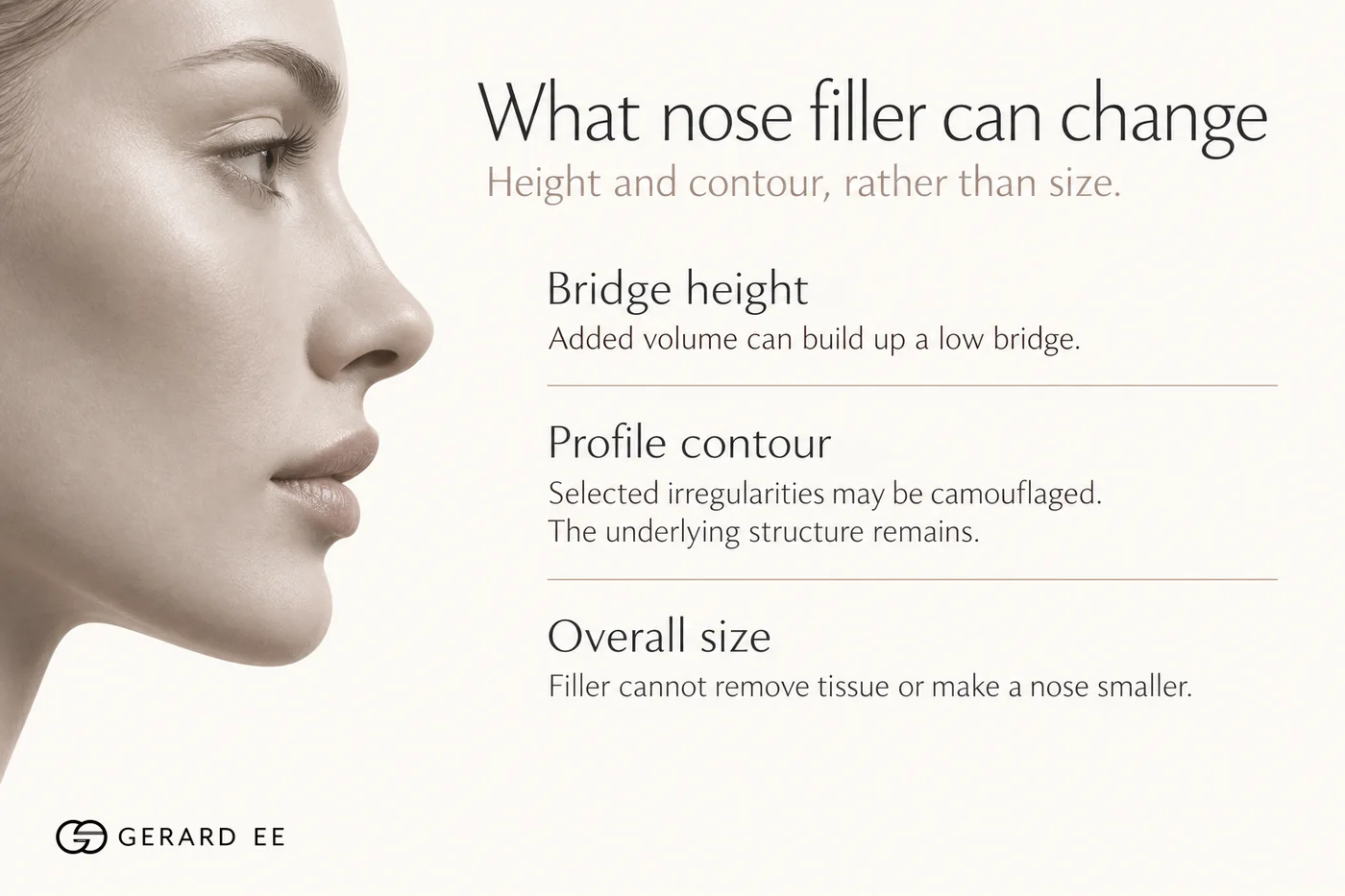
Nose filler is a gel injected beneath the skin of the nose to raise the bridge, project the tip or straighten the line of the profile. It is also called non-surgical rhinoplasty or a liquid nose job. Every result is produced by adding volume, so filler can make a nose taller, straighter and more defined, and it can never make a nose smaller, narrower or shorter.
In the largest systematic review to date, covering 9,657 patients across 30 studies, hyaluronic acid was the filler used in 96.8 per cent of non-surgical rhinoplasty cases and calcium hydroxylapatite in 1.2 per cent, and overall patient satisfaction was 99 per cent. The nasal hump was the most common indication across 23 studies of HA nose filler, and the tip and columella were the most commonly injected sites.
Those figures describe a treatment that performs well for the shapes it suits. The remainder of this review covers how each filler works, where the vascular risk sits, and how that risk is kept low.
How hyaluronic acid nose filler works
Hyaluronic acid nose filler is a firm, cross-linked gel that I place deep on the bone and cartilage of the nose to raise the bridge or project the tip, and it is my default nose filler because hyaluronidase can dissolve it within hours. The products, how they differ and which suits the bridge or the tip are compared on best filler for the nose.
How CaHA (Radiesse) nose filler works
Radiesse is calcium hydroxylapatite, microspheres in a gel carrier that give immediate height and then stimulate your own collagen, so it lasts longer than HA but cannot be dissolved, and it was first used in the nose to smooth dips after rhinoplasty at a mean dose of 0.19 ml. I place it only on the bone at the bridge and the radix, never at the tip, for a patient who has already had a good HA result, as described on Radiesse nose filler.
HA or CaHA nose filler, which to choose
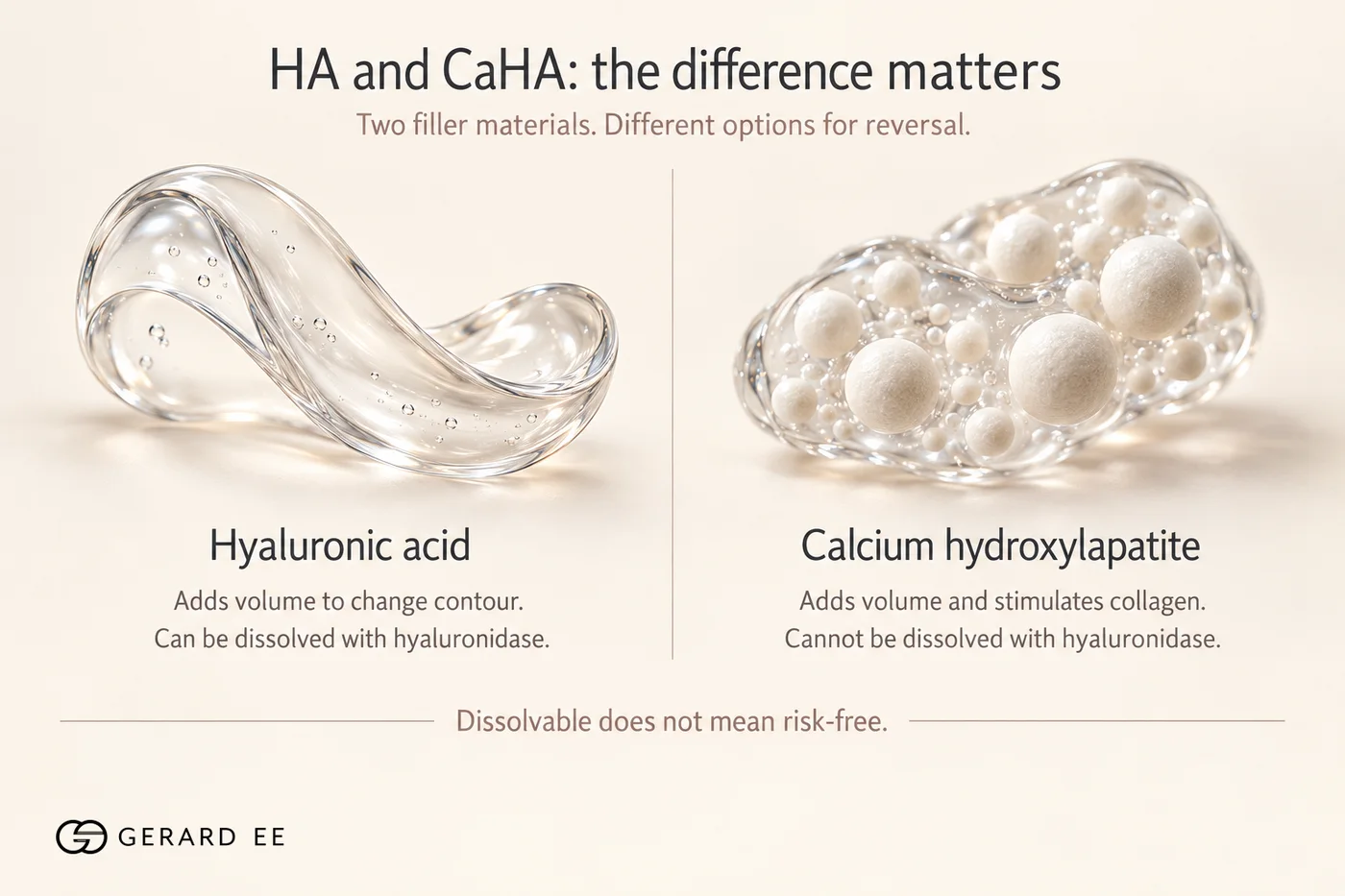
The difference that matters is reversibility, and every other difference follows from it.
| HA nose filler | CaHA nose filler (Radiesse) | |
|---|---|---|
| What it is | Cross-linked hyaluronic acid gel | Calcium hydroxylapatite microspheres in a gel carrier |
| Where it is used in the nose | Bridge, radix, tip and columella | Bridge and radix only, on bone |
| Reversible | Yes, with hyaluronidase, within hours | No |
| How long it lasts | Typically 8 to 12 months, often longer in the nose | Longer than HA, and part of the result is the patient’s own collagen |
| Best for | A first treatment, the tip, and any patient who wants the option to adjust | A repeat patient who is happy with the shape and wants duration |
For a first nose filler treatment I recommend HA in almost every case. The patient sees the shape, lives with it for about a year, and if the same shape is wanted for longer, CaHA on the bridge is discussed at the review.
Nose filler safety, the precautions that make it safe
Nose filler is safe when it is placed with the precautions the nose demands, and most of this review is devoted to those precautions. The serious risk with any facial filler is gel entering an artery. In the nose the arteries communicate, through the dorsal nasal and angular arteries, with the ophthalmic artery that supplies the eye, so an occlusion here can cause loss of skin on the nose or, in the worst reported cases, loss of vision. An occlusion declares itself within minutes as blanching of the skin, followed by a mottled purple pattern and pain out of proportion to the injection, and the outcome depends on how quickly it is recognised and reversed.
The published numbers put the risk in proportion. In the world literature review of filler-related vision loss, the nasal region was the injection site in 56.3 per cent of the 48 cases reported between 2015 and 2018, more than any other site, and HA was the filler involved in 81.3 per cent, because HA is the filler most used. Across 9,657 non-surgical rhinoplasty patients, arterial occlusion of any kind occurred in 0.27 per cent. A 2026 systematic review of vision loss specifically after nose filler found 22 published cases worldwide, with the bridge or dorsum the injection site in 57 per cent, and full recovery of vision in only 27 per cent.
Two anatomical facts explain where the danger lies. The dorsal nasal artery runs roughly 4 to 5 mm to either side of the midline of the nose, superficial over the bone and deeper over the cartilage. On Doppler ultrasound the midline of the radix is free of the artery, whereas at the rhinion, the junction of bone and cartilage, the artery can sit within 1.2 mm of the bone. The midline, deep on the bone at the radix, is therefore the safe corridor, and the rhinion and anything off the midline are not.
Can nose filler cause blindness? Rarely, and how I keep it that way
Nose filler can cause blindness, it almost never does, and every step of the way I perform nose filler is designed to prevent it.
The numbers are best read in order. Across 9,657 published nose filler patients, a blocked artery of any kind, including the minor skin occlusions that resolve with treatment, occurred in 0.27 per cent, or about one in 370. Vision loss is a much smaller fraction of that figure. A 2026 review searched the world literature for every reported case of vision loss after nose filler and found 22. Twenty-two cases, across every country and every injector, stand against a treatment performed thousands of times a day. The risk is real, it is very low, and it is lower still in the hands of an injector who treats the nose as the vascular site it is.
Anatomy makes the nose the site where this matters. Its arteries communicate with the eye through the dorsal nasal and angular arteries, and the tissue is tight, so filler pushed in under high pressure can travel backwards along a vessel into the ophthalmic circulation and, when the pressure is released, forward into the artery of the retina. None of that is a reason to avoid nose filler. It is a reason to choose carefully where it is done.
How I keep the nose filler risk low
- Needle, midline, on the bone. The paired arteries run either side of the midline, roughly 4 to 5 mm out. I use a needle rather than a cannula on the dorsum because from experience it is more accurate and allows me to reach the bone and the periosteum, the safest plane there is.
- Aspiration before every pass. The plunger is drawn back before each injection, and if blood enters the hub, the needle is in a vessel and is withdrawn. A negative aspiration does not exclude a vessel, because a fine needle and a viscous gel can fail to draw blood back, so aspiration is one safeguard among several rather than the safeguard.
- 0.05 ml at a time, slowly. No single push is large enough or fast enough to drive a column of filler back along an artery, because retrograde flow requires a bolus larger than the segment of artery between the nose and the eye, delivered faster than the pulse pushes it forward.
- The rhinion is not injected. The junction of bone and cartilage is where the dorsal nasal artery can sit within 1.2 mm of the periosteum. Height across it is built from the radix above and the supratip below.
- The tip receives the smallest volumes of all, because the lateral nasal artery crosses it, and crosses the midline in about one in five noses.
- HA by default, so it can be undone. Hyaluronidase dissolves an HA filler within hours. It is drawn up and on the tray before the first injection, and if the skin blanches, mottles or the pain is out of proportion, the filler is dissolved on the spot. Immediate hyaluronidase is the single most effective treatment for an HA occlusion.
What is on site if a vascular occlusion ever happened
Most clinics that offer nose filler can dissolve it. Fewer can provide what comes after. The Clifford Clinic has its own hyperbaric oxygen (HBOT) chamber on the premises. Hyperbaric oxygen is the recognised second-line treatment for a filler occlusion, because breathing oxygen under pressure raises the amount dissolved in the plasma and keeps skin and retinal tissue alive while the vessel is cleared, and the 2026 review of vision-loss cases singled it out as the treatment that showed promise where others had failed. Having the chamber under the same roof means the interval between recognising a problem and treating it is measured in minutes, not in a transfer to another facility.
The answer to where nose filler should be done is therefore a clinic where the injector treats the nose as the vascular site it is, uses a dissolvable filler, keeps the antidote in the room and has the next line of treatment on site. That is the arrangement here.
I have performed nose filler since 2012 and nose thread lifts since 2014, and have not had a vascular occlusion in either.
Nose filler danger zones
Every part of the nose has an artery near it. The vessels below decide where the filler is placed and where it is not.
| Zone | Vessel | What it means for injection |
|---|---|---|
| Radix (between the eyes) | Dorsal nasal artery branches from the ophthalmic artery here, and the intercanthal vein sits in the midline of the radix | Deep on the bone in the midline is the safe plane, and anything superficial or lateral is not |
| Rhinion (junction of bone and cartilage) | Dorsal nasal artery can lie within 1.2 mm of the periosteum here | Not injected directly, and height across it is built from above and below |
| Upper dorsum, either side of the midline | Dorsal nasal artery 4 to 5 mm lateral, superficial over bone, deeper over cartilage, and crossing the midline in 16 per cent of noses | Midline only, small volumes, aspiration before each pass |
| Supratip | Branches mostly from the dorsal nasal artery | Deep, midline, small volumes |
| Nasal tip and columella | Lateral nasal artery crosses the tip and the columellar artery runs up the columella, and the lateral nasal artery crosses the midline in 18 per cent | The most cautious zone, with the smallest volumes, the slowest injection and HA only |
| Alar base and nasolabial junction | Angular artery, the link between the facial and ophthalmic systems | Not a nose filler site, and treated only as part of nasolabial fold filler with its own technique |
The figures come from cadaver and Doppler studies in Asian noses, which is the anatomy of most of my patients.
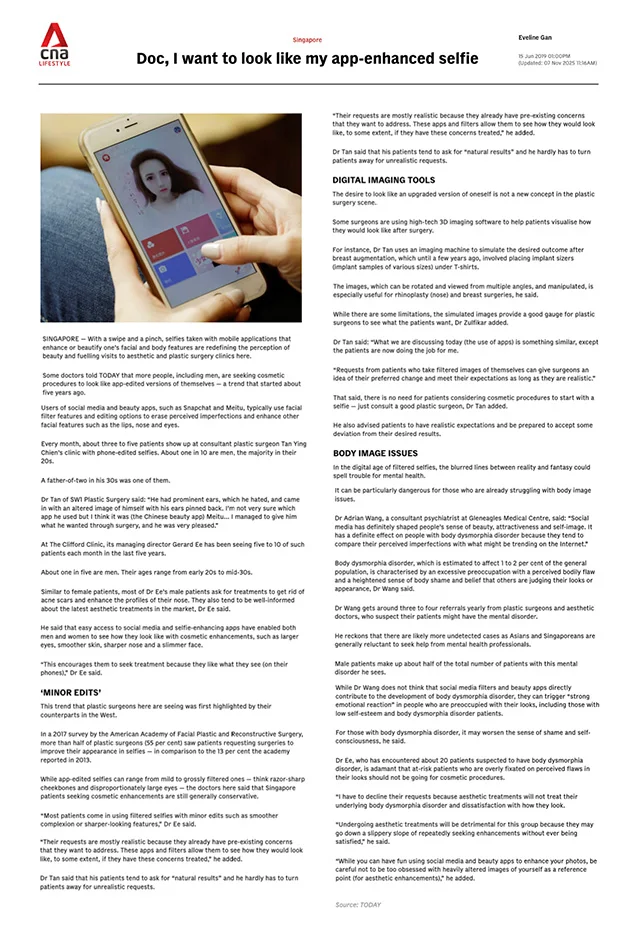
More features on the media coverage page.
How nose filler is placed safely
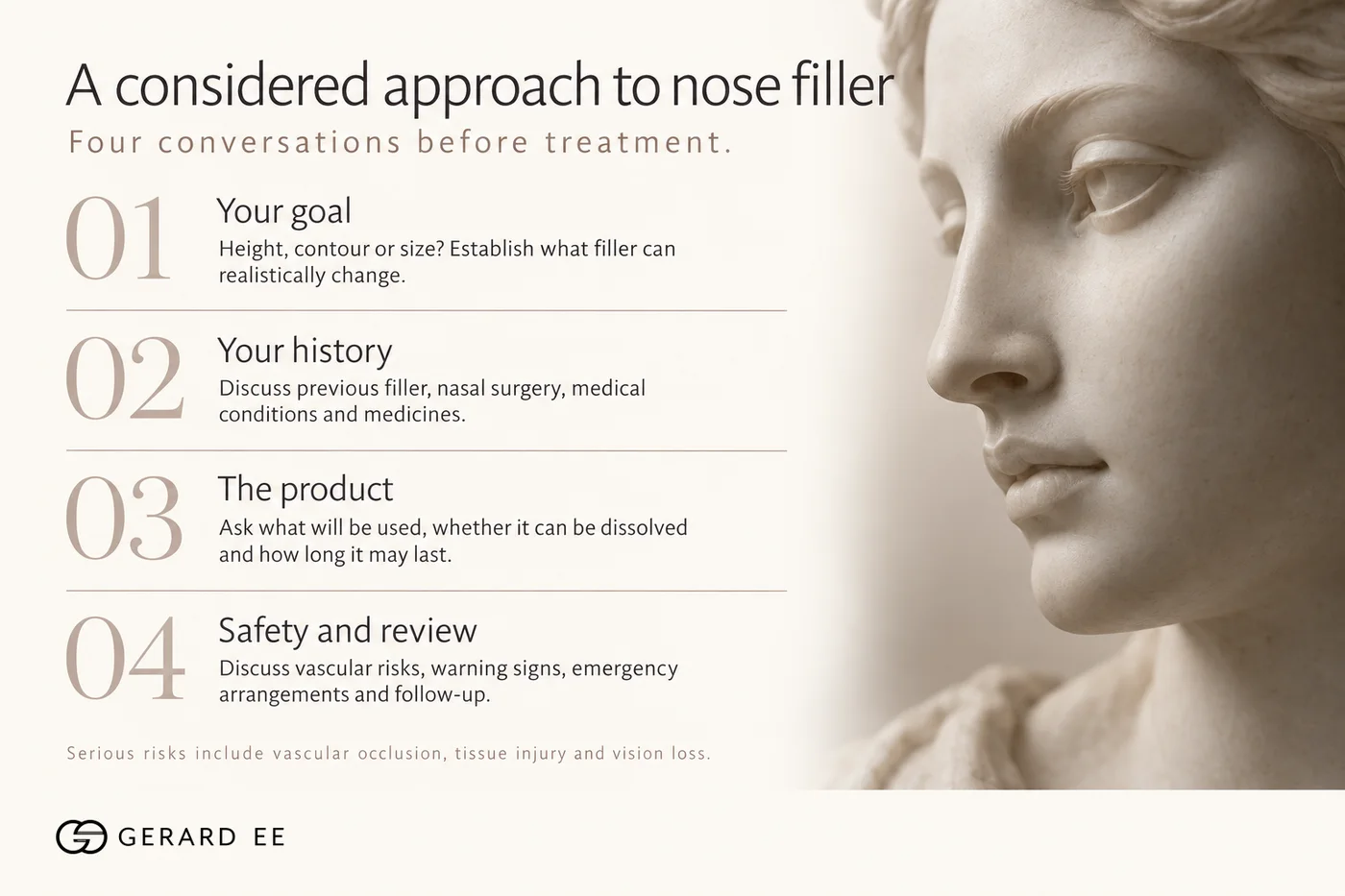
The technique follows from the anatomy. Filler is placed in the midline, on the periosteum, away from the paired vessels on either side. I aspirate before injecting, drawing back on the syringe to confirm the needle is not in a vessel. I inject slowly at low pressure, because high pressure is what forces gel backwards along an artery, and in small aliquots, meaning separate pushes of 0.05 ml, so that any single bolus is too small to occlude a vessel. At the tip, the most cautious area, the volumes are smaller still.
Hyaluronidase is in the room, drawn up, before the first injection. If the skin blanches or pain is out of proportion, the HA filler is dissolved immediately, on the spot, which is the single most effective treatment for an HA occlusion and the reason the emergency protocol for fillers is built around it. It is also the reason I do not use CaHA at the tip or off the midline, because CaHA has no equivalent antidote.
A nose that has had surgical rhinoplasty is not a routine nose to inject, because previous surgery alters the blood supply. Scar tissue fixes the vessels in unpredictable positions and reduces the collateral circulation that would otherwise compensate for a blocked branch. It is not an automatic refusal, but it changes the risk calculation, and I say so explicitly rather than treat it as a standard case.
How long nose filler lasts
Nose filler lasts longer than filler elsewhere in the face. The nose barely moves, so the gel is not worked away by muscle the way it is around the mouth, and the deep plane on the bone has a low blood supply, so the enzymes that break hyaluronic acid down reach it slowly. A literature review of 16 studies found that most authors report a duration of 8 to 12 months, and the remainder report longer, up to eight years in one series.
That persistence has a downside. HA filler placed years ago can still be present, and because HA attracts water it spreads sideways under the thin skin of the dorsum and widens the bridge, a delayed change that has been named the “Avatar nose” and confirmed on ultrasound years after a single injection. For a patient who has had nose filler before and whose nose now looks broader than when they started, the answer is not another syringe. The first step is establishing how much of the old filler is still in place, and dissolving it if it is.
A CaHA filler lasts longer than HA because part of the result is collagen, but the exact duration in the nose has not been established in a controlled study, and I state that rather than quote a figure.
Nose filler side effects and downtime
Swelling, bruising and tenderness for three to five days are usual. Small lumps can occur and usually settle, and they arise where a bolus sits too close to the surface or has not spread evenly, so they are moulded at the time of injection or dissolved at the review if they persist. In the pooled data across 9,657 patients, some complication was recorded in 39 per cent of cases, and almost all of it was redness and swelling, which accounted for 28 per cent on its own. Those are the expected effects of a needle in the nose, not complications in the sense that matters.
Downtime is practical rather than medical. The area is kept clean and left alone. Pressing, massaging or wearing spectacles that rest heavily on the bridge is avoided for two weeks, so that the gel sets in the shape it was placed rather than being displaced before it integrates with the tissue. A review appointment is included, and any small adjustment is made there.
Who should not have nose filler
Filler is postponed or declined where there is an active skin infection or inflamed acne over the nose, because the needle can carry bacteria into the gel and seed an infection around it, during pregnancy or breastfeeding, because no safety data exist for either, where there is a known allergy to a component of the product, and where an autoimmune or connective tissue condition is active, because the inflammatory response to the implant can be exaggerated. Blood-thinning medication is not an absolute barrier, but it raises the bruising risk and needs to be discussed beforehand.
Filler is also the wrong treatment, rather than an unsafe one, for a nose that needs to be smaller. A wide nose, a bulbous tip, a long nose or a large hump are surgical shapes. Filling around a large hump raises the whole bridge to the level of the hump, and the nose ends up larger. I would rather state that at the consultation than after a syringe.
The four shapes filler does suit, the low bridge, the small to moderate hump, the flat tip and the curved nose, are described one by one on the nose shape concerns page.
Nose filler or nose threads, which suits which nose
I perform both, and they are not interchangeable. Filler adds volume where it is placed. Threads, which are made of polydioxanone (PDO), an absorbable surgical suture material, add a scaffold along the length of the nose that lifts, straightens and, over months, stimulates collagen around itself as the body reacts to the thread. Each does one job well and the other job badly. Both results last about a year.
| Nose shape | Better choice | Why |
|---|---|---|
| Low or flat bridge with little height to begin with | Filler first | A thread has nothing to anchor to on a flat bridge (see below) |
| Bridge with some height that needs a straighter, sharper line | Threads, or threads plus a small volume of filler | Threads run the length of the dorsum and define the line, and filler is not needed for height |
| Flat tip that needs to come forward | Filler | Threads rotate a tip, and cannot push it forward |
| Tip that droops and needs to rotate upward | Threads | Threads lift and rotate, and filler cannot rotate a tip |
| Dorsal hump | Filler | Volume above and below the hump straightens the profile, whereas a thread cannot hide a bump |
| Curved nose | Filler | The concave side is filled, whereas a thread cannot move the bones |
| A result that can be reversed | Filler (HA) | Hyaluronidase dissolves it, whereas a thread is absorbed over about a year and cannot be removed early |
| A longer-lasting line without a firm gel under the skin | Threads, or CaHA filler on the bridge | Collagen stimulated around a thread or CaHA outlasts an HA gel |
At the consultation I examine the profile from the side and the front and advise which one, or which combination, suits the nose. Most first-time patients with a low bridge and a flat tip need filler, not threads, and I say so rather than sell both.
Tip elevation and nose tip projection need filler, not threads
Projection is how far the tip stands forward from the face. Rotation is the angle at which the tip points. Threads produce rotation. A thread anchored at the radix and run down to the tip pulls the tip upward and gives the nose a lifted appearance, but it cannot push the tip forward because it has nothing to push against.
Projection needs material placed at the tip and the columella, and that is filler. A small volume of HA at the tip pushes it forward, and a small volume in the columella supports it from below so that the projection holds. The change is visible from the side immediately and settles as the swelling resolves.
The tip is also the part of the nose with the least margin for error. The lateral nasal artery crosses the tip and the columellar artery runs beneath it, so the tip is treated with the smallest volumes, the slowest injection and HA only, never CaHA, so that it can be dissolved at once if it ever needs to be.
Where a patient asks for threads to project a flat tip, the answer is that the thread will rotate it and leave it flat. Filler comes first, and a thread later if rotation is wanted as well.
A very flat bridge needs filler before threads
A nose thread needs something to anchor to. It is placed along the dorsum from the radix toward the tip and relies on the existing bridge to hold it in position while collagen forms around it over the following months, as the body lays down fibrous tissue along the track of the absorbing thread. On a nose that already has some height that works, and the thread sharpens and defines a line that is already there.
On a very flat bridge there is no line to anchor to. The thread sits on flat bone with no dorsum to follow, it cannot stimulate collagen into a shape that does not exist, and it cannot create height on its own. The result is a thread that does nothing visible, or one that shows through the skin.
A very flat bridge is therefore built with filler first. HA on the bone in the midline creates the height and the line. Once that height exists, and if a sharper, longer-lasting line is wanted, threads can be added six to twelve months later. Placing the thread first wastes it.
The most common mistake I see in patients who present after threads elsewhere with a bridge that is still flat is a thread placed on a nose that needed filler.
Nose filler cost in Singapore

For current prices and what is included, see my nose filler in Singapore page.
Nose filler Singapore review, what the published results show
Nose filler is one of the best-studied things I do. The biggest pooled analysis to date, nearly 10,000 patients across 30 studies, found that almost everyone who had it was happy with the result. An earlier review of 1,600 patients said the same, and a review of the HA studies alone found high satisfaction in every single paper it looked at.
I prefer the studies that used a proper questionnaire rather than a thumbs up. One clinic followed nearly 500 patients for a year with the FACE-Q, the validated scale for facial surgery, and satisfaction with the nose and with the outcome both scored in the 90s. Another group asked the same questions before treatment, straight after and 6 months later, and the lift in how people felt about their nose, their face and themselves was still there at 6 months. In a blinded study, more than 200 strangers rated photographs before and after nose filler and rated the person better on every first-impression measure. And when one surgeon tracked what his filler patients did next, only about 1 in 20 ever went on to surgery, and those who did said they wanted something permanent, not that the filler had let them down.
My own review is simpler. On a flat bridge, a dorsal hump or a tip that needs forward projection, one syringe of HA placed on the bone changes the profile in about 20 minutes, the patient sees it in the mirror before leaving, and what the studies measured is what I see at the review appointment. What filler cannot do is make a large nose smaller, narrow wide nostrils or lift a tip with no cartilage under it, and those are the patients I send to a surgeon.
Nose filler before and after, measured on 3D imaging rather than photographs
I cannot show before and after photographs on this page, so here is what has been measured instead. A Korean team scanned 40 women in 3D before HA nose filler and again 2 weeks later. The angle between the forehead and the bridge opened by about 6 degrees, the angle under the tip lifted by nearly 4, the nose gained height and volume, and not one of the 40 had a bruise that mattered, a lump or a skin problem. In the blinded photograph study, every patient’s hump was measurably lower afterwards.
In the largest series ever published, 5,000 treatments by one injector, a hump was the commonest reason people walked in, nearly half of them, and that matches my clinic. A hump is not shaved away by filler. It is camouflaged, with filler above and below it, so the line from forehead to tip runs straight and the nose reads slightly longer and higher in profile. On an Asian nose the international consensus is to place the filler deep on the bone or cartilage in small, slow, low-pressure amounts with a firm, cohesive gel, which is exactly the technique described in the safety sections above.
The change you do not see on the day is the one that shows up years later. HA that stays in the nose can draw in water and slowly broaden the bridge, and ultrasound has found filler still sitting there years after a single session. That is why anyone who has had nose filler elsewhere is checked for old product before I place any more.
Is nose filler better than rhinoplasty, the evidence on both sides
They are different tools for different noses. Surgery is permanent, and it can make a nose smaller, narrower or rebuild a collapsed tip, which nothing injectable can do. The price of permanence is that surgery sometimes needs redoing. In a study of more than 175,000 nose operations, about 1 in 30 needed a revision, rising to about 1 in 12 when the surgery was cosmetic, and surgeons themselves quote revision rates of 5 to 15 per cent. HA filler has quietly become the usual way to tidy up small irregularities after surgery, with satisfaction in those series between 80 and 100 per cent.
Filler is reversible, needs no general anaesthetic and no weeks of swelling, and in the 10,000-patient analysis a serious vascular complication happened in fewer than 3 patients in 1,000. In the 500-patient HA series, the 3 suspected blockages all cleared with hyaluronidase. The trade is that filler lasts around a year in most studies, longer in some people, and it has to be repeated.
My rule is this. A hump, a low bridge or a tip that needs projection on a nose of normal size is a filler nose, and only about 1 in 20 of those patients ever go on to surgery. A nose that is too big, too wide or structurally collapsed is a surgical nose, and filler is at best a preview. Anyone who wants a permanent result is sent to a plastic surgeon, and filler can still be used afterwards to refine what surgery leaves.

Dr Gerard Ee, Aesthetic Doctor in Singapore
Dr Gerard Ee is an aesthetic doctor in Singapore and the Medical Director of his practice at 50 Raffles Place. He graduated from St George’s, University of London, trained in surgery at Singapore General Hospital and the National University Hospital, and holds the MRCS (Edinburgh) and a postgraduate diploma in practical dermatology from Cardiff University.
He has practised aesthetic medicine since 2012, is the author of sixteen peer-reviewed papers, and writes and medically reviews every article on this site. Read more about Dr Gerard Ee.

Book a consultation with Dr Gerard Ee at The Clifford Clinic
Dr Gerard Ee consults and performs nose filler treatment at The Clifford Clinic, 50 Raffles Place, Singapore. Consultations are by appointment. Message the clinic on WhatsApp, or call 6532 2048.
Common questions about nose filler in Singapore
Is nose filler safe?
Nose filler is safe when it is placed with the right precautions. The serious risk, filler entering a blood vessel, occurred in 0.27 per cent of nearly 10,000 published patients, and vision loss is a small fraction of that. The risk is kept that low by placing the filler in the midline on the bone, slowly, in 0.05 ml amounts, after aspirating, with hyaluronidase in the room and a hyperbaric oxygen chamber on site if it were ever needed.
How long does nose filler last?
Most studies report 8 to 12 months for HA, and in the nose it is often longer, because the nose barely moves. CaHA lasts longer still. Filler that has persisted for years can widen the bridge and should be assessed before any more is added.
Does nose filler migrate?
Nose filler does not migrate in the sense of moving to another part of the face. What happens is slower. HA placed in the nose can persist for years, and over that time it spreads sideways and widens the bridge. The remedy is dissolving the old filler, not adding more.
Is nose filler permanent?
Nose filler is not permanent. HA breaks down over one to two years, more slowly in the nose than elsewhere, and can be dissolved at any point. CaHA lasts longer because part of the result is the patient’s own collagen, but it also fades.
Does nose filler hurt?
Numbing cream is applied first and left on until the skin is numb. Most patients describe pressure rather than pain, and the tip is the most sensitive point.
HA or Radiesse for the nose, which is better?
HA is used for a first treatment and for the tip, because it can be dissolved. Radiesse, a CaHA filler, is used for the bridge of a patient who has had a good HA result and wants it to last longer. Neither is better in the abstract, and reversibility decides. CaHA for the cheek, chin and jawline is covered on my CaHA treatment page.
Can nose filler go wrong?
The common problems are bruising, a small lump or a result that is slightly more or less than intended, all of which settle or are adjusted at the review. The rare serious problem is a blocked vessel, and that is the reason the technique above is followed on every nose and an HA filler, which can be dissolved on the spot, is the default.
How much should nose fillers cost in Singapore?
Clinics on the first page of Google advertise nose filler from about $700 to $1,200 a syringe. At my practice HA nose filler is $1,200 and CaHA is $1,400, both before GST, with the review appointment included, and most noses need 1 syringe. The price buys the product, the injector and what is on site if something goes wrong, which is the part a cheap syringe leaves out. The full breakdown is on my nose filler treatment page.
How long should nose fillers last?
Most studies say 8 to 12 months for HA in the nose, and plenty of patients hold the result longer, in one series for years. In the 5,000-treatment series the result lasted about a year, roughly a third of patients came back at 12 months, and some needed nothing at 2 years. In my practice HA lasts about a year and CaHA longer, and filler that has stayed for years can broaden the bridge and should be checked before more is added.
Is it worth getting nose fillers?
For the right nose, yes, and the studies are unusually consistent on that. Almost every patient in the 10,000-patient analysis was satisfied, the FACE-Q scores were in the 90s, the improvement was still there at 6 months, and only about 1 in 20 went on to surgery. It is not worth it for a nose that needs to be smaller or narrower, because filler adds and never subtracts.
Is nose filler better than rhinoplasty?
Neither is better, they suit different noses. Rhinoplasty is permanent and can reduce or rebuild a nose, and about 1 in 30 operations needs a revision, more for cosmetic cases. Nose filler is reversible, takes about 20 minutes, carries a serious vascular risk of fewer than 3 in 1,000 in the pooled data, and lasts about a year. A hump, a low bridge or a tip needing projection on a normal-sized nose is a filler nose. A nose that is too large or too wide is a surgical nose.
Selected References
Published studies cited on this page
- Song D, Wang X, Yu Z. Nonsurgical rhinoplasty: an updated systematic review of technique, outcomes, complications, and its treatments. Aesthetic Plast Surg. 2024;48(23):4902-4915. PMID 38862661
- Mortada H, Korb A, Mawdsley E, et al. The use of hyaluronic acid in non-surgical rhinoplasty: a systematic review of complications, clinical, and patient-reported outcomes. Aesthetic Plast Surg. 2024;48(2):194-209. PMID 37217605
- Beleznay K, Carruthers JDA, Humphrey S, Carruthers A, Jones D. Update on avoiding and treating blindness from fillers: a recent review of the world literature. Aesthet Surg J. 2019;39(6):662-674. PMID 30805636
- Pistone ES, Patel MM, Brondeel K, Nguyen P, Smith JM. Vision loss following nonsurgical rhinoplasty injections: systematic review of cases and management. Aesthet Surg J. 2026; online ahead of print. PMID 42660550
- Choi DY, Bae JH, Youn KH, et al. Topography of the dorsal nasal artery and its clinical implications for augmentation of the dorsum of the nose. J Cosmet Dermatol. 2018;17(4):637-642. PMID 30058278
- Moon HJ, Lee W, Do Kim H, Lee IH, Kim SW. Doppler ultrasonographic anatomy of the midline nasal dorsum. Aesthetic Plast Surg. 2021;45(3):1178-1183. PMID 33140196
- DeLorenzi C. Complications of injectable fillers, part 2: vascular complications. Aesthet Surg J. 2014;34(4):584-600. PMID 24692598
- Beneduce N, Botter C, Coiante E, Hersant B, Meningaud JP. The longevity of the nonsurgical rhinoplasty: a literature review. J Stomatol Oral Maxillofac Surg. 2023;124(1S):101319. PMID 36280110
- Lau E, Bohórquez JMC, Schelke L, et al. Persistent HA fillers and nasal broadening: role of ultrasound in managing “Avatar nose”. J Craniofac Surg. 2025; online ahead of print. PMID 40146331
- Stupak HD, Moulthrop TH, Wheatley P, Tauman AV, Johnson CM Jr. Calcium hydroxylapatite gel (Radiesse) injection for the correction of postrhinoplasty contour deficiencies and asymmetries. Arch Facial Plast Surg. 2007;9(2):130-136. PMID 17372068
- Lu Y, Hong WJ, Luo CE, Zhan WF, Luo SK. Vasculature of the nasal cartilage region related to filler injection. Aesthetic Plast Surg. 2022;46(5):2461-2468. PMID 35680708
- Williams LC, Kidwai SM, Mehta K, Kamel G, Tepper OM, Rosenberg JD. Nonsurgical rhinoplasty: a systematic review of technique, outcomes, and complications. Plast Reconstr Surg. 2020;146(1):41-51. PMID 32590640
- Jalali A. Nonsurgical rhinoplasty using the hyaluronic acid filler VYC-25L: safety and patient satisfaction in a retrospective analysis of 492 patients. J Cosmet Dermatol. 2024;23(2):426-433. PMID 37740484
- Lombardo GAG, Melita D, Stivala A, Cuomo R, Tamburino S. Assessing the long-term impact of non-surgical rhinoplasty on patient satisfaction and quality of life: a prospective study using FACE-Q. Aesthetic Plast Surg. 2025;49(13):3629-3637. PMID 39747421
- Demesh D, Cristel RT, Gandhi ND, Kola E, Issa TZ, Dayan SH. Effects of hyaluronic acid filler injection for non-surgical rhinoplasty on first impressions and quality of life (FACE-Q scale). J Cosmet Dermatol. 2022;21(8):3351-3357. PMID 35398952
- Ghosh K, Greger L, Zarder A, Patel P. Nonsurgical rhinoplasty: patient satisfaction and progression to surgery. Aesthet Surg J Open Forum. 2026;8:ojag043. PMID 41907165
- Rho NK, Park JY, Youn CS, Lee S, Kim HS. Early changes in facial profile following structured filler rhinoplasty: an anthropometric analysis using a 3-dimensional imaging system. Dermatol Surg. 2017;43(2):255-263. PMID 28099202
- Harb A, Brewster CT. The nonsurgical rhinoplasty: a retrospective review of 5000 treatments. Plast Reconstr Surg. 2020;145(3):661-667. PMID 32097303
- Trevidic P, Kim H, Harb A, Ho WWS, Liew S. Consensus recommendations on the use of hyaluronic acid-based fillers for nonsurgical nasal augmentation in Asian patients. Plast Reconstr Surg. 2022;149(2):384-394. PMID 35077414
- Spataro E, Piccirillo JF, Kallogjeri D, Branham GH, Desai SC. Revision rates and risk factors of 175 842 patients undergoing septorhinoplasty. JAMA Facial Plast Surg. 2016;18(3):212-219. PMID 26967651
- Bouaoud J, Belloc J. Use of injectables in rhinoplasty retouching: towards an evolution of surgical strategy? Literature review. J Stomatol Oral Maxillofac Surg. 2020;121(5):550-555. PMID 32205302
This page is written from published research and from clinical experience in Singapore since 2012. It is for general education, not medical advice. Whether a treatment suits you, what it may achieve and what it may risk can only be established at a consultation. Dr Gerard Ee is the Medical Director of The Clifford Clinic, a private clinic in Singapore, and treatments discussed on this site are provided commercially.