This is the evidence companion to my main guide, dark eye circle treatment in Singapore. If you want to know which treatment suits your type of dark circle, start there. If you want to know what the published evidence actually says about each injectable around the eye — the sample sizes, the treated areas, the safety signals and the gaps — this is that page.
Dr Gerard Ee consults at The Clifford Clinic, 50 Raffles Place, Singapore.
The short answer
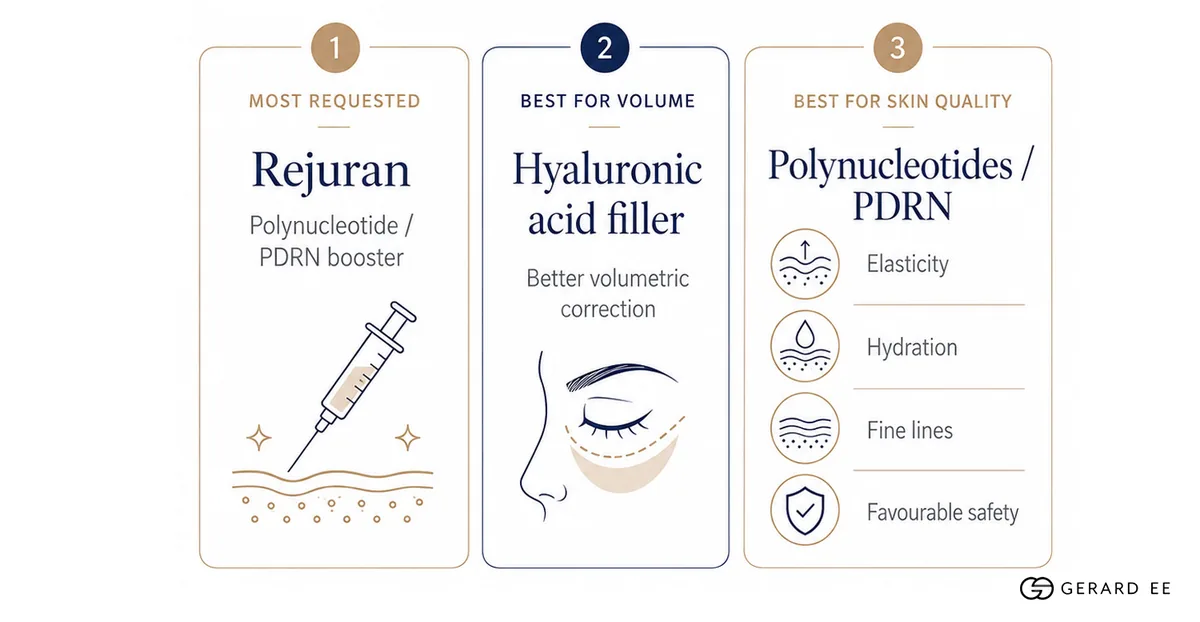
None of these products is a treatment for pigment. They act on skin quality — thickness, elasticity, hydration and fine lines. That matters around the eye, because thicker and better-supported lower-lid skin transmits less of the blue-purple beneath it. But the names most often quoted together carry very different amounts of evidence, and much of it was generated in a different part of the face.
Evidence at a glance
Evidence Summary for Periorbital Injectables and Adjuncts
| Product or Class | Best Available Study | Where It Was Studied | What It Showed | Evidence Grade |
|---|---|---|---|---|
| Polynucleotides / PDRN | Observational cohort, n=61 [1]; 2026 comparative review [2] | Periorbital colour | Significant shift toward less severe hyperpigmentation, concentrated in the structural subtype | Open-label, no control, trout-derived PN HPT rather than Rejuran |
| PDLLA-HA PDLLA skin booster |
Prospective cohort, n=15 [3] | Tear trough | Significant gains in elasticity, hydration and skin quality | Level IV, small |
| ECM booster Particulated human ADM |
Randomised split-face, n=20 [4] | Cheeks | Better density, elasticity and wrinkle depth versus HA at 20 weeks | Randomised, but off-target site |
| CellREDM | None found | — | — | No indexed record at 31 Aug 2026 |
| ADM as a Surgical Graft | Retrospective series, n=26 [5] | Tear trough | High satisfaction, no rejection or rapid resorption, 2–12 months | Retrospective, on-target |
| Autologous Fat-Derived Injectable | Preliminary study, n=11 [6] | Infraorbital colour | 72.7% rated effective; significant colour change at outer infraorbital edge | Preliminary, uncontrolled |
| Carboxytherapy | Prospective imaging study, n=78 [7] | Periorbital | Imaging gains sustained to 6 months | No control; 25/78 withdrew |
Polynucleotides and Rejuran: what the evidence supports, and what I see
Polynucleotide and PDRN injectables are the most widely used of the boosters in this region, and Rejuran is the name most patients arrive with. This section is longer than the others because the gap between how the product is marketed and what has been measured is wider here than anywhere else on this page.
The class evidence is for skin quality. A 2026 review comparing hyaluronic acid fillers with polynucleotides for under-eye rejuvenation concluded that hyaluronic acid remains superior for volumetric correction, while polynucleotides consistently improve dermal quality — elasticity, hydration, fine lines — with a favourable safety profile. The same review notes significant heterogeneity in study design and outcome measures across the published work, and calls for standardised long-term comparisons [2]. None of that is a measurement of the darkness itself.
One study has measured periorbital colour directly, and it is worth reading carefully. A 2026 multinational observational cohort treated 61 subjects (mean age 41.5, range 20 to 67) across all periorbital hyperpigmentation subtypes with three intradermal sessions of a polynucleotide preparation, with photographs digitally analysed for colour at one and three months after the final injection. It reported a highly significant shift toward less severe periorbital hyperpigmentation (p<0.001) [1].
Three things about that study change how it should be quoted:
- It was open-label and uncontrolled. No randomisation, no blinding, no comparison group. Subjective specialist and patient rating scales sat alongside the digital analysis. For a treatment where expectation strongly shapes perceived outcome, that is a real limitation, and the authors present it as real-world evidence rather than a trial.
- The improvement concentrated in the structural subtype. The effect was strongest in needle-treated subjects whose darkness came from hollowing, and the authors attribute part of it to the immediate volume-enhancing effect of the injected material — correction of hollows and tissue loss — rather than to any action on pigment. In other words, the clearest signal came from doing something a filler also does.
- It did not use Rejuran. The study used a trout-derived polynucleotide preparation. Rejuran is a salmon-derived PDRN product. Same class, different product, and the distinction matters when a clinic cites this study in support of Rejuran specifically.
Where that leaves the position. Polynucleotides have a genuine role in the periorbital area, and it is the one the class evidence supports: improving the quality and thickness of thin lower-lid skin. Where the skin is thin and translucent, better-supported skin transmits less of the vascular colour beneath it, and that is a reasonable mechanism. What has not been shown is that polynucleotides remove periorbital pigment, and the one study that measured colour found its strongest effect in the subtype where the darkness was a shadow rather than a colour.
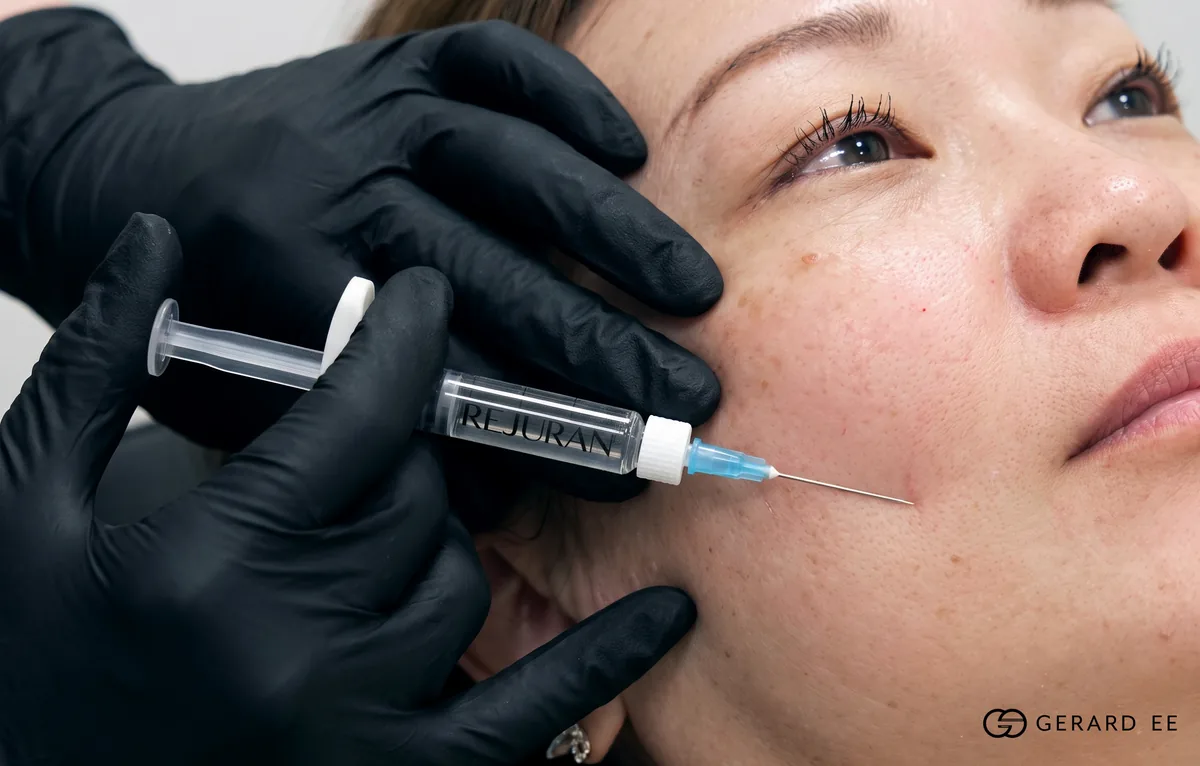
My own observation, stated as an observation. In my practice I have not found Rejuran to make much visible difference to dark circles specifically. I use polynucleotides, and I think they do what the evidence says they do for skin quality — but when a patient’s complaint is the darkness itself, the results I see from Rejuran alone have been modest, and I would rather say that than let a patient spend a course of sessions on the wrong expectation. That is one clinician’s experience across one practice, not a trial, and it should be weighed as such against the published data above. It is also consistent with that data: if the measurable effect sits mostly in the structural subtype and comes partly from volume, then in a patient whose darkness is pigmented or vascular there is not much left for it to do.
What I take from this in practice: if there is a hollow, treat the hollow, and a hyaluronic acid filler is the better-supported way to do that [8, 9]. If the skin is thin, polynucleotides are a reasonable choice and the safest of the boosters. If the problem is pigment, treat the pigment. Rejuran is not the answer to all three, and it is worth being clear which of the three you are treating.
Separately, a randomised, double-blind, split-face trial of a topical 0.1% PDRN eye cream against retinol over 28 days found roughly double the increase in dermal thickness and density on ultrasound, greater reduction in eye-bag volume and tear-trough depression, and larger reductions in crow’s-feet and infraorbital wrinkle area — around 20–23% against 6–7% for retinol — with no adverse reactions in either arm [10]. That is a topical, not an injectable, and the distinction matters when a clinic quotes it in support of an injection.
PDLLA skin boosters
PDLLA skin booster is a hybrid of poly-D,L-lactic acid (PDLLA) and hyaluronic acid. The hyaluronic acid hydrates immediately; the PDLLA acts as a biostimulator, provoking a controlled tissue response that activates fibroblasts and lays down new collagen over weeks to months [11, 12]. I describe the product in more detail on my PDLLA skin booster page.
The tear-trough evidence is real but small. A prospective cohort of 15 women (mean age 38.5) received three sessions of PDLLA-HA for tear trough correction, with significant improvement (p<0.001) in lower-lid elasticity, hydration, skin quality and radiance, and no adverse events reported. It is a level IV study [3]. A separate study of PDLLA delivered by needle-free device followed 40 patients over five sessions to 24 weeks, but assessed the face broadly rather than the eye area [13].
The safety point must be stated. A 2026 case report describes a 67-year-old woman who developed delayed-onset, bilateral, multiple foreign-body giant-cell granulomas roughly a month after three PDLLA infraorbital sessions. Conservative treatment failed; corticosteroids caused dermal and subcutaneous atrophy; definitive management required two surgical debridements with orbicularis myocutaneous flap reconstruction, and was complicated by bilateral ectropion needing further surgery [14]. A systematic review of adverse events across collagen biostimulators is currently underway precisely because nodules and granulomas are recognised complications of this class [11].
That is one case, and one case is not an incidence rate. But the lower eyelid is thin, mobile and anatomically unforgiving, and a biostimulator is designed to provoke a tissue reaction. My position is that PDLLA has a place around the eye in the right patient, in small volumes, in the correct plane, and that anyone offering it should be able to tell you what they would do if a nodule appeared at week four.
A published tear trough case treated with PDLLA skin booster by supraperiosteal and subdermal cannula documented increased skin thickness on ultrasound, CT and MRI, which is the effect I rely on under the eye: a thicker envelope over the hollow rather than volume in it. [17]
ECM boosters: ECM booster, CellREDM and what the material class has actually been studied for
These are the newest category and the one where marketing has run furthest ahead of evidence. Both are described as injectable extracellular matrix boosters derived from donated human dermal tissue that has been decellularised — cells and DNA removed — then reduced to particles for injection. Particle sizes are quoted in clinic and distributor material, but I have not been able to trace those figures to a manufacturer technical specification or a regulatory filing, so I do not repeat them here as though they were established.
ECM boosters
ECM booster has one peer-reviewed trial: a randomised, split-face, double-blinded clinical study with a preclinical arm, in 20 adults (mean age 54.7), comparing injectable particulated human acellular dermal matrix against hyaluronic acid on the opposite side, followed for 20 weeks. The matrix side showed greater improvement in skin density, volume, elasticity, wrinkle depth, pore area and hydration at multiple time points (p<0.05), with no serious adverse events and only mild transient redness and swelling [4].
Two caveats matter for the eye area: it treated cheeks, and the comparator was hyaluronic acid rather than placebo. It is a genuine randomised trial, and better evidence than most boosters carry — but it is not an under-eye study, and it should not be quoted as one.
CellREDM
A search of PubMed and Crossref on 31 August 2026, using “CellREDM”, “Cell REDM” and relevant brand variants, found no indexed clinical trial, case series or preclinical paper under the brand name. This finding may change as new research is published.
That is a statement about the published literature, not about whether the product works. At the time of writing, claims made for it rest on manufacturer material and clinical experience rather than on published evidence, and it is reasonable to ask which of the two a recommendation is based on.
The material class has a longer history around the eye — in a different form
This is the distinction most often blurred when these products are sold. Acellular dermal matrix has been used for the tear trough as a surgically placed sheet for over a decade. A retrospective series of 26 patients used ADM sheets to camouflage the tear trough contour alongside correction of fat bulging and lid skin excess, with 20 patients very satisfied, three satisfied and three requiring further volume, and no graft rejection, rapid resorption or inflammation over 2 to 12 months [5]. It was also described earlier for tear trough deformity in revision lower blepharoplasty [15].
That is real evidence for the material in the periorbital region. It is not evidence for an injected particle booster, and the two should not be quoted for each other.
Regenerative injectables derived from your own fat
A more interesting line of evidence for dark circles specifically comes from autologous fat-derived products, because unlike the boosters above these have been tested on infraorbital darkness rather than on cheeks.
A 2024 study reported correction of infraorbital dark circles using an autologous adipose-derived collagen filler [16]. Separately, a preliminary clinical study of cell-free fat extract — an acellular fraction of the patient’s own fat with anti-melanogenic activity — injected intradermally into the infraorbital region of 11 patients found 72.7% rated the treatment effective, with statistically significant improvement in skin colour at the outer infraorbital edge and reduction in periocular wrinkles by three months. Adverse effects were bruising, redness and swelling, all self-limiting [6].
Eleven patients is a preliminary study and I present it as one. But it is the only category on this page where an injectable has been tested against the actual complaint — the colour — rather than against skin quality in a different part of the face.
Carboxytherapy
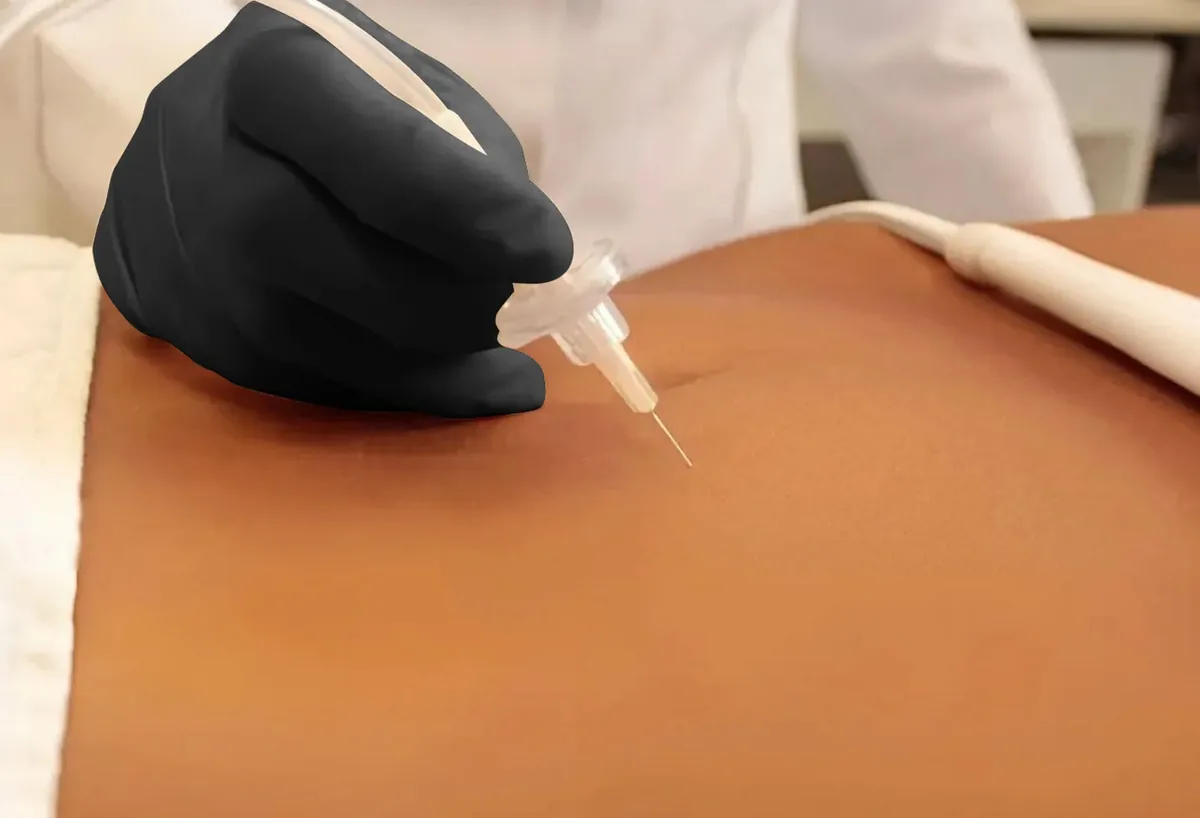
Carboxytherapy — small volumes of carbon dioxide gas injected under the skin — is included as an option in the periorbital systematic reviews [8, 9], and now has imaging-based data. A prospective study of 78 patients with Fitzpatrick I to V skin and moderate-to-severe infraorbital dark circles used weekly injections to the upper and lower lids for seven weeks, with ultrasound, microvascular imaging and shear-wave elastography at baseline, one month and six months. Visual analogue scores improved significantly, with measurable increases in epidermal-dermal and orbicularis thickness and in the vascular index, sustained at six months [7].
The finding that should be quoted alongside that one: 25 of the 78 participants withdrew during the course because the injections hurt. There was no control group. The withdrawal rate is important when discussing tolerability, and it is worth knowing before the first session.
How I use these in practice
Boosters are a skin-quality intervention, and skin quality is the third question I ask, not the first. The order is: what type of dark circle is this, is there a treatable driver such as allergy or anaemia, and only then is the lower-lid skin thin enough that improving it would meaningfully reduce what shows through. Where the answer to that last question is yes, polynucleotides are where I start, because they are the safest of the boosters and their skin-quality effect is the best supported — while being clear with the patient that I do not expect much change in the darkness itself. PDLLA has a place in selected patients who understand the granuloma risk. The ECM boosters I discuss honestly: an interesting material with genuine periorbital history in graft form, an off-target randomised trial for one brand, and nothing published for the other.
What no booster does is remove pigment or fill a significant hollow. If that is the problem, the treatment is in the main dark eye circles guide.
Where the darkness itself is pigment or visible vessels rather than skin quality, a laser rather than a booster is the treatment; the laser treatment for dark eye circles page sets out which laser suits which type.

Dr Gerard Ee, Aesthetic Doctor in Singapore
Dr Gerard Ee is an aesthetic doctor in Singapore and the Medical Director of his practice at 50 Raffles Place. He graduated from St George’s, University of London, trained in surgery at Singapore General Hospital and the National University Hospital, and holds the MRCS (Edinburgh) and a postgraduate diploma in practical dermatology from Cardiff University.
He has practised aesthetic medicine since 2012, is the author of sixteen peer-reviewed papers, and writes and medically reviews every article on this site. Read more about Dr Gerard Ee.

Book a consultation with Dr Gerard Ee at The Clifford Clinic
Dr Gerard Ee consults at The Clifford Clinic, 50 Raffles Place, Singapore. Consultations are by appointment. Message the clinic on WhatsApp, or call 6532 2048.
References
Sources cited on this page
Only papers whose article title itself contains the requested brand name are included below. Product names mentioned only in the abstract, keywords or methods were excluded.
- Amado R, Al-Mukhtar Y, Lanza E, et al. A real-world study of polynucleotides HPT for treating periorbital hyperpigmentation. Clin Cosmet Investig Dermatol. 2026;19:1-15. doi:10.2147/CCID.S605046
- Khan RS, Hafeez K. Hyaluronic acid fillers versus polynucleotides for under-eye rejuvenation. J Clin Med. 2026;15(13):4971. doi:10.3390/jcm15134971
- Young SM, Lau EKH. Hybrid biostimulator and hyaluronic acid injectable for tear trough rejuvenation. Aesthetic Plast Surg. 2026;50(13):5337-5343. doi:10.1007/s00266-026-05817-z
- Lee YI, Chau NH, Nguyen NH, et al. Injectable particulated human acellular dermal matrix booster for skin restoration: an integrated randomized, split-face, double-blinded clinical trial and preclinical study. Int J Mol Sci. 2026;27(5):2193. doi:10.3390/ijms27052193
- Yue D, Wu X, Song H, et al. The application of the acellular dermal matrix in the correction of the tear trough deformity. Aesthetic Plast Surg. 2018;42(5):1298-1303. doi:10.1007/s00266-018-1191-1
- Kang B, Cai Y, Jia Z, et al. Cell-free fat extract with anti-melanogenic property improves the appearance of infraorbital dark circles: a preliminary clinical study. Aesthetic Plast Surg. 2025;49(5):1526-1535. doi:10.1007/s00266-024-04445-9
- Hamid R, Bayramoğlu MN, Şirolu S, et al. Beyond aesthetics: imaging-based evaluation of carboxytherapy in periorbital hyperpigmentation. J Clin Med. 2026;15(10):3776. doi:10.3390/jcm15103776
- Michelle L, Pouldar Foulad D, Ekelem C, Saedi N, Mesinkovska NA. Treatments of periorbital hyperpigmentation: a systematic review. Dermatol Surg. 2021;47(1):70-74. doi:10.1097/DSS.0000000000002484
- Beer J, Boghosian T, Sherif R, et al. What’s new with under eye treatment: a multispecialty systematic review of recent under eye treatments. Dermatol Surg. 2026;52(2):155-163. doi:10.1097/DSS.0000000000004964
- Ye R, Wang Q, Du L, Li L, Hu F. Topical medium-length PDRN enhances dermal extracellular matrix repair in photodamaged skin via PI3K–Akt/TGF-β–regulated pathways. PLOS One. 2026;21(7):e0350905. doi:10.1371/journal.pone.0350905
- Honnef LR, Coelho MS, Dias de Oliveira JM, et al. Proportion of adverse events of injectable collagen biostimulators after facial aesthetic treatment: a systematic review protocol. J Clin Med. 2026;15(9):3182. doi:10.3390/jcm15093182
- Geara J, Luo L, Parlak O, Sommar P, Xu Landén N. Poly-L-lactic acid microspheres promote skin rejuvenation via enhanced fibroblast function. J Biomed Mater Res A. 2025;113(11):e38017. doi:10.1002/jbm.a.38017
- Seo SB, Wan J, Yoon SE, et al. The effective delivery of poly(D,L-lactic acid) (Juvelook) via needle-free injection (CUREJET) for facial rejuvenation. Aesthetic Plast Surg. 2026;50(9):3382-3388. doi:10.1007/s00266-025-05434-2
- Garlaschi A, Colombo G, Dotto A. Complex surgical management of PDLLA-induced lower eyelid granulomas. J Craniofac Surg. 2026 (in press). doi:10.1097/SCS.0000000000012811
- Kridel RWH, Sturm-O’Brien AK. Acellular dermal grafts for tear trough deformity in revision lower blepharoplasty. JAMA Facial Plast Surg. 2013;15(3):232-234. doi:10.1001/jamafacial.2013.783
- Cheong S, Yang H, Hao C, Lu F, He Y. Correction of infraorbital dark circles using autologous adipose-derived collagen filler: a novel regenerative option. Aesthetic Plast Surg. 2024;48(22):4693-4701. doi:10.1007/s00266-024-04417-z
- Ravera K. Ultrasound and Radiological Patterns in Assessing the Efficacy of Juvelook for Collagen Stimulation and Tear Trough Enhancement: A Case Report. Cureus. 2025;17(4):e82668. doi:10.7759/cureus.82668. PMID 40400849.
Every reference above was verified against Crossref — authors, title, journal, volume, issue, pages and year. Evidence search completed 31 August 2026.
This page is written from published research and from clinical experience in Singapore since 2012. It is for general education, not medical advice. Whether a treatment suits you, what it may achieve and what it may risk can only be established at a consultation. Dr Gerard Ee is the Medical Director of The Clifford Clinic, a private clinic in Singapore, and treatments discussed on this site are provided commercially.