HIFU is a category rather than a single treatment. Machines differ in how they focus and deliver ultrasound, in the depths available, in whether tissue is visualised during treatment, in the consistency of the thermal points produced, and in the volume of clinical evidence supporting that exact system.
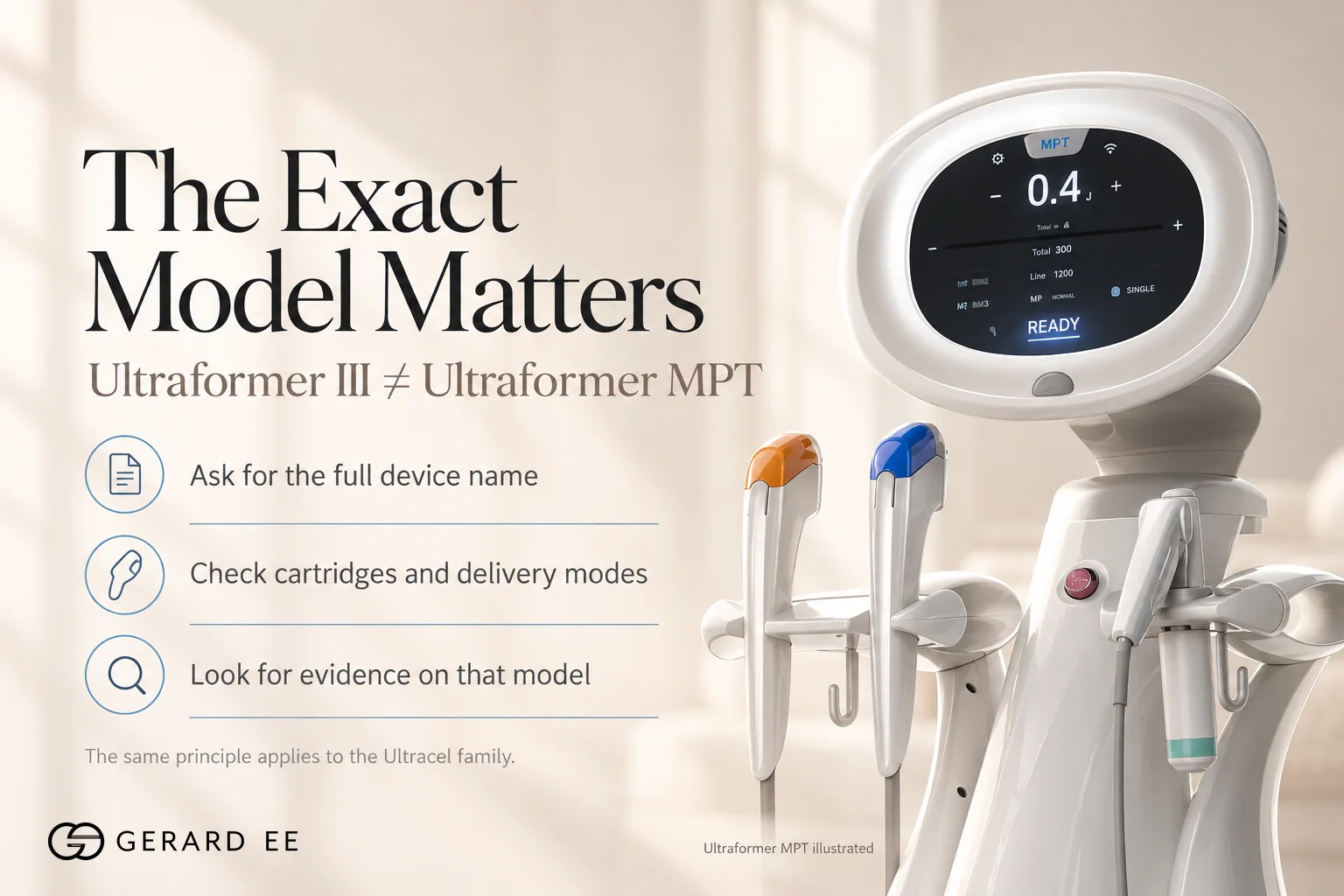
A useful comparison starts with the full device name and model. Ultracel and Ultraformer each name a product family containing more than one version, and cartridges and delivery modes differ between versions within a family.
What Differs Between HIFU Machines
- Ultrasound format may be microfocused, macrofocused, fractionated, linear or pulsed.
- Focal depths on facial cartridges commonly include 1.5, 3.0 and 4.5 mm, and some systems add further depths. The availability of a cartridge is not evidence that every depth should be used.
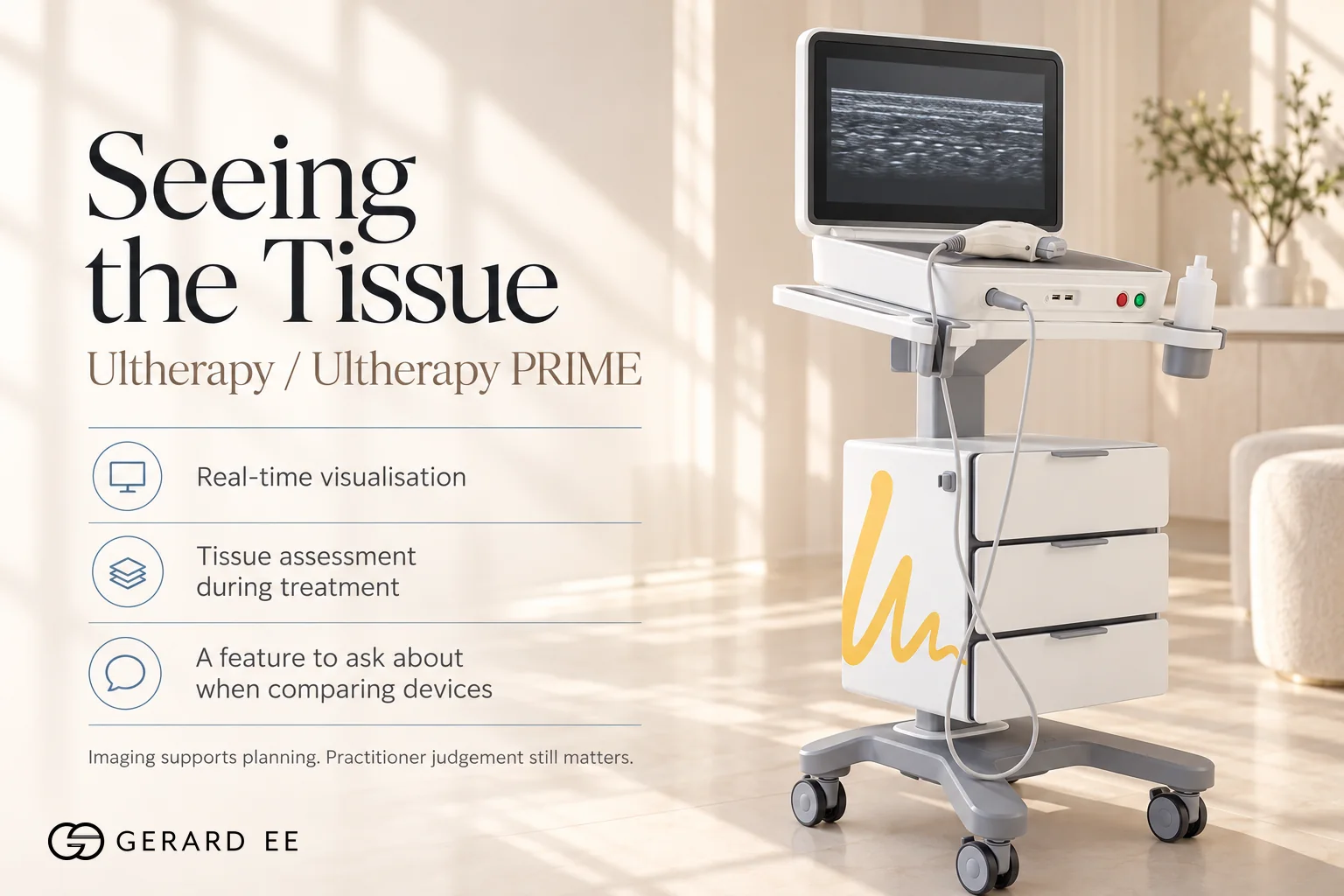
- Visualisation is displayed during treatment on Ultherapy. Most other HIFU systems rely on external mapping and anatomical knowledge.
- Energy delivery varies in the size, spacing and consistency of the thermal points produced at a given setting.
- Treatment speed and comfort follow from the firing pattern, energy, depth and anatomical area, and differ markedly between systems.
- Evidence and regulatory indications attach to a model, and do not transfer to another model in the same family.
HIFU Machines Patients Encounter in Singapore
| Device or family | HIFU category | Distinguishing feature to ask about |
|---|---|---|
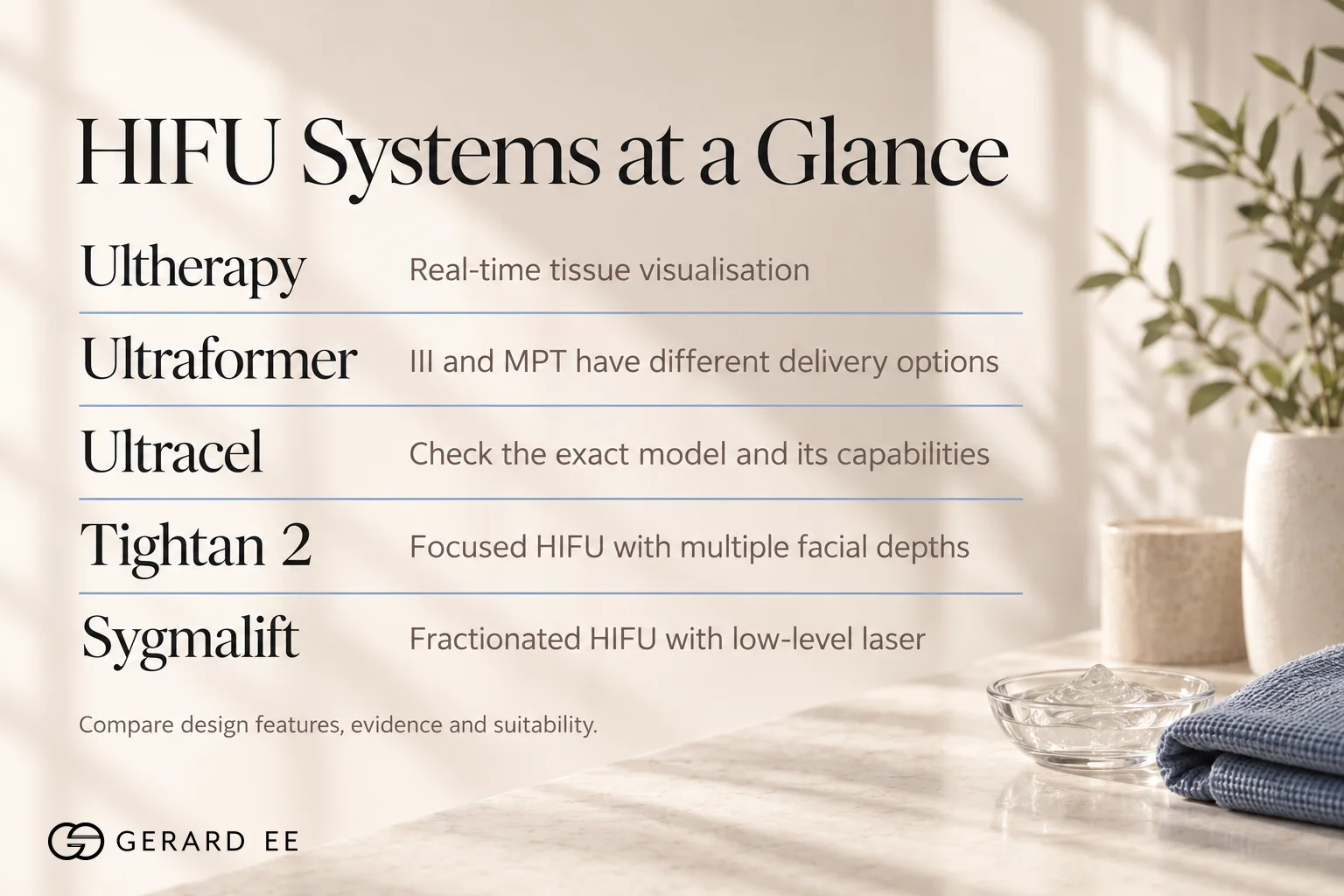
| Ulthera, Ultherapy, Ultherapy Prime | Focused HIFU with real-time visualisation | Treatment transducers at 1.5, 3.0 and 4.5 mm |
| Ultraformer III, Ultraformer MPT | Focused HIFU with microfocused and macrofocused modes | Model-dependent facial and body cartridges, with micro-pulsed delivery modes added on MPT |
| Ultracel | Focused HIFU within a broader device family | The exact model, because ultrasound and radiofrequency capabilities vary across the family |
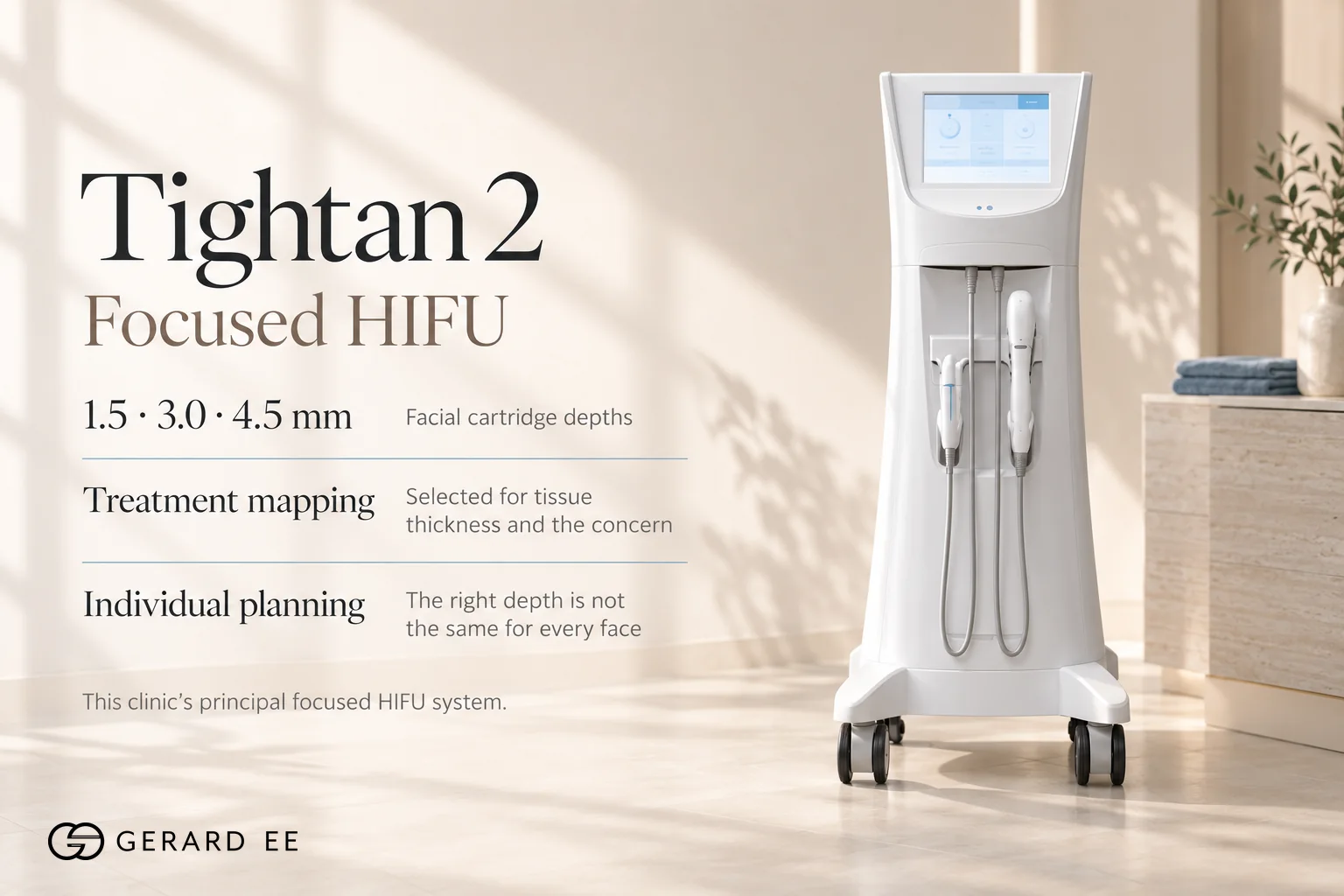
| Tightan 2 | Focused HIFU | Facial cartridges at 1.5, 3.0 and 4.5 mm, with additional applicators depending on configuration |
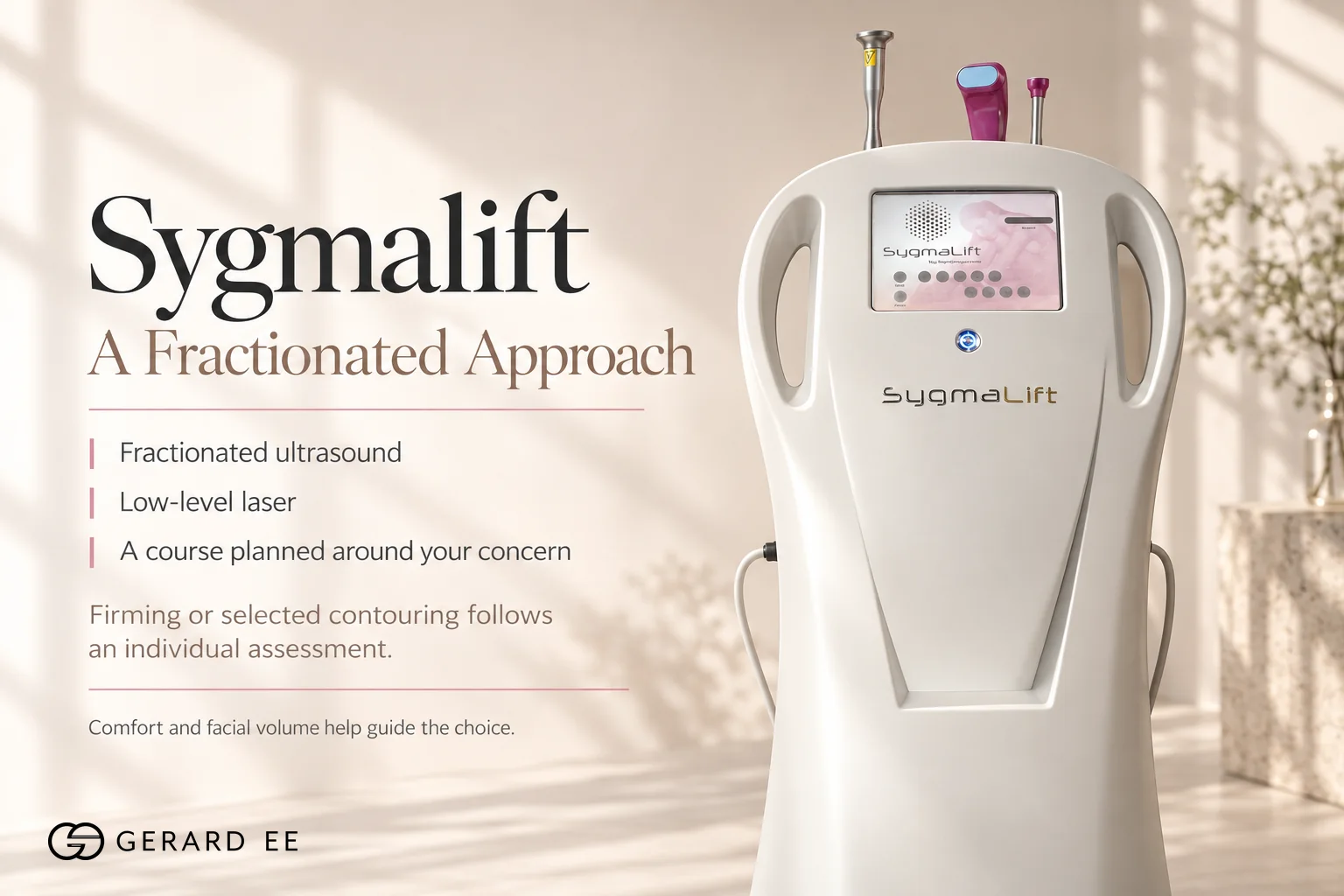
| Sygmalift | Fractionated HIFU with low-level laser | Staged protocols for firming, or for selected facial and submental contouring |
For a patient-facing comparison the first useful division is focused HIFU against fractionated HIFU. Ultherapy, Tightan 2 and Ultraformer sit on the focused side, and Sygmalift on the fractionated side. The table compares design features rather than declaring a winner. Cartridge availability, local registration and approved indications vary by market and model.
Which HIFU Machines Are Used at My Clinic
I have performed HIFU since 2012, beginning on the original Ulthera system before Ultherapy Prime was introduced. Tightan 2 is the principal focused HIFU system at my clinic, used for a single-session treatment planned across deeper and more superficial facial layers. Having used both, I find it much more comfortable than Ultherapy, which in practice means a patient will tolerate the coverage the plan actually calls for.
Sygmalift uses a fractionated HIFU approach and is offered as a gentler course for selected firming or contouring concerns. I choose it most often at two ends of the age range and for different reasons. In patients in their twenties, where nothing is sagging and there is no volume to spare, it firms without reducing facial fat. In patients in their sixties and seventies, I choose it for comfort and for its effect in the superficial layer.
The choice follows facial volume, tissue thickness, the location and severity of laxity, the need to avoid unwanted fat reduction, comfort, and willingness to complete a course. Age alone is a poor basis for selecting a machine, and the two preferences above are starting points that an examination can overturn.
Does the HIFU Machine or the Practitioner Matter More
Both matter, in different ways. The machine determines which depths, delivery patterns, imaging features and safety controls are available. The practitioner determines whether HIFU is suitable at all, which areas require treatment, which structures must be avoided, and how the device is set and placed.
A recognised brand cannot correct poor patient selection or poor planning, and clinical skill cannot give a device functions or evidence it does not have.

What the Evidence Shows About HIFU Devices and Settings
The evidence should be read device by device. A 2022 review that independently tested the Ultherapy system and three other HIFU systems found differences in visualisation, thermal regulation, focal accuracy and the consistency of thermal coagulation points [1]. The article was supported by the manufacturer of Ultherapy, which is relevant when interpreting its comparative conclusions.
A 2025 study using Ultraformer MPT examined pig skin histology alongside clinical outcomes in 50 Asian women. It reported changes in collagen, elastin and fat at different frequencies and depths, with 85.3% of participants satisfied overall and 70.6% reporting improved facial contour [2]. Those findings concern that device and that protocol rather than every HIFU platform.
An animal study of microfocused ultrasound found sustained dermal thickening over 90 days. A low-power 3.0 mm setting produced a 39% increase in dermal thickness at day 90, and neither longer treatment time nor higher power produced a statistically different effect [3]. Preclinical findings help explain tissue response but cannot determine the ideal setting for a patient.
A study of 30 Asian patients used 4.5 and 6.0 mm transducers specifically for unwanted submental fat and found significant improvement after one session, with four weeks of follow-up [4]. That supports a targeted fat-reduction protocol, and it should not be read as evidence that all facial HIFU causes fat loss, or that the same depths suit a lean face.

HIFU by Dr Gerard Ee in Singapore
Dr Gerard Ee is an aesthetic doctor in Singapore and the Medical Director of his practice at 50 Raffles Place. He graduated from St George’s, University of London, trained in surgery at Singapore General Hospital and the National University Hospital, and holds the MRCS (Edinburgh) and a postgraduate diploma in practical dermatology from Cardiff University.
He has performed HIFU since 2012, has studied HIFU techniques with doctors in Korea, and is the author of sixteen peer-reviewed papers. Read more about Dr Gerard Ee.

Discuss Which HIFU Machine Suits Your Concern
Dr Gerard Ee consults and performs HIFU at The Clifford Clinic, 50 Raffles Place, Singapore. Consultations are by appointment. Message the clinic on WhatsApp, or call 6532 2048.
Book a consultation to compare the Tightan 2 and Sygmalift options available at the clinic. The discussion can cover treatment depth, facial volume, comfort and your preferred treatment schedule. Current prices for both are on the HIFU price guide.
HIFU machine questions
Which HIFU machine is best in Singapore?
No single device is best for every concern. Compare the exact model, imaging, depths, delivery pattern, published evidence and suitability for your anatomy, then ask how the proposed settings relate to the intended result.
Is Ultraformer the same as Ultherapy?
Both use focused HIFU, but they are different systems. Ultherapy includes real-time imaging, whereas Ultraformer uses microfocused and macrofocused ultrasound with model-dependent cartridges and delivery modes.
Is Ultraformer a HIFU machine?
Yes. HIFU Ultraformer and Ultraformer HIFU both refer to the Ultraformer device family, although the exact model still matters. Ultraformer III and Ultraformer MPT offer different delivery options, so a clinic should identify the model and the proposed cartridge rather than quoting the family name alone.
Is Ultherapy the only HIFU with imaging?
Ultherapy is the established HIFU system providing simultaneous real-time imaging and treatment. Any clinic claiming equivalent visualisation on another system should identify the exact device and feature rather than relying on the HIFU label.
Does a more expensive HIFU machine give a better result?
Device cost does not predict an individual outcome. The exact technology and its evidence matter, but patient selection, treatment depth, energy, placement and follow-up remain decisive.
This page is written from published research and from clinical experience treating faces in Singapore since 2012. It is for general education, not medical advice. Suitability, likely result, downtime and risk can only be established at a consultation. Dr Gerard Ee provides the treatments described on this page at The Clifford Clinic.
Dr Gerard Ee consults and performs this treatment at The Clifford Clinic, 50 Raffles Place, Singapore.
Show the 4 references
1. Pavicic T, Ballard JR, Bykovskaya T, et al. Microfocused ultrasound with visualization: Consensus on safety and review of energy-based devices. J Cosmet Dermatol. 2022;21(2):636-647. doi:10.1111/jocd.14666. PubMed 34951735
2. Hwang Y, Wan J, Yi KH. Do Different High-Intensity-Focused Ultrasound Frequencies Have Different Effects? A Histological Analysis Correlated With Patients’ Subjective Assessments. J Cosmet Dermatol. 2025;24(2):e70069. doi:10.1111/jocd.70069. PubMed 39973106
3. Tang H, Li Y, Xiang X, et al. Micro-Focused Ultrasound Technology for Remodeling of Skin Tissue Architecture in an Animal Model. Lasers Surg Med. 2025;57(5):439-449. doi:10.1002/lsm.70025. PubMed 40344435
4. Goo B, Kim E, Yoon SE, et al. Efficacy and Safety of High-Intensity Focused Ultrasound (HIFU) on Reduction of Unwanted Submental Fat in Asian Patients. Aesthetic Plast Surg. 2025;49(13):3750-3755. doi:10.1007/s00266-025-04890-0. PubMed 40355620