HIFU, Thermage and Oligio are all used for non-surgical skin tightening, and they deliver energy differently. HIFU focuses ultrasound at selected depths. Thermage and Oligio use monopolar radiofrequency to produce broader tissue heating.
That difference shapes treatment planning, without dividing faces into a rule where ultrasound always lifts and radiofrequency only treats the surface. Both modalities have evidence for improving mild to moderate laxity, and their effects depend on the device, settings, tissue depth and patient.
HIFU and Monopolar Radiofrequency Compared
Focused HIFU creates discrete thermal points at predetermined depths, and fractionated HIFU uses a different spatial and treatment pattern. Depending on the device and cartridge, ultrasound energy may be placed in the dermis, the subcutaneous tissue or the deeper fibromuscular planes.
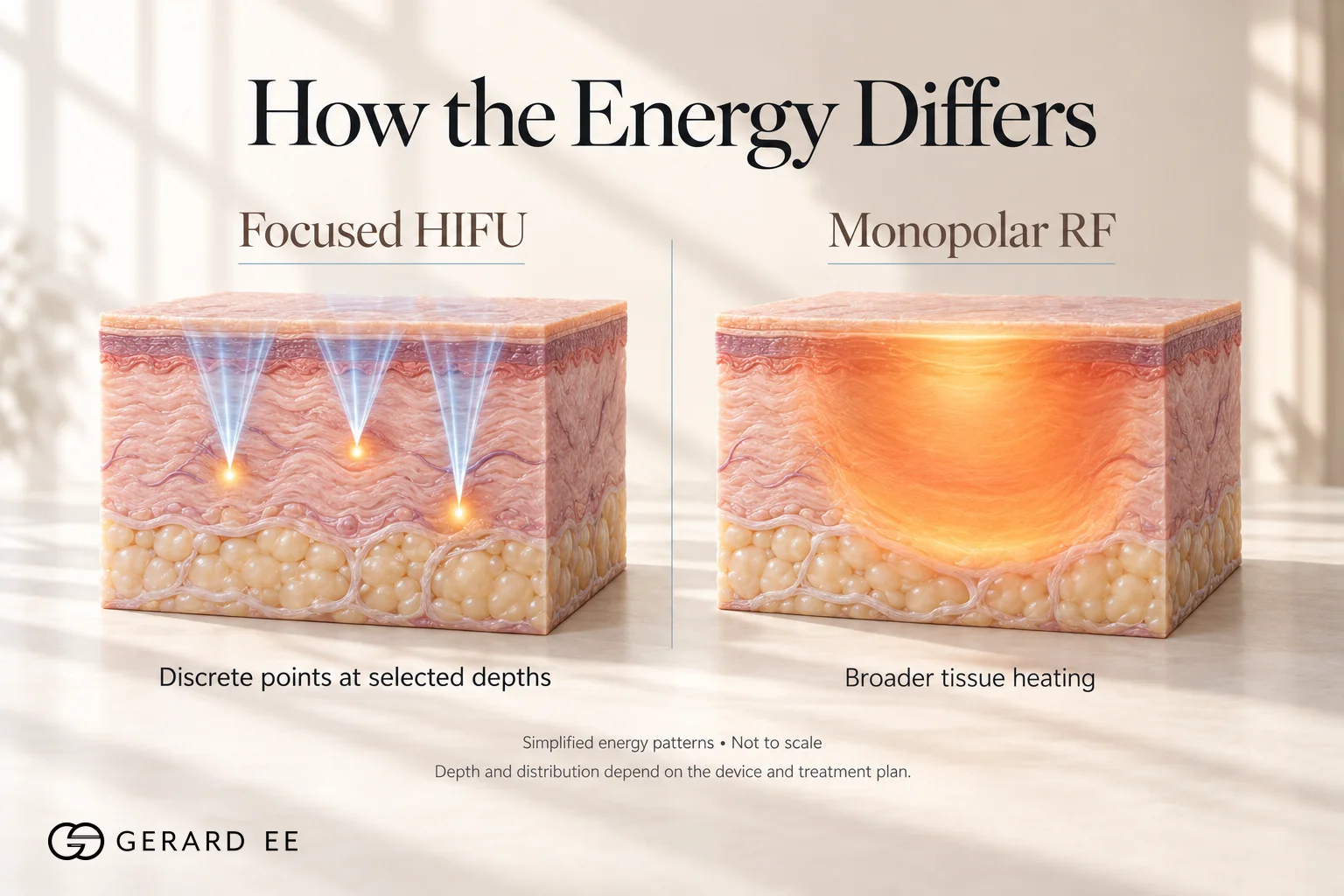
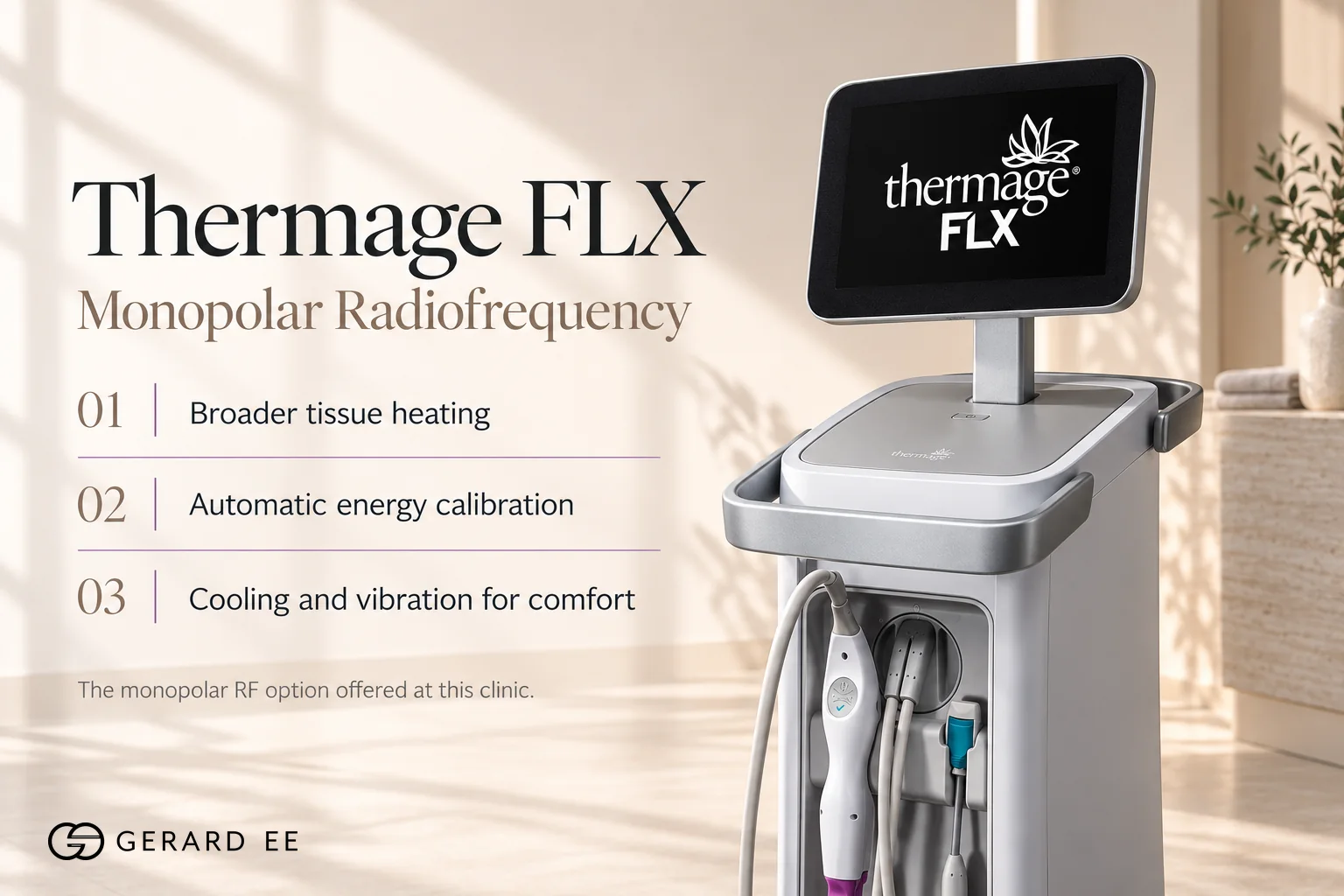
Monopolar radiofrequency passes current through tissue and produces volumetric heating. Its depth and distribution follow from device design, tissue impedance, contact, cooling and settings. Thermage and Oligio share the modality, and they remain different devices with different applicators, software, protocols and evidence.
| Feature | HIFU | Thermage and Oligio monopolar RF |
|---|---|---|
| Energy | Focused ultrasound | Monopolar radiofrequency |
| Tissue pattern | Discrete focused points, or fractionated micro-zones, depending on the system | Broader volumetric heating |
| Visualisation | Available on Ultherapy | Device feedback and external clinical assessment only |
| Best suited to | Mild to moderate laxity, selected lifting and contouring | Mild to moderate laxity, firmness and wrinkles |
| Sensation | Brief stings or deeper aching, varying by area, depth and device | Repeated heat pulses, with cooling on some systems |
| Main limitation | Outcomes vary across devices and protocols | Thermage evidence does not transfer to Oligio |
What Is Oligio, and Where It Fits Against HIFU and Thermage
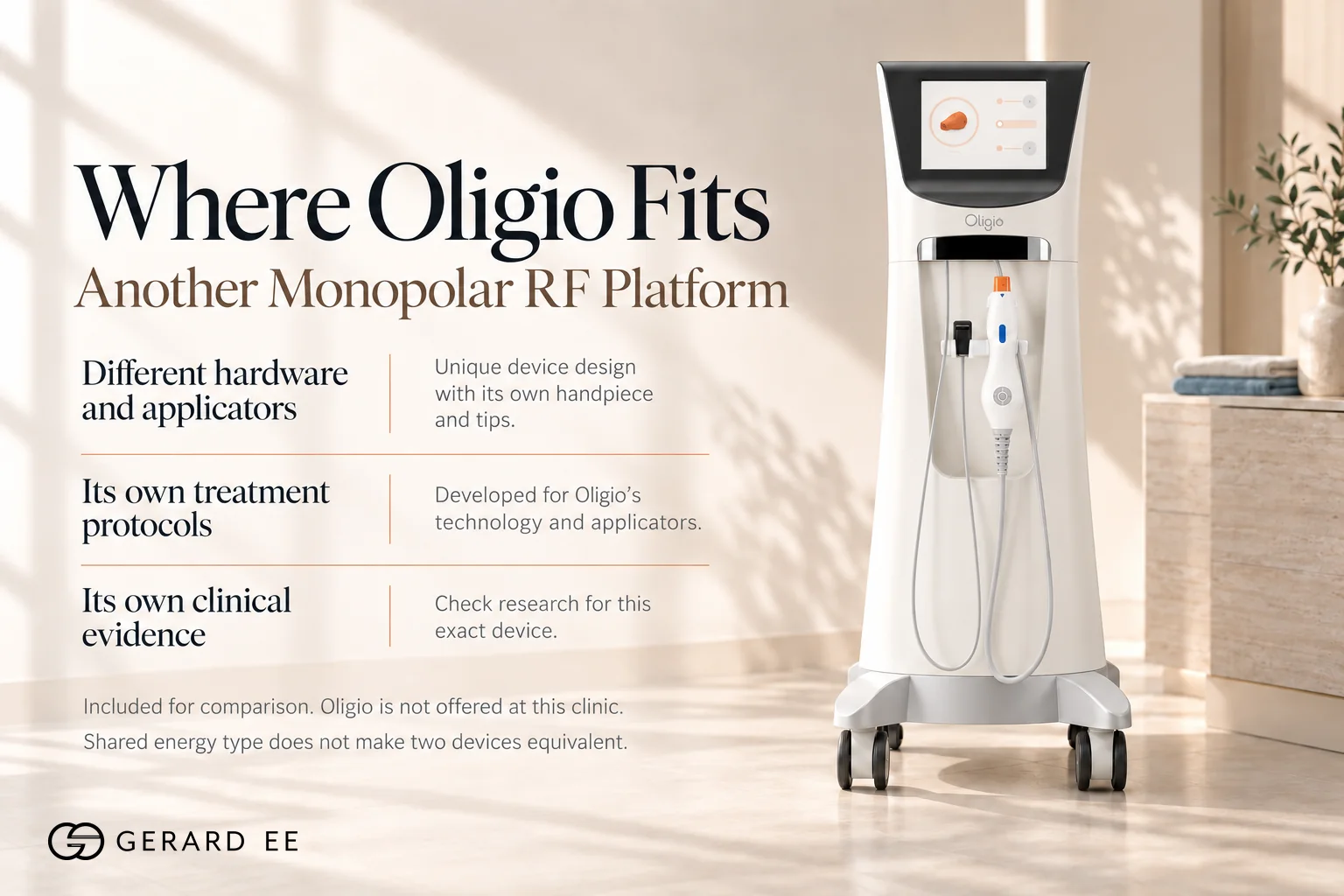
Oligio is a monopolar radiofrequency device developed by WONTECH. It belongs to the same energy category as Thermage, and describing it as equivalent to Thermage would overlook differences in hardware, treatment protocols and the volume of published evidence.
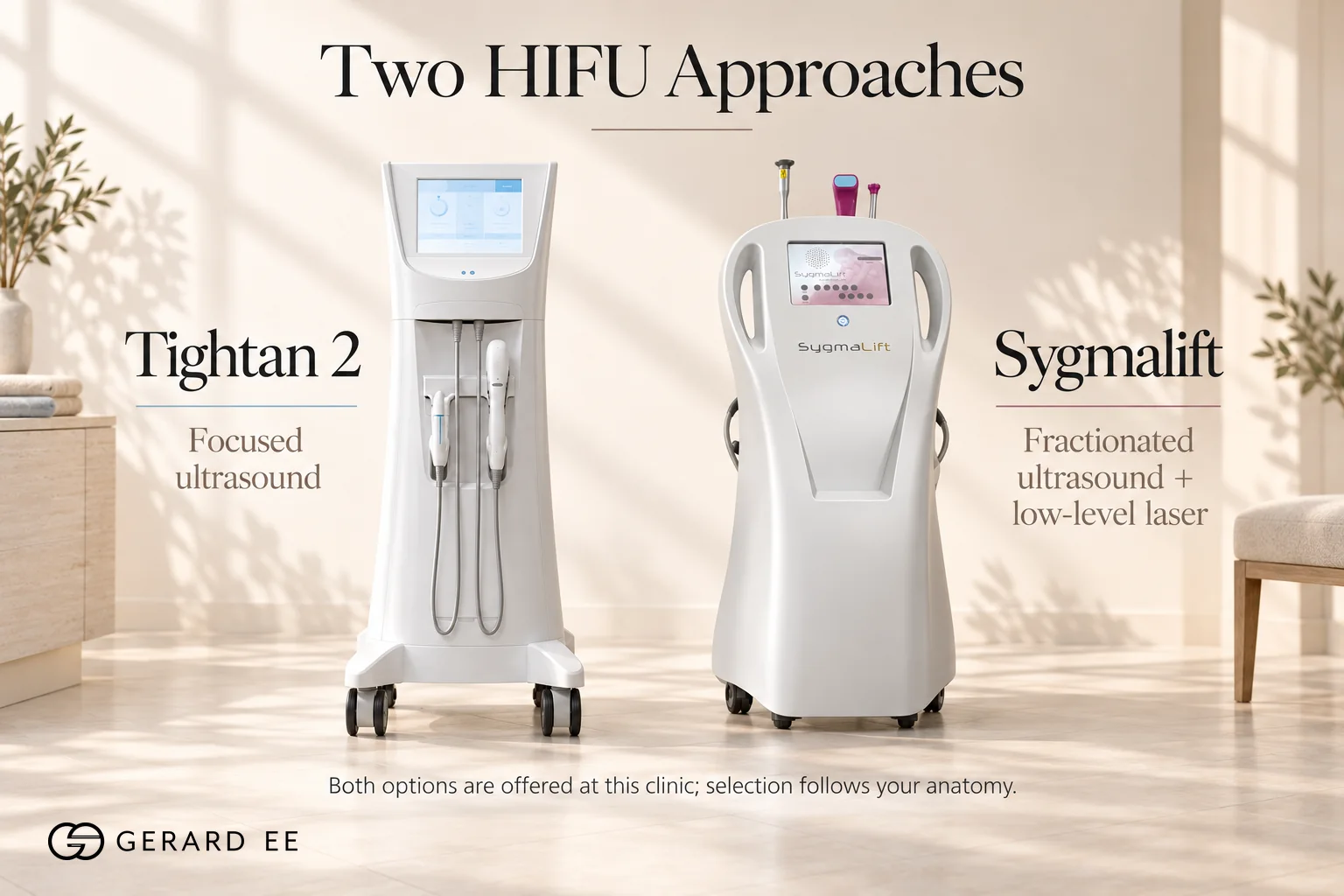
At my clinic Thermage is the monopolar radiofrequency option, and the HIFU options are the focused Tightan 2 and the fractionated Sygmalift. Thermage is the higher-priced of the three and Sygmalift the lowest per session, although the figures describe different treatment plans and should not be compared as though they were the same procedure. Current prices for all three are on the HIFU price guide, which also explains how to read each quote.
Oligio vs HIFU
Oligio vs HIFU comes down to depth. Oligio heats the dermis, the layer that sets firmness and fine texture. HIFU focuses ultrasound deeper, into the support layer that holds the jawline and lower face. For skin that has loosened with little descent, a radiofrequency treatment such as Oligio can be enough. For jowls and a softening jawline I use HIFU, because focused ultrasound reaches that support layer directly.
Comfort differs too. Oligio spreads its heat with cooling and vibration, so most patients find it gentle. HIFU delivers brief, deeper prickles of heat, strongest over the jawbone and brow. At my practice I use the focused Tightan 2 for deeper lifting and the fractionated Sygmalift where comfort matters most.
Oligio vs Thermage
Oligio and Thermage are the same kind of machine. Both use monopolar radiofrequency to heat the dermis broadly, and both are used for mild to moderate laxity and crepey skin. The difference is the device and the evidence behind it. Thermage FLX has the longer track record and the larger body of published studies, and results from Thermage trials should not be assumed for Oligio. Thermage is the radiofrequency device I use.
Oligio vs Ultherapy
Ultherapy is a HIFU device with built-in ultrasound imaging, so Oligio vs Ultherapy is the same choice as Oligio vs HIFU. Ultherapy reaches the deep support layer and is the more uncomfortable of the two. Oligio treats the dermis and is gentler. I used Ultherapy for years before moving to Tightan 2, which reaches the same layer with considerably less discomfort. The full comparison is on my HIFU vs Ultherapy page.
How I Decide Between HIFU, Thermage and Oligio
Around the eyes, Thermage FLX Eyes and HIFU are compared for sagging eyelids in the sagging eyelids treatment page.

| Assessment finding | Treatment discussion |
|---|---|
| Mild to moderate laxity with a softening jawline | Focused ultrasound or monopolar RF, selected according to tissue depth, volume and the desired treatment pattern |
| Thin or crepey skin with relatively little descent | A dermal tightening plan, which may include monopolar RF |
| Localised submental fullness | A device and depth intended for contouring, once fat reduction has been confirmed as desirable |
| Significant volume loss | I do not treat these faces with HIFU. Volume support matters more than additional heating, and reducing facial fat further makes the problem worse |
| Advanced skin excess or tissue descent | Surgical assessment, which is more likely to match the concern |
This is also where collagen biostimulators and EMFACE may enter a broader plan. They address different components of facial ageing and should be included only where each treatment has a defined role.
What the Comparative Evidence Shows
A randomised split-face study of 20 participants with mild to moderate laxity treated one side of the face and upper neck with monopolar radiofrequency and the other with Ultherapy. Both sides improved from day 30 through day 180, with no statistically significant difference in investigator-rated laxity, patient satisfaction or adverse events [1].
A separate randomised study of 20 participants with moderate neck laxity also found improvement with both modalities and no significant difference in efficacy or safety, although Ultherapy caused more procedural pain in that trial [2]. Neither study was large enough to establish that the modalities are interchangeable across devices or patients.
A 2025 systematic review of 45 HIFU trials and cohort studies reported laxity improvements ranging from 18% to 30%, particularly in the lower face, neck and periorbital areas. The authors identified variation in energy settings, protocols and patient selection as important limitations, and called for more long-term data [3].
Can HIFU and Radiofrequency Be Combined?
Combination treatment is possible, although it is not automatically better. The practitioner has to decide whether both modalities are needed, which areas each will treat, the sequence, and the interval between them.
A split-face study of 24 Korean adults compared monopolar radiofrequency followed by HIFU with the reverse sequence. Both sides improved with minimal side effects, and three-dimensional imaging showed slightly greater wrinkle reduction on the radiofrequency-first side [4]. That small study supports further investigation rather than a universal sequence, and it does not show that every patient needs both treatments.


Dr Gerard Ee, Aesthetic Doctor in Singapore
Dr Gerard Ee is an aesthetic doctor in Singapore and the Medical Director of his practice at 50 Raffles Place. He graduated from St George’s, University of London, trained in surgery at Singapore General Hospital and the National University Hospital, and holds the MRCS (Edinburgh) and a postgraduate diploma in practical dermatology from Cardiff University.
He has practised aesthetic medicine since 2012, is the author of sixteen peer-reviewed papers, and writes and medically reviews every article on this site. Read more about Dr Gerard Ee.

Discuss HIFU and Thermage at a Consultation
Dr Gerard Ee consults and performs HIFU at The Clifford Clinic, 50 Raffles Place, Singapore. Consultations are by appointment. Message the clinic on WhatsApp, or call 6532 2048.
Book a consultation to assess your skin laxity, facial volume and treatment priorities. The discussion covers the HIFU and Thermage options offered at the clinic, and whether either has a useful role in your plan.
HIFU, Thermage and Oligio questions
Is Thermage or HIFU better for sagging skin?
Either may improve mild to moderate laxity. Focused ultrasound delivers discrete points at selected depths, whereas Thermage produces broader monopolar radiofrequency heating. Facial anatomy, volume, skin quality and the intended tissue target guide the choice.
Is Oligio better than HIFU?
Oligio and HIFU use different energy modalities, so the answer follows the concern and the treatment plan rather than the device name. Evidence for Thermage should not be presented as proof of Oligio outcomes merely because both devices use monopolar radiofrequency.
Is Oligio better than Thermage?
Neither is better across the board. Both use monopolar radiofrequency on the same layer of skin. Thermage has more published evidence, and that evidence cannot be borrowed to describe Oligio results. The choice should follow your skin and the device your doctor knows well.
Do you offer Oligio at your clinic?
No. Thermage is the monopolar radiofrequency device I use, and the HIFU options are Tightan 2 and Sygmalift. Oligio is included on this page because patients ask about it, not because it is offered here.
Can I do HIFU and Thermage together?
Selected patients may undergo both, either in one planned sequence or at separate visits. The interval and order should follow the exact devices, treatment areas, prior procedures and clinical assessment rather than a fixed rule.
This page is written from published research and from clinical experience treating faces in Singapore since 2012. It is for general education, not medical advice. Suitability, likely result, downtime and risk can only be established at a consultation. Dr Gerard Ee provides the treatments described on this page at The Clifford Clinic.
Dr Gerard Ee consults and performs this treatment at The Clifford Clinic, 50 Raffles Place, Singapore.
Show the 4 references
1. Alhaddad M, Wu DC, Bolton J, et al. A Randomized, Split-Face, Evaluator-Blind Clinical Trial Comparing Monopolar Radiofrequency Versus Microfocused Ultrasound With Visualization for Lifting and Tightening of the Face and Upper Neck. Dermatol Surg. 2019;45(1):131-139. doi:10.1097/DSS.0000000000001653. PubMed 30531187
2. Jones IT, Guiha I, Goldman MP, Wu DC. A Randomized Evaluator-Blinded Trial Comparing Subsurface Monopolar Radiofrequency With Microfocused Ultrasound for Lifting and Tightening of the Neck. Dermatol Surg. 2017;43(12):1441-1447. doi:10.1097/DSS.0000000000001216. PubMed 28902019
3. Haykal D, Sattler S, Verner I, Madhumita M, Cartier H. A Systematic Review of High-Intensity Focused Ultrasound in Skin Tightening and Body Contouring. Aesthet Surg J. 2025;45(7):690-698. doi:10.1093/asj/sjaf053. PubMed 40184185
4. Choi WJ, Jang YJ, Jung DY, Song BH, Park EJ, Kim KJ, Kim KH. Comparative Study of Monopolar Radiofrequency and High-Intensity Focused Ultrasound for Facial Rejuvenation: A Split-Face Approach. Dermatol Surg. 2025;51(9S):S49-S53. doi:10.1097/DSS.0000000000004794. PubMed 41405928