
Written by Dr Gerard Ee, MBBS (UK), MRCS (Edinburgh), PGDip Practical Dermatology (Cardiff). Founder and Medical Director, The Clifford Clinic and The Clifford Surgery, Singapore. Last medically reviewed and updated September 2026.
There are three main types of skin cancer. Basal cell carcinoma and squamous cell carcinoma, together called non-melanoma skin cancer, make up more than nine in ten skin cancers diagnosed in Singapore. Melanoma is less common but more likely to spread. The three types differ in appearance, rate of growth and treatment, and all three are usually curable when detected early.
I examine suspicious skin lesions under dermoscopy, a magnified examination of the skin in polarised light, and remove them myself. I perform the surgery as a day surgery case in an MOH approved ambulatory surgery centre, so it is claimable under day surgery insurance, subject to your policy. Every excised lesion is sent to Singapore General Hospital for histology, the microscopic examination that establishes the final diagnosis and determines any further treatment.
Types of skin cancer at a glance
- Basal cell carcinoma (BCC) accounts for about two in three skin cancers in Singapore. It grows slowly and very rarely spreads.
- Squamous cell carcinoma (SCC) accounts for just over one in four. It grows faster and can spread to the lymph nodes if left untreated.
- Malignant melanoma accounts for about one in twenty. It is the type most likely to spread, and in Asian skin it often arises on the palms, soles and nails.
- All three are confirmed by histology after a biopsy or excision, and surgical excision is the first treatment for each.
Basal cell carcinoma (BCC), the most common skin cancer
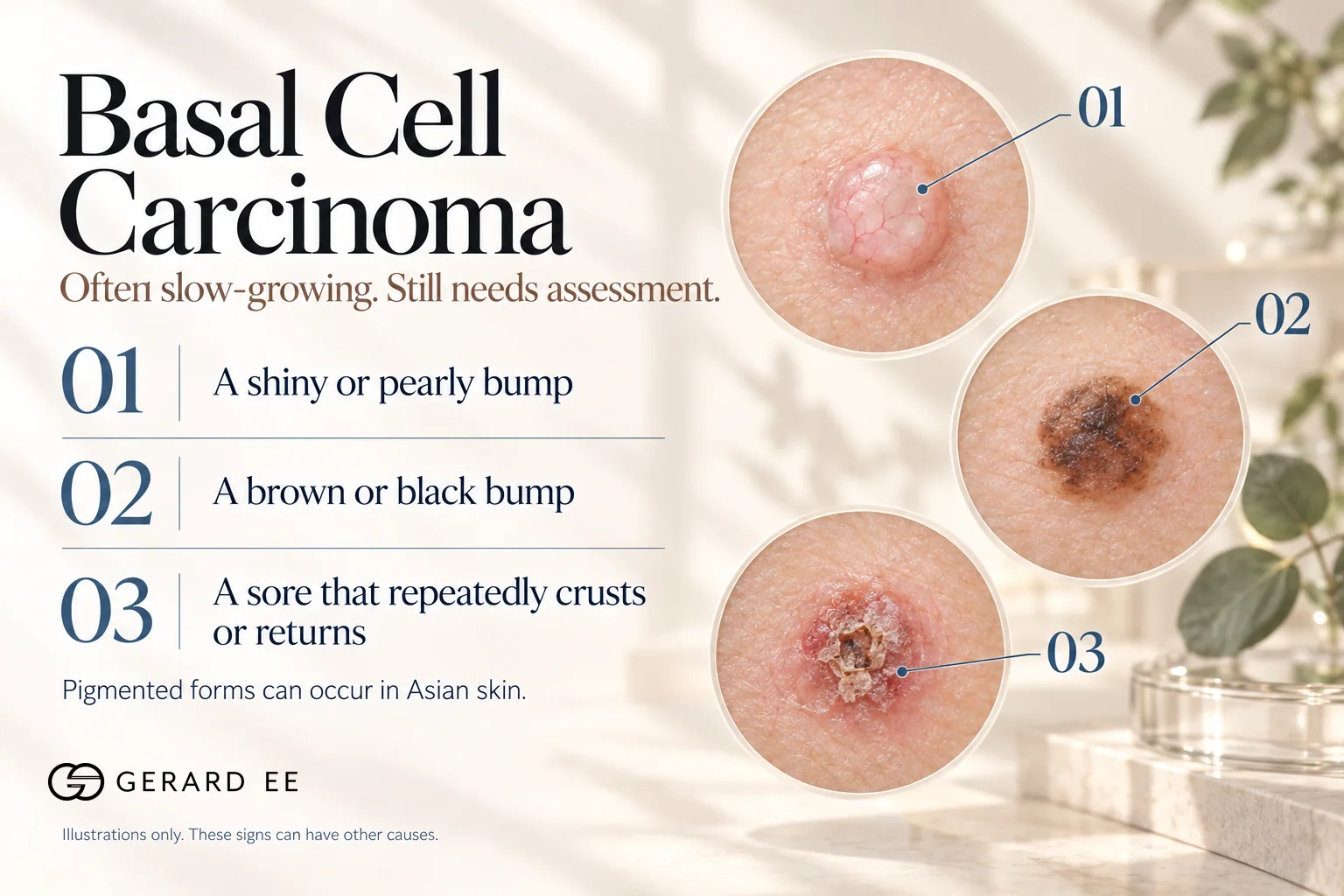
Basal cell carcinoma arises from the basal cells in the deepest layer of the epidermis, the outer layer of the skin. It is the most common skin cancer in Singapore, accounting for 65.9% of the 12,692 skin cancers recorded between 1968 and 2016, and its incidence among Chinese Singaporeans rose 2.5-fold over that period.
It typically presents as a shiny or pearly bump crossed by fine visible blood vessels, or as a small sore that bleeds, crusts and fails to heal. In Asian skin, basal cell carcinoma is often pigmented brown or black and is easily mistaken for a mole. It favours sun-exposed skin, with 81.3% of cases in Singapore arising on sun-exposed sites, most often the face and nose. The average age at diagnosis is 67.
Basal cell carcinoma very rarely spreads to distant organs. Untreated, however, it continues to invade the surrounding tissue, and this local destruction is most damaging around the nose, eyes and ears. Surgical excision with a clear margin is curative in most cases.
Squamous cell carcinoma (SCC), the second most common skin cancer
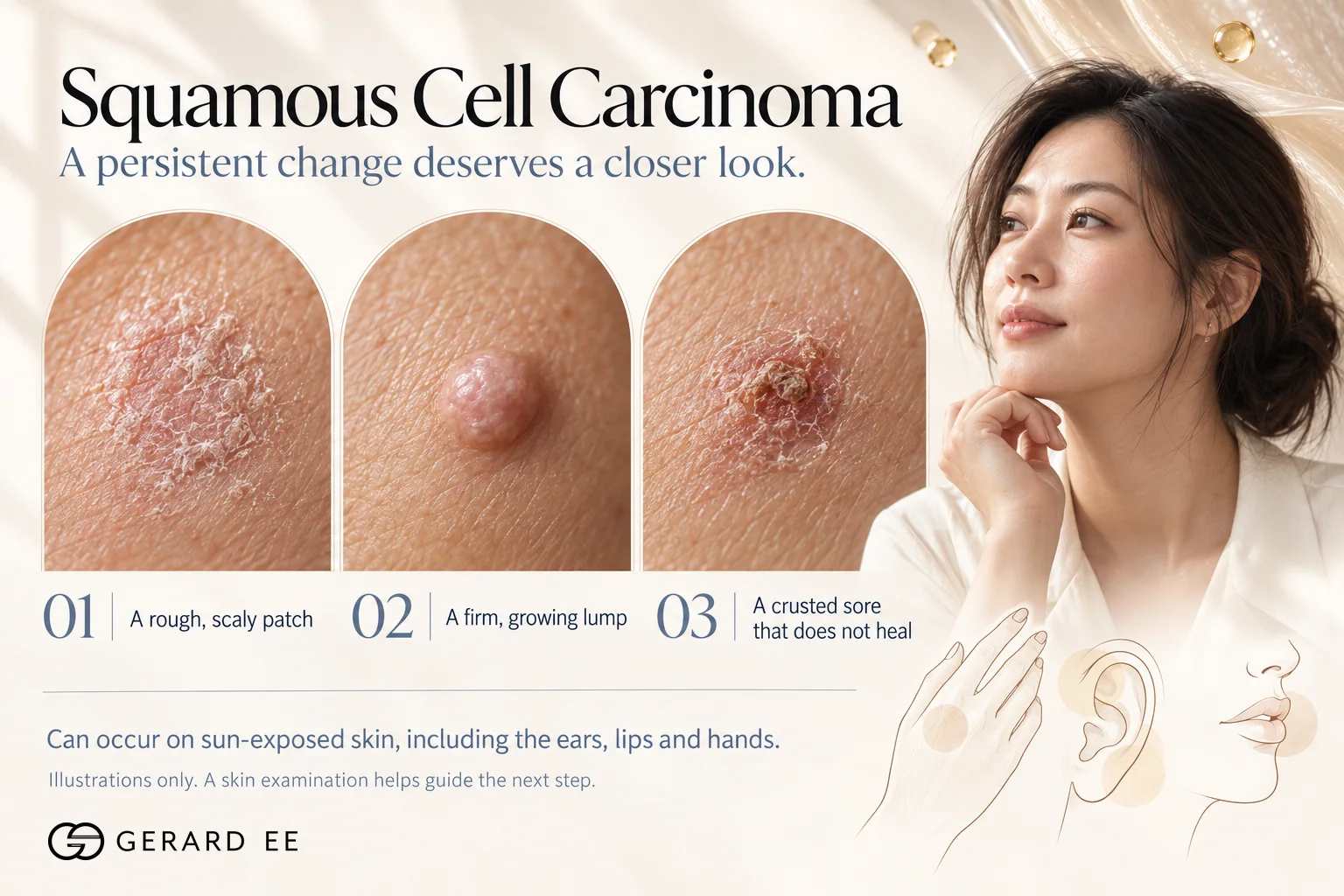
Squamous cell carcinoma arises from the squamous cells, the flat cells of the upper epidermis. It accounted for 28.3% of skin cancers in Singapore between 1968 and 2016, and the average age at diagnosis is 73.
It usually presents as a firm red or skin-coloured lump, a thick scaly patch, or a crusted sore that may be tender. It grows over weeks to months, faster than basal cell carcinoma, and favours skin with long-term sun damage such as the face, lips, ears, scalp and backs of the hands. It often develops from two precancerous lesions. Actinic keratoses are rough, scaly patches caused by chronic sun damage, whereas Bowen’s disease is squamous cell carcinoma still confined to the epidermis. Both are treated when found, before they progress to invasive cancer.
The risk of squamous cell carcinoma is substantially higher in patients on long-term immunosuppression, for example after an organ transplant. Because a small proportion spread to the lymph nodes, squamous cell carcinomas are removed promptly with a margin of normal skin.
Malignant melanoma, the most dangerous type of skin cancer
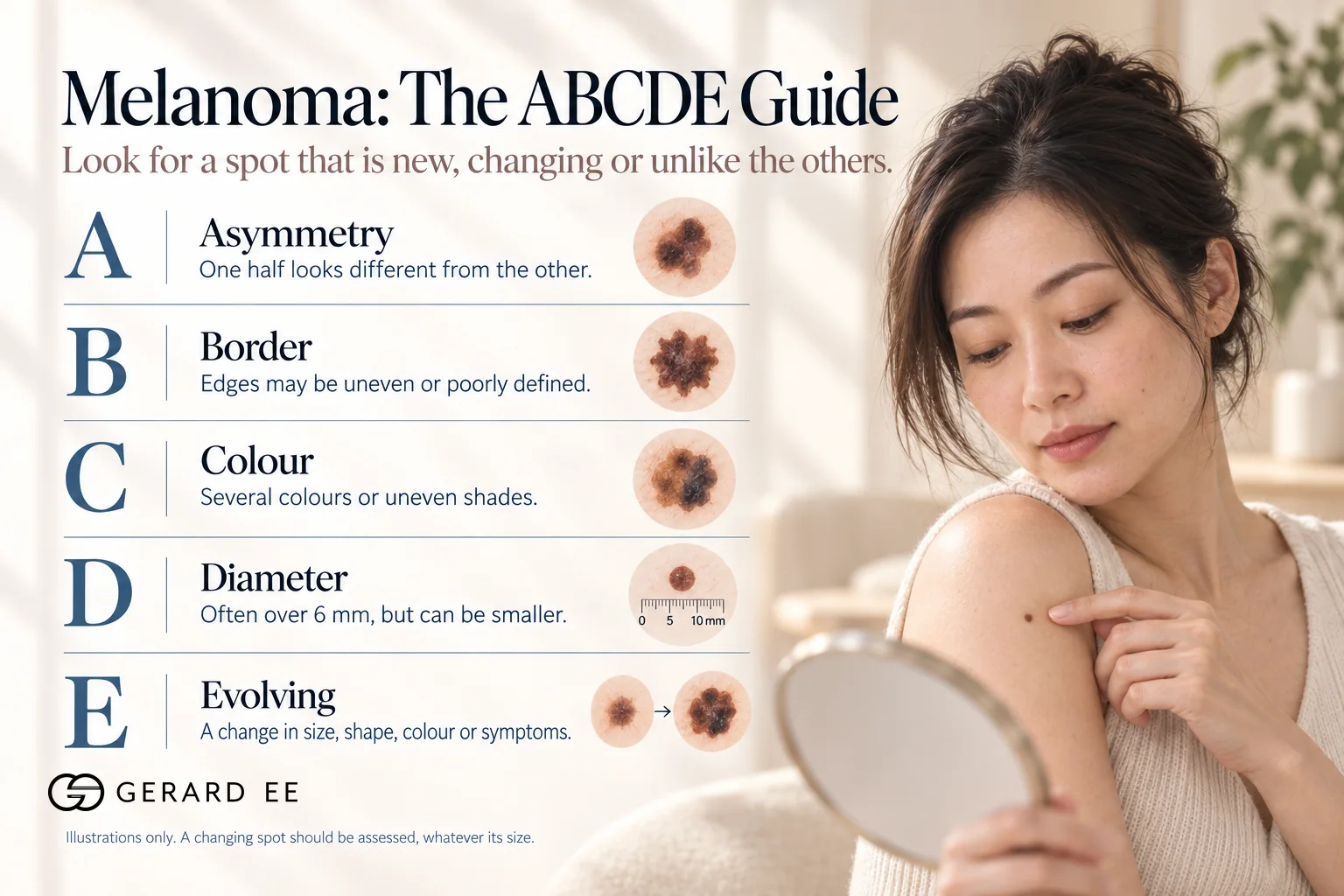
Malignant melanoma arises from the melanocytes, the cells that produce skin pigment. It is the least common of the three, accounting for 5.8% of skin cancers in Singapore between 1968 and 2016, yet it is the type most likely to spread to the lymph nodes and other organs.
It usually presents as a new dark spot or as an existing mole that changes. Its features are summarised by the ABCDE signs, an Asymmetric shape, an irregular Border, uneven Colour, a Diameter above 6 mm and Evolution over time. A mole that looks different from all of a person’s other moles, known as the ugly duckling sign, is one of the strongest single indicators of melanoma.
Melanoma follows a different pattern in Asian skin. About half of melanomas in Asian patients are acral lentiginous melanoma, which arises on the palms, soles and nail beds, compared with 2 to 3% in Caucasian patients. In a Singapore series, acral melanomas were diagnosed after a delay of 27 months, versus 12 months for other melanomas, and only 25% were detected at stage 1, versus 48%. Only 26.7% of melanomas in Singapore occur on sun-exposed skin. A dark streak in a nail or a dark patch on the sole therefore warrants examination. Atypical moles, which can resemble early melanoma, are discussed in atypical moles vs melanoma.
Melanoma vs carcinoma, how the types of skin cancer differ
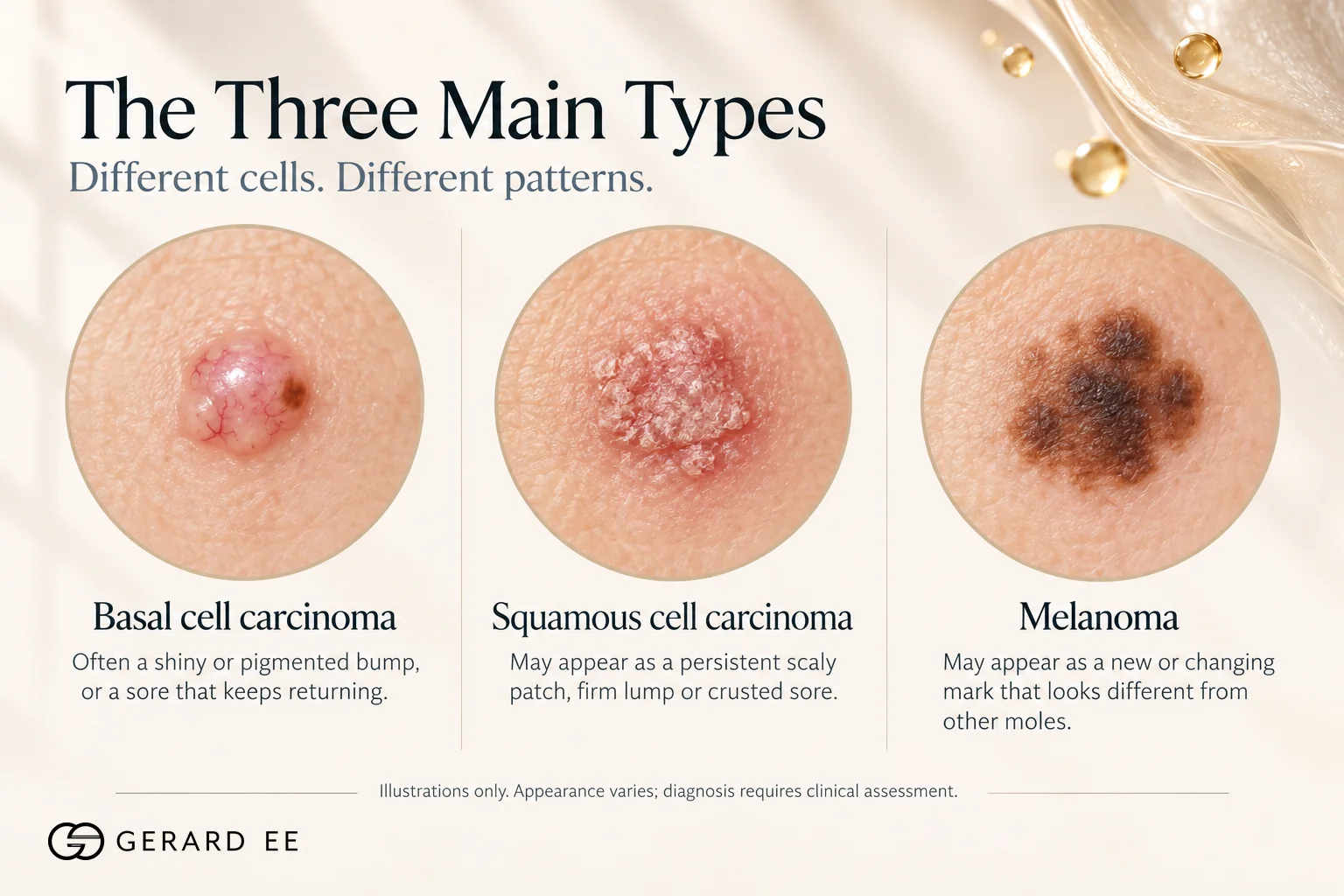
| Basal cell carcinoma | Squamous cell carcinoma | Melanoma | |
|---|---|---|---|
| Cell of origin | Basal cells | Squamous cells | Melanocytes |
| Share of skin cancers in Singapore | 65.9% | 28.3% | 5.8% |
| Typical appearance | Pearly or pigmented bump, non-healing sore | Firm scaly lump, crusted sore | New or changing dark spot, nail streak |
| Typical site | Face and nose | Face, lips, ears, hands | Any site, often palms, soles and nails in Asian skin |
| Risk of spread | Very low | Low to moderate | Highest |
| First treatment | Excision with a 4 mm margin when low risk | Excision with a 4 to 6 mm margin when low risk | Excision, margin set by thickness |
Carcinoma is the general term for a cancer arising from the keratinocytes, the cells that form the surface layer of the skin, and it covers both basal cell and squamous cell carcinoma. Melanoma, by contrast, arises from the pigment cells. Melanoma is staged by its thickness under the microscope, known as the Breslow thickness, and it requires wider excision margins and closer follow-up.
Early signs of skin cancer to check for

- A new spot that looks different from the surrounding moles.
- A mole that changes in size, shape or colour.
- A sore that bleeds, crusts and has not healed within four weeks.
- A scaly or rough patch that persists or recurs.
- A pearly or shiny bump, especially on the face.
- A dark streak along a nail, or a dark patch on the palm or sole.
Most skin cancers are painless in their early stages, so the absence of pain does not exclude cancer. A monthly self-examination in good light, including the scalp, palms, soles and nails, with photographs of any spot under observation, allows a change to be detected early.
When to have a skin lesion checked in Singapore
Any of the signs above warrants prompt examination rather than waiting for the next routine check. Routine skin cancer screening is most valuable for people with a personal or family history of skin cancer, many or atypical moles, fair skin that burns, years of outdoor work or sport, or long-term immunosuppression.
My skin cancer screening is a full-body skin examination under dermoscopy, with mole mapping for patients who have many or atypical moles. No referral letter is required, and the screening consultation is S$100 before GST.
How skin cancer is diagnosed and treated in Singapore
Dermoscopy identifies which lesions require removal. A suspicious lesion is removed whole with a small margin, known as an excision biopsy, or sampled first when it is large. Histology at Singapore General Hospital confirms the type of cancer, its depth and whether the margins are clear, with results available in two to three weeks.
Surgical excision is the first treatment for all three types. I perform the surgery as a day surgery case in an MOH approved ambulatory surgery centre, so it is claimable under day surgery insurance, subject to your policy. Where histology shows that a wide local excision is needed, I refer the patient to our in-house plastic surgeon, and the operation is performed as a day surgery case. The treatment options are set out on the skin cancer treatment page, and the full pathway from screening to follow-up is described in the skin cancer guide.
Types of skin cancer, frequently asked questions
Which type of skin cancer is most common in Singapore?
Basal cell carcinoma is the most common, accounting for about two in three skin cancers recorded in Singapore between 1968 and 2016, followed by squamous cell carcinoma at just over one in four and melanoma at about one in twenty.
Is basal cell carcinoma dangerous?
Basal cell carcinoma very rarely spreads to other organs, but it continues to grow into the surrounding skin and tissue if untreated. On the nose, eyelids or ears, that growth can be destructive, and the tumour is therefore removed once it is diagnosed.
Can skin cancer look like a normal mole?
Skin cancer can closely resemble a normal mole. Melanoma often begins as a dark spot that looks like a mole, and in Asian skin, basal cell carcinoma is frequently pigmented and mistaken for one. Dermoscopy distinguishes most of these lesions from benign moles, and histology confirms the diagnosis.
Does skin cancer hurt?
Skin cancer is usually painless in its early stages. A spot that is changing, bleeding or failing to heal therefore needs to be examined even when it causes no discomfort.
Do Asians get melanoma?
Asians do develop melanoma, although less often than people of European descent. In Asian patients, about half of melanomas arise on the palms, soles or nail beds, sites that are easily overlooked, and these melanomas are diagnosed later on average.
How is the type of skin cancer confirmed?
The type of skin cancer is confirmed by histology, in which a pathologist examines the lesion, or a sample of it, under the microscope. Every specimen is reported by Singapore General Hospital, and results take two to three weeks.

Book a consultation with Dr Gerard Ee
Dr Gerard Ee consults and treats skin cancer at his practice at 50 Raffles Place, Singapore. Consultations are by appointment. Message the clinic on WhatsApp, or call 6532 2048.
Selected References
- Oh CC, Jin A, Koh WP. Trends of cutaneous basal cell carcinoma, squamous cell carcinoma, and melanoma among the Chinese, Malays, and Indians in Singapore from 1968 to 2016. JAAD Int. 2021. PMID 34409390.
- Lee HY, Chay WY, Tang MB, Chio MT, Tan SH. Melanoma, differences between Asian and Caucasian patients. Ann Acad Med Singapore. 2012. PMID 22499476.
- Abbasi NR, Shaw HM, Rigel DS, et al. Early diagnosis of cutaneous melanoma, revisiting the ABCD criteria. JAMA. 2004. PMID 15585738.
- Gaudy-Marqueste C, Wazaefi Y, Bruneu Y, et al. Ugly duckling sign as a major factor of efficiency in melanoma detection. JAMA Dermatol. 2017. PMID 28196213.
- Work Group, Invited Reviewers, Kim JYS, et al. Guidelines of care for the management of basal cell carcinoma. J Am Acad Dermatol. 2018. PMID 29331385.
- Work Group, Invited Reviewers, Kim JYS, et al. Guidelines of care for the management of cutaneous squamous cell carcinoma. J Am Acad Dermatol. 2018. PMID 29331386.
- Swetter SM, Tsao H, Bichakjian CK, et al. Guidelines of care for the management of primary cutaneous melanoma. J Am Acad Dermatol. 2019. PMID 30392755.
Dr Gerard Ee examines and excises suspicious skin lesions at his practice at 50 Raffles Place, Singapore.
This page is written from published research and clinical experience in Singapore since 2012. It is for general education, not medical advice. Suitability, results, downtime and cost vary from person to person. Please arrange a consultation for advice specific to your skin.

