
Nose filler raises and defines the nose without surgery, using a hyaluronic acid gel placed along the bridge, at the radix or at the tip. Nose fillers in Singapore are performed here by Dr Gerard Ee, MBBS (UK), MRCS (Edinburgh), PGDip Practical Dermatology (Cardiff), using a hyaluronic acid (HA) filler as the default and a calcium hydroxylapatite (CaHA) filler where a patient wants something that lasts longer.
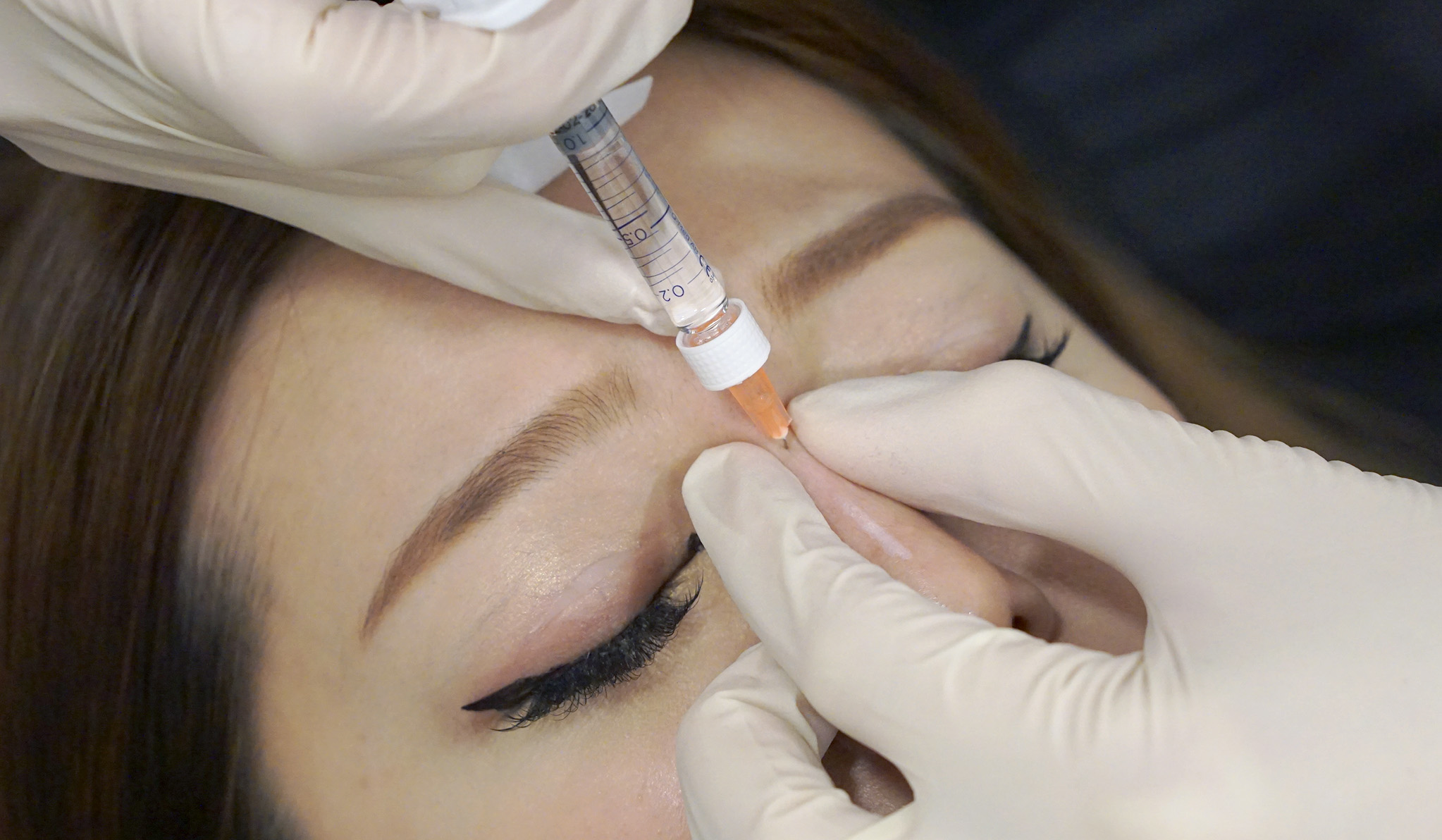
Nose fillers in Singapore at a glance
Nose filler treatment summary
| Item | Details |
|---|---|
| Filler Used | HA filler by default. CaHA filler where a longer-lasting, collagen-stimulating option is preferred. |
| Price | HA filler $1,200 per syringe. CaHA filler $1,400 per syringe. Before GST, review appointment included. |
| Session | About 20 minutes |
| Sessions Needed | Usually one |
| Results | Visible immediately, settling over 1 to 2 weeks |
| Downtime | 3 to 5 days of swelling, sometimes bruising |
| Reversible | HA filler, yes, and it is dissolved with hyaluronidase. CaHA filler, no. |
Nose filler or nose thread lift, which suits your nose
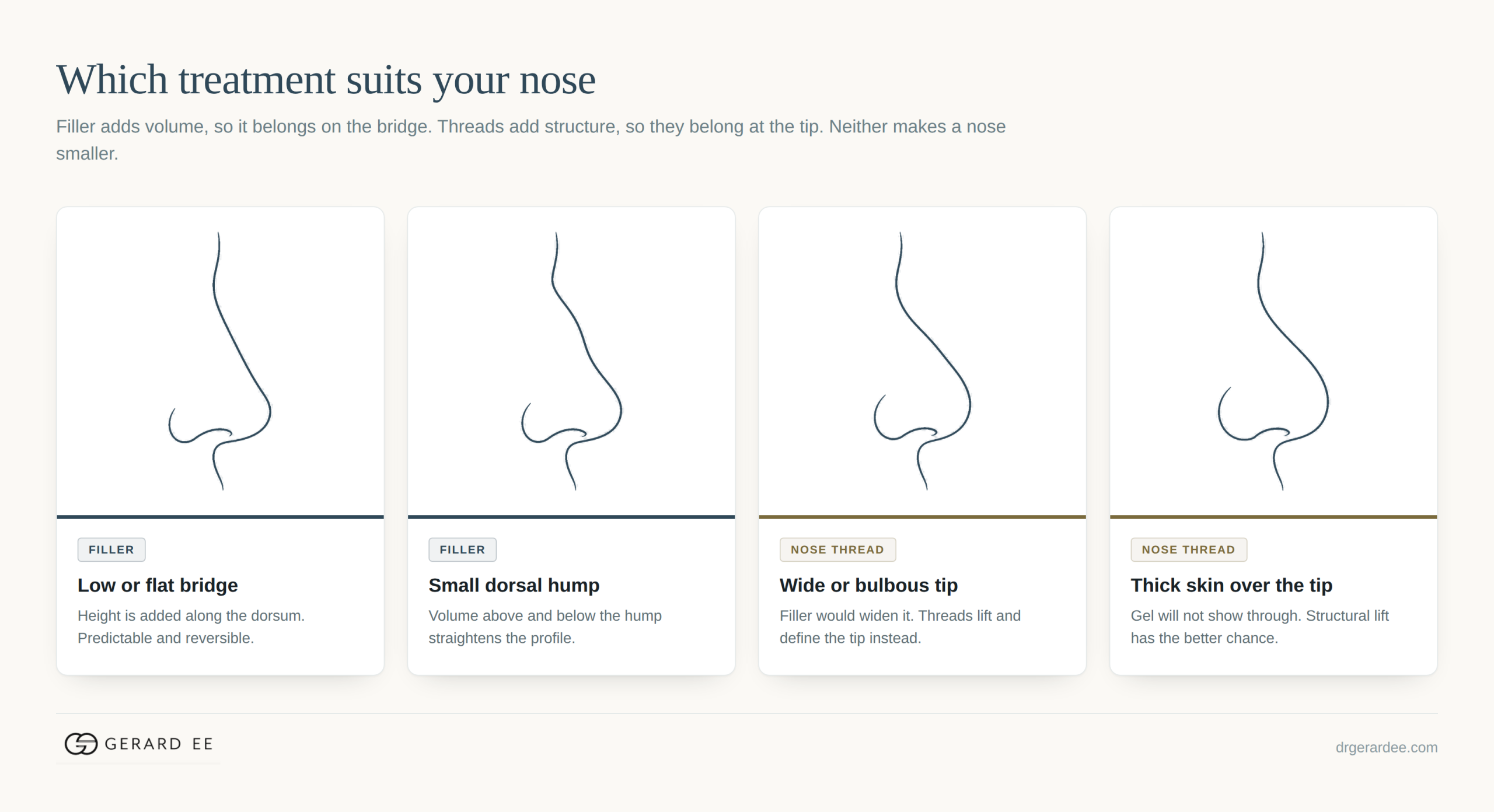
Filler adds volume, so it works on the bridge, where height is what is missing. Threads add structure along the length of the nose, so they lift and rotate a tip rather than push it forward. Neither makes a nose smaller, because both work by adding material rather than removing it. If your concern is overall size, that is a surgical question and I will say so.
What nose filler does for the bridge, hump and tip
Nose bridge filler
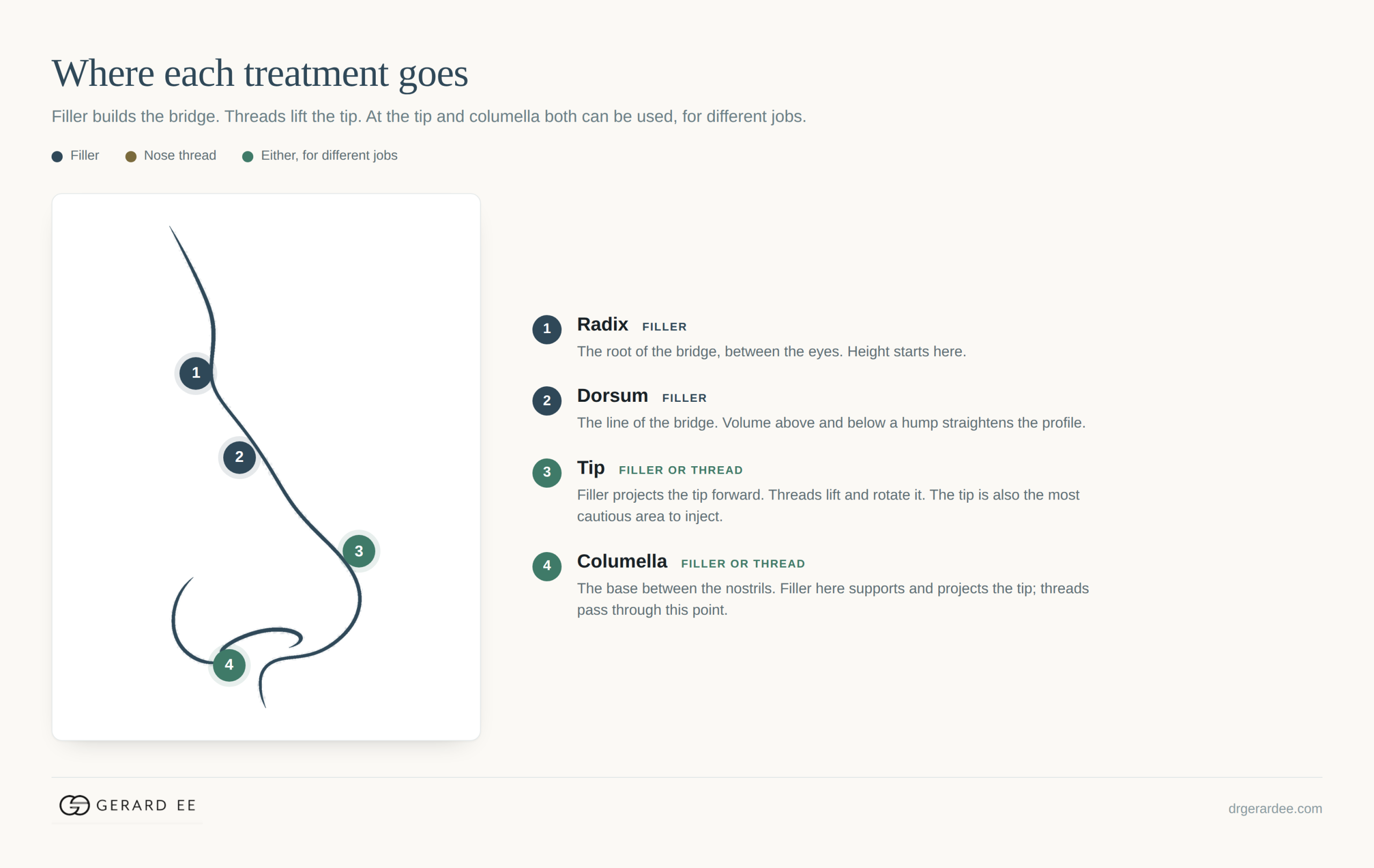
Hyaluronic acid gel is placed along the bridge, at the radix between the eyes, or at the tip and columella. A dorsal hump is not removed, because filler can only add. Volume is placed above and below the hump instead, so the profile reads straighter even though the bump itself is still there. A low bridge is raised by building height along the dorsum, and mild asymmetry is balanced by filling the shallower side until it matches the fuller one.
Nose tip filler
Filler also works at the tip. A small amount at the tip and columella projects it forward and gives the profile more definition, which suits a tip that sits flat or lacks projection. Threads do a different job there, lifting and rotating the tip rather than projecting it, so the two are chosen by what the tip actually needs. The tip is the most cautious area of the nose to inject, and it is treated with small volumes and a slow technique at low injection pressure.
The four shapes I treat most often, the low bridge, the dorsal hump, the flat tip and the curved nose, are described one by one on my nose shape concerns page, and the detail behind how the filler is chosen and placed, with the published safety data, is in my guide to how nose filler works.
Nose filler before and after, what changes and what does not
From the side, the bridge sits higher and the line from the brow to the tip runs straighter, so a hump reads as part of a continuous slope rather than a bump. The tip sits further forward and the angle between the nose and the upper lip opens slightly. From the front, the nose looks narrower, not because anything has been removed but because a higher bridge catches the light along one line instead of spreading it across a flat one.
What does not change: the width of the nostrils, the size of the tip, the length of the nose and the bones underneath. Filler adds; it never takes away. The result is visible as soon as the syringe is out and settles as the swelling goes down over one to two weeks. Photographs are taken at every visit for your own record and compared at the review appointment.
Nose filler for men
Most men who consult me about nose filler are seeking a higher, straighter bridge in profile, or camouflage of a small hump. In a male face the bridge is kept straight from brow to tip and the tip is not rotated upwards, as an upturned tip is perceived as feminine. Male nasal skin is often thicker and oilier, so the bridge can be raised well, whereas fine definition at the tip is harder to achieve because thick skin blurs the contour of the filler beneath it. Where a broad, oily tip is the concern, filler is not the appropriate treatment, and the soft tissue is thinned instead, as described on how to make a bulbous nose smaller. Most men return to work the following day.
HA or CaHA, which nose filler is used
The default is a hyaluronic acid filler, an HA filler from the firmer end of the range. It is firm enough to hold height along the bridge without spreading sideways, it behaves predictably from one syringe to the next, and it can be dissolved with hyaluronidase if the result is not what you wanted.
A calcium hydroxylapatite filler, a CaHA filler, is the alternative where a patient wants something longer lasting, at $1,400 per syringe. It is microspheres suspended in a gel carrier that provide immediate volume and stimulate long-term collagen production, so part of the result is your own tissue rather than the product, and it does not break down on the same timescale.
The difference that matters is reversibility. An HA filler can be dissolved in an afternoon. A CaHA filler cannot, because there is no equivalent antidote, and that applies to an unwanted result and to a vascular complication alike. That is the trade-off for the longer duration, and it is the reason I default to HA in the nose and treat CaHA as a considered choice rather than an upgrade.
Nose filler cost in Singapore
An HA filler is $1,200 per syringe. A CaHA filler is $1,400 per syringe. Both figures are before GST, and both include your review appointment.
These are fixed prices, not starting prices, so the figure does not move according to how much of the syringe is used or which part of the nose is treated. Most noses need one syringe. The consultation is charged separately and waived if you go ahead with treatment on the day.
What happens during a nose filler treatment
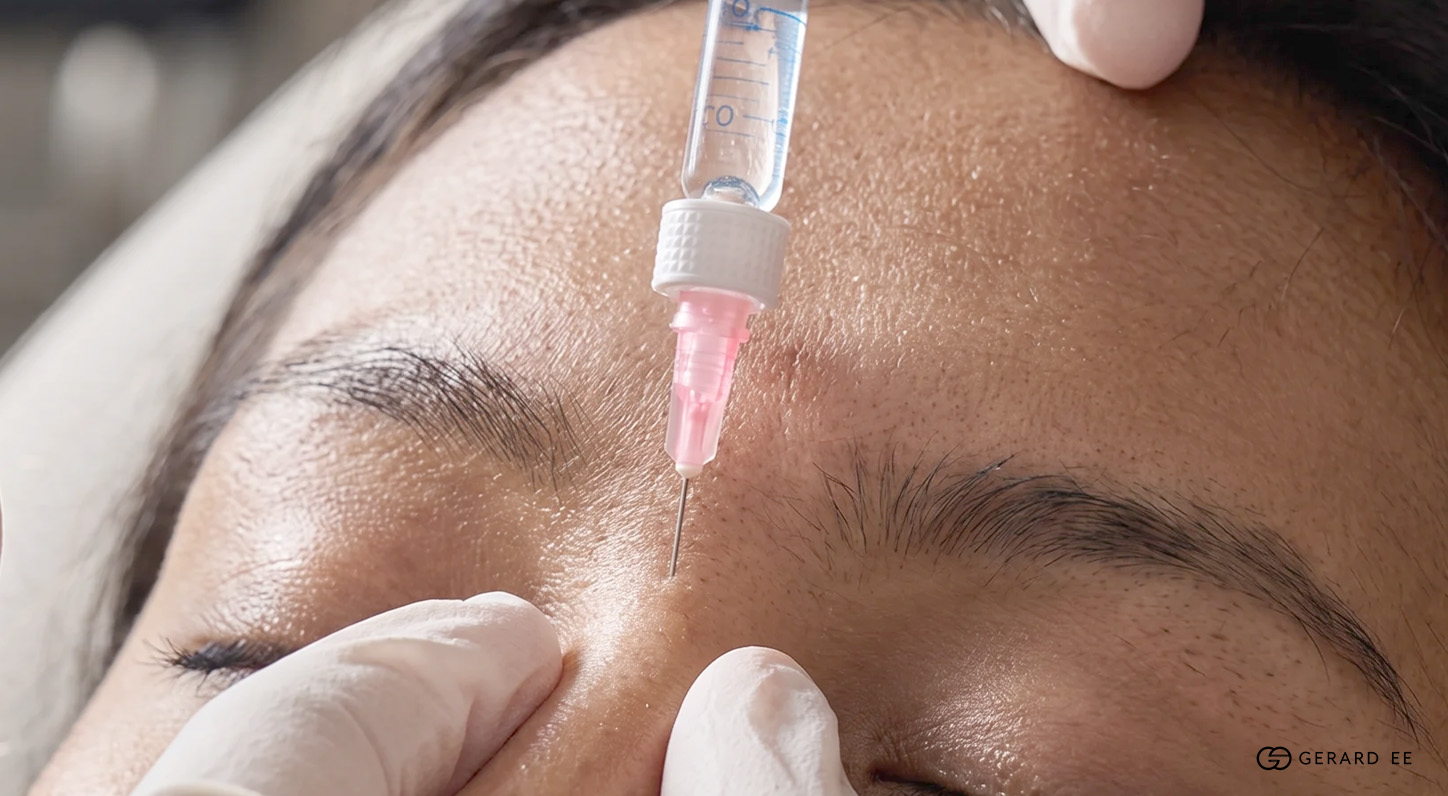
At the consultation I examine and measure the nose, take photographs for your record, and tell you whether filler is right for you. If it is not, that is where it ends, and the reason is explained rather than left as a refusal. If it is, numbing cream goes on and the filler is then placed with the needle, down to the periosteum and staying central, away from any blood vessels. The injection itself takes about twenty minutes. Swelling settles over a few days, and nothing needs to be done to it in the meantime.
Nose filler aftercare and recovery
Keep the area clean and leave it alone. No pressing, massaging or wearing spectacles that rest heavily on the bridge for two weeks. Avoid strenuous exercise, alcohol, saunas and hot yoga for 24 to 48 hours after nose filler, because heat and a raised pulse increase swelling along the bridge. Sunscreen goes on daily. Swelling along the bridge and at the tip settles over three to five days, and any bruising at the radix fades over the same time. The final nose shape shows at one to two weeks, which is when I review the bridge and tip with you and compare the photographs.
Contact the clinic straight away, not at your review, if you develop increasing pain rather than settling discomfort, blanching or dusky discolouration of the skin, or any change in vision. These are uncommon, and they are treatable when they are treated early, which is the reason the call should not wait until the review appointment.
When nose filler is not suitable
Filler is postponed or declined if there is an active skin infection or inflamed acne over the area, during pregnancy or breastfeeding, where there is a known allergy to a component of the product, and where an autoimmune or connective tissue condition is active, each of which either raises the chance of infection at the injection site or makes the response to a complication harder to predict. Blood-thinning medication is not an absolute barrier but it raises the bruising risk and needs discussing beforehand, particularly if you bruise easily on the face.
A nose that has had surgical rhinoplasty is not a routine nose to inject, because previous surgery alters the blood supply. It is not an automatic no, but it changes the risk calculation and I will say so explicitly rather than treat it as a standard case.
Why more nose filler is not better
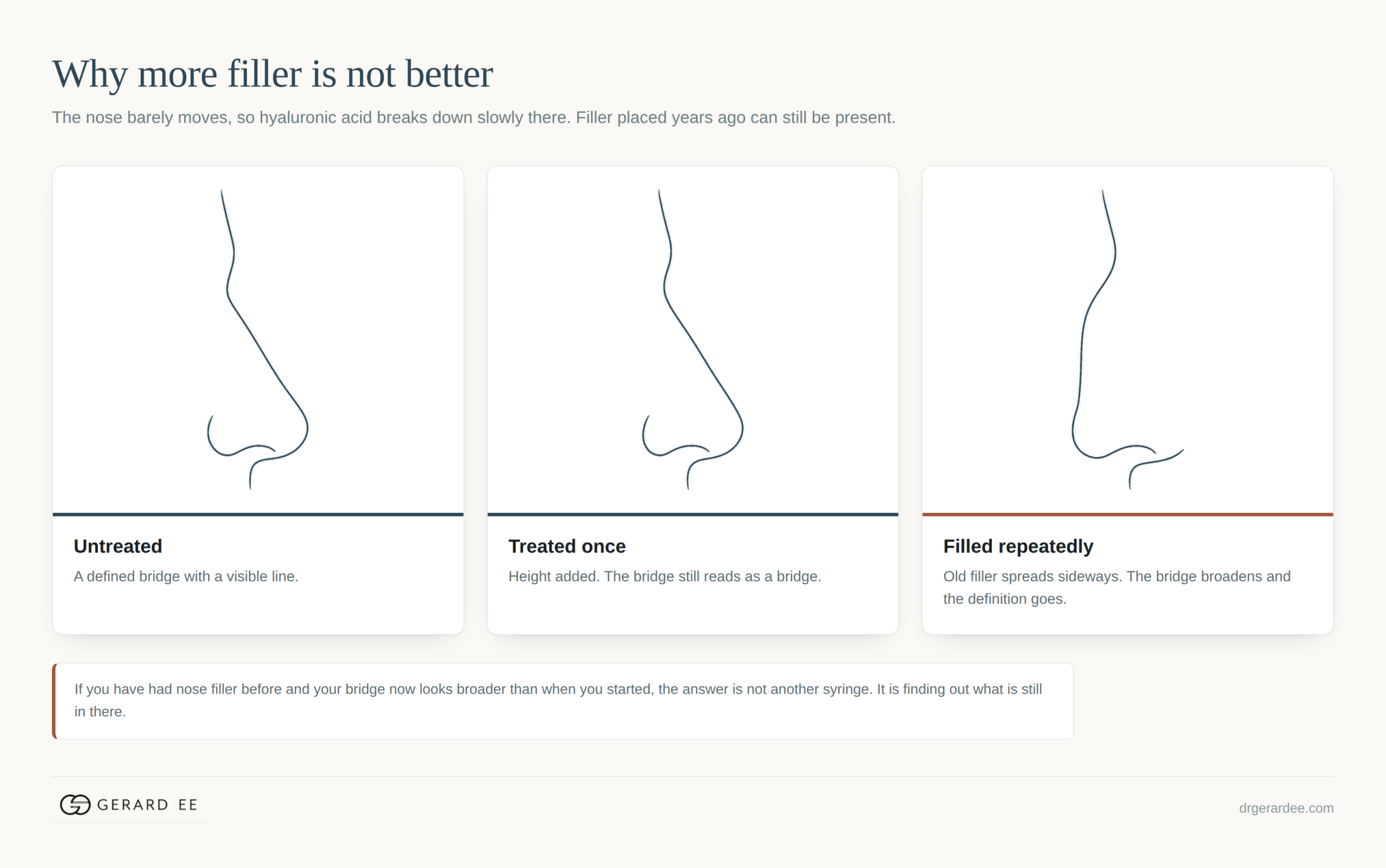
Hyaluronic acid in the nose breaks down slowly because the nose barely moves. Filler placed years ago can still be there, spreading sideways and widening the bridge. If you have had nose filler before and it now looks broader than when you started, the answer is not another syringe. The first step is establishing how much of the old filler is still in place.
Nose filler safety and vascular risk
The nose is the site most often implicated in published cases of filler-related vision loss. The event is rare, but it can cause skin loss or permanent loss of sight. That risk is managed by aspiration, low injection pressure, small volumes, placement down to the periosteum in the midline away from the vessels, and hyaluronidase kept in the room. Hyaluronidase reverses an HA filler, and it does nothing for a CaHA filler, which is a further reason the HA option is the default here. The published data is set out in full in nose threads vs nose fillers.
Nose filler after rhinoplasty or a nose implant
Filler can correct a small dip, step or asymmetry remaining after surgical rhinoplasty, without a second operation. Surgery and scar tissue alter the blood supply of the nose, and published reviews report a higher risk of skin damage from filler in an operated nose, because scarred tissue stretches less around filler and has fewer alternative vessels to compensate if one is compressed. I use smaller amounts over two visits, placed deep on the bone and cartilage, with hyaluronic acid first in most cases, as it can be dissolved if the skin shows any sign of strain. Swelling after rhinoplasty can take up to a year to settle, and small corrections are therefore usually deferred until the result is stable.
Where the skin over an implant is thin or the implant shows through, I do not add filler, and I refer the patient back to a surgeon. Where the skin cover is thick and healthy, a small dip or defect beside the implant can be corrected with hyaluronic acid or Radiesse, placed carefully in small amounts away from the implant. The use of Radiesse for contour defects is covered on Radiesse nose filler.
Nose fillers by Dr Gerard Ee

Dr Gerard Ee, MBBS (UK), MRCS (Edinburgh), PGDip Practical Dermatology (Cardiff). He trained and practised in orthopaedic surgery at Singapore General Hospital and the National University Hospital before moving into aesthetic medicine, has performed nose fillers since 2012, and is the author of sixteen peer-reviewed papers, thirteen of them indexed in PubMed.
The nose is the part of the face where anatomy, injection pressure and knowing what to do when something goes wrong count for more than product choice, which is where a surgical background earns its place. More about the training is on the about page, and the published work is listed on the publications page.
Where I perform nose fillers in Singapore
50 Raffles Place, #01-01 Singapore Land Tower, Singapore 048623. Telephone 6532 2048.
Monday to Friday, 10am to 8pm. Saturday, 10am to 5pm.
I perform nose fillers at my practice at 50 Raffles Place, a two-minute walk from Raffles Place MRT.
Nose fillers in Singapore, frequently asked questions
How much do nose fillers cost in Singapore?
An HA filler is $1,200 per syringe and a CaHA filler is $1,400 per syringe, both before GST and both including the review appointment. Fixed prices, not starting prices. The consultation is charged separately and waived if you proceed on the day.
Is it worth getting nose fillers?
For a low bridge, a small hump or a tip that needs projection, yes, because it does the job at a fraction of the cost and downtime of surgery, and if you choose hyaluronic acid it can be dissolved if you dislike it. For a wide or large nose it is not worth it at any price, because it cannot deliver what you are asking for.
How long do fillers last in your nose?
Nose filler lasts longer than filler placed almost anywhere else in the face, because the nose barely moves. The usual nine-to-twelve-month figure understates it, and residual filler has been confirmed on ultrasound years after a single treatment. That is worth knowing before a second syringe.
Can filler lift or project my nose tip?
Yes, filler can do both. A small amount at the tip and columella projects the tip forward and sharpens the profile. If what you want is the tip rotated upwards rather than pushed forward, threads have the better mechanism. Which one suits you depends on the tip you start with.
Can I have nose filler after rhinoplasty or over an implant?
Filler is often suitable for a small dip, step or asymmetry, once the nose has settled after surgery. Where the skin over an implant is thin or the implant shows through, I do not add filler.
Is nose filler different for men?
In men, the bridge is kept straight and strong and the tip is not rotated upwards. Thicker male skin also shows less definition at the tip.
Nose filler or nose thread?
Filler for the bridge. For the tip, either will work, since filler projects and threads lift and rotate. Neither makes a nose smaller. The full comparison, with the published studies, is in nose threads vs nose fillers.
What are the side effects?
Swelling along the bridge, bruising at the radix and tenderness at the tip are usual for a few days, and a small lump can occur and settle as the filler integrates. The serious one is filler entering a blood vessel, which is rare but can cause skin loss or loss of sight. The nose is the site most often implicated in published cases, which is why technique and having hyaluronidase in the room matter.
Is nose filler safe?
Nose filler is safe when it is placed with the precautions the nose needs, and it is the site where those precautions matter most. The serious risk is filler entering a blood vessel, which is rare but can cause skin loss or, in the worst reported cases, loss of vision. I manage that by aspirating before injecting, using low pressure and small volumes, placing the filler on the bone in the midline away from the vessels, and keeping hyaluronidase in the room to dissolve an HA filler immediately if it is ever needed.
Which filler do you use for the nose?
An HA filler by default, a hyaluronic acid gel that holds height well and can be dissolved, at $1,200 per syringe. A CaHA filler is available at $1,400 where a patient wants something longer lasting, with the trade-off that it cannot be reversed.
Can nose filler be dissolved?
An HA filler, yes, because hyaluronidase breaks it down, usually within hours. A CaHA filler cannot be dissolved, which is the main reason to think carefully before choosing it for the nose.
Do nose fillers hurt?
Numbing cream is applied over the nose first and left on until the bridge and tip are numb. Most patients describe pressure rather than pain. The radix, the area between the eyes, is the most sensitive part, which is why it is injected slowly and in small amounts.

Book a nose filler consultation with Dr Gerard Ee
Dr Gerard Ee consults and performs nose filler treatment at his practice at 50 Raffles Place, Singapore. Consultations are by appointment. Message the clinic on WhatsApp, or call 6532 2048.
This page is written from published research and from clinical experience in Singapore since 2012. It is for general education, not medical advice. Whether a treatment suits you, what it may achieve and what it may risk can only be established at a consultation. Dr Gerard Ee is the Medical Director of The Clifford Clinic, a private clinic in Singapore, and treatments discussed on this site are provided commercially.

