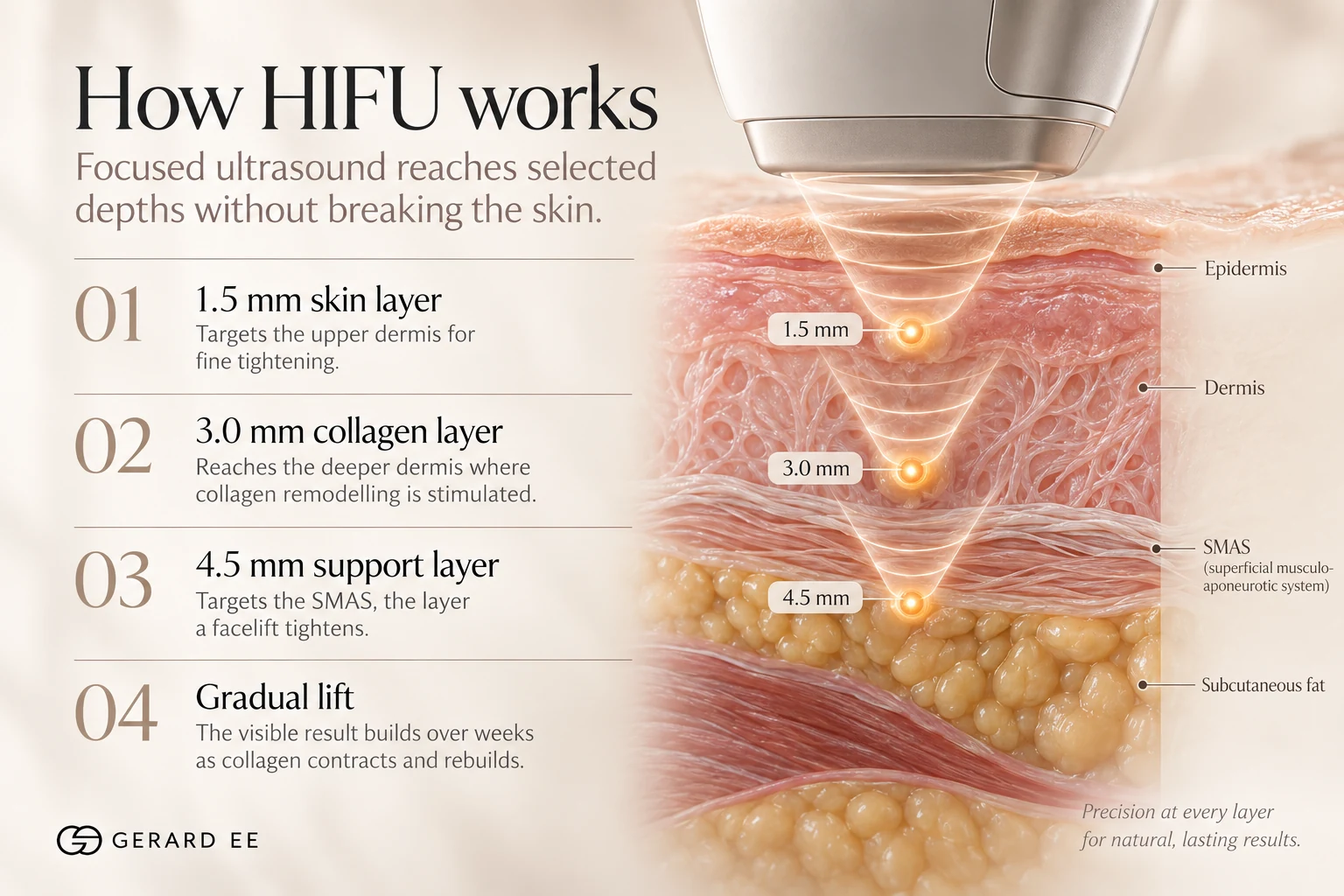
HIFU (high-intensity focused ultrasound) is a non-surgical face lift that places small points of heat at depths of 1.5, 3.0 and 4.5 mm beneath the skin. The heated tissue contracts on the day of treatment and is then rebuilt with new collagen over the following two to three months. I have performed HIFU in Singapore since 2012 and use two machines, Tightan 2 for focused HIFU and Sygmalift for fractionated HIFU.
HIFU is the most searched non-surgical face lift in Singapore, and also the most confusing, because the same name is applied to treatments that differ in machine, depth and operator. Search for HIFU Singapore and you will find a HIFU face lift advertised at prices from $250 to $3,500, performed by doctors and by therapists, on machines that share little beyond the name. This guide covers what HIFU does, which faces it suits, which HIFU machine a clinic is offering, what it should cost and why it disappoints. Each study cited is listed at the end with a link to the paper, and statements drawn from my own practice are identified as such.
Key takeaways on HIFU treatment
- HIFU is focused ultrasound that heats small points of tissue at 1.5, 3.0 and 4.5 mm beneath the skin. The tissue contracts on the day and is rebuilt with new collagen over two to three months.
- HIFU suits a face that has begun to sag but retains good skin quality, usually between the late thirties and the late fifties. A thin face, a face with marked volume loss and a face with heavy acne scarring are not suitable.
- Three different treatments are sold as HIFU in Singapore. Deep three-depth HIFU lifts a face that has dropped. Gentle fractional HIFU firms the skin over a course of sessions. Single-depth or mini HIFU cannot reach the layer that a lift requires.
- Deep HIFU is a single session. Results appear at two to three months and last about a year, and pooled studies show improvement in about three in four suitable patients.
- HIFU prices in Singapore run from $250 to several thousand dollars because different treatments share the name. In my practice, Tightan 2 is $3,500 for the full face, neck, under the chin and eyes, and Sygmalift is $1,200 a session or $4,500 for five, before GST.
- I have performed HIFU since 2012, treat about ten faces a week with it, and have travelled to Korea to discuss HIFU technique with Korean doctors.
What HIFU treatment is and how it lifts the face
| HIFU at a glance | |
|---|---|
| What it is | Focused ultrasound that heats tiny points under the skin to lift and tighten |
| Depths | 1.5, 3.0 and 4.5 mm |
| Machines used here | Tightan 2 (focused HIFU, for lifting) and Sygmalift (fractionated HIFU, gentle) |
| Sessions | Deep HIFU is one session. Gentle HIFU is a course of five, about a month apart |
| When results show | Two to three months |
| How long it lasts | About a year, sometimes longer |
| Pain | 3 to 6 out of 10 in published studies, with numbing cream for deep HIFU |
| Downtime | None |
| Price here | Tightan 2 $3,500 for full face, neck, under the chin and eyes. Sygmalift $1,200 a session or $4,500 for five. Before GST. How HIFU prices compare |
Ultrasound is sound at a frequency too high to hear. At the low intensity used in a pregnancy scan, it passes through tissue without heating it. When the beam is focused to a single point, in the way a magnifying glass focuses sunlight, the energy converges there and heats a spot of tissue roughly the size of a sesame seed to above 60°C, the temperature at which collagen contracts. A HIFU treatment places hundreds of these points in lines at selected depths, and because the energy converges only at the focal point, the skin surface above it is not heated.
Each heated point produces two effects. The collagen fibres at that point contract immediately, which accounts for the slight lift some patients notice on the day of treatment. Over the following weeks, the body repairs each point with new collagen, and this remodelling produces the lasting result. In the first Asian study, skin samples taken from Korean patients before and two months after a single treatment showed more collagen and firmer elastic fibres in the treated skin [2].
Depth distinguishes HIFU from other non-surgical tightening treatments. Radiofrequency devices such as Thermage and Oligio heat a broad volume of tissue just beneath the skin surface. At 4.5 mm, HIFU reaches the superficial musculoaponeurotic system, the thin, tough support layer over the facial muscles that a surgeon tightens during a facelift. HIFU is therefore the better choice when the face has dropped, whereas radiofrequency is better suited to skin that has loosened without descending.
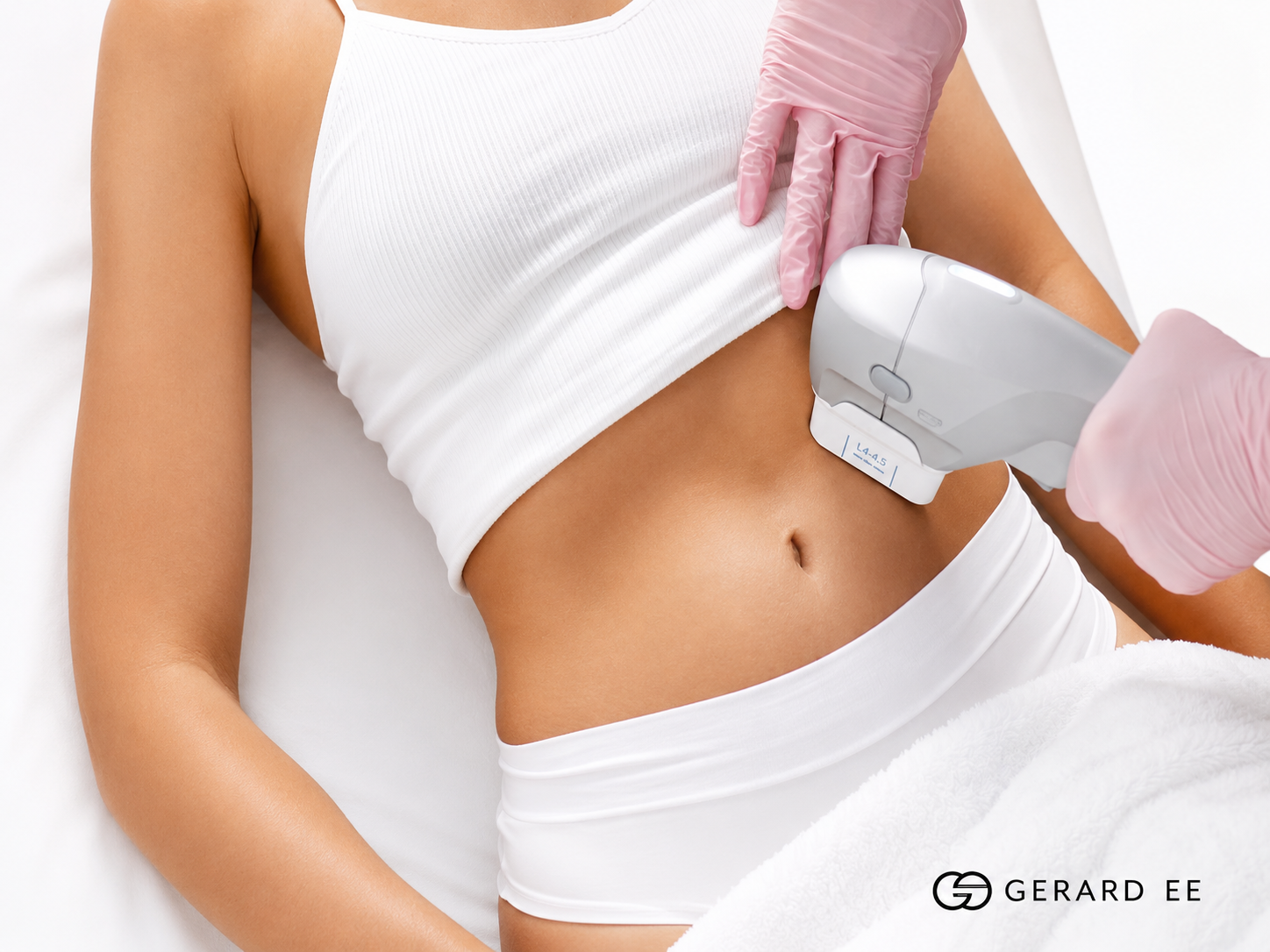
HIFU treatment areas on the face, neck and body
- Cheeks. HIFU lifts cheek fat that has descended and deepened the fold beside the nose.
- Jowls and jawline. HIFU restores definition to a jawline that has softened and reduces early jowls.
- Double chin. A mild double chin consists as much of loose tissue as of fat, and HIFU tightens the tissue while the heat at the deeper focal points reduces the fat. The reduction has been measured on side-view photographs [7]. The HIFU double chin page explains when a dedicated fat reduction treatment achieves more.
- Neck. A randomised trial has shown measurable tightening of the neck [12].
- Brow. The first controlled study measured the brow lift directly [1].
- Around the eyes. The eye area is treated with a smaller handpiece and conservative settings because the skin is thin. Gentle fractional HIFU suits the eye area best, including crow’s feet, the skin under the eye and the upper lid. Neither type of HIFU removes an eye bag, which is fat pushing forward and has a treatment of its own. For the upper eye area, HIFU complements the AGNES with Secret RF eyelid lift, and both are compared in the droopy eyelids guide.
- Body. HIFU treats the abdomen after pregnancy or weight loss, the upper arms and the inner thighs with a deeper body cartridge. Reviews report a reduction of a few centimetres in circumference [8]. Body HIFU suits loose skin over a modest amount of fat and does not replace weight loss.
The full face is the usual treatment area, because sagging rarely confines itself to one region, and a lifted cheek makes an untreated jawline appear heavier by contrast. An isolated double chin is common in younger patients who have no sagging elsewhere, and it can be treated on its own.
Who is suitable for a HIFU face lift, and who is not
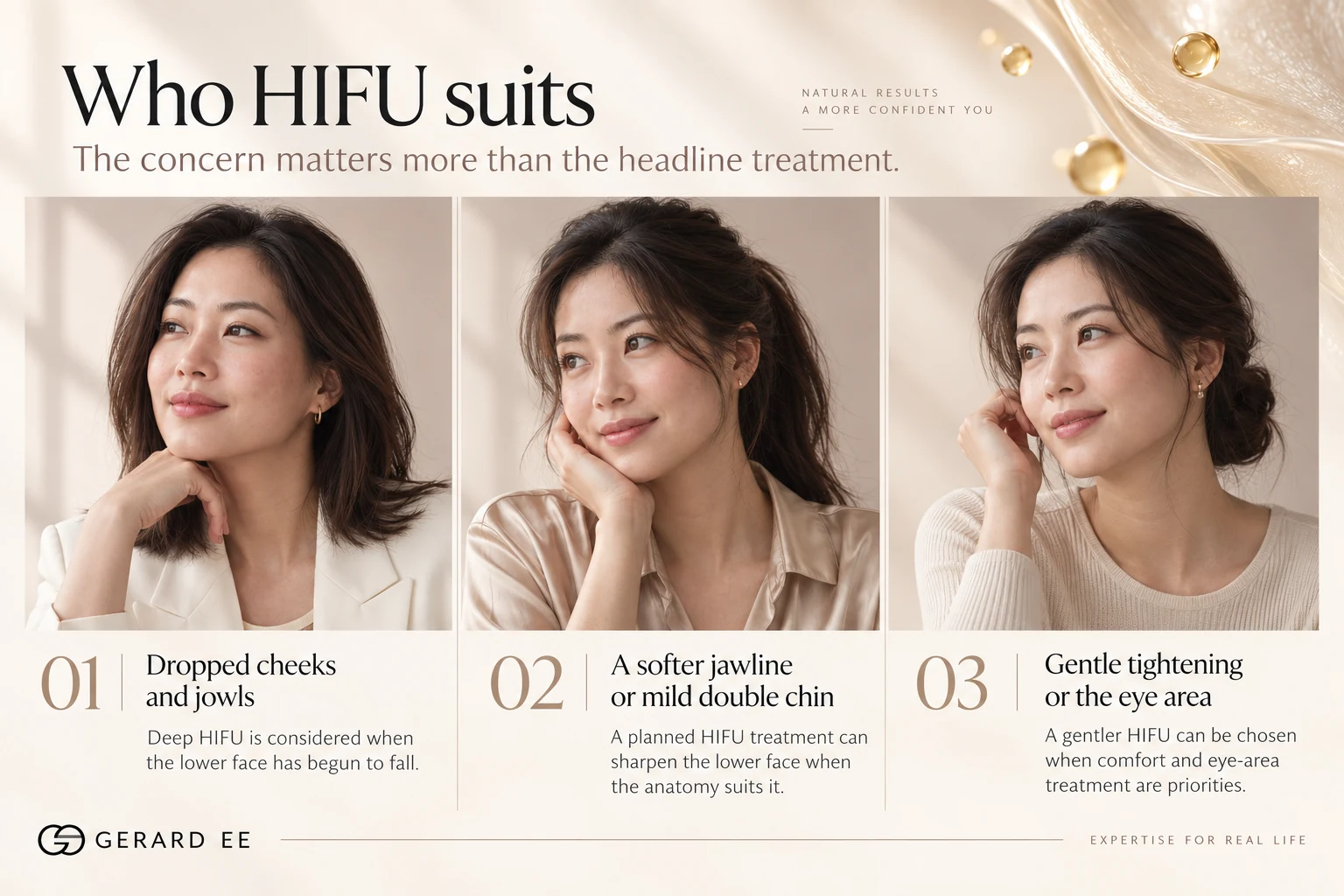
HIFU suits a face that has begun to sag but retains good skin quality. The typical patient is between the late thirties and the late fifties, presents with early jowls, a softening jawline, a descending cheek, a mild double chin or a loss of definition in the neck, and wants a lift without an operation, a scar or time off work. If your jawline has softened or your cheeks have started to drop, but your skin is still in good condition, you are likely to be a good candidate.
I decline HIFU for three types of face, and in each case the published research supports the decision.
- A face with marked volume loss. Deep HIFU reduces fat as well as tightening tissue, so a thin or deflated face loses further volume and appears gaunt rather than lifted. A Korean study on an earlier machine from the manufacturer of Tightan 2 reported that deep ultrasound “can also cause significant fat atrophy, limiting its use in patients with a lean face” [11].
- A face with extensive acne scarring. Acne scars lie in the upper skin, which HIFU deliberately spares, so lifting the tissue beneath them does not improve their appearance. That face needs scar treatment first.
- A face with advanced sagging or a heavy face. The response falls away with both in the published studies [3, 7]. In the largest trial, more than half of the patients with a body mass index (BMI) over 30 showed no change at all, compared with about one in eight of the other patients [3]. A few millimetres of tissue contraction cannot support the weight of heavy jowls or a fully descended neck, and those faces are better assessed for threads or surgery.
HIFU is not performed during pregnancy, over metal implants in the treated area, over an active skin infection, or on skin with open spots or severe acne. Where texture, pores or acne scars are the main concern, RF microneedling or another skin treatment is assessed instead. RF microneedling acts on the upper skin, where texture and scarring lie, whereas HIFU acts on the deeper support layer, so the two are not interchangeable even though both stimulate collagen.
HIFU on Asian skin and the risk of pigmentation
Laser light is absorbed by melanin, which is the source of the pigmentation risk that lasers carry on darker skin. Ultrasound is not absorbed by melanin, and HIFU leaves the skin surface unheated, so that risk does not apply in the same way. A trial of 52 people with skin types III to VI on the Fitzpatrick scale, from light brown to deeply pigmented skin and covering most Singaporeans, recorded three temporary side effects, all resolved by three months [13]. The first Asian study, in Korean patients, found improvement in every patient and no lasting side effects [2].
HIFU for patients in their twenties, sixties and seventies
Patients at both ends of the age range request HIFU, and in my practice I usually recommend the gentle machine for both. In the twenties the skin is not sagging, and deep treatment risks fat loss in a face with none to spare. Sygmalift firms the skin and, on its fat reduction setting, sharpens the jawline and chin, which is usually the aim at that age. In the sixties and seventies the loosening is more advanced. Deep HIFU achieves little lift on an advanced sag, is less comfortable, and does not treat the upper layer of the skin, where an older face shows most of its ageing. Sygmalift is mild, comfortable and treats that upper layer. The result is gentler, but for these two groups a gentle result that can be tolerated and repeated is the better balance.
Does a HIFU face lift work? What the studies found
A HIFU face lift works for a suitable face, and the research quantifies the effect. The first controlled study, published in 2010, treated 35 people across the whole face and neck, and three doctors who were blinded to the treatment rated the photographs. At three months, 30 of the 35 showed a visible brow lift, averaging just under two millimetres [1]. The largest single trial, of 93 people treated on the lower face, found improvement in about six in ten patients by blinded assessment and in two in three by the patients’ own rating [3]. Pooled across studies, roughly three in four suitable patients improve at three months, and about seven in ten remain improved at six months [5]. A 2025 pooled analysis put improvement closer to nine in ten, although its authors cautioned that the figure may be overstated [6].
Two limitations in the same studies are as important as the positive findings. The lift is measured in millimetres, and one review describes the improvement as mild [7], so HIFU produces a visible change but not the result of a surgical facelift. Results also diminish as sagging advances and as body weight increases, most clearly in patients with a BMI over 30 [3].
HIFU results in my practice
The published figures are consistent with my own results. Most suitable patients improve, and those who do not are the patients the studies predicted, with a heavy face or an advanced sag, neither of whom I treat with HIFU. The complaint I hear most often from patients treated elsewhere is not a burn or hollowing but that HIFU produced no result at all. On examination and on review of what was done, the cause is usually too few shots, shots placed in the wrong area or a machine that never reached the support layer, as described in the next two sections.
Doctor-grade HIFU vs therapist-grade HIFU, the three types sold in Singapore
Not every treatment sold as HIFU in Singapore is the same, and some of it is marketed as a “HIFU facial”, which is a contradiction. A facial acts on the skin surface, whereas HIFU acts beneath it. The machine accounts for most of the spread in prices and for most of the reports that HIFU produced no result.
| Deep, three-depth HIFU | Gentle, fractional HIFU | Single-depth or “mini” HIFU | |
|---|---|---|---|
| Depths | 1.5, 3.0 and 4.5 mm, with a cartridge for each | Many weak fractions in the upper layers of the skin | One cartridge, usually shallow |
| Who performs it | A doctor | A doctor or a trained therapist | Usually a therapist |
| What it does | Lifts a face that has dropped | Firms and smooths, and can be set to reduce fat under the chin | Firms the skin a little |
| Sessions | One, repeated after about a year | A course of five, about a month apart | Sold by the shot, often as a package |
| Pain | 3 to 6 out of 10 in studies, with numbing cream | Close to painless | Mild |
| Published evidence | Dozens of trials, including systematic reviews [1, 2, 3, 5, 6, 11] | Thinner than the deep machines | None found |
| Examples | Ultherapy, Ultraformer, Tightan 2 | Sygmalift | Unbranded machines sold by shot count |
| Price here | Tightan 2, $3,500 full face, neck, chin and eyes | Sygmalift, $1,200 a session or $4,500 for five | Typically $250 to $600 elsewhere |
Deep three-depth HIFU, the focused machines that lift
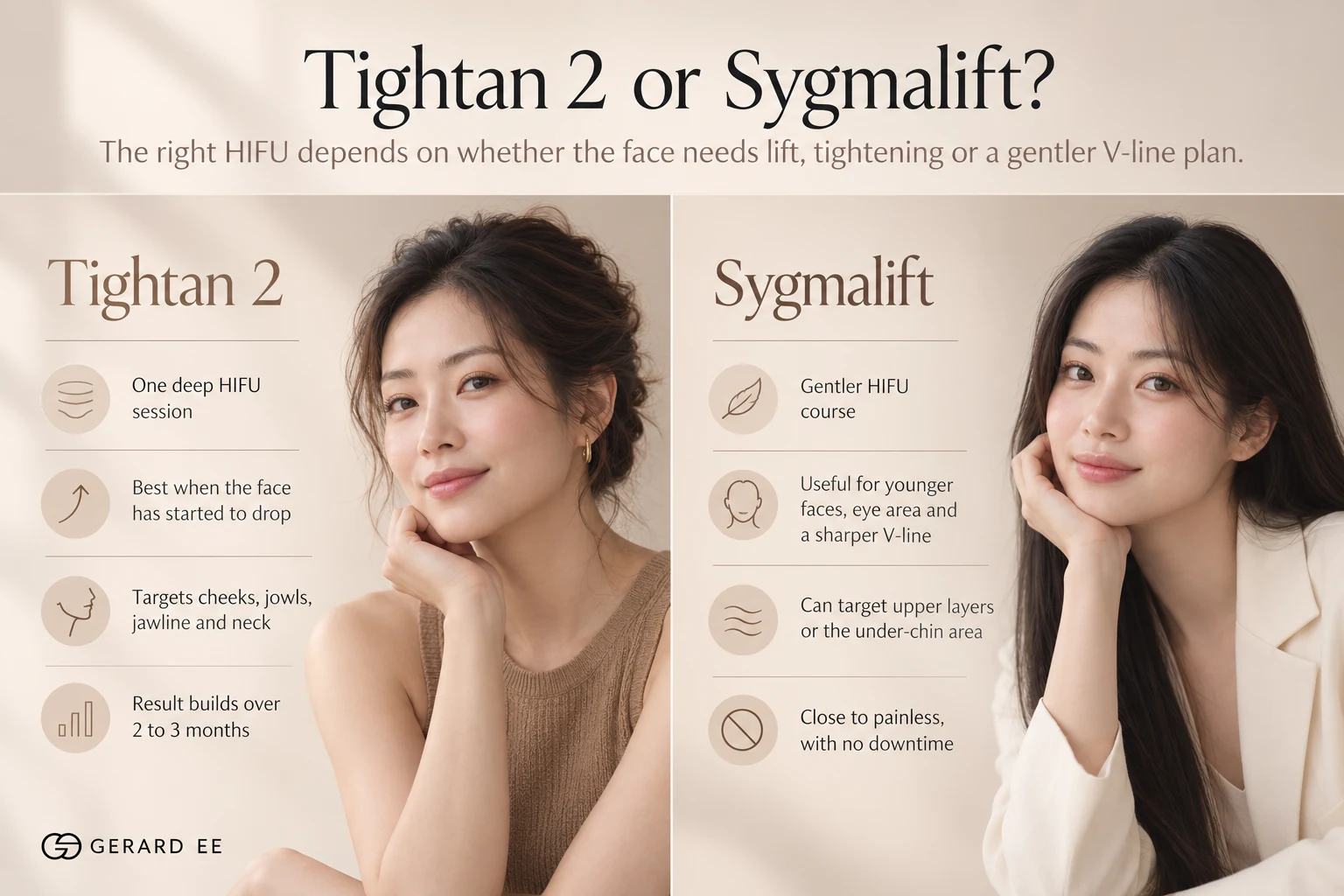
The lifting research was conducted on these machines [1, 2, 11], and they are the only type that lifts a face that has dropped. Ultherapy is the original system and displays an ultrasound image of the tissue layers to the operator. Ultraformer is a widely used Korean system. Tightan 2, which I use for lifting, is a Korean system from WONTECH, the company whose earlier machine was tested in the Korean study cited above [11]. It treats the same three depths, has a pen-shaped handpiece for the eyes and the jawline, and delivers its shots quickly, which shortens the time spent under treatment.
Gentle fractional HIFU, the machines that firm
Fractional, or fractionated, HIFU divides each pulse into many low-energy fractions placed close together in the upper layers of the skin. Each point delivers far less heat, so the treatment is close to painless, and because the energy remains shallow it can be used close to the eyes. It firms and smooths the skin rather than lifting the face, and is given as a course. Sygmalift, the fractionated machine I use, can also be set to reduce fat under the chin and along the jawline. Its published evidence is thinner than that for the deep machines, so the deep HIFU figures quoted in this guide do not apply to it.
Single-depth and mini HIFU, and why it cannot lift
Single-depth HIFU uses one cartridge, usually a shallow one, and is sold cheaply and often by the number of shots. It can firm the skin slightly, but it cannot reach the support layer treated in the lifting studies, so it does not lift a face that has dropped. A patient who paid for a lift and received this treatment is the most common case of failed HIFU that I see. The differences between machines are set out on the HIFU machines page.
How to tell which type of HIFU a clinic is offering
Four questions identify the treatment before booking. The first is which machine will be used, by name. The second is which depths it treats, and whether the deep 4.5 mm layer is included. The third is whether a doctor or a therapist will perform the treatment. The fourth is whether the price covers the whole face in one session at a fixed cost, or is a trial that is later converted into a package. A clinic that answers all four clearly is offering a defined treatment, whereas a clinic that answers with a shot count alone is offering a number that says nothing about depth or placement.
HIFU shot counts, and why I do not advertise one
I do not advertise a shot count, because the number of shots I use is customised to each face. Some clinics charge less because they deliver very few shots. A very low full-face price usually means too few shots or a single depth, and a smaller result. Other clinics deliver enough shots but place them poorly, with hundreds across a cheek that cannot afford the fat loss and too few along the jawline that needed lifting. Neither problem is visible in the advertised number. The result depends on a treatment planned to the patient’s anatomy, with the correct depth and number of lines for each area of the face.
What HIFU costs in Singapore, and why prices vary so widely
HIFU Singapore price lists run from $250 to several thousand dollars. The range does not reflect one treatment sold at different margins but several different treatments that share a name. The price depends on the machine and the number of depths it treats, whether a doctor or a therapist performs it, how much of the face is included, and whether the quote is a single fixed price or the first instalment of a course.
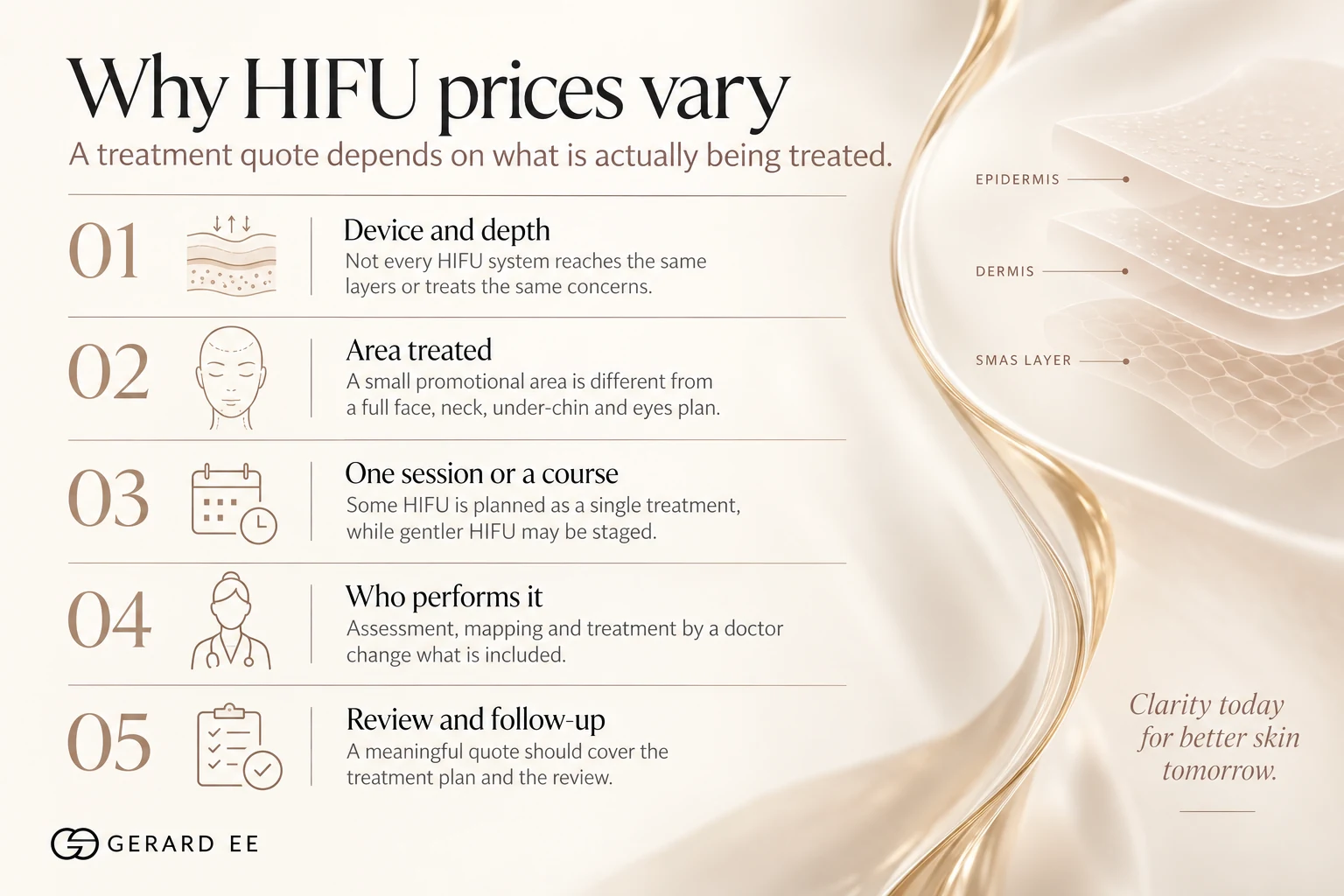
In my practice, deep HIFU with Tightan 2 is $3,500 for the full face, neck, under the chin and eyes in one session, before GST, with the review included and no additional charges on the day. Sygmalift is $1,200 for a session of about an hour, or $4,500 for a course of five. For early loosening without descent, a less expensive treatment may be sufficient. For a face that has begun to descend, a $250 promotion rarely delivers enough energy at the deep layer to produce a lift, whereas a three-depth machine planned and operated by a doctor usually does. The HIFU price guide shows how to compare two quotes line by line, and the sagging skin page sets out which layer each treatment addresses.
How long does HIFU last, and how many sessions?
Deep HIFU is a single session. A slight lift may be visible on the day, which partly subsides over the first week as the initial swelling settles. The lasting result develops over two to three months as new collagen forms, and the studies therefore measured outcomes at three months [1, 3, 4]. The improvement held to at least six months in the studies that followed patients for that long [4, 5], and one review found patients still reporting improvement at a year [7]. In my practice the result lasts about a year, sometimes longer, because the face continues to age after treatment, and most patients repeat the treatment annually. Gentle HIFU is given as a course of about five sessions a month apart, followed by a maintenance session about every six months.
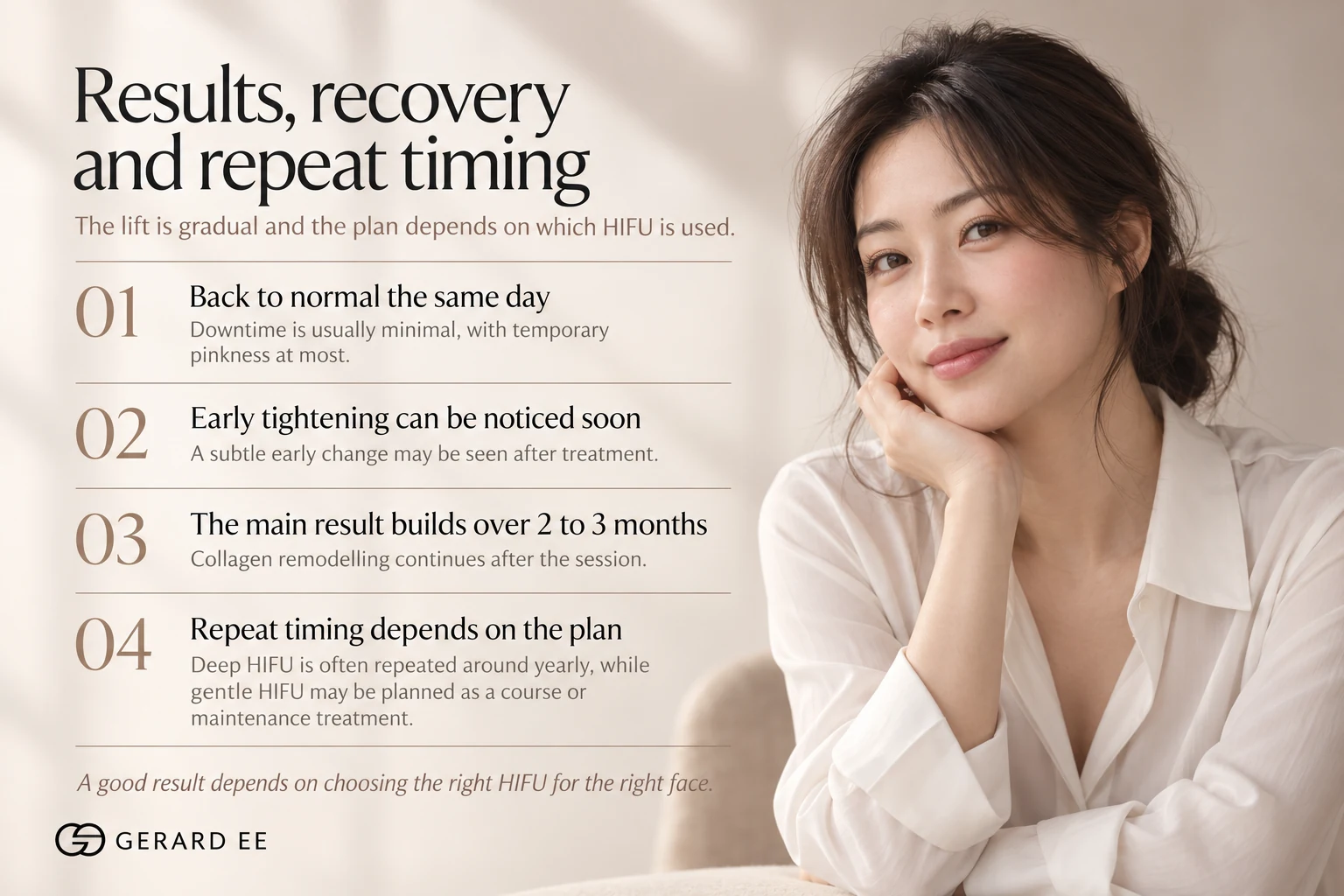
A realistic expectation from deep HIFU is a lifted cheek, a sharper jawline, lighter jowls, a smaller double chin and better definition in the neck, but not the result of a surgical facelift.
What happens at a HIFU appointment, and what the treatment feels like
The treatment decision is made at the consultation. I assess how far the face has descended and how much of the change lies in the skin, the fat and the support layer, decide which layers to treat and which to leave alone, and mark the treatment lines on the face rather than following a fixed grid. A small 2026 study of women over 60 compared standard HIFU with treatment planned to each woman’s own tissue thickness measured on ultrasound, and the individually planned group achieved better results [16]. Photographs are taken at the consultation for comparison at the review.
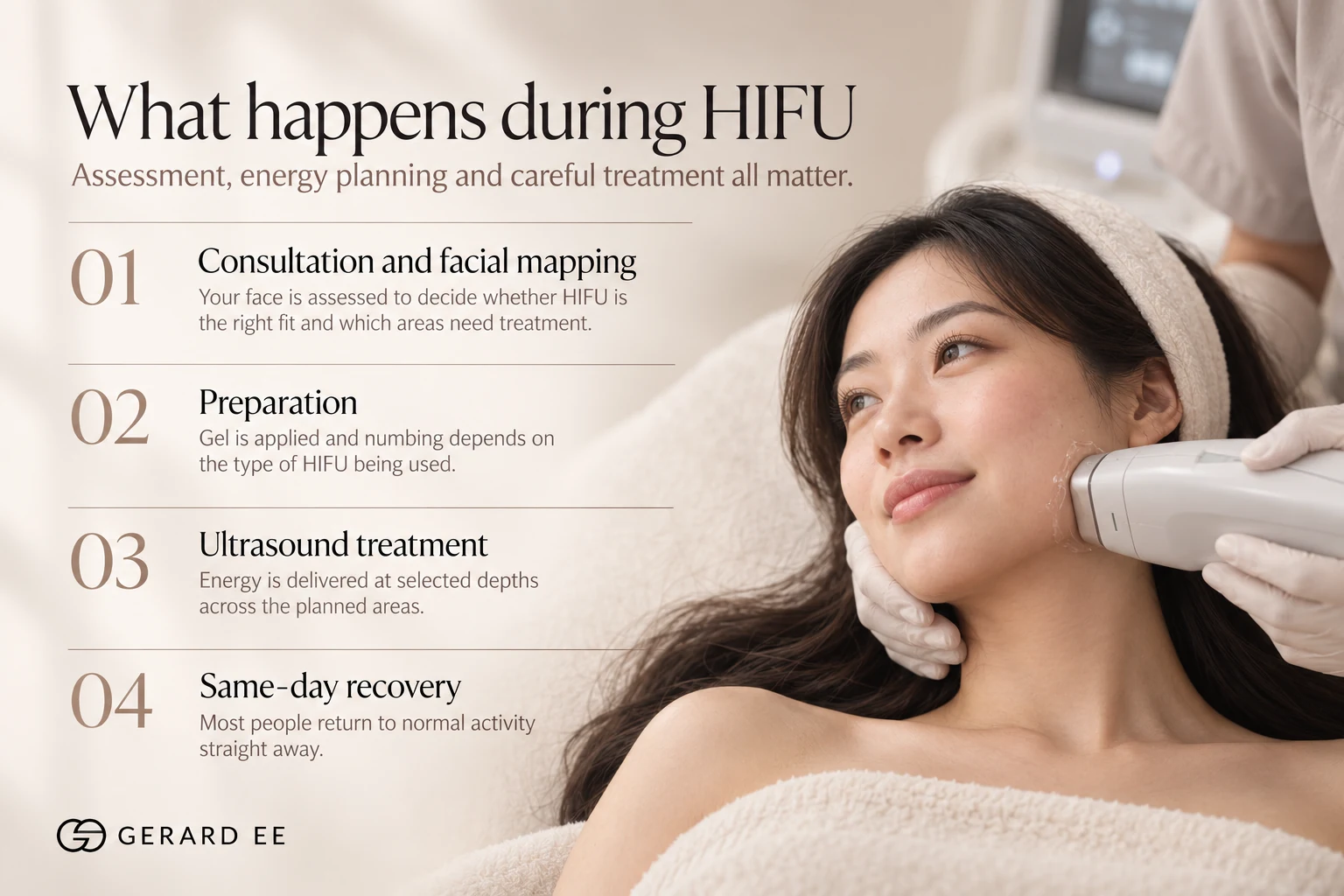
On the day of treatment, numbing cream is applied for 20 to 30 minutes. A cold ultrasound gel is then spread over the skin, and the handpiece is moved across each area in passes. Each pass produces a brief, deep prickle of warmth, strongest over the jawbone and brow, where the energy lands close to the bone, and mildest over the cheek, where more soft tissue lies above the bone. The deep layer is treated first, then the collagen layer, then the eyes and jawline with the pen handpiece. The full face takes 60 to 90 minutes on the deep machine and about an hour on the gentle one. No marks are left on the face, and patients can return to work immediately.
Having had HIFU myself, I can describe the sensation. Each shot can sting briefly, and the discomfort ends when the pass ends. The studies put pain at about 3 to 6 out of 10 [3, 5, 6], and in the pooled studies no patient was unable to complete treatment [5]. Numbing cream is used for the deep treatment, whereas the gentle treatment requires none.
HIFU pain and comfort in my practice
Tightan 2 is considerably more comfortable than the Ultherapy systems I used for years before it. The pain of deep HIFU depends more on the energy settings and the operator than on the brand of machine, and pushing through severe discomfort gains nothing. Effective settings are those that the patient can tolerate for the full treatment.
HIFU by a doctor or a therapist, and why the difference matters
HIFU is offered in Singapore by both doctors and therapists. The difference lies less in the machine than in the treatment plan. A doctor decides, line by line, which depth each area of the face requires, knows where the facial nerves and vessels run, and can identify when HIFU is the wrong treatment for a particular face. The safety research supports this. Surface burns occurred where technique was poor [9], and the trial in darker skin concluded that the treatment is safe “when performed by trained physicians” after every side effect was traced to technique [13]. Technique matters more with a deep machine than with a gentle one, and every HIFU treatment at the clinic, deep or gentle, is performed by me.
When HIFU disappoints, and why
Most poor HIFU results in Singapore have one of four causes, each documented in the safety literature.
- Unwanted fat loss. Deep HIFU reduces the fat under the skin as well as tightening the layer beneath it. In a full face this contributes to the result, but in a thin face, or a face treated at too high an energy or too often, it produces hollow temples and cheeks that appear months later [11]. A 2025 review found fat loss among the most common complaints filed with the United States Food and Drug Administration, alongside nerve problems and scarring, even though the published studies recorded only one case [10].
- Treatment at the wrong depth. A single-depth machine cannot lift a face that needs all three depths, and when the energy never reaches the support layer, the patient pays for a lift and receives slightly firmer skin.
- Marks on the skin. Correctly delivered HIFU leaves no visible trace, so welts, lines, blisters or small burns indicate that energy reached the surface, through poor contact between handpiece and skin, the wrong cartridge or excessive energy in thin skin. The safety review attributes these to poor technique [9], and a systematic review puts the rarer effects, including numbness, bruising and small burns along the jaw, at around 2 per cent [7].
- Nerve effects. Tingling or numbness along the jaw for a week or two can occur even with correct treatment and settles without intervention [9]. Weakness from a facial nerve injury is rare and has been reported in single case reports [14, 15]. The branch of the facial nerve that moves the lower lip runs close to the surface along the jaw, and the risk is lowest when the operator knows its course and adjusts the depth over it.
Across the studies, the usual side effects are redness, mild swelling and tenderness that settle within days [6, 9]. None of these is a reason to avoid HIFU, but each is a reason to be treated by a doctor who assesses the face and declines HIFU when it is the wrong treatment. The consequences of a HIFU treatment gone wrong are covered on the HIFU risks page. Volume loss is corrected with filler rather than HIFU, and the nose, chin, cheek and temple filler pages set out what each treatment does.
How HIFU compares with Ultherapy, Thermage and Oligio
How HIFU compares with Ultherapy
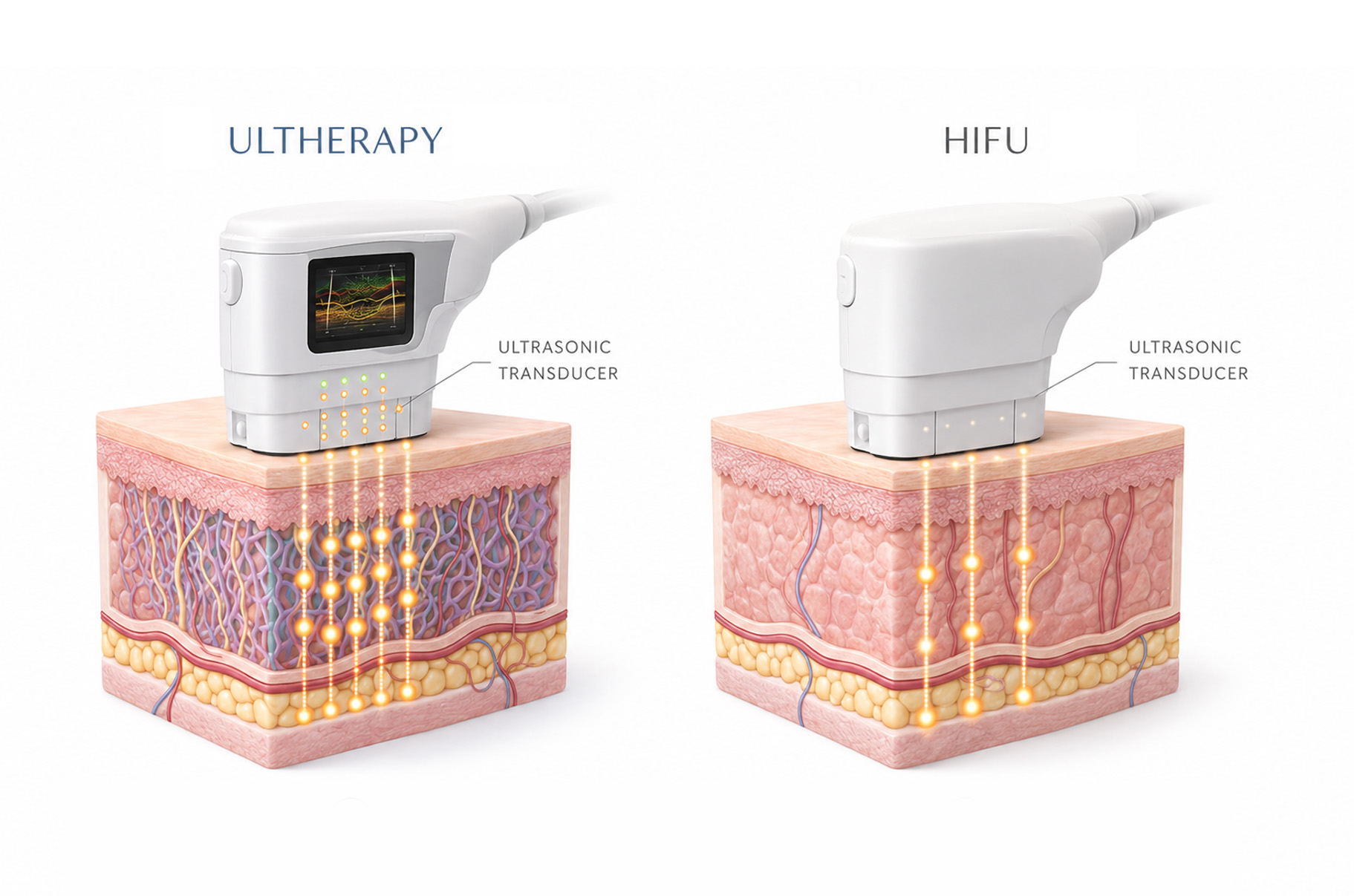
Ultherapy is a brand of HIFU, the original focused ultrasound lifting machine, working in the same way at the same depths, and the machine on which most of the research in this guide was conducted [1, 3, 4, 6]. I used it for years. It differs from Tightan 2 in engineering and in its on-screen ultrasound image, not in its effect on the tissue. Ultherapy is not offered at the clinic, and I have written separately about where it is worth having. For most faces the result depends more on the treatment plan than on the machine, as the HIFU vs Ultherapy page explains in detail.
Where Thermage radiofrequency fits alongside HIFU
HIFU lifts, whereas Thermage tightens. HIFU reaches the support layer over the muscle and is the better choice when the face has dropped. Thermage uses radiofrequency to heat the whole collagen layer and is the better choice when the skin itself has loosened, particularly thin skin, and for the eyelids. The only randomised trial comparing the two directly, in 20 people treated on the neck, found no significant difference at six months and found the ultrasound more painful [12], although it was small and confined to the neck. HIFU costs less than Thermage, and many patients in their late forties and fifties have both treatments a few months apart.
Where Oligio sits among the tightening devices
Oligio is a radiofrequency machine from WONTECH, the Korean company that also makes Tightan 2. It acts like Thermage, heating a broad layer to tighten loose skin, whereas HIFU lifts a face that has dropped. A face with both problems is often treated with one device of each type. The Oligio vs HIFU vs Thermage page compares the three.
How to choose a HIFU clinic in Singapore
A suitable HIFU clinic names its machine, states which depths it treats, confirms who will perform the treatment, quotes one fixed price for the area requested, shows photographs of its own patients at the consultation, and is prepared to advise against HIFU when it is the wrong treatment. HIFU reviews and Reddit threads show that results vary widely between clinics, that inexpensive packages often disappoint and that thin faces can become hollow, all of which the research predicts. They do not show that HIFU is ineffective, but that HIFU performed on the wrong face, at the wrong depth or with poor technique fails.
Why patients choose Dr Gerard Ee for HIFU in Singapore
- Since 2012. I started with the original Ulthera, before Ultherapy Prime existed, and have used focused ultrasound on the face every week since.
- About ten HIFU treatments a week. Every HIFU treatment, deep or gentle, is performed by me and not delegated.
- Trained on the machines I use. I travelled to Korea to discuss HIFU technique and HIFU technology with Korean doctors, including how Ultherapy and the Korean HIFU systems differ in clinical use.
- Two machines, chosen for the face in front of me. Tightan 2 is used for lifting, and Sygmalift for firming, the eye area and younger or older faces.
- I have had HIFU myself. I know how each setting feels from the patient’s side.
- A clear no when HIFU is unsuitable. A thin face, a face with marked volume loss or scarring, or an advanced sag receives a different recommendation, not a HIFU package.

Dr Gerard Ee, Aesthetic Doctor in Singapore
Dr Gerard Ee is an aesthetic doctor in Singapore and the Medical Director of his practice at 50 Raffles Place. He graduated from St George’s, University of London, trained in surgery at Singapore General Hospital and the National University Hospital, and holds the MRCS (Edinburgh) and a postgraduate diploma in practical dermatology from Cardiff University.
He has practised aesthetic medicine since 2012, is the author of sixteen peer-reviewed papers, and writes and medically reviews every article on this site. Read more about Dr Gerard Ee.

Book a consultation with Dr Gerard Ee
Dr Gerard Ee consults and performs HIFU at his practice at 50 Raffles Place, Singapore. Consultations are by appointment. Message the clinic on WhatsApp, or call 6532 2048.
HIFU Singapore questions answered
What is HIFU treatment for the face?
HIFU treatment for the face uses focused ultrasound to create small points of heat beneath the skin, including in the support layer over the facial muscles. The heated tissue tightens immediately and is rebuilt with new collagen over two to three months, and skin samples taken after treatment show increased collagen. HIFU lifts and tightens the face without surgery, needles or downtime.
How much does HIFU treatment cost in Singapore?
Advertised HIFU prices in Singapore range from about $250 to several thousand dollars. The difference reflects the machine, the number of depths treated, the number of shots, who performs the treatment and how much of the face is included. Each shot heats one small point of tissue at a set depth, and the lift comes from collagen contracting and regrowing around those points, so a price that buys fewer shots treats less tissue and produces a smaller lift. In my practice, Tightan 2 costs $3,500 for the full face, neck, under the chin and eyes in one session, with the shot count customised to each face rather than fixed. Sygmalift costs $1,200 a session, or $4,500 for a course of five. Both prices are before GST. A method for comparing two quotes line by line is set out in the HIFU price guide.
Is HIFU really worth it?
HIFU is worth having if you have mild to moderate loosening of the face and neck. A 2025 systematic review of 45 studies found that lower-face and neck laxity improved by 18 to 30%, and that transient side effects occurred in under 5% of patients. HIFU lifts tissue by millimetres rather than centimetres, and in one randomised trial the brow rose by an average of 2.16 mm at 90 days, so it does not replace a surgical facelift. It is not worth having on a face with marked volume loss, on a thin face, or where acne scarring is the main concern. Sagging caused by volume loss needs the lost volume replaced, which HIFU does not do. On a thin face, the deepest shots can reduce fat the face needs, which leaves it looking more hollow. Acne scars sit in the upper skin and respond better to resurfacing and subcision. The complaint I hear most often is that HIFU produced no result at all, usually because too few shots were delivered or the shots were placed in the wrong area. The common causes of a poor result are set out in Is HIFU worth it?
How long will HIFU last?
Deep HIFU lasts about a year, sometimes longer. In the studies, the result builds over three months and holds at six, and in one review patients still reported improvement at a year. A gentle course lasts around a year from the final session, with a maintenance session every six months.
Which is better, HIFU or Ultherapy?
Ultherapy is a type of HIFU, so choosing between HIFU and Ultherapy means choosing between HIFU machines. Ultherapy displays a live ultrasound image of the skin layers, which lets the operator confirm the depth before each line of shots, and it has the largest body of published research of any HIFU device. It is also generally regarded as more painful than other HIFU devices. Tightan 2, the focused HIFU device I use for lifting in place of Ultherapy, treats the same three depths of 1.5, 3.0 and 4.5 mm and is much more comfortable. The treatment plan and the accuracy of shot placement usually influence the result more than the choice of machine. The full comparison is in HIFU vs Ultherapy.
What are the disadvantages of HIFU on the face?
Fat loss is documented in a thin or over-treated face. No lift occurs if the treatment never reaches the support layer. Welts or small burns occur if energy reaches the skin surface, which reflects poor technique. Temporary tingling or numbness along the jaw can follow treatment. Facial nerve injury is rare and has been reported in single cases. Each is far less likely when a doctor plans the treatment to the individual face.
How many HIFU sessions do I need?
If you choose deep HIFU, you need one session, repeated about once a year. Gentle HIFU requires a course of five sessions about a month apart, followed by a maintenance session every six months. A double chin sometimes needs a second deep session.
Can HIFU reduce a double chin?
HIFU can reduce a mild double chin. It tightens the loose tissue under the chin and reduces the small pocket of fat that softens the jawline, and the reduction has been measured on photographs after a single treatment.
Is HIFU safe for Asian skin?
HIFU is safe for Asian skin when correctly performed. Ultrasound is not absorbed by skin pigment and the skin surface is not heated, so the pigmentation risk associated with lasers does not apply, and a trial in skin types III to VI found only temporary side effects, all resolved by three months.
At what age should I start HIFU?
Deep HIFU is best started when the face begins to descend, which for most people is in the late thirties or early forties. In the twenties, where the aim is a sharper jawline and prevention, and in the sixties and seventies, where deep HIFU achieves little lift on an advanced sag and comfort and the skin surface matter more, the gentle course is usually more suitable.
Why are there HIFU promotions and trials, and should I take one?
A $250 HIFU trial is usually a partial treatment at a single depth, priced to attract a first visit and followed by the sale of a package. Some patients with early loosening achieve the result they wanted, but a face that has dropped does not, and the cost is better spent once on the appropriate treatment.
What should I look for in HIFU before and after photos?
Reliable HIFU before and after photos use the same lighting and angle and carry a date on the after photo, because the result at three months differs from the result the following week. A clinic’s own before and after photos are best reviewed at the consultation, because before and after images are not permitted in public healthcare advertising in Singapore.
HIFU or Sygmalift, which should I choose?
Deep HIFU with Tightan 2 suits a face that has dropped and a patient who wants a single session. Sygmalift suits patients in their twenties who want a sharper jawline, patients in their sixties or seventies who prioritise comfort, and anyone who prefers a gentle course to one strong treatment and accepts a more modest result.
About the author, and how this guide was written
I trained in medicine at St George’s, University of London, then in surgery, working in orthopaedic surgery at Singapore General Hospital and the National University Hospital and taking the MRCS of the Royal College of Surgeons of Edinburgh, before completing the Postgraduate Diploma in Practical Dermatology at Cardiff University and moving into aesthetic medicine. I have thirteen PubMed-indexed publications. I have used HIFU since 2012 and today perform it with two systems, Tightan 2 for lifting a face that has dropped, and Sygmalift for gentler tightening. I have also had HIFU on my own face, which informs how I describe the sensation to patients.
The studies quoted in this guide are peer-reviewed and PubMed-indexed, and I read the original paper for each one rather than a secondary summary. Most published HIFU research was conducted on one machine, Ultherapy, whereas the Korean systems, including the one I use for lifting, have smaller published series. Where a finding comes from Ultherapy studies, this guide says so, and the finding is not assumed to apply to every machine. The clinic offers the treatments described here, and no manufacturer paid for or reviewed this guide.

Key references
Dr Gerard Ee consults and performs this treatment at his practice at 50 Raffles Place, Singapore.
Show the 16 references
1. Alam M, White LE, Martin N, et al. Ultrasound tightening of facial and neck skin: a rater-blinded prospective cohort study. J Am Acad Dermatol. 2010;62(2):262-9. PubMed 20115948
2. Suh DH, Shin MK, Lee SJ, et al. Intense focused ultrasound tightening in Asian skin: clinical and pathologic results. Dermatol Surg. 2011;37(11):1595-602. PubMed 21806707
3. Oni G, Hoxworth R, Teotia S, et al. Evaluation of a microfocused ultrasound system for improving skin laxity and tightening in the lower face. Aesthet Surg J. 2014;34(7):1099-110. PubMed 24990884
4. Fabi SG, Goldman MP. Retrospective evaluation of micro-focused ultrasound for lifting and tightening the face and neck. Dermatol Surg. 2014;40(5):569-75. PubMed 24689931
5. Ling J, Zhao H. A Systematic Review and Meta-Analysis of the Clinical Efficacy and Patients’ Satisfaction of Micro-focused Ultrasound (MFU) Treatment for Facial Rejuvenation and Tightening. Aesthetic Plast Surg. 2023;47(5):1806-1823. PubMed 37198297
6. Amiri M, Ajasllari G, Llane A, et al. Microfocused Ultrasound With Visualization (MFU-V) Effectiveness and Safety: A Systematic Review and Meta-Analysis. Aesthet Surg J. 2025;45(3):NP86-NP94. PubMed 39540440
7. Contini M, Hollander MHJ, Vissink A, et al. A Systematic Review of the Efficacy of Microfocused Ultrasound for Facial Skin Tightening. Int J Environ Res Public Health. 2023;20(2). PubMed 36674277
8. Haykal D, Sattler S, Verner I, et al. A Systematic Review of High-Intensity Focused Ultrasound in Skin Tightening and Body Contouring. Aesthet Surg J. 2025;45(7):690-698. PubMed 40184185
9. Hitchcock TM, Dobke MK. Review of the safety profile for microfocused ultrasound with visualization. J Cosmet Dermatol. 2014;13(4):329-35. PubMed 25399626
10. Humphrey VS, Rambhia PH, Gmyrek R, et al. Microfocused Ultrasound With Visualization: A Systematic Review of Adverse Events and Risk of Subsequent Facelift Compromise. Dermatol Surg. 2025;51(4):424-429. PubMed 39625163
11. Suh DH, Kim DH, Lim HK, et al. Intense focused ultrasound (IFUS) with a modified parameter on facial tightening: A study on its safety and efficacy. J Cosmet Laser Ther. 2016;18(8):448-451. PubMed 27593509
12. Jones IT, Guiha I, Goldman MP, et al. A Randomized Evaluator-Blinded Trial Comparing Subsurface Monopolar Radiofrequency With Microfocused Ultrasound for Lifting and Tightening of the Neck. Dermatol Surg. 2017;43(12):1441-1447. PubMed 28902019
13. Harris MO, Sundaram HA. Safety of Microfocused Ultrasound With Visualization in Patients With Fitzpatrick Skin Phototypes III to VI. JAMA Facial Plast Surg. 2015;17(5):355-7. PubMed 26313402
14. Marr K, Carruthers JDA, Humphrey S. Transient Nerve Damage After Microfocused Ultrasound With Visualization. Dermatol Surg. 2017;43(6):894-896. PubMed 28498208
15. Sathaworawong A, Wanitphakdeedecha R. Nerve injury associated with high-intensity focused ultrasound: A case report. J Cosmet Dermatol. 2018;17(2):162-164. PubMed 29165881
16. Yi KH, Park Y, Song JK, et al. Individualized HIFU in women over 60: ultrasound assessment of layer-specific facial soft-tissue thickness changes. Sci Rep. 2026. PubMed 42469307
This guide is written from published research and from clinical experience treating faces in Singapore since 2012. It is for general education, not medical advice. Suitability, results, downtime and cost vary from person to person. Please arrange a consultation for advice specific to your skin. Dr Gerard Ee provides the treatments described on this page at his practice at 50 Raffles Place, Singapore.