
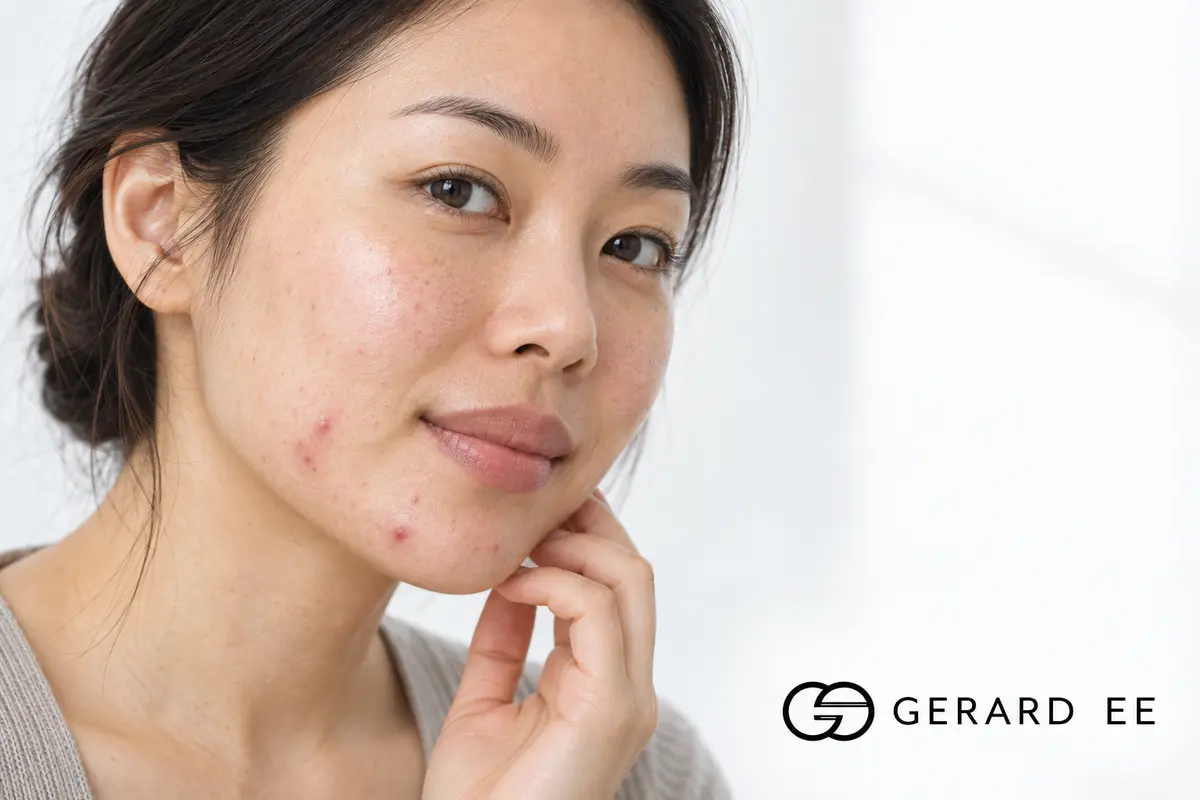
The women I see for adult acne have usually been through the same sequence. Topicals that worked at nineteen and do nothing now. A course of doxycycline that cleared things until it stopped. Breakouts along the jaw and chin that arrive on a schedule. Skin that is oily by midday whatever is put on it.
Spironolactone is one of the treatments for that pattern. This page covers who it suits, the dose I use, what to expect, the risks worth knowing about and what it costs. For the wider picture of how hormonally driven acne is assessed and treated, see hormonal acne treatment in Singapore.
How spironolactone helps hormonal acne
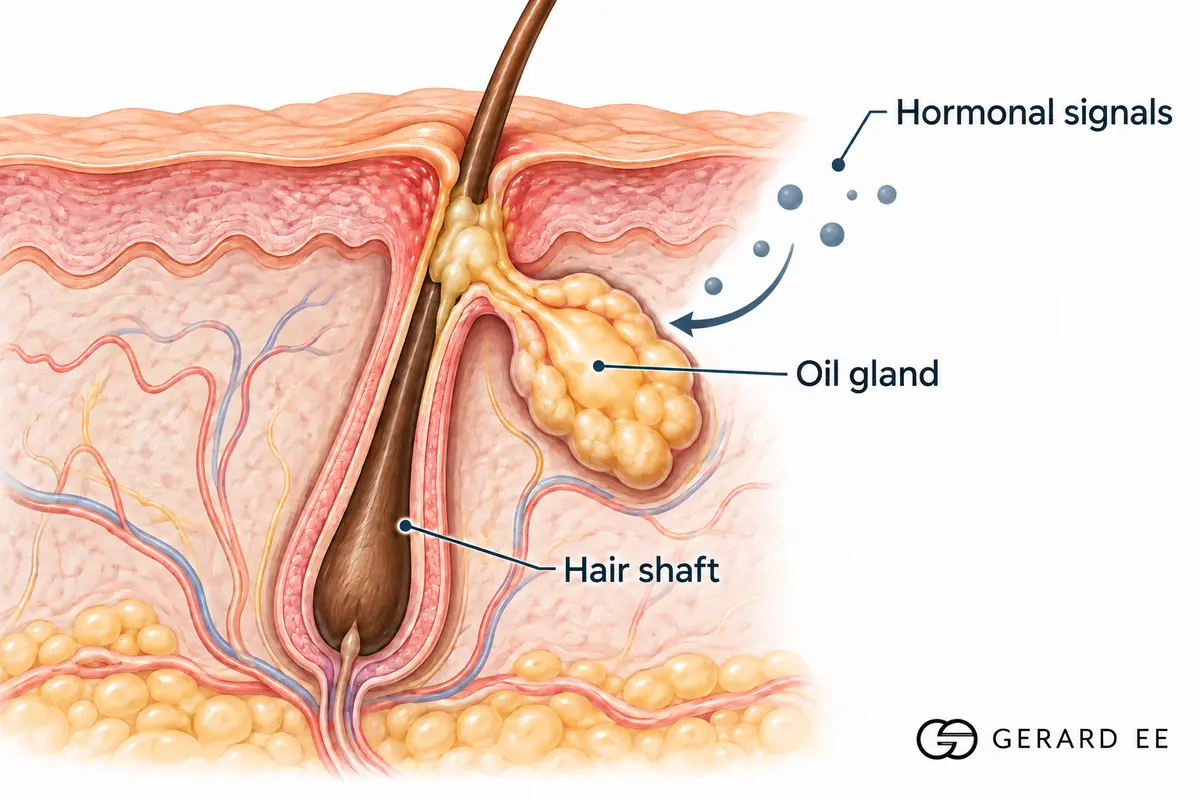
Spironolactone was developed as a diuretic. Its use in acne rests on a property of the original drug: it blocks androgen receptors.
Androgens drive the sebaceous gland. Block the receptor and the gland produces less oil, the follicle is less likely to occlude, and the inflammatory cascade behind a deep tender lesion has less to feed on. It does not correct a hormonal abnormality, and most women who benefit have entirely normal blood hormone levels. What it changes is how the skin responds to hormones that are already there.
That mechanism explains what it is good at and what it is not. Oiliness and deep jawline lesions respond. Comedones, meaning blackheads and whiteheads, respond much less, because they are not primarily androgen-driven and need a retinoid instead.
Who spironolactone suits, and who I turn away
It suits adult women with acne along the lower face, jaw and neck, oily skin, breakouts that track with the menstrual cycle, and acne that has come back after antibiotics or is holding out against topicals. It is also an option where polycystic ovary syndrome is part of the picture.
I do not prescribe it to anyone in renal failure. Spironolactone is potassium-sparing and the kidney is what clears potassium, so impaired renal function is the one situation where I will not use it regardless of how well the acne might respond.
I also rarely use it above the age of 45, for the reasons set out under blood tests below.
Beyond that: it is not used in men at the doses acne requires, because blocking androgen receptors causes breast tenderness and gynaecomastia. It is not the first choice where the picture is mostly comedonal. And where acne is severe, nodular or scarring, isotretinoin is the treatment that changes the outcome.
The spironolactone dose I use for acne, and how I titrate it
I start at 25 mg a day. If the response is incomplete and it is being tolerated, I titrate upward. I do not go beyond 50 mg a day.
That is deliberately at the lower end of what is published. The trial evidence below used higher doses: SAFA ran 50 mg daily for six weeks and then 100 mg daily to week twenty-four. Studies generally describe an effective range of 50 to 200 mg daily, with more of the measured benefit at 100 mg and above.
That ceiling is a balance of side effects and safety against efficacy. In my hands 50 mg a day is more than sufficient. Where it is not enough, I do not push the dose higher — I change the plan.
How long spironolactone takes to work on acne, and what follow-up involves
This is the question that decides whether a patient stays on it long enough for it to work.
Oiliness usually settles first, often within four to six weeks. Lesion counts follow. The published trials measured their outcomes at twelve and twenty-four weeks, and the twenty-four week results were better than the twelve week results. Someone who stops at eight weeks because it is not working has usually stopped too early.
Spironolactone is a maintenance treatment. It works while it is being taken, and acne generally returns some months after it is stopped. That is a different proposition from a finite course of isotretinoin and is worth understanding before starting.
Side effects of spironolactone for acne, and which ones matter
Most are dose-related and settle, or resolve on a lower dose.
The common ones are increased urinary frequency in the first weeks, menstrual irregularity, breast tenderness, light-headedness on standing, and occasionally headache. Menstrual irregularity is the most common reason women stop, and it is much less of a problem when spironolactone is taken alongside a combined oral contraceptive.
The uncommon ones worth knowing about are a rise in potassium, covered next, and low blood pressure in someone who already runs low.
The drug is not compatible with pregnancy, which has its own section below.
Do you need a blood test before or during spironolactone?
Spironolactone is potassium-sparing, so in the wrong patient it can raise serum potassium. That is why renal failure is an absolute no from me, and it is the reason the question comes up at all.
In the population usually treated for acne, meaning healthy young women with normal kidney function, the published evidence does not support routine repeat testing. A study in JAMA Dermatology examined potassium testing in healthy young women taking spironolactone for acne and found the rate of raised potassium no different from the background rate in untested women, with most abnormal results transient.
Age changes that. A 2026 cohort study in the Journal of the American Academy of Dermatology looked at women over 45 taking spironolactone for a range of dermatological conditions, not acne alone, and found a higher incidence of raised potassium in that group than in younger patients.
What I do. In patients under 45 I do not usually order a blood test to check potassium. Above 45 I usually do not prescribe spironolactone at all, and in the cases where I do, I check renal function first.
Spironolactone, pregnancy and contraception
Spironolactone is an anti-androgen. In pregnancy it carries a theoretical risk of undervirilisation of a male foetus, and it is not used by women who are pregnant, trying to conceive, or breastfeeding. Acne in pregnancy is managed differently.
Reliable contraception is therefore part of the conversation before the first prescription rather than after it. A combined oral contraceptive is often used alongside spironolactone, which covers contraception and menstrual irregularity at once and has an effect on acne in its own right.
Does spironolactone cause cancer? What the evidence shows
This comes up in almost every consultation, usually from something read online.
The concern traces back to old rodent studies at doses far above anything used in people. The human data does not support it. A systematic review and meta-analysis published in JAMA Dermatology in 2022 examined spironolactone use and cancer risk across the available studies and did not find an increased risk of breast cancer. A separate analysis in the Journal of the American Academy of Dermatology found no increase in recurrence among women with a history of breast cancer. A case series of 403 women followed on long-term spironolactone for acne gives the best available picture of what years of use look like.
Spironolactone or isotretinoin for acne?
They are not competing versions of the same thing. Isotretinoin acts on the sebaceous gland itself and offers the prospect of remission after a finite course, which makes it the treatment for severe, nodular or scarring acne. Spironolactone blocks the androgen signal reaching that gland, works while it is being taken, and suits persistent adult female acne along the jaw where a course of isotretinoin is not wanted or not appropriate. The two are occasionally used in sequence.
The full comparison, including side effects and what each course involves, is here: spironolactone vs Accutane for acne.
Spironolactone acne treatment cost in Singapore
Spironolactone is a prescription-only medicine in Singapore. It cannot be bought over the counter and it cannot be supplied without a consultation, which is a clinical requirement rather than a formality: the assessment decides the dose, the monitoring and whether the drug is appropriate at all.
| Consultation | S$109 including 9% GST |
| Spironolactone, 25 mg daily | S$93.20 including 9% GST for one month |
| Review consultation | Nil — reviews are not charged |
Reviews are not charged, so once treatment is running the ongoing cost is the medicine itself. Because spironolactone is a maintenance treatment rather than a course, it is worth working out the annual cost before starting rather than the first month’s.
What the published evidence on spironolactone for acne shows
For a long time spironolactone was prescribed on clinical experience rather than trial evidence. That changed recently.
SAFA, a double-blinded randomised controlled trial published in 2024, tested spironolactone against placebo in women with persistent facial acne, at 50 mg daily to week six and 100 mg daily thereafter. The benefit on acne severity was present at twelve weeks and larger at twenty-four, and the trial carried a cost-effectiveness analysis alongside it. It is the strongest evidence the drug has.
FASCE, also 2024, compared spironolactone head to head against doxycycline in moderate acne in adult women. That is the comparison that matters in practice, because doxycycline is usually what has already been tried.
A 2025 systematic review and meta-analysis of randomised placebo-controlled trials, with trial sequential analysis, pooled the evidence and supported both efficacy and safety in this group.
Guidelines have followed. The American Academy of Dermatology’s 2024 guidelines of care for acne vulgaris include spironolactone for appropriately selected patients, and the EuroGuiDerm acne guideline update in 2026 does the same.

Spironolactone for acne in Singapore: book a consultation with Dr Gerard Ee
Dr Gerard Ee consults and prescribes spironolactone for acne at The Clifford Clinic, 50 Raffles Place, Singapore. Consultations are by appointment. Message the clinic on WhatsApp, or call 6532 2048.
Spironolactone is prescription-only, so treatment starts with an assessment.
Frequently asked questions about spironolactone for acne
Do I need a prescription for spironolactone in Singapore?
Yes. It is a prescription-only medicine, so it is supplied after a consultation rather than bought over the counter. A doctor must assess suitability, set the dose and decide what monitoring is appropriate.
Can men take spironolactone for acne?
It is not used in men at the doses required for acne, because blocking androgen receptors causes breast tenderness and gynaecomastia.
Does spironolactone cause weight gain?
It is a diuretic, so if anything it tends to reduce fluid retention rather than cause it. Weight gain is not a typical effect at acne doses.
Can I take spironolactone with the contraceptive pill?
Yes, and the two are often used together. A combined oral contraceptive covers contraception, reduces the menstrual irregularity spironolactone can cause, and has its own effect on acne.
What happens when I stop spironolactone?
Acne generally returns over the following months, because the drug works while it is being taken. It is a maintenance treatment, not a cure.
Does spironolactone help acne scars?
No. It reduces the acne that causes scarring, which matters, but it does nothing to existing scars. Those are treated separately — see acne scar treatment in Singapore.
Show the 13 references
- Santer M, Lawrence M, Pyne S, et al. Clinical and cost-effectiveness of spironolactone in treating persistent facial acne in women: SAFA double-blinded RCT. Health Technol Assess. 2024;28(56):1-86. PubMed 39268864
- Dréno B, Nguyen JM, Hainaut E, et al. Efficacy of spironolactone compared with doxycycline in moderate acne in adult females: the FASCE study. Acta Derm Venereol. 2024;104:adv26002. PubMed 38380975
- Ghanem L, Kirmani N, De León Fernández N, et al. Efficacy and safety of oral spironolactone for women with acne vulgaris: a systematic review and meta-analysis of randomized placebo-controlled trials with trial sequential analysis. J Cosmet Dermatol. 2025;24(8):e70411. PubMed 40823723
- Reynolds RV, Yeung H, Cheng CE, et al. Guidelines of care for the management of acne vulgaris. J Am Acad Dermatol. 2024;90(5):1006.e1-1006.e30. PubMed 38300170
- Nast A, Al Wattar BH, Beylot Barry M, et al. Update of the EuroGuiDerm evidence-based guideline for the treatment of acne — short version. J Eur Acad Dermatol Venereol. 2026;40(7):1162-1172. PubMed 41847993
- Layton AM, Eady EA, Whitehouse H, et al. Oral spironolactone for acne vulgaris in adult females: a hybrid systematic review. Am J Clin Dermatol. 2017;18(2):169-191. PubMed 28155090
- Plovanich M, Weng QY, Mostaghimi A. Low usefulness of potassium monitoring among healthy young women taking spironolactone for acne. JAMA Dermatol. 2015;151(9):941-944. PubMed 25796182
- Barbieri JS, Margolis DJ, Mostaghimi A. Temporal trends and clinician variability in potassium monitoring of healthy young women treated for acne with spironolactone. JAMA Dermatol. 2021;157(3):296-300. PubMed 33502462
- Gregoire S, Dewey E, Sanchez K, et al. Hyperkalemia incidence in females over 45 years old on spironolactone for dermatologic conditions: a retrospective cohort study. J Am Acad Dermatol. 2026;94(6):1671-1678. PubMed 41655839
- Bommareddy K, Hamade H, Lopez-Olivo MA, et al. Association of spironolactone use with risk of cancer: a systematic review and meta-analysis. JAMA Dermatol. 2022;158(3):275-282. PubMed 35138351
- Wei C, Bovonratwet P, Gu A, et al. Spironolactone use does not increase the risk of female breast cancer recurrence: a retrospective analysis. J Am Acad Dermatol. 2020;83(4):1021-1027. PubMed 32446820
- Garg V, Choi JK, James WD, et al. Long-term use of spironolactone for acne in women: a case series of 403 patients. J Am Acad Dermatol. 2021;84(5):1348-1355. PubMed 33434594
- Ershadi S, Barbieri JS. Spironolactone for acne: practical strategies for optimal clinical outcomes. Cutis. 2025;116(1):26-31. PubMed 40875941
For related decisions, read the guides to the contraceptive pill for acne, spironolactone versus isotretinoin and hormonal acne treatment.
This page is written from published research and from clinical experience in Singapore since 2012. It is for general education, not medical advice. Whether a treatment suits you, what it may achieve and what it may risk can only be established at a consultation. Dr Gerard Ee is the Medical Director of The Clifford Clinic, a private clinic in Singapore, and treatments discussed on this site are provided commercially.

