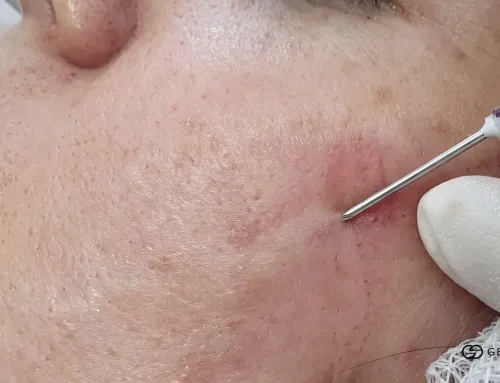
Fractional CO2 laser is often described as the gold standard for resurfacing acne scars, and for the right scar in the right skin that description holds. Used carelessly it can also cause harm, particularly in darker skin, so it is best understood as a powerful component of a plan rather than a cure in itself. This article sets out how fractional CO2 acts, which scars it treats well, what recovery involves, and where a second laser, Pico MLA, fits alongside it. In my experience the patients least satisfied with CO2 resurfacing were offered it as the whole plan rather than as one stage within a sequence, and outcomes vary with scar type and skin tone rather than with the device alone.
Dr Gerard Ee consults and performs fractional CO2 laser treatment for acne scars at The Clifford Clinic, 50 Raffles Place, Singapore.
How fractional CO2 works
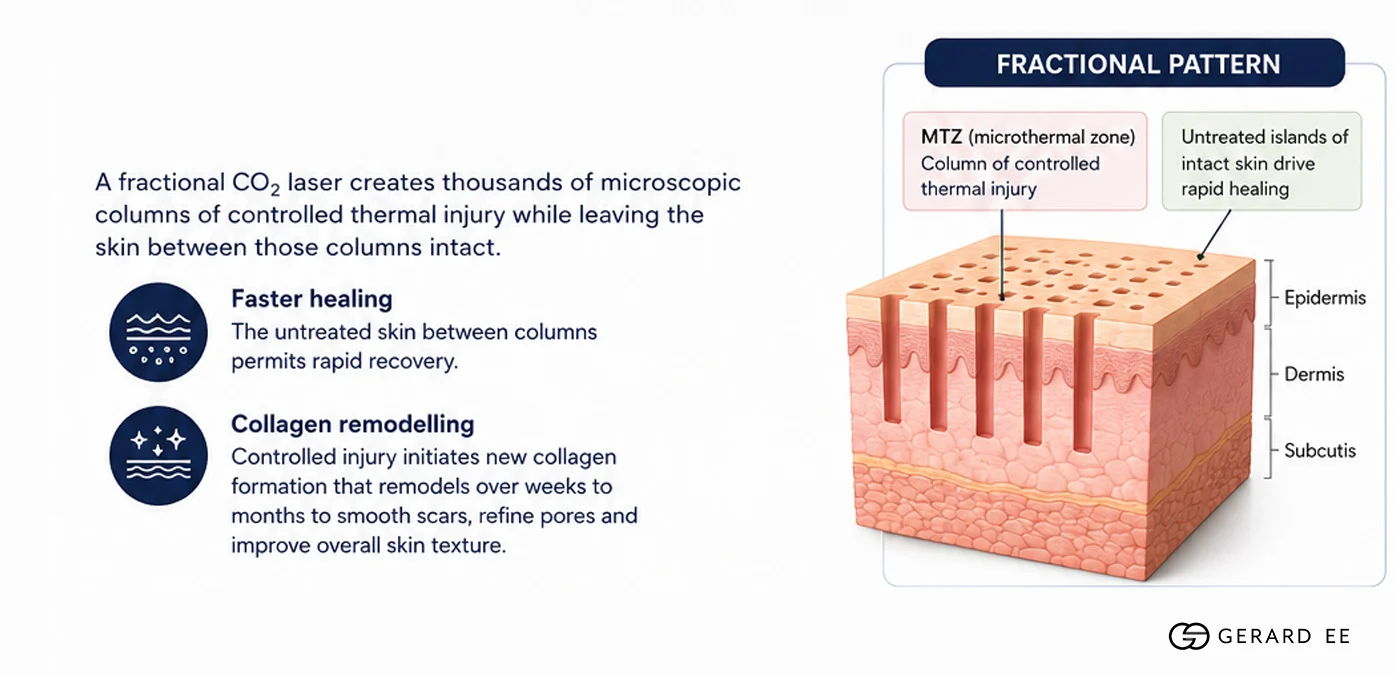
A fractional CO2 laser creates thousands of microscopic columns of controlled thermal injury and leaves the skin between those columns intact. That fractional pattern permits rapid healing while the controlled injury initiates fresh collagen formation, which remodels over the following weeks and months to smooth the surface and lift depressed scars. The same collagen response refines pore size and overall surface texture rather than acting on depressed scars alone. Fuller accounts of the procedure and the device appear on the fractional CO2 laser treatment and Edge fractional CO2 laser pages.
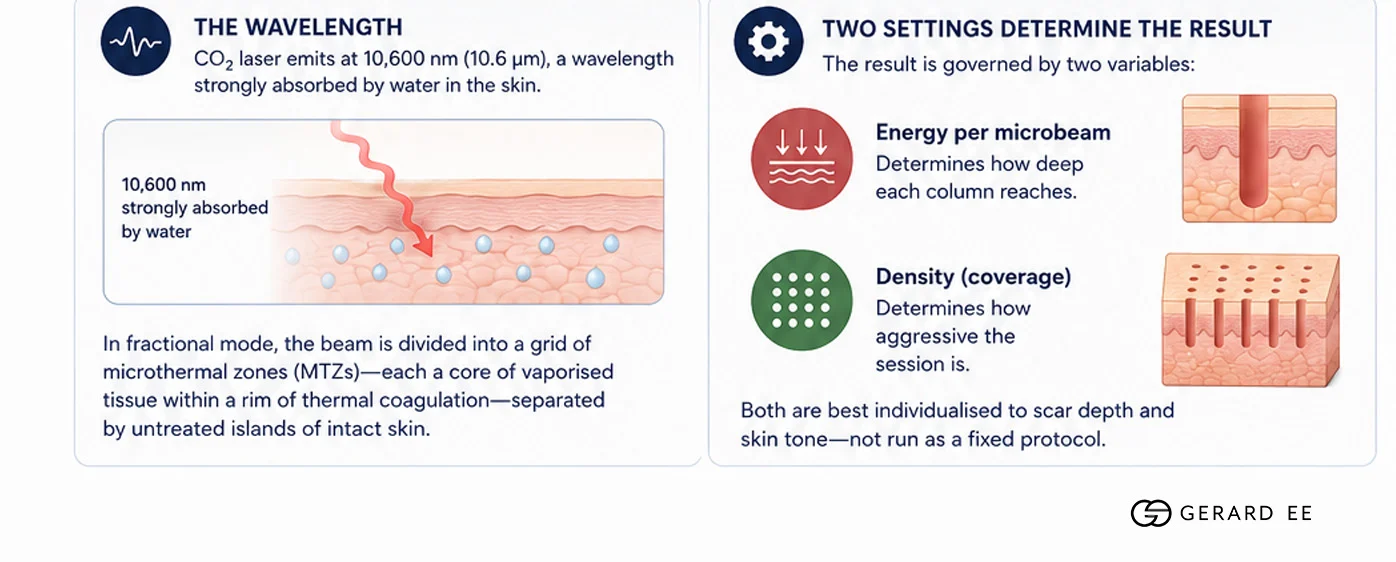
The CO2 laser emits at 10,600 nm, a wavelength strongly absorbed by water in the skin. In fractional mode the beam is divided into a grid of microthermal zones (MTZs), each a core of vaporised tissue within a rim of thermal coagulation, separated by untreated islands of intact skin that drive rapid healing. Two settings determine the result, the energy per microbeam, which governs how deep each column reaches, and the density or coverage, which governs how aggressive the session is. Both are best individualised to scar depth and skin tone rather than run as a fixed protocol. Energy and density are also the two variables a patient cannot see and rarely asks about, so two courses named for the same device may differ considerably in what they deliver.
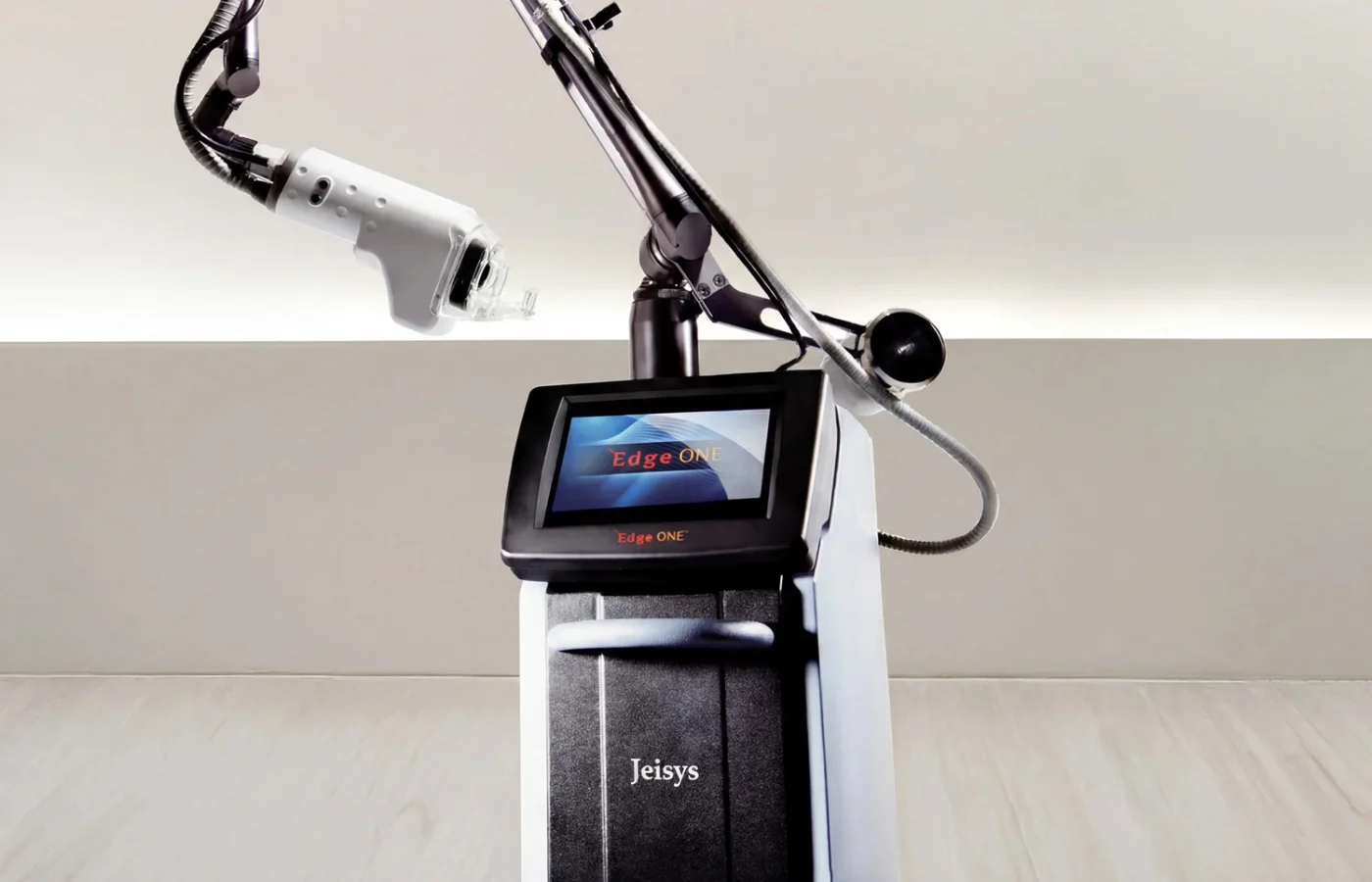
The device used in this practice, the Edge fractional CO2 laser (the Jeisys EdgeOne CO2, FDA-cleared under 510(k) K162169), is the latest generation of the technology. Emitting at 10,600 nm (10.6 µm), it produces fractional microbeams as fine as 120 µm, with per-beam energy of up to 300 mJ and adjustable spot density up to 42.4%. Finer beams and higher per-beam energy allow the depth a scar requires to be reached while less of the surface is treated, so ablative damage is lower than with older CO2 lasers. Recovery is correspondingly gentler and the risk of post-inflammatory hyperpigmentation lower, a meaningful advantage in the darker skin tones common in Singapore. Having treated acne scars for sixteen years, I have found that the difference between generations of CO2 device shows most in the recovery rather than in the depth achieved. A newer device lowers that pigment risk without removing it, and in darker skin the settings chosen still matter more than the model used.
What it treats well, and what it does not
Fractional CO2 is well suited to boxcar scars, surface irregularity and overall texture. Two scar types, however, respond poorly when fractional CO2 is used as the only modality. Deep ice pick scars usually require TCA CROSS rather than laser, because the beam cannot rebuild the base of a narrow, deep pit. Tethered rolling scars, similarly, will not lift with resurfacing until the bands beneath them are released by subcision. The recurring lesson of scar work is that laser is one tool, and that matching it to the right scar produces the result. The commonest error I see in a previous treatment plan is a full course of resurfacing delivered to scars that were never going to answer to it, after which the patient concludes that laser does not work. Even in the scars it suits, the outcome is an improvement rather than a clearance, and results vary between patients whose scarring appears similar.
Where Pico MLA fits
Fractional CO2 is not the only useful laser. Pico MLA is a picosecond laser fitted with a microlens array, which concentrates the beam into many tiny high-energy points just beneath the surface, activating collagen and dispersing pigment while leaving the intervening skin intact, so recovery is quick. Enlarged pores, fine surface irregularity and uneven pigment or post-acne marks all respond to it. Its limits matter equally, since it acts at and near the surface and is therefore ineffective against tethered rolling scars and deep ice pick scars. It belongs in a plan as a surface-and-pigment complement rather than as a treatment for depressed scars in its own right. Pico laser is the treatment patients most often request by name, and it may not always be the most clinically appropriate option for the scars they actually have. Of the patients who consult me asking for Pico specifically, a substantial share are describing depressed scars that sit below the depth it reaches, and declining the request serves them better than granting it.
Fraxel 1550, the non-ablative erbium-glass option
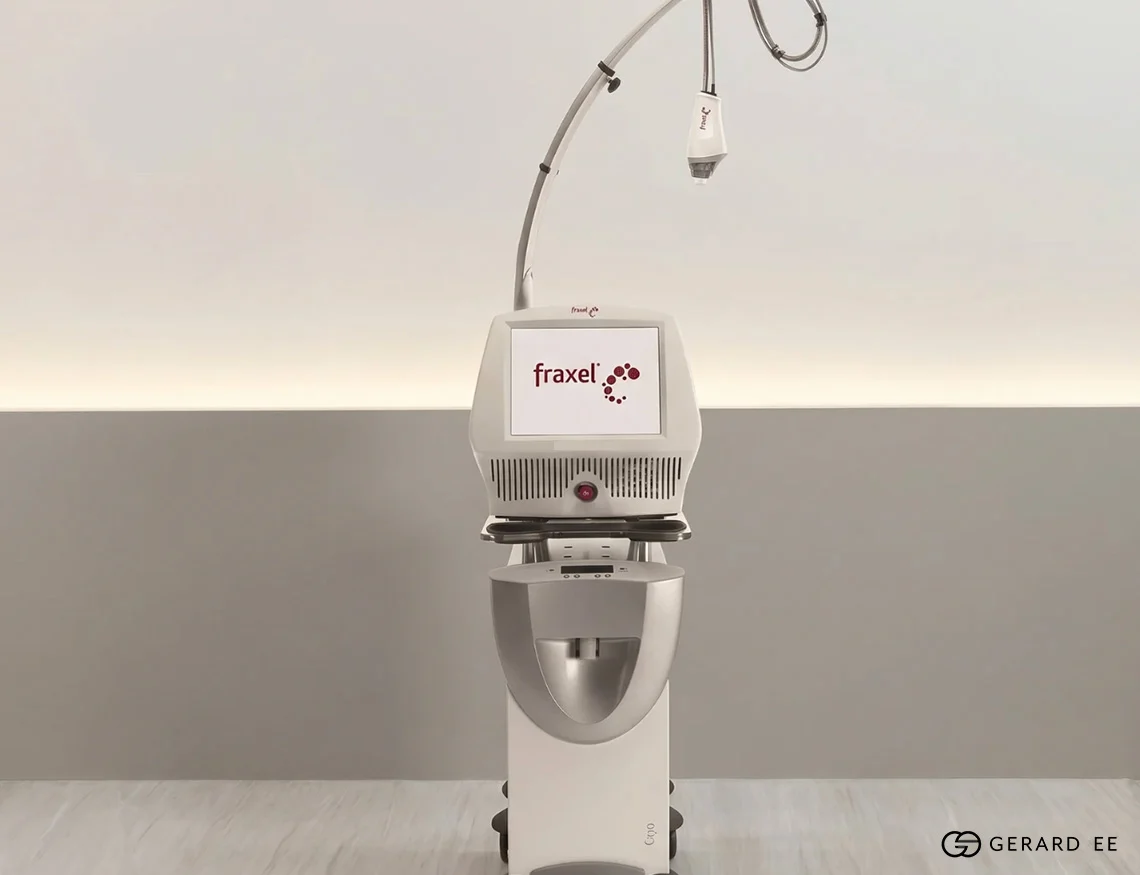
Not every patient wants, or should have, an ablative laser. The Fraxel 1550 is a non-ablative fractional laser built around an erbium-doped fibre emitting at 1,550 nm. Its chromophore is also water, but it coagulates rather than vaporises, so the epidermis remains intact while each microbeam leaves a column of coagulated dermis, a microthermal zone, cleared as microscopic epidermal necrotic debris over the following days as new collagen forms. Remodelling is genuine and downtime far shorter than with ablative CO2, usually a day or two of redness, bronzing and fine flaking. When a patient tells me that downtime rather than scar depth is the deciding constraint, the 1,550 nm option is usually the one that gets a course finished.
The Fraxel 1550 suits boxcar scars and texture in patients who cannot take much downtime, or whose skin tone carries a higher pigment risk, since non-ablative 1,550 nm resurfacing has a good safety record in Fitzpatrick IV to VI skin. Being gentler per pass, it usually requires more sessions than CO2 for a comparable result, and like all resurfacing it does not correct tethered rolling scars, which need subcision, or deep ice pick scars, which need TCA CROSS. A good safety record in deeper skin is not the same as an absence of risk, and choosing the gentler laser trades a longer course for a lower probability of pigment trouble.
Downtime and what to expect
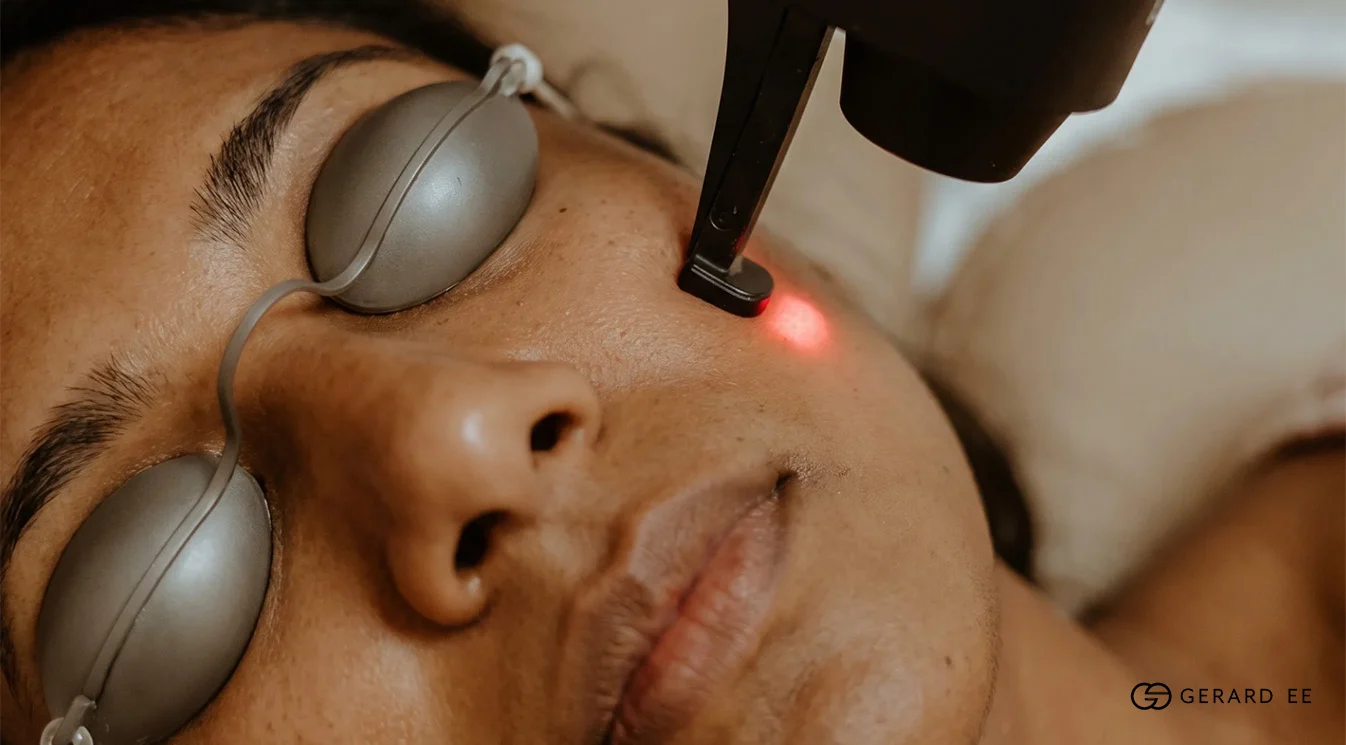
Fractional CO2 involves real, if short, downtime, usually a few days of redness, mild swelling and flaking, and sometimes a little longer at higher energy. Recovery of a few days from a correctly dosed session is preferable to a zero-downtime treatment too gentle to remodel a scar. Pico MLA, by contrast, has minimal downtime. A course of either is usual, with improvement developing over months as collagen matures. I am direct with patients about the downtime, because the visible redness and flaking are what they most often underestimate at the consultation and most often resent afterwards.
Laser and darker skin
Judgement matters most in darker skin, and the governing constraint there is the pigment risk rather than the scarring itself. Fractional CO2 carries a higher risk of post-inflammatory hyperpigmentation in these skin tones, so it is used cautiously and at lower energy, and insulated RF microneedling such as Infini is often preferred as the deeper-working backbone because it spares the surface. Recovery is supported by pairing treatment with PDRN such as Rejuran. The acne scars on dark skin guide sets out the safe options in full. In my experience the decision that most often needs revisiting in a darker-skinned patient is not which laser was chosen but the energy at which it was delivered. Lower energy, priming and pigment prophylaxis reduce that risk rather than abolishing it, and a minority of patients develop pigment despite every precaution.
Where laser fits in a combination plan
Fractional CO2 is rarely used alone. A typical sequence opens with subcision and Secret RF together to release tethers and begin remodelling, then adds fractional CO2 about a month later once the skin has settled, with Pico MLA for pores and pigment along the way. Spacing the modalities allows each to act without overwhelming the skin and
gives collagen the time it needs to build. The reasoning is set out in combination therapy for atrophic scars and the complete treatment guide.
Sessions, downtime and lowering the risks
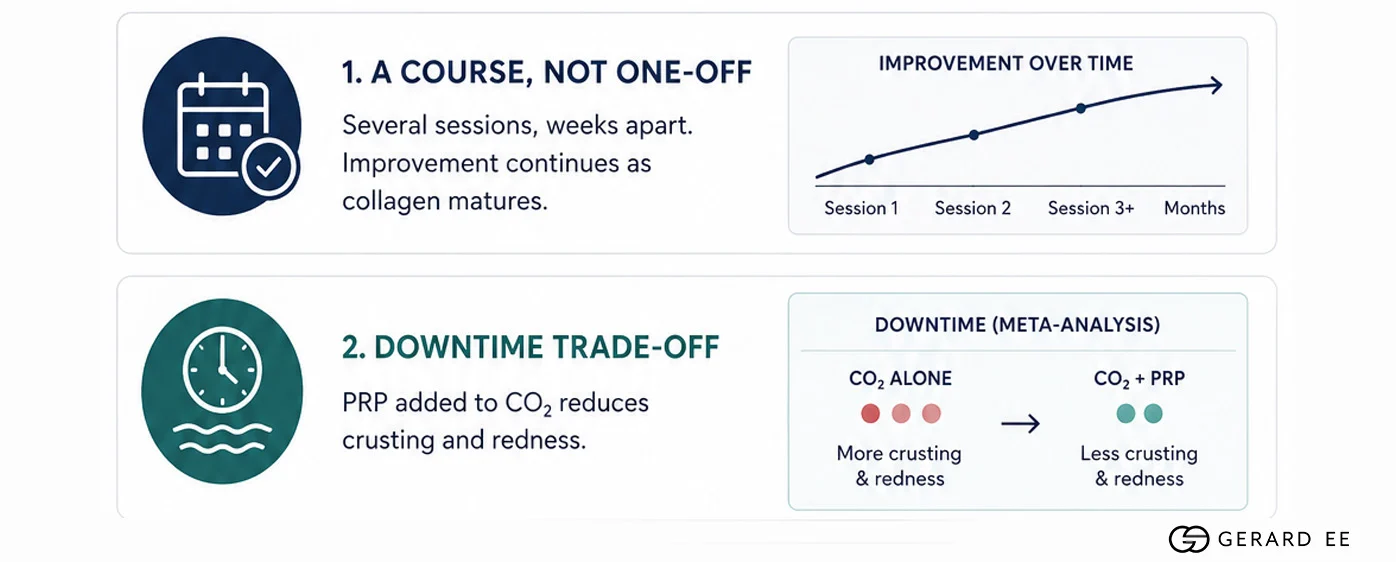
Fractional CO2 is a course rather than a single treatment, and most studies use several sessions spaced weeks apart, with improvement continuing as collagen matures (CO2 monotherapy). Downtime is the principal trade-off, and adding platelet-rich plasma shortens crusting and redness in meta-analysis (PRP plus CO2). Lower fluence and density, pre-treatment priming and pigment prophylaxis including topical corticosteroids measurably reduce the risk of post-inflammatory hyperpigmentation in darker skin (PIH prevention in Asians). Measures of this kind shorten recovery rather than removing it, and a published effect describes a treated group rather than predicting one patient’s course.
A fixed protocol applied to every patient regardless of scar depth or skin tone is therefore best avoided. The 121-patient study that identified energy as an independent factor in success is equally a reminder that excessive energy in the wrong skin causes problems, so the discipline lies in delivering enough energy to remodel while respecting the individual skin type (energy-as-factor study). I cannot reliably predict at a first consultation which patients will tolerate the higher end of that energy range, and that uncertainty is itself the argument for individualising settings rather than running one protocol.
What the research shows
Fractional CO2 has one of the deepest evidence bases of any acne-scar treatment. Meta-analyses report meaningful improvement in atrophic scars and find that ablative CO2 generally outperforms Er:YAG fractional laser (CO2 versus Er:YAG meta-analysis, monotherapy series). In a retrospective study of 121 patients, scar type and the laser energy used emerged as independent factors determining how well patients responded (121-patient study).
Combinations are well supported too. Pairing PDRN such as Rejuran with fractional CO2 supports healing and reduces downtime, since PDRN promotes fibroblast activity and collagen synthesis (PDRN scar prevention), while delivering poly-L-lactic acid alongside the laser improved 95% of scars in one series (PLLA plus CO2). For darker skin the literature again supports lower energy and density with priming and pigment prophylaxis (skin-of-colour optimisation, PIH prevention in Asians). A 95% improvement rate in one series describes the scars that entered that study rather than every scar, so it may support a combination approach without guaranteeing one.
Fractional CO2 head-to-head with newer devices
Recent head-to-head trials set fractional CO2 against its newer alternatives and clarify what each comparison costs. Compared with non-insulated microneedle fractional radiofrequency in a split-face study, fractional CO2 achieved comparable scar improvement but with more pain, longer recovery and significantly more pigment and redness, one report recording post-inflammatory hyperpigmentation in 36.4% of CO2-treated patients and erythema lasting around ten days (radiofrequency versus CO2 study). Set against a picosecond laser with holographic optics, fractional CO2 showed no significant difference in ECCA scores, although physicians rated the CO2 result slightly better while the picosecond side produced far fewer adverse effects (picosecond versus CO2 trial). The figure of 36.4% is one I quote to patients rather than soften, because a pigment risk of that size belongs in the consultation and not in an aftercare sheet. Fractional CO2 buys its advantage in remodelling at a measurable cost in pain, recovery and pigment, which is a trade the patient is entitled to weigh.
Fractional CO2 shows its clearest advantage in combination with subcision. A 413-patient analysis found CO2 plus subcision significantly better than CO2 alone for boxcar and rolling scars, though not for ice pick scars (413-patient analysis), while a randomised study found subcision plus CO2 outperformed subcision alone (subcision combination trial). The combination-first approach is reflected in the 2022 international consensus on energy-based devices (consensus). TCA CROSS rather than resurfacing of any kind remains the treatment for that subtype.
Preparing for and recovering from laser resurfacing
Good preparation and aftercare protect the result and lower the risk of complications. Sun exposure is avoided beforehand and topical retinoids are usually paused for a few days, and in darker skin the doctor may prime the skin with pigment-suppressing agents to reduce the risk of post-inflammatory hyperpigmentation. On the day, a numbing cream is applied for comfort. Redness afterwards, a sensation similar to sunburn, mild swelling and fine flaking are normal over several days, and sometimes longer at higher energy. Recovery care consists of gentle cleansing, a bland moisturiser and strict broad-spectrum sun protection once the skin and any active acne allow. The flaking should be left to shed on its own rather than picked. Spreading redness, unusual pain, blistering or signs of infection warrant prompt contact with the clinic. The aftercare step most often abandoned is sun protection in the weeks after the flaking settles, which in darker skin works directly against the pigment prophylaxis used in preparation.
The bottom line
Fractional CO2 is well suited to boxcar scars and texture, and Pico MLA to pores and pigment, but both are parts of a plan rather than cures. Deep ice pick scars need TCA CROSS, tethered rolling scars need subcision first, and darker skin needs lower energy with careful pairing of RF and PDRN. Sixteen years of treating acne scars has persuaded me that the device named on a plan predicts the outcome far less reliably than whether the plan was matched to the scars in front of it. Continue with RF microneedling: Infini vs Secret RF or subcision for rolling scars.

Dr Gerard Ee, Aesthetic Doctor in Singapore
Dr Gerard Ee is an aesthetic doctor in Singapore and the Medical Director of his practice at 50 Raffles Place. He graduated from St George’s, University of London, trained in surgery at Singapore General Hospital and the National University Hospital, and holds the MRCS (Edinburgh) and a postgraduate diploma in practical dermatology from Cardiff University.
He has practised aesthetic medicine since 2012, is the author of sixteen peer-reviewed papers, and writes and medically reviews every article on this site. Read more about Dr Gerard Ee.

Book a consultation with Dr Gerard Ee at The Clifford Clinic
Dr Gerard Ee consults and performs fractional CO2 laser treatment for acne scars at The Clifford Clinic, 50 Raffles Place, Singapore. Consultations are by appointment. Message the clinic on WhatsApp, or call 6532 2048.
Frequently asked questions about CO2 laser for acne scars
What removes acne scars fast?
No treatment removes true scars overnight. Fractional CO2 ranks among the more powerful options for boxcar scars and texture, but it acts across a series of sessions and months of collagen remodelling. Promises of instant results warrant caution, since speed is the one thing collagen remodelling cannot be made to supply.
Is Fraxel 1550 or fractional CO2 better for acne scars?
Fractional CO2 and the Fraxel 1550 are different tools rather than competing versions of the same one. Fractional CO2 (ablative, 10,600 nm) produces stronger remodelling per session at the cost of more downtime and greater pigment risk. Fraxel 1550 (non-ablative erbium-glass, 1,550 nm) is gentler, with less downtime and a better safety record in darker skin, though it usually requires more sessions. Scar depth, skin tone and downtime tolerance determine the choice, so neither device is superior in the abstract.
Is Pico MLA good for acne scars?
Pico MLA is excellent for refining pores and evening out pigment, with minimal downtime. Tethered rolling scars, which require subcision, and deep ice pick scars lie outside what it can reach. It belongs in a plan as a surface-and-pigment complement rather than as a treatment for depressed scars. Pico is the treatment most often requested by name, and where the main problem is a depression in the surface it may not be the most clinically appropriate option.
Is fractional CO2 laser safe for dark skin?
Fractional CO2 may be used in darker skin provided the energy is chosen with care. Settings are lowered and insulated RF microneedling such as Infini is often preferred, because aggressive CO2 carries a higher risk of post-inflammatory hyperpigmentation. One split-face trial recorded post-inflammatory hyperpigmentation in 36.4% of CO2-treated patients, which is a reason for caution rather than a reason to exclude the laser.
How much downtime does fractional CO2 have?
Downtime is typically a few days of redness, mild swelling and flaking, and a little longer at higher energy. Pico MLA has minimal downtime by comparison. Recovery times vary, and a minority of patients take longer than the usual few days to settle.
References
Key references, comparative trials and device sources
Key references
- CO2 versus Er:YAG fractional laser for atrophic acne scars: meta-analysis. PubMed.
- Fractional CO2 laser resurfacing as monotherapy for atrophic facial acne scars. PubMed.
- Fractional CO2 for atrophic acne scars and related clinical factors: retrospective study of 121 patients. PubMed.
- PDRN (polydeoxyribonucleotide) for scar prevention and enhanced wound healing. PubMed.
- Atrophic scars treated with fractional CO2 facilitating topical poly-L-lactic acid (95% improved). PubMed.
- Optimizing fractional CO2 outcomes for pigmented atrophic acne scars in skin of colour. PubMed.
Comparative trials cited
- Qu L, Sha S, He C, et al. Non-insulated microneedle fractional radiofrequency versus ablative fractional CO2 laser for facial atrophic acne scars: pilot randomised split-face study. Acta Derm Venereol. 2025. PubMed.
- Yuan Y, He Y, Fang J, et al. Fractionated 1064 nm picosecond laser with holographic optics versus fractional CO2 laser for atrophic acne scars: randomised split-face study. Int J Dermatol. 2025;64:85-91. PubMed.
- Li X, Fan H, Wang Y, et al. Fractional CO2 laser combined with subcision for three subtypes of atrophic acne scars: retrospective analysis of 413 patients. Lasers Med Sci. 2023;38:195. PubMed.
- Abdelwahab AA, Omar GAB, Hamdino M. Combined subcision with fractional CO2 laser or cross-linked hyaluronic acid versus subcision alone in atrophic post-acne scars. Lasers Med Sci. 2022;38:20. PubMed.
- Salameh F, Shumaker PR, Goodman GJ, et al. Energy-based devices for the treatment of acne scars: 2022 international consensus recommendations. Lasers Surg Med. 2022;54:10-26. Journal.
Device specifications & sources
- S. FDA 510(k) K121481 (INFINI, Lutronic Inc.): insulated RF microneedling system, 49-pin handpiece, maximum RF generator output approximately 50 W.
- S. FDA 510(k) K162169 (EdgeOne CO2 Laser, Jeisys Co., Ltd.): fractional CO2 laser, 10.6 µm (10,600 nm). Fractional spot sizes 120/350/800 µm. Fractional pulse energy 1-300 mJ. Spot density 0-42.4%. Cleared for ablative skin resurfacing.
Written, medically reviewed and expert opinion by Dr Gerard Ee, aesthetic doctor and Founder & Medical Director of The Clifford Clinic. This article reflects my clinical experience treating acne scars in Singapore and is intended for general education, not medical advice. Treatment suitability, results, downtime and cost vary from person to person. Please arrange a consultation for advice specific to your skin.