
Scarless eye bag removal takes the fat out of a lower eyelid bag through an incision inside the eyelid, so there is no cut in the skin and no visible scar. The operation is done under local anaesthesia in about 20 minutes, bruising settles over one to two weeks, and the swelling takes up to eight weeks to disappear fully. It is the right procedure for a Grade 3 to 4 bag, or for any bag that sits on loose skin, which is where radiofrequency stops being enough. The surgical fee is $2,988 plus a day surgery facility fee of $500 to $1,000, before GST.
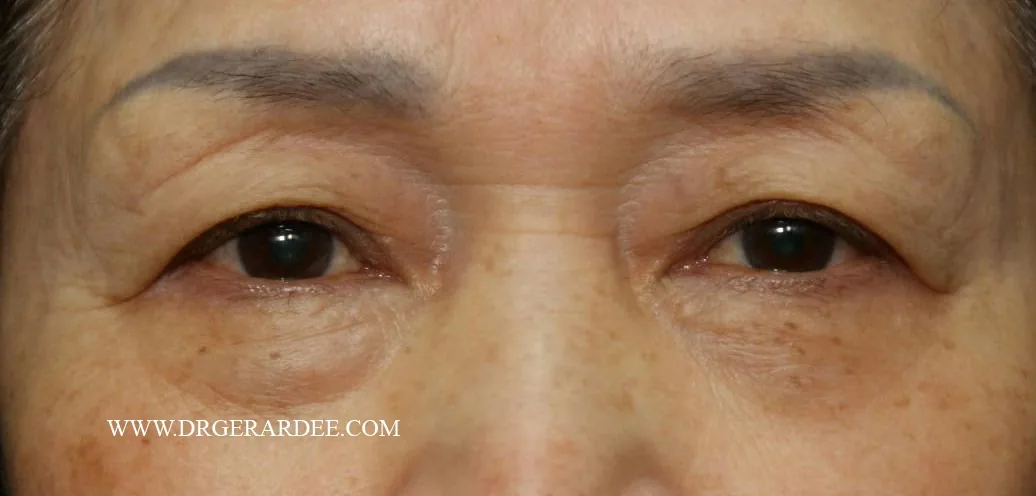
Scarless eye bag removal at a glance
| Treats | Grade 3 to 4 lower eyelid fat bags; bags with loose or crepey skin |
| Method | Transconjunctival lower blepharoplasty: incision inside the lower eyelid, fat removed or repositioned; pinch skin excision added where skin is in excess |
| Anaesthesia | Local anaesthesia; no anaesthetist fee |
| Time | About 20 minutes |
| Downtime | Bruising one to two weeks; swelling settles over up to eight weeks; back to regular activities in 7 to 14 days |
| Result | Judged at three months, once the tissue has settled |
| Lasts | Longer than any non-surgical treatment; ageing continues, so the lid can change again over years |
| Price | $2,988 plus $500 to $1,000 facility fee; pinch excision $2,788; before GST |
Who scarless eye bag removal is for
Surgery is the correct recommendation when the fat protrusion is Grade 3 to 4, when the lower eyelid skin has lost its recoil and folds when pinched, or when a non-surgical session has already been done and the residual bag is limited by skin rather than by fat. Older patients most often fall into this group, not because of age itself but because skin laxity accumulates with age and no energy device tightens genuinely redundant skin.
It is not the first choice for a mild Grade 1 to 2 bag on firm skin, where AGNES and Secret RF non-surgical eye bag removal reduces the fat without an operation, and it does nothing for a hollow, which needs filler or a fat graft rather than fat removal. I assess both routes, so the recommendation follows the anatomy rather than the tool in the room.
How I grade eye bags before recommending anything
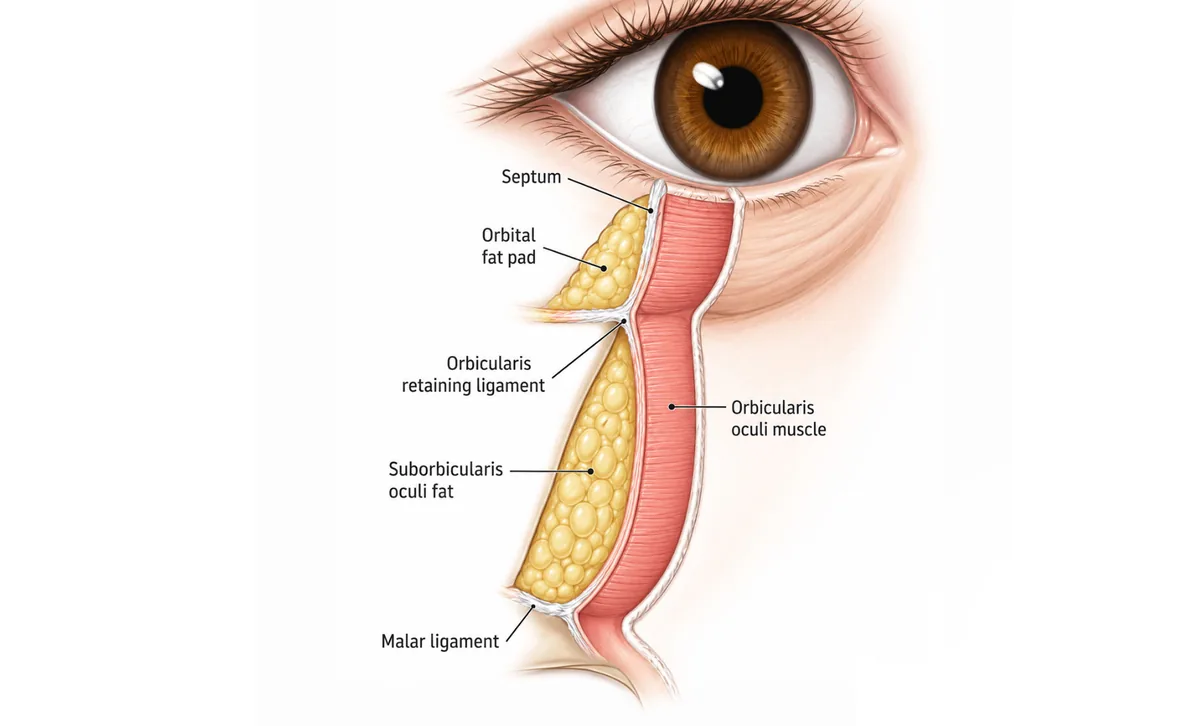
The most useful published framework for this is the graded approach set out by Hashem, Zins and colleagues, which matches the operation to the clinical findings rather than to the surgeon’s preference.3
It works like this. A patient with isolated fat bags, a normal lid-cheek junction and good lid tone can be treated with transconjunctival fat resection alone. A patient with an abnormal lid-cheek junction, lower lid laxity, or who needs a transcutaneous skin-muscle flap generally also requires lateral canthal tightening — canthopexy for mild laxity, canthoplasty for more severe laxity — to stop the lid margin being pulled out of position afterwards.3
Two bedside tests decide which group you are in, and any doctor assessing you for eye bags should be doing both:
- The snap-back test. The lower lid is pulled away from the globe and released, and you are asked not to blink. A healthy lid snaps straight back. A lid that returns slowly, or only after a blink, is lax.3,4
- The lower lid distraction test. The lid is pulled forward off the globe and the distance measured. The further it comes, the more horizontal laxity there is.4
The snap-back and distraction tests help assess lower-lid laxity. The treatment decision also depends on the amount of fat protrusion, true skin excess, lid-cheek anatomy, eye position and ocular surface health. If nobody has examined your lid tone and you have been offered eye bag surgery, ask why, because laxity determines whether canthal support is needed, and that is the difference between a good result and a lower lid pulled downward.
Before any of this is relevant, the diagnosis has to be right in the first place. A great many people who think they have eye bags have a tear trough hollow, a festoon, or dark pigmentation with no bulge at all, and each of those has a different answer. I have written separately on distinguishing eye bags from tear troughs.
Transconjunctival eye bag surgery: why the incision is inside the eyelid
The transconjunctival approach reaches the fat compartments from behind the eyelid, through the conjunctiva, without cutting the skin or the orbicularis muscle. The middle layer of the eyelid is left intact, which is why the risk of the lid pulling downwards afterwards, the ectropion and scleral show associated with skin-incision surgery, is lower. Where the skin itself is in excess, a pinch of redundant skin is removed along the lash line without undermining; the fine line sits in the lash shadow. An evidence-based grading of lower lid surgery places transconjunctival fat resection alone as the operation for an isolated bag, with a skin pinch added for mild laxity, and reserves more extensive procedures for an abnormal lid-cheek junction.
Whether the fat is removed or repositioned over the orbital rim depends on whether a hollow sits beneath the bag. Removing fat from an eyelid that already has a tear trough deepens the trough; repositioning it fills the trough at the same time as flattening the bag.
The scarless eye bag removal procedure: what happens
At consultation I grade the bag, test the lid with a snap-back and distraction test, pinch the skin, and decide between removal and repositioning and whether a skin pinch is needed. On the day, local anaesthetic is placed in the lower eyelid. The incision is made on the inside of the lid, the fat compartments are opened one at a time and trimmed or repositioned, and the conjunctiva is left to close on its own or with a fine dissolving stitch. The operation takes about 20 minutes and you go home the same day.
Bruising is worst in the first week and coverable sooner than the swelling settles. Most of the swelling goes in two weeks; the last of it is slow and can be asymmetric, and it takes up to eight weeks to resolve fully. Regular activities resume in 7 to 14 days. Contact lenses and eye make-up are avoided for the first days, and the result is judged at three months, not at two weeks.
Scarless eye bag removal cost in Singapore
The surgical fee is $2,988. The day surgery facility fee is $500 to $1,000, billed by the duration of the procedure, and there is no anaesthetist fee because the operation is done under local anaesthesia. A pinch skin excision, where needed, is $2,788. All fees are before GST. For comparison, non-surgical AGNES and Secret RF treatment is $2,500 for a first session, and a fat graft to a tear trough is $3,988. The eye bag removal cost page compares every option.
Transconjunctival versus transcutaneous eye bag surgery
This is the comparison that should drive the conversation, and there are real numbers behind it.
A meta-analysis of 19 studies covering 2,103 patients compared the subciliary (transcutaneous) approach against the transconjunctival approach.5
Lower Blepharoplasty Complications: Subciliary vs Transconjunctival Approach
| Complication | Odds Ratio | 95% CI | Favours |
|---|---|---|---|
| Ectropion The lower lid turning outward |
2.94 | 1.63–5.31 | Transconjunctival |
| Scleral Show White visible below the iris |
2.33 | 1.12–4.84 | Transconjunctival |
| Visible Scarring | 5.62 | 1.65–19.18 | Transconjunctival |
| Entropion The lower lid turning inward |
0.17 | 0.07–0.42 | Subciliary |
Important limitation: these figures come from orbital and zygomaticofacial fracture repair, not from cosmetic blepharoplasty. The incisions and the anatomy are the same; the patients and the operative context are not. This is the best comparative evidence available on surgical approach, and it is not a cosmetic trial.5
The transconjunctival approach is not superior on every measure, as the entropion row shows, and the limitation stated beneath the table matters as much as the odds ratios themselves.
Cosmetic data point the same direction. A retrospective cohort of 1,047 aesthetic lower blepharoplasty patients found that persistent conjunctival chemosis — swelling of the conjunctiva that does not settle — was significantly more common after transcutaneous blepharoplasty with lateral canthoplasty than after the transconjunctival approach with canthopexy.6 A comprehensive safety review reaches the same conclusion for the same anatomical reason: lid retraction, scleral show and ectropion cluster with the transcutaneous skin-muscle flap, and the risk is modified by eyelid laxity, negative vector anatomy, globe prominence and how much of the anterior lamella is excised.7
None of which means transcutaneous surgery is wrong. Where there is genuine skin excess, it is the operation that addresses it, and technique matters more than approach: a prospective series of 340 consecutive patients using a modified transcutaneous technique with a subtarsal capsulopalpebral fascia incision and septal re-anchoring reported zero cases of ectropion.8 That is a single-surgeon series with no comparison group, so it demonstrates what a refined technique in experienced hands can achieve rather than what the average result looks like.
The practical translation: if you have fat and no significant skin excess, transconjunctival should be the default and you should ask why if it is not being offered. If you have real skin excess, transcutaneous may be necessary, and then the surgeon’s specific technique and their canthal support plan become the things to ask about.
Should the fat be removed or repositioned?
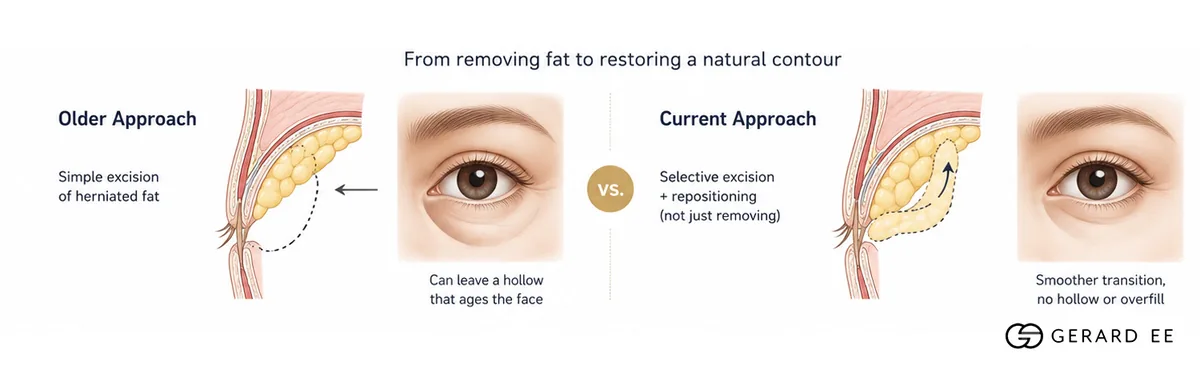
Older blepharoplasty simply excised the herniated fat. The problem with that is the hollow it can leave, which ages a face in a different way — a common reason people are unhappy with an operation that technically worked.
Current practice favours a graded approach, and two recent series show what that looks like:
- 107 patients treated transcutaneously with selective deep fat excision combined with a septum-fat flap transposition: complete elimination of the fat bulge and tear trough deformity in 91.6%, undercorrection in 8.4%, and FACE-Q scores improving from 66.7 to 21.9 (p<0.001).9
- 97 patients treated transconjunctivally with refined trimming of orbital fat — preserving and repositioning rather than simply resecting: no major complications, resolution of fat herniation and tear trough deformity without overfilling, and patient satisfaction of 3.63 out of 4.10
Neither is a randomised trial and there is no head-to-head comparison, but both point the same way. Selective, graded excision combined with repositioning avoids the two failure modes at either end: leaving a residual bulge, or creating a hollow. If a surgeon tells you they will simply take the fat out, that is a reasonable question to press on.
Eye bag surgery risks
Bleeding, infection, asymmetry, a period of blurred or double vision if the small nerves are disturbed, temporary dry eye or watering, and swelling of the conjunctiva are the recognised complications, and each is uncommon. Lower lid malposition is the risk specific to lower eyelid surgery; it is reported at 15 to 20 per cent after conventional skin-incision techniques and is markedly lower when the fat is reached from inside the lid and the skin is handled by pinch alone. Hollowing after over-removal of fat is avoided by conservative trimming or by repositioning. The published complication rates are set out in full in the complications section below.
Eye bag surgery complications and how likely they are
Every source I have cited is clear that the common complications are transient and the serious ones are rare. Being specific about which is which is more useful than either reassurance or alarm.
Common and usually self-limiting: swelling, bruising, ocular surface irritation and chemosis. In one 97-patient transconjunctival series, lower eyelid swelling occurred in every single patient — 100% — and resolved within 8 weeks; mild chemosis settled within 2 weeks and midfacial numbness within 3 weeks.10
Approach-dependent: ectropion, scleral show, lid retraction and visible scarring, all more frequent with the transcutaneous route, with the odds ratios given above.5,7 Persistent chemosis is likewise more common after transcutaneous surgery with canthoplasty.6
Rare but serious: orbital haemorrhage, diplopia, infection and vision loss. The published safety literature describes these as rare without giving pooled incidence figures, because the studies are too heterogeneous to combine.7 I am not going to quote you a percentage that does not exist. What I will say is that a rare catastrophic risk is a real consideration for an elective cosmetic operation in a way it is not for a necessary one, and that is a legitimate part of your decision.
Eye bag surgery recovery: the realistic timeline
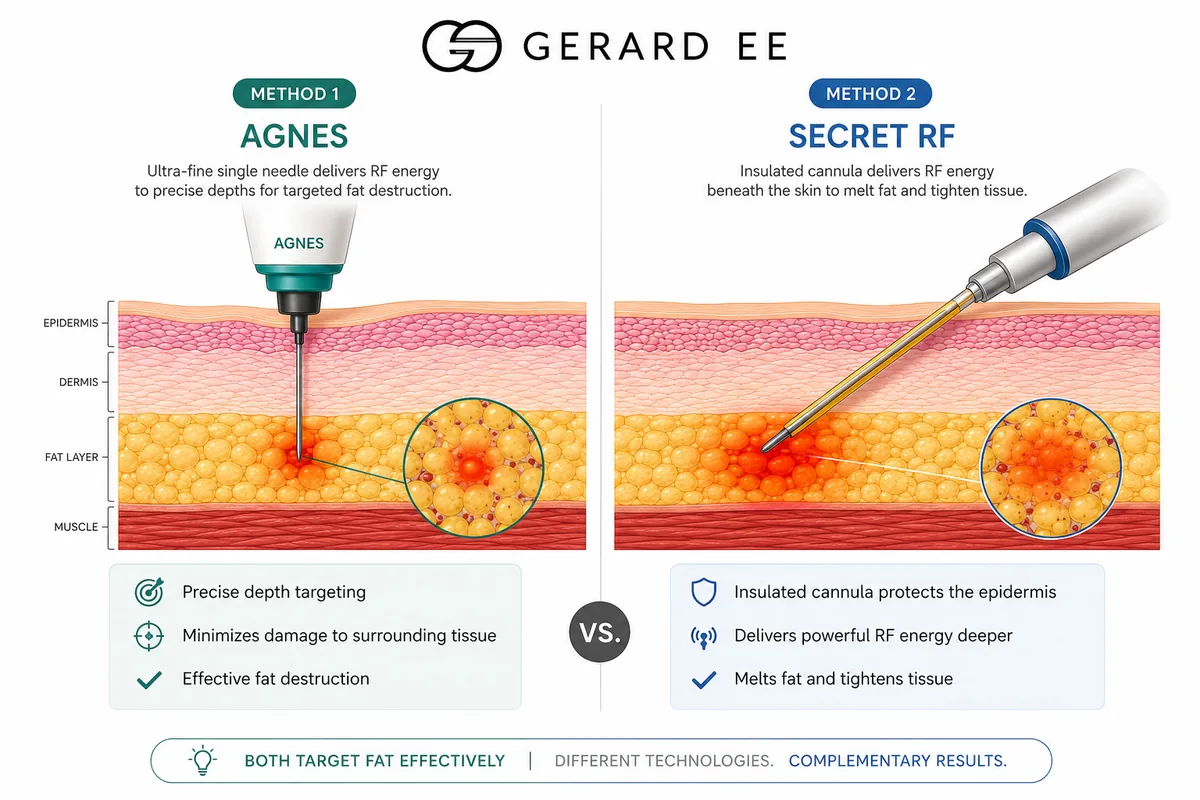
From the published series, and consistent with the patients I see afterwards:10
- Swelling: universal, and it takes up to 8 weeks to fully settle. Most of it goes in the first two weeks, but the last of it is slow and asymmetric, which unsettles people who were expecting to be finished at two weeks.
- Chemosis: where it occurs and is mild, about 2 weeks.
- Midfacial numbness: around 3 weeks.
- Bruising: generally the first one to two weeks, and coverable with makeup sooner than the swelling settles.
Judging your own result before three months is a mistake, in the same way it is with non-surgical treatment. The tissue is still settling.
How long does eye bag surgery last?
Longer than anything non-surgical, and I say that as someone who offers the non-surgical option. Excised fat has been physically removed, but residual fat, the orbital septum, lower-lid support and the surrounding midface continue to age. The under-eye contour can therefore change again over time.
But here is a gap in the literature that nobody advertises: none of the studies above report long-term recurrence rates. Follow-up in the fat repositioning and excision series runs from about 8 months to 2 years.6,9,10 Nobody has published what these patients look like at ten years. Ageing continues after surgery — the septum keeps weakening, the lid keeps losing tone, the midface keeps descending — so “permanent” is a word to be careful with here too, for the same reason I stopped using it about whether non-surgical eye bag removal is permanent.
Who should not have eye bag surgery
The published risk factors for a poor outcome are consistent across sources: significant lower lid laxity without planned canthal support, negative vector orbital anatomy, prominent globe, pre-existing ocular surface disease such as dry eye, previous periocular surgery, and anticoagulant use.3,7
None of these is an absolute bar. Each is a reason for the surgeon to modify the plan — canthal support, a different approach, more conservative excision — and a reason for you to be told about it beforehand rather than after.
I would also add a non-clinical one. If your bags are mild and you are considering surgery because a clinic has told you it is the only way, get a second opinion. Mild bags respond to less than that.
The questions I would ask a surgeon
- Which approach are you proposing, transconjunctival or transcutaneous, and why that one for me?
- Did you perform a snap-back and distraction test, and what did they show?
- Am I having canthal support, and if not, why not?
- Are you excising the fat, repositioning it, or both?
- What is your revision rate, and who pays for a revision?
- What does my result look like at three months, not at two weeks?
A surgeon should be able to answer these questions clearly and explain how the proposed plan fits your anatomy, priorities and risk profile.
Who performs scarless eye bag removal
The assessment and the treatment plan are with me, Dr Gerard Ee, MBBS (UK), MRCS (Edinburgh), PGDip Practical Dermatology (Cardiff), Medical Director of The Clifford Clinic. The operation is performed by Dr Shen or A/Prof Vincent Yeow at The Clifford Surgery, at the same address. I see you at the consultation and the reviews, and the non-surgical route remains available at the same clinic, so the recommendation is made without a commercial reason to prefer one over the other.
The clinic at Raffles Place
50 Raffles Place, #01-01 Singapore Land Tower, Singapore 048623. Telephone 6532 2048. Raffles Place MRT is a two-minute walk. Monday to Friday, 10am to 8pm. Saturday, 10am to 5pm.
Book a consultation
Dr Gerard Ee assesses and reviews at The Clifford Clinic, 50 Raffles Place, Singapore; the surgery is performed by Dr Shen or A/Prof Vincent Yeow at The Clifford Surgery.
Scarless eye bag removal FAQ
What is scarless eye bag removal?
It is the transconjunctival approach — the incision is made inside the lower lid rather than through the skin, so there is no external scar. It suits patients whose problem is fat rather than excess skin.
How much does scarless eye bag removal cost in Singapore?
$2,988 plus a $500 to $1,000 day surgery facility fee at my clinic, before GST. A pinch skin excision, where excess skin also needs removing, is $2,788. Across Singapore it varies widely between practices. What the quotation includes — approach, canthal support, follow-up, revision policy — matters more for comparison than the headline figure.
Is scarless eye bag removal permanent?
The fat that is removed does not come back. The eyelid continues to age, the septum keeps weakening and the surrounding cheek descends, so the contour can change again over years. Surgery lasts longer than any non-surgical treatment; it does not stop time. No published study follows these patients beyond about two years,6,9,10 so permanent is a stronger word than the evidence supports.
How long is the recovery after scarless eye bag surgery?
Bruising for one to two weeks, most swelling gone by two weeks, the last of it by eight weeks, and regular activities from 7 to 14 days. The result is assessed at three months. Swelling occurred in 100% of patients in one transconjunctival series and took up to 8 weeks to fully resolve, with mild chemosis settling in about 2 weeks and midfacial numbness in about 3.10
What are the risks of eye bag surgery?
Swelling is expected after lower-eyelid surgery, while bruising, irritation and chemosis are common but vary between patients.10 Ectropion, scleral show and lid retraction are the approach-dependent risks and cluster with transcutaneous surgery.5,7 Orbital haemorrhage, diplopia and vision loss are rare, and the published literature does not give reliable pooled rates for them.7
Is it done under general anaesthesia?
No. The operation is performed under local anaesthesia in a day surgery facility, which is why there is no anaesthetist fee.
Will I be hollow under the eyes afterwards?
Not if the fat is trimmed conservatively or repositioned into the tear trough where a hollow already exists. Over-removal is the cause of a hollow, and it is avoided at the planning stage. Current technique favours graded excision combined with repositioning, and series using that approach report elimination of the bulge without overfilling or hollowing.9,10
Is transconjunctival surgery better than a skin incision?
For a fat bag without a large skin excess, yes: the incision is hidden, the muscle is not cut and the risk of the lid being pulled down is lower. A skin incision is reserved for cases with a lot of redundant skin that a pinch cannot handle. Comparative data show the transcutaneous route carries higher odds of ectropion (OR 2.94), scleral show (OR 2.33) and visible scarring (OR 5.62), while transconjunctival carries a higher risk of entropion.5
What is canthopexy and do I need it?
It is a tightening of the lateral canthal tendon that supports the lower lid. The graded approach indicates it for patients with lid-cheek junction abnormality, lower lid laxity, or where a transcutaneous skin-muscle flap is used — canthopexy for mild laxity, canthoplasty for more severe.3 Without it, in a lax lid, the lid margin can end up pulled downward.
Can I combine surgery with filler or radiofrequency?
Yes. A residual hollow after surgery can be filled once the swelling has settled, and skin quality can be treated with collagen stimulators. Radiofrequency before surgery is not needed for a bag that already meets surgical criteria.
Do you perform eye bag surgery?
No. I treat eye bags non-surgically and refer patients who need an operation to Dr Shen or A/Prof Vincent Yeow at The Clifford Surgery, at the same address. That is precisely why I can set out the surgical evidence without a commercial interest in the answer.

Book a consultation with Dr Gerard Ee at The Clifford Clinic
Dr Gerard Ee consults and performs scarless eye bag removal at The Clifford Clinic, 50 Raffles Place, Singapore. Consultations are by appointment. Message the clinic on WhatsApp, or call 6532 2048.
Published evidence
- Beer J, Boghosian T, Sherif R, et al. What’s new with under eye treatment: a multispecialty systematic review of recent under eye treatments. Dermatol Surg. 2026;52(2):155–163. doi:10.1097/DSS.0000000000004964
- Shin JW, Park JT, Chae JB, et al. The efficacy of micro-insulated needle radiofrequency system for the treatment of lower eyelid fat bulging. J Dtsch Dermatol Ges. 2019;17(2):149–156. doi:10.1111/ddg.13736
- Hashem AM, Couto RA, Waltzman JT, Drake RL, Zins JE. Evidence-based medicine: a graded approach to lower lid blepharoplasty. Plast Reconstr Surg. 2017;139(1):139e–150e. doi:10.1097/PRS.0000000000002849
- Lee J. Lateral tarsal strip procedure for left lower eyelid entropion. J Med Insight. 2023. doi:10.24296/jomi/402
- Chen YY, Lai YJ, Chen TY, Yen YF. Eyelid complications in subciliary versus transconjunctival approaches to orbital and zygomaticofacial fractures: a meta-analysis. J Clin Med. 2025;14(18):6431. doi:10.3390/jcm14186431
- Di Maria A, Barone G, Gaeta A, et al. Persistent conjunctival chemosis after lower lid blepharoplasty: a comparison of different surgical techniques. J Clin Med. 2024;13(7):2093. doi:10.3390/jcm13072093
- Taghioff SM, Munkwitz SE, Quan H, et al. Safety considerations in blepharoplasty: a comprehensive review. J Craniofac Surg. 2026. doi:10.1097/SCS.0000000000013144
- Nomoto S, Ogawa R. Subtarsal capsulopalpebral fascia incision: a new paradigm for ectropion-free transcutaneous lower blepharoplasty. Plast Reconstr Surg. 2026;157(4):486e–495e. doi:10.1097/PRS.0000000000012429
- Chen J, Li C, Zhang F, et al. Fat repositioning with deep fat excision in transcutaneous lower blepharoplasty. Plast Reconstr Surg. 2026;157(4):622–631. doi:10.1097/PRS.0000000000012416
- Li W, Gao Y, Qi Z, Li Z, Wu F. Refined trimming of orbital fat in transconjunctival lower blepharoplasty: a retrospective cohort study on clinical outcomes and aesthetic assessment. Medicine. 2025;104(43):e45314. doi:10.1097/MD.0000000000045314
- Choi B, Yang S, Park J, Lee H, Baek S. Effectiveness and satisfaction degree of transconjunctival-approach lower blepharoplasty combined with pinch skin excision technique. J Craniofac Surg. 2020;31(3):766-768. PMID 32028371. (69 patients, success 96.7% under 60 and 97.4% over 60, three persistent complications, six-month follow-up.)
- Kim EM, Bucky LP. Power of the pinch: pinch lower lid blepharoplasty. Ann Plast Surg. 2008;60(5):532-537. PMID 18434828. (Conventional transcutaneous lower lid malposition 15 to 20%; pinch plus transconjunctival fat removal leaves the middle lamella intact.)

