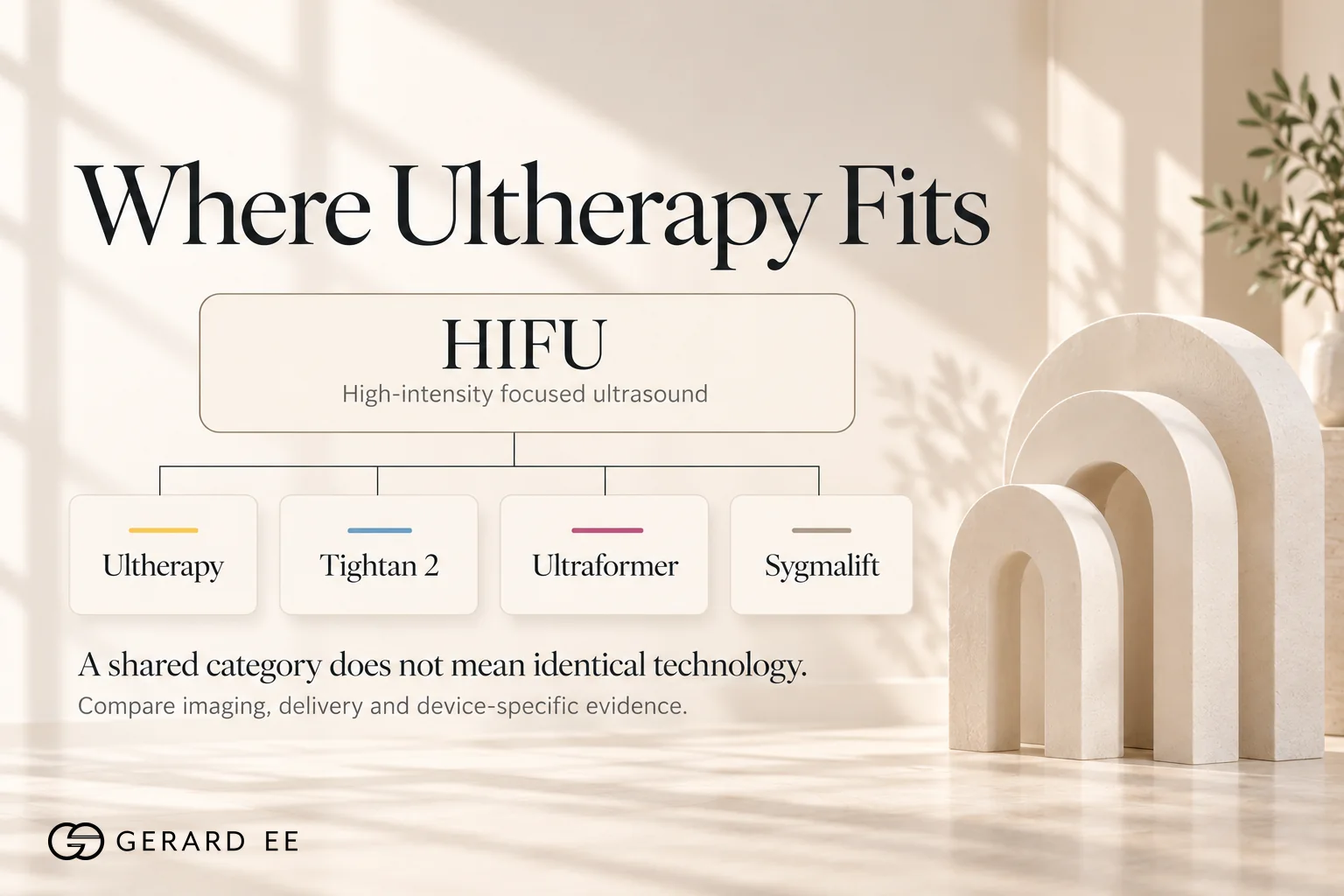
Ultherapy is a type of HIFU. Ulthera is the original system name, whereas Ultherapy is the treatment name most patients recognise, so a search for Ultherapy vs HIFU compares one named ultrasound platform with the other machines in the same category. I have performed HIFU since 2012, beginning on the original Ulthera system, and this comparison draws on experience with that brand as well as with the wider category.
The differences that matter are real-time imaging, treatment depth, energy delivery, comfort, published evidence and the way the procedure is planned. A brand name alone does not establish whether a treatment suits a given anatomy, or what degree of change is realistic.
What HIFU Means and Where Ultherapy Sits Within It
HIFU means high-intensity focused ultrasound. Energy is concentrated at selected points beneath the skin, and each point produces a small controlled thermal coagulation zone. Collagen within that zone is denatured, the healing response that follows deposits new collagen over the subsequent weeks, and the tissue contracts gradually without an incision. Ultherapy, Tightan 2, Ultraformer and Sygmalift all sit within the HIFU category, although they do not deliver that energy in the same way.
Medical papers describe Ultherapy more precisely as microfocused ultrasound with visualisation. That phrase identifies the exact device type studied, whereas Ultherapy and HIFU remain the terms patients use. The full HIFU guide explains how treatment depth, tissue thickness and facial fat influence planning.
Focused HIFU and Fractionated HIFU Compared
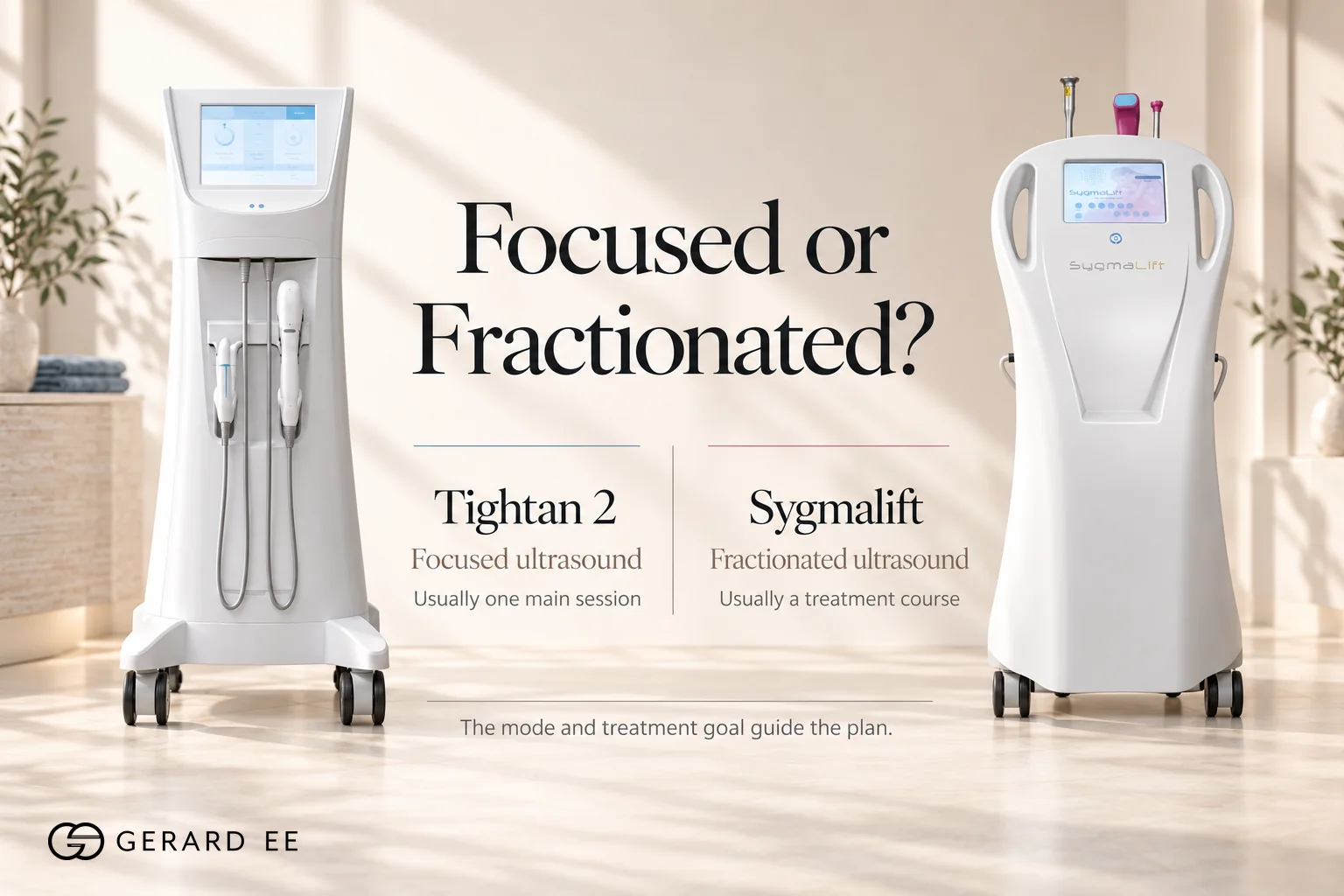
The more useful distinction is between focused HIFU and fractionated HIFU. Focused devices create discrete coagulation points at predetermined depths. Fractionated HIFU divides comparable energy into many smaller zones, which allows a gentler protocol delivered as a staged course.
| Focused HIFU | Fractionated HIFU | |
|---|---|---|
| Examples | Tightan 2, Ultherapy, Ultraformer | Sygmalift |
| Delivery | Discrete focused thermal points | Many smaller fractionated zones |
| Best suited to | Deeper lifting, lower-face laxity and selected contouring | Gentler firming, skin quality, and treatment where unwanted fat reduction is a concern |
| Comfort | More intense, particularly over bone, and it varies considerably between devices | Usually more comfortable |
| Treatment pattern | Usually one main session | Usually a course |
The framework is clinical rather than technical, and it does not imply that every machine within a group behaves identically. The cartridge, treatment depth, energy and intended tissue effect still need to be stated for any quoted treatment. Comfort in particular varies within the focused group, and that difference is set out below.
What Makes Ultherapy Different from Other HIFU Machines
Ultherapy provides real-time ultrasound visualisation while energy is delivered, so tissue depth and coupling can be confirmed before each line is placed. That capability matters because energy delivered above or below the intended plane either wastes the treatment or raises the risk of injuring structures the operator cannot otherwise see. A published review comparing Ultherapy with three other HIFU systems found differences in visualisation, thermal regulation and the consistency of treatment points [1].
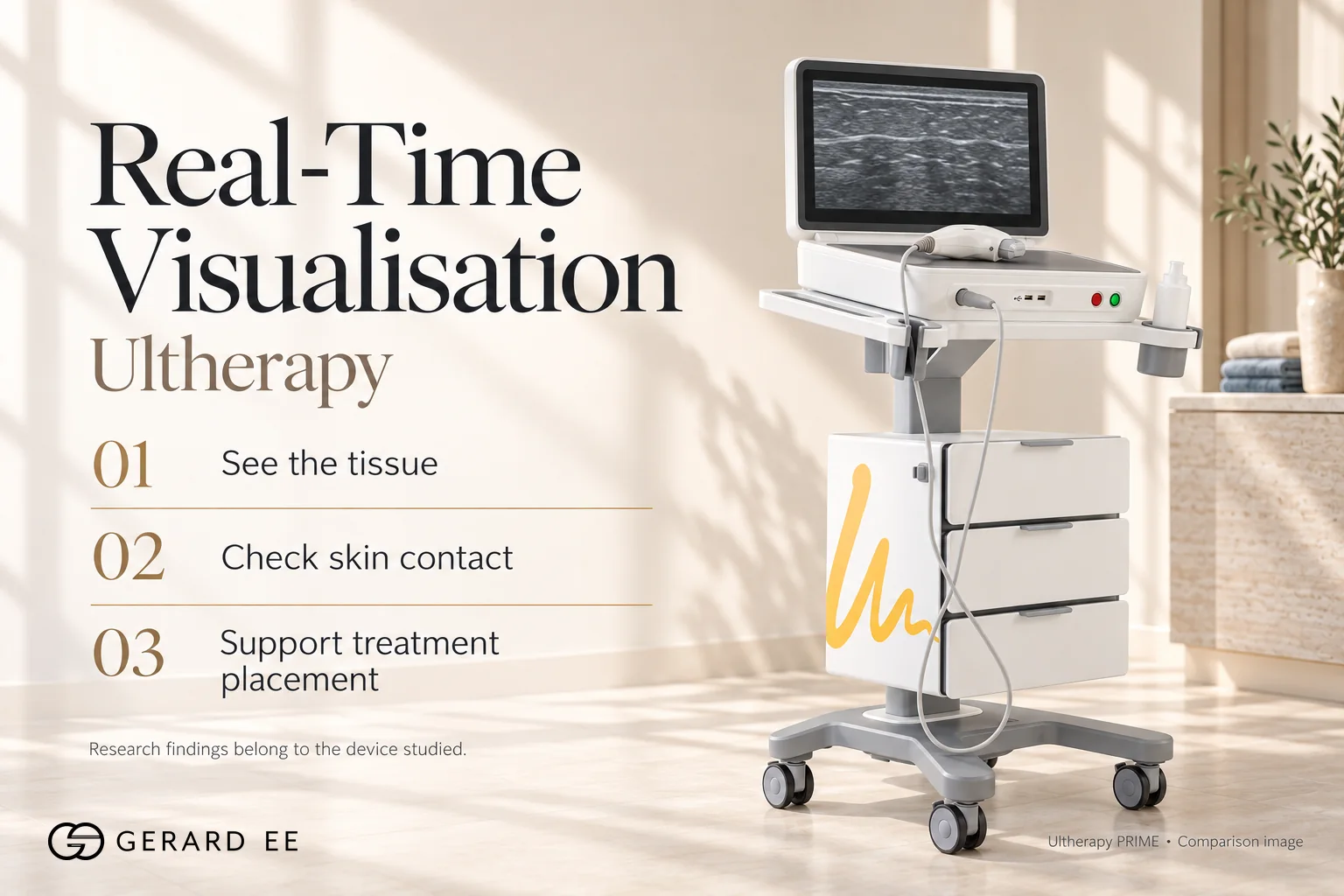
Ultherapy also carries a substantial published evidence base and specific United States FDA clearances for lifting the brow, neck and submental tissue, and for improving lines and wrinkles on the décolletage. Evidence for Ulthera or Ultherapy should not be transferred to another HIFU machine merely because the general mechanism is similar.
How Tightan 2 and Sygmalift Differ from Ultherapy
Tightan 2 is the focused HIFU system I use for deeper face and neck treatment. It treats at predetermined depths in the same way as Ultherapy, but without real-time visualisation, so the treatment plan is mapped externally against palpable landmarks rather than confirmed on screen line by line. It is normally planned as a single session rather than a course.
Having worked with both, I find Tightan 2 much more comfortable than Ultherapy. That difference matters more than it sounds. Comfort sets the ceiling on the energy and the coverage a patient will actually sit through, and a treatment cut short because it hurts is a treatment that under-delivers.
Sygmalift is the fractionated HIFU option, delivered as a gentler course and directed either at superficial firming or at selected facial and submental contouring. The mode selected matters, because the same device can be set towards skin quality or towards fat reduction, and those are different goals in a lean face.
I reach for Sygmalift most often at two ends of the age range, for opposite reasons. In patients in their twenties there is usually nothing sagging yet and no volume to lose, so a fractionated treatment that firms without reducing facial fat is the appropriate choice. In patients in their sixties and seventies I choose it for comfort and for its work in the superficial layer.
Which HIFU Treatment Suits Which Face
| Assessment finding | Preferred approach | Reason |
|---|---|---|
| Early jowl, softening jawline or mild to moderate neck laxity | Focused HIFU, including Tightan 2 or Ultherapy | Tissue thickness and facial fat determine cartridge choice and treatment zones |
| Preference for real-time imaging | Ultherapy | Tissue depth and coupling can be confirmed during treatment |
| Patient in their twenties, nothing yet sagging | Fractionated HIFU, Sygmalift | Firming without reducing facial fat, which a younger face has no reason to lose |
| Patient in their sixties or seventies | Fractionated HIFU, Sygmalift | Comfort, and treatment directed at the superficial layer |
| Poor tolerance of discomfort | Fractionated HIFU, or a modified focused HIFU protocol | Comfort limits the energy and coverage a patient can complete |
| Marked facial volume loss | I turn these faces away for HIFU | Unwanted fat reduction makes a lean or hollow face look worse, not better |
| Advanced tissue descent | Surgical assessment | Energy-based treatments produce more modest change than surgery |
| Acne scarring as the main concern | I turn these faces away for HIFU | Subcision, resurfacing and scar-directed procedures address a different problem, and HIFU will not treat it |
Turning a patient away is part of the assessment rather than an exception to it. The two findings above account for most of the faces I decline to treat with HIFU.
Why HIFU or Ultherapy Sometimes Does Not Work
A limited result usually has one of four explanations. The visible concern is volume loss rather than laxity. The degree of descent exceeds what a non-surgical treatment can correct. The depths, energy and coverage selected do not match the anatomy. Or the result was judged too early, since collagen remodelling continues for two to three months after treatment and individual response varies.
Shot count contributes to coverage, but additional shots do not produce a proportionally better Ultherapy or HIFU result. Device type, energy per line, focal depth, spacing, treatment area and placement determine the outcome together, and the HIFU price guide explains how to read a quoted line count. The risks and results page covers what I see most often when a treatment produces no visible change.

What the Evidence on Ultherapy and HIFU Shows
Evidence is strongest for mild to moderate laxity and remains uneven across HIFU devices. A 2025 systematic review and meta-analysis of 42 Ultherapy-type studies found that 89% of patients showed some degree of investigator-rated global improvement and 84% reported improvement. Satisfaction was 62% in studies that offered a neutral response option, which shows how questionnaire design can change the apparent result [2].
A randomised blinded study of the upper face reported a mean brow elevation of 2.16 mm at 90 days after one focused ultrasound treatment, and two blinded assessors judged 87.5% of participants to have clinically significant brow elevation at 180 days [3]. The finding applies to that protocol and that anatomical area rather than to every face or device.
A randomised Ultherapy study of 51 participants compared a standard treatment-line pattern with a customised protocol based on lower-face and neck anatomy. Both groups improved, and customised planning maximised results in patients whose anatomy differed from the standard template [4].

Dr Gerard Ee, Aesthetic Doctor in Singapore
Dr Gerard Ee is an aesthetic doctor in Singapore and the Medical Director of his practice at 50 Raffles Place. He graduated from St George’s, University of London, trained in surgery at Singapore General Hospital and the National University Hospital, and holds the MRCS (Edinburgh) and a postgraduate diploma in practical dermatology from Cardiff University.
He has practised aesthetic medicine since 2012, is the author of sixteen peer-reviewed papers, and writes and medically reviews every article on this site. Read more about Dr Gerard Ee.

Book a HIFU Consultation in Singapore
Dr Gerard Ee consults and performs HIFU at The Clifford Clinic, 50 Raffles Place, Singapore. Consultations are by appointment. Message the clinic on WhatsApp, or call 6532 2048.
Book a consultation to discuss whether HIFU suits your facial concerns. The assessment covers skin quality, facial volume and treatment goals, and sets out where the focused Tightan 2 and fractionated Sygmalift options fit.
HIFU vs Ultherapy questions
Is Ultherapy better than HIFU?
Ultherapy is itself a HIFU treatment, so the comparison is between one platform and the rest of the category. Ultherapy is the stronger choice where real-time visualisation and the largest published evidence base are the priorities. Another HIFU machine can be preferable where a different depth range, delivery pattern, treatment time or comfort profile suits the anatomy and the treatment goal better.
Is Ultherapy more painful than other HIFU treatments?
In my experience Ultherapy is the less comfortable treatment, and Tightan 2 is much more comfortable. Pain still varies with energy, depth, facial area and individual sensitivity. A 2025 meta-analysis of Ultherapy-type studies reported a pooled mean pain score of 4.85 out of 10, with substantial variation between studies [2]. Head-to-head published comparisons between Ultherapy and every other HIFU machine are unavailable, so this reflects clinical experience rather than trial data.
How long do Ultherapy results last?
Ultherapy improvement is commonly assessed over three to six months as tissue remodelling develops. A small prospective Ultherapy study of 20 patients reported that some improvements persisted for up to one year, although only 14 participants were available for blinded assessment at that point [5]. Duration varies and cannot be promised for every device or patient.
Is Ulthera the same as Ultherapy?
Ulthera is the name of the original device system, whereas Ultherapy is the treatment brand most patients encounter. The terms are closely linked in clinical papers and in search, and Ultherapy Prime is the newer platform within the same treatment family.
Who should not have HIFU or Ultherapy?
I turn away two groups in particular. Faces with marked volume loss, because reducing facial fat further makes a hollow face look worse. And faces where acne scarring is the main concern, because scarring needs subcision, resurfacing or another scar-directed procedure rather than focused ultrasound. Advanced tissue descent is better assessed surgically.
This page is written from published research and from clinical experience treating faces in Singapore since 2012. It is for general education, not medical advice. Suitability, likely result, downtime and risk can only be established at a consultation. Dr Gerard Ee provides the treatments described on this page at The Clifford Clinic.
Dr Gerard Ee consults and performs this treatment at The Clifford Clinic, 50 Raffles Place, Singapore.
Show the 5 references
1. Pavicic T, Ballard JR, Bykovskaya T, et al. Microfocused ultrasound with visualization: Consensus on safety and review of energy-based devices. J Cosmet Dermatol. 2022;21(2):636-647. doi:10.1111/jocd.14666. PubMed 34951735
2. Amiri M, Ajasllari G, Llane A, et al. Microfocused Ultrasound With Visualization (MFU-V) Effectiveness and Safety: A Systematic Review and Meta-Analysis. Aesthet Surg J. 2025;45(3):NP86-NP94. doi:10.1093/asj/sjae228. PubMed 39540440
3. Chen W, Deng Y, Qiao G, Cai W. Ultrasound rejuvenation for upper facial skin: A randomized blinded prospective study. J Cosmet Dermatol. 2024;23(12):3942-3949. doi:10.1111/jocd.16482. PubMed 39034504
4. Wood E, Gonzalez A, Almukhtar R, Fletcher L, Fabi S. Comparing the Safety and Effectiveness of Microfocused Ultrasound: Standard vs Targeted Tissue Protocol in Lifting and Tightening the Lower Face and Upper Neck. J Drugs Dermatol. 2024;23(4):249-254. doi:10.36849/JDD.7647. PubMed 38564386
5. Werschler WP, Werschler PS. Long-term Efficacy of Micro-focused Ultrasound with Visualization for Lifting and Tightening Lax Facial and Neck Skin Using a Customized Vectoring Treatment Method. J Clin Aesthet Dermatol. 2016;9(2):27-33. PubMed 27047630