
Written by Dr Gerard Ee, MBBS (UK), MRCS (Edinburgh), PGDip Practical Dermatology (Cardiff). Founder and Medical Director, The Clifford Clinic and The Clifford Surgery, Singapore. Last medically reviewed and updated September 2026.
Most skin cancers can be cured when they are detected early, and early detection depends on a systematic examination of the whole skin surface. Skin cancer screening in my practice combines a full-body examination under dermoscopy with mole mapping to record change over time, and any biopsy, excision and histology is arranged within the same practice by the same doctor, without referral to another centre.
I have examined and removed moles for more than ten years. My surgical training, as a Member of the Royal College of Surgeons of Edinburgh, and my postgraduate diploma in practical dermatology underpin both the assessment and the excision. I perform the surgery as a day surgery case in an MOH approved ambulatory surgery centre, so it is claimable under day surgery insurance, subject to your policy. Any lesion that remains suspicious after dermoscopy is removed and sent for histology, because microscopic examination of the tissue is the only test that confirms or excludes skin cancer.

Skin cancer screening at a glance
- Full-body skin examination under a dermatoscope, taking 20 to 30 minutes.
- Mole mapping with AI change detection, which flags any mole that has grown or changed its pattern since the previous visit.
- Excision of suspicious lesions by Dr Gerard Ee, with histology reported by Singapore General Hospital. Laser is reserved for moles assessed as benign.
- Excision in an MOH approved day surgery centre, claimable under day surgery insurance.
- Screening consultation S$100 before GST.
Skin cancer screening in Singapore, what the examination involves
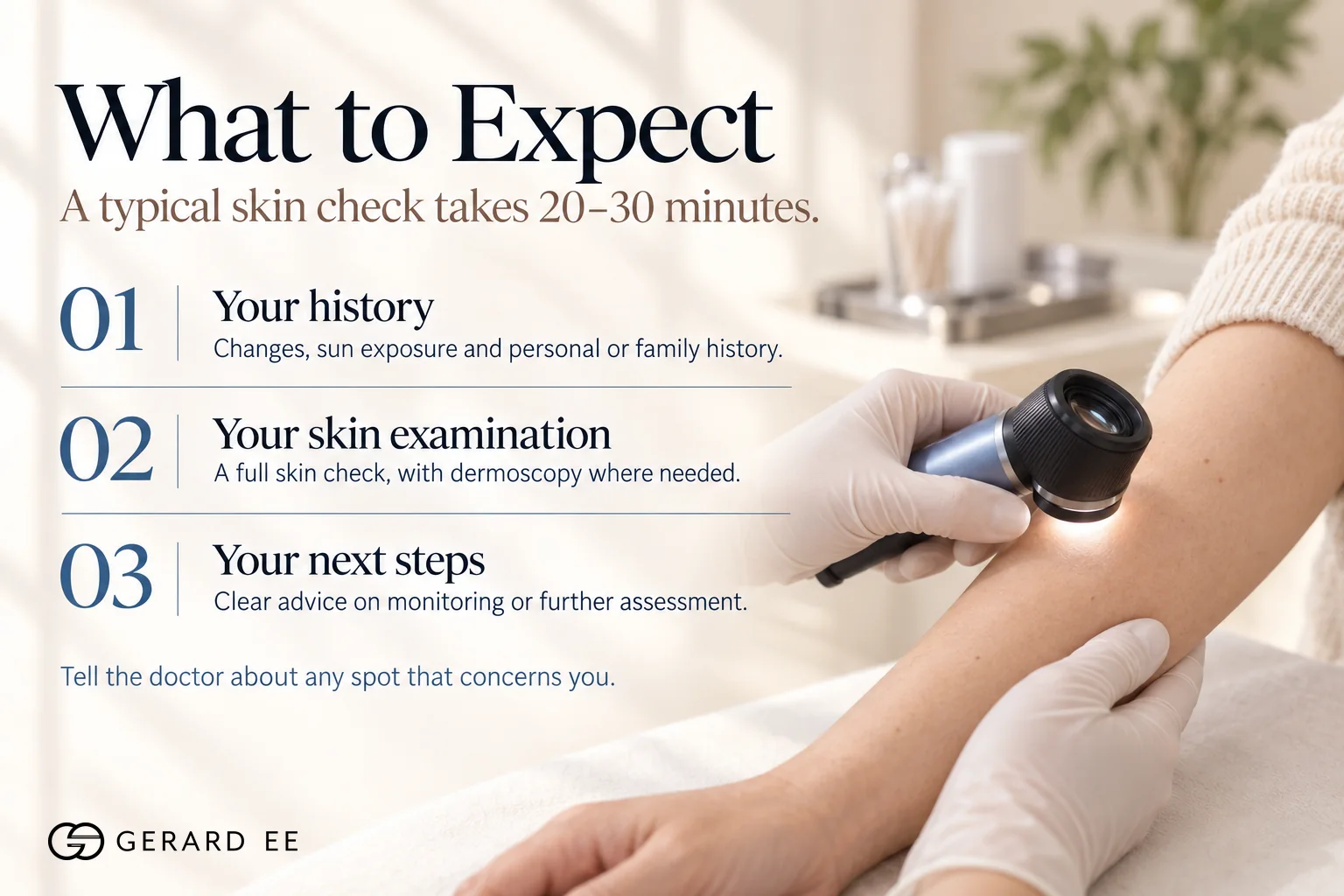
The screening begins with a history of the risk factors that determine how closely each area is examined. These include cumulative sun exposure, previous sunburn, a personal or family history of skin cancer, any mole that has changed, and any sore that has not healed.
The examination covers the entire skin surface. Every mole and every pigmented or scaly patch is assessed under a dermatoscope, a polarised-light magnifier that removes surface glare and shows the pigment network and blood vessel pattern beneath the skin surface. A meta-analysis of clinical studies found that dermoscopy improved diagnostic accuracy for melanoma over naked-eye examination, with the greatest gain among trained examiners. A Cochrane review found that dermoscopy also improves the diagnosis of basal cell carcinoma, although the evidence for squamous cell carcinoma is less certain.
Patients with many moles, or with a mole that warrants surveillance rather than removal, also have mole mapping at the first visit, which adds about 15 minutes.
Each screening concludes with a management plan. For most patients the plan is reassurance and an interval for the next examination, and for some it is excision of a specific mole. Where the clinical finding is clear, the biopsy is taken at the same visit.
Who should have a mole check or skin cancer screening

A new mole, a changing mole, or a sore that repeatedly crusts or bleeds warrants prompt examination rather than a wait for the next routine screening.
Routine screening is of greatest value for patients with a personal or family history of skin cancer, more than about fifty moles, atypical or large moles, fair skin that burns easily, a history of blistering sunburn, or years of outdoor work or sport. Singapore lies close to the equator, so the ultraviolet index remains high throughout the year and outdoor exposure accumulates without a seasonal break. Patients on long-term immunosuppression, for example after an organ transplant, carry a substantially higher risk of squamous cell carcinoma, because suppressed immunity is thought to reduce the clearance of sun-damaged skin cells, and these patients are examined every year.
Skin cancer in Singapore is predominantly non-melanoma skin cancer. Basal cell carcinoma and squamous cell carcinoma are far more common than melanoma, and their incidence has risen over five decades across Chinese, Malay and Indian Singaporeans. Melanoma is less common in Asian skin, and a larger proportion of cases arise on the palms, soles and nail beds (acral melanoma), where sunlight plays a smaller role. These sites are examined at every screening, including the soles of the feet, which are seldom checked at home.
Signs of skin cancer and melanoma to check for
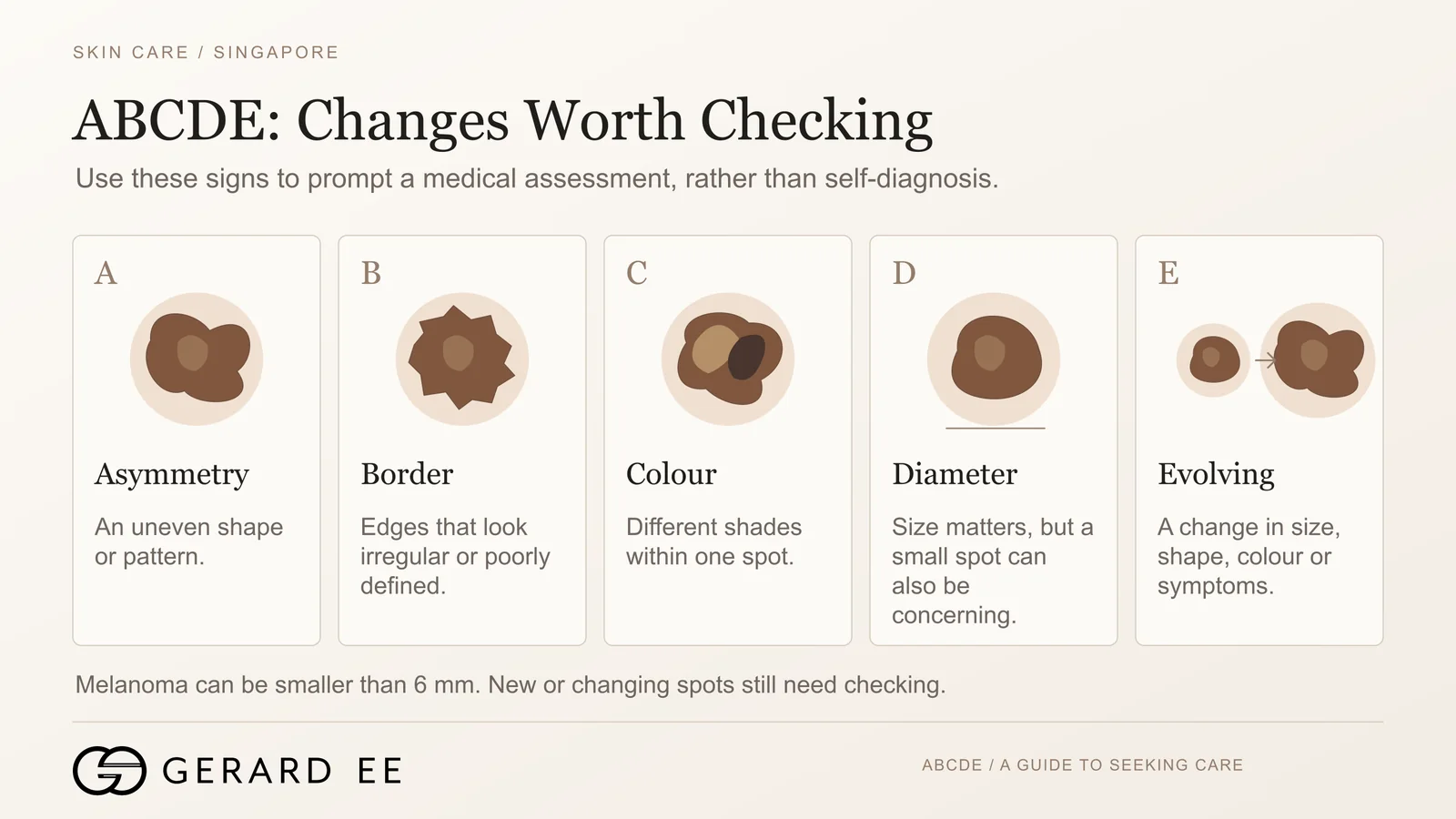
The ABCDE rule is the most widely used checklist for melanoma. Its five criteria are Asymmetry, an irregular Border, more than one Colour, a Diameter above 6 mm, and Evolution, meaning any change in size, shape, colour or symptoms. Evolution was added to the original ABCD criteria in 2004, because a changing mole is among the strongest warning signs and some melanomas are detected while still smaller than 6 mm.
The ugly duckling sign is the second rule. Moles on the same person tend to resemble one another, so a mole that differs from the rest warrants examination whatever its ABCDE score. In a prospective study of skin examinations by dermatologists, the ugly duckling sign was a major contributor to the efficiency of melanoma detection.
Non-melanoma skin cancers are easily missed because they often do not resemble a typical mole. Basal cell carcinoma usually presents as a pearly or skin-coloured bump, often with fine surface vessels, which bleeds, crusts, appears to heal and then breaks down again. In Asian skin, basal cell carcinoma is frequently pigmented and can be mistaken for a benign mole, so every pigmented lesion is assessed under dermoscopy rather than by eye. Squamous cell carcinoma usually presents as a firm, scaly or crusted lump, or a persistent rough red patch, on the face, ears, scalp, forearms or hands. Any sore that has not healed within six weeks should be examined.
Mole mapping in Singapore, how dermoscopy tracks change over time

Mole mapping makes surveillance measurable for patients with many moles, by recording the whole body and each mole of interest in high-magnification dermoscopic photographs. Removing every mole that is slightly unusual is not recommended, because each excision leaves a scar and most atypical moles never become melanoma. Photographing atypical moles and comparing them at each follow-up is the recommended approach in high-risk patients. The images are stored securely against the patient record, and I review the software comparison at each follow-up, which flags any mole that has grown or changed its pattern. In a pooled analysis of digital dermoscopic follow-up, melanomas were detected at an early, thin stage, and about a third showed no dermoscopic features of melanoma at the first examination.
Mole mapping complements the clinical examination and does not replace it. Basal cell carcinoma does not arise from a mole and is therefore not captured in a mole map, so the photographs cover the melanocytic lesions and the dermatoscope examination covers every other lesion.
Suspicious mole removal, biopsy and histology

A lesion that looks suspicious is discussed at the same visit and the next step is planned there. For most lesions that step is excision, in which the whole mole is removed with a small margin of normal skin under local anaesthetic and sent for histology. For larger lesions, or where the diagnosis will determine the extent of surgery, a small biopsy is taken first.
I perform the surgery as a day surgery case in an MOH approved ambulatory surgery centre, so it is claimable under day surgery insurance, subject to your policy. Histology is reported through my practice’s collaboration with Singapore General Hospital, whose pathology service returns each report in two to three weeks. A benign report concludes the episode, whereas a skin cancer report is explained in terms of the type of cancer, the margin status and the treatment plan. Where a wider excision is needed, it is performed by our in-house plastic surgeon as a day surgery case.
Laser is never used on a mole that has not been assessed as benign under the dermatoscope, because laser destroys the tissue and leaves no specimen for histology. The mole check therefore precedes any cosmetic mole removal.
Skin cancer screening cost in Singapore
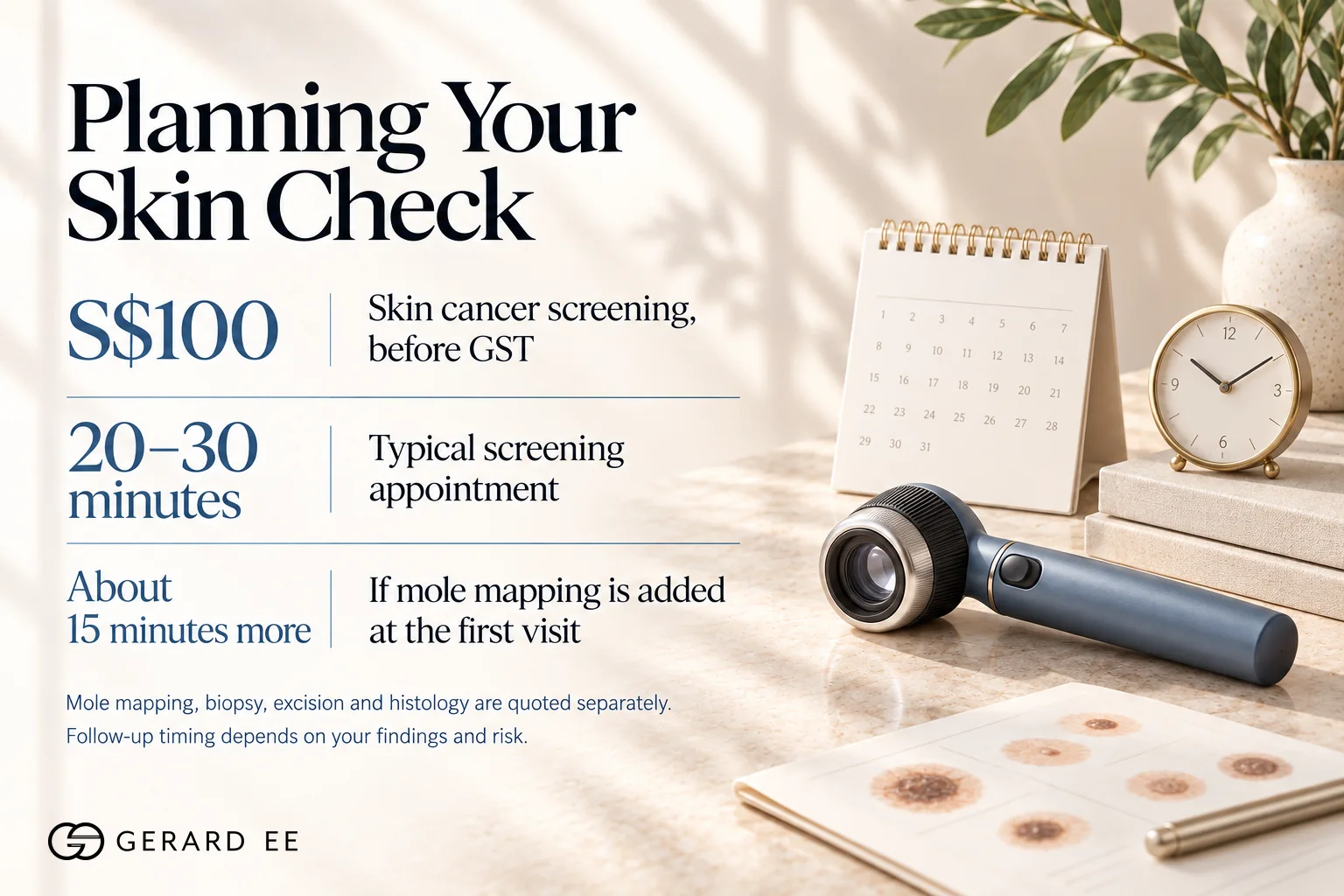
The screening consultation, including the full-body examination under dermoscopy, is S$100 before GST. Mole mapping, biopsy, excision and histology are quoted at the visit according to the findings, also before GST. Excisions in the day surgery centre are claimable under day surgery insurance, and my practice prepares the claim documentation.
How often should you have a skin check
For a patient with few moles and no risk factors, an examination every one to two years is generally appropriate, together with a self-examination every few months. For a patient with a previous skin cancer, many or atypical moles, or immunosuppression, the interval is usually yearly with mole mapping, so that any change is measured against the previous year’s images. A new or changing lesion between visits warrants bringing the appointment forward.
Why patients choose Dr Gerard Ee for skin cancer screening
The examination, the excision and the histology result remain with one doctor throughout. My surgical training and Membership of the Royal College of Surgeons of Edinburgh allow excision, margins and wound closure to be performed to a surgical standard, and my postgraduate diploma in practical dermatology from Cardiff University underpins the dermoscopic assessment. With an MOH approved ambulatory surgery centre on site, a suspicious mole identified on a Monday can usually be excised within the same week as a day surgery case, claimable under day surgery insurance, subject to your policy. Histology is reported by Singapore General Hospital, wider excision is available in the same centre when a cancer is confirmed, and mole mapping with AI change detection allows surveillance to be measured rather than recalled from memory.
Skin cancer screening in Singapore, frequently asked questions
Is a mole check painful?
A mole check is not painful. The examination is visual and the dermatoscope rests lightly on the skin, and any biopsy or excision is performed under local anaesthetic.
How long does a full-body skin check take?
The examination takes about 20 to 30 minutes. Mole mapping adds about 15 minutes at the first visit.
Do I need to undress for a full-body skin check?
Undressing is required, because a full-body skin check covers the scalp, face, trunk, limbs, palms, soles and nails. Underwear stays on unless there is a specific concern in that area.
Can you tell if a mole is cancerous by looking at it?
Dermoscopy is considerably more accurate than the naked eye and determines which moles need to be removed, but only histology of the excised mole, reported by Singapore General Hospital, confirms the diagnosis.
What happens if skin cancer is found?
The histology report from Singapore General Hospital confirms the type of skin cancer and whether the margins are clear. Where a wider excision is needed, it is performed by our in-house plastic surgeon as a day surgery case. Any case requiring oncology care is referred with the histology report and clinical images.
Is skin cancer screening covered by insurance?
The screening consultation is usually self-funded. An excision performed in the day surgery centre is claimable under day surgery insurance, subject to the terms of the individual policy.

Book a consultation with Dr Gerard Ee
Dr Gerard Ee consults and performs skin cancer screening, mole mapping and mole excision at his practice at 50 Raffles Place, Singapore. Consultations are by appointment. Message the practice on WhatsApp, or call 6532 2048.
Selected References
- Vestergaard ME, Macaskill P, Holt PE, Menzies SW. Dermoscopy compared with naked eye examination for the diagnosis of primary melanoma, a meta-analysis of studies performed in a clinical setting. Br J Dermatol. 2008. PMID 18616769.
- Dinnes J, Deeks JJ, Chuchu N, et al. Visual inspection and dermoscopy, alone or in combination, for diagnosing keratinocyte skin cancers in adults. Cochrane Database Syst Rev. 2018. PMID 30521688.
- Salerni G, Terán T, Puig S, et al. Meta-analysis of digital dermoscopy follow-up of melanocytic skin lesions, a study on behalf of the International Dermoscopy Society. J Eur Acad Dermatol Venereol. 2013. PMID 23181611.
- Abbasi NR, Shaw HM, Rigel DS, et al. Early diagnosis of cutaneous melanoma, revisiting the ABCD criteria. JAMA. 2004. PMID 15585738.
- Gaudy-Marqueste C, Wazaefi Y, Bruneu Y, et al. Ugly duckling sign as a major factor of efficiency in melanoma detection. JAMA Dermatol. 2017. PMID 28196213.
- Oh CC, Jin A, Koh WP. Trends of cutaneous basal cell carcinoma, squamous cell carcinoma, and melanoma among the Chinese, Malays, and Indians in Singapore from 1968 to 2016. JAAD Int. 2021. PMID 34409390.
Dr Gerard Ee consults and performs skin cancer screening, mole mapping and mole excision at his practice at 50 Raffles Place, Singapore.
This page is written from published research and clinical experience in Singapore since 2012. It is for general education, not medical advice. Suitability, results, downtime and cost vary from person to person. Please arrange a consultation for advice specific to your skin.

