By Dr Gerard Ee
Dr Gerard Ee consults at The Clifford Clinic, 50 Raffles Place, Singapore.
Tear trough filler does not remove an eye bag and commonly makes one appear heavier, because an eye bag is an excess of fat volume and filler adds further volume to the same region. Mild Grade 1 to 2 bags with firm skin are treated by fat reduction with AGNES and Secret RF, and Grade 3 to 4 bags or loose skin usually require surgery. Filler remains the correct treatment where the under eye is genuinely hollow rather than convex.
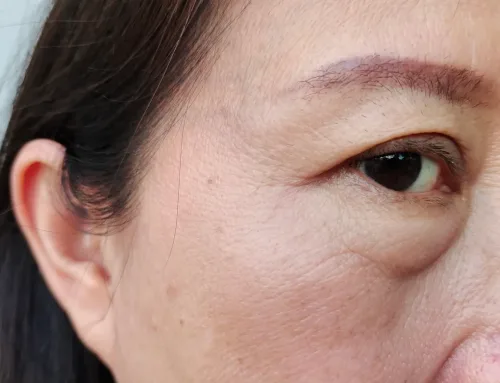
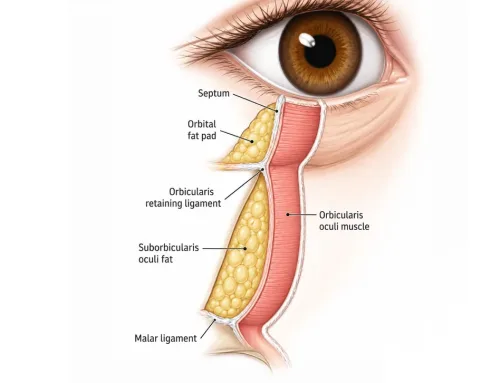
Fillers do not remove eye bags. A dermal filler is a soft gel implant that adds volume to a region which lacks it. An eye bag is the opposite problem, an excess of volume produced by lower eyelid fat pushing forward through a weakened orbital septum, the thin sheet of connective tissue that normally retains that fat behind the eyelid. Adding volume beside, beneath, or around a bulge does not reduce the bulge. It raises the total volume of a region that already holds too much. At best, the step between the bulge and the cheek is camouflaged. At worst, and I see this regularly in my consultation room, the entire under eye area becomes heavier, puffier, and visibly lumpy when the patient smiles.
After more than 10 years treating the under eye area, the most common correctable error I encounter is a true eye bag treated as though it were a tear trough. The two present similarly in a mirror and are opposite in anatomy, so the distinction between eye bags and tear troughs governs the treatment, and the injection that improves one can worsen the other. This article sets out when filler helps, why it fails on a true eye bag, and how the distinction is made on examination.
When under eye filler is the correct treatment
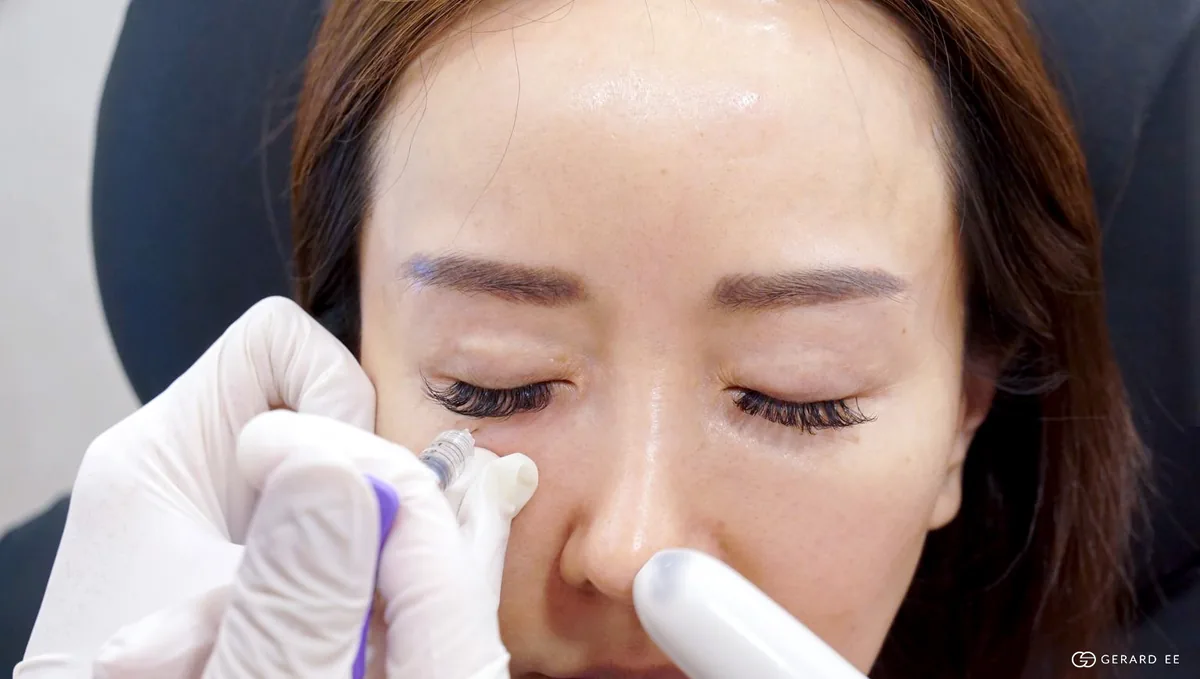
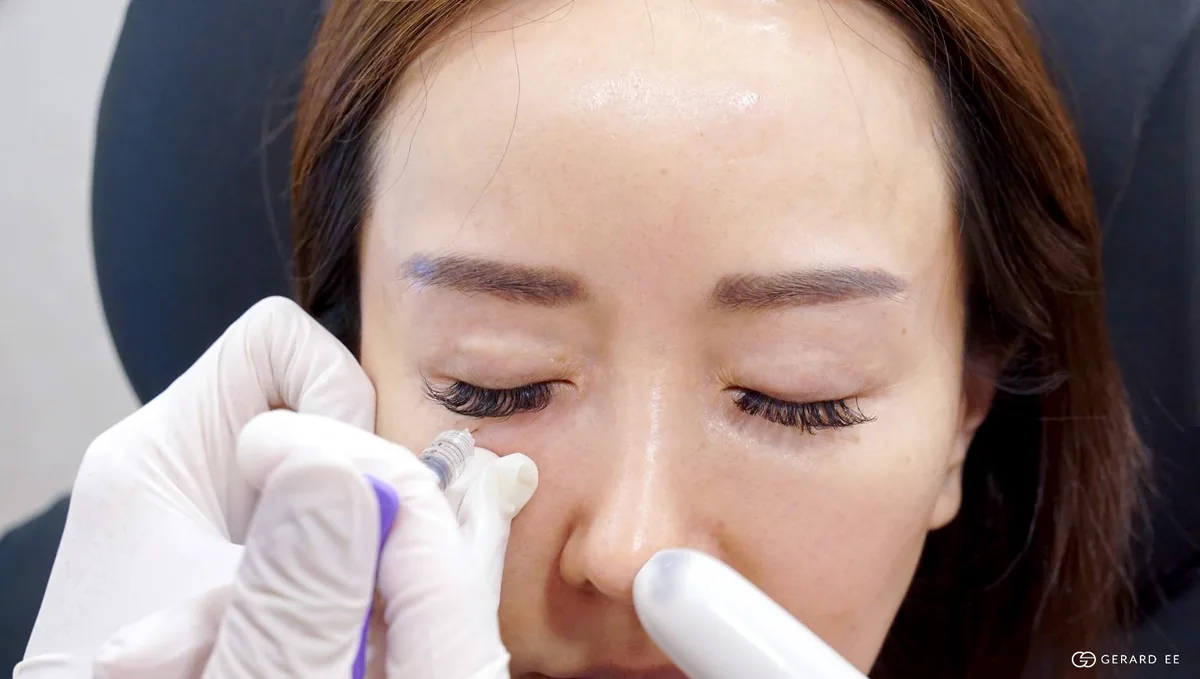
The failures described below are failures of diagnosis rather than failures of the product. Filler is the appropriate tool whenever the under eye problem is a deficit of volume, and two anatomical situations meet that description. In my experience treating patients who request tear trough filler by name, I have found that a proportion have precisely the anatomy filler corrects and do well with it, while the remainder carry a fat bulge that no injectable can reduce.
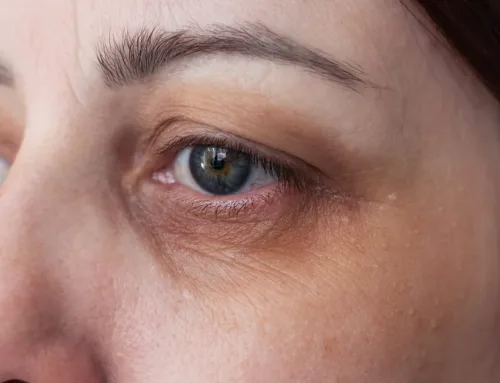
The first situation is a true tear trough. This appears as a hollow groove running from the inner corner of the eye toward the cheek, where the skin is tethered directly to the bone of the orbital rim by a retaining ligament and no fat lies in front of it. Overhead light falls across that depression and casts a shadow, which is read as tiredness even in a well rested patient. A conservative volume of filler placed deep in the groove restores the missing contour, the surface no longer slopes away from the light, and the shadow softens. The result is a softening of the shadow rather than its abolition, and in most patients the groove remains detectable under direct overhead light.
The second situation is mid cheek deficiency. As the cheek below the eyelid loses volume and forward projection, the junction between lid and cheek is no longer supported from beneath, and the whole under eye region falls back toward the orbital rim and reads as sunken. Restoring projection at the cheek, often without any injection into the eyelid at all, moves that junction forward again and improves the under eye area indirectly.
Both situations share one feature. The under eye contour is concave, so added volume corrects a deficit instead of adding to an excess. Filler is therefore the right treatment for a patient whose lower eyelid is hollow rather than convex, whose lower eyelid skin is firm, and in whom no fat bulge sits above the groove, and in that group a conservative volume placed deep is the treatment I would choose ahead of any device.
When filler is the wrong treatment for a true eye bag
Filler is the wrong tool when the anatomy is convex, meaning that a bulge of protruding fat is already present. The mechanism of failure is arithmetic before it is aesthetic. An eye bag is a fixed quantity of orbital fat lying in front of the orbital rim, filler is a further quantity of gel placed beneath or behind that fat, and the lower eyelid has to accommodate both. No injection removes fat, restores the orbital septum, or reduces the pressure pushing the fat forward, so the protrusion that produced the bag is unchanged while the tissue in front of it now has more to contain. Filler behaves differently in the nose, where it is used as nose filler to add height to the bridge rather than to correct a hollow; the options there are compared in nose threads vs nose fillers. The sequence that follows is predictable and runs in five steps.
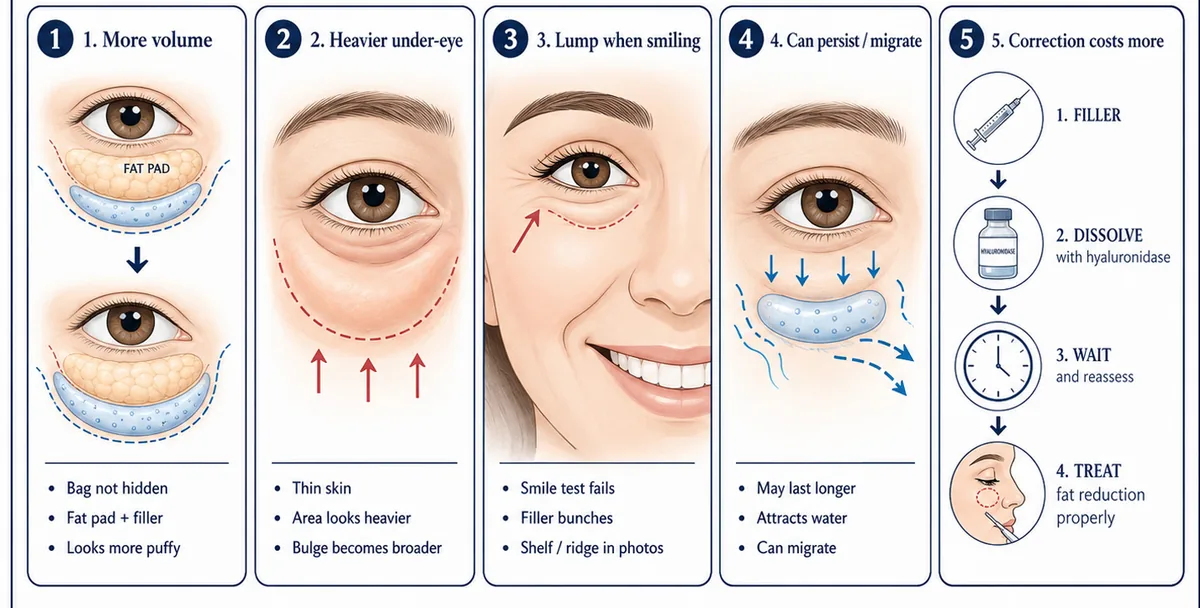
First, the bag is not concealed. Filling the groove beneath a bulge is intended to level the step between bag and cheek so that the shadow at the base of the bag disappears. What it produces is a raised platform beneath an unchanged fat pad. The under eye then carries the original fat pad and the injected filler together, total volume rises, and the region projects further forward than it did before treatment. In my experience the eye bag is not concealed by this and is usually made more conspicuous.
Second, the area becomes heavier. Lower eyelid skin is the thinnest on the body and lies over soft tissue with almost no subcutaneous fat beneath it. Nothing in the region disguises what is placed under the skin, so any added volume is visible at the surface rather than absorbed within it. Filler beneath a fat pad therefore converts a defined bag with a clear lower border into a broad and shapeless area of puffiness that extends onto the cheek.
Third, the appearance fails on smiling. This is the sign I encounter most frequently. At rest, the result may appear acceptable. On smiling, the orbicularis oculi muscle contracts and the cheek rises, the space beneath the lower eyelid narrows, and the gel is displaced into a smaller pocket where it gathers into a ridge. A lump becomes visible under the eye at precisely the moment the face is most often photographed. Patients describe a shelf or a ridge appearing in photographs whenever they smile naturally. An under eye result that holds only while the face is at rest is not an acceptable result.
Fourth, filler in this area persists and can migrate. The under eye moves little and drains slowly, so hyaluronic acid gel placed there is broken down far more gradually than the commonly quoted 9 to 18 months would suggest. The opposite is true where the tissue moves constantly, which is why the same gel used for lip fillers behaves on a shorter timescale. Hyaluronic acid is also strongly hydrophilic, meaning that it draws water out of the surrounding tissue, so a trough that was only slightly overfilled at the time of injection keeps swelling over the following months. Gel deposited in thin mobile tissue can also spread from where it was placed and settle lower on the cheek. In my experience assessing patients who present with puffiness after under eye filler placed elsewhere, I have found gel still identifiable on examination well beyond the quoted 9 to 18 months. The durations commonly quoted for hyaluronic acid are drawn largely from other facial regions, and the long-term behaviour of gel in the lower eyelid is not well established by controlled study. The area can look worse a year after treatment than the original bag ever did.
Fifth, correction costs more than accurate treatment would have. The remedy usually involves dissolving the filler with hyaluronidase, an enzyme that breaks hyaluronic acid down, allowing the tissue to settle for several weeks, re-examining the true anatomy and only then performing the fat directed treatment that was required at the outset. Each of those steps carries its own fee, paid in addition to the original filler, and the treatment finally performed is the one that would have been performed first had the anatomy been read correctly.
The simple way to understand it
Under-Eye Anatomy and Whether Filler Helps
| Anatomical Problem | Cause of the Problem | Does Filler Help? |
|---|---|---|
| A Hollow Groove Also known as a tear trough |
Missing volume | Yes, if conservatively placed |
| Flattened Mid-Cheek | Missing support below the eyelid | Yes, placed in the cheek |
| A Soft Bulge Below the Lash Line This is a true eye bag |
Excess volume | No, and it usually worsens the appearance |
| Bulge and Groove Together A true eye bag with a valley beside it |
Bulge caused by excess volume. Groove likely caused by missing volume. | Fat is treated first and the groove reassessed afterwards |
| Loose, Crepey Skin | Skin that cannot support added weight due to loss of elasticity | No, and surgery is often required |
The combination row matters most, because most patients present with more than one of these features at once. The common pattern is a mild eye bag with a groove immediately beneath it, where the groove looks deep largely by contrast with the bulge sitting above it. The sequence in my practice is almost always to address the fat first, using AGNES with Secret RF for mild Grade 1 to 2 bags, and to reassess the groove once the swelling has settled. Once the bulge is reduced the contrast goes with it, and in my experience treating combined bulge and groove I have found that the trough which originally concerned the patient frequently needs no filler at all, although a minority of patients retain a genuine hollow that a conservative volume then corrects well.
How I choose between filler and eye bag fat reduction
The algorithm I use, refined across more than 500 eye bag cases at The Clifford Clinic, turns on two questions, whether the dominant fault is excess volume or missing volume, and whether the lower eyelid skin is firm enough to retract over a reduced contour. Mild Grade 1 to 2 eye bags with firm skin receive AGNES with Secret RF for fat reduction. A deep tear trough or mid cheek deficiency without significant fat protrusion receives conservative filler. Grade 3 to 4 eye bags or loose lower eyelid skin receive surgery, often with pinch blepharoplasty in older patients. Combination cases receive fat reduction first, with filler considered later only where a genuine hollow remains once the bulge has settled.
Fat reduction carries its own ceiling. AGNES melts the protruding fat from the outside in through micro-insulated needles, and Secret RF then ablates the deeper portion of the same fat through a single direct insulated cannula carrying a radiofrequency tip. The heat that cannula conducts to the overlying skin tightens it to a degree, although it does not correct established laxity, which is why loose lower eyelid skin is referred for surgery rather than treated with either injectable. Results are typically visible from 8 weeks, and they last 3 to 5 years in most patients rather than permanently. No published trial compares filler against fat reduction in combined under eye anatomy, so the sequence set out above rests on anatomical reasoning and on the outcomes observed in my own practice rather than on comparative evidence.
The Clifford Clinic and The Clifford Surgery together offer fillers, non-surgical fat reduction, and both surgical procedures. These include scarless eye bag removal and pinch blepharoplasty. Among the aesthetic clinics commonly compared for eye bag treatment in Singapore, ours is the only centre with every option available in-house. A practice equipped only with injectables can recommend only injectables, whereas a centre holding the full range has no reason to favour one method over another.
Preventative tear trough filler in younger patients
A growing number of younger patients request small preventative tear trough fillers after encountering the idea online. Where a genuine tear trough already exists, conservative treatment is reasonable at any age. Injecting volume into a normal under eye in order to prevent ageing has no anatomical basis, because an eye bag forms through forward movement of orbital fat and weakening of the septum that retains it, and neither process is affected by gel placed in front of them. A younger patient with a normal under eye contour is the clearest example of a patient who asks for filler by name and should be declined rather than treated. Where a patient carries a hereditary tendency toward eye bags, filler has by then been placed in precisely the plane through which a fat pad will later protrude, which obscures the later assessment and complicates the eventual treatment. In my experience assessing younger patients who have had preventative filler, I have found the later examination harder rather than easier, because the injected gel and the fat pad can no longer be separated by inspection alone. Prevention in this region is a matter of sun protection and the avoidance of habitual eye rubbing rather than injection, because ultraviolet exposure and repeated mechanical traction are what weaken the eyelid skin and the septum over time.
Correcting under eye filler that has made the area worse
The situation is correctable in most cases. The pathway begins with an assessment of what was injected, in which plane and how long ago, since only hyaluronic acid products can be dissolved. Hyaluronic acid filler is then dissolved with hyaluronidase, sometimes over more than one round, as gel that has sat in place for years is denser and less accessible to the enzyme than recently injected material.
A filler that is not hyaluronic acid cannot be dissolved at all, and its removal may require surgical excision. The tissue is allowed to settle for several weeks until the true anatomy becomes visible again. The actual problem is then treated, typically with fat reduction through AGNES and Secret RF, or with surgery depending on the grade and skin quality. In my experience treating patients who present after poorly placed under eye filler, I have found that most regain an acceptable contour once the gel is dissolved and the underlying fat is addressed, although outcomes vary and a small number are left with lower eyelid laxity that dissolving does not improve. Adding further filler in an attempt to smooth the area raises the total volume in a region that already holds too much, which is the error that produced the appearance in the first place, and should be avoided.
Related reading on eye bags and under-eye concerns
- Non-surgical eye bag removal: price, what happens and FAQ
- Comparing every eye bag treatment marketed in Singapore
- Eye bags vs tear troughs: how to tell the difference
- Non-surgical eye bag removal in Singapore, and the evidence for it
- Lower eyelid surgery: approaches, risks and recovery
- Is non-surgical eye bag removal permanent?
- Eye creams and cold compresses: what they can and cannot fix
- Dark eye circles from allergies: treat the rhinitis first
- A review of dark eye circle treatments
- Emface Eyes for the under-eye area
- Eye bag removal cost in Singapore

Dr Gerard Ee, Aesthetic Doctor in Singapore
Dr Gerard Ee is an aesthetic doctor in Singapore and the Medical Director of his practice at 50 Raffles Place. He graduated from St George’s, University of London, trained in surgery at Singapore General Hospital and the National University Hospital, and holds the MRCS (Edinburgh) and a postgraduate diploma in practical dermatology from Cardiff University.
He has practised aesthetic medicine since 2012, is the author of sixteen peer-reviewed papers, and writes and medically reviews every article on this site. Read more about Dr Gerard Ee.

Book a consultation with Dr Gerard Ee at The Clifford Clinic
Dr Gerard Ee consults at The Clifford Clinic, 50 Raffles Place, Singapore. Consultations are by appointment. Message the clinic on WhatsApp, or call 6532 2048.
Frequently asked questions
Can fillers remove eye bags?
No. Fillers add volume, whereas an eye bag is already an excess of volume caused by protruding lower eyelid fat. No injectable filler reduces that fat, so on a true eye bag the total volume rises and the area usually looks heavier than it did before treatment.
Why does my under eye filler show a lump when I smile?
Smiling raises the cheek and compresses the tissue beneath the lower eyelid, which reduces the space available to the filler. The gel is displaced into a narrower pocket and gathers into a visible ridge. A lump that appears only on smiling is a common sign of filler placed where fat reduction was required.
Is tear trough filler ever a good idea?
Tear trough filler is appropriate in selected cases. Where the under eye is genuinely hollow, from a true tear trough or from mid cheek deficiency, and there is no significant fat protrusion, a conservative volume of filler is an effective treatment and the one I recommend. It is not appropriate where a fat bulge is present, where the lower eyelid skin is lax, or where a younger patient with a normal contour is requesting it as prevention.
How long does under eye filler last?
Hyaluronic acid filler is commonly quoted as lasting 9 to 18 months, although in the tear trough it frequently persists considerably longer, because the region moves little and clears the gel slowly. Since hyaluronic acid binds water, the treated area can also grow puffier in the months after injection rather than steadily fading.
Can poorly placed under eye filler be reversed?
Hyaluronic acid fillers can usually be dissolved with hyaluronidase, occasionally over more than one session where the gel has been in place for years. The tissue is then allowed to settle and the anatomy reassessed before any further treatment is planned.
What should I do if I am unsure whether I have bags or hollows?
Examination should precede treatment, because bags and hollows are distinguished by how the contour behaves on smiling and on upward gaze rather than by how it looks in a static mirror. An eye bag assessment can be booked at The Clifford Clinic, which provides non-surgical eye bag removal alongside fillers and surgical options, so the recommendation follows the diagnosis rather than the device.

Dr Gerard Ee is the founder and medical director of The Clifford Clinic, Singapore. He has performed AGNES and Secret RF eye bag treatments for more than 10 years, across over 500 eye bag patients. This article reflects his clinical opinion and is for general information; it does not replace a medical consultation.
This page is written from published research and from clinical experience in Singapore since 2012. It is for general education, not medical advice. Whether a treatment suits you, what it may achieve and what it may risk can only be established at a consultation. Dr Gerard Ee is the Medical Director of The Clifford Clinic, a private clinic in Singapore, and treatments discussed on this site are provided commercially.