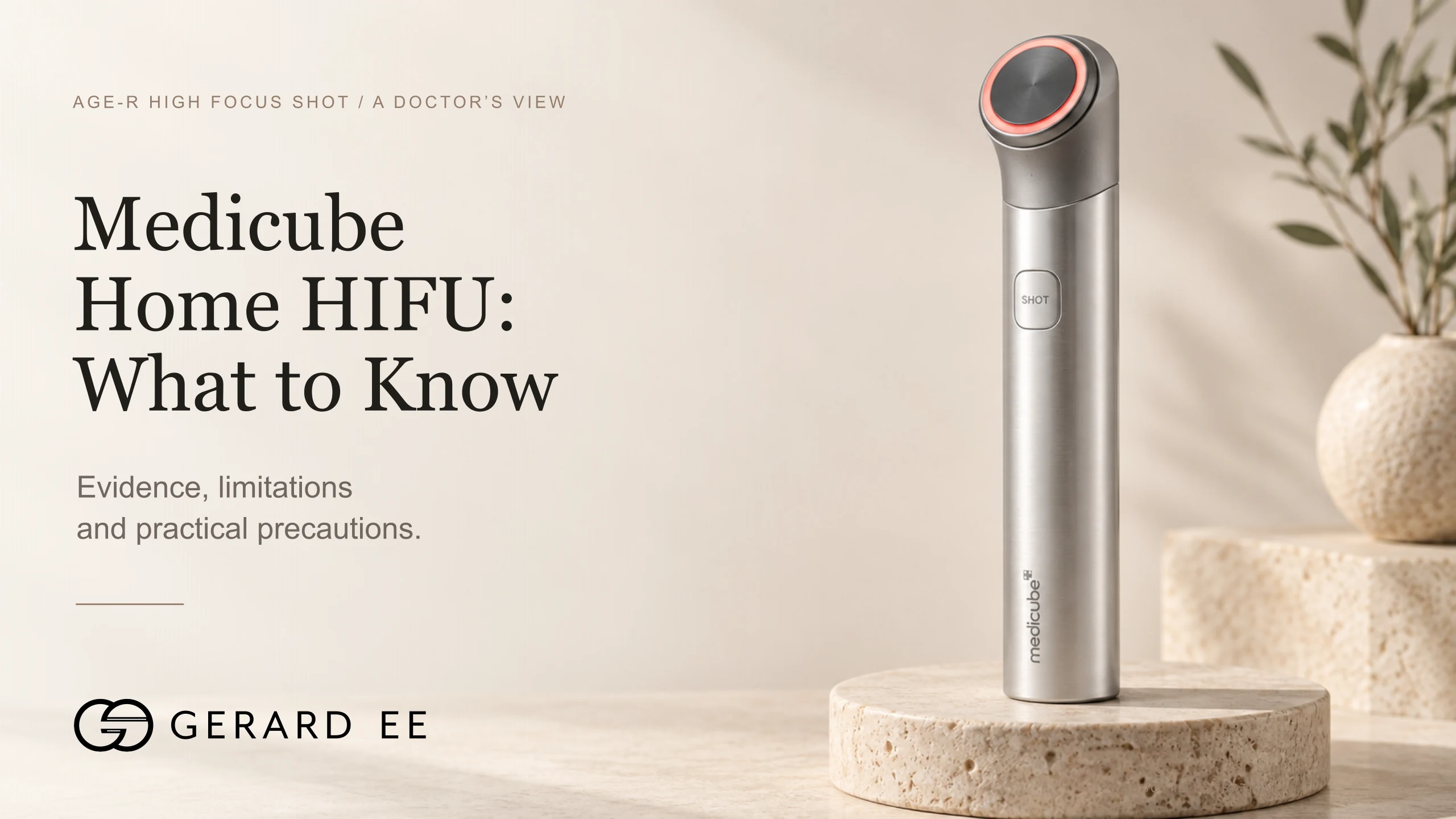
At-home HIFU devices such as the Medicube AGE-R High Focus Shot are sold for skin firming, but no published clinical trial has tested a consumer home HIFU device. Clinic HIFU is planned around the depth, the nerves and the fat in each part of the face. A home device cannot do that for you. It may help skin texture a little, and it will not lift a face that has dropped.
Patients bring home HIFU devices to consultations and ask whether to keep using them. This page sets out what the evidence says, where the risks are, and how a home device compares with HIFU in a clinic.
What an at-home HIFU device is
Home devices sold as HIFU are handheld units meant for self-use. They deliver ultrasound at a fixed setting chosen by the manufacturer. Clinic HIFU uses cartridges at 1.5, 3.0 and 4.5 mm, and the doctor chooses the depth, the energy and the number of lines for each area. I could not find an independent measurement of the depth or energy of any consumer home HIFU device.
My clinical perspective
Home HIFU devices are usually weak and low powered, and they do not give much result.
Is the Medicube High Focus Shot really HIFU?
Medicube describes the AGE-R High Focus Shot as MFU, or micro-focused ultrasound. Its product pages give the shot rate, one or two shots a second, and a routine of 600 to 1,200 shots once or twice a week. They do not publish the frequency, the focal depth or the energy of each shot, and they list no clinical test [5]. Without those figures nobody outside the company can confirm that the energy is focused deep enough to tighten the SMAS, the layer clinic HIFU lifts.
Clinic HIFU to the deep layers is one session, repeated after about a year. A device made to be used once or twice a week works at a much lower energy.
Medicube’s own instructions tell users to avoid the jawbone, the area around the eyes, the lips, the nose and the thyroid, and warn that a damaged film raises the risk of burns [5].
What the evidence shows for home HIFU devices
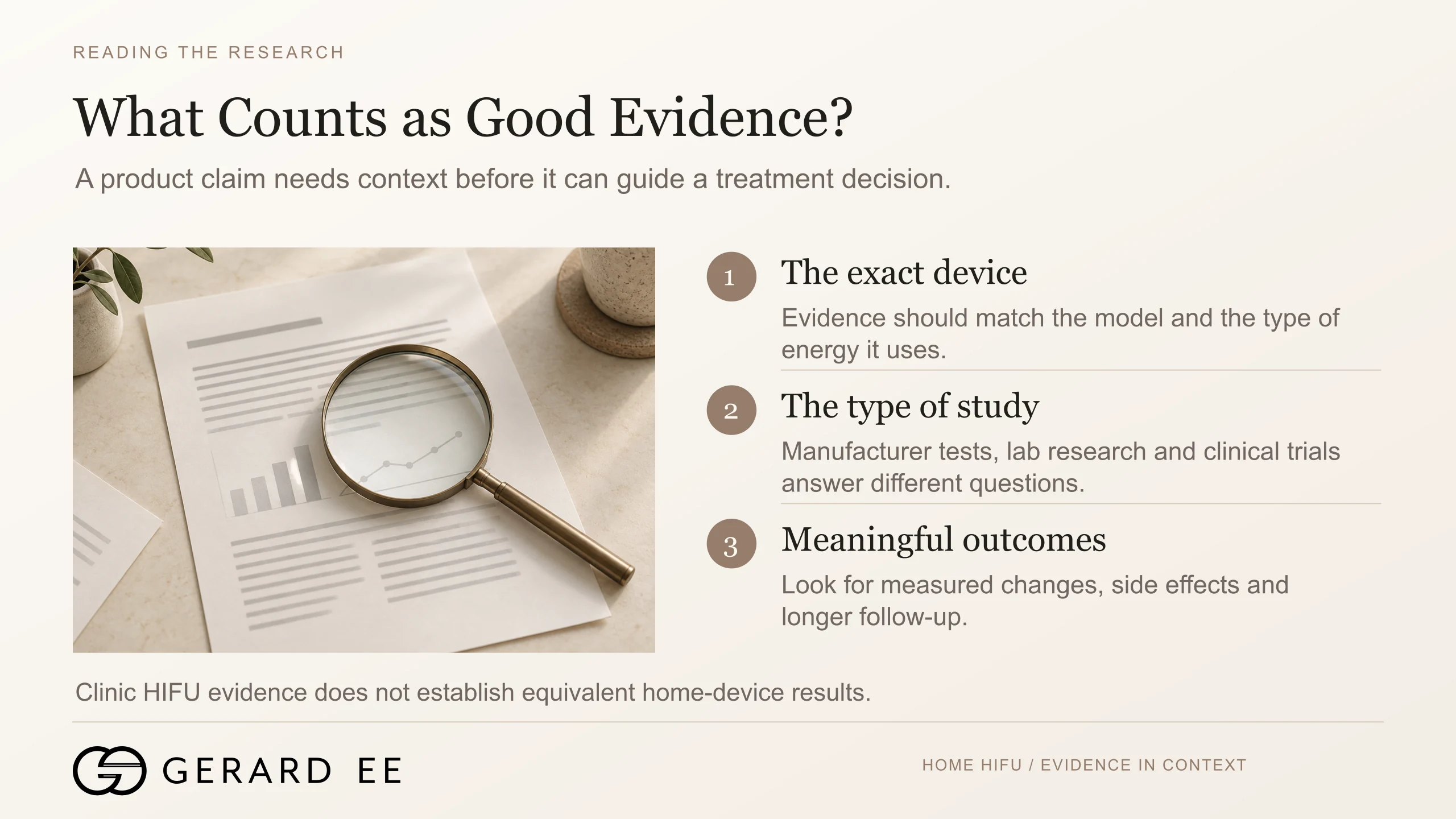
- A 2022 systematic review of 37 trials of home dermatology devices found evidence for home intense pulsed light, laser diodes, radiofrequency, LED and UVB devices. No home ultrasound or HIFU device was among them [1].
- A 2024 split-face trial in 36 Korean women tested a home multi-energy device for eight weeks. It combined low-level light, low-dose radiofrequency, low-energy microcurrent and low-intensity ultrasound. Skin hydration, elasticity, roughness, pore size and eye wrinkle volume improved, with no adverse effects [2]. That is not focused high-intensity ultrasound, and the result does not carry over to a home HIFU device.
The absence of trials is not evidence that home HIFU is safe or that it works. It means nobody has measured it.
At-home HIFU side effects and risks
Common and temporary
Redness and swelling are common after HIFU and settle within a few days. Bruising and tenderness can last a little longer [8, 9].
Less common but more serious
- Burns and blisters. These happen when the gel is uneven and leaves air gaps, or when the energy lands too close to the surface [3, 8].
- Nerve symptoms. Energy over the jawline, the temple or the forehead can cause temporary numbness or weakness of the muscles that move the face [3, 8].
- Pigmentation. Dark patches can follow HIFU in Asian skin, and they are more likely if the skin is exposed to sun afterwards. In one study of 49 Chinese patients, two developed pigmentation on the forehead [9].
- Fat loss. Heat in the wrong layer, or repeated shots on the same spot, can melt fat and leave a hollow cheek [3, 8].
The US FDA lists pain, redness, swelling, blisters, burns and nerve damage as possible complications of ultrasound body contouring. It advises against treating broken or compromised skin [4].
A home device also skips the assessment. Nobody checks whether the loosening comes from the skin, the fat or the bone, or whether a spot or lump in the area should be seen by a doctor first. Nobody follows up if something goes wrong. I would keep any home device off the jawline, the temples and the area around the eyes. How clinic HIFU goes wrong is covered on the HIFU risks page.
Home HIFU vs clinic HIFU
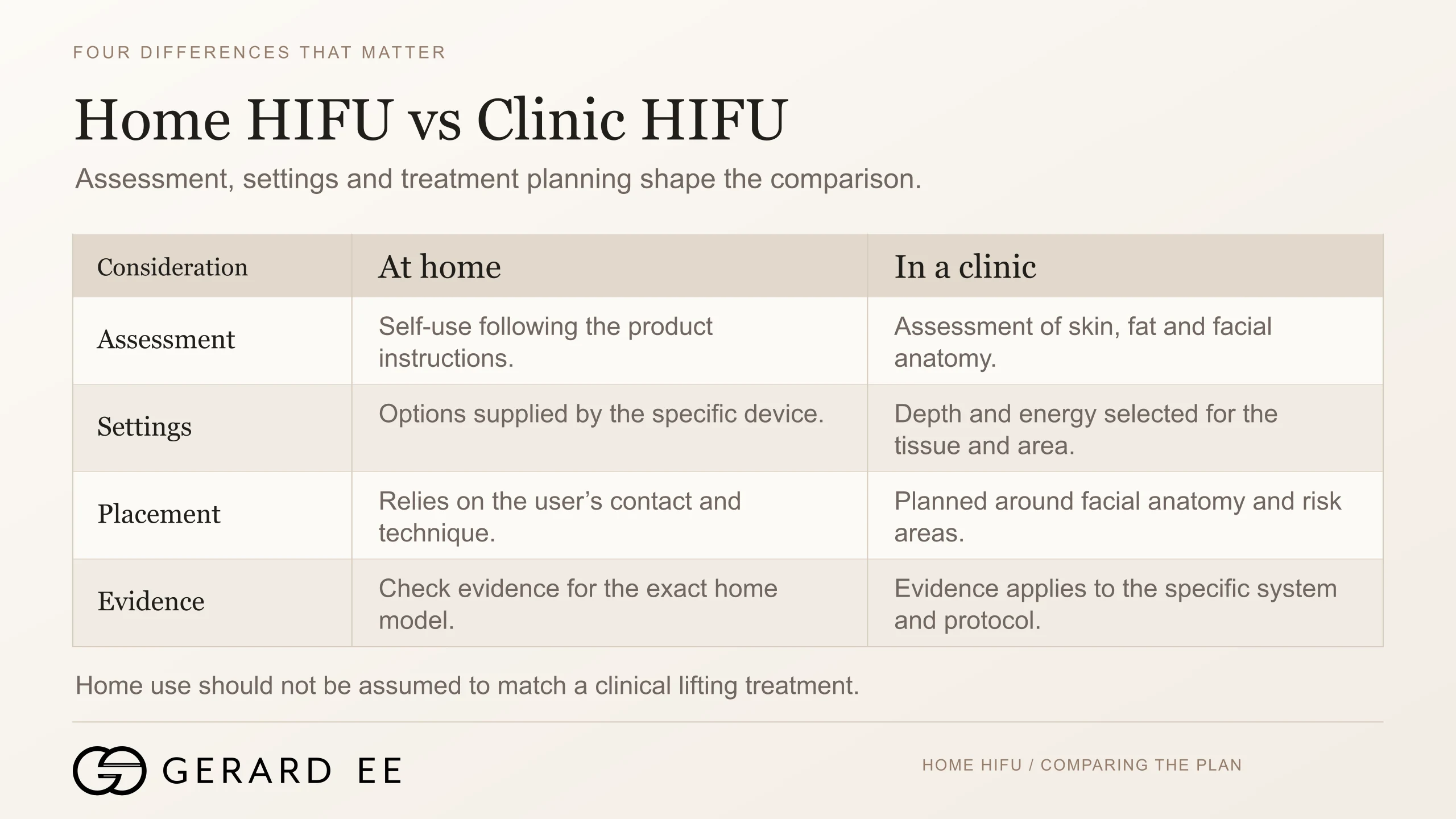
| Home HIFU device | Clinic HIFU | |
|---|---|---|
| Type of ultrasound | Sold as HIFU or MFU. Frequency, depth and energy not published | Focused ultrasound at set depths of 1.5, 3.0 and 4.5 mm |
| Who sets the depth | Fixed by the manufacturer | Chosen for each area by the doctor |
| Depths | Not independently published | 1.5, 3.0 and 4.5 mm cartridges |
| Power | Usually weak and low powered | Set to the tissue and the face |
| Published trials | None found | Dozens, including systematic reviews |
| Nerve and fat planning | None | Part of the treatment plan |
| What it can do | Possibly a small change in skin texture | Lift and tighten mild to moderate laxity |
How the clinic machines differ from each other is covered on the HIFU machines page. For a gentle clinic option with no downtime, Sygmalift HIFU is the one I use.
At-home HIFU vs LDM skin ultrasound
Not every ultrasound device for the face is HIFU. LDM, or Local Dynamic Micro-massage, is a clinic treatment that uses two or three ultrasound frequencies, such as 3 and 10 MHz, without focusing the beam. It works on the skin itself and does not aim for the SMAS.
In a multicentre study of 39 adults, 8 to 12 LDM sessions improved fine and coarse wrinkles, pores and skin firmness. The only side effect was brief redness [6]. The study was not randomised, and one author was from the company that makes the device. That author has proposed that LDM rebalances the enzymes that break down collagen and raises the heat shock proteins that help skin cells repair [6, 7].
My clinical perspective
LDM is excellent for the skin and stimulates many of the proteins that help with skin ageing. It is not a lifting treatment. The Clifford Clinic offers LDM for skin ageing and for eczema. Bellasonic is also excellent for skin ageing.
Who should not use a home HIFU device
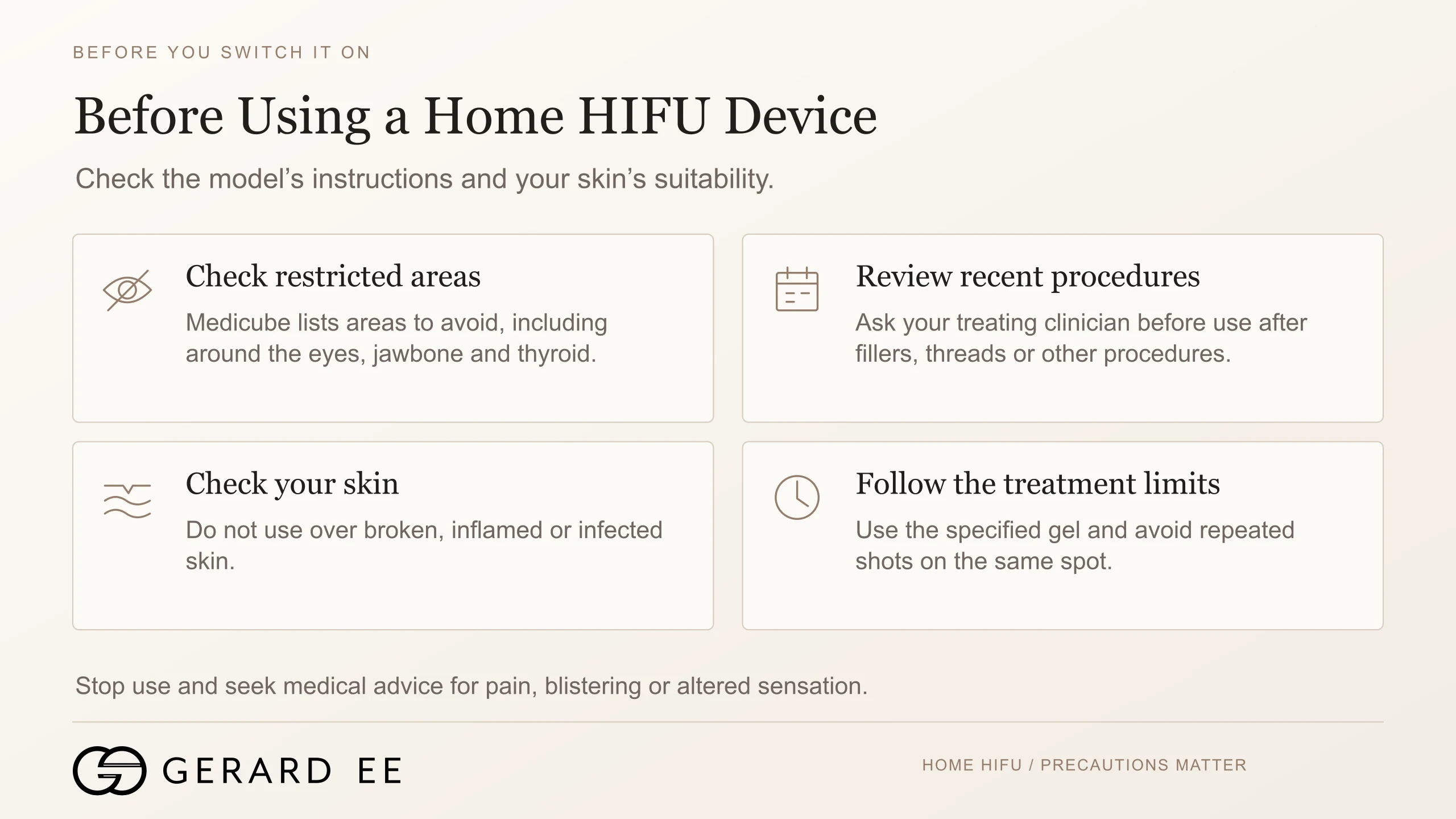
- Anyone who wants a real lift. A home device will not deliver it.
- Anyone with a thin face, where heat in the wrong place can hollow the cheek.
- Anyone with recent filler or threads in the area. Do not use a home device over them, as it can cause excess blistering or infection.
- Anyone with broken, inflamed or infected skin in the area.

Dr Gerard Ee, Aesthetic Doctor in Singapore
Dr Gerard Ee is an aesthetic doctor in Singapore and the Medical Director of his practice at 50 Raffles Place. He graduated from St George’s, University of London, trained in surgery at Singapore General Hospital and the National University Hospital, and holds the MRCS (Edinburgh) and a postgraduate diploma in practical dermatology from Cardiff University.
He has practised aesthetic medicine since 2012, is the author of sixteen peer-reviewed papers, and writes and medically reviews every article on this site. Read more about Dr Gerard Ee.

Book a consultation with Dr Gerard Ee
Dr Gerard Ee consults and performs HIFU at The Clifford Clinic, 50 Raffles Place, Singapore. Consultations are by appointment. Message the clinic on WhatsApp, or call 6532 2048.
At-home HIFU questions
Does Medicube HIFU work?
There is no published clinical trial of it. Home HIFU devices are usually weak and low powered, and they do not give much result. They are not a substitute for clinic HIFU.
Is at-home HIFU safe?
No study has measured the safety of a consumer home HIFU device. Clinic HIFU itself can cause burns and nerve symptoms when placed badly, and a home device has no one checking depth or placement.
Can I use a home HIFU device over filler or threads?
No. Do not use a home HIFU device over recent filler or threads, as it can cause excess blistering or infection.
Can I use a home HIFU device after clinic HIFU?
Wait until any swelling or tenderness from the clinic treatment has settled, and avoid the jawline, temples and eye area.
Is the Medicube High Focus Shot real HIFU?
Medicube calls it micro-focused ultrasound but does not publish its frequency, focal depth or energy, so nobody outside the company can confirm that it reaches the layer clinic HIFU lifts. It is made for use once or twice a week, which points to a much lower energy than clinic HIFU.
Is LDM the same as HIFU?
No. LDM uses unfocused ultrasound at two or three frequencies to work on skin quality. HIFU focuses the energy at set depths to tighten and lift. LDM is not a lifting treatment.
This page is written from published research and from clinical experience treating faces in Singapore since 2012. It is for general education, not medical advice. Suitability, likely result, downtime and risk can only be established at a consultation. Dr Gerard Ee provides the treatments described on this page at The Clifford Clinic.
Dr Gerard Ee consults and performs this treatment at The Clifford Clinic, 50 Raffles Place, Singapore.
Show the 9 references
1. Cohen M, Austin E, Masub N, et al. Home-based devices in dermatology, a systematic review of safety and efficacy. Arch Dermatol Res. 2022;314(3):239-246. doi:10.1007/s00403-021-02231-0
2. Choi S, Kim J, Lee YI, et al. Efficacy and safety of a home-use handheld multi-energy-based device for skin rejuvenation, clinical, ex vivo, and histological studies. Lasers Med Sci. 2024;39(1):38. doi:10.1007/s10103-024-03982-8
3. Humphrey VS, Rambhia PH, Gmyrek R, Chapas A. Microfocused Ultrasound With Visualization, a Systematic Review of Adverse Events and Risk of Subsequent Facelift Compromise. Dermatol Surg. 2025;51(4):424-429. doi:10.1097/DSS.0000000000004510. PubMed 39625163
4. US Food and Drug Administration. Non-Invasive Body Contouring Technologies. Updated 15 October 2025. fda.gov
5. Medicube. AGE-R High Focus Shot product page and instructions. medicube.us. Accessed 25 September 2026.
6. Meyer-Rogge D, Rösken F, Holzschuh P, D’hont B, Kruglikov I. Facial skin rejuvenation with high frequency ultrasound, multicentre study of dual-frequency ultrasound. J Cosmet Dermatol Sci Appl. 2012;2(2). doi:10.4236/jcdsa.2012.22016
7. Kruglikov IL, Sontag W. Ultrasound of 10 MHz frequency as a novel strategy for skin anti-aging therapy. Med Hypotheses. 2010;74(3):620-621. PubMed 19942353
8. Biskanaki F, Tertipi N, Sfyri E, Kefala V, Rallis E. Complications and risks of high-intensity focused ultrasound (HIFU) in esthetic procedures, a review. Appl Sci. 2025;15(9):4958. doi:10.3390/app15094958
9. Chan NPY, Shek SYN, Yu CS, Ho SGY, Yeung CK, Chan HHL. Safety study of transcutaneous focused ultrasound for non-invasive skin tightening in Asians. Lasers Surg Med. 2011;43(5):366-375. PubMed 21674541