
Rosacea is persistent redness across the centre of the face that flushes with heat, sun, spice or alcohol, sometimes with small red bumps that look like acne. In Singapore it is under-diagnosed in Asian skin and very often treated as acne first, which strips an already compromised barrier and worsens the redness. Rosacea responds well to treatment. A reduction in flush intensity and baseline redness, with the bumps controlled, is achievable with a correct course of prescription creams and pulsed dye laser. The goal is control and stability, not a perfect face in one session.
Written by Dr Gerard Ee, MBBS (UK), MRCS (Edinburgh), Postgraduate Diploma in Practical Dermatology (Cardiff). Founder and Medical Director, The Clifford Clinic and The Clifford Surgery, Singapore. Last medically reviewed and updated September 2026.
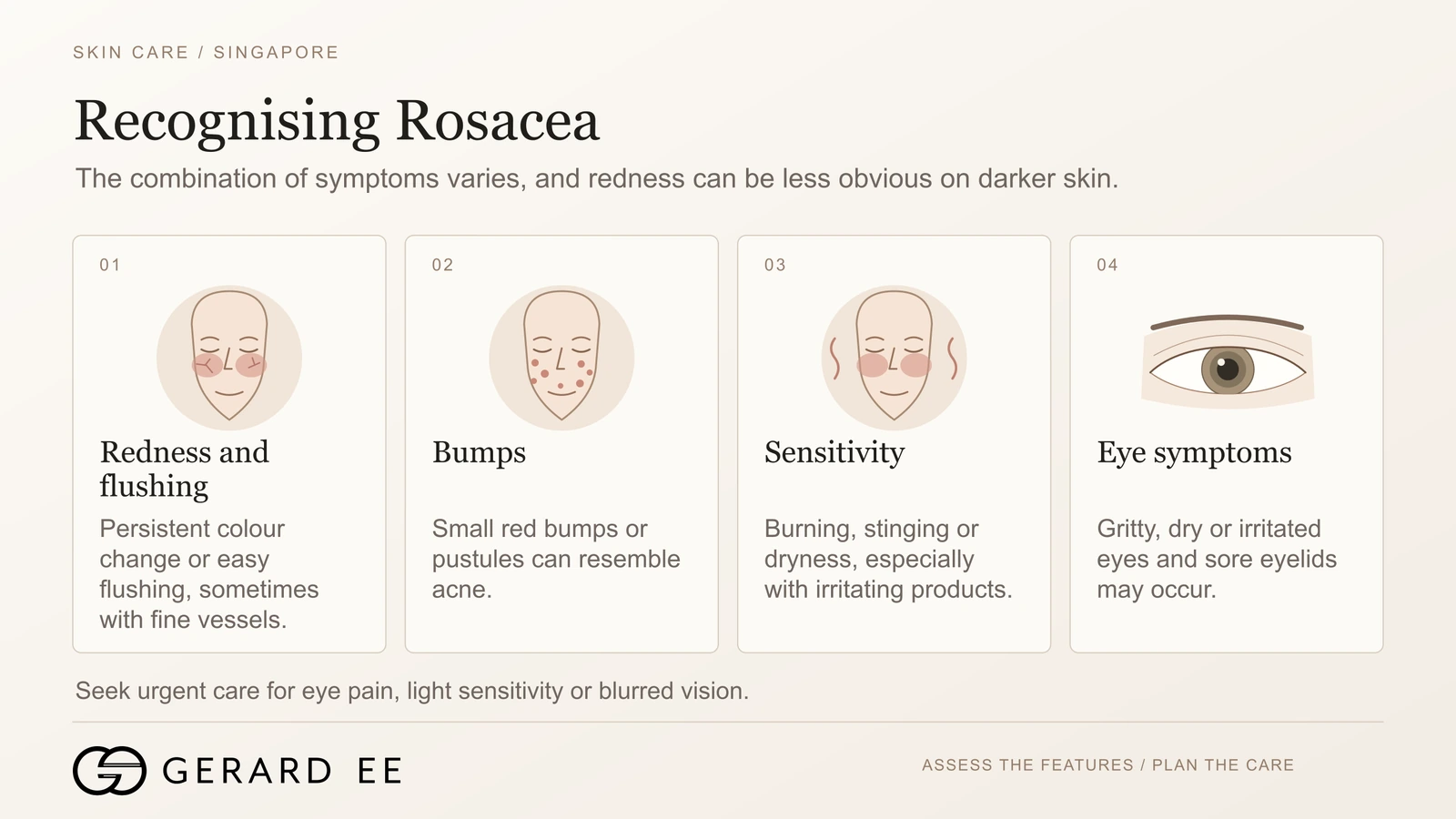
Rosacea symptoms, from redness and flushing to bumps and stinging
International consensus replaced the old subtypes with a phenotype-based diagnosis, so rosacea is now identified by the features present rather than by a fixed “type”. Persistent redness across the cheeks, nose, chin and forehead that does not fade is diagnostic on its own. The other features are transient flushing, visible small blood vessels, red bumps and pustules without blackheads, a burning or stinging feeling with skincare that used to be fine, dry gritty eyes, and, rarely, thickening of the skin over the nose. Most patients I see present with two or three of these features together.
Is rosacea common in Asians?
Rosacea is common in Asian patients and is under-recognised, because the textbook photographs are of fair skin. In Chinese patients the typical picture is a woman in her thirties with redness and flushing rather than bumps, with burning or stinging in most cases and sun as the commonest trigger. In a series of 254 Chinese patients the mean age of onset was 31 years, burning was reported by 93.7% and sun exposure was a trigger in 90.9%. On tan skin the redness appears as a dusky or brown-red tone rather than pink, which is one reason it is mistaken for pigmentation or acne.
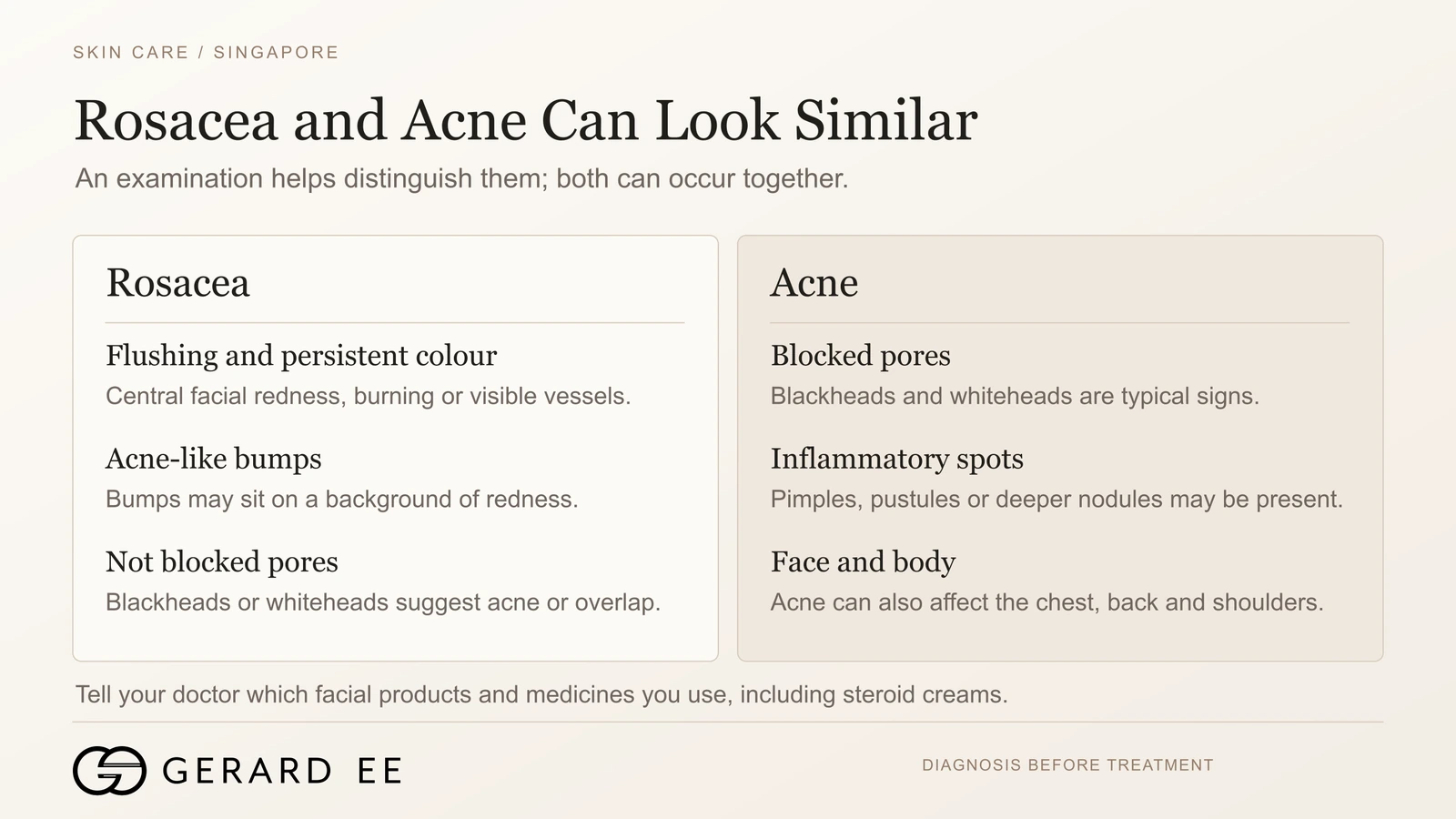
Rosacea or acne, the mistake I see most
Acne presents with blackheads and whiteheads and responds to acne treatments. Rosacea shows neither, sits on a background of redness and flushing, and deteriorates with many acne products. The commonest offender is a topical corticosteroid on the face. It suppresses the redness for a few weeks by constricting the vessels, but the vessels dilate further as the effect wears off and the skin becomes dependent, so the rosacea rebounds worse than before. In a series of 110 patients with steroid-induced rosacea-like dermatitis, most flared on withdrawal. Where a steroid cream has been used for facial redness, stopping it is the first step in the plan. Where true acne and rosacea overlap, the rosacea is controlled first and the acne treated afterwards, for example with AGNES for the oil glands.
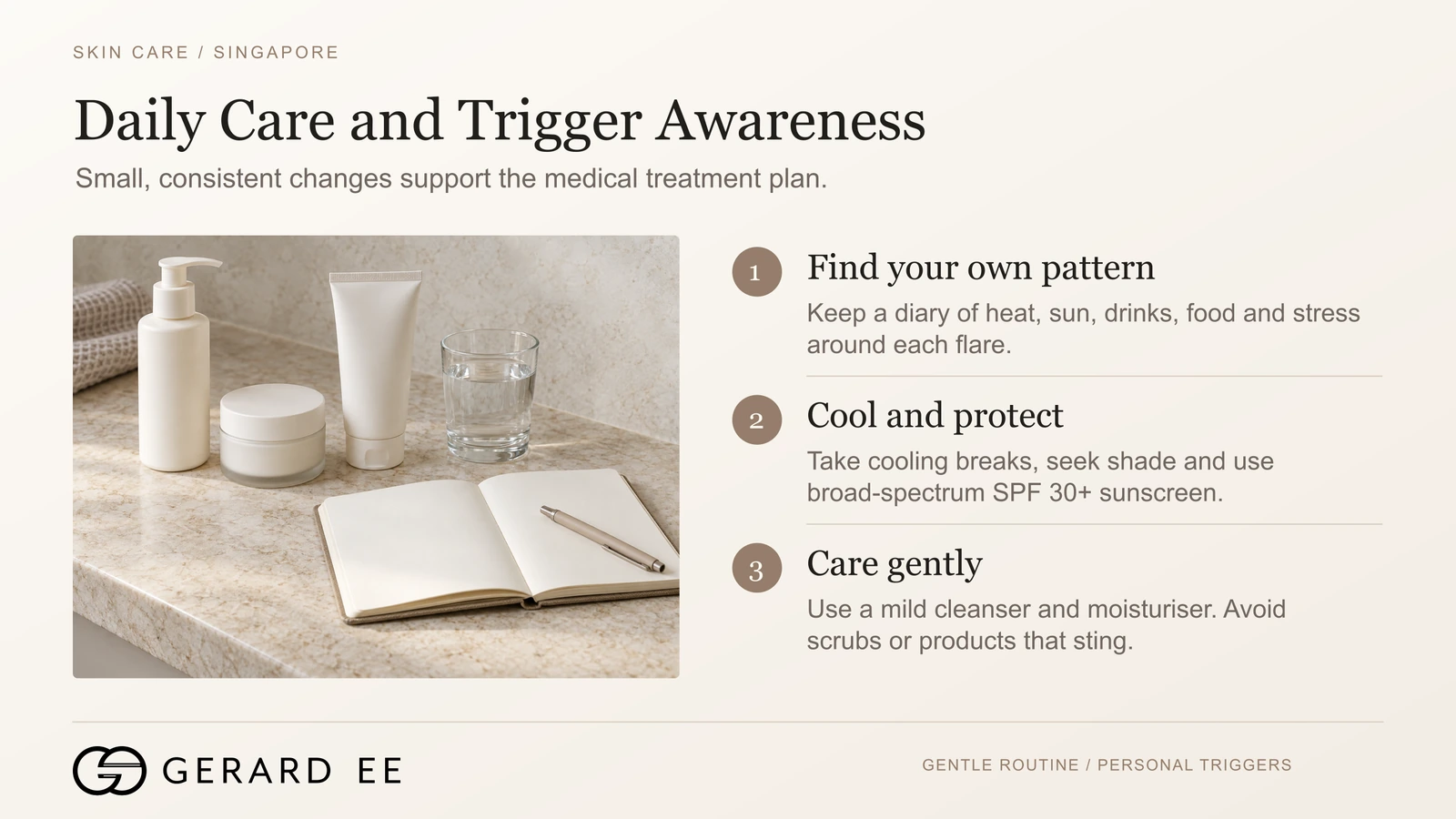
Rosacea triggers in a hot climate
Heat, sun, humidity, hot drinks, spicy food, alcohol, hard exercise and emotional stress all widen the facial blood vessels. In Singapore several of these commonly coincide on the same day. Complete trigger avoidance is neither realistic nor necessary. What I ask for is fewer triggers in any one day, a tinted mineral sunscreen every morning, a bland fragrance-free moisturiser, and no scrubs, toners or acids until the skin is stable.
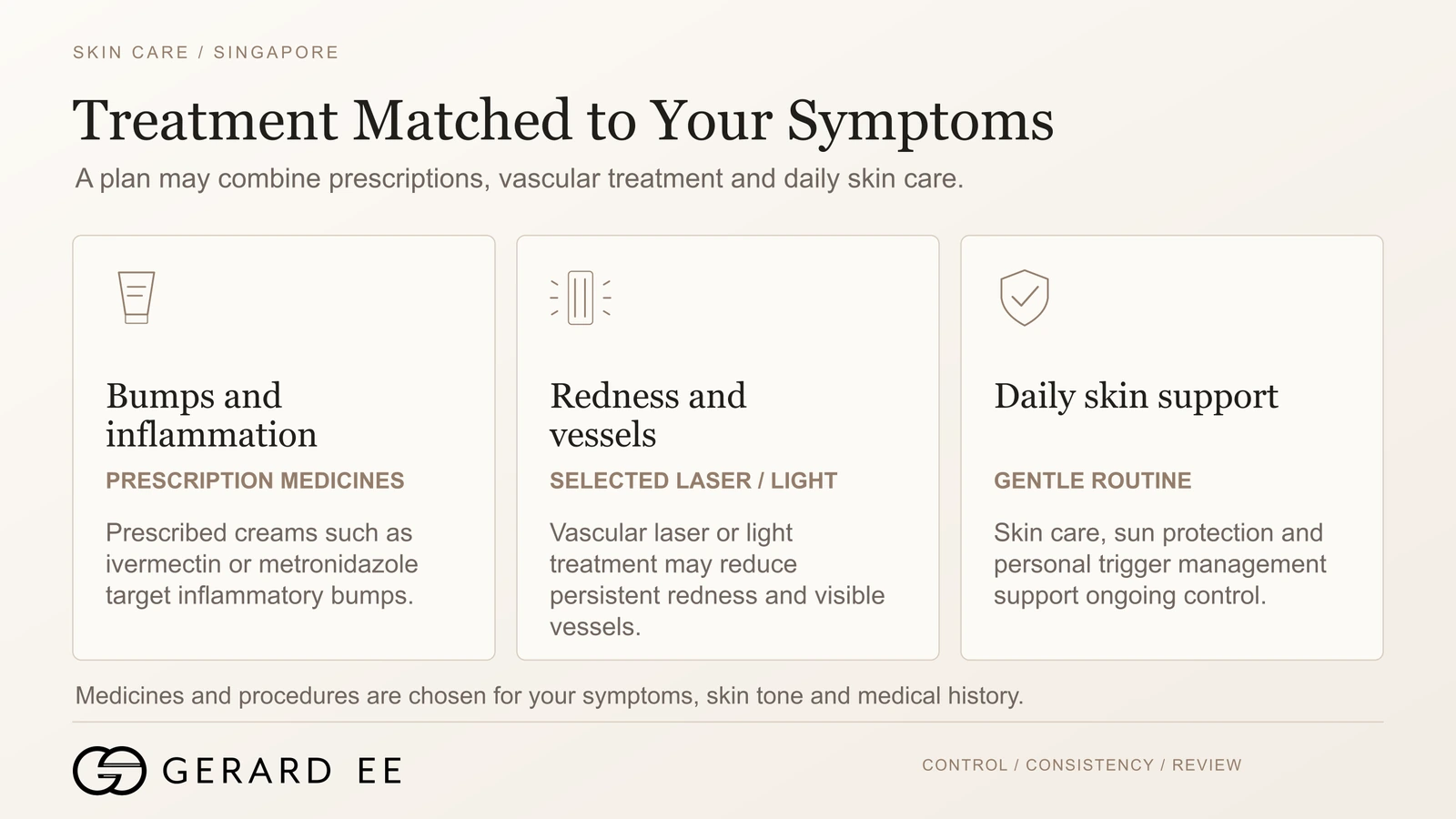
Rosacea treatment, prescription creams first
I treat rosacea in two layers. The inflammation layer, the bumps and pustules, responds to topical ivermectin 1% (Soolantra), which reduces both the Demodex mite population and the inflammatory response it provokes, or to metronidazole (Rozex), with azelaic acid as an alternative and a short oral course for severe flares. In a head-to-head trial, ivermectin once daily reduced inflammatory lesions by 83.0% at sixteen weeks against 73.7% for metronidazole twice daily. Topical therapy is the foundation of every plan. Brimonidine gel (Mirvaso) constricts the facial vessels for about twelve hours, and paradoxical worsening on withdrawal has been reported in practice. It is not the basis of a rosacea plan, although it retains a limited role for a specific occasion under supervision.
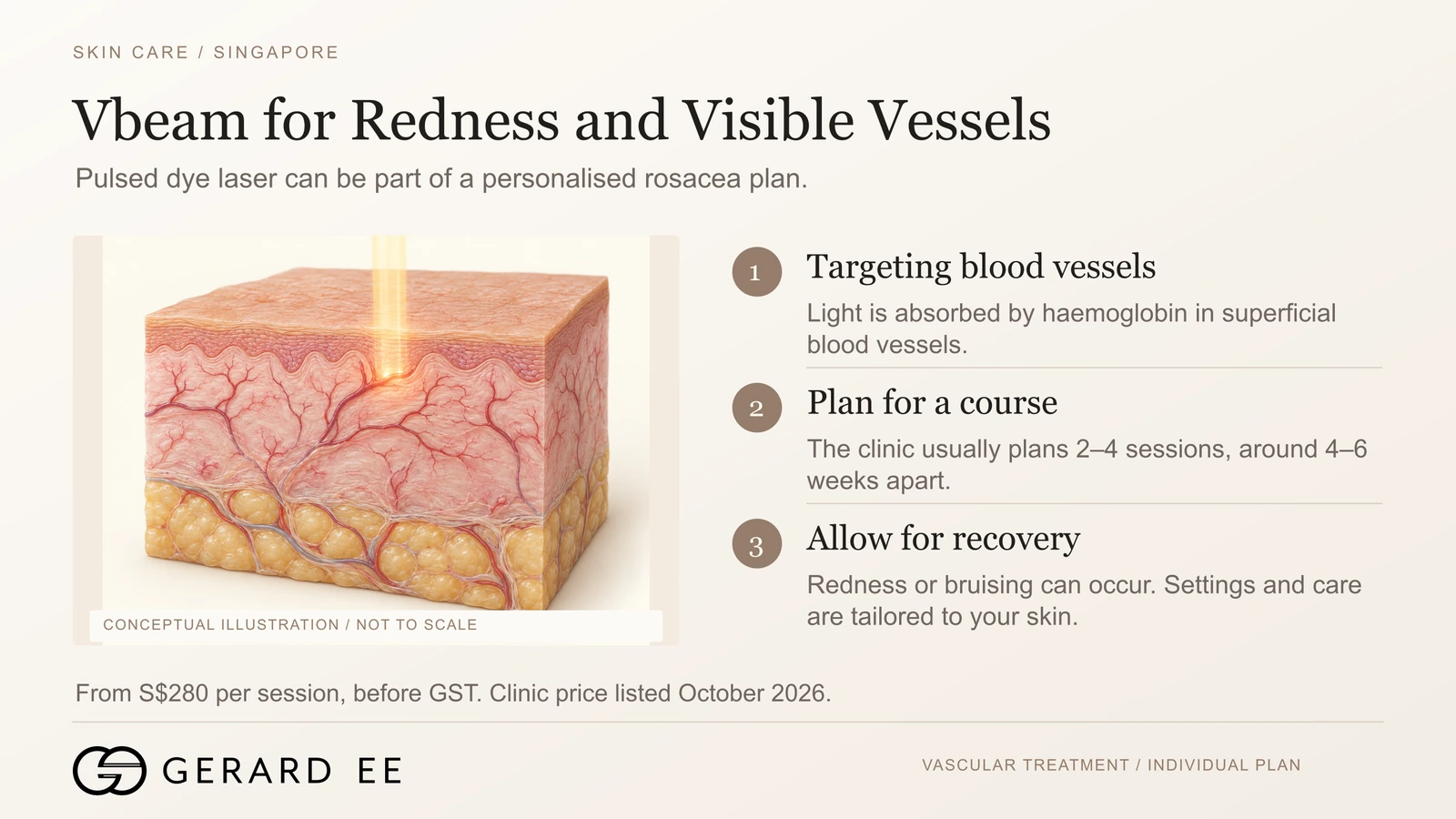
Vbeam pulsed dye laser for rosacea redness and visible vessels
The vascular layer, the persistent redness, flushing and visible vessels, does not respond to creams. The 595 nm pulsed dye laser is the reference treatment. Its light is absorbed by haemoglobin, the red pigment in blood, which heats the abnormal vessels and seals them, while a cooling spray protects the surface. A planned series of two to four sessions of fifteen to thirty minutes, four to six weeks apart, is usual for facial redness. Over four monthly sessions, pulsed dye laser and intense pulsed light have produced comparable reductions in measured facial redness, so the choice between them turns on vessel calibre and skin type rather than on one being decisively superior. Anaesthesia is not usually required. Redness after treatment settles within a day or two. With the purpura-free settings I use, bruising is uncommon although it remains possible depending on the vessel calibre. Details and prices are on the V-Beam page, and the physics is in pulsed dye laser for rosacea.
Rosacea treatment cost in Singapore
| Treatment | Price at this clinic | Usual course |
|---|---|---|
| Consultation and prescription creams | Consultation fee plus the creams, quoted at the visit | Reviewed at 6 to 8 weeks, with creams continued long term at lower frequency |
| Vbeam pulsed dye laser | From S$280 a session | 2 to 4 sessions for redness, then maintenance once or twice a year |
| Sunscreen and barrier repair | Retail | Daily, indefinitely |
Prices are before GST.
Rosacea treatment FAQ
What is the most effective treatment for rosacea?
Topical ivermectin treats the bumps, and the pulsed dye laser treats the redness and flushing. Most patients need both, because each treats a different layer of the condition.
What is the biggest trigger for rosacea?
Sun and heat, in that order, are the dominant triggers in Singapore. Alcohol and spicy food matter for some patients and not others, and a two-week diary usually identifies which.
Does rosacea go away on its own?
Rosacea does not resolve spontaneously. Untreated, it tends to worsen with age, with redness that becomes fixed and vessels that become permanent. Treated early, it is much easier to keep stable. I have written about why rosacea worsens with age.
Is Vbeam safe on darker skin?
The pulsed dye laser is safe on darker skin with lower energy and longer pulse durations. The laser targets blood, not melanin, but the settings are adjusted on skin types IV and V to protect the surface.
Can I wear makeup after the laser?
Makeup can be applied from the following day, with mineral sunscreen applied first.
Will my skin stop stinging?
The stinging usually settles once the barrier recovers and the inflammation is controlled. The stinging is part of rosacea, not a separate allergy. My page on sensitive skin covers the barrier side.

Book a consultation with Dr Gerard Ee at The Clifford Clinic
Dr Gerard Ee consults and treats rosacea at The Clifford Clinic, 50 Raffles Place, Singapore. Consultations are by appointment. Message the clinic on WhatsApp, or call 6532 2048.
Published evidence on rosacea
Show the 7 references
- Tan J, Almeida LM, Bewley A, Cribier B, Dlova NC, Gallo R et al. Updating the diagnosis, classification and assessment of rosacea: recommendations from the global ROSacea COnsensus (ROSCO) panel. Br J Dermatol. 2017;176(2):431-438. doi:10.1111/bjd.15122. PMID 27718519. The global ROSCO panel recommended replacing subtypes with a phenotype-based classification, with persistent centrofacial erythema and phymatous changes each independently diagnostic of rosacea.
- Chang J, Wang Y, Sun D, Zhang L, Man MQ, Tu Y et al. Characterization of rosacea in Chinese: An analysis of 254 cases. J Cosmet Dermatol. 2021;20(11):3666-3671. doi:10.1111/jocd.14039. PMID 33655687. Among 254 Chinese rosacea patients (female:male 5.68:1, mean onset 31 years), the erythematotelangiectatic subtype predominated (51.6%), burning (93.7%) and dryness (90.6%) were near-universal, and sun exposure (90.9%) and temperature change (87.4%) were the main triggers.
- Taieb A, Ortonne JP, Ruzicka T, Roszkiewicz J, Berth-Jones J, Peirone MH et al. Superiority of ivermectin 1% cream over metronidazole 0·75% cream in treating inflammatory lesions of rosacea: a randomized, investigator-blinded trial. Br J Dermatol. 2015;172(4):1103-10. doi:10.1111/bjd.13408. PMID 25228137. Ivermectin 1% cream once daily reduced inflammatory lesions by 83.0% at week 16 versus 73.7% with metronidazole 0.75% twice daily (P<0.001), with IGA clear/almost clear in 84.9% vs 75.4%.
- Elewski BE, Fleischer AB, Pariser DM. A comparison of 15% azelaic acid gel and 0.75% metronidazole gel in the topical treatment of papulopustular rosacea: results of a randomized trial. Arch Dermatol. 2003;139(11):1444-50. doi:10.1001/archderm.139.11.1444. PMID 14623704. Azelaic acid 15% gel reduced inflammatory lesions by 72.7% versus 55.8% with metronidazole 0.75% gel over 15 weeks (P<0.001) and improved erythema in 56% vs 42%, with neither affecting telangiectasia.
- Ruan J, Zheng Y, Cai S. Efficacy and safety comparison between pulsed dye laser and intense pulsed light configured with different wavelength bands in treating erythematotelangiectatic rosacea. Lasers Med Sci. 2024;39(1):146. doi:10.1007/s10103-024-04098-9. PMID 38822948. In erythematotelangiectatic rosacea, 595-nm pulsed dye laser and three IPL wavelength configurations all significantly reduced clinical symptom and VISIA red-area scores (P<0.001) with no between-group difference after 4 monthly sessions.
- Fowler J, Jackson M, Moore A, Jarratt M, Jones T, Meadows K et al. Efficacy and safety of once-daily topical brimonidine tartrate gel 0.5% for the treatment of moderate to severe facial erythema of rosacea: results of two randomized, double-blind, and vehicle-controlled pivotal studies. J Drugs Dermatol. 2013;12(6):650-6. PMID 23839181. Once-daily brimonidine 0.5% gel was significantly more effective than vehicle for facial erythema throughout 12 hours on days 1, 15 and 29 (P<0.001), with onset by 30 minutes and no rebound observed within the 4-week trial (rebound/paradoxical erythema has since been reported in practice).
- Rathi SK, Kumrah L. Topical corticosteroid-induced rosacea-like dermatitis: a clinical study of 110 cases. Indian J Dermatol Venereol Leprol. 2011;77(1):42-6. doi:10.4103/0378-6323.74974. PMID 21220878. In 110 patients with topical corticosteroid-induced rosacea-like dermatitis (89% women; steroid use 4 months to 20 years), diffuse facial erythema was the commonest presentation and most had rebound flaring on steroid withdrawal, with betamethasone valerate the usual culprit.
The clinic offers the treatments described here. No manufacturer funded this page. This page is general education, not medical advice.
Dr Gerard Ee consults and performs this treatment at The Clifford Clinic, 50 Raffles Place, Singapore.

