Home›Blog›Face›Nose Filler in Korea vs Singapore, What to Know Before You Fly
Written by Dr Gerard Ee, MBBS (UK), MRCS (Edinburgh), PGDip Practical Dermatology (Cardiff). Founder and Medical Director, The Clifford Clinic and The Clifford Surgery, Singapore. Last medically reviewed and updated September 2026.
Key points
- Seoul is a large and experienced market for nose filler, and prices are often lower than in Singapore.
- Many of the same products are used in both countries, alongside Korean HA brands.
- The main difference is aftercare, as problems after nose filler usually appear within hours to days, often after the patient has flown home.
- The product name and the amount injected should be recorded before leaving the clinic.
- Hyaluronic acid (HA) is the safest choice for nose filler done abroad, because a doctor at home can dissolve it.
Why patients go to Korea for nose filler
Korea has high volumes of non-surgical nose treatment and many clinics that combine filler and threads. A large East Asian series of 528 patients treated with a standardised, cannula-based filler protocol reported measurable gains in tip projection and nose length with no vascular complications. Experienced Korean practitioners achieve excellent results, and the price per syringe is often lower than in Singapore.
Nose filler products used in Korea and Singapore
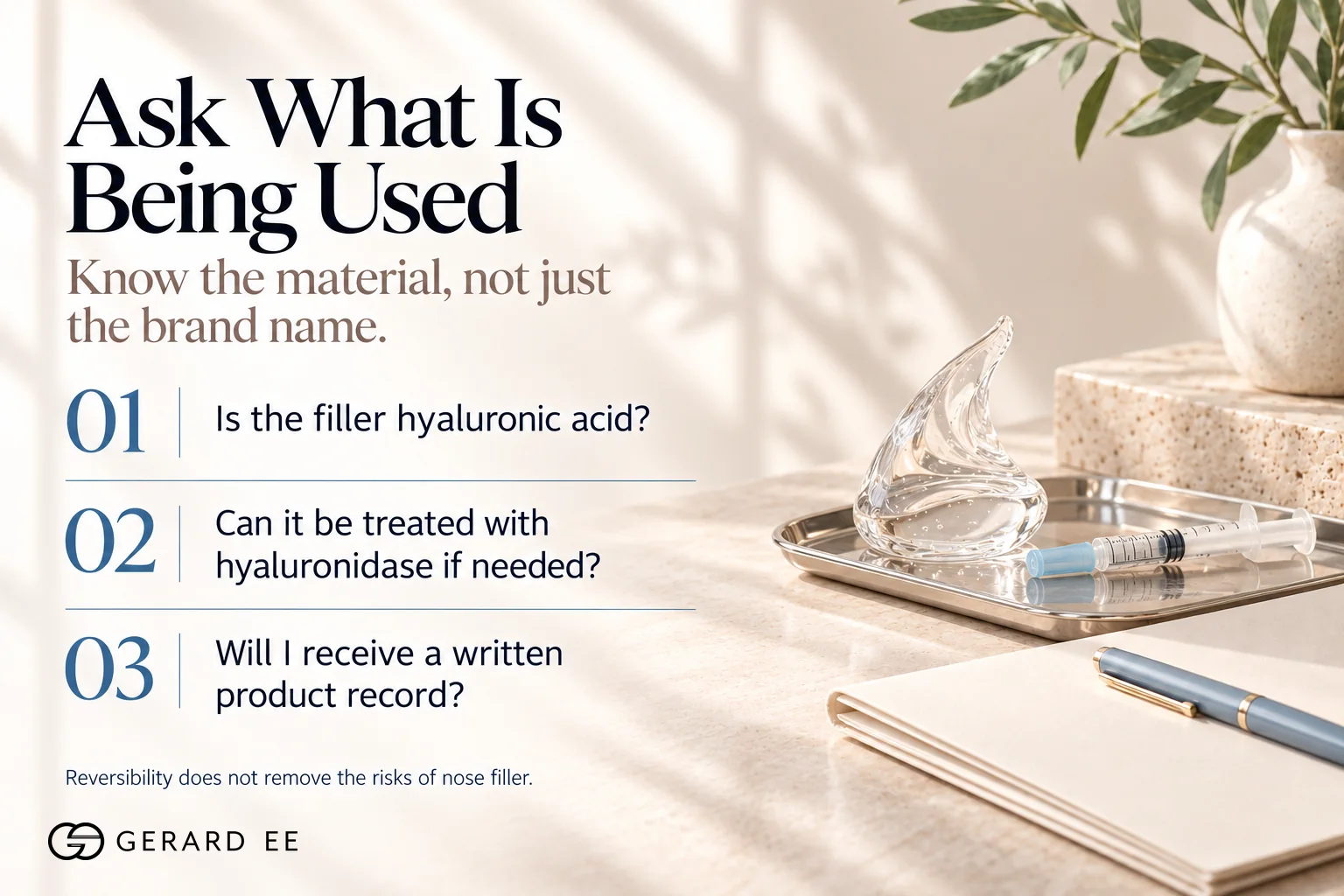
International HA brands such as Restylane and Juvederm are used in both countries. Korean clinics also use Korean HA brands such as Neuramis, YVOIRE and Chaeum, as well as Korean nose threads. The product name, and the sticker from the syringe, should be obtained before treatment. If a problem later requires treatment in Singapore, the doctor needs to know exactly what was injected, and whether it is HA that can be dissolved.
Nose filler aftercare, the real difference between Korea and Singapore

The most serious problem after nose filler, a blocked vessel, usually shows within the first hours to days. Swelling, bruising and lumps can take a week to assess. For a patient flying home two days after treatment, the treating clinic is no longer within reach when these signs appear.
Three questions should be answered before booking abroad.
- Who do I contact if my nose turns pale or dusky after I fly home?
- Which product and how much will you inject, and will you give me the sticker?
- Is the filler hyaluronic acid, so a doctor in Singapore can dissolve it?
Combining nose threads and filler in Korea
Korean clinics often combine threads and filler in one session. Threads rotate and lift the tip, whereas filler projects it forward and raises the bridge. Combining both in one visit produces more swelling, which makes the result harder to judge before the flight home. In my practice, a flat bridge is filled first and threaded 6 to 12 months later, as threads need a raised bridge to anchor to. The two treatments are compared on nose threads vs nose fillers.
Nose filler price in Korea vs Singapore
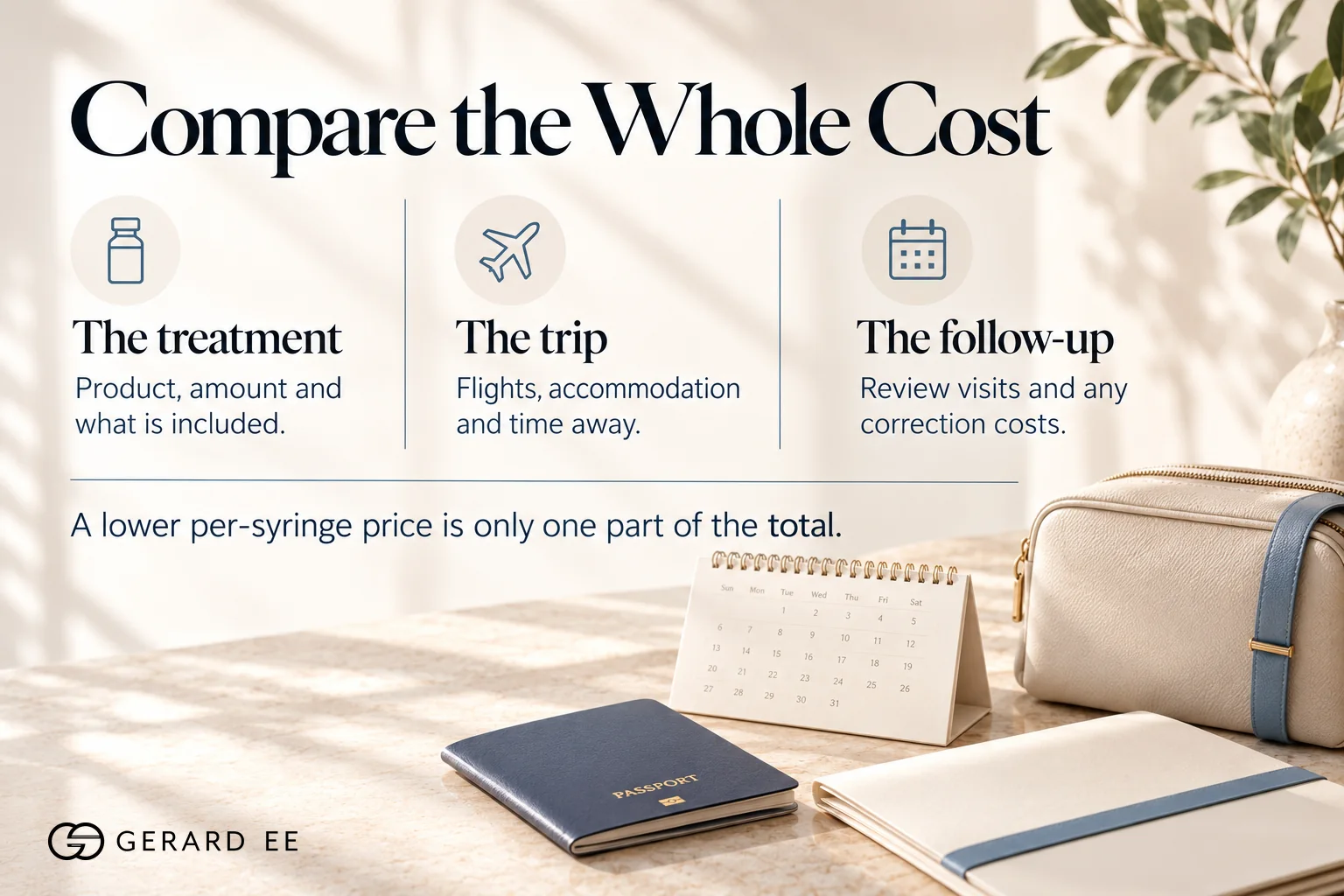
Prices in Seoul are often lower per syringe, but the difference narrows once the flight, the hotel and the cost of any follow-up visit are included. In Singapore, HA nose filler at my practice starts at $1,200 per syringe before GST. The full breakdown is on my nose filler in Singapore page, and the full review of results and safety is on my nose filler Singapore page.

Correcting Korean nose filler in Singapore

Correction of nose filler done in Korea is a common reason for consultation. The usual problems are a bridge that appears wider than expected, a tip that is too full, or a slight asymmetry. The first step is an examination to identify the product and where it sits. HA can then be dissolved and replaced in a smaller amount, as described on dissolve nose filler.

Dr Gerard Ee, Aesthetic Doctor in Singapore
Dr Gerard Ee is an aesthetic doctor in Singapore and the Medical Director of his practice at 50 Raffles Place. He graduated from St George’s, University of London, trained in surgery at Singapore General Hospital and the National University Hospital, and holds the MRCS (Edinburgh) and a postgraduate diploma in practical dermatology from Cardiff University.
He has practised aesthetic medicine since 2012, is the author of sixteen peer-reviewed papers, and writes and medically reviews every article on this site. Read more about Dr Gerard Ee.

Book a consultation with Dr Gerard Ee
Dr Gerard Ee consults and performs nose filler and nose filler correction at his practice at 50 Raffles Place, Singapore. Consultations are by appointment. Message the clinic on WhatsApp, or call 6532 2048.
Nose filler in Korea vs Singapore, frequently asked questions
Is nose filler cheaper in Korea?
Nose filler is often cheaper per syringe in Korea, but flights, accommodation and any follow-up narrow the difference.
Can I fly after nose filler?
Most patients fly without problems, but warning signs of a complication appear in the first few days. A doctor who can be reached during that period is therefore essential.
Can a doctor in Singapore dissolve Korean nose filler?
A doctor in Singapore can dissolve Korean nose filler if it is HA, and the product name helps to confirm this.
Are Korean HA fillers different?
Korean HA fillers act in the same way as international brands. The firmness of the gel and the placement depth matter more than the brand.
Selected References
- Ye J, Wang X, Yi K, et al. A cannula-based sequential injection protocol for non-surgical rhinoplasty in East Asian patients. Aesthetic Plast Surg. 2026. PMID 42443422.
- DeVictor S, Ong AA, Sherris DA. Complications secondary to nonsurgical rhinoplasty, a systematic review and meta-analysis. Otolaryngol Head Neck Surg. 2021. PMID 33588622.
- Fabi SG, Desyatnikova S, Dayan SH. Prevention and management of dermal filler complications, a review. Facial Plast Surg Aesthet Med. 2025. PMID 39570704.
Dr Gerard Ee consults and performs nose filler and nose filler correction at 50 Raffles Place, Singapore.
This page is written from published research and clinical experience in Singapore since 2012. It is for general education, not medical advice. Suitability, results, downtime and cost vary from person to person. Please arrange a consultation for advice specific to your nose.