
When a HIFU treatment goes wrong, the outcome patients describe most often is no result at all. Far less commonly it means unwanted fat reduction, a burn, or nerve-related symptoms. Those outcomes are not equivalent, and they have different causes.
I have performed HIFU since 2012, and I have had it myself. For a suitable patient seeking a modest non-surgical improvement in mild to moderate facial or neck laxity, it is worth having. Its value depends on selecting the right concern, using an appropriate device and protocol, and accepting a result that is smaller and less predictable than surgery. The HIFU Singapore guide explains the treatment category, and this page addresses why disappointing results and complications occur.
Is HIFU Painful?
HIFU is uncomfortable rather than painful for most of my patients. Each shot is a brief, deep prickle of heat, strongest over the jawbone and brow and mildest over the cheek, and it stops when the pass ends. I apply numbing cream for 20 to 30 minutes before deep HIFU and set the energy to what you can comfortably sit through.
The sensation is usually described as a series of brief stings, heat, or a deeper ache. Areas close to bone, including parts of the jaw and forehead, feel more sensitive. Discomfort varies with the device, cartridge depth, energy, treatment area and individual pain threshold.
A 2025 meta-analysis of 42 Ultherapy studies reported a pooled mean pain score of 4.85 out of 10, with high variation between studies, so the average does not predict how a particular machine or protocol will feel [1]. Pain relief and energy adjustment should follow the device instructions and preserve an effective, safe treatment plan.
Comfort also varies considerably between machines. The focused Tightan 2 is much more comfortable than Ultherapy in my experience, and the fractionated Sygmalift is gentler again. This is not a minor point of convenience. Comfort sets the ceiling on the energy and coverage a patient will tolerate, and a treatment abandoned halfway is a treatment that will not work.
Common HIFU Side Effects
- Redness or warmth for several hours.
- Mild swelling or oedema.
- Tenderness, tingling or sensitivity, particularly along the jaw.
- Small areas of bruising.
- Temporary tightness or altered sensation.
Most patients resume ordinary activities on the same day, although tenderness or swelling can last several days. Recovery varies, so the phrase “no downtime” should be read as minimal expected interruption rather than as a guarantee of no symptoms.
What Can Happen When a HIFU Treatment Goes Wrong
No Visible Result, the Most Common Complaint
This is what I hear most often from patients who have had HIFU elsewhere and come to me disappointed. When I look into it, the cause is usually one of two things: too few shots for the area treated, or shots placed in the wrong area. Both produce the same outcome, which is a face that looks no different and a patient who concludes that HIFU does not work.
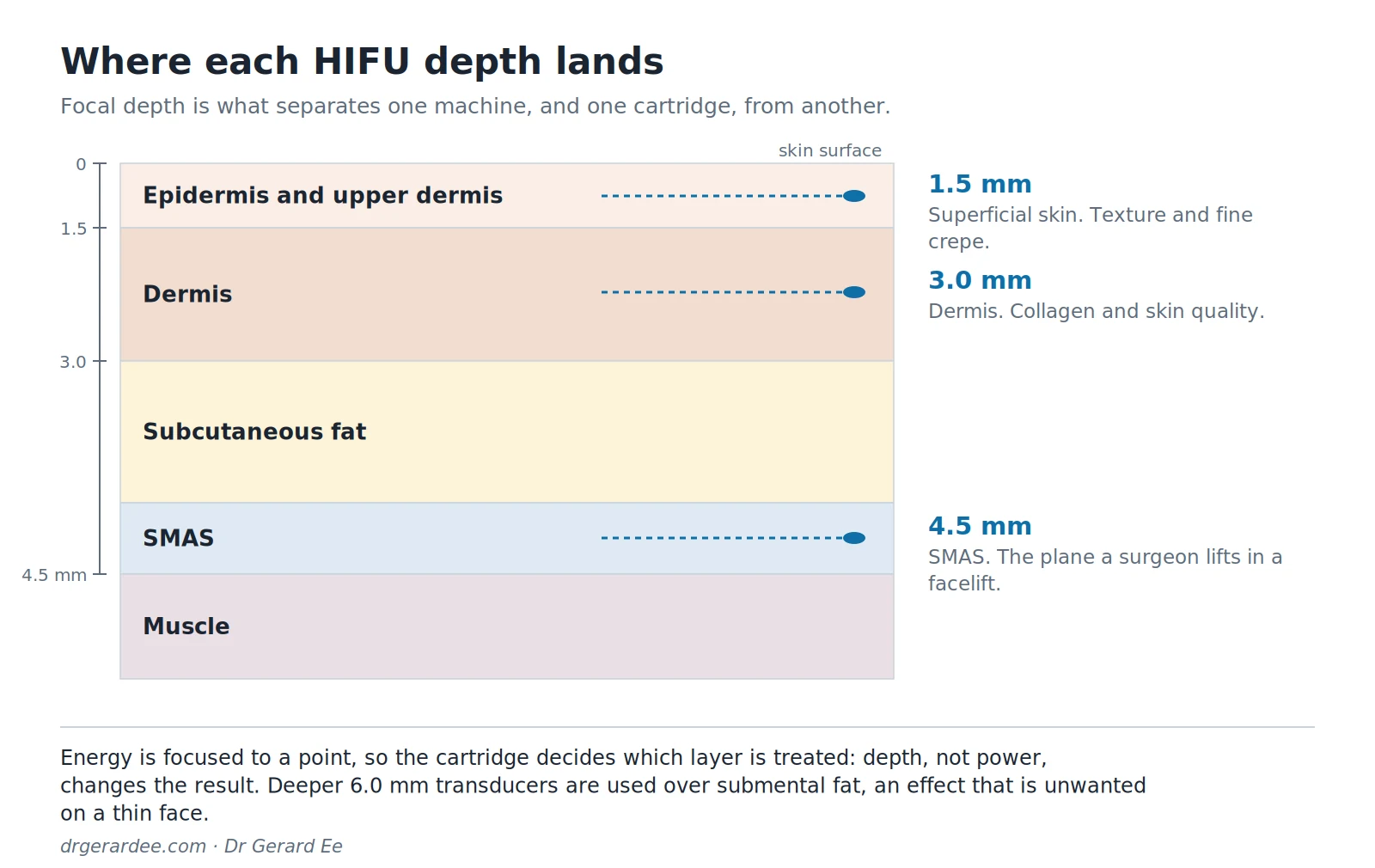
It can work. It will not work if the treatment was too small for the anatomy, or if the energy went somewhere that was never the problem. That is a planning failure rather than a failure of the technology.
The other explanations are genuine and worth ruling out. HIFU produces little visible change where the main problem is volume loss, skin texture or advanced descent rather than mild to moderate laxity. Results also vary with depth, energy and individual tissue response, and a result judged before two to three months has not finished developing. A quote that leads with a line count and no examination is a warning sign; the HIFU price guide sets out what a complete quote should contain.
Unwanted Fat Loss or Contour Change
Focused ultrasound can reduce fat where energy is intentionally delivered to subcutaneous tissue with an appropriate device and protocol. The same effect may be undesirable in a thin face, or in an area that already lacks support. Evidence from fat-targeting protocols should not be used to imply that every facial HIFU treatment causes fat loss, and the possibility still deserves discussion before treatment.
Burns, Nerve Irritation or Altered Movement
Burns, numbness, tingling and temporary weakness have been reported. Risk relates to device performance, coupling, depth, energy, anatomical knowledge and treatment technique. Persistent pain, blistering, increasing swelling, marked numbness or weakness should be assessed promptly by the treating clinic or another doctor.
Who May Be Unsuitable for HIFU
Contraindications follow the device instructions for use. Treatment is commonly deferred where there is an active infection, an open wound or significant inflammation in the treatment area. Implanted electronic or metal devices near the treatment field, pregnancy, significant neurological symptoms, recent facial procedures and relevant medical conditions all require device-specific review.
Two groups I turn away regularly. Faces with marked volume loss, because reducing facial fat further makes a hollow face look worse rather than better, and no amount of tightening replaces missing volume. And faces where acne scarring is the main concern, because scarring calls for subcision, resurfacing or another scar-directed procedure, and focused ultrasound will not treat it. Advanced laxity may also be unlikely to respond enough to justify treatment, and is better assessed surgically.
A history of fillers, threads, surgery or other energy-based procedures should be disclosed so that timing and treatment zones can be planned.
Is HIFU Worth It?
HIFU is worth having for a patient seeking a gradual non-surgical improvement in mild to moderate laxity who accepts the limits of the result. I have had it myself, which is the plainest answer I can give. It offers poor value where the concern is poorly matched to the treatment, where the expected change is surgical in scale, or where the quote does not describe a complete treatment plan.
The decision should follow an examination rather than a price list. A balanced consultation covers likely benefit, alternatives, discomfort, possible adverse effects, total cost, and the option of having no procedure.
What the Evidence Shows About HIFU Safety and Results
The 2025 Ultherapy meta-analysis found some degree of investigator-rated improvement in 89% of patients and patient-reported improvement in 84%, with satisfaction at 62% in studies that included a neutral response option. Common adverse effects were redness, oedema, swelling, bruising and tenderness, usually of mild to moderate severity [1].
An earlier meta-analysis of 17 HIFU studies involving 477 participants found moderate objective and subjective improvements of 2.74 and 2.68 out of 5, and reported mean procedural pain of 4.2 out of 10. Most of the included studies lacked long follow-up [2].
In a series of 75 patients, procedural pain occurred in 25.3% and transient redness in 6.7%. One patient developed numbness over the mandibular region, which resolved spontaneously within ten days [3]. A separate 2025 systematic review found that fewer than 5% of participants across the included studies reported transient redness, swelling or mild discomfort, although protocols and reporting methods varied [4].
Research has also documented fat reduction with selected HIFU frequencies and depths [5]. That evidence supports careful anatomical and device-specific planning rather than the conclusion that fat loss is inevitable after facial HIFU.

Dr Gerard Ee, Aesthetic Doctor in Singapore
Dr Gerard Ee is an aesthetic doctor in Singapore and the Medical Director of his practice at 50 Raffles Place. He graduated from St George’s, University of London, trained in surgery at Singapore General Hospital and the National University Hospital, and holds the MRCS (Edinburgh) and a postgraduate diploma in practical dermatology from Cardiff University.
He has practised aesthetic medicine since 2012, is the author of sixteen peer-reviewed papers, and writes and medically reviews every article on this site. Read more about Dr Gerard Ee.

Considering HIFU? Discuss Suitability First
Dr Gerard Ee consults and performs HIFU at The Clifford Clinic, 50 Raffles Place, Singapore. Consultations are by appointment. Message the clinic on WhatsApp, or call 6532 2048.
Book a consultation to review the likely benefits, discomfort, risks and alternatives for your face. Bring details of previous HIFU, fillers, threads or surgery, so the assessment can take your treatment history into account.
HIFU side effect questions
Why did my HIFU not work?
The two causes I see most often are too few shots for the area treated and shots placed in the wrong area. Beyond that, HIFU produces little change where the real problem is volume loss or advanced descent rather than mild to moderate laxity, and a result judged before two to three months has not finished developing. Bring the previous treatment record if you have it, since the device, areas and settings used usually explain the outcome.
Can HIFU damage your face?
Serious or lasting injury appears uncommon, although unwanted contour change, burns and nerve-related symptoms can occur. Appropriate patient selection, an authentic and maintained device, correct coupling and settings, and knowledge of facial anatomy all reduce that risk.
Does HIFU cause facial fat loss?
HIFU can reduce subcutaneous fat where the device and protocol are designed to target it. Facial tightening settings do not make fat loss inevitable, although conservative planning matters in a lean or volume-depleted face. This is one of the two findings that leads me to turn a patient away.
How soon will I see a result?
Early tightness may be noticed soon after treatment, although the outcome is usually judged over two to three months as remodelling develops. Timing varies with the device, protocol and patient.
What should I do if HIFU has gone wrong?
Contact the treating clinic promptly and ask for a medical assessment. Blistering, worsening pain, marked swelling, persistent numbness, facial weakness, visual symptoms or other concerning changes warrant urgent review rather than waiting for a routine follow-up.
This page is written from published research and from clinical experience treating faces in Singapore since 2012. It is for general education, not medical advice. Suitability, likely result, downtime and risk can only be established at a consultation. Dr Gerard Ee provides the treatments described on this page at The Clifford Clinic.
Dr Gerard Ee consults and performs this treatment at The Clifford Clinic, 50 Raffles Place, Singapore.
Show the 5 references
1. Amiri M, Ajasllari G, Llane A, et al. Microfocused Ultrasound With Visualization (MFU-V) Effectiveness and Safety: A Systematic Review and Meta-Analysis. Aesthet Surg J. 2025;45(3):NP86-NP94. doi:10.1093/asj/sjae228. PubMed 39540440
2. Ayatollahi A, Gholami J, Saberi M, Hosseini H, Firooz A. Systematic review and meta-analysis of safety and efficacy of high-intensity focused ultrasound (HIFU) for face and neck rejuvenation. Lasers Med Sci. 2020;35(5):1007-1024. doi:10.1007/s10103-020-02957-9. PubMed 32026164
3. Aşiran Serdar Z, Aktaş Karabay E, Tatlıparmak A, Aksoy B. Efficacy of high-intensity focused ultrasound in facial and neck rejuvenation. J Cosmet Dermatol. 2020;19(2):353-358. doi:10.1111/jocd.13008. PubMed 31141286
4. Haykal D, Sattler S, Verner I, Madhumita M, Cartier H. A Systematic Review of High-Intensity Focused Ultrasound in Skin Tightening and Body Contouring. Aesthet Surg J. 2025;45(7):690-698. doi:10.1093/asj/sjaf053. PubMed 40184185
5. Hwang Y, Wan J, Yi KH. Do Different High-Intensity-Focused Ultrasound Frequencies Have Different Effects? A Histological Analysis Correlated With Patients’ Subjective Assessments. J Cosmet Dermatol. 2025;24(2):e70069. doi:10.1111/jocd.70069. PubMed 39973106