
Knee pain—most often from osteoarthritis—can narrow the space between what you want to do and what your knee will allow. When activity modification, exercise therapy, and simple analgesics are not enough, injection therapies become a pragmatic bridge. They aim to calm inflammation, improve lubrication, and alter the joint environment to reduce pain and improve function.
This review explains the treatment options – platelet rich plasma (PRP), hyaluronic acid (HA), their combination, corticosteroids, non steroidal anti inflammatory drug (NSAID) injections, and bone marrow aspirate concentrate (BMAC)—and it sets realistic expectations about how much relief people typically feel and how long it lasts. Although research is most robust for osteoarthritis, I also discuss about injections for meniscal, ligament, and cartilage pathology when they coexist with degenerative change.

MBBS (UK), MRCS (Edinburgh), PGDip Practical Dermatology (Cardiff)
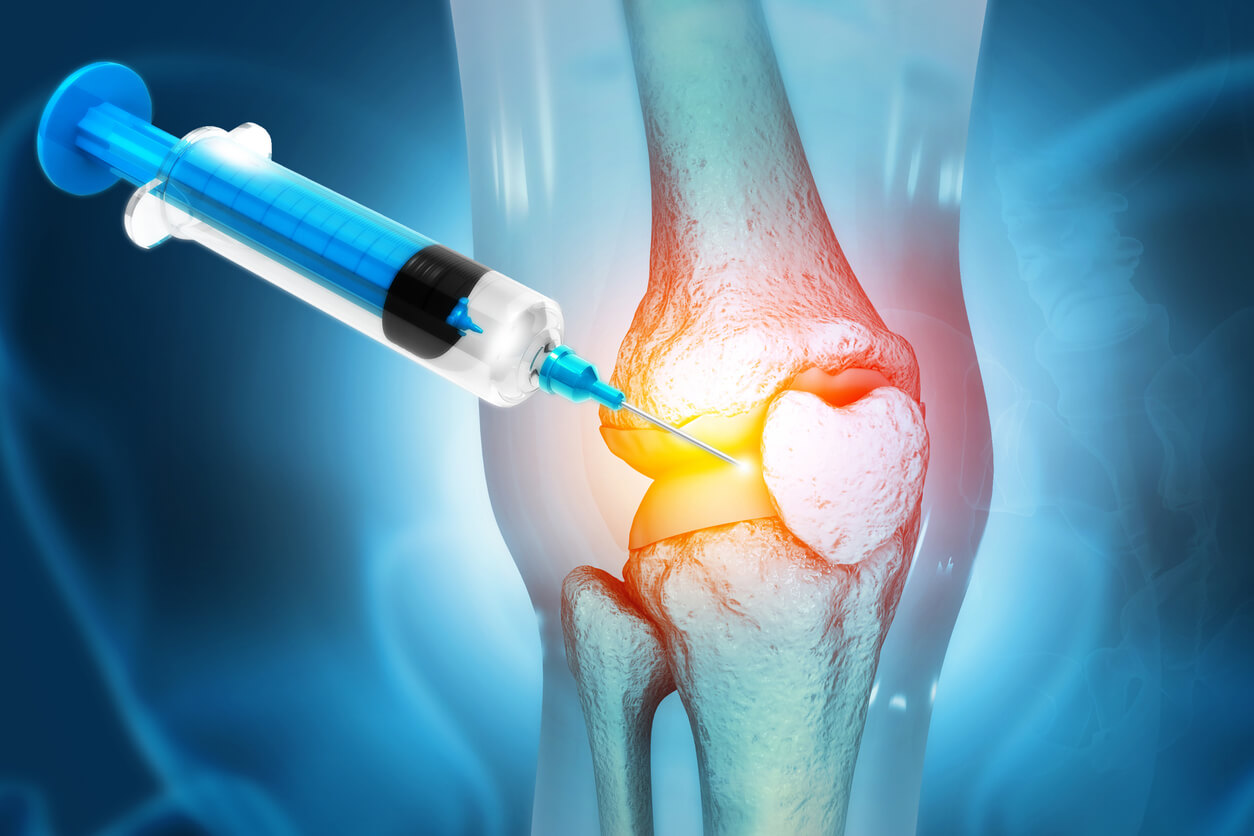
Understanding the options
PRP is prepared from your own blood. A small sample is centrifuged so the platelet rich portion—with its cargo of growth factors and anti inflammatory mediators—can be injected into the joint. Most clinical protocols use one to three knee injections spaced one to two weeks apart. Differences in how PRP is prepared matter; many clinicians favor “leukocyte poor” PRP (with fewer white blood cells) because it tends to cause fewer post injection flares and may yield slightly better clinical outcomes in knee osteoarthritis. Across multiple randomized trials and meta analyses, PRP knee injections consistently shows greater improvement in pain and function at six to twelve months than HA knee injections, with benefits that are large enough for most patients to notice in day to day life.
HA, by contrast, is a viscoelastic lubricant, a cousin of the substance that naturally gives healthy synovial fluid its smooth, shock absorbing quality. Depending on the product, HA is given as a single injection or a short series. In well done trials, HA’s average effect is real but modest, most apparent over weeks to a few months, and often below the threshold that researchers consider a clearly meaningful advantage over placebo in head to head comparisons. That does not mean HA never helps; many individuals report worthwhile relief, and coverage is more common than it is for PRP. But on average, HA trails PRP in both pain reduction and functional gains by mid term follow up.
Combination therapy with PRP plus HA knee inection is an intuitive idea: blend the biological “signal” from PRP with HA’s mechanical lubrication. Recent systematic reviews suggest that combining them produces better pain and function outcomes than HA alone and, in several analyses, slightly better or longer lasting outcomes than PRP alone. Importantly, pooled safety data show fewer adverse events with the combination than with either agent by itself. Protocols vary—some mix the injectates, others sequence them across visits—and no single “best” recipe has been established, but for patients who can access it, the combination is a reasonable way to try to capture the strengths of both approaches.
Corticosteroid injections remain the most familiar option. They rapidly tamp down synovitis, often shrinking a swollen, irritable knee within days. Their place is short term relief: the greatest benefit tends to emerge in the first two to six weeks and then fades. Repeated, scheduled steroid injections are not advisable as a long term strategy in osteoarthritis. For the right moment, however—an acute flare that is blocking rehabilitation—a single injection can be an effective reset that allows you to resume progressive strengthening and activity.
Intra articular NSAID injections, such as ketorolac, offer a steroid sparing way to reduce inflammation for the short term. Evidence is smaller than for steroids, HA, or PRP, but comparative studies suggest similar early relief without steroid related issues like transient hyperglycemia. When a patient wants a brief anti inflammatory effect and wishes to avoid corticosteroids, this can be a practical alternative while a rehabilitation program gets underway.
BMAC and related cell based approaches concentrate nucleated cells and signaling factors from your own bone marrow for intra articular injection. Syntheses that include BMAC and PRP often find both outperform HA on pain and function over six to twelve months, with no consistent winner when PRP and BMAC are compared directly. These therapies are more heterogeneous in how they are harvested and processed, they are frequently self pay, and they are not uniformly regulated across jurisdictions. For some patients working with experienced clinicians, BMAC can be a considered option after a nuanced discussion of costs, uncertainties, and realistic goals.
Other injectables—including dextrose prolotherapy, ozone, and intra articular botulinum toxin—have been studied, but the evidence base is smaller and more variable. They may have a role in selected, refractory cases or in research settings, yet most patients and clinicians will begin with the better validated options above.

What outcomes to expect
Most people want to know, “How much better will I feel, and how long will it last?”
The answer varies with osteoarthritis severity, activity level, comorbidities, and the quality of the surrounding care plan (exercise therapy, weight management, sleep, pacing). Even so, some generalizations are fair. With PRP, it is common to see meaningful reductions in day to day pain and stiffness evolve over several weeks, with many patients describing sustained improvement that carries through six to twelve months. From the perspective of numbers, within person pain reductions of two to three points on a zero to ten scale are frequently reported across PRP cohorts, with between treatment comparisons favoring PRP over HA at six to twelve months by roughly half a point to a full point on that same scale. HA, on average, produces smaller improvements that are most noticeable between about four and sixteen weeks; some individuals experience more significant gains, especially when disease is mild and expectations are aligned, but group level effects are modest.
Dr Gerard Ee consults and performs knee joint injections at The Clifford Clinic, 50 Raffles Place, Singapore, with the type of knee joint injection customised to the knee pathology and severity.

Combination PRP+HA generally outperforms HA alone and sometimes shows a small advantage over PRP alone at later follow ups, with fewer adverse reactions recorded in pooled analyses. Corticosteroids deliver their best relief quickly—often within days—but the benefit typically wanes by four to eight weeks, which is why they work best as a one off nudge to unlock rehabilitation rather than as a maintenance plan. NSAID injections track similarly to steroids in the near term without the steroid specific downsides. BMAC tends to mirror PRP’s medium term profile in comparative syntheses, though details vary by protocol and patient selection.
Are knee injections safe?
Any injection carries small risks: temporary soreness, swelling, or a feeling of fullness, and—rarely—joint infection. In practice, PRP’s most common side effect is a brief post injection ache that settles within forty eight hours; leukocyte poor preparations appear to minimize this. HA can produce a transient effusion in some patients. Combination therapy has compared favorably on safety when pooled across randomized trials. Steroid injections can spike blood sugar transiently in people with diabetes and should not be repeated on a fixed schedule as a long term plan. NSAID and BMAC injections share the usual local risks of an intra articular procedure. Regardless of the agent chosen, a careful no-touch aseptic technique with the needle placed by anatomical landmarks can improve the experience and reduce the chance of a “missed” injection, especially in bigger knees, postsurgical joints, or when using small volumes.
Choosing an injection for your situation
A sensible choice starts with your goal and time horizon. If you need fast relief from a swollen, irritable flare that is blocking therapy, a single corticosteroid injection can make sense to calm the knee while you re establish strength and motion. If your aim is months of improvement with a favorable safety profile, PRP is a leading option, with many clinicians favoring two or three leukocyte poor injections spaced over several weeks. If insurance coverage is decisive and you have had some benefit from HA before, repeating a series with realistic expectations is reasonable. If you want to avoid steroids but still need a short term anti inflammatory effect, an intra articular NSAID is worth discussing. If you are exploring biologic options beyond PRP, BMAC can be considered in a center with experience after a transparent conversation about evidence, cost, and regulation. Whatever you select, remember that injections work best when embedded in a program: a progressive strengthening plan (particularly quadriceps and hip musculature), weight management where appropriate, activity pacing, and sleep and stress strategies to reduce pain amplification.
Evidence at a glance
Across modern randomized trials and network meta analyses, PRP repeatedly ranks above HA for pain and function at six to twelve months, with within person pain reductions commonly reaching clinically noticeable territory and between treatment differences that favor PRP by roughly half to one point on a ten point pain scale. HA’s average effect is smaller and shorter lived, though some individuals benefit more than the group mean. Combining PRP with HA improves outcomes over HA alone and, in several syntheses, slightly extends or amplifies PRP’s benefits while lowering adverse event rates, albeit with heterogeneity in sequencing and preparation. Corticosteroids are reliable short term anti inflammatories whose best window is measured in weeks, not months; they are most valuable as rescue therapy rather than maintenance. NSAID injections provide a steroid sparing short term option with comparable early symptom relief. BMAC and PRP tend to outperform HA in pooled analyses at mid term follow up, with head to head differences between BMAC and PRP inconsistent. Guidelines reflect this hierarchy: HA is not recommended for routine use in all comers, PRP may reduce pain and improve function with moderate certainty, steroids help briefly, and combination regimens are promising though protocols are not standardized.
Conclusion
Injection therapy does not replace the fundamentals of osteoarthritis care, but it can widen the lane for you to do the things that matter—walk farther, climb stairs with less hesitation, sleep better, and return to the activities you enjoy. If your priority is the greatest chance of meaningful relief that lasts months, PRP—often as two or three leukocyte poor injections—is a strong candidate; if you can access it, pairing PRP with HA is a thoughtful way to try to capture lubrication and biologic signaling in one strategy. If you are chasing a painful flare, a single corticosteroid injection can be the right move to re start therapy, and if you wish to avoid steroids, an intra articular NSAID can serve a similar short term purpose. BMAC may be reasonable in selected settings when the trade offs are clear. Whatever path you take, set expectations honestly, track progress with simple measures you care about, and pair the injection with a focused rehabilitation plan so that symptom relief turns into sustained capability.
References
- 1. Singh H, Knapik DM, Polce EM, et al. Relative Efficacy of Intra Articular Injections in the Treatment of Knee Osteoarthritis: A Systematic Review and Network Meta Analysis. Am J Sports Med. 2022;50(11):3140 3148. doi:10.1177/03635465211029659.2. Jawanda H, Khan ZA, Warrier AA, et al. Platelet Rich Plasma, Bone Marrow Aspirate Concentrate, and Hyaluronic Acid Injections Outperform Corticosteroids in Pain and Function Scores at a Minimum of 6 Months as Intra Articular Injections for Knee Osteoarthritis: A Systematic Review and Network Meta Analysis. Arthroscopy. 2024;40(5):1623 1636.e1. doi:10.1016/j.arthro.2024.01.037.3. Hunter CW, Deer TR, Jones MR, et al. Consensus Guidelines on Interventional Therapies for Knee Pain (STEP Guidelines) From the American Society of Pain and Neuroscience. J Pain Res. 2022;15:2683 2745. doi:10.2147/JPR.S370469.4. Belk JW, Kraeutler MJ, Houck DA, et al. Platelet Rich Plasma Versus Hyaluronic Acid for Knee Osteoarthritis: A Systematic Review and Meta Analysis of Randomized Controlled Trials. Am J Sports Med. 2021;49(1):249 260. doi:10.1177/0363546520909397.5. Belk JW, Lim JJ, Keeter C, et al. Patients With Knee Osteoarthritis Who Receive Platelet Rich Plasma or Bone Marrow Aspirate Concentrate Injections Have Better Outcomes Than Patients Who Receive Hyaluronic Acid: Systematic Review and Meta Analysis. Arthroscopy. 2023;39(7):1714 1734. doi:10.1016/j.arthro.2023.03.001.6. Gökçeoğlu YS, Yapti M, Öncel F, Levent A, Demir S. Comparative Efficacy of Intra Articular Platelet Rich Plasma, Hyaluronic Acid, Corticosteroids, and NSAIDs for Knee Osteoarthritis: A Retrospective Cohort Study. Medicine (Baltimore). 2025;104(40):e44929. doi:10.1097/MD.0000000000044929.
7. American Academy of Orthopaedic Surgeons (AAOS). Management of Osteoarthritis of the Knee (Non Arthroplasty): Evidence Based Clinical Practice Guideline. 2021.
8. Qiao X, Yan L, Feng Y, et al. Efficacy and Safety of Corticosteroids, Hyaluronic Acid, and PRP and Combination Therapy for Knee Osteoarthritis: A Systematic Review and Network Meta Analysis. BMC Musculoskelet Disord. 2023;24(1):926. doi:10.1186/s12891 023 06925 6.
9. Xu H, Shi W, Liu H, et al. Comparison of Hyaluronic Acid and Platelet Rich Plasma in Knee Osteoarthritis: A Systematic Review. BMC Musculoskelet Disord. 2025;26(1):236. doi:10.1186/s12891 025 08474 6.
10. Liu Q, Ye H, Yang Y, Chen H. The Efficacy and Safety of Intra Articular Platelet Rich Plasma Versus Sodium Hyaluronate for the Treatment of Osteoarthritis: Meta Analysis. PLOS ONE. 2025;20(3):e0314878. doi:10.1371/journal.pone.0314878.
11. Baria MR, Vasileff WK, Borchers J, et al. Treating Knee Osteoarthritis With Platelet Rich Plasma and Hyaluronic Acid Combination Therapy: A Systematic Review. Am J Sports Med. 2022;50(1):273 281. doi:10.1177/0363546521998010.
12. Sun SF, Lin GC, Hsu CW, et al. Comparing Efficacy of Intraarticular Single Crosslinked Hyaluronan (HYAJOINT Plus) and Platelet Rich Plasma (PRP) Versus PRP Alone for Treating Knee Osteoarthritis. Sci Rep. 2021;11(1):140. doi:10.1038/s41598 020 80333 x.
Learn More About Dr Gerard Ee
MBBS (UK), MRCS (Edinburgh), PGDip Practical Dermatology (Cardiff)
Qualifications and Experience
Dr Gerard Ee is a medical aesthetic doctor specialising in treating acne and acne scar removal in Singapore. He earned his medical degree (MBBS) from St George’s University of London. He pursued further training and became a member of the Royal College of Surgeons (MRCS) in Edinburgh.
Areas of Expertise
- Acne and Acne Scar Treatment
- Medical Aesthetics
- Skin Rejuvenation
Patient-Centric Approach
Dr Gerard Ee believes in building strong relationships with individuals based on trust and open communication. He takes the time to understand their concerns and goals, creating personalised treatment plans tailored to their specific needs. He is committed to providing a comfortable and supportive environment where patients feel empowered to make informed decisions about their skin health.

Frequently Asked Questions About Knee Injections
Will one injection fix my knee?
An injection can reduce pain and make movement easier, but it is not a cure. The best results come when the temporary symptom relief is used to fuel a consistent strengthening and activity program.
If hyaluronic acid didn’t help me before, is platelet rich plasma still worth trying?
Yes. Across multiple studies, PRP outperforms HA for pain and function at six to twelve months. Prior lack of response to HA does not predict a poor response to PRP.
Is PRP plus hyaluronic acid better than PRP alone?
Combination therapy beats HA alone and often shows a small long term edge over PRP alone with fewer adverse events, but the advantage over PRP by itself is not universal. Cost, access, and your priorities should drive the decision.
Are repeated steroid injections harmful?
A single steroid injection can be helpful for a flare. Routine, scheduled steroid injections are discouraged for long term management in osteoarthritis because benefits wane and there are concerns about cartilage health with frequent use.
How do I know which option fits me best?
Match the strategy to your goal and context: fast relief for a flare, months of durable improvement, insurance coverage, comorbidities like diabetes, and willingness to invest in a rehabilitation plan. A brief conversation with your clinician using your X rays, pain goals, and daily demands usually reveals the best fit.

Book a consultation with Dr Gerard Ee at The Clifford Clinic
Dr Gerard Ee consults and performs knee joint injections, with the type of knee joint injection customised to the knee pathology and severity, at The Clifford Clinic, 50 Raffles Place, Singapore. Consultations are by appointment. Message the clinic on WhatsApp, or call 6532 2048.

