
Sagging skin treatment in Singapore works when it is matched to the layer that has loosened. HIFU lifts the deeper SMAS layer, radiofrequency tightens the skin, and fillers or collagen stimulators replace lost volume. I assess which layer has changed first, then plan the treatment around it.
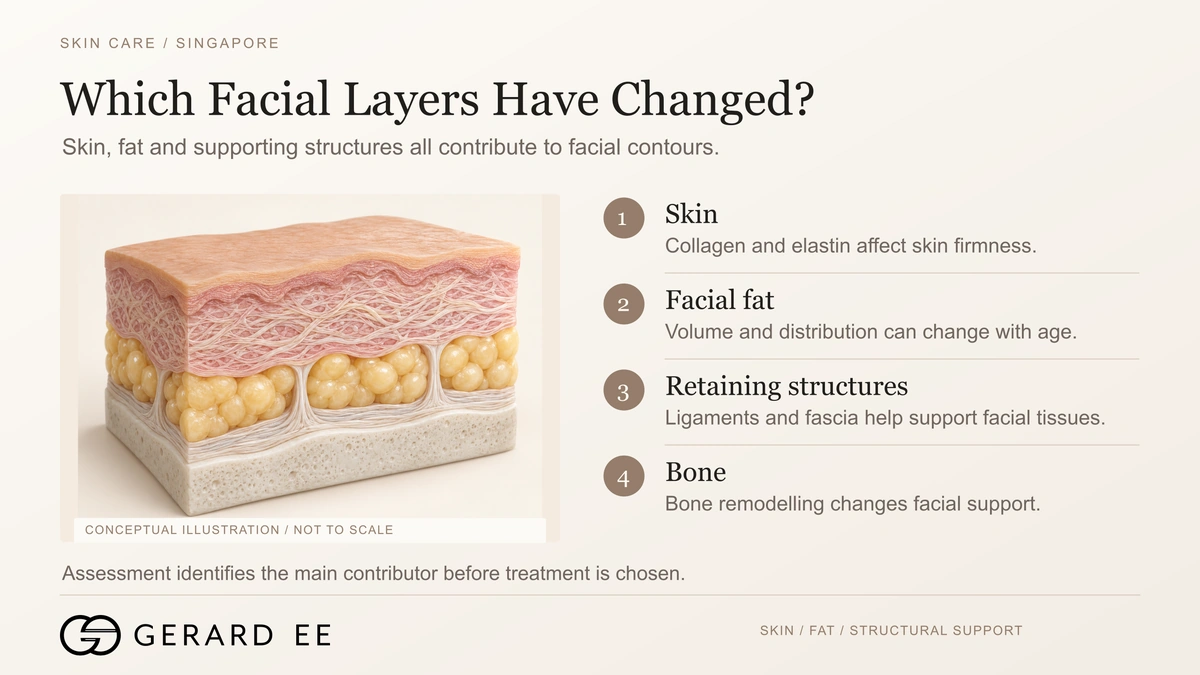
Facial laxity develops through changes in several anatomical layers. Collagen and elastin decline within the skin, facial fat compartments lose or redistribute volume, retaining structures weaken, and the facial skeleton remodels with age. Muscle activity and the platysma also influence the jawline and neck.
Written by Dr Gerard Ee, MBBS (UK), MRCS (Edinburgh), PGDip Practical Dermatology (Cardiff). Last medically reviewed and updated: September 2026.
The visible result may be a softer jawline, jowls, flatter cheeks, deeper folds or looser skin. Patients searching for skin tightening in Singapore often use one label for these different changes, and treatment becomes more precise once the main contributor is identified.

What Causes Sagging Skin on the Face
Skin becomes thinner and less elastic as its extracellular matrix changes. Beneath it, some fat compartments lose volume while others become more prominent or descend. Ligaments and fascial support weaken, and age-related bone remodelling reduces structural support around the orbit, cheek and jaw.
These processes overlap, which is why one treatment rarely addresses every feature. Tightening cannot replace missing volume, and adding volume cannot remove substantial skin excess.
Which Skin Tightening Treatment Addresses Which Concern
Sagging of the upper eyelid is treated differently from the face and neck, and is covered in the sagging eyelids treatment page.
| What you see | Possible contributors | Treatment discussion |
|---|---|---|
| Thin or crepey skin | Dermal collagen and elastin change | Skin care, resurfacing, radiofrequency, skin boosters or biostimulators, according to the area |
| Early jowl or softening jawline | Skin laxity, fat distribution, fascial support and volume loss | Focused ultrasound, monopolar RF or a combination plan after assessment |
| Flat cheeks or hollow temples | Loss of deep and superficial volume, with skeletal remodelling | Fillers or collagen biostimulators where appropriate |
| Lines visible at rest | Repeated movement, plus dermal change and volume loss | Botulinum toxin for the movement-related component, with resurfacing, injectables or skin-quality treatments for lines etched at rest |
| Under-eye heaviness | Fat prolapse, fluid, thin skin, ligament shadowing or adjacent hollowing | An eye-specific assessment rather than a general tightening plan |
| Marked skin excess or advanced descent | Structural tissue redundancy | Surgical consultation |
How I Assess Sagging Skin
Assessment is performed with the face upright, at rest and in movement. It covers skin thickness and elasticity, fat distribution, facial proportions, jawline and neck anatomy, muscle activity, previous procedures, and the change the patient actually wants to see.
Photographs and palpation help separate laxity from volume loss or localised fat. That distinction matters, because a heavily treated but poorly selected face can look tighter without looking better. Where the dominant finding is volume loss, I do not treat with HIFU at all; reducing facial fat in a face that has already lost it makes the result worse.
Focused and Fractionated HIFU for Mild to Moderate Laxity
HIFU places ultrasound energy at predetermined depths to create small thermal points beneath the skin. It may improve mild to moderate laxity without an incision, although the scale of lifting is smaller than surgery and results vary across devices.
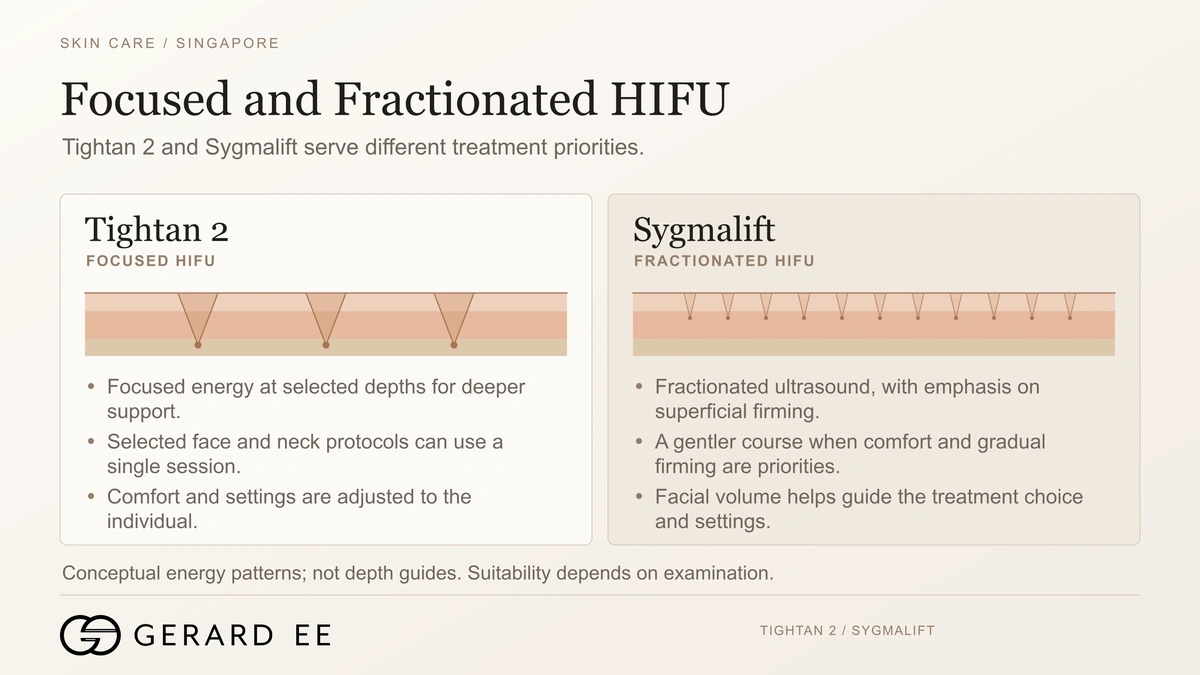
At my clinic Tightan 2 is the focused HIFU option for selected single-session face and neck protocols, and I find it much more comfortable than Ultherapy. Sygmalift uses a fractionated HIFU approach and is offered as a gentler course. I use it most often in patients in their twenties, where the aim is firming without reducing facial fat, and in patients in their sixties and seventies, for comfort and for its effect in the superficial layer. Facial volume, and whether any fat reduction is desirable, influence both the choice and the settings.
A thread lift mechanically repositions selected tissues and may be considered in suitable cases. Its effect is temporary and it does not reproduce a surgical facelift, so the expected degree and duration of change need to be discussed before treatment.
Radiofrequency for Skin Tightening
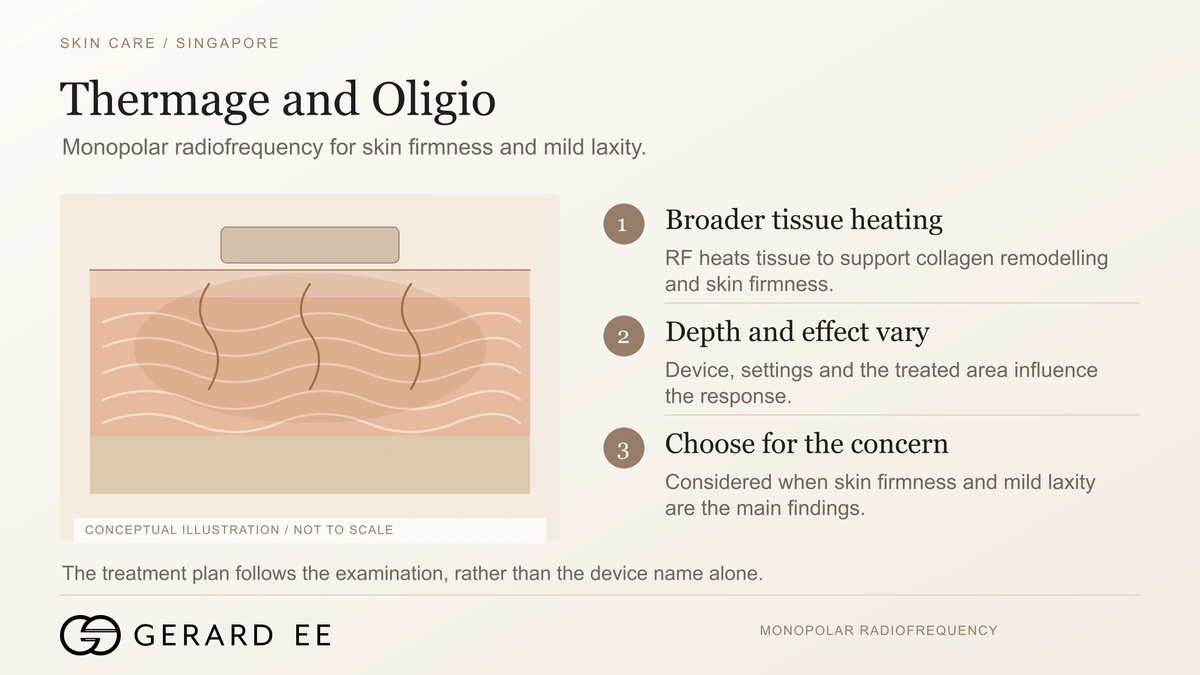
Monopolar radiofrequency devices such as Thermage and Oligio heat tissue more broadly than focused ultrasound. They are often discussed where skin firmness and mild laxity are the main concerns, although depth and effect depend on the exact device and protocol.
Clinical trials comparing monopolar radiofrequency with Ultherapy have found improvement with both modalities and no consistent difference in mild to moderate face or neck laxity [1]. That supports matching the treatment pattern to the face rather than choosing by brand recognition. The Oligio vs HIFU vs Thermage comparison covers the two modalities in detail.
Restoring Facial Support and Volume
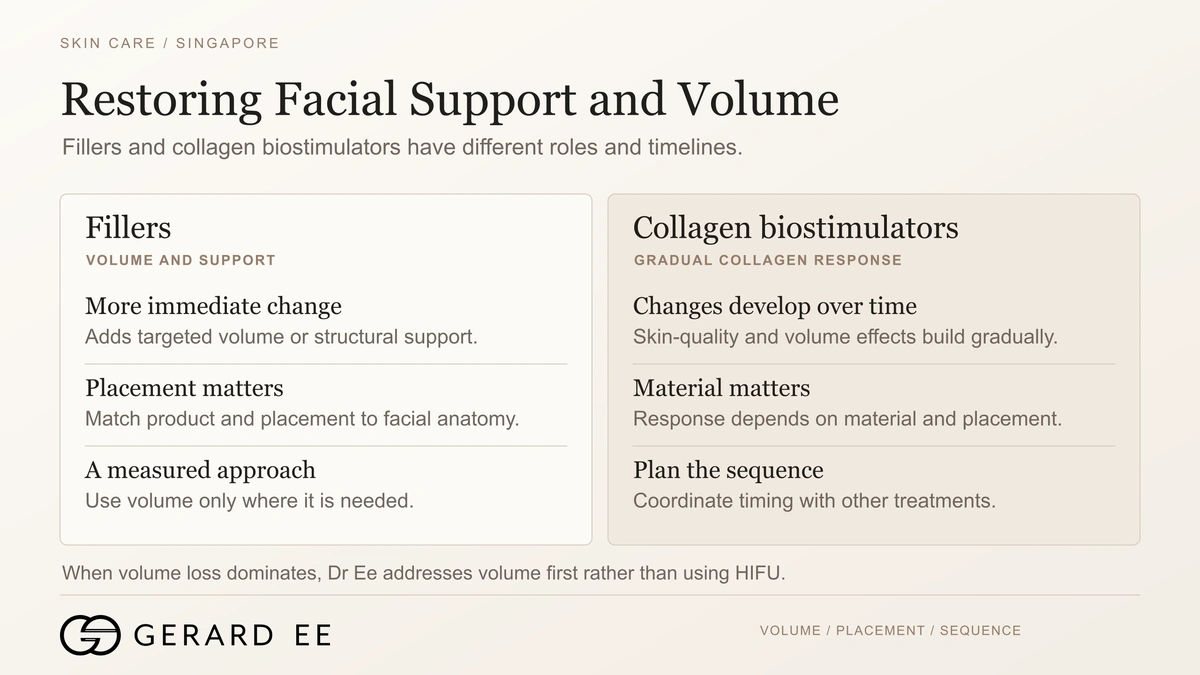
Collagen biostimulators can gradually improve selected aspects of skin quality and volume, depending on the material and placement. Fillers provide more immediate volume or structural support. Each carries different risks, and neither should be used simply to inflate every area that appears to have descended.
The sequence of volume treatment and energy treatment is individual. It depends on the material already present, the intended energy depth, the priority of each concern, and the interval recommended for the specific procedures.
For the nose specifically, what filler can and cannot change, from a low bridge to a dorsal hump, is set out on the nose shape concerns page.
Where EMFACE Fits in a Skin Tightening Plan
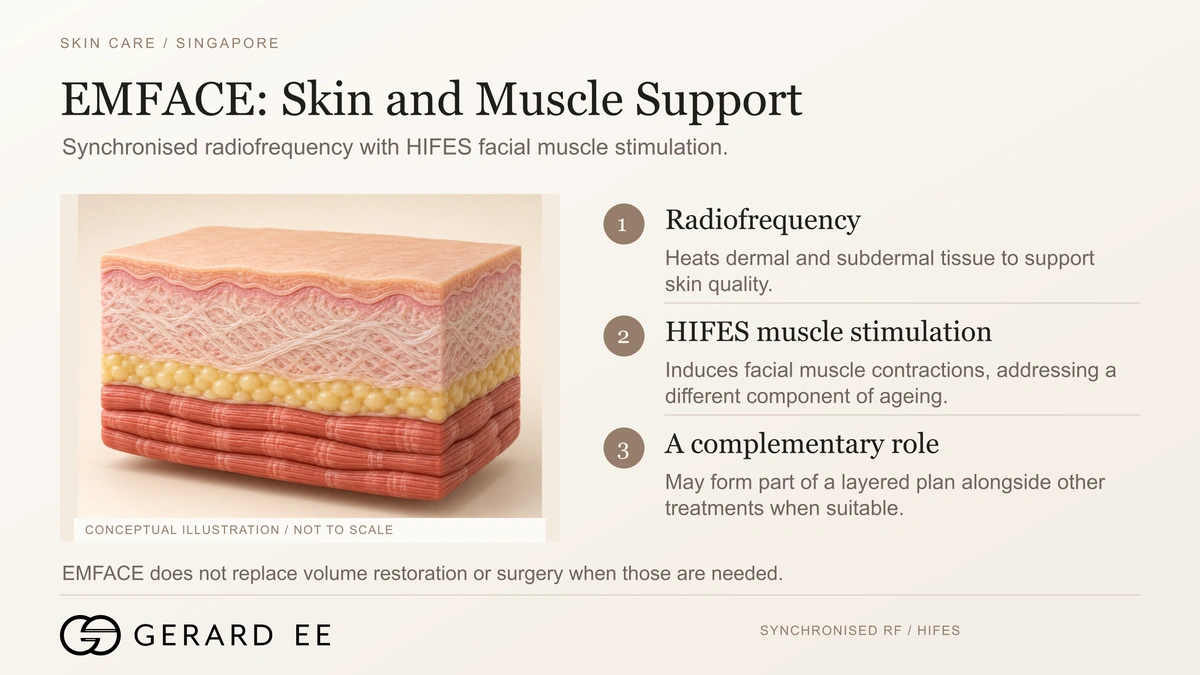
EMFACE combines synchronised radiofrequency with high-intensity facial electrical stimulation. It heats dermal and subdermal tissue while inducing facial muscle contractions, so it addresses a different component of facial ageing from focused ultrasound alone.
Its place in a plan depends on the examination and on the strength of evidence for the intended concern. It is an option for selected patients rather than a replacement for volume restoration, HIFU or surgery.
What Sagging Skin Treatment Costs in Singapore
Cost depends on the treatment category, device, area, number of sessions, and whether a combination is proposed. The HIFU price guide carries the clinic’s current ultrasound and radiofrequency prices and explains how to compare quotes.
A written plan should identify the purpose and cost of each treatment. That prevents several overlapping procedures being sold for the same layer without a clear clinical reason.
What the Evidence on Skin Tightening Shows
A 2025 systematic review of 45 HIFU clinical trials and cohort studies reported improvements in skin laxity ranging from 18% to 30%, most consistently in the lower face, neck and periorbital regions. Transient redness, swelling or mild discomfort was reported by fewer than 5% of participants, and protocol standardisation and long-term evidence remained limitations [2].
In a study of 20 Korean patients treated across seven facial areas, the jawline, cheek and perioral regions showed the greatest improvement, and clinical effects and satisfaction were not significantly related to the number of treatment shots [3].
A randomised split-face study of 20 patients found that monopolar radiofrequency and Ultherapy both improved mild to moderate face and upper-neck laxity through 180 days, with no statistically significant difference in laxity, satisfaction or adverse events between the treated sides [1].
Focused ultrasound produces measurable but modest changes in defined areas. A randomised blinded upper-face study reported a mean brow elevation of 2.16 mm at 90 days after one treatment [4]. A separate study used 4.5 and 6.0 mm depths to reduce unwanted submental fat in 30 Asian patients, with four weeks of follow-up [5]. That second study concerned fat reduction, and it is not evidence that the same protocol lifts every sagging jawline.

Arrange a Sagging Skin Assessment in Singapore
Dr Gerard Ee consults and performs sagging skin treatment at The Clifford Clinic, 50 Raffles Place, Singapore. Consultations are by appointment. Message the clinic on WhatsApp, or call 6532 2048.
Book a consultation to discuss changes in your jawline, cheeks or neck. An assessment can separate skin laxity from volume loss and localised fat, then guide a discussion of suitable skin tightening or other treatment options.
Frequently Asked Questions
Can I have a face lift without surgery?
Mild to moderate laxity may improve with focused ultrasound, monopolar radiofrequency or selected combination treatments. These options produce a non-surgical improvement, and they do not reproduce a surgical face lift. Marked skin excess and advanced tissue descent are more likely to require surgical assessment for a substantial change.
What is the best treatment for sagging jowls?
The answer follows whether the jowl is driven mainly by laxity, local fat, volume loss higher in the face, platysma activity, or a combination. Focused ultrasound or monopolar RF may help selected early jowls, whereas advanced descent may need surgery.
Does skin tightening work on thin skin?
Thin skin can improve with a dermal treatment, although energy settings and depth need particular care where facial fat is limited. Skin quality, volume and laxity should be assessed separately before a device is chosen.
Should I tighten the skin or replace the volume first?
That depends on which is the dominant finding, and it is the main thing an examination settles. Where volume loss is the larger problem, tightening alone tends to disappoint and can make a hollow face look worse, so volume is addressed first. Where laxity dominates and volume is adequate, energy treatment comes first. Many faces need both, in a stated order and with an interval appropriate to the specific procedures.
At what age should I start treatment?
Treatment should respond to a visible concern and a suitable examination finding rather than to a birthday. Daily sun protection, avoiding smoking and appropriate skin care remain more relevant for prevention than starting an energy procedure before laxity appears.
Dr Gerard Ee consults and performs this treatment at The Clifford Clinic, 50 Raffles Place, Singapore.
Show the 5 references
1. Alhaddad M, Wu DC, Bolton J, et al. A Randomized, Split-Face, Evaluator-Blind Clinical Trial Comparing Monopolar Radiofrequency Versus Microfocused Ultrasound With Visualization for Lifting and Tightening of the Face and Upper Neck. Dermatol Surg. 2019;45(1):131-139. doi:10.1097/DSS.0000000000001653. PubMed 30531187
2. Haykal D, Sattler S, Verner I, Madhumita M, Cartier H. A Systematic Review of High-Intensity Focused Ultrasound in Skin Tightening and Body Contouring. Aesthet Surg J. 2025;45(7):690-698. doi:10.1093/asj/sjaf053. PubMed 40184185
3. Park H, Kim E, Kim J, Ro Y, Ko J. High-Intensity Focused Ultrasound for the Treatment of Wrinkles and Skin Laxity in Seven Different Facial Areas. Ann Dermatol. 2015;27(6):688-693. doi:10.5021/ad.2015.27.6.688. PubMed 26719637
4. Chen W, Deng Y, Qiao G, Cai W. Ultrasound rejuvenation for upper facial skin: A randomized blinded prospective study. J Cosmet Dermatol. 2024;23(12):3942-3949. doi:10.1111/jocd.16482. PubMed 39034504
5. Goo B, Kim E, Yoon SE, et al. Efficacy and Safety of High-Intensity Focused Ultrasound (HIFU) on Reduction of Unwanted Submental Fat in Asian Patients. Aesthetic Plast Surg. 2025;49(13):3750-3755. doi:10.1007/s00266-025-04890-0. PubMed 40355620
This page is written from published research and from clinical experience treating faces in Singapore since 2012. It is for general education, not medical advice. Suitability, likely result, downtime and risk can only be established at a consultation. Dr Gerard Ee provides the treatments described on this page at The Clifford Clinic.

