
Dr Gerard Ee consults and performs this treatment at The Clifford Clinic, 50 Raffles Place, Singapore.
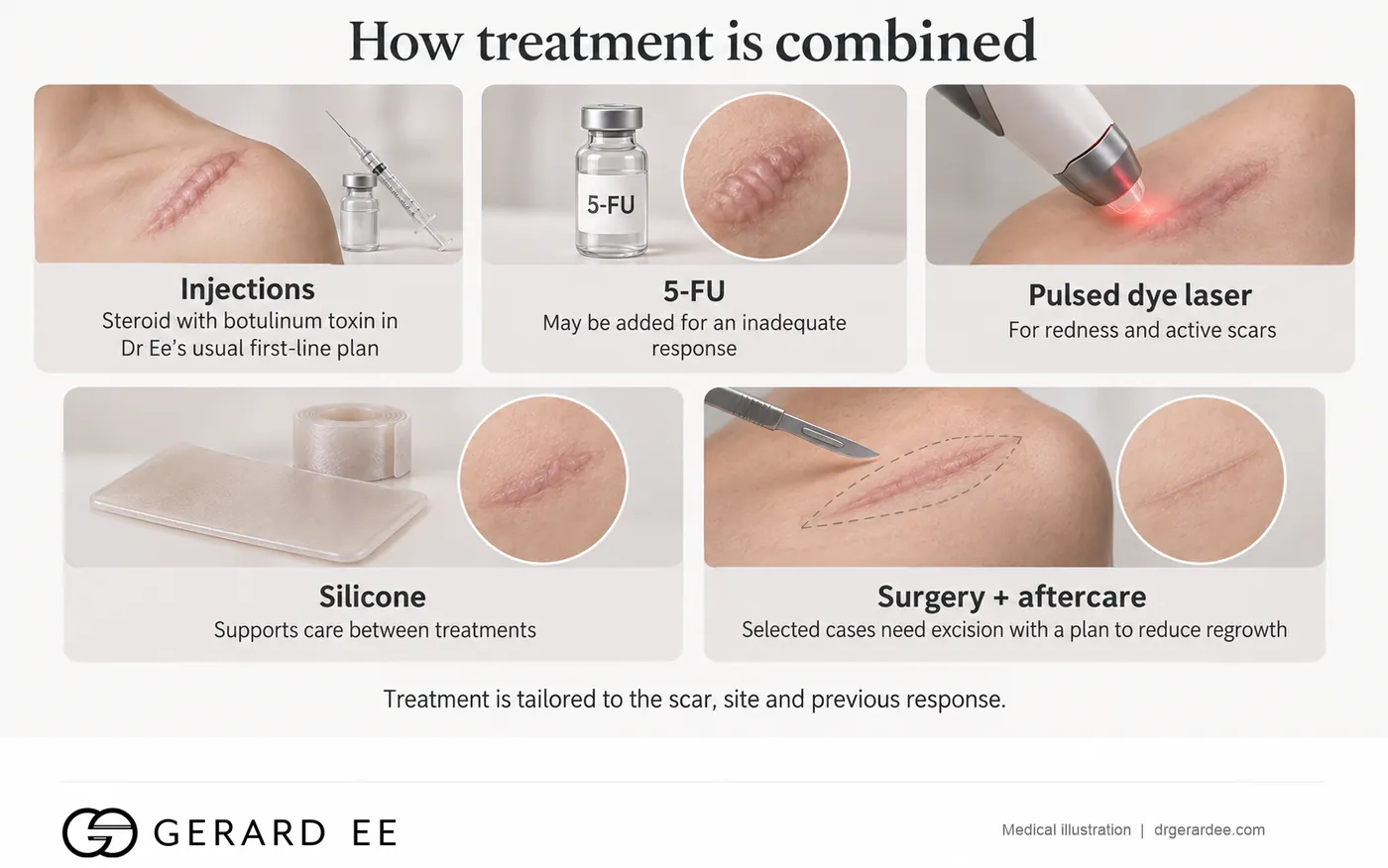
Keloid treatment in Singapore rests on a small number of interventions with trial evidence behind them and a longer list without it. I have treated keloids since 2012 and see about 20 keloid cases a month, and the protocol I use follows a fixed order. Botulinum toxin and steroid are injected together as the first line, 5-fluorouracil (5-FU) is added when the keloid does not respond, pulsed dye laser (V Beam) is used for red and active keloids, silicone gel and plaster are continued throughout, and excision followed by adjuvant radiotherapy is reserved for the keloid that is too large or too established for injections. I perform the injections, the laser and the excision myself, and the first treatment is usually given at the first visit.
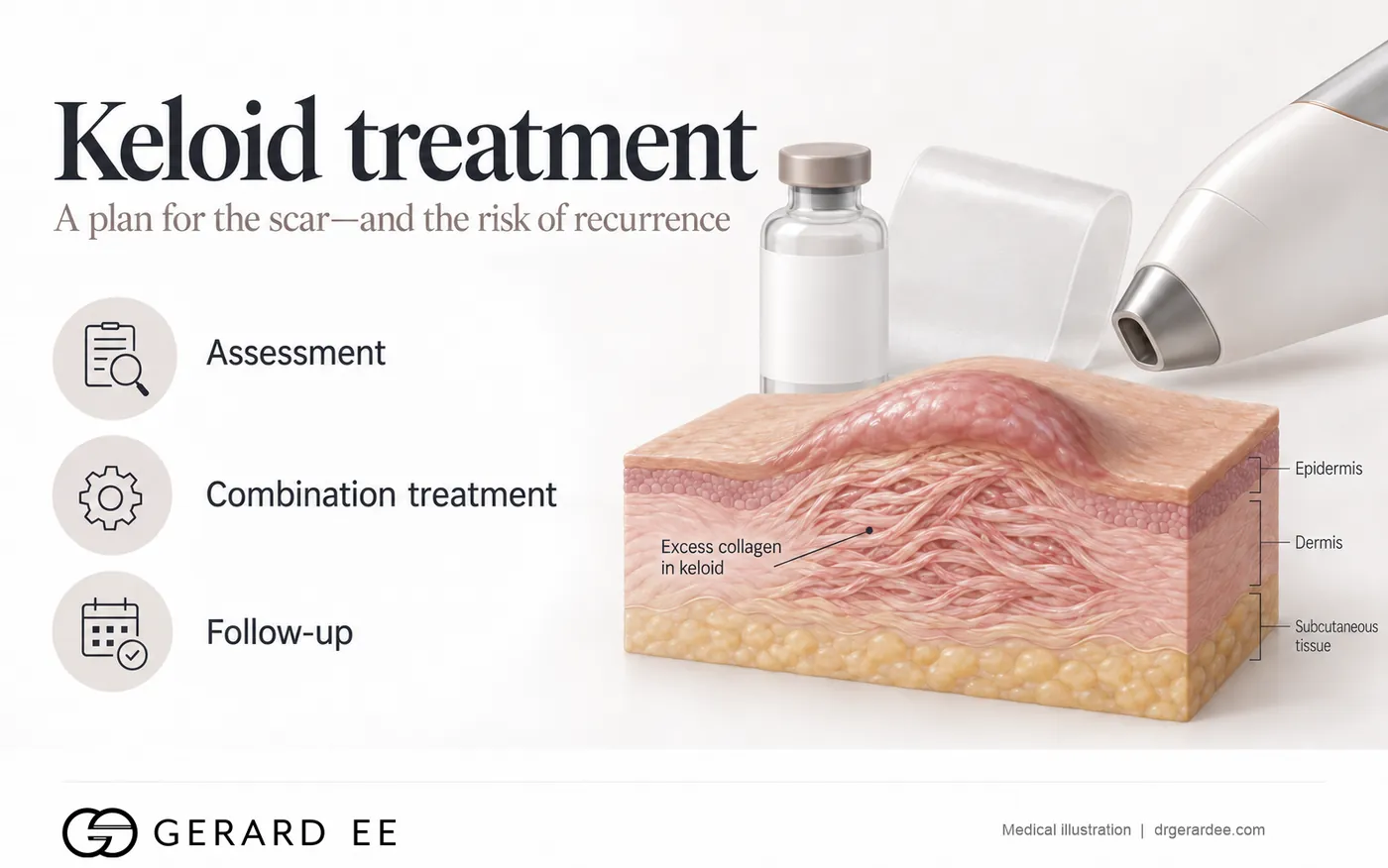
Most keloids need two or three of these treatments in combination, because each acts on a different part of the problem. The injections suppress the inflammation that drives collagen growth and relieve the tension on the scar, the laser reduces the redness and the blood supply feeding it, silicone maintains the result between sessions, and surgery with radiotherapy removes the keloid that is too large to flatten. The strategy is the same whether the keloid followed acne, a piercing or an operation. The number of lesions and the site are what change the plan. A large part of my keloid work is patients who have had repeated steroid injections elsewhere and still have recurrence, and the approach to those keloids is set out in its own section below.
Keloid treatment at a glance
| Item | Details |
|---|---|
| Suitable for | Keloids on the ear, chest, shoulder, back, jaw, neck, arm and surgical scars, and hypertrophic scars that are not flattening |
| Treatments | Botulinum toxin and steroid injection (first line), 5-FU injection (added when needed), pulsed dye laser (V Beam), silicone gel and plaster, excision with adjuvant electron-beam radiotherapy |
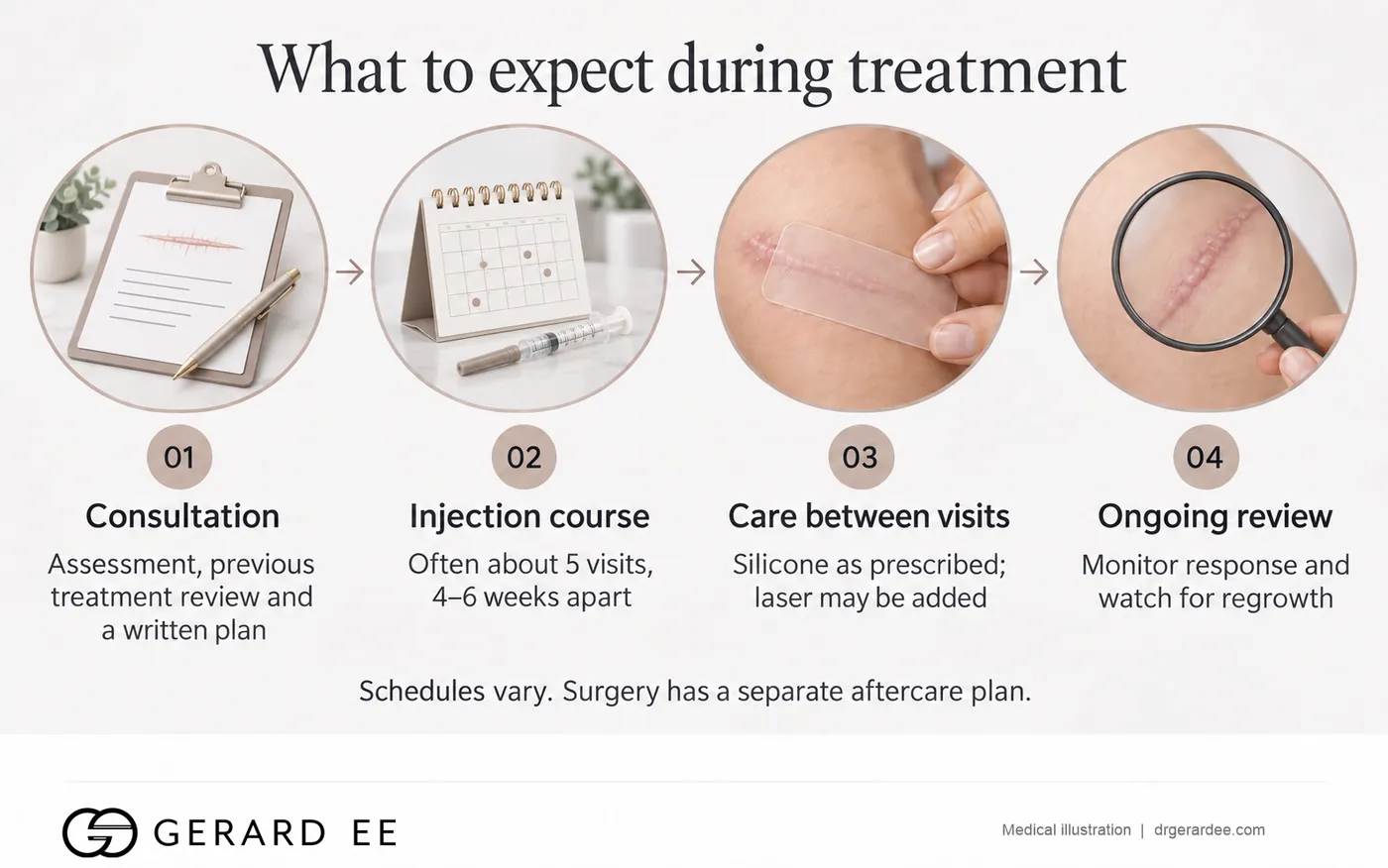
| Sessions | About 5 injection sessions, 4 to 6 weeks apart. V Beam every 3 to 4 weeks alongside them, up to 10 sessions |
| Downtime | None for injections. A purple mark for 3 to 5 days after V Beam. Dressings for about a week after excision |
| Price before GST | Steroid injection around $200 a session and botulinum toxin injection around $200 a session. V Beam and excision quoted at the consultation. Radiotherapy billed separately by the hospital |
| Performed by | Dr Gerard Ee |
Keloid steroid injection with botulinum toxin, the first-line treatment
For almost every keloid, the first-line treatment is two injections given at the same visit, namely triamcinolone acetonide, a long-acting corticosteroid, and botulinum toxin. The steroid reduces the inflammation that drives the growth, softens the collagen and usually relieves the itch within days, and it has been the first-line keloid treatment in every international guideline since 2002. The botulinum toxin relaxes the muscle beneath the keloid, which reduces the tension across the scar, and it also appears to act directly on the fibroblasts that produce the collagen. Because keloids grow where the skin is under tension, the two injections address the growth and its cause at the same time.
The evidence for the combination is consistent. In a 2024 meta-analysis of 11 randomised trials with 561 patients, adding botulinum toxin to the steroid injection improved the response rate and reduced pain and scar scores compared with steroid alone. A network meta-analysis of 20 trials ranked botulinum toxin alongside steroid with 5-FU as the two most effective injectable treatments, with a side-effect rate no higher than steroid alone. In my experience, this combination, with V Beam added, is also the one that recurs least.
Because keloid tissue is dense, the injection meets resistance. I numb the skin first and inject slowly across the whole lesion, so that the drugs are distributed evenly through the keloid rather than pooled in one spot, since a concentrated steroid deposit is the likely cause of the skin thinning described below. Most keloids need about five sessions, 4 to 6 weeks apart. Steroid injection is around $200 a session and botulinum toxin injection around $200 a session, before GST.
The steroid has three clinically significant, dose-related side effects, namely thinning of the skin around the keloid, fine visible vessels, and a pale patch in darker skin. In one controlled study they occurred in half of the sites treated with steroid alone at full concentration. The steroid is therefore paired rather than escalated, used at the lowest concentration that is effective, and spread across the lesion.
5-FU injection for keloids that do not respond to steroid
Intralesional 5-FU stops the fibroblasts in the keloid from dividing, which limits the new collagen they can lay down. Mixed with the steroid, or injected on its own, it has outperformed steroid alone in the randomised trials that compared them. In 150 patients randomised to steroid alone or steroid with 5-FU, good-to-excellent results rose from 68 to 84 per cent and complications fell from 24 to 8 per cent, and across 20 randomised trials the steroid with 5-FU combination ranked first for efficacy, with an adverse event rate no different from steroid alone. I add 5-FU, combined with the steroid or as a stand-alone injection, when the keloid has not responded sufficiently to the first-line injections, and for the larger keloids on the chest, shoulder and back, where response is slowest. The injection stings more than steroid alone and can occasionally leave a small ulcer at the site, which heals.
Pulsed dye laser (V Beam) for red, active keloids
V Beam is a 595 nm pulsed dye laser whose energy is absorbed by haemoglobin. A red, thickening keloid has a rich blood supply feeding the inflammation, and the laser closes those vessels, which reduces the redness and, with repeated sessions, the thickness and the itch. It was the first laser shown to flatten keloid scars, and in a direct comparison it improved scar texture more than injections did, whereas injections reduced thickness faster. The combination of the two gave better results than either alone.
I use V Beam on keloids that are red and active, on the face and neck where steroid-induced skin thinning would be visible, and on the chest and shoulder alongside the injections. The treated area is purple for 3 to 5 days. Sessions are every 3 to 4 weeks, alongside the steroid injections. The injections usually total about five, and V Beam can continue for up to ten sessions. The V Beam page covers the laser itself.
Silicone gel and silicone plaster for keloid scars
Silicone is the only over-the-counter treatment with trial evidence behind it. A Cochrane review of 20 trials found that silicone gel sheeting reduces the incidence of raised scarring in people prone to it and reduces the thickness of established scars. It acts by hydrating and occluding the scar surface, which reduces water loss from the scar and, in turn, the signalling that keeps the fibroblasts beneath it active. On its own it is unlikely to flatten an established keloid, but it maintains the result between injections and after excision, and it reduces the risk of new keloids on fresh wounds.
I prescribe silicone plaster for scars that can be covered (chest, shoulder, back, arm, abdomen), worn 12 to 24 hours a day for at least three months, and silicone gel for the face, neck and ear, applied twice a day. Silicone is the one component of keloid treatment that depends entirely on the patient, and a keloid that recurs after injections has often been one where silicone was stopped early.
Keloid removal surgery with adjuvant electron-beam radiotherapy
Excising a keloid and leaving the wound to heal on its own is the one approach I do not offer. The recurrence rate for excision alone is 50 to 80 per cent, and the keloid that returns is usually larger than the one removed. Excision is therefore always followed by a treatment that suppresses the regrowth, either adjuvant radiotherapy, given to the wound within 24 hours of surgery while the fibroblasts that would rebuild the keloid are most active, or, for earlobe keloids, 5-FU and steroid injections into the healing scar. In a randomised trial of 60 ear keloids, excision followed by 5-FU and steroid injections kept 73 per cent recurrence-free at six months, against 43 per cent for excision followed by radiotherapy. For the ear, that is the sequence I use, with excision plus radiotherapy reserved for the keloid that has failed every other treatment. Across 72 studies and 9,048 keloids, radiotherapy after surgery brought recurrence down to 22 per cent overall, lowest on the earlobe and highest on the chest. Centres that adjust the dose by body site report recurrence below 10 per cent, and in the largest single series, 834 keloids treated with excision and radiotherapy started within 24 hours, recurrence was 9.6 per cent. Because the timing of the first fraction affects the recurrence rate, the surgery and the radiotherapy are booked together.
I trained in surgery (MRCS, Edinburgh) and perform the excision myself at The Clifford Clinic. The adjuvant radiotherapy is electron-beam radiotherapy, delivered by the radiation oncology team at Mount Alvernia Hospital, to which I refer. The regimen used to date has been two fractions of 7.5 Gy, 15 Gy in total, which is the dose the largest published protocols use for most body sites. The first fraction is given within 24 hours of the excision, and the surgery and the radiotherapy are usually arranged together on the same day. The keloids that go to surgery are large earlobe keloids, pedunculated keloids that hang from the skin on a stalk, and keloids that have failed a full course of injections and laser. Steroid injection into the healed scar and silicone for six months afterwards complete the protocol.
Which keloid treatment for which keloid
| Keloid | First-line | Added when needed |
|---|---|---|
| Small earlobe keloid, under 1 cm | Botulinum toxin with steroid injection | V Beam if red, silicone gel throughout |
| Large or hanging earlobe keloid | Excision, then 5-FU and steroid injections into the scar | Excision with adjuvant radiotherapy if it recurs |
| Ear cartilage keloid | Botulinum toxin with steroid injection | V Beam, and 5-FU if slow |
| Chest, shoulder or back keloids from acne | Botulinum toxin with steroid injection, plus V Beam | 5-FU, silicone plaster, and treatment of active acne |
| Jawline or neck keloid | Botulinum toxin with low-dose steroid | V Beam for colour, and 5-FU if slow |
| Surgical or caesarean scar keloid | Botulinum toxin with steroid injection, silicone plaster | 5-FU, and excision with radiotherapy if thick and not responding to injections |
| Fresh wound in a keloid-former | Silicone from suture removal | Early injection at first thickening |
| Keloid that recurred after steroid injections elsewhere | Botulinum toxin with steroid, 5-FU added, V Beam | Excision with radiotherapy if it fails again |
Recurrent keloids after steroid injections elsewhere
The keloid I see most often is not a new one. It is a keloid that has had repeated steroid injections at another clinic and has recurred, sometimes with a pale, thinned ring of skin around it from the steroid. Steroid alone is the weakest of the injectable options for preventing recurrence, and once the injections stop the keloid regrows, leaving the patient with the side effects of the steroid and no durable result.
The plan for these keloids changes in four ways. The steroid dose is reduced and botulinum toxin is added to it, so that the tension that regrew the keloid is addressed. 5-FU is added early rather than late. V Beam is used for any redness, because a red keloid is an active one. Silicone is worn for 12 to 24 hours a day, which in a recurrent keloid has usually not been done. If the keloid still fails after that course, it is excised with adjuvant radiotherapy, never excised alone. A keloid that has recurred is not untreatable. It has usually been treated with one modality when it needed three.
Keloid treatment cost in Singapore
Steroid injection is around $200 a session and botulinum toxin injection around $200 a session, before GST, so the first-line combination is around $400 a visit. 5-FU, V Beam and excision are quoted at the consultation, and the radiotherapy is billed separately by the hospital. Because most keloids are treated over about five sessions, a course of injections is priced as a course rather than as a single visit, and a written plan with the total is given at the consultation.
The keloid consultation and the first treatment
At the consultation I examine the keloid, ask when it started and what has been done to it, and check the rest of the skin for others. A keloid that has been injected many times elsewhere, with thinning and pale skin around it, is treated differently from one that is untreated. The first treatment is usually given at the same visit, with numbing cream, the injection, and a silicone plan to take home. Laser sessions are booked separately. Excision is a separate appointment coordinated with the hospital’s radiotherapy team.
Recovery after keloid treatment
Injection sites are tender for about a day. V Beam leaves a purple mark for 3 to 5 days that can be covered. After excision, the dressings stay on for about a week, and the radiotherapy visits fall within that week. Silicone is continued for at least three months after any of these treatments. Review is at 4 to 6 weeks for injections and laser, and at 1, 3, 6 and 12 months after excision, because recurrence after radiotherapy, when it occurs, usually appears within the first year.
When keloid treatment is not suitable
Radiotherapy is not used in pregnancy or in children, nor over the thyroid, breast or gonads without a radiation oncologist’s specific clearance, because the small long-term cancer risk of irradiating growing or radiosensitive tissue is not justified for a benign scar. Steroid and 5-FU injections are restricted in patients with uncontrolled diabetes, because triamcinolone can raise blood glucose for several days after each dose, in pregnancy, because 5-FU can harm the developing baby, and where there is an active skin infection at the site. Botulinum toxin is avoided in pregnancy and in neuromuscular disease. Hypertrophic scars that are already flattening are managed with silicone and time rather than injections.
Common questions about keloid treatment
How much does keloid removal cost in Singapore?
Steroid injection is around $200 a session and botulinum toxin around $200 a session, before GST. V Beam, 5-FU and excision are quoted at the consultation, and the hospital bills the radiotherapy separately. Most keloids are treated with injections and laser over about five sessions rather than surgically removed.
What is the best cure for keloid?
There is no single cure for keloids. The best results come from combining botulinum toxin and steroid injection, adding 5-FU or V Beam when the keloid responds slowly, maintaining the result with silicone, and reserving excision with radiotherapy for keloids that must be removed. Combination treatment has outperformed single treatments in the published comparisons.
Can keloid be cured permanently?
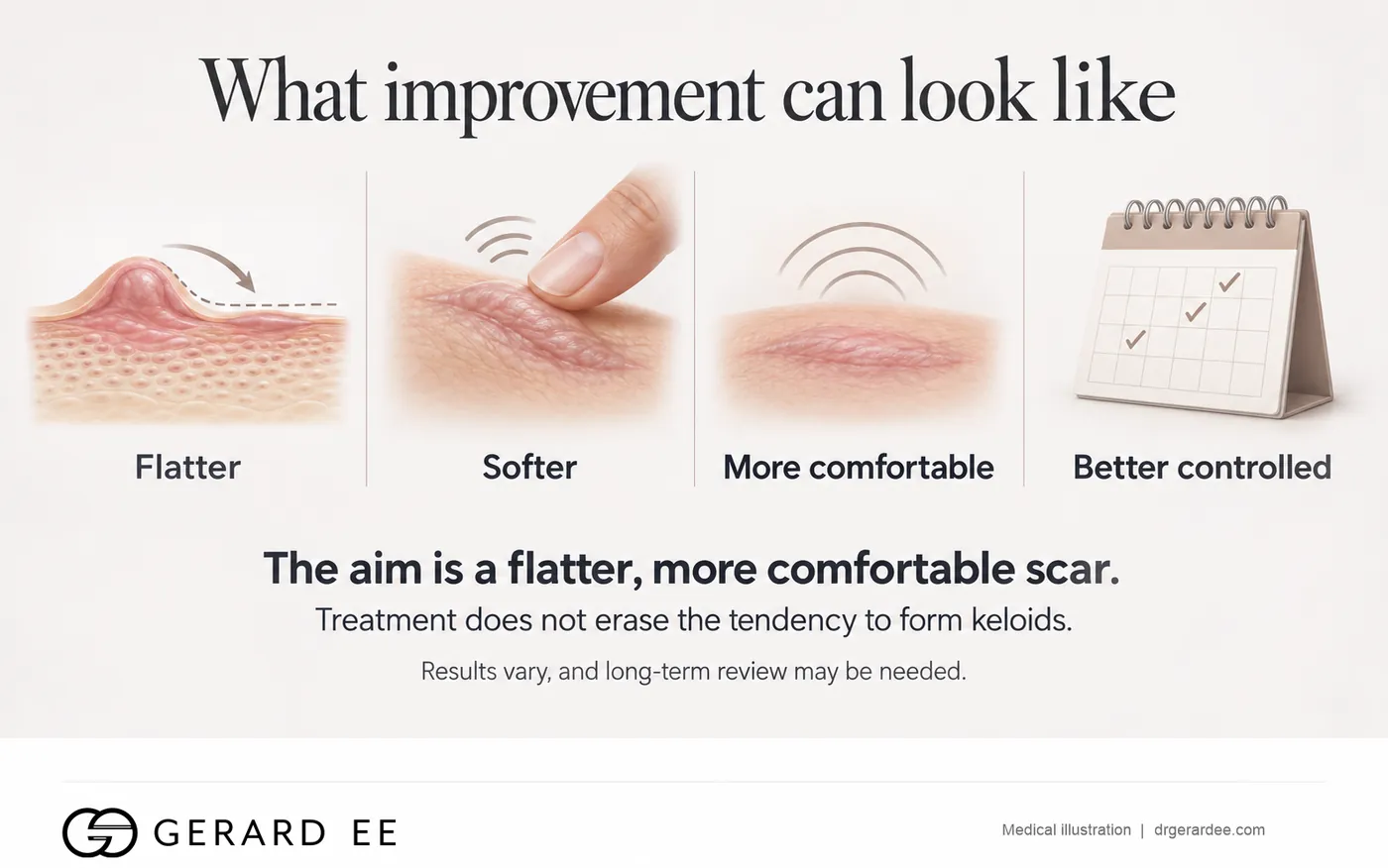
Flattened keloids can stay flat for years, and excised keloids treated with radiotherapy do not recur in about four out of five cases. The tendency to form keloids is lifelong, however, so any new wound needs silicone from the outset and early review.
Is keloid injection painful?
Because keloid tissue is dense, the injection is felt as pressure and a sting. Numbing cream beforehand and a slow injection make it tolerable, and the itch usually settles within days of the first injection.
How many keloid injections are needed?
Usually about five sessions, 4 to 6 weeks apart, with botulinum toxin and steroid given together at each. A small earlobe keloid may need fewer, and a chest or shoulder keloid may need more, in which case 5-FU and V Beam are added rather than the steroid dose escalated.
Does keloid removal cream work?
No cream removes a keloid. Silicone gel reduces thickness and lowers the risk of new keloids, and no other over-the-counter product has trial evidence. Creams marketed for keloid removal delay effective treatment while the keloid continues to grow.
Can a keloid come back after treatment?
After injections alone, recurrence is common, usually within a year, if silicone is stopped early or the site is re-injured. In my experience recurrence is low when the injections are combined with V Beam and botulinum toxin. After excision with radiotherapy, published recurrence is about 22 per cent across all sites and lower on the earlobe.
My keloid came back after steroid injections. Can it still be treated?
A keloid that has recurred after steroid injections can still be treated, and recurrence after steroid alone is the commonest reason patients come to me. The keloid is re-treated with botulinum toxin and steroid together, with 5-FU added, V Beam for redness and silicone worn for 12 to 24 hours a day, and it is excised with adjuvant radiotherapy only if that course fails.
Do I need a dermatologist for keloids?
Keloid treatment is performed by dermatologists, plastic surgeons and aesthetic doctors. What matters more than the specialty is access to the full range of treatments in one place, namely injections, laser, silicone and a surgical option with radiotherapy.
For the evidence behind each treatment, recurrence rates by method and the side effects to ask about, read my complete review of keloid treatment in Singapore. The scar types themselves, and how to tell a keloid from a hypertrophic scar or a piercing bump, are on the keloid scars page.

Book a consultation with Dr Gerard Ee at The Clifford Clinic
Dr Gerard Ee consults and performs keloid treatment at The Clifford Clinic, 50 Raffles Place, Singapore. Consultations are by appointment. Message the clinic on WhatsApp, or call 6532 2048.
Selected References
Published studies cited on this page
- Gold MH, McGuire M, Mustoe TA, et al. Updated international clinical recommendations on scar management: part 2, algorithms for scar prevention and treatment. Dermatol Surg. 2014;40(8):825-831. PMID 25068544.
- Khan MA, Bashir MM, Khan FA. Intralesional triamcinolone alone and in combination with 5-fluorouracil for the treatment of keloid and hypertrophic scars. J Pak Med Assoc. 2014;64(9):1003-1007. PMID 25823177.
- Khalid FA, Farooq UK, Saleem M, et al. The efficacy of excision followed by intralesional 5-fluorouracil and triamcinolone acetonide versus excision followed by radiotherapy in the treatment of ear keloids: a randomized control trial. Burns. 2018;44(6):1489-1495. PMID 29534885.
- Manuskiatti W, Fitzpatrick RE. Treatment response of keloidal and hypertrophic sternotomy scars: comparison among intralesional corticosteroid, 5-fluorouracil, and 585-nm flashlamp-pumped pulsed-dye laser treatments. Arch Dermatol. 2002;138(9):1149-1155. PMID 12224975.
- Yang HA, Jheng WL, Yu J, Huang JJ, Cheng KY, Lee JJ. Comparative efficacy of drug interventions for keloids: a network meta-analysis. Ann Plast Surg. 2024. PMID 38285997.
- Shi J, Zhang S, Zhang Z, Xu J, Chen Y, Sun S. Efficacy of triamcinolone acetonide combined with botulinum toxin A in the treatment of hypertrophic scars and keloids: a meta-analysis. Burns. 2024;50(9):107250. PMID 39447283.
- Alster TS, Williams CM. Treatment of keloid sternotomy scars with 585 nm flashlamp-pumped pulsed-dye laser. Lancet. 1995;345(8959):1198-1200. PMID 7739306.
- O’Brien L, Jones DJ. Silicone gel sheeting for preventing and treating hypertrophic and keloid scars. Cochrane Database Syst Rev. 2013;(9):CD003826. PMID 24030657.
- Ogawa R, Tosa M, Dohi T, Akaishi S, Kuribayashi S. Surgical excision and postoperative radiotherapy for keloids. Scars Burn Heal. 2019;5:2059513119891113. PMID 31840001.
- Shen J, Lian X, Sun Y, et al. Hypofractionated electron-beam radiation therapy for keloids: retrospective study of 568 cases with 834 lesions. J Radiat Res. 2015;56(5):811-817. PMID 26224888.
- Mankowski P, Kanevsky J, Tomlinson J, Dyachenko A, Luc M. Optimizing radiotherapy for keloids: a meta-analysis systematic review comparing recurrence rates between different radiation modalities. Ann Plast Surg. 2017;78(4):403-411. PMID 28177974.
This page is written from published research and from clinical experience in Singapore since 2012. It is for general education, not medical advice. Whether a treatment suits you, what it may achieve and what it may risk can only be established at a consultation. Dr Gerard Ee is the Medical Director of The Clifford Clinic, a private clinic in Singapore, and treatments discussed on this site are provided commercially.

