
A keloid is a scar that has continued to grow after the wound has healed. In normal healing, collagen is laid down for a few weeks and production then stops. In a keloid, production does not stop, and the scar extends beyond the edge of the original wound for months or years after the injury has closed. The lesion is firm, raised and often darker than the surrounding skin, and it itches or hurts to a degree most patients do not expect of a scar. Keloids are benign, but they are progressive, and the earlier a keloid is treated the less treatment it requires.
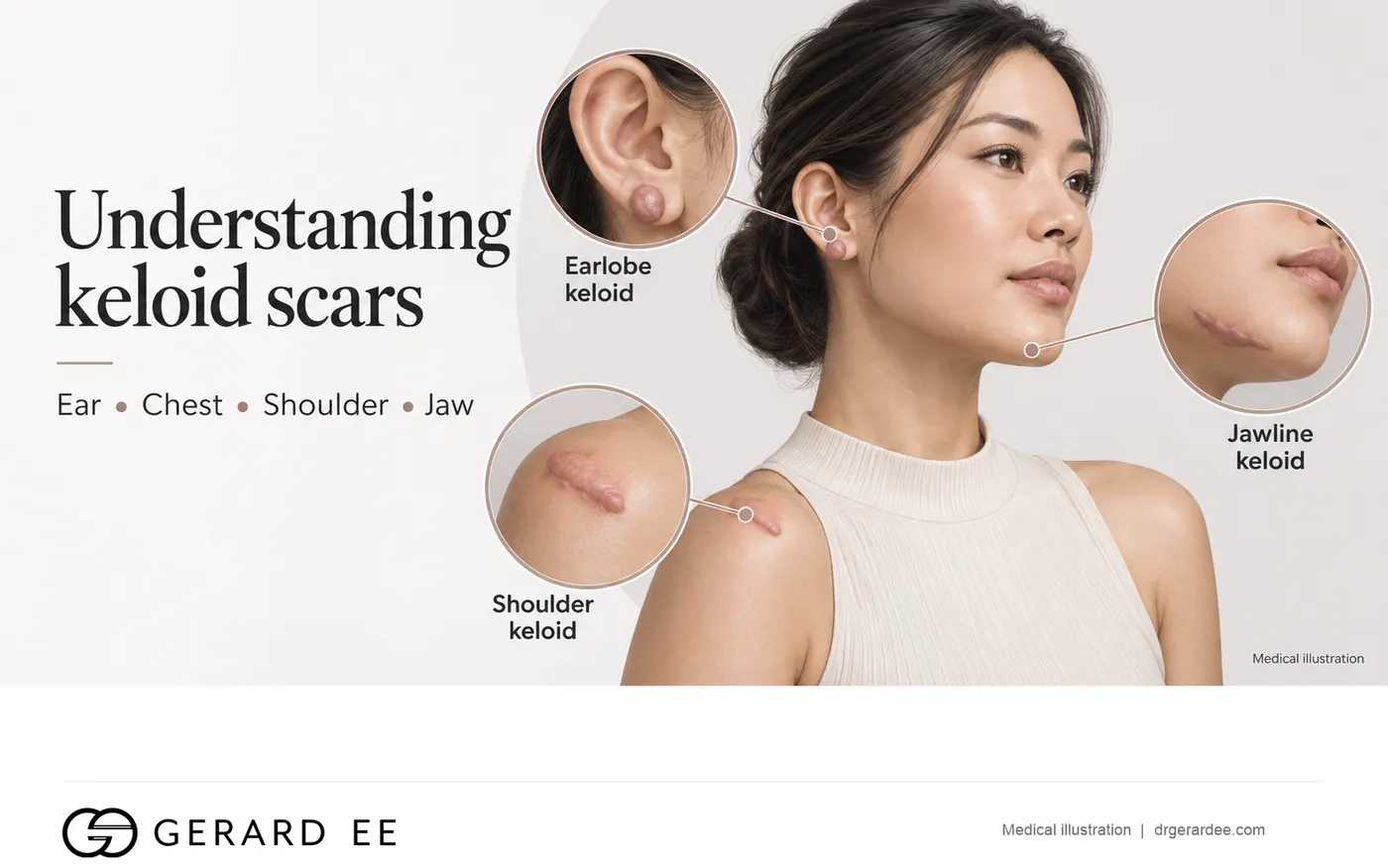
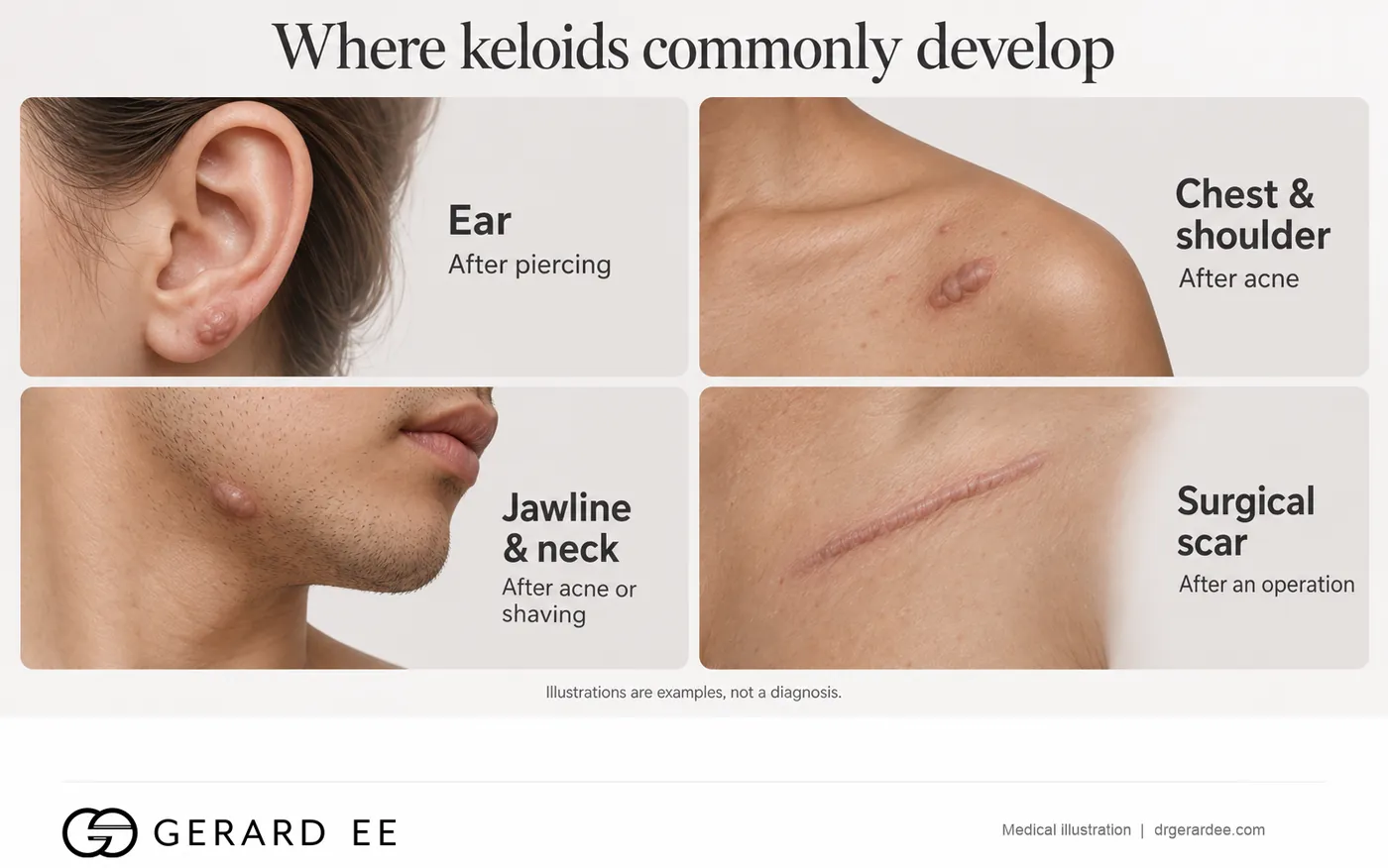
I have treated keloids since 2012, at about 20 cases a month, and I see them most often at four sites, namely the earlobe and ear cartilage after piercing, the chest and shoulder after acne, the jawline after acne or shaving, and surgical scars anywhere on the trunk. This page covers what a keloid is, how it is distinguished from a hypertrophic scar or a piercing bump, and what treatment can achieve at each site. The treatments themselves are set out on the keloid treatment in Singapore page.
Keloid vs hypertrophic scar, how the two are told apart
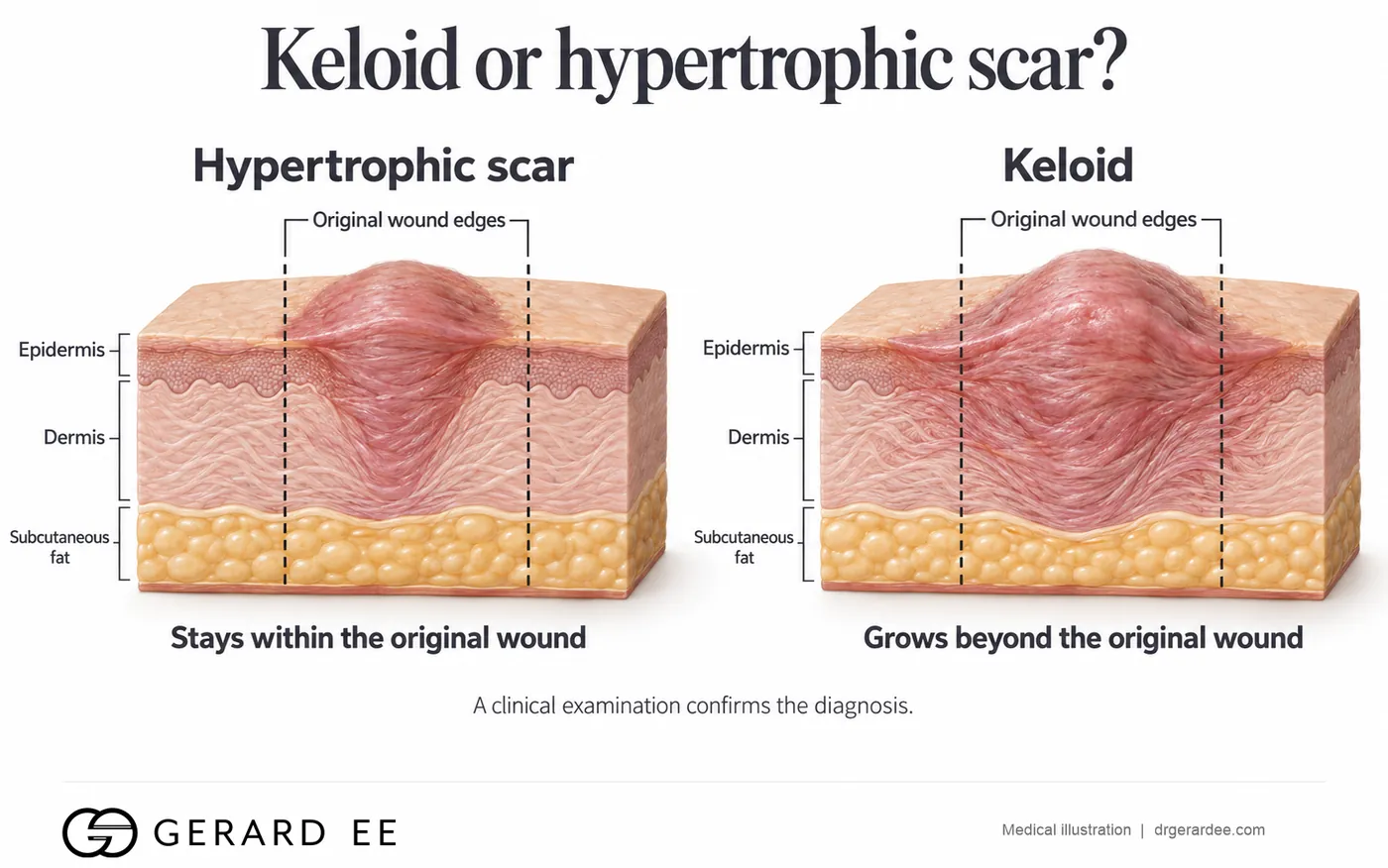
Both are raised, both are red or dark, and both itch, so the distinguishing feature is the boundary of the scar rather than its appearance. A hypertrophic scar remains within the outline of the original wound and usually flattens without treatment within 12 to 24 months. A keloid extends beyond that outline into the normal skin around it and does not regress. On the chest, a hypertrophic scar is an oval that matches the incision, whereas a keloid has spread sideways into a claw or dumbbell shape, and the same lateral spread is seen on the shoulder and jaw.
The distinction determines the treatment. A hypertrophic scar responds to silicone and time, with one or two steroid injections where flattening is slow. A keloid requires treatment that suppresses the inflammation driving its growth, and a plan for recurrence from the first visit, because a keloid that is excised without adjuvant treatment recurs in 50 to 80 per cent of cases. Treating a hypertrophic scar as a keloid exposes the patient to injections the scar did not need, and treating a keloid as a hypertrophic scar loses a year during which the lesion continues to grow.
Why keloids itch, hurt and keep growing
A keloid is chronic inflammation in the reticular dermis, the deep layer of the skin, that never resolves. The inflammatory signals keep the fibroblasts, the cells that make collagen, producing collagen long after the wound has closed, and the same inflammation sensitises the nerve fibres within the scar. Itch and pain are therefore intrinsic to the condition rather than an incidental finding, and they are reported by the majority of patients with keloids. Skin tension aggravates the process. The skin over the chest, shoulder and jaw is stretched in several directions with every movement, and the mechanical pull stimulates further collagen production, so keloids at those sites are the hardest to control and the most likely to recur after any treatment.
Keloid tendency is inherited and is markedly more common in people of Asian and African ancestry than in Europeans, which accounts for the number of keloids seen in Singapore. For patients with a parent or sibling who forms keloids, any wound on the trunk or ears should be managed as high-risk from the day it occurs, with silicone applied as soon as the wound has closed.
Ear keloid after piercing, and how it differs from a piercing bump
The earlobe and the cartilage of the upper ear are the commonest keloid sites I see in patients under 30. A lump at a piercing that appeared within a few weeks, is soft, and settles once the jewellery is removed is usually an irritation bump or a small granuloma rather than a keloid. A lump that appeared months after the piercing, is firm, continues to enlarge and has spread beyond the piercing hole is a keloid. Small earlobe keloids respond well to botulinum toxin and steroid injection. Larger lobe keloids are excised, with 5-fluorouracil (5-FU) and steroid injections into the healing scar to prevent regrowth, and adjuvant radiotherapy is reserved for keloids that recur despite this. The earlobe recurs least of any site after treatment, because the lobe carries no muscle and its skin is under almost no tension.
Keloid on the chest and shoulder from acne
Acne on the chest, shoulder and upper back leaves raised scars in keloid-prone patients, often dozens at once. These keloids itch most and respond most slowly, because the skin is under constant tension, and the chest carries the highest recurrence rate after any treatment. The aim at these sites is therefore control rather than removal. Injections and pulsed dye laser flatten the lesions and reduce the redness and itch, silicone holds the result, and any active acne is treated so that new keloids stop forming. The strategy is the same as for a piercing or surgical keloid, and only the number of lesions differs. Where active acne on the trunk coincides with a family history of keloids, the acne should be treated before it scars, as set out in my guide to acne scar treatment in Singapore.
Keloid on the jawline and neck
Jawline keloids follow acne cysts and, in men, shaving folliculitis. They are conspicuous, they sit on skin that moves with speech and chewing, and they lie close to the face, so treatment is selected for the least visible side effects. Botulinum toxin is combined with a lower steroid dose, because the toxin reduces the muscle pull on the scar while the smaller steroid dose lowers the risk of a depression or a pale patch in the surrounding skin, and pulsed dye laser is used to reduce the redness. Steroid atrophy on the jawline is more conspicuous than the keloid was, which is the reason the dose is kept low at this site.
Keloid from surgery, BCG vaccination or a caesarean scar
Any surgical scar can form a keloid in a susceptible person, including the BCG vaccination site on the upper arm, a caesarean scar, a thyroid scar on the neck and a sternotomy scar on the chest. These are the cases in which prevention matters most, because the wound is planned and the risk is known in advance. For patients who know they form keloids and have surgery scheduled, silicone from the day the sutures are removed, worn for at least 12 hours a day for three months, and a steroid injection at the first sign of thickening usually prevent a keloid from forming. A sternotomy scar warrants particular attention, because the chest is the site with the highest recurrence rate after any treatment.
Piercings, tattoos and aesthetic injections in keloid-prone skin
Any break in the skin can initiate a keloid in a susceptible person, including ear piercings, tattoos and insect bites, because each produces the inflammatory wound response that a keloid-prone dermis fails to terminate. Aesthetic injections through intact skin with a fine needle very rarely do so, since the puncture is too small to provoke a sustained inflammatory response, but I ask every patient about keloid history before any procedure. A strong history alters what I am prepared to perform on the trunk and ears, and treatments that breach the skin at those sites are approached with caution.
What keloid treatment can and cannot achieve
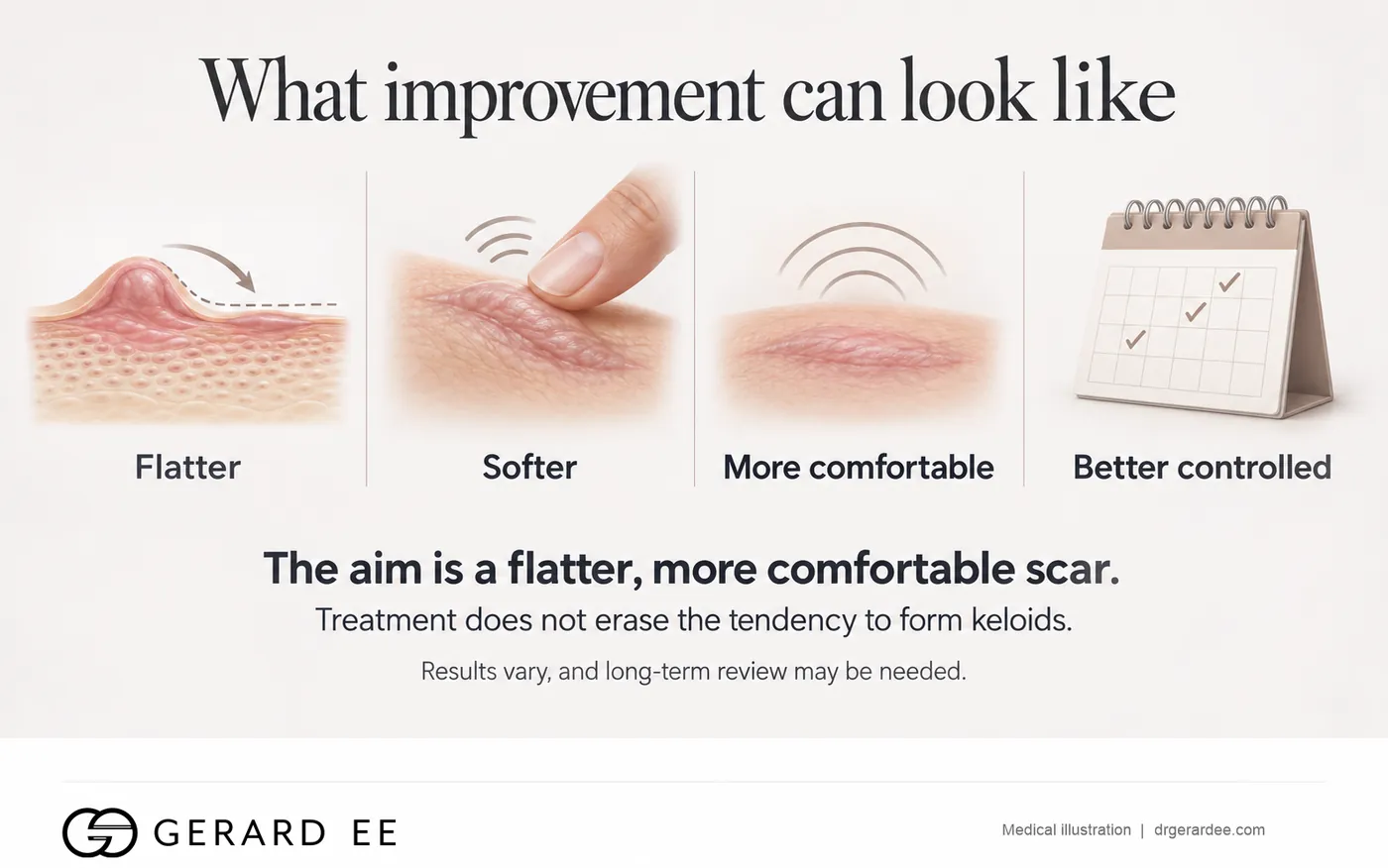
A keloid can be flattened, softened, lightened and relieved of its itch. Most can be reduced to a flat mark, and some can be removed outright, with adjuvant radiotherapy afterwards to prevent regrowth. What cannot be promised is skin that appears never to have been injured. The realistic aim is a flat, pale, comfortable scar. A keloid that has already been treated and has recurred remains treatable. Recurrence after steroid injections alone is the commonest reason patients are referred to me, and it is managed with a different combination, botulinum toxin with a lower steroid dose and 5-FU added where the response is slow, rather than with further steroid alone. The options, in the order I use them, are on the keloid treatment page, and the evidence behind each is in my complete review of keloid treatment in Singapore.
Common questions about keloid scars
Is it a keloid or a hypertrophic scar?
A raised scar that has grown beyond the edge of the original wound is a keloid. A raised scar that remains within the wound outline and is flattening with time is hypertrophic.
Do keloids go away on their own?
Keloids do not resolve on their own. Hypertrophic scars flatten over one to two years, whereas keloids persist and usually enlarge, so the earlier a keloid is treated the less treatment it requires.
Why does my keloid itch?
Itch and pain arise from the same chronic inflammation that drives the growth, and from the sensory nerve fibres within the scar that the inflammation sensitises. Both usually settle within days of a steroid injection, which suppresses the inflammation at its source.
Can a keloid turn into cancer?
Keloids are benign and do not become malignant. A scar that ulcerates, bleeds persistently or changes rapidly should be examined to exclude another diagnosis, but a keloid itself carries no risk of cancer.
Will a keloid come back after removal?
A keloid that is excised and left to heal without adjuvant treatment recurs in 50 to 80 per cent of cases. With adjuvant radiotherapy after excision, published recurrence falls to about 22 per cent across all sites, and it is lower still on the earlobe.
Can filler fix a keloid?
Filler cannot treat a keloid. A keloid is excess tissue rather than a depression. Fillers are used for atrophic scars, whereas a keloid requires the opposite, a reduction in volume.

Book a consultation with Dr Gerard Ee at The Clifford Clinic
Dr Gerard Ee consults and performs keloid treatment at The Clifford Clinic, 50 Raffles Place, Singapore. Consultations are by appointment. Message the clinic on WhatsApp, or call 6532 2048.
References
Published studies cited on this page
- Delaleu J, Charvet E, Petit A. Keloid disease: review with clinical atlas. Part I: definitions, history, epidemiology, clinics and diagnosis. Ann Dermatol Venereol. 2023;150(1):3-15. PMID 36494213
- Ogawa R. Keloid and hypertrophic scars are the result of chronic inflammation in the reticular dermis. Int J Mol Sci. 2017;18(3):606. PMID 28287424
- Ogawa R, Tosa M, Dohi T, Akaishi S, Kuribayashi S. Surgical excision and postoperative radiotherapy for keloids. Scars Burn Heal. 2019;5:2059513119891113. PMID 31840001
- Hawash AA, Ingrasci G, Nouri K, Yosipovitch G. Pruritus in keloid scars: mechanisms and treatments. Acta Derm Venereol. 2021;101(10):adv00582. PMID 34518894
- Mankowski P, Kanevsky J, Tomlinson J, Dyachenko A, Luc M. Optimizing radiotherapy for keloids: a meta-analysis systematic review comparing recurrence rates between different radiation modalities. Ann Plast Surg. 2017;78(4):403-411. PMID 28177974
This page is written from published research and from clinical experience in Singapore since 2012. It is for general education, not medical advice. Whether a treatment suits you, what it may achieve and what it may risk can only be established at a consultation. Dr Gerard Ee is the Medical Director of The Clifford Clinic, a private clinic in Singapore, and treatments discussed on this site are provided commercially.

