
Four nose shapes account for almost every nose filler consultation I see in Singapore. They are a low or flat bridge, a dorsal hump, a tip that sits flat against the face, and a nose that curves to one side. Each is a distinct anatomical problem with its own correction, and not every one of them is corrected by filler.
This page describes the four shapes, what nose filler can achieve for each, whether a hyaluronic acid (HA) filler or a calcium hydroxylapatite (CaHA) filler such as Radiesse is selected, and when rhinoplasty is the appropriate answer. The treatment itself, its price and what happens on the day are on the nose fillers in Singapore page.

Which nose shapes nose filler can correct
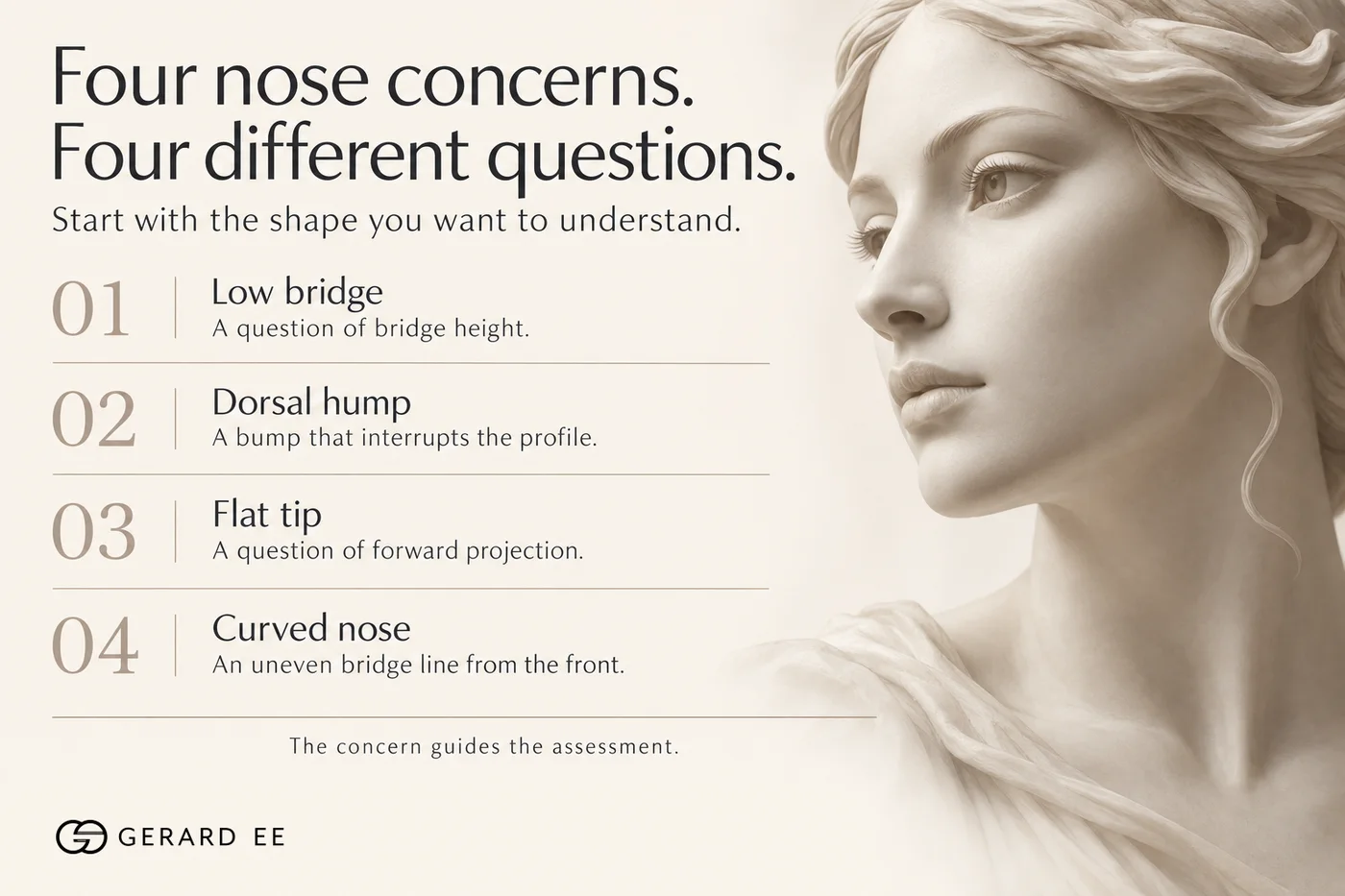
Filler can only add volume, and that single property decides what it can and cannot do for the nose. A shape that lacks height, projection or symmetry can be built up by placing material where it is missing. A shape that is too large, too wide or too long cannot be reduced, because no placement of additional material makes a nose smaller.
A low bridge, a flat tip, a hump that breaks the profile and a curve that is visible from the front are therefore all filler shapes, because each is corrected by adding material in the right place. A bulbous tip, a wide nose or a long nose are surgical shapes. Where a patient presents with one of these, I say so at the consultation, because a syringe placed in a nose that needs reduction adds volume to a nose that is already too large.
The four shapes below are set out in the order in which I see them, most common first.
Low or flat nose bridge, corrected with nose bridge filler
A low bridge is the most common reason for nose filler in Singapore, and it is common because the East Asian nasal skeleton typically carries a lower radix and shorter nasal bones than a European nose. The dorsum sits flat between the eyes, the nose appears short from the front, the eyes can appear further apart than they are, and spectacles slide down because there is no ridge to hold them. The deficit is one of height, not of size.
Filler raises the bridge by building height along the dorsum, from the radix between the eyes down to the supratip just above the tip. I place it with a needle rather than a cannula, in aliquots of 0.05 ml, deep on the bone in the midline, because the periosteum is the plane furthest from the dorsal nasal arteries that run to either side of the bridge. Mild asymmetry along the bridge is balanced at the same time by filling the shallower side until it matches the fuller one.
An HA filler from the firmer end of the range is used by default, because a firm gel holds height without spreading sideways and can be dissolved with hyaluronidase if the result needs to be adjusted. A CaHA filler such as Radiesse is the longer lasting alternative for the bridge, and the bridge is where I most often use it, since the radix and upper dorsum sit on bone and hold a firmer product well.
Dorsal hump on the nose bridge, straightened with nose filler
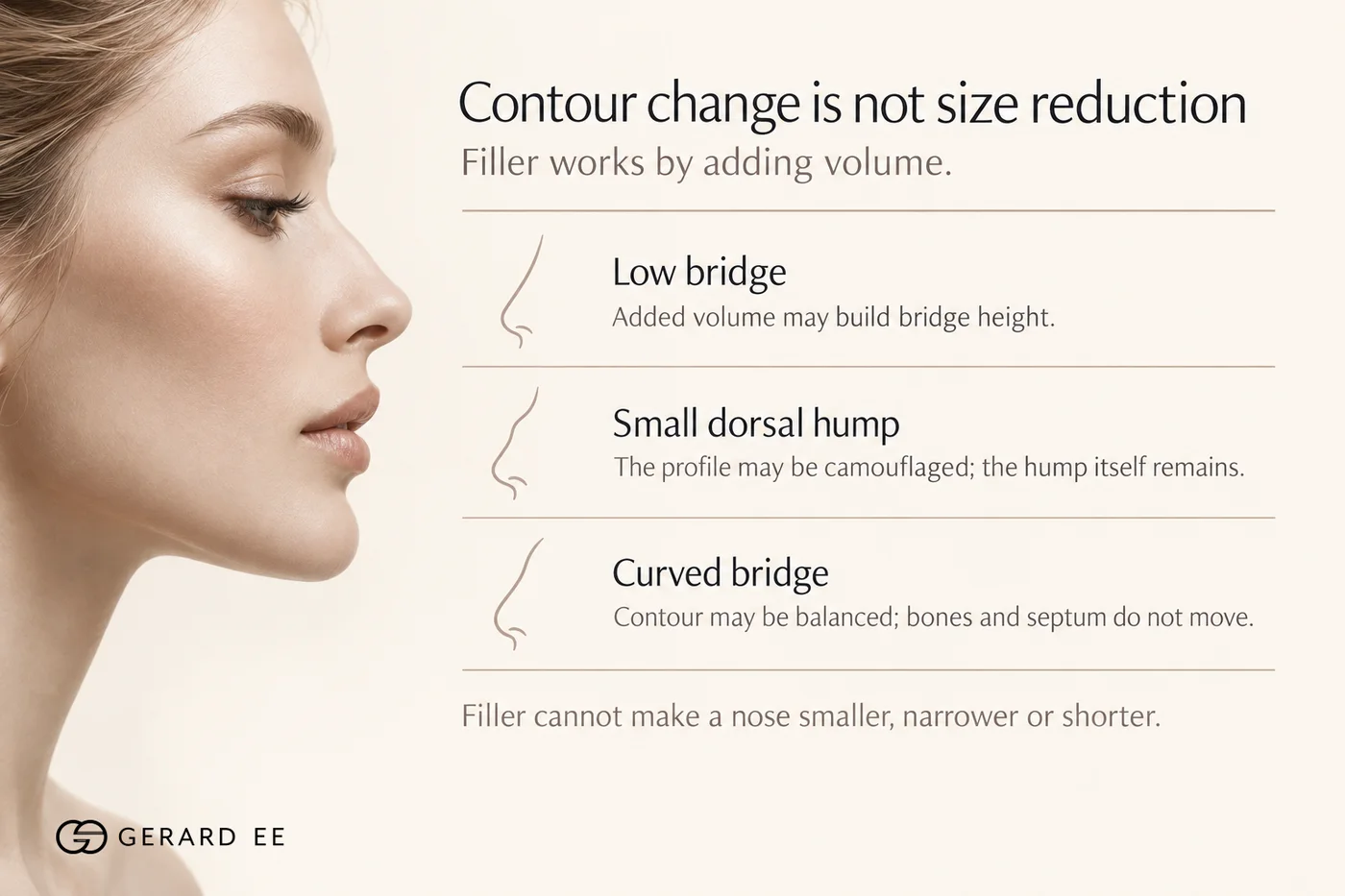
A dorsal hump is a bump along the bridge, usually bone at its upper end and cartilage below, that interrupts the straight line of the profile. It is more visible from the side than from the front, and it often makes a nose appear larger than it is, because the eye judges the size of a nose by the highest point of its profile.
The hump is not removed, because filler can only add. Volume is placed above and below it, at the radix between the eyes and along the dorsum toward the tip, so that the profile becomes a straight line from radix to tip even though the bump itself remains. On a small to moderate hump, usually one that stands 2 to 3 mm above the line of the profile, this is a convincing correction with under 1 ml of filler. On a large hump, filling around it raises the whole bridge, the nose ends up bigger, and surgical hump reduction becomes the appropriate answer.
An HA filler is used by default. A CaHA filler such as Radiesse is used where a longer lasting result is wanted, on the same bony sites as for the low bridge.
Nose tip filler for poor tip projection (flat nose tip)

A tip with poor projection sits flat against the face rather than standing forward from it, because the cartilages that support the tip are short or weak. The nose appears blunt from the side and wide from the front, and the nostrils are more visible than they should be. Poor tip projection is common in Singapore, and it is often the feature a patient dislikes most, even when the initial request is for the bridge.
A small amount of filler at the tip and along the columella, the strip of tissue between the nostrils, pushes the tip forward and gives the profile more definition. The tip is the area of the nose I inject with the most caution, because its blood supply runs through small end vessels that connect with the arteries of the eye, so it is treated with small volumes, a slow technique and low injection pressure. Threads perform a different task at the tip, lifting and rotating it rather than projecting it, so the choice between the two is made by what the tip lacks.
An HA filler only is used at the tip. The tip has the least margin for error, and a product that can be dissolved with hyaluronidase is the only one I place there. CaHA is not used at the tip because it cannot be dissolved.
Crooked nose filler, camouflage for a curved nose

A curved nose is one in which the bridge does not run straight from the radix to the tip. It bows to one side, or it follows a C or S curve along its length, and the two sides of the nose appear different from the front. Some result from an old fracture that healed out of line, and some are simply the way the nasal bones and septum grew.
Filler does not straighten the septum or move the bones. It fills the concave side of the curve so that the light reflex along the bridge runs straight from the front, and the deviation is camouflaged rather than corrected. A curve that arises from a deviated septum with a blocked nose or breathing difficulty is a surgical question, because filler adds nothing to the airway, and I say so at the consultation.
An HA filler is used, so that the camouflage can be adjusted or dissolved. A CaHA filler such as Radiesse is offered to a patient who has had the HA result, is satisfied with it and wants it to last longer.
Nose filler or rhinoplasty, what each nose shape needs
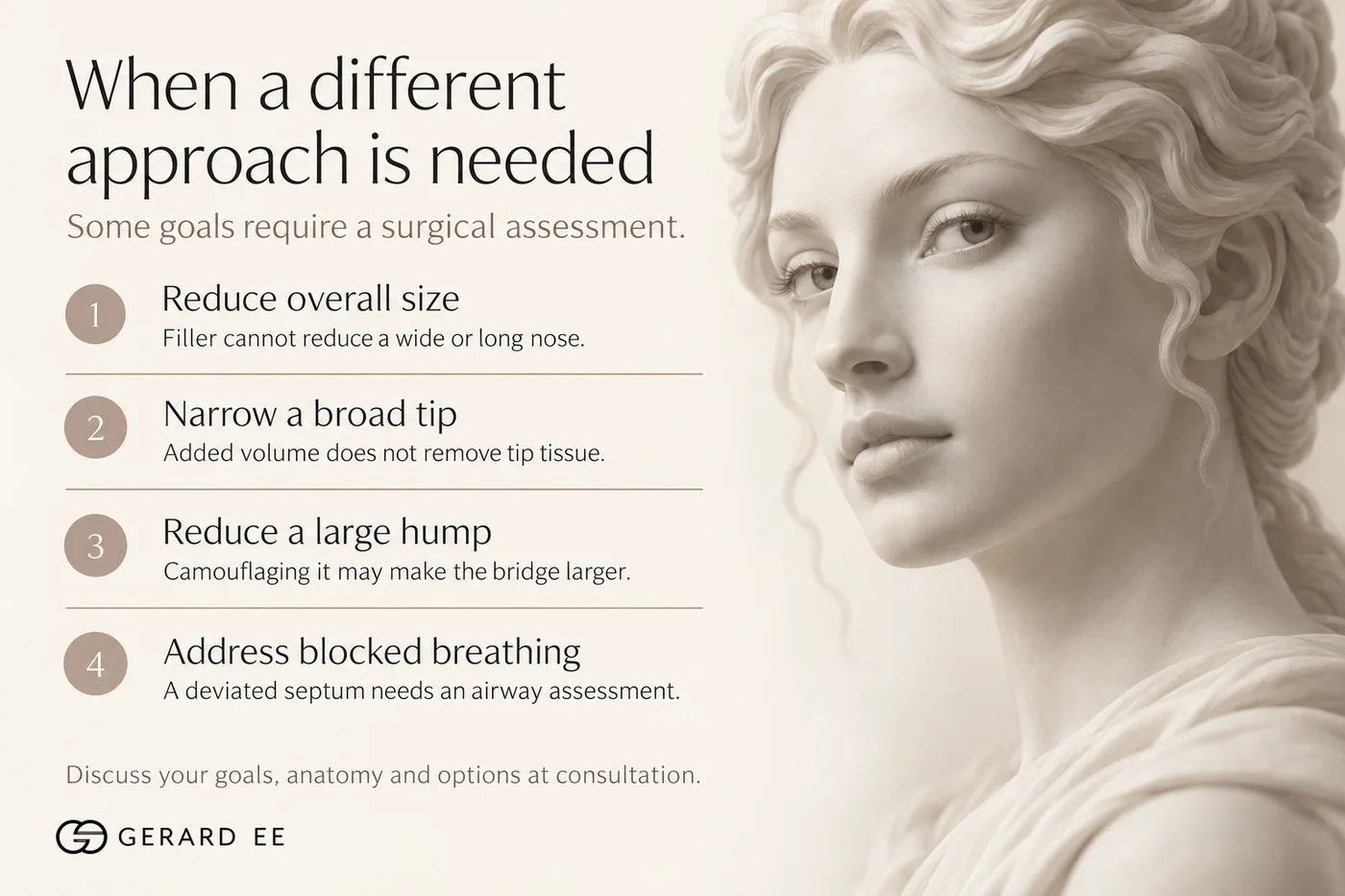
The table sets out the four shapes side by side, what nose filler does for each, which filler is used and when the answer is rhinoplasty instead.
| Nose shape | What nose filler does | Filler used | When it is a surgical question |
|---|---|---|---|
| Low or flat bridge | Builds height along the dorsum from radix to supratip | HA by default, CaHA (Radiesse) for longer duration | Rarely. A very low bridge with a wide base may need an implant |
| Dorsal hump | Fills above and below the hump so the profile reads straight | HA by default, CaHA (Radiesse) where longer lasting | A large hump, where filling around it makes the nose bigger |
| Poor tip projection | Projects the tip forward from the tip and columella | HA only | A bulbous or wide tip, which filler cannot narrow |
| Curved or crooked nose | Fills the concave side so the bridge reads straight from the front | HA, then CaHA (Radiesse) after a successful HA result | A deviated septum with a blocked nose or breathing difficulty |
Whatever the shape, filler makes a nose taller, straighter or more defined. It never makes a nose smaller, because it acts by adding material rather than removing it. Where the concern is overall size, the answer is rhinoplasty, and I would rather say so at the consultation than after a syringe has been placed.
HA filler or CaHA filler (Radiesse) for the nose
Hyaluronic acid is the default for every one of the four shapes. A firm HA filler holds height along the bridge, it behaves predictably from one syringe to the next, and it can be dissolved with hyaluronidase within hours if the result is not the one intended or if filler ever enters a blood vessel. Reversibility is the property that matters most in the nose, where a vessel occlusion, although very rare, must be cleared quickly, and the clinic keeps hyaluronidase and its own hyperbaric oxygen chamber on site for that purpose. Nose filler results last about a year. HA filler is $1,200 per syringe before GST.
Calcium hydroxylapatite, the class to which Radiesse belongs, is the longer lasting option. It consists of microspheres in a gel carrier that give immediate volume and then stimulate the patient’s own collagen, so part of the result is the patient’s own tissue and the result usually outlasts HA. It cannot be dissolved, so I use it only on the bone at the bridge and the radix, never at the tip, and I treat it as a considered choice rather than an upgrade. CaHA filler is $1,400 per syringe before GST.
How the two behave in the nose, what the published safety data shows and how long each lasts are set out in my guide to nose filler Singapore.
Common questions about nose shape and nose filler

Can nose filler make my nose smaller?
Nose filler cannot make a nose smaller. Filler adds material, so it can make a nose taller, straighter or more defined, but never smaller. A wide nose, a bulbous tip or a long nose is a surgical question.
Can a wide or bulbous nose be made smaller without surgery?
A nose that is bulbous because of thick, oily soft tissue can be made smaller without surgery by thinning that tissue with Infini and hyperdiluted Shincort, as described on how to make a bulbous nose smaller. A nose that is large because of bone or cartilage requires surgery.
Which nose shape gets the best result from filler?
The low bridge gives the most reliable result. Height is exactly what filler adds, the bridge sits on bone where the product holds its shape, and the change is visible from the front and the side. A small dorsal hump is the next most reliable.
Can a crooked nose be fixed with filler?
A crooked nose can be camouflaged rather than straightened. Filler on the concave side makes the bridge appear straight from the front, but the bones and septum stay where they are. A crooked nose that also obstructs breathing needs an ear, nose and throat surgeon or a rhinoplasty surgeon rather than a syringe.
Can filler fix a dent in the nose?
A dent can be filled if it is a depression in the soft tissue rather than a break in the bone. A small volume of HA placed in the dent, usually one left by an injury or a previous surgery, levels the line of the bridge. A dent with a step in the bone underneath is a surgical question.
Is Radiesse used for nose filler in Singapore?
Radiesse is used in Singapore as the longer lasting alternative for the bridge and radix, where it sits on bone. I do not use it at the tip, because it cannot be dissolved and the tip is where reversibility matters most.
Do I need one treatment or several?
One treatment is usually sufficient. Each of the four shapes is treated in a single session of about 20 minutes, with a review appointment included. A second syringe is occasionally needed for a very low bridge, and that is decided at the review rather than on the day.

Book a consultation with Dr Gerard Ee at The Clifford Clinic
Dr Gerard Ee consults and performs nose filler treatment at The Clifford Clinic, 50 Raffles Place, Singapore. Consultations are by appointment. Message the clinic on WhatsApp, or call 6532 2048.
This page is written from published research and from clinical experience in Singapore since 2012. It is for general education, not medical advice. Whether a treatment suits you, what it may achieve and what it may risk can only be established at a consultation. Dr Gerard Ee is the Medical Director of The Clifford Clinic, a private clinic in Singapore, and treatments discussed on this site are provided commercially.

