Does 4D eye bag removal work?
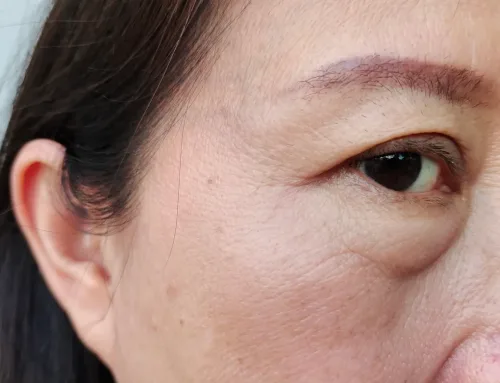
4D eye bag removal does not remove an eye bag, because no step in the package reaches the orbital fat that forms it. The lasers heat the conjunctiva, the lining on the inside of the lower eyelid, and the skin on the outside. The fat pad sits behind both, separated from the lining by the lower lid retractors and the orbital septum, and no pass in the protocol delivers energy to it. Fine lines on the eyelid skin may soften for a few months. The protrusion is unchanged at the end of the course. I do not offer the treatment, and a proportion of the eye bag patients I see have already completed a course elsewhere before consulting me.
Dr Gerard Ee consults and performs non-surgical eye bag removal at The Clifford Clinic, 50 Raffles Place, Singapore.
What is 4D eye bag removal?
4D is a marketing name rather than a device, a procedure or a medical term. The number refers to four laser passes delivered in one session from a platform that combines an erbium YAG laser at 2940 nm and a neodymium YAG laser at 1064 nm, and the content of the four passes varies from clinic to clinic. The package sold as 4D eye bag removal in Singapore usually consists of the following steps.
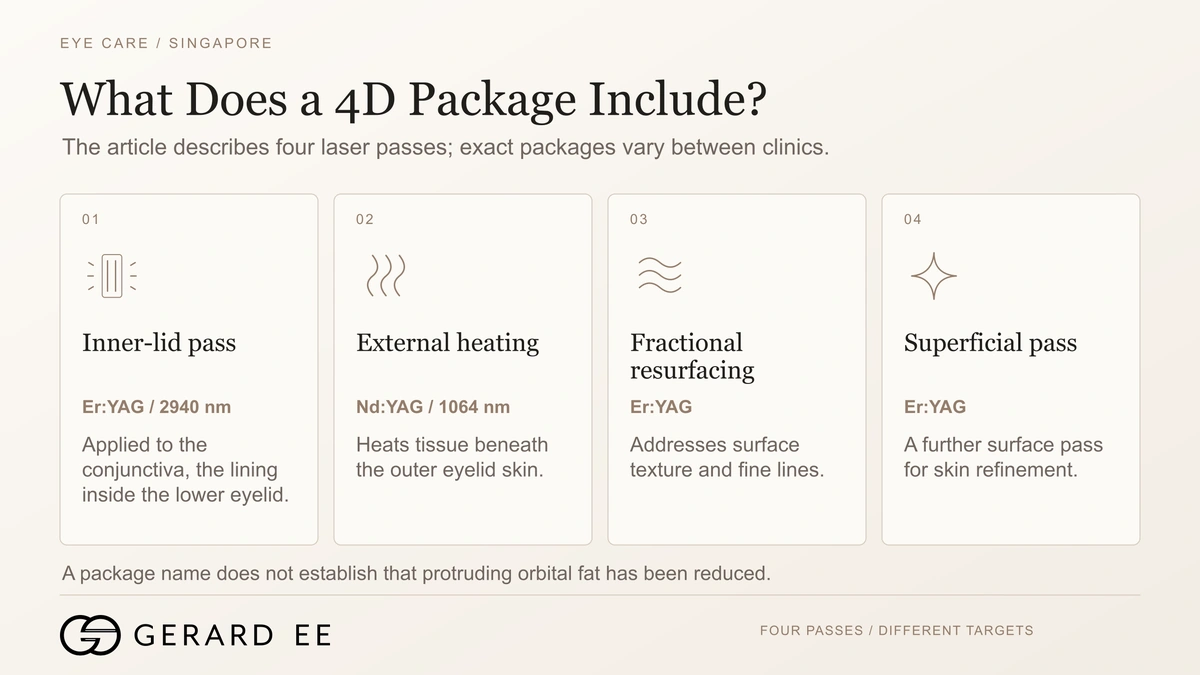
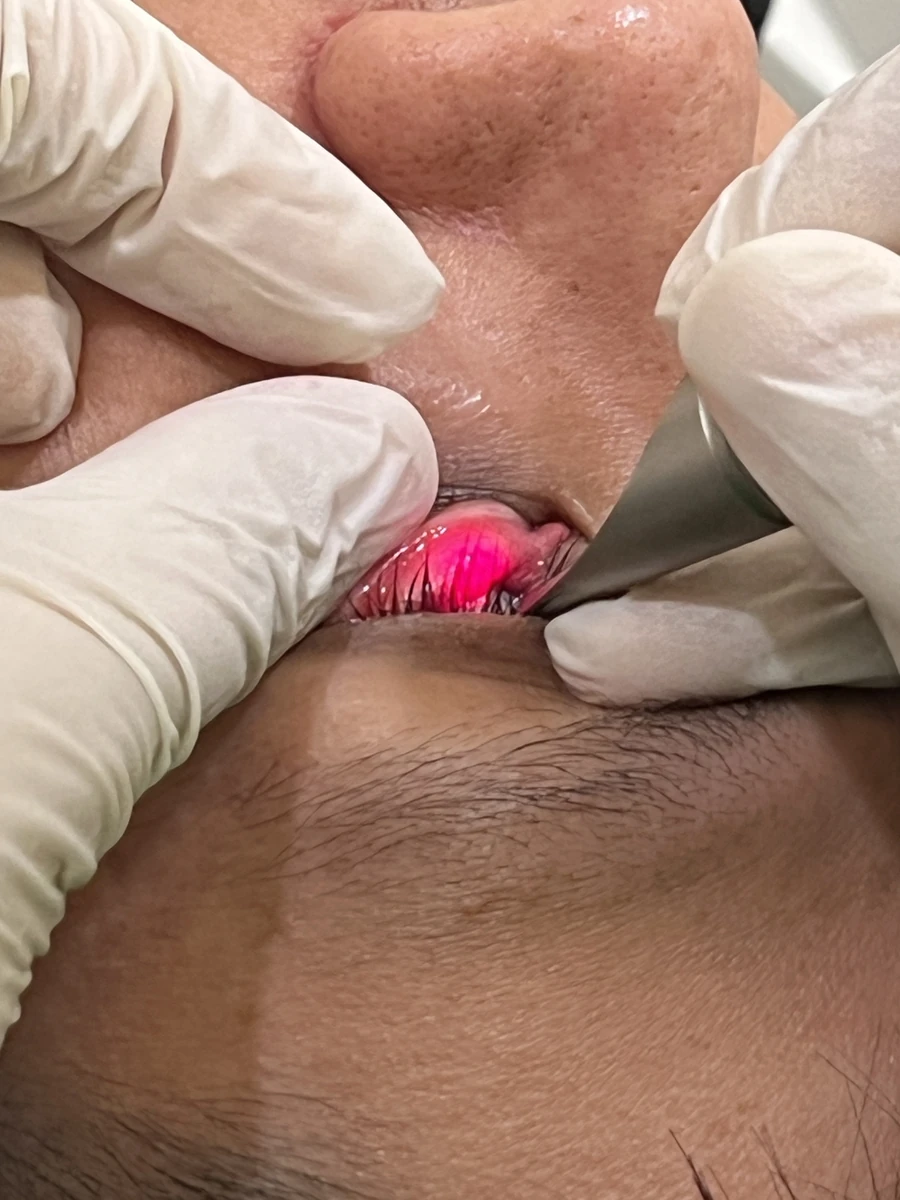
The first pass is delivered to the conjunctiva. The lower lid is everted with a finger or a gauze swab and the handpiece is held against the exposed lining. This is the pass promoted as “melting the fat from inside the eyelid”, and it is the subject of this review, because it is the only pass that claims to act on the fat.
The second pass is a long-pulse neodymium YAG pass over the skin of the lower eyelid. It heats the dermis, the collagen-bearing layer beneath the skin surface, to produce a degree of tightening.
The third and fourth passes are a fractional and a superficial erbium YAG pass over the skin surface. These resurface the outer layers of the skin and improve texture and fine lines, which is where any visible change from the package is produced.
Some packages add tear trough filler. Where filler is included, the improvement seen in the photographs is attributable to the filler rather than to the laser.
What an eye bag is, and why a laser on the lining cannot reach it
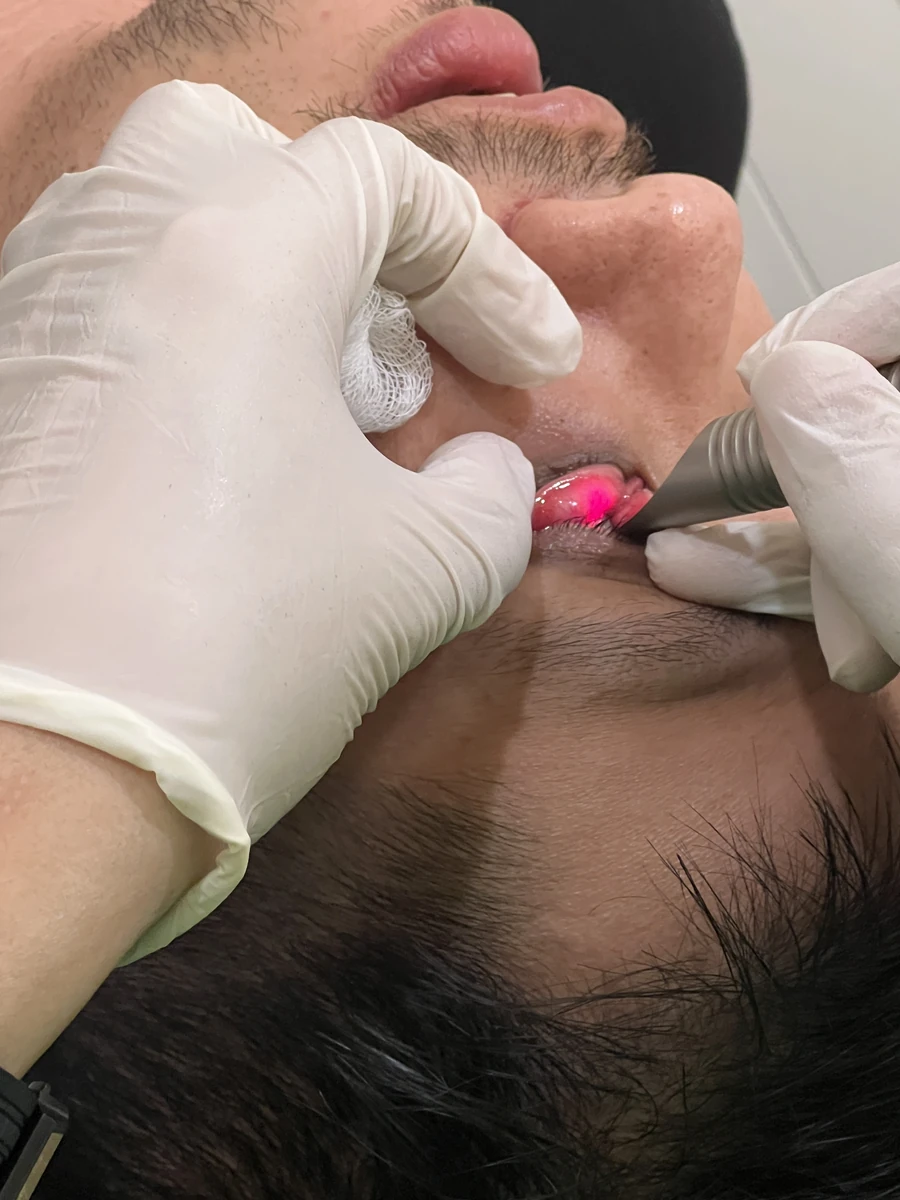
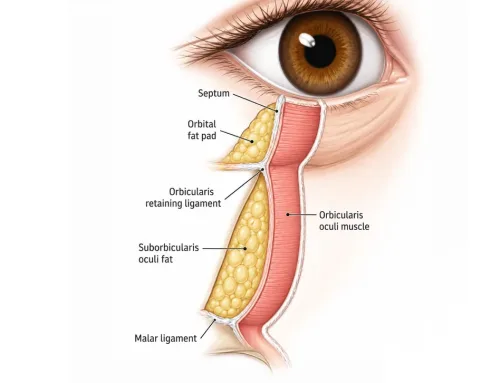
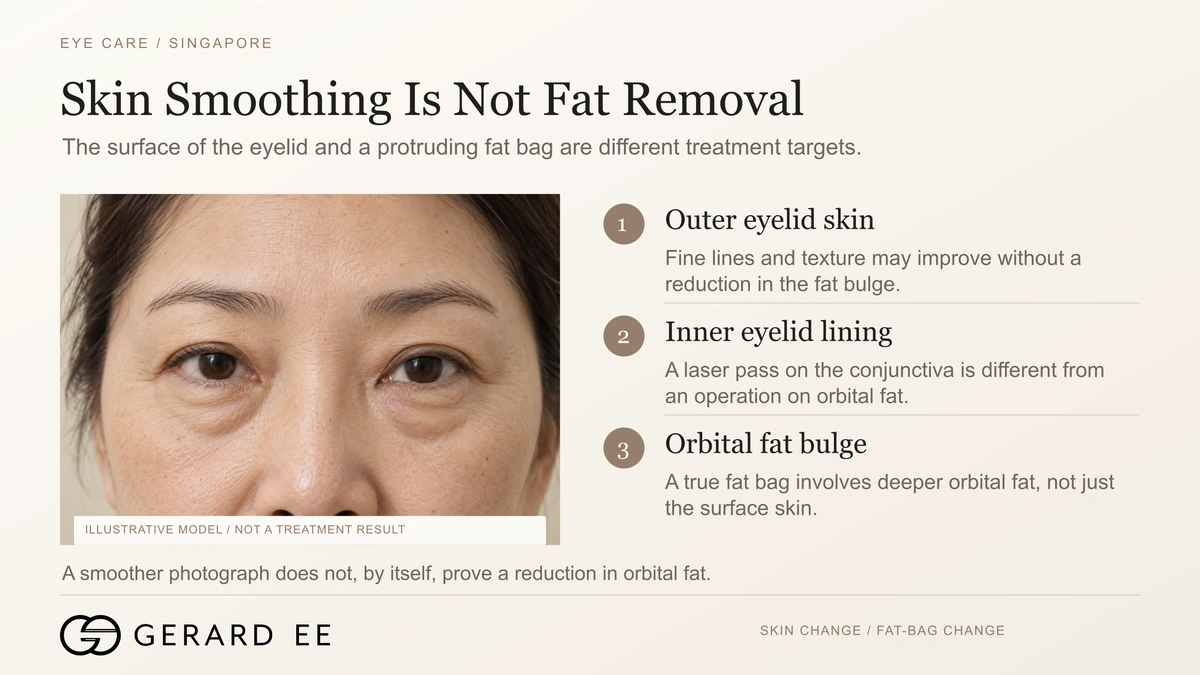
An eye bag is orbital fat pushing forward through a weakened orbital septum, the thin fibrous sheet that normally holds the fat within the eye socket. Working from the inside of the eyelid outwards, the layers are the conjunctiva, the lower lid retractors, the orbital septum and then the fat. The fat is not within the lining. It lies behind two further layers of tissue, which is why a surgeon removing it through the inside of the eyelid must incise the conjunctiva and the retractors to reach it.
A laser held against the conjunctiva heats the conjunctiva. Whether any energy reaches the tissue beyond it depends on the wavelength, because each wavelength is absorbed by a different tissue component at a different depth.
The erbium YAG wavelength of 2940 nm is absorbed by water more strongly than any other wavelength used in aesthetic medicine. On wet tissue the energy is therefore spent within the first fraction of a millimetre. The non-ablative SMOOTH mode used in the published inside-the-lid protocol delivers the energy as a train of low-energy pulses that warm the surface of the lining without ablating it, and the heat does not propagate beyond the lining.1 The retractors are not reached, and the septum and the fat behind them are not reached.
The neodymium YAG wavelength of 1064 nm penetrates further, but it is absorbed by water and haemoglobin and only weakly by fat. Fat absorbs selectively at wavelengths around 1210 nm and 1720 nm, and lasers designed to target fat were built at those wavelengths for that reason.2 A 1064 nm beam applied to the lining of the lid heats the wet lining and the blood within it. The small fraction of the energy that reaches the fat passes through it largely unabsorbed, so the fat is not heated to a temperature at which fat cells are damaged.
With either wavelength the fat pad is untouched. No mechanism exists by which this pass can remove an eye bag, and that conclusion stands before any clinical evidence is considered.
What the evidence shows for 4D eye bag removal
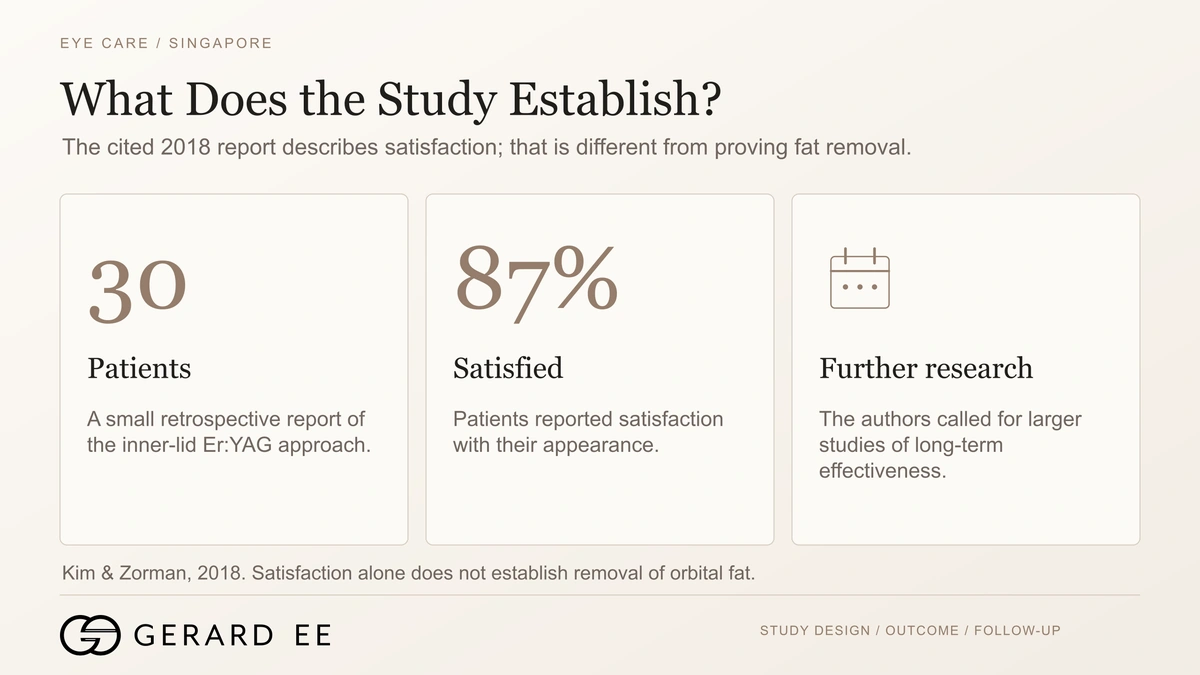
The entire published evidence for the inside-the-lid pass is one report, and it is the report on which the packages rest.
Thirty patients were treated with the non-ablative erbium YAG mode on the lower eyelid conjunctiva. The outcome was judged from photographs and from patient satisfaction, with the photographs taken one month after the last session. No measurement of the fat was made, and thirteen per cent of the patients were dissatisfied. The report was published in the laser manufacturer’s own journal, one of its two authors is a manufacturer employee, and the authors themselves called for longer follow-up and a control group.1 A satisfaction survey at one month, while the swelling from the treatment is still settling, is not evidence that fat has been removed. It shows only that some patients preferred their appearance a month after a course of eyelid heating.
The one published series in which a 1064 nm laser reduced lower eyelid fat used a 1 mm fibre inserted into the fat pad through an incision, delivering about 450 J inside the fat under local anaesthesia.3 That procedure is laser-assisted blepharoplasty, which is surgery. It shares nothing with a handpiece held against the lining of the lid except the wavelength, and the two should not be confused, although marketing material frequently does so.
The only study of external neodymium YAG on the lower eyelid measured wrinkles and dark circles in 16 patients selected for those two features. Fat was not measured and eye bags were not an inclusion criterion, so the study says nothing about the bag.4
A 2017 review of lasers and energy-based devices for lower eyelid fat bulging concluded that non-ablative heating devices do not reduce infraorbital fat volume.5 A 2026 multispecialty systematic review of under-eye treatments concluded that lasers address skin quality, whereas surgery remains the definitive option for herniated orbital fat.6
The published evidence therefore consists of one manufacturer-affiliated satisfaction survey with no fat measurement, two reviews concluding that heating devices do not reduce the fat, and one surgical series describing a different procedure.
Can HIFU or skin tightening remove eye bags?
HIFU and skin tightening cannot remove an eye bag, for the same reason. High-intensity focused ultrasound (HIFU), Thermage and the other heating devices bundled into eye bag packages heat the dermis or the deeper support layer of the skin, and neither layer contains the fat. One HIFU series in 15 patients treated infraorbital skin laxity and reported tighter skin at six months, and fat was not measured.7 Tighter skin over the same fat pad gives a smoother surface for a period of months. The bag remains, and in a younger patient with firm skin and a true fat bag there is no laxity for a tightening device to act on.
Why 4D eye bag removal before and after photos look convincing
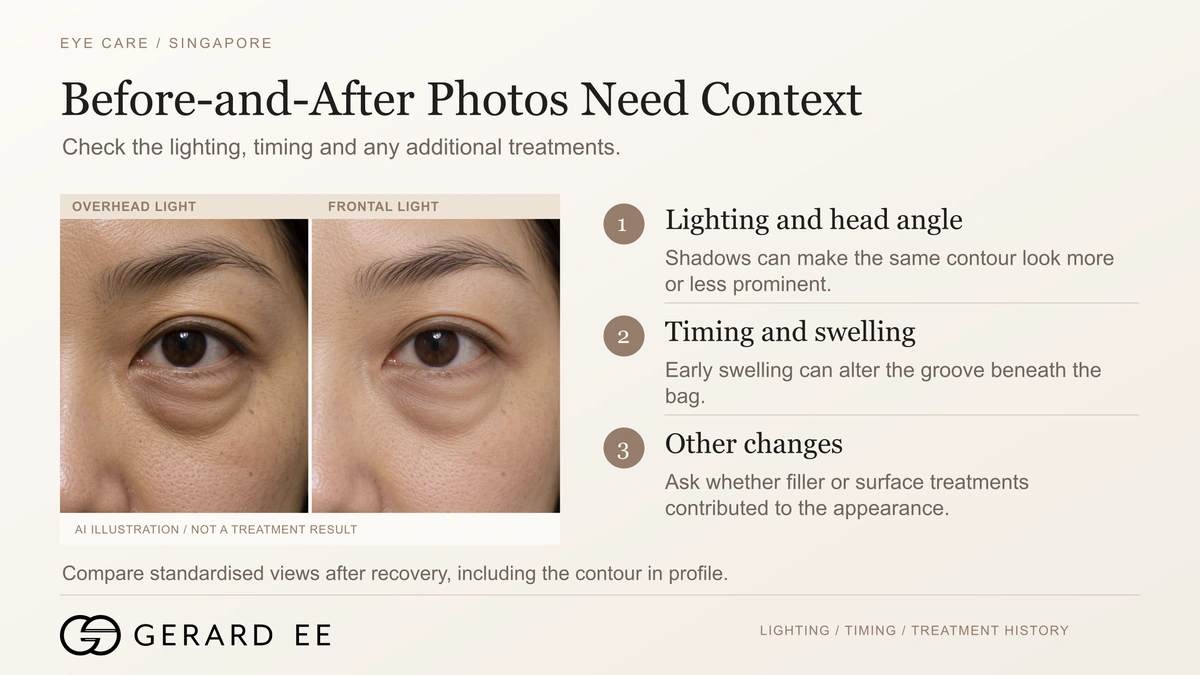
Since the laser does not reach the fat, the improvement in the photographs requires another explanation, and it is usually one of the following four.
The first is swelling. Heat on the lower eyelid causes the tissue to swell for one to two weeks. The swelling fills the groove below the bag, so the step between bag and cheek flattens. The after photograph is taken within that window, and the published report took its photographs at one month, when the swelling from a course of sessions can still be settling.1
The second is lighting and head angle. A bag is visible because of the shadow it casts on the cheek. Overhead light and a slight downward tilt of the head deepen that shadow in the before photograph, whereas front light and a slight upward tilt remove it in the after photograph.
The third is filler that is not mentioned. Tear trough filler conceals a bag for 9 to 18 months by filling the groove beside it, so that the bag no longer stands proud of the surrounding tissue. Where the package includes filler, the after photograph shows the effect of the filler.
The fourth is better skin read as a smaller bag. The surface passes improve texture and fine lines, and a smoother, brighter lower eyelid photographs as an improvement even when the bulge is unchanged.
When a patient who has had 4D eye bag removal consults me, I ask for the photographs and compare the bulge in profile under the same lighting, because a profile view removes the effect of shadow and skin tone. In profile the fat either protrudes less or it does not, and in the patients I have examined it has not.
4D eye bag removal price in Singapore
4D eye bag removal in Singapore is sold per session, and most packages recommend a course of several sessions with maintenance sessions afterwards. I do not quote other clinics’ prices. The relevant question is what the fee purchases, which is warming of the eyelid lining and skin. A course that does not reach the fat is expensive at any price, because the eye bag still requires treatment when the course ends, and the cost of that treatment is added to what has already been spent.
The two treatments I use that act on the fat itself are priced as follows, before GST. AGNES with Secret RF, which reduces the fat pad through the skin with an insulated radiofrequency needle, is $2,500 with reviews at 4 and 8 weeks included. Scarless eye bag removal surgery is $2,988 plus a day surgery facility fee of $500 to $1,000. The full list is on my eye bag removal cost page.
4D eye bag removal side effects
The energy stays in the lining and the skin, so the side effects are those of heating the lower eyelid. These comprise redness and swelling for several days, a gritty, irritated eye after the inside-the-lid pass, and a risk of burns to the lining or the skin if the surface temperature is not controlled. The published cannula series reported a full-thickness burn as a complication of overheating.3,5 Post-inflammatory pigmentation is possible in darker skin after the external passes, because heat in the dermis can stimulate the pigment cells to produce excess melanin. The eye must be shielded during every external pass to protect the retina.
The outcome I see most often is not a complication. It is a patient who has paid for a course of sessions, still has the eye bag, and is now told that none of the expenditure bought treatment of the fat.
What removes an eye bag, treatments that reach the fat
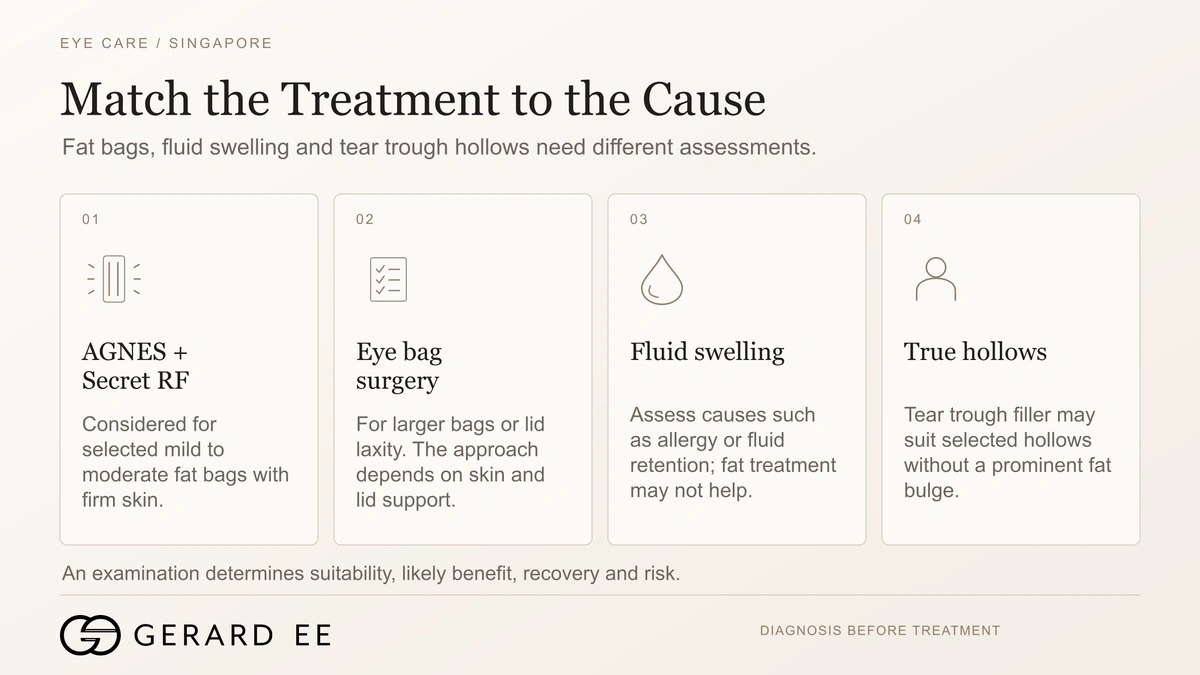
Only a treatment that reaches the fat removes an eye bag. Four situations are distinguished at examination.
For a mild to moderate fat bag with firm skin, insulated microneedle radiofrequency delivered into the fat pad reduces the bulge. The insulated needle releases heat only at its tip, so the fat is heated and the overlying skin is spared. A published series measured the reduction in the bulge on three-dimensional photography and found it maintained at 24 weeks.8 This is the non-surgical eye bag removal I perform, and in my patients the result typically holds for 3 to 5 years.
For a large bag, loose skin or a lax lower lid, scarless eye bag removal through an incision inside the eyelid removes or repositions the fat directly, and leaves no visible scar because the incision lies on the conjunctival surface.6
A fluid bag is worse in the morning and flattens by midday, because fluid pools in the loose tissue of the lower lid overnight and drains once the head is upright. No device is effective on fluid, and the cause, usually allergy or lifestyle, is addressed instead.
For a tear trough hollow without a bulge, filler is the correct treatment. Filler placed beside a true fat bag adds volume next to the protrusion, and the lower lid can look fuller rather than flatter.
Which of these applies is decided at examination, from the amount of fat protrusion, the quality of the skin, the tone of the lower lid and the position of the eye relative to the cheek. My review of every eye bag treatment in Singapore sets out how I choose between them. For the home measures that work on fluid, and why none of them works on fat, see my article on how to get rid of eye bags.
Related reading on eye bags and under-eye concerns
- Non-surgical eye bag removal: price, what happens and FAQ
- Eye bag treatment in Singapore: every option reviewed
- Is it an eye bag or a tear trough?
- How non-surgical eye bag removal actually works
- How long non-surgical eye bag results last
- When tear trough filler helps and when it does not
- Can eye creams, sleep or cold compresses remove eye bags?
- When dark eye circles are caused by allergic rhinitis
- How dark eye circles are treated
- What Emface Eyes does for the eye area
- Scarless eye bag removal: procedure, recovery and fee
- Eye bag removal cost in Singapore

Dr Gerard Ee, Aesthetic Doctor in Singapore
Dr Gerard Ee is an aesthetic doctor in Singapore and the Medical Director of his practice at 50 Raffles Place. He graduated from St George’s, University of London, trained in surgery at Singapore General Hospital and the National University Hospital, and holds the MRCS (Edinburgh) and a postgraduate diploma in practical dermatology from Cardiff University.
He has practised aesthetic medicine since 2012, is the author of sixteen peer-reviewed papers, and writes and medically reviews every article on this site. Read more about Dr Gerard Ee.

Book a consultation with Dr Gerard Ee at The Clifford Clinic
Dr Gerard Ee consults at The Clifford Clinic, 50 Raffles Place, Singapore. Consultations are by appointment. Message the clinic on WhatsApp, or call 6532 2048.
Frequently asked questions about 4D eye bag removal
Is 4D eye bag removal effective?
4D eye bag removal is not effective for an eye bag. The inside-the-lid pass heats the conjunctiva. The erbium YAG wavelength is absorbed within a fraction of a millimetre of wet tissue and the neodymium YAG wavelength is not absorbed by fat, so neither reaches or reduces the fat pad behind the lid retractors and the septum. Fine lines may improve, but the bag does not.
Is 4D eye bag removal the same as laser eye bag surgery?
4D eye bag removal is not the same as laser eye bag surgery. Laser-assisted blepharoplasty inserts a 1 mm fibre into the fat through an incision and delivers the energy inside the fat. 4D eye bag removal holds a handpiece against the lining of the lid with no incision. One is surgery on the fat, whereas the other is warming of a surface two layers away from it.
How long does 4D eye bag removal last?
The softening seen in the first weeks is swelling, and it settles within one to two weeks. Skin tightening from the external passes lasts a few months. The fat is unchanged, so the bag persists exactly as it did before treatment.
What are the side effects of 4D eye bag removal?
The side effects of 4D eye bag removal are redness and swelling for several days, irritation of the eyelid lining, a risk of burns to the lining or skin if the surface temperature is not controlled, and pigmentation change in darker skin. The eye must be shielded during the external passes.
How much does 4D eye bag removal cost in Singapore?
4D eye bag removal is sold per session, with a course of several sessions recommended. Whatever the figure, the fee buys heating of the eyelid lining and skin rather than treatment of the fat. Non-surgical eye bag removal with AGNES and Secret RF at my clinic is $2,500 and scarless eye bag surgery is $2,988 plus a facility fee, both before GST.
I had 4D eye bag removal and my eye bags are still there. What now?
A persisting eye bag after 4D eye bag removal is the expected outcome, not a failure of the individual treatment, because the laser never reached the fat. The bag should be examined in profile once the swelling has settled, usually within a month. A mild to moderate fat bag with firm skin is reduced with radiofrequency delivered into the fat pad, whereas a large bag, or one on loose skin, requires surgery.
Selected references
Sources cited on this page
- Kim JG, Zorman A. Reduction of the volume and wrinkles under the eyes using non-ablative 2940 nm Er:YAG laser on the lower eyelid palpebral conjunctiva. J Laser Health Acad. 2018;2018(1):36–38.
- Anderson RR, Farinelli W, Laubach H, et al. Selective photothermolysis of lipid-rich tissues: a free electron laser study. Lasers Surg Med. 2006;38(10):913–919. doi:10.1002/lsm.20393
- Zhang Y, Zhang L, Sun X, et al. Evaluation of lower blepharoplasty treated with the SmartLipo 1064-nm system and its clinical implications: a retrospective review. J Cosmet Laser Ther. 2016;18(7):376–380. doi:10.1080/14764172.2016.1191644
- Yang YS, Ha JH, Song BH, Kang DH, Ahn HJ. Nonsurgical lower eyelid rejuvenation using a novel 1064-nm Nd:YAG laser with a 650-microsecond pulse duration. Lasers Med Sci. 2025;40:432. doi:10.1007/s10103-025-04682-7
- Chung ST, Rho NK. Surgical and non-surgical treatment of the lower eyelid fat bulging using lasers and other energy-based devices. Med Lasers. 2017;6(2):58–66. doi:10.25289/ML.2017.6.2.58
- Beer J, Boghosian T, Sherif R, et al. What’s new with under eye treatment: a multispecialty systematic review of recent under eye treatments. Dermatol Surg. 2026;52(2):155–163. doi:10.1097/DSS.0000000000004964
- Suh DH, Oh YJ, Lee SJ, et al. Intense focused ultrasound tightening in the treatment of infraorbital laxity. J Cosmet Dermatol. 2012;11(4):290–295. doi:10.1111/jocd.12006
- Shin JW, Park JT, Chae JB, Choi JY, Na JI, Park KC, Huh CH. The efficacy of micro-insulated needle radiofrequency system for the treatment of lower eyelid fat bulging. J Dtsch Dermatol Ges. 2019;17(2):149–156. doi:10.1111/ddg.13736
This page is written from published research and from clinical experience in Singapore since 2012. It is for general education, not medical advice. Whether a treatment suits you, what it may achieve and what it may risk can only be established at a consultation. Dr Gerard Ee is the Medical Director of The Clifford Clinic, a private clinic in Singapore, and treatments discussed on this site are provided commercially.