
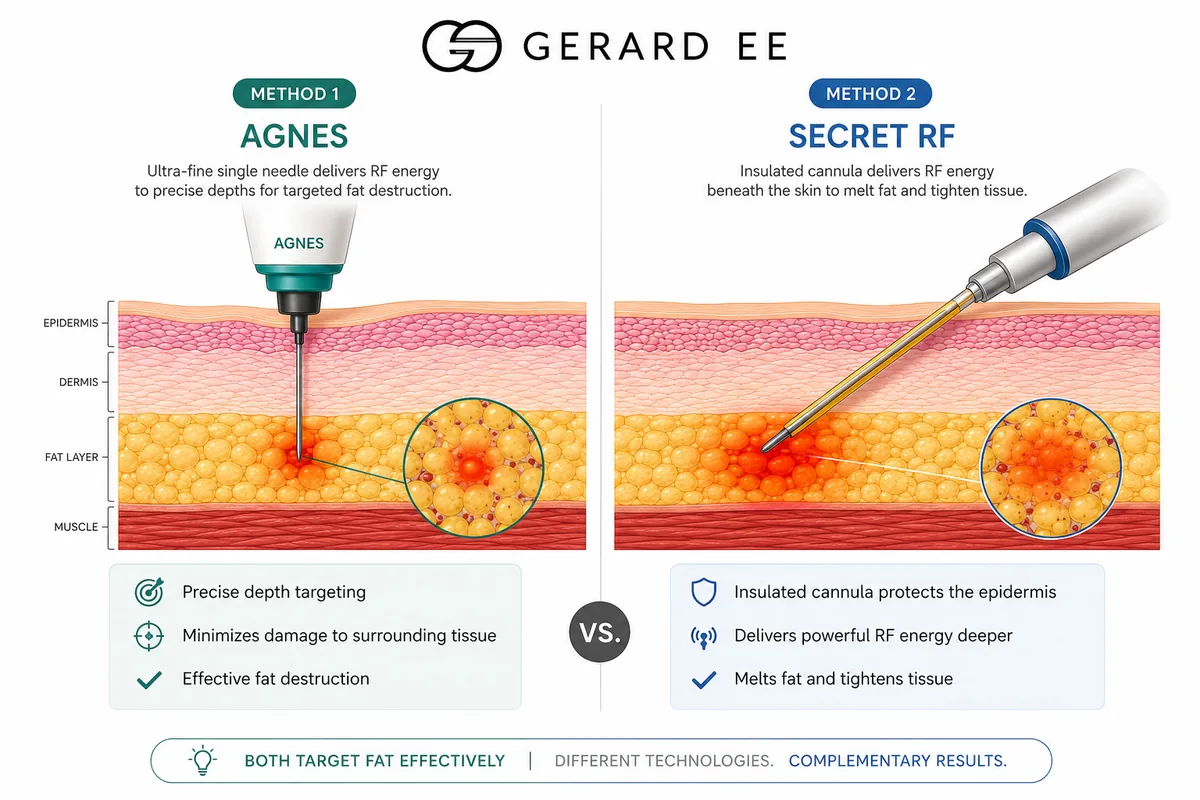
No non-surgical eye bag removal is permanent in the strict sense, because the eyelid continues to age after treatment. The longest-lasting result is obtained from treatment that reduces the orbital fat itself. AGNES with Secret RF radiofrequency reduces the fat through the skin, and the result typically holds for 3 to 5 years. Filler conceals a bag for 9 to 18 months. Lasers, HIFU and eye creams do not reach the fat and produce no lasting change in a true eye bag.
Dr Gerard Ee consults and performs non-surgical eye bag removal at The Clifford Clinic, 50 Raffles Place, Singapore.
What permanent means for an eye bag
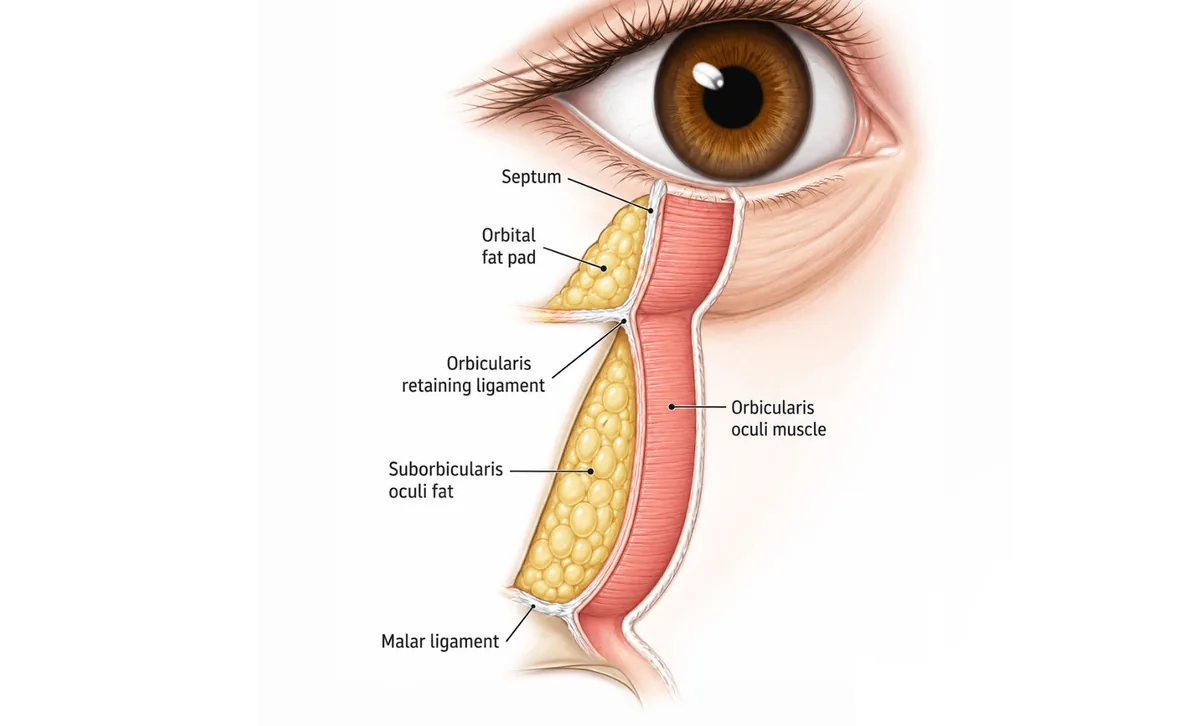
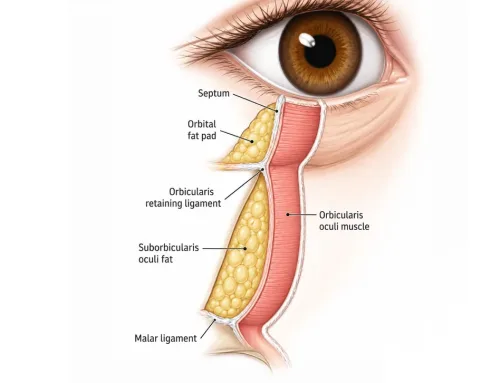
An eye bag is orbital fat pushing forward against a weakened septum, the thin sheet that normally holds the fat back. A treatment that lasts must either remove or shrink that fat, or conceal it.
Treatments that reduce the fat give a result that holds for years, because the fat cells that have been cleared are not replaced. Treatments that conceal the fat, such as filler placed in the trough below the bag, last only as long as the product remains in the tissue. Treatments that heat the skin above the bag do neither, because the energy is absorbed in the skin and the deeper support layers before it reaches the fat, so on a fat bag they give no lasting result at all.
Even after the fat is reduced, the septum continues to weaken with age and the cheek below the eye continues to descend, so a new and usually smaller protrusion can appear years later. For this reason I use the phrase “a result that lasts” rather than “permanent” for anything short of surgery, and I apply the same wording to surgery on my scarless eye bag removal page.
Non-surgical eye bag removal in Singapore ranked by how long it lasts
| Treatment | What it does to the fat | How long the result lasts | My price |
|---|---|---|---|
| AGNES with Secret RF | Shrinks the fat pad through the skin with insulated microneedle radiofrequency | Full result by 8 weeks, then typically 3 to 5 years | $2,500 |
| Tear trough filler | Nothing. It fills the hollow beside the bag so the step looks smaller | 9 to 18 months, then it degrades | $1,200 |
| HIFU | Nothing. The focused heat is aimed at deeper tissue planes and cannot reduce orbital fat | No lasting effect on a fat bag | Not offered for eye bags |
| 4D and other long-pulse laser packages | Nothing. The wavelength is absorbed by water, not fat, including when fired through the inside of the lid | No lasting effect on a fat bag | Not offered |
| Skin boosters and collagen stimulators | Nothing to the fat. They improve skin texture above it | Skin quality for months, no change to the bag | From $800 |
| Eye creams, cold compresses, sleep | Nothing. They move fluid, not fat | Hours to a day | — |
Prices are before GST. The AGNES with Secret RF fee includes the reviews at 4 and 8 weeks.
One published series measured lower eyelid fat bulging with three-dimensional photography after two sessions of micro-insulated needle radiofrequency performed four weeks apart. The reduction was significant at 12 weeks and was maintained at 24 weeks, and swelling and bruising lasting about a week were the only side effects reported.1 In my own patients, treated since 2012, the result typically holds for 3 to 5 years in mild to moderate bags with firm skin.
Why radiofrequency into the fat gives the longest non-surgical result
AGNES delivers radiofrequency through an insulated needle whose tip is placed in the fat pad. The insulation protects the skin, so the heat is released only at the tip, where it destroys a measured amount of fat that is then cleared by the body over the following weeks. Secret RF treats the skin above the bag at the same session, so that the skin tightens as the volume beneath it falls. The two devices, how I combine them and what a session feels like are covered on my AGNES eye bag removal page.
Fat cleared in this way does not return, because adult fat cells are not replaced in significant numbers once destroyed. What changes over the years is the tissue around the treated fat, namely the septum, the lid skin and the cheek beneath.
Which eye bags get the longest result without surgery
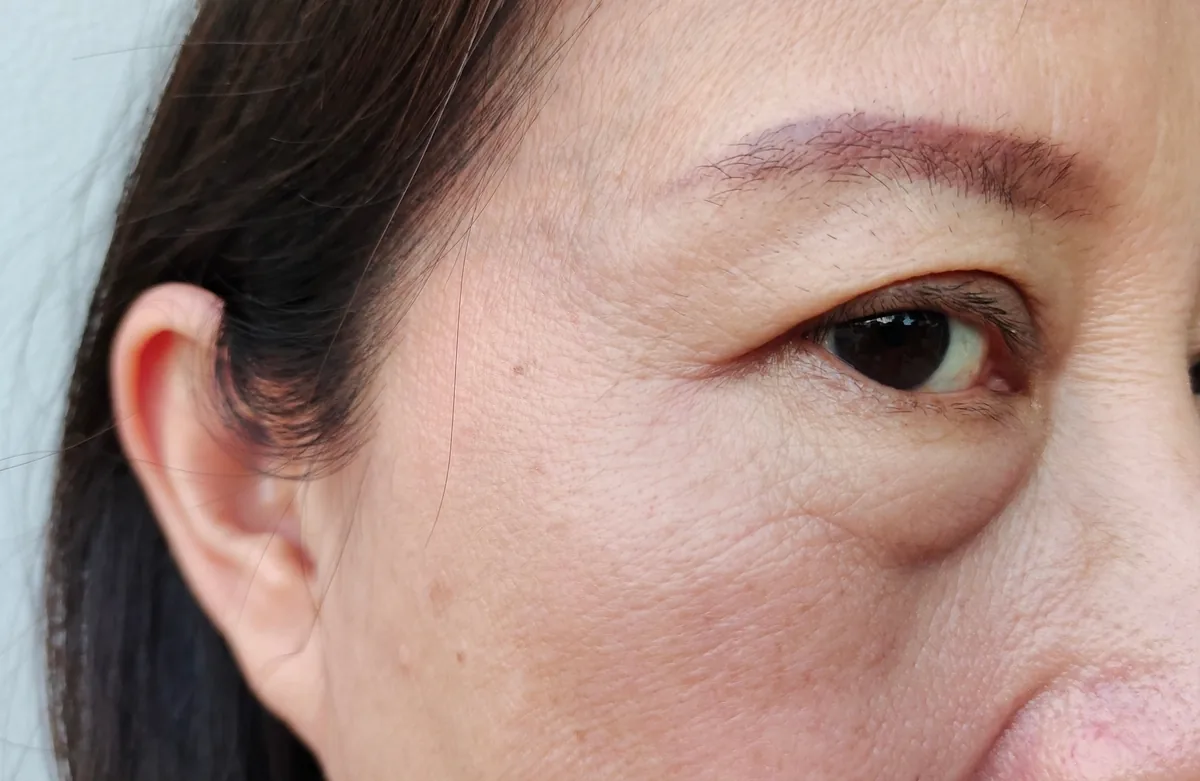
The result lasts longest when the bag is composed of fat, the skin is firm and the protrusion is mild to moderate. Across more than 500 treated eye bag cases, patients with Grade 1 to 2 bags, meaning a visible but not pronounced protrusion, and good lower-lid tone hold the result for years. Treating the bag before the septum has weakened substantially also extends the result, because a septum that still restrains its remaining fat has less to release later.
Three situations give a short result or none.
The first is a fluid bag. Puffiness that is worse in the morning, varies with salt, alcohol, allergy or sleep, and flattens by midday is fluid rather than fat, because fluid pools in the loose tissue of the lower lid overnight and drains once the head is upright. No device gives a lasting result on fluid because there is no fat to reduce, and the cause, usually allergy or lifestyle, is treated instead. My article on eye creams and cold compresses for eye bags explains the two-week test that separates the two.
The second is loose skin. Where the skin itself is slack, reducing the fat beneath it can leave a fold, and skin tightening devices cannot remove a fold. In that anatomy I recommend surgery rather than AGNES.
The third is a large bag. Beyond mild to moderate protrusion there is too much fat for thermal reduction to produce a visible difference.
When non-surgical eye bag removal is not enough
A multispecialty systematic review of under-eye treatments reached a conclusion that clinics offering only devices seldom cite. Fillers, lasers, microneedling and neuromodulators address volume, pigment and skin quality, but surgery remains the preferred and most definitive option for herniated orbital fat and poor lower-lid support, particularly where the integrity of the fat pad is significantly compromised.2
Radiofrequency can reduce the volume and prominence of selected fat. Unlike surgery, it does not physically excise or reposition the orbital fat pad, and it does not tighten a lax lower lid. The published radiofrequency data show meaningful reduction in fat bulge height in mild to moderate cases,1 and good results are obtained in exactly those patients. Above that range, the fraction of the bag that a single thermal session can clear is too small to be visible.
In practice I refer for scarless eye bag removal when I see one of the following at examination.
The first is marked fat pseudoherniation producing a pronounced and persistent lower-eyelid bulge. There is too much fat for thermal reduction to produce a visible difference.
The second is significant lower lid laxity. If the lid does not spring back against the globe when pulled gently away from it, reducing fat will not help and may leave the lid looking hollow and slack.
The third is true skin excess. Redundant skin needs to be excised or tightened surgically, because collagen stimulation does not remove a fold.
The fourth is a pronounced negative vector, in which the globe sits forward of the cheek. The bag is then partly a projection problem, and no amount of fat reduction changes the underlying skeletal relationship. Filling the trough does not correct the vector either, and in this anatomy under-eye filler tends to look puffy rather than smooth, because hyaluronic acid draws water into tissue that has no bony support beneath it.
The fifth is a patient who wants the bag treated once. Non-surgical treatment can be repeated after some years, whereas surgery removes or repositions the fat in a single operation. Some patients prefer the operation for that reason.
Can you combine surgery with non-surgical treatment?
This question is asked often, and the evidence does not answer it. I searched the literature for studies on sequencing or combining energy-based skin tightening with lower blepharoplasty and found none.
In the absence of evidence, my clinical practice is as follows. Surgery addresses the fat and the skin. Skin quality, meaning texture, fine lines and pigment, can be treated afterwards once the tissues have settled, usually at three months or more. I would not treat the same area with energy in the weeks around an operation, and I would want the operating surgeon’s agreement on timing.
Keeping the result after non-surgical eye bag removal
Stable weight, allergy control and daily sun protection extend the result, because weight gain enlarges the remaining orbital fat, allergy adds fluid to the lid, and ultraviolet exposure accelerates the skin laxity that exposes a smaller bag. Rubbing the eyes and heavy salt or alcohol intake bring fluid back to an area that has been treated for fat, which makes the bag appear to have returned when the fat pads are still flat. When a bag does change years later, a short repeat session is usually sufficient. A full article on prevention will follow on this site.
Related reading on eye bags and under-eye concerns
- Non-surgical eye bag removal: price, what happens and FAQ
- Eye bag treatment in Singapore: every option reviewed
- Is it an eye bag or a tear trough?
- How non-surgical eye bag removal actually works
- How long non-surgical eye bag results last
- When tear trough filler helps and when it does not
- Can eye creams, sleep or cold compresses remove eye bags?
- When dark eye circles are caused by allergic rhinitis
- How dark eye circles are treated
- What Emface Eyes does for the eye area
- Scarless eye bag removal: procedure, recovery and fee
- Eye bag removal cost in Singapore

Dr Gerard Ee, Aesthetic Doctor in Singapore
Dr Gerard Ee is an aesthetic doctor in Singapore and the Medical Director of his practice at 50 Raffles Place. He graduated from St George’s, University of London, trained in surgery at Singapore General Hospital and the National University Hospital, and holds the MRCS (Edinburgh) and a postgraduate diploma in practical dermatology from Cardiff University.
He has practised aesthetic medicine since 2012, is the author of sixteen peer-reviewed papers, and writes and medically reviews every article on this site. Read more about Dr Gerard Ee.

Book a consultation with Dr Gerard Ee at The Clifford Clinic
Dr Gerard Ee consults at The Clifford Clinic, 50 Raffles Place, Singapore. Consultations are by appointment. Message the clinic on WhatsApp, or call 6532 2048.
Frequently asked questions about permanent non-surgical eye bag removal
Can eye bags be removed without surgery?
Eye bags can be removed without surgery where the bag is fat rather than loose skin and the protrusion is mild to moderate. AGNES with Secret RF radiofrequency shrinks the fat pad through the skin with no incision, and the result typically holds for 3 to 5 years. A large bag, or one on loose skin, needs surgery.
Do I need eye bag surgery or will non-surgical treatment work?
The decision depends on how much fat is present and how lax the lower lid is. Mild to moderate bags with reasonable lid tone respond to radiofrequency,1 whereas severe fat herniation, significant laxity or true skin excess needs surgery, which systematic review evidence identifies as the definitive option for herniated orbital fat.2 The decision rests on the amount of fat protrusion, true skin excess, lid tone, lid-cheek anatomy and eye position, assessed together at examination rather than from a description of symptoms.4
Can I have fillers instead of surgery?
Filler addresses a hollow, not a bulge. On a true fat bag it camouflages rather than corrects, lasts 9 to 18 months, and the infraorbital area is the most complication-prone site on the face for non-vascular filler problems.3 I have covered this in detail in my article on tear trough fillers versus eye bag removal.
Which non-surgical eye bag treatment lasts longest?
Radiofrequency delivered into the fat pad lasts longest. It is the only non-surgical treatment that reduces the fat itself, and the published series shows the reduction maintained at 24 weeks,1 with my own patients typically holding the result for 3 to 5 years. Filler, HIFU, lasers and creams do not reduce the fat.
How do I remove eye bags permanently without surgery?
The eyelid cannot be stopped from ageing, so no non-surgical treatment is permanent in the strict sense. The closest is AGNES with Secret RF, which clears a measured amount of fat that is not replaced. If a smaller protrusion appears years later, it can be treated again.
Selected references
Sources cited on this page
- Shin JW, Park JT, Chae JB, Choi JY, Na JI, Park KC, Huh CH. The efficacy of micro-insulated needle radiofrequency system for the treatment of lower eyelid fat bulging. J Dtsch Dermatol Ges. 2019;17(2):149–156. doi:10.1111/ddg.13736
- Beer J, Boghosian T, Sherif R, et al. What’s new with under eye treatment: a multispecialty systematic review of recent under eye treatments. Dermatol Surg. 2026;52(2):155–163. doi:10.1097/DSS.0000000000004964
- Stutman RL, Codner MA. Tear trough deformity: review of anatomy and treatment options. Aesthet Surg J. 2012;32(4):426–440. doi:10.1177/1090820X12442372
- Lee H, Ahn SM, Chang M, Park M, Baek S. Analysis of lower eyelid aging in an Asian population for customized lower eyelid blepharoplasty. J Craniofac Surg. 2014;25(2):348–351. doi:10.1097/01.scs.0000436736.60042.92
This page is written from published research and from clinical experience in Singapore since 2012. It is for general education, not medical advice. Whether a treatment suits you, what it may achieve and what it may risk can only be established at a consultation. Dr Gerard Ee is the Medical Director of The Clifford Clinic, a private clinic in Singapore, and treatments discussed on this site are provided commercially.
Related Posts



3 Comments
Comments are closed.


[…] is some mild orbital hollowing. I did her tear trough fillers together with the AGNES and Secret RF Eye Bag removal protocol. You can see improvement in the bulging of the fats, which were especially pronounced over the eye […]
[…] SGD2500 (before GST) for a single treatment of non-surgical eye bag removal, this is one clinic that you should consider going to if you want to remove eye bags permanently […]
[…] everyone is willing to go under the knife. For those with such concerns, I strongly recommend the Clifford Clinic Eye Bag Protocol with AGNES and Secret […]