
A collagen biostimulator is an injection that prompts the skin to grow its own collagen rather than filling a hollow with gel. A search for collagen biostimulator Singapore returns PLLA, Loviselle, Juläine, PDLLA skin booster, PCL and Radiesse, sold as a biostimulator filler, a collagen stimulator, a skin booster or a “baby face” injection, at anything from $900 to $2,500 a vial. They are not the same material, and they do not suit the same faces. I have used poly-L-lactic acid (PLLA) since 2023 and treat about 300 faces a year with collagen biostimulators. This guide covers the four materials, PLLA against Loviselle, who suits which, price, and what goes wrong. Every study quoted is listed at the end with a link to the paper, and where a statement is my own clinical opinion I say so.
What the published evidence on PLLA, PCL, PDLLA skin booster and the hybrid HA formulation for fat compartments shows
Only papers whose article title itself contains the requested brand name are included below. Product names mentioned only in the abstract, keywords or methods were excluded.
PLLA has the strongest trial base of the group. A randomised controlled study of PLLA for moderate to severe cheek wrinkles reported a responder rate of 71.6% against 26.1% for no treatment at 12 months, with improvements in skin radiance and firmness and mostly mild adverse events; its safety was first characterised in four clinical trials in HIV-related facial lipoatrophy. [18] [19]
PCL is supported mainly by consensus and review rather than randomised trials: a multinational expert group published recommendations on indications, treatment areas and injection technique for the polycaprolactone biostimulator, and a 2024 review summarised its features and complication avoidance. [20] [21]
PDLLA skin booster has prospective data for the face: five needle-free sessions in 40 patients produced sustained Global Aesthetic Improvement Scale gains and a measured 2.3 mm lift at 24 weeks. [22]
the hybrid HA formulation for fat compartments, the hyaluronic acid formulation designed for fat compartments rather than the dermis, increased soft tissue thickness with the effect persisting to six months in a 22-patient series, and improved volume-loss and wrinkle scores in a 50-patient study after two injections a month apart. [23] [24]
About the author, and how this guide was written
I trained in medicine at St George’s, University of London, and then in surgery, practising orthopaedic surgery at Singapore General Hospital and the National University Hospital before taking the MRCS of the Royal College of Surgeons of Edinburgh. I completed the Postgraduate Diploma in Practical Dermatology at Cardiff University and moved into aesthetic medicine, and I have thirteen PubMed-indexed publications. Three collagen biostimulators are used in this clinic, Loviselle and PLLA, both PLLA, and PCL, which is polycaprolactone (PCL). PDLLA skin booster, a poly-D,L-lactic acid (PDLLA), is used as a skin booster. I have also had a biostimulator injected into my own face, which informs the account below of how the treatment feels more directly than any of the published research does.
Every study quoted is peer-reviewed and PubMed-indexed, and each was read in the original rather than in summary. Most of the published research on biostimulators was conducted on a single product, PLLA, over twenty years. The newer products have shorter clinical records and smaller studies, and where that applies it is stated rather than PLLA’s figures being borrowed for them. The clinic offers the treatments described here, and no manufacturer paid for or reviewed this guide.
What is a collagen biostimulator, and how it differs from a filler
A hyaluronic acid filler is a gel that occupies space as soon as it is injected, so the result is visible before the patient leaves the room. A collagen biostimulator is a suspension of fine particles of a material the body breaks down slowly, and the particles add almost no volume of their own. Each particle instead provokes the skin’s repair cells, the fibroblasts, to lay down new collagen around it, so that over two to three months the treated area thickens and firms with tissue that is entirely the patient’s own.
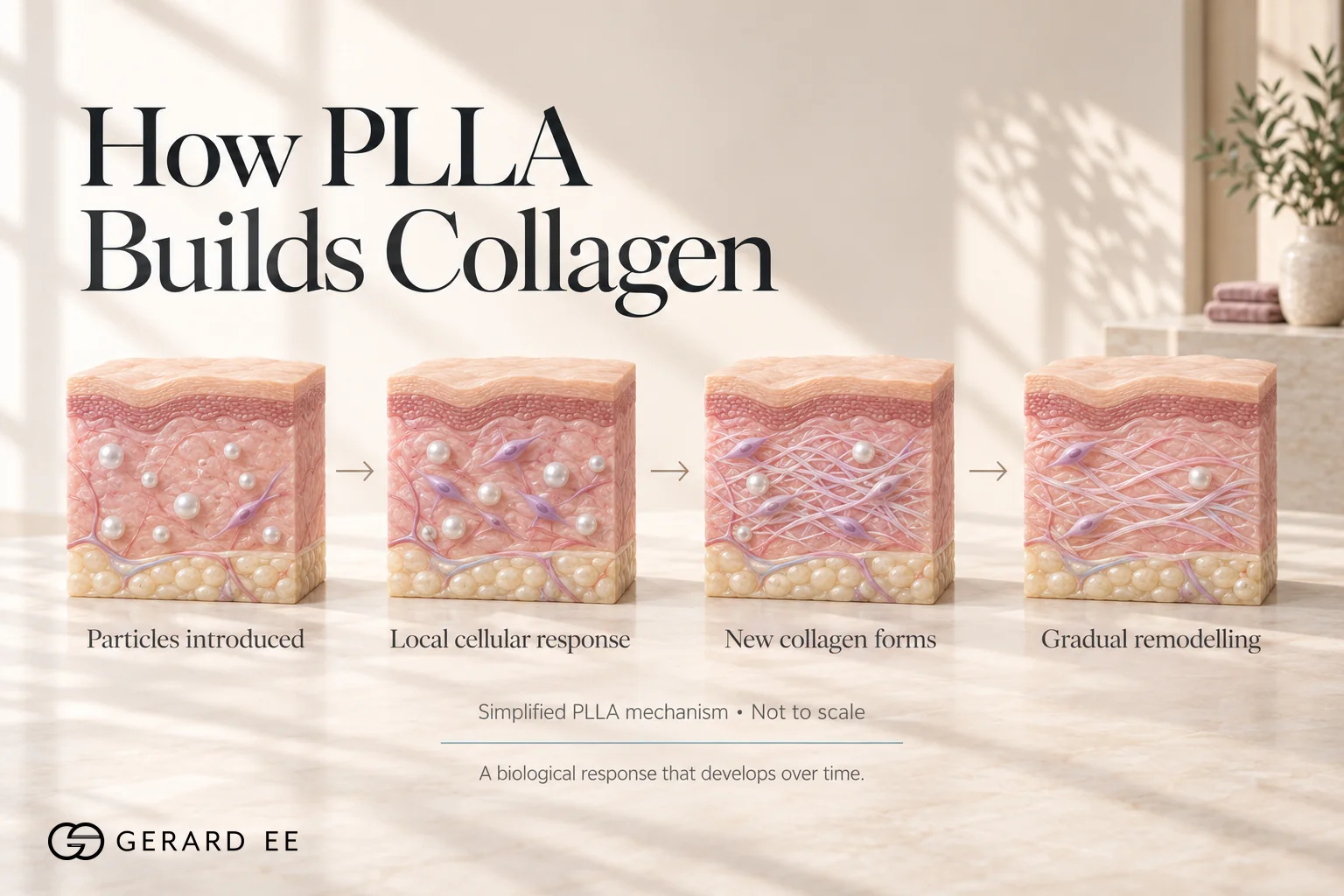
That sequence has been demonstrated histologically. In biopsies taken at three, six and twelve months after PLLA, type I collagen, the collagen that gives skin its structural strength, was significantly increased at three and six months, with no or only mild inflammation in every subject [5]. A German cell-biology study described the sequence in tissue, in which scavenger cells gather around each particle, fibroblasts migrate in beside them, and collagen type III is laid down first with type I deposited around it [6]. A 2025 animal study observed the same order, type III early and type I later [11].
The two therefore differ in their timing as much as in their material. A filler produces a result on the day that fades over about a year. A biostimulator produces very little on the day, a visible result at three months, and skin that remains thicker for one to two years because the collagen is the patient’s own. In the longest controlled trial, correction after PLLA was still measurable at twenty-five months [3, 4].
Are collagen biostimulators considered fillers?
In Singapore they are regulated as injectable medical devices, and most are marketed as fillers. Clinically the two are used for different problems. A filler is indicated for a discrete hollow that requires volume on the day. A biostimulator is indicated for a face that has lost firmness and thickness across a region, namely the cheeks, the temples, the jawline, the lower face and the neck. Many faces require both, and the order matters, because lifting is addressed before thickness is added, a sequence set out under combining treatments below.
Biostimulator materials, PLLA, PDLLA, PCL and calcium hydroxylapatite
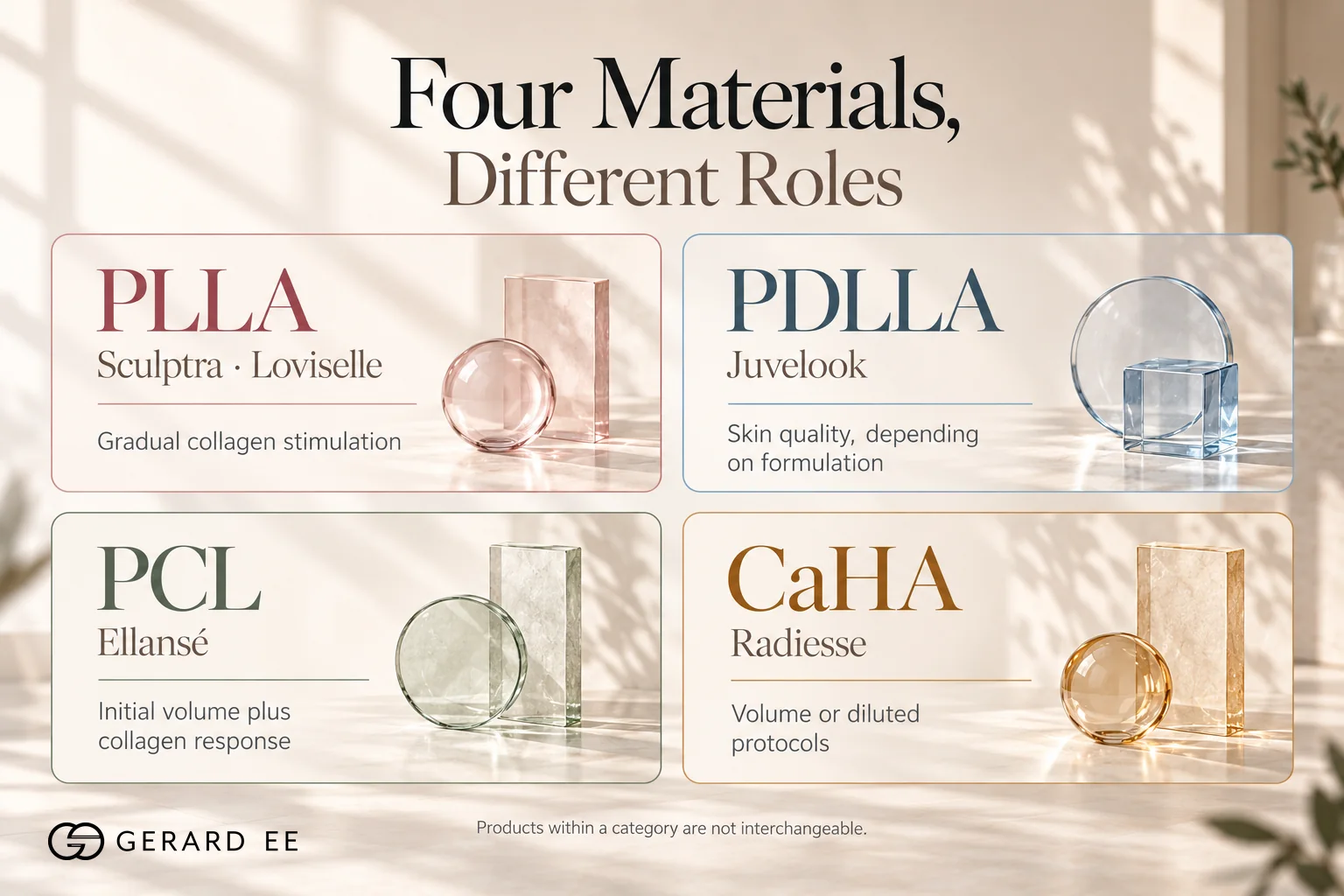
Every biostimulator on the Singapore market is made from one of four materials. The material determines the immediate feel, the duration of the result and the indication.
PLLA, poly-L-lactic acid (童颜针, Loviselle 艾维岚, Juläine)
PLLA is the original collagen biostimulator. Lactic acid polymers have been used in dissolving surgical sutures for decades, and PLLA was first injected into the face in Europe in 1999. It is supplied as a powder, reconstituted with sterile water or saline before injection, and adds no volume on the day. Its evidence base is the deepest of the four materials, comprising a European series of more than 2,500 patients in whom correction lasted eighteen to twenty-four months in most cases [1], and a randomised trial against a collagen implant in 233 patients that followed the PLLA group for twenty-five months [3]. The PLLA brands differ in particle shape and in how the product is prepared, and the clinical consequence of that difference is set out in the PLLA brand comparison versus Loviselle section.
PDLLA, poly-D,L-lactic acid
PDLLA is a closely related polymer with a more porous particle that degrades faster, usually over about a year. PDLLA skin booster combines it with a small quantity of hyaluronic acid, so a degree of immediate effect is produced. It acts more gently and is directed at skin quality rather than at volume, and it is therefore used here as a skin booster and beneath the eyes rather than to rebuild a cheek. The evidence is more recent. A 260-patient randomised trial found that PDLLA improved nasolabial folds in about two in three patients at six months, slightly ahead of a hyaluronic acid filler [12], and a 2026 split-face trial found a PDLLA and hyaluronic acid product no worse than PLLA at six months, with the authors requesting longer follow-up [13].
PCL, polycaprolactone (少女针)
PCL carries its polymer in a gel, so unlike PLLA it adds volume on the day and then builds collagen over the following months, and the result lasts one to two years. It is the biostimulator selected where a cheek or a chin requires both immediate shape and firmness over time. The full account of its mechanism, its price and the sites in which it is not used appears on the PCL filler page.
Calcium hydroxylapatite (Radiesse)
Calcium hydroxylapatite is a mineral, the same one found in bone, carried in a gel. It adds volume on the day and also stimulates collagen. When it was injected into skin subsequently removed at surgery, the treated area showed new type III collagen among the mature fibres [16]. It is widely used in diluted form for the neck and the hands. I use it undiluted for the jawline, cheek and chin, diluted for skin tightening, and in sequence with HIFU. The published evidence is set out in my CaHA filler in Singapore review, and sessions and prices are on my CaHA treatment page.
CaHA is also the longer-lasting option I offer for nose filler in Singapore, where its non-reversibility is the trade-off to weigh.
What is not a collagen biostimulator
Rejuran (polynucleotides), Hybrid HA and the hyaluronic acid skin boosters are sold alongside biostimulators and are frequently confused with them. They improve skin hydration and surface quality and have defined indications of their own, but they do not provoke the fibroblast response that lays down structural collagen, so they do not thicken the tissue the way the four materials above do. Rejuran and hybrid HA are covered separately.
The original PLLA and Loviselle, what is actually different
Both are PLLA. Both are supplied as a powder, reconstituted before injection, add no volume on the day and build collagen over months. A clinic that describes one as a filler and the other as a biostimulator is describing them incorrectly. The differences between them lie in the particle and in the preparation.
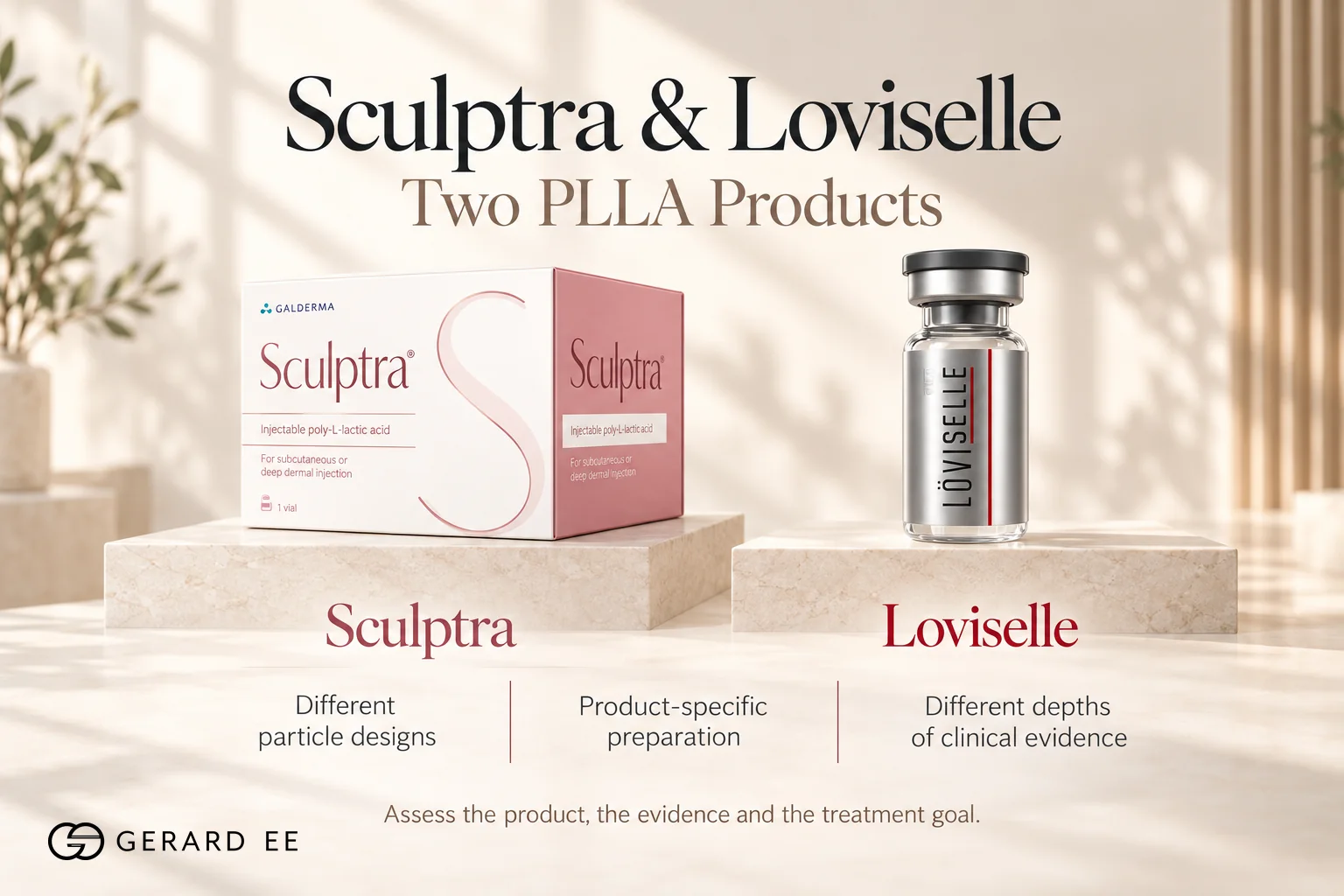
PLLA, manufactured by Galderma, has been on the market since 1999 and carries almost all of the long-term research, including the 2,500-patient series [1], the twenty-five-month randomised trial [3, 4] and the human biopsy work [5]. Its particles are irregular flakes of PLLA. The powder is reconstituted with water at least a day in advance, and the suspension foams and separates as it stands [9]. That behaviour has to be managed at reconstitution rather than avoided, and how it is managed accounts for much of the nodule risk described below.
Loviselle, manufactured by Changchun SinoBiomaterials and registered in Singapore as a Class D medical device, was the first PLLA approved by China’s regulator, in 2021. Its PLLA is produced as smooth, round microspheres of twenty to fifty microns, carried with carboxymethyl cellulose and mannitol. Manufacturer laboratory work published in 2025 compared this microsphere PLLA with the earlier flake product. The microspheres reconstituted quickly into an even suspension without foaming, whereas the flakes formed a two-phase mixture that required vigorous shaking and clumped [9]. In an accompanying cell study, the microspheres induced fibroblast migration, proliferation and matrix production with little immune activation, whereas the flakes provoked inflammatory gene expression [10]. Those are laboratory findings from studies connected to the manufacturer rather than long-term patient outcomes. Loviselle therefore offers the more refined particle and the shorter clinical record, and PLLA the older particle and twenty years of patients.
My clinical perspective on choosing between them
Both products are used here, and the choice is made from the examination rather than from the product literature. Where volume loss or laxity is more advanced, PLLA is preferred, because the depth of its evidence covers the larger volumes and the repeated courses such a face requires. Loviselle is preferred in the younger face that has begun to lose thickness and wants a result that reads as entirely natural, where its even microsphere suspension may distribute more predictably through thinner tissue. Price does not decide the choice.
Which collagen biostimulator for which face
The material is a more consequential choice than the brand, and it follows from the examination rather than from a price list.

A face that has lost volume across the cheeks, temples and lower face, so that it appears tired or gaunt rather than lax, is treated with PLLA in a course, because PLLA rebuilds thickness over a wide area without any region appearing filled. This is the classic biostimulator patient, usually from the late thirties onward, and it is the indication PLLA was developed for [1].
A face that requires shape on the day, such as a flattened cheek or a short chin, together with firmness over time, is treated with PCL, because PCL provides both. The alternative is a hyaluronic acid filler for the shape and PLLA for the firmness, placed a few weeks apart.
Skin that has lost quality rather than volume, being crepey, thin and dull with fine lines, whether in a younger face or across the neck, is treated with PDLLA as a skin booster, or with PLLA diluted and placed more superficially. Nothing that adds volume is indicated, because a young face does not require it.
A face that has descended rather than deflated, with jowls and a soft jawline over good skin, is not treated with a biostimulator first. Lifting is the first requirement, and high intensity focused ultrasound (HIFU) is covered in a separate guide. Biostimulators and HIFU are frequently combined in the same face, and the combination has been described in the literature [17], with HIFU (Tightan 2 or Sygmalift) performed first and the biostimulator on the same day or a few weeks later.
Rolling acne scars are treated with PLLA or PCL after subcision, where a biostimulator placed beneath a released scar limits re-tethering and builds the collagen the scar lacks. Subcision is covered in the subcision guide and the acne scar guide.
The faces not suited to a biostimulator
The face with abundant soft tissue and a thick dermis gains nothing from being made thicker, and a biostimulator can leave it appearing heavier rather than younger. Such a face usually requires lifting or fat reduction instead, and that is said plainly at the consultation. The standard exclusions also apply, namely pregnancy, active skin infection, a flaring autoimmune condition, a history of granulomas from earlier fillers, and any patient who requires the result within three weeks.
Areas treated with a biostimulator, and areas avoided
Biostimulators are placed in the cheeks and mid-face, the temples, the jawline and pre-jowl area, the chin, the lower face, the neck, the décolletage and the backs of the hands. A diluted PDLLA can be used beneath the eyes where the injector is experienced in that plane. PLLA and PCL are avoided in the lips, in the thin skin directly beneath the eye, in the glabella between the brows and in the nose. In the lips and the under-eye the skin is too thin to conceal a nodule, and in the glabella and the nose any particle injection carries a risk of vascular occlusion. Every published complication series reports the same restriction for the lips and the eyes.
When biostimulator results appear, and how long they last
PLLA produces little visible change on the day. The slight swelling that follows comes from the fluid the powder was reconstituted with, settles within a day or two, and is sometimes mistaken for an immediate result. The genuine change begins at four to six weeks and is usually clear at three months. The trials measured at three months for that reason, and patients are photographed before treatment and again at three months so that the comparison is objective. PCL produces shape on the day, with firmness building behind it.
Duration depends on the material and on the individual patient. In the controlled PLLA trial, improvement was still present at twenty-five months after the final session, and blinded investigators rated more than 85 per cent of patients as improved throughout [3, 4]. The European series recorded correction at eighteen to twenty-four months in most patients [1]. Loviselle’s manufacturer states up to twenty-four months. PCL lasts one to two years depending on the version, and PDLLA about a year. The face does not then return to its starting point, because the collagen that has been grown belongs to the patient and ages at the normal rate.
How many biostimulator sessions, and how far apart
PLLA is a course rather than a single treatment, because each session lays down a further layer of collagen. Two to three sessions four to eight weeks apart is usual for a face in its forties. One session may suffice for a younger face or a small area, and four may be required for a markedly deflated one. The trials used up to four sessions three weeks apart [3]. Loviselle’s manufacturer recommends about three sessions four to eight weeks apart. PCL is given as a single session and repeated when the effect fades. PDLLA as a skin booster is given as a course of about three sessions a month apart. After a course, a single maintenance session every twelve to eighteen months sustains the result.
Collagen biostimulator price in Singapore, and why it ranges
Collagen biostimulator prices in Singapore range from about $900 to $2,500 a vial, and some clinics quote a package that conceals the vial count altogether. The price is determined by the product, the number of vials the face requires, the volume of fluid each vial is reconstituted with, and whether a doctor is injecting. In this clinic Loviselle is $2,000 a vial, PLLA is $1,800 a vial, PCL is $1,400 a syringe, CaHA is $1,400 a syringe or $1,800 a session for biostimulator lifting and contouring, and PDLLA skin booster is $1,500 as a skin booster combination, all before GST, with the consultation and the three-month review included. One vial treats a small area or a younger face, and a full mid-face in its forties usually requires one vial per session over two to three sessions. The vial count is stated at the consultation, before anything is reconstituted.

Two questions separate a cheaper offer from a cheaper treatment. The first is the volume the vial is reconstituted with, because a vial diluted to eleven millilitres and spread across a whole face is not the treatment a vial at five millilitres delivers, and it is the dilution rather than the headline price that determines how much collagen is produced. The second is whether a doctor is injecting, because placement contributes as much to the result as the product does.
What happens at a biostimulator appointment
The decision is made at the consultation, covering which material is used, how many vials, how many sessions, and whether a biostimulator is indicated at all. The examination distinguishes where the face has lost thickness from where it has descended, because those two findings call for different treatments, and the plan is then marked on the skin. Photographs are taken for the three-month review.
On the day, topical anaesthetic cream is applied for twenty to thirty minutes, and the product itself is reconstituted with local anaesthetic, so the injection is more comfortable than a filler. PLLA is placed in a fan of passes beneath the skin with a blunt cannula from one or two entry points a side. The treated area is then massaged firmly for several minutes to distribute the particles uniformly, which is the step that determines how evenly the collagen subsequently forms. The injections themselves take fifteen to thirty minutes. Patients are given a home massage routine of five minutes, five times a day, for five days, and that routine accounts for most of the nodule prevention.
Does it hurt, and is there downtime?
The procedure is less painful than most patients expect. The product is reconstituted with anaesthetic, and the cannula delivers it through two or three small entry points. The pooled studies record pain in most patients during the injection and bruising in about a quarter [8], and with a cannula the bruising rate observed here is considerably lower than that. Having had a biostimulator injected into my own face, the sensation I would describe is pressure and a dull ache during the massage rather than the sharp sting of a needle-based filler. Swelling for a day or two from the reconstitution fluid and a possible bruise at an entry point are the usual findings, and neither prevents a patient working. There is no further downtime.

What can go wrong with a collagen biostimulator
The complications of biostimulators are well documented, and most of them are attributable to product, placement, dilution or massage.
Nodules are small firm lumps beneath the skin that are palpable and occasionally visible, and they are the complication of greatest clinical consequence. In the pooled analysis of biostimulator studies, nodules formed in about five in a hundred patients, with a range of two to ten depending on the study [8]. The rate has fallen as technique has changed. In the first HIV lipoatrophy trial, PLLA was reconstituted with very little water and injected at high concentration, and forty-four in a hundred patients developed palpable, non-visible micronodules [2]. Once greater dilution and post-treatment massage became standard the rate fell, and a series of 568 patients over eight years reported late nodules in one in a hundred, attributing every case to technique [7]. Nodules that do form are usually invisible, usually resolve without intervention over months, and can be treated with massage, an intralesional steroid injection or, rarely, excision. Loviselle’s manufacturer reports none in its own trials, which is a reasonable indication in favour of the microsphere rather than a guarantee, because every biostimulator carries this risk where dilution, placement or massage is inadequate.
Granulomas are delayed inflammatory lumps that appear months to years after treatment, sometimes precipitated by an infection or a dental procedure. They are rare and have been reported for every particle filler, and it is for that reason that earlier fillers and any autoimmune history are asked about before treatment.
Absence of result is usually attributable to too little product, excessive dilution, too few sessions, or an unsuitable patient, most often a face that had descended and required lifting rather than thickening. A genuine non-responder is occasionally seen, as with every biostimulator, and is more likely in a smoker or in a patient taking medication that suppresses the immune response, because the collagen is laid down by that immune response.
Over-correction follows from repeated courses continued until the face appears heavy, and PLLA cannot be dissolved as a hyaluronic acid filler can. The safeguard is to under-treat and review at three months rather than to treat to a deadline.
Vascular injury is the rare but serious risk of any facial injection, and it is the reason for using a cannula, for avoiding the nose and the glabella, and for treatment by a doctor who knows the course of the facial vessels.
None of this constitutes a reason to avoid biostimulators. Across the studies the usual effects are swelling, bruising and tenderness that settle within days, and satisfaction in the pooled analysis was about nine in ten [8]. It is instead a reason to be treated by an injector who dilutes, places and massages the product correctly and who will say when a biostimulator is the wrong treatment.
My clinical perspective on why treatments fail
The complaint heard most often from patients treated elsewhere is that there was no result. On enquiry the treatment was almost always a single vial in a large volume of diluent spread across the whole face on one occasion, or a biostimulator given to a face that had descended and required lifting instead. Neither failure is attributable to the product.
How to know what you are being injected with
Four questions are worth asking before booking anywhere. The first is which product is being used, by name, with a request to see the vial. The second is the volume it is reconstituted with. The third is how many vials and how many sessions the quotation covers. The fourth is whether a doctor is injecting. A clinic that answers all four plainly is quoting a treatment plan. A clinic that answers only with a package price has not disclosed the two variables, dilution and vial count, that determine the result.
Combining biostimulators with other treatments
Biostimulators combine well with other treatments, and the sequence matters. HIFU or radiofrequency is performed first and the biostimulator follows, either in the same session or two to four weeks later, so that the energy is delivered before the particles are placed. The combination is described in the literature [17], and Loviselle’s manufacturer states that its microspheres tolerate energy devices. A hyaluronic acid filler for a discrete hollow can be placed in the same session or a few weeks later. Skin boosters and lasers are scheduled around a course, and botulinum toxin does not interact. Two combinations are avoided on the same day, a biostimulator with a permanent filler, and a biostimulator into an area that already contains a filler of unknown type.

Dr Gerard Ee, Aesthetic Doctor in Singapore
Dr Gerard Ee is an aesthetic doctor in Singapore and the Medical Director of his practice at 50 Raffles Place. He graduated from St George’s, University of London, trained in surgery at Singapore General Hospital and the National University Hospital, and holds the MRCS (Edinburgh) and a postgraduate diploma in practical dermatology from Cardiff University.
He has practised aesthetic medicine since 2012, is the author of sixteen peer-reviewed papers, and writes and medically reviews every article on this site. Read more about Dr Gerard Ee.

Book a consultation with Dr Gerard Ee at The Clifford Clinic
Dr Gerard Ee consults and performs collagen biostimulator treatment at The Clifford Clinic, 50 Raffles Place, Singapore. Consultations are by appointment. Message the clinic on WhatsApp, or call 6532 2048.
Collagen biostimulator FAQ
How much do collagen biostimulator injections cost in Singapore?
Across Singapore the range is about $900 to $2,500 a vial. In this clinic Loviselle is $2,000 a vial, PLLA $1,800 a vial, PCL $1,400 a syringe and PDLLA skin booster $1,500 as a skin booster combination, before GST, with consultation and review included. Most mid-faces require one vial per session over two to three sessions.
Do collagen biostimulators work?
Yes, in a face that is suited to them. Human biopsies show significantly more type I collagen at three and six months after PLLA [5], and the controlled trial showed improvement lasting twenty-five months [3]. They do not work in a face that has descended rather than deflated, which requires lifting.
Is a collagen biostimulator worth it?
Where a face has lost thickness and firmness across an area and the patient wants a result that reads as their own face and lasts one to two years, yes. Where a single hollow needs filling on the day, a filler is cheaper and quicker. Where the face has descended, HIFU or threads are indicated first.
How long do biostimulator results last?
PLLA lasts eighteen to twenty-five months after a course [1, 3], PCL one to two years, and PDLLA about a year. The collagen that has been grown belongs to the patient and then ages normally.
Are collagen biostimulators the same as dermal fillers?
No. A filler is a gel that occupies space on the day. A biostimulator is a particle that prompts the skin to grow collagen over months. PCL provides a degree of both.
Which is better, the original PLLA or Loviselle?
Both are PLLA and both are effective. PLLA has twenty years of research behind it and suits a face with more volume loss or laxity. Loviselle has a smooth microsphere particle and suits the younger face that wants the most natural result. Both are offered here, and the choice is made at consultation.
What is the difference between PLLA and PDLLA?
PDLLA is a more porous form of the same polymer that degrades faster, produces a gentler result and is directed at skin quality. PLLA lasts longer and rebuilds volume.
What are the side effects of collagen biostimulators?
The common effects are swelling for a day or two, bruising in about a quarter of patients, and tenderness. Nodules occur in about five in a hundred across the studies [8], and are usually invisible and usually self-limiting. Granulomas are rare, as is the vascular risk carried by any facial injection.
Can biostimulators cause lumps?
Yes. Nodules are the main complication, and they arise from concentration, placement and massage. Adequate dilution, a cannula, avoidance of the lips and the thin under-eye skin, and the five-day massage routine keep the rate low.
How many PLLA sessions do I need?
Usually two to three sessions, four to eight weeks apart, followed by one maintenance session every twelve to eighteen months. A younger face or a small area may require only one.
When will I see results?
Results appear from four to six weeks and are clear at three months. PLLA produces no genuine result on the day, and the swelling from the reconstitution fluid settles within a day or two.
Is there downtime?
Swelling for a day or two and a possible bruise are usual. Patients work the same day, and make-up is avoided over the entry points for a day.
Can I have a biostimulator under my eyes or in my lips?
Not with PLLA or PCL, because the skin in both sites is too thin to conceal a nodule. A diluted PDLLA can be used beneath the eyes. Lips are treated with hyaluronic acid.
Can I combine it with HIFU or fillers?
Yes. HIFU is performed first and the biostimulator follows, on the same day or two to four weeks later. A hyaluronic acid filler for a discrete hollow can be placed on the same day or a few weeks apart.
Is it safe for Asian skin?
Yes. Biostimulators are placed beneath the skin and carry no pigmentation risk. The early controlled trials were conducted largely in lighter skin [3], and the Loviselle, PDLLA skin booster and PCL trials were conducted in Asian patients [12, 13, 14, 15].
Who should not have a collagen biostimulator?
A biostimulator is not given in pregnancy, in active skin infection, in a flaring autoimmune condition, where there is a history of granulomas or keloids, or where an unknown permanent filler is present in the area. It is also unsuitable for any patient who requires the result within three weeks.
Raised scars that grow beyond the original wound are keloids, a different problem from the pitted scars above; see my guide to keloid scars and the options for keloid treatment in Singapore.
Can a biostimulator be dissolved?
No. Unlike hyaluronic acid there is no dissolving injection, and the treatment is therefore given conservatively and reviewed rather than delivered all at once.
Which clinic should I choose for a collagen biostimulator in Singapore?
One in which a doctor injects, names the product and the dilution, quotes by the vial, uses a cannula, provides a massage routine, and reviews the patient at three months with photographs.
Key references
Dr Gerard Ee consults and performs this treatment at The Clifford Clinic, 50 Raffles Place, Singapore.
Show the 25 references
1. Vleggaar D. Facial volumetric correction with injectable poly-L-lactic acid. Dermatol Surg. 2005;31(11 Pt 2):1511-7; discussion 1517-8. PubMed
2. Valantin MA, Aubron-Olivier C, Ghosn J, et al. Polylactic acid implants (New-Fill) to correct facial lipoatrophy in HIV-infected patients: results of the open-label study VEGA. AIDS. 2003;17(17):2471-7. PubMed
3. Narins RS, Baumann L, Brandt FS, et al. A randomized study of the efficacy and safety of injectable poly-L-lactic acid versus human-based collagen implant in the treatment of nasolabial fold wrinkles. J Am Acad Dermatol. 2010;62(3):448-62. PubMed
4. Brandt FS, Cazzaniga A, Baumann L, et al. Investigator global evaluations of efficacy of injectable poly-L-lactic acid versus human collagen in the correction of nasolabial fold wrinkles. Aesthet Surg J. 2011;31(5):521-8. PubMed
5. Goldberg D, Guana A, Volk A, Daro-Kaftan E. Single-arm study for the characterization of human tissue response to injectable poly-L-lactic acid. Dermatol Surg. 2013;39(6):915-22. PubMed
6. Stein P, Vitavska O, Kind P, Hoppe W, Wieczorek H, Schürer NY. The biological basis for poly-L-lactic acid-induced augmentation. J Dermatol Sci. 2015;78(1):26-33. PubMed
7. Redaelli A, Forte R. Cosmetic use of polylactic acid: report of 568 patients. J Cosmet Dermatol. 2009;8(4):239-48. PubMed
8. Smith L, Rahmati M, Pizzol D, et al. Biostimulants in Aesthetic Medicine: A Systematic Review and Meta-analysis of Efficacy, Safety, and Patient Satisfaction. Aesthet Surg J. 2025;45(12):1278-1284. PubMed
9. Kubik P, Gruszczyński W, Filipowska M. Comparative Analysis of Reconstitution and Solubility of Two Poly-L-Lactic Acid Fillers for Medical Applications. Polymers (Basel). 2025;17(13). doi:10.3390/polym17131778. PubMed
10. Geara J, Luo L, Parlak O, Sommar P, Xu Landén N. Poly-L-Lactic Acid Microspheres Promote Skin Rejuvenation via Enhanced Fibroblast Function. J Biomed Mater Res A. 2025;113(11):e38017. PubMed
11. Yu H, Zhang YL, Chen Y, Dong YX, Hong WJ, Luo SK. In Vivo Effectiveness of Poly-L-Lactic Acid Microsphere Dermal Fillers in Stimulating Collagen Synthesis. Aesthetic Plast Surg. 2025;49(13):3803-3813. PubMed
12. Ting W, Chong Y, Long X, et al. A Randomized, Evaluator-Blinded, Multicenter Study to Compare Injectable Poly-D,L-Lactic Acid vs Hyaluronic Acid for Nasolabial Fold Augmentation. Aesthet Surg J. 2024;44(12):NP898-NP905. PubMed
13. Park JY, Im DJ, Jeon HD, et al. A Split Face Study Comparing the Effect of a PDLLA Based Product and PLLA on the Nasolabial Fold (NLF). Skin Res Technol. 2026;32(1):e70324. PubMed
14. Yi KH, Rosellini I, Min JLJ, Kim HS. A Clinical Study on the Efficacy and Safety of Injectable PDLLA for Nasolabial Fold Correction: Juvelook treatment for Nasolabial fold. J Craniofac Surg. 2026. doi:10.1097/SCS.0000000000012819. PubMed
15. Park JW, Choi SY, Kim KR, et al. A randomized, participant- and evaluator-blinded, matched-pair prospective study to compare the safety and efficacy between polycaprolactone-based fillers in the correction of nasolabial folds. Dermatol Ther. 2022;35(7):e15508. PubMed
16. Zerbinati N, Calligaro A. Calcium hydroxylapatite treatment of human skin: evidence of collagen turnover through picrosirius red staining and circularly polarized microscopy. Clin Cosmet Investig Dermatol. 2018;11:29-35. PubMed
17. Hart DR, Fabi SG, White WM, Fitzgerald R, Goldman MP. Current Concepts in the Use of PLLA: Clinical Synergy Noted with Combined Use of Microfocused Ultrasound and Poly-L-Lactic Acid on the Face, Neck, and Décolletage. Plast Reconstr Surg. 2015;136(5 Suppl):180S-187S. PubMed
18. Fabi S, Hamilton T, LaTowsky B, Kazin R, Marcus K, Mayoral F, et al. Effectiveness and Safety of Sculptra Poly-L-Lactic Acid Injectable Implant in the Correction of Cheek Wrinkles. J Drugs Dermatol. 2024;23(1):1297-1305. doi:10.36849/JDD.7729. PMID 38206151.
19. Engelhard P, Humble G, Mest D. Safety of Sculptra: a review of clinical trial data. J Cosmet Laser Ther. 2005;7(3-4):201-5. doi:10.1080/14764170500451404. PMID 16414909.
20. de Melo F, Nicolau P, Piovano L, Lin SL, Baptista-Fernandes T, King MI, et al. Recommendations for volume augmentation and rejuvenation of the face and hands with the new generation polycaprolactone-based collagen stimulator (Ellansé®). Clin Cosmet Investig Dermatol. 2017;10:431-440. doi:10.2147/CCID.S145195. PMID 29184426.
21. Chen Q, Wang Y. Ellansé: Advanced Technology and Advantageous Selection of New Collagen Stimulating Agents for Face Rejuvenation. Aesthetic Plast Surg. 2024;48(10):1977-1984. doi:10.1007/s00266-023-03761-w. PMID 38305923.
22. Seo SB, Wan J, Yoon SE, Wong IKJ, Lee KWA, Chua D, et al. The Effective Delivery of Poly(D,L-lactic Acid) (Juvelook) via Needle-Free Injection (CUREJET) for Facial Rejuvenation. Aesthetic Plast Surg. 2026;50(9):3382-3388. doi:10.1007/s00266-025-05434-2. PMID 41389157.
23. Cassuto D, Cigni C, Bellia G, Schiraldi C. Restoring Adipose Tissue Homeostasis in Response to Aging: Initial Clinical Experience with Profhilo Structura®. Gels. 2023;9(8). doi:10.3390/gels9080614. PMID 37623069.
24. Sparavigna A, Grimolizzi F, Cigni C, Lualdi R, Bellia G. Efficacy and tolerability of Profhilo® Structura intended to restore lateral cheek fat compartment: An observational pilot study. Health Sci Rep. 2024;7(1):e1743. doi:10.1002/hsr2.1743. PMID 38260185.
25. Ee G. Radiesse Singapore, a doctor’s review of the clinical evidence. drgerardee.com. 2026.
This guide is written from published research and my own clinical practice. It is general information and not a substitute for a consultation. Treatment decisions are made after examination.