Written by Dr Gerard Ee | Medically reviewed by Dr Gerard Ee | Expert opinion by Dr Gerard Ee
Dr Gerard Ee is an aesthetic doctor and the founder and medical director of The Clifford Clinic, which he established 14 years ago. He has treated acne scars for 16 years and more than 2,000 acne-scar patients, and is one of Singapore’s longest-standing users of the Infini RF microneedling system (16 years). He holds a Diploma in Dermatology (Cardiff) and is a Member of the Royal College of Surgeons (MRCS). More on Dr Gerard Ee.
Radiofrequency microneedling is one of the core tools for depressed acne scars, and the two systems patients ask about most are Infini and Secret RF. They are not interchangeable, and choosing between them is a clinical decision rather than a matter of brand preference. The difference between insulated and non-insulated needles, and the energy each delivers, decides which is the better choice for a given patient. The following explains how that choice is made, with the regulatory figures to support it. Having used Infini for sixteen years, longer than almost any other doctor in Singapore, I have found that the two devices separate most often on one question, which is whether the acne that produced the scars is still active. Where it is active the non-insulated system is the correct starting point, and where it is settled and the scars are deep the insulated system is. Outcomes still vary between patients treated on the same device, so the choice sets the ceiling on what a course can achieve rather than guaranteeing the result.
How RF microneedling works
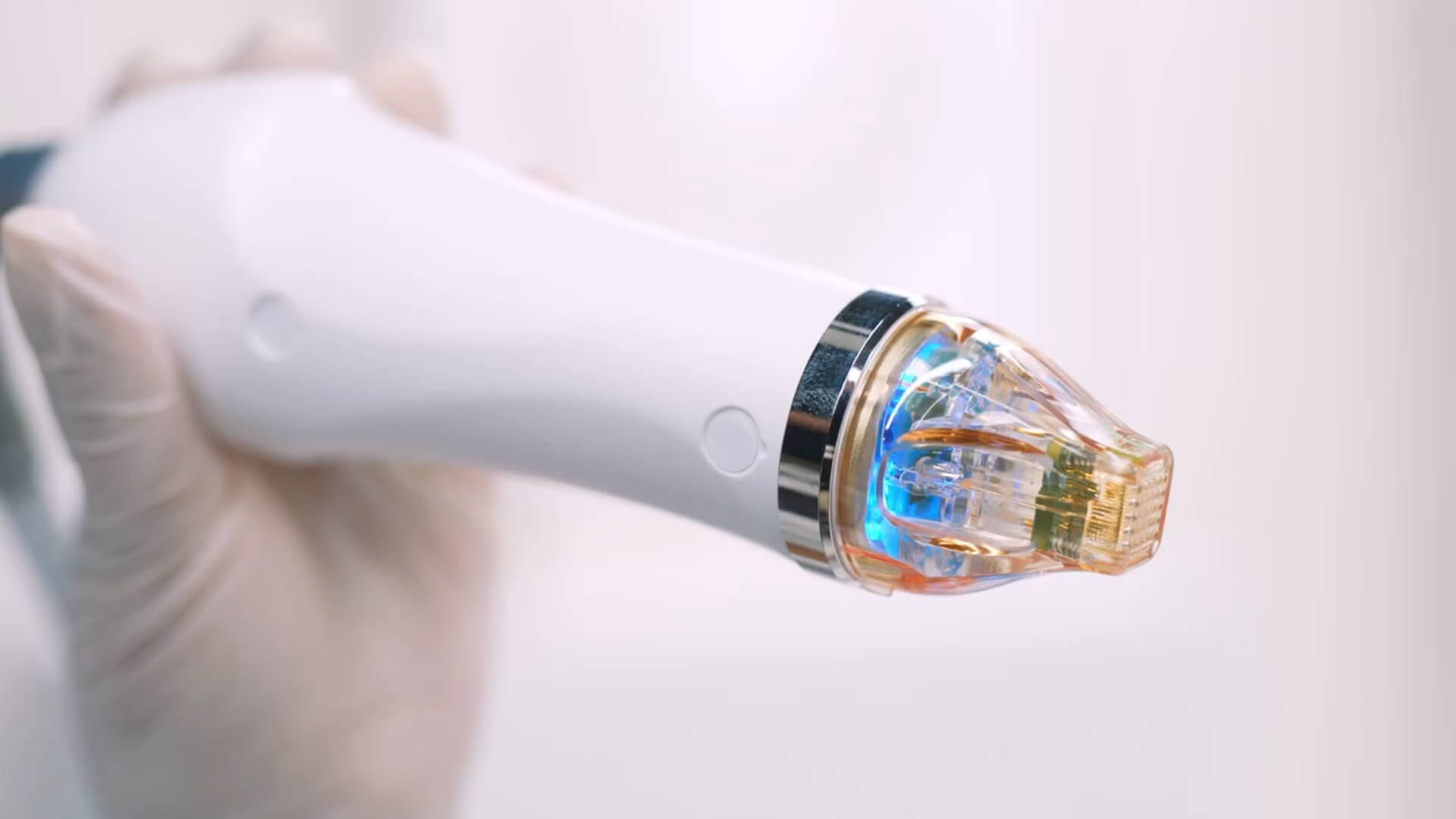
Fine needles deliver radiofrequency energy into the dermis, heating it in a controlled way to trigger new collagen and elastin. Over the following months that collagen remodels, filling and lifting depressed scars while refining the surface, which is why a session produces almost nothing visible on the day it is performed. Because the heat is delivered through needles rather than across the surface, RF microneedling is generally safer in pigmented and Asian skin than older fully ablative lasers, a meaningful advantage in Singapore. In my experience the most common reason a patient concludes that radiofrequency microneedling has failed is an assessment made before that remodelling has run its course, rather than a genuine lack of response to the device.
Insulated versus non-insulated needles
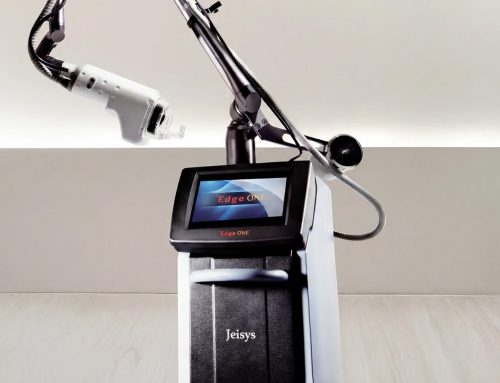
This distinction is the substance of the whole comparison. Infini uses insulated needles, which concentrate energy at the tip deep in the dermis while sparing the surface, so high energy can be placed exactly where a deep scar needs it, with a strong safety margin. This is the reason it is the preferred choice in darker skin, where surface heat is what drives pigmentation. Secret RF uses non-insulated needles that deliver energy along the whole shaft. That is gentler on the deep dermis but carries a distinct advantage, since the energy passes through and calms the oil gland on its way. Having worked with the insulated system for sixteen years, I have found the difference shows most in deep boxcar and rolling scars, where the energy has to arrive at depth without the surface heating that limits how hard a non-insulated device may safely be driven. Neither design is superior in the abstract, and the insulation is an advantage only when the scar is deep enough to require it.
The figures that matter
For depressed scars, the maximum power a device can deliver is the specification that most determines the result, and the FDA filings are clear. Infini’s generator reaches up to around 50 W (FDA 510(k) K121481). Secret RF is cleared to 25 W (FDA 510(k) K170325), which is half that ceiling and the reason it is not the device chosen when deep remodelling is the priority. For context, the gentler Sylfirm X is cleared to just 16 W (FDA 510(k) K213612), which is why it is not a reliable choice for deep remodelling, as discussed in is Sylfirm X good for acne scars and the three-way comparison. The figure that counts is the ceiling rather than the setting used on the day, because a device cleared to 25 W cannot be driven to the depth an insulated 50 W system reaches, however many sessions are added. Of the patients who consult me after a course of radiofrequency microneedling that produced nothing, a substantial share were treated on a device whose cleared maximum was never going to remodel the scars they present with. Cleared power is nonetheless a ceiling and not a promise, and a well-judged 25 W treatment on the right patient outperforms a poorly judged 50 W one.
Sylfirm X, Secret RF and Infini Compared
| Specification | Sylfirm X | Secret RF | Infini |
|---|---|---|---|
| Manufacturer | ViOL | Ilooda / Cutera | Lutronic |
| Max RF Output Power | Max 16 W, 50 Ω | Max 25 W, 500 Ω | Max ~50 W, 49-pin |
| FDA 510(k) Clearance | K213612 | K170325 | K121481 |
| Needle Type | Non-insulated | Non-insulated | Insulated |
| Frequency | 2 MHz | 2 MHz | 1-2 MHz class |
| Needle Depth | 0.3-4.0 mm | 0.5-3.5 mm | Up to ~3.5 mm |
| Design Focus | Pigment, vascular, pores | Texture, scars, acne control | Deep atrophic scars |
Why Secret RF suits acne-prone skin
My first question in any scar patient is whether the acne is still active, because many patients continue to break out while believing the acne has resolved. When it is active, Secret RF is the appropriate choice, since its non-insulated needles pass through and calm the oil gland while improving texture, which makes it the one radiofrequency scar treatment genuinely suited to acne-prone skin. This is the basis of the signature combination of AGNES plus Secret RF, performed together, which brings the acne under control and resurfaces the rough texture at the same time. It is the pattern relied on for the many patients whose acne has never quite gone away. The answer to that first question changes the device more often than the scar type does, and where the scars are deep as well, Secret RF remains the correct starting point while the deep remodelling waits until the acne has settled.
Why Infini suits deep scars and darker skin
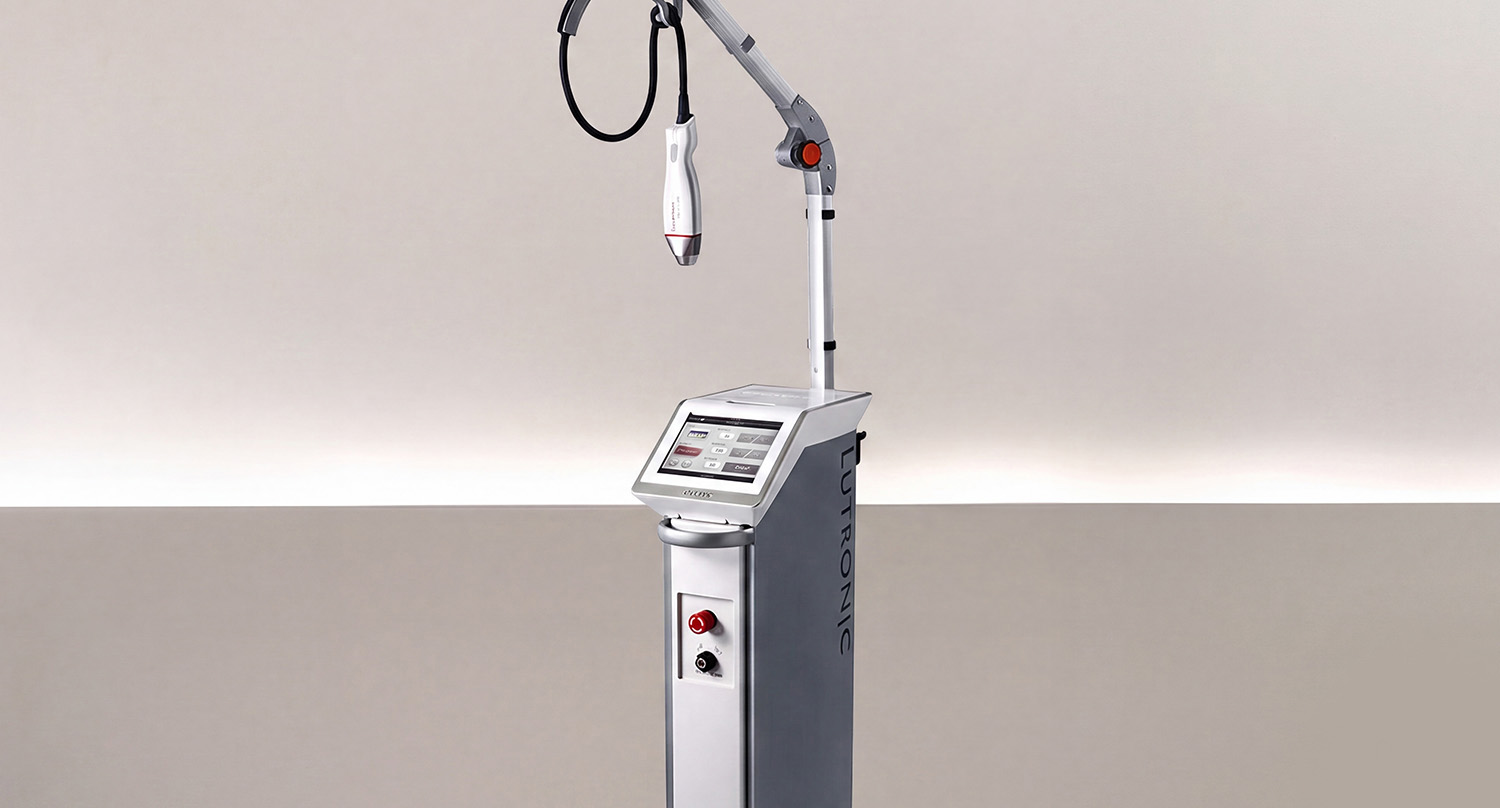
When the acne is settled and the priority is deep remodelling, especially in darker skin, Infini is the preferred device rather than one of two equivalent options. Its insulated needles deliver that higher 50 W energy deep into the dermis while protecting the epidermis, which is what lowers the risk of pigmentation in skin that pigments readily. In these patients, Infini is often paired with injectables such as Rejuran, Sculptra, Juvelook or RE20 for the best overall result. The dark skin guide expands on this. Across sixteen years with the insulated system I have found that the insulation counts for most in the patients with the least margin for error, which is those with deeper skin tones and deep atrophic scarring. Deeper or more extensive scarring nonetheless needs more sessions, and the improvement accrues over the months after each session rather than during the appointment, so the correct device does not shorten the timeline.
Combining RF with PDRN and other tools
Radiofrequency microneedling is rarely the whole answer, and neither device changes that. PDRN, Rejuran, is a useful addition to either device, reducing downtime and potentiating results, and it can be performed alongside the RF in the same visit. Tethered rolling scars are not lifted by energy delivered from above and still need subcision. Deep ice pick scars sit outside what either device reaches and need TCA CROSS. A common sequence is subcision with Secret RF first, then fractional CO2 about a month later, as covered in subcision for rolling scars. The comparison between the two systems therefore settles a smaller question than most patients expect, since it decides the backbone of a plan rather than the plan itself.
Limitations and common mistakes
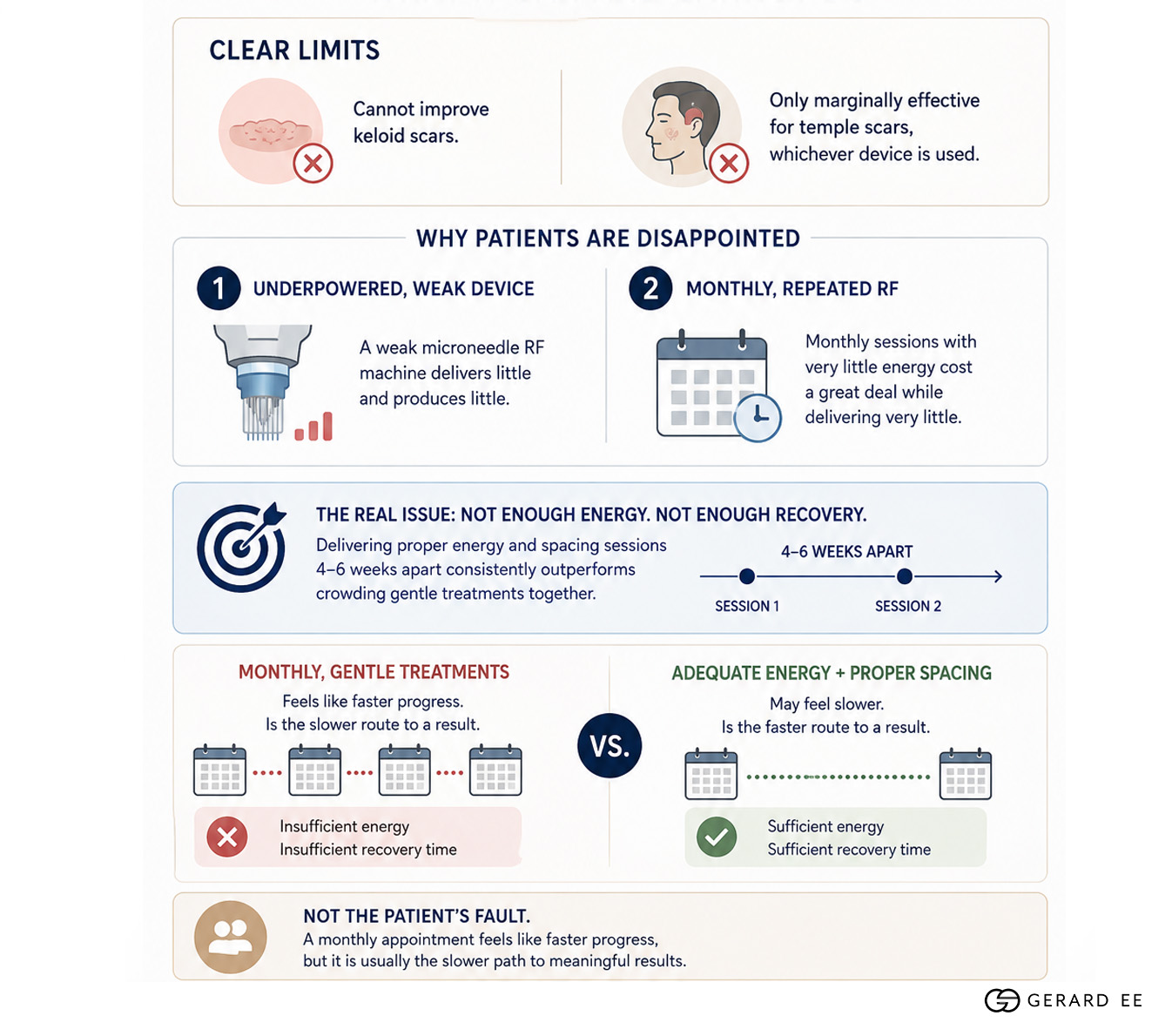
Radiofrequency microneedling has clear limits, since it cannot improve keloid scars and is only marginally effective for temple scars whichever device is used. Two patterns account for most disappointed patients, the first an underpowered, weak microneedle RF machine that produced little, and the second monthly, repeated RF that delivered very little while costing a great deal. Both come down to insufficient energy and insufficient recovery time. Delivering proper energy and spacing sessions four to six weeks apart consistently outperforms crowding gentle treatments together. Neither pattern reflects anything unreasonable on the patient’s part, and in my experience a monthly appointment feels like faster progress while being the slower route to a result. The limits apply equally to a correctly chosen device, so a patient with keloid scarring or scars across the temples may be considered for radiofrequency microneedling elsewhere on the face while being told plainly that those areas are not what it treats.
RF microneedling versus laser, and the mechanism
Patients regularly ask how radiofrequency microneedling compares with laser, and the two are not competing choices. Both are supported for atrophic scars, and a comprehensive review covers their complementary roles (microneedling and CO2 review). The mechanism explains the preference in acne-prone skin, since a randomised comparative trial showed that microneedle fractional RF improves both acne and acne scars, partly by reducing sebaceous gland activity, the clinical basis for using non-insulated Secret RF when the acne is still active (RF mechanism RCT).
The insulation question, Infini versus non-insulated devices, resolves to a single physical trade-off, which is how much energy can be placed deep in the dermis without heating the surface that carries the pigment. The safety literature supports the approach as a whole, since RF microneedling performs well even in the highest-risk skin types (type VI study), which is why it is a preferred backbone for darker-skinned patients rather than ablative laser. The evidence cited here covers radiofrequency microneedling as a category rather than one branded system against another, so the choice between Infini and Secret RF rests on needle design and cleared output rather than on a direct comparative trial.
What the research shows
Radiofrequency microneedling has matured into an evidence-based treatment rather than a passing device trend. A systematic review of 16 studies and 481 patients concluded that fractional RF microneedling is an effective, well-tolerated monotherapy for acne scars (systematic review). Randomised work supports it, since a split-face, double-blinded, placebo-controlled trial reported around a 46% reduction on the ECCA acne-scar scale after four monthly sessions of microneedle fractional RF (split-face RCT), and a comparative randomised trial found microneedle fractional RF improved both acne and acne scars, partly by reducing sebaceous activity, consistent with the preference for non-insulated Secret RF in acne-prone skin (RF mechanism RCT). The 46% figure is an average on a scar-grading scale rather than a promise that half of the scarring is removed, and outcomes vary with the depth and mix of scars a patient presents with.
Because the needles deliver energy below the surface rather than across it, RF microneedling is also reported as safe across skin types, including Fitzpatrick type VI (type VI safety study), one reason insulated Infini is relied on in darker skin. Reported safety across skin types is not the same as an absence of risk, and post-inflammatory hyperpigmentation remains the outcome that governs how hard any device may be driven in a darker-skinned patient.
RF microneedling versus ablative laser, the 2025 trial
A 2025 randomised split-face trial speaks directly to the insulated-versus-ablative question. Comparing non-insulated microneedle fractional radiofrequency with ablative fractional CO2 laser for atrophic acne scars, it found comparable efficacy, both significantly reduced ECCA scores at every follow-up, but a clearly better safety profile for radiofrequency, with less pain, shorter recovery, and significantly less post-inflammatory hyperpigmentation, and with the CO2 side showing raised melanin and erythema indices at one and two months (radiofrequency versus CO2 split-face trial). A properly powered radiofrequency microneedling device therefore matches ablative laser on results while imposing less on the skin. The trial tested a non-insulated device, so it establishes the standing of radiofrequency microneedling as a category and does not settle the choice between the insulated and non-insulated systems compared here.
This is the evidence behind the everyday preference for radiofrequency microneedling as the backbone for most patients, with more aggressive laser reserved for selected cases. The 2022 international consensus on energy-based devices likewise positions RF microneedling and fractional lasers as front-line, often-combined options (consensus recommendations). The patients I see do best are not the ones treated hardest, and a plan built on a properly powered device at sensible intervals reaches further than one built on repeated aggressive resurfacing.
What an RF microneedling session involves
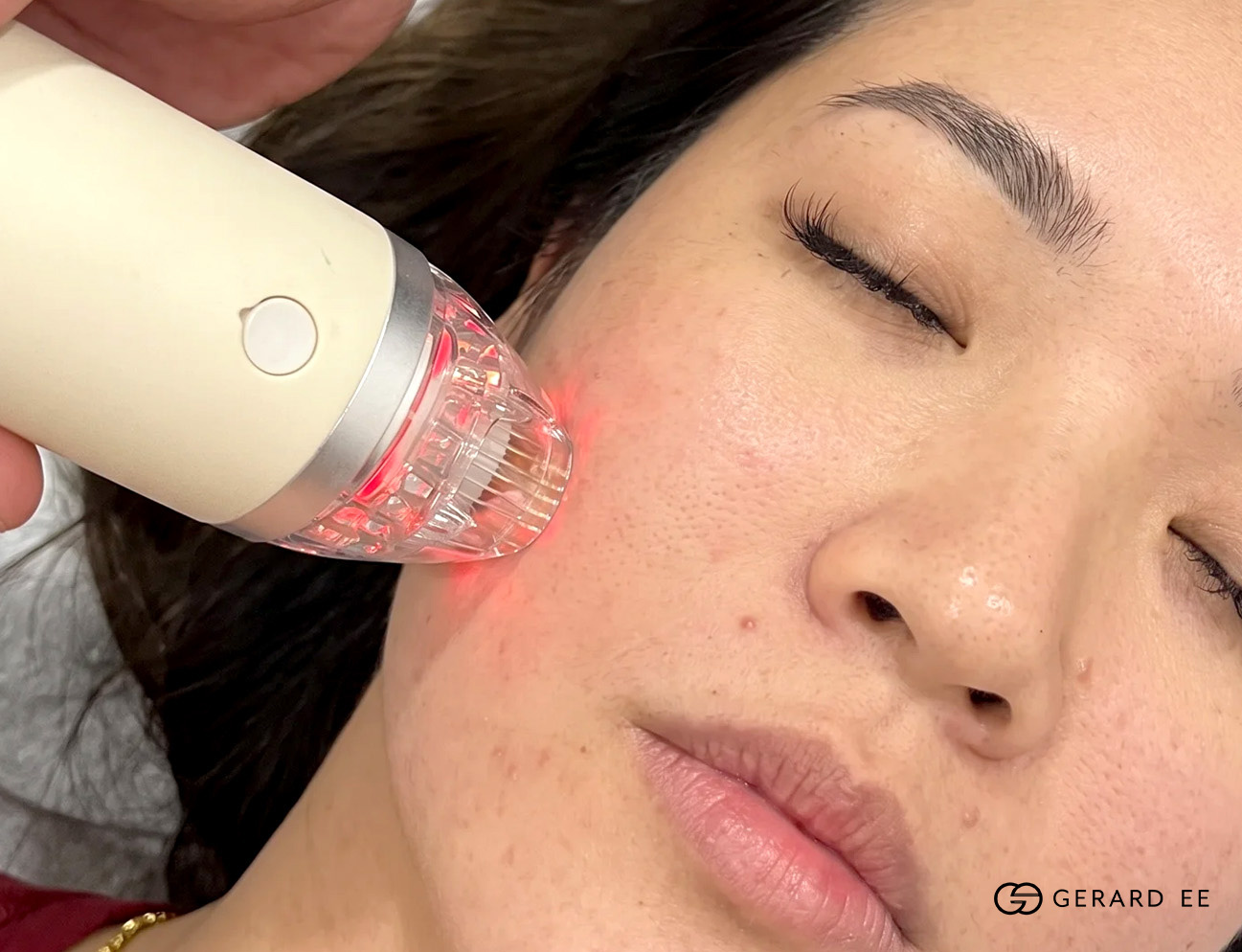
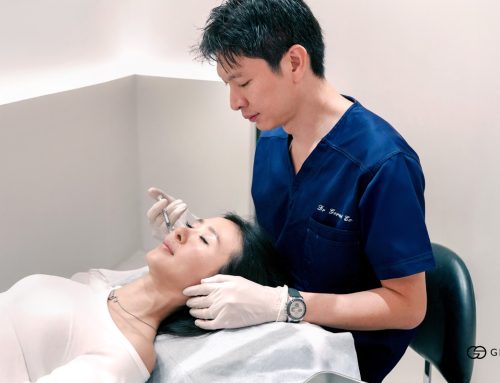
A session begins with a numbing cream applied for around thirty to forty-five minutes so the treatment is comfortable. The handpiece then places fine needles to a set depth in the skin and delivers radiofrequency energy at the tips, and the doctor works across the treatment area in several passes, often varying the depth to address different layers. Patients typically feel heat and pressure rather than sharp pain, although a minority find the deeper passes uncomfortable even after numbing. The active treatment usually takes twenty to forty minutes depending on the area, after which the skin shows redness and sometimes pinpoint bleeding, both of which settle quickly. Those passes at varying depths are where the two systems diverge, because an insulated needle allows the deepest pass to be driven harder than a non-insulated needle safely permits.
How needle depth is chosen
Needle depth is matched to the depth of the scar and to the area being treated. Thicker skin with deep cheek scarring can take deeper penetration, whereas thinner skin, such as around the temples, is treated more conservatively, which is one reason temple scars respond poorly to either system. This is where insulation matters, because an insulated device concentrates the energy at the needle tip deep in the dermis while sparing the surface, which allows higher energy to be delivered safely at depth, particularly important in darker skin where surface heat drives pigmentation. Depth is the setting patients never ask about and, in my experience, the one that most decides the result, since the same device set too shallow for the scar produces the underpowered outcome described above.
RF microneedling versus traditional microneedling
Traditional microneedling creates fine mechanical channels in the skin to stimulate a wound-healing response and new collagen. RF microneedling adds controlled heat delivered through the needles into the dermis, which provides a stronger and more targeted remodelling stimulus. For depressed scars, that added thermal energy is the reason RF microneedling generally outperforms mechanical microneedling alone, although basic microneedling still has a role for milder textural concerns and for supporting the fading of marks. The same reasoning separates a properly powered radiofrequency system from an underpowered one, since the thermal energy delivered at depth is the active part of the treatment, and a device that cannot deliver it behaves closer to mechanical microneedling than to either of the systems compared here.
Delivering actives through the channels
The micro-channels created during treatment can also enhance the delivery of healing-focused agents applied immediately afterwards, such as PDRN, exosomes or growth factors. Used this way, these adjuncts support recovery and may potentiate the collagen response. RF microneedling is frequently paired with PDRN (Rejuran) for exactly this reason, combining a strong remodelling stimulus with support for the skin’s repair, and the pairing works equally with the insulated and the non-insulated system. An adjunct of this kind supports a result rather than producing one, and nothing applied through the channels compensates for a device that did not deliver enough energy to remodel the scar.
Downtime, sessions and spacing
Downtime is modest by comparison with ablative resurfacing. Redness and mild swelling are usual for one to three days, occasionally with a faint grid pattern, and gentle skincare with sun protection is all that is generally needed, with makeup usually possible the following day. RF microneedling for scars is a course rather than a single treatment, typically several sessions spaced four to six weeks apart so that each session’s collagen can mature before the next. Deeper or more extensive scarring needs more sessions, and the visible improvement accrues over the following months rather than immediately. The interval is the part of the plan patients most often ask to shorten, and shortening it is the reliable route to spending more and gaining less, which is the second of the two patterns described above.
Where RF microneedling fits among energy devices
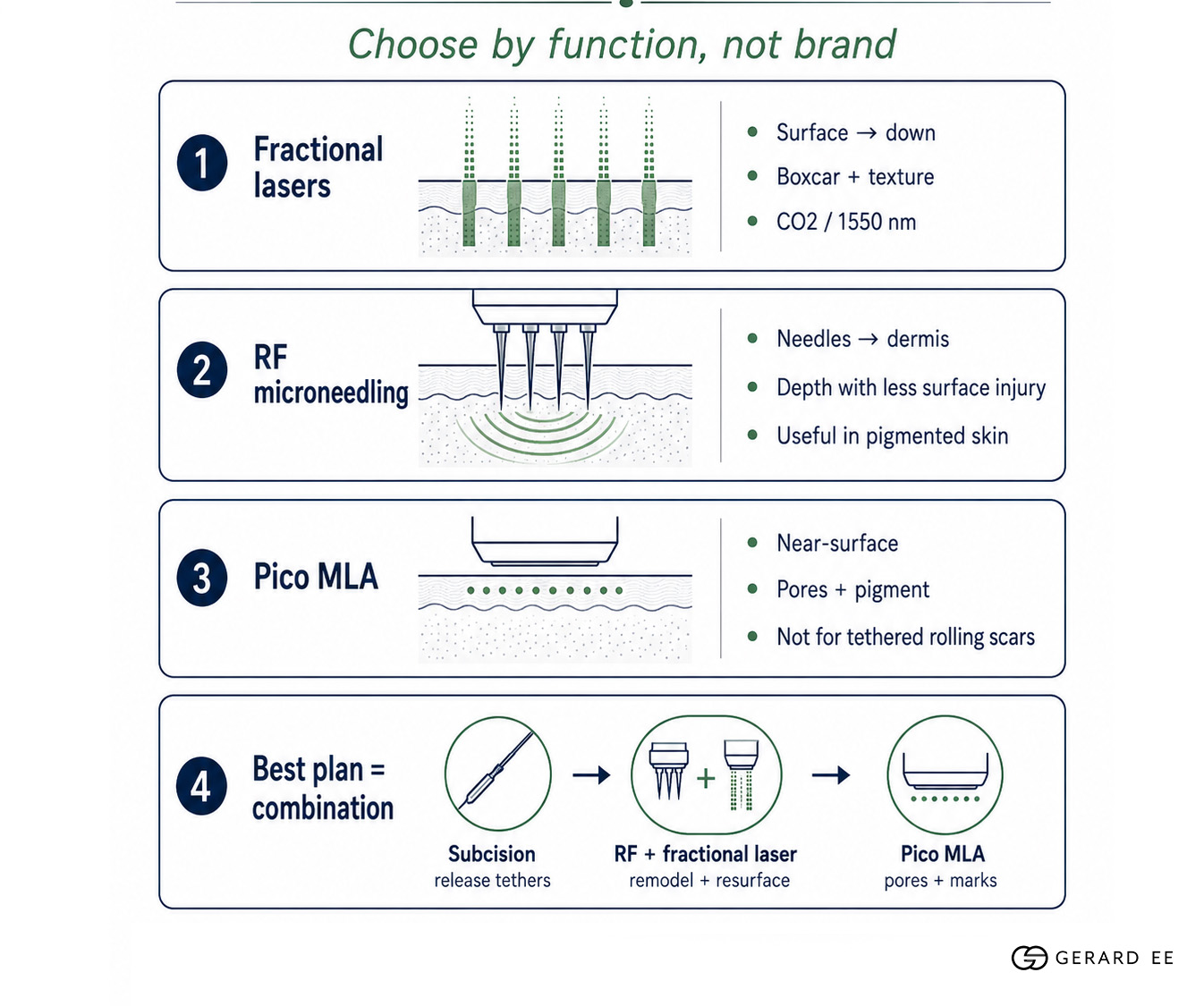
Radiofrequency microneedling is best understood alongside the other energy treatments used for scars, because they are complementary rather than competing. Fractional lasers, whether ablative CO2 or non-ablative erbium-glass, resurface by creating microscopic thermal zones from the surface downward, which makes them strong for boxcar scars and general texture. RF microneedling instead delivers heat through needles into the dermis, which reaches depth while sparing more of the surface, an advantage in pigmented skin. Picosecond lasers with a microlens array work mainly at and near the surface and excel at pores and pigment, which also fixes their limit, since a tethered rolling scar sits below the level they reach. Because a typical face carries several scar types, these devices are frequently combined within one plan, with subcision to release tethers, RF microneedling and fractional laser to remodel and resurface, and a picosecond device for pores and marks. Understanding each device by what it physically does, rather than by brand, is what allows them to be sequenced sensibly rather than chosen in isolation. The error I see most often in a previous treatment plan is a single device used across every scar type on one face, and no choice between Infini and Secret RF corrects it.
The bottom line
Infini and Secret RF are both capable systems built for different jobs, and the comparison has an answer rather than a preference. Secret RF, non-insulated and cleared to 25 W, is the correct device where the acne is still active, because the energy travels along the whole shaft and calms the oil gland. Infini, insulated and reaching around 50 W, is the correct device where the acne is settled and the scars are deep, and it is the safer of the two in darker skin because the insulation keeps the heat off the surface. Where both conditions are present the acne is brought under control first and the deep remodelling follows, which resolves the choice in sequence rather than leaving it open. What the choice of device cannot do is guarantee the size of the result, which depends on the depth and mix of scars and on the recovery time allowed between sessions. Continue with subcision for rolling scars or acne scars on dark skin.
Frequently Asked Questions
What do Koreans do for acne scars?
Korean practice popularised much of modern scar treatment, RF microneedling, fractional lasers, subcision and PDRN (Rejuran), usually in combination. The same evidence-based modalities are used here, matched to each patient’s scar type and skin tone, so the question that decides a plan is which device suits the skin being treated rather than where the protocol originated.
Can Rejuran be combined with RF microneedling?
PDRN (Rejuran) may be combined with either device. It is a useful addition to Infini or Secret RF, and the choice of radiofrequency system does not change its role. It reduces downtime and potentiates results, and it can be performed alongside the RF treatment in the same session.
Is Infini or Secret RF better for acne scars?
Neither device is better for every patient, and the answer follows the state of the acne. Secret RF (non-insulated, 25 W) is the choice where the acne is still active, because its energy travels along the whole shaft and calms the oil gland. Infini (insulated, around 50 W) is the choice where the acne is settled and the scars are deep, and it is also the safer option in darker skin. Where the scars are deep and the acne is still active, the acne is brought under control first and the deep remodelling follows, so the two systems are often used in sequence rather than chosen between.
Is RF microneedling safe for dark skin?
Radiofrequency microneedling is generally safe in dark skin, and insulated Infini is the safest of the options because its insulation spares the epidermis while delivering deep energy, which lowers the risk of post-inflammatory hyperpigmentation. Safety across skin types describes how the energy is delivered rather than an absence of risk, so sessions are still spaced four to six weeks apart and the energy is matched to the depth of the scar.
Key references
- Fractional radiofrequency microneedling as monotherapy in acne scars: systematic review (16 studies, 481 patients). PubMed.
- Microneedle fractional RF for facial atrophic acne scars: split-face, double-blinded, randomised, placebo-controlled trial. PubMed.
- Fractional microneedling RF versus bipolar RF on acne and acne scar, with mechanism: randomised controlled trial. PubMed.
- Safety and efficacy of fractional radiofrequency facial treatment in skin type VI. PubMed.
Comparative trials cited
- Qu L, Sha S, He C, et al. Non-insulated microneedle fractional radiofrequency versus ablative fractional CO2 laser for facial atrophic acne scars: pilot randomised split-face study. Acta Derm Venereol. 2025. PubMed.
- Salameh F, Shumaker PR, Goodman GJ, et al. Energy-based devices for the treatment of acne scars: 2022 international consensus recommendations. Lasers Surg Med. 2022;54:10-26. Journal.
Device specifications & sources
- S. FDA 510(k) Summary K213612 (SYLFIRM X, ViOL Co., Ltd.): Output power Max 16 W at 50 Ω. 2 MHz. Bi-polar RF.
- S. FDA 510(k) Summary K170325 (Secret RF, Ilooda Co., Ltd.): Max power Max 25 W at 500 Ω. 2 MHz. Needle depth 0.5-3.5 mm.
- S. FDA 510(k) K121481 (INFINI, Lutronic Inc.): insulated RF microneedling system, 49-pin handpiece, maximum RF generator output approximately 50 W.

Dr Gerard Ee
Written, medically reviewed and expert opinion by Dr Gerard Ee, aesthetic doctor and Founder & Medical Director of The Clifford Clinic. This article reflects my clinical experience treating acne scars in Singapore and is intended for general education, not medical advice. Treatment suitability, results, downtime and cost vary from person to person. Please arrange a consultation for advice specific to your skin.