Home›Blog›Acne›Acne Scars & Marks›Microneedling for Acne Scars, Results Timeline, Sessions and When to Expect Change
Microneedling for acne scars is measured in months, and most disappointment comes from judging it in weeks. This page sets out the timeline, covering what the skin does in the first three days, how a scar looks at four weeks, why the third session is the first reliable checkpoint, and when a scar that has not changed needs a different treatment. Which device to use, and whether radiofrequency (RF) microneedling is worth the difference, is covered on RF microneedling in Singapore.
Dr Gerard Ee consults at The Clifford Clinic, 50 Raffles Place, Singapore.
How RF microneedling is combined with subcision, TCA CROSS and laser over six months is set out in the acne scar treatment guide.
Microneedling results timeline for acne scars
| When | What is happening | What is visible |
|---|---|---|
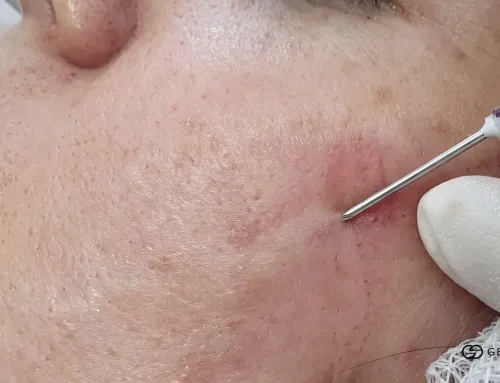
| Day 1 to 3 | Controlled injury. The skin is red and warm, sometimes with pinpoint crusts after RF | Redness like sunburn, mild swelling |
| Week 1 | Surface healed. Collagen production has not started | Faint pink, fine flaking, scars look the same |
| Week 4 | New collagen being laid down in the dermis | First softening of edges and slightly smoother texture. A scar photographed side by side may look 10 to 20 percent shallower |
| Session 3, about month 3 | Cumulative remodelling | The first reliable checkpoint. A rolling or boxcar scar that is responding is visibly shallower, and one that is unchanged needs reassessment |
| Month 6 | Collagen matured | Final assessment of the course. Further sessions or a different treatment are decided here |
A 30 percent improvement, the figure the better trials report for a course, means a scar that is a third shallower rather than a scar that has gone. On the face it reads as softer edges and smoother texture in side lighting, which is where scars show most. A scar that has not moved by the third session is usually tethered and needs subcision before further needling, or is an ice pick scar that needs TCA CROSS.
How many microneedling sessions acne scars need
Three to four sessions, four to six weeks apart, is the usual course for rolling and boxcar scars with RF microneedling, and conventional needling usually needs more. Secret RF is $1,500 a session before GST and Infini from $1,888. The arithmetic for a full course is on the RF microneedling page.
Sessions, recovery and assessing progress
Courses commonly involve several sessions separated by weeks, with the schedule adjusted to the procedure and response. My RF protocols often space sessions around four to six weeks apart. More treatment is not automatically better if the skin is not healing or the target concern is not changing.
Redness, swelling, tenderness, pinpoint bleeding or crusting can occur. Visible recovery varies. Remodelling continues after the immediate reaction settles, so compare photographs over an agreed follow-up period.
Microneedling can also cause infection or pigment change, and complications may persist. [13] RF has additional heat-related risks, discussed in the RF treatment and safety guide. Clinical treatment reduces avoidable risk through assessment and technique; it does not eliminate all complications.
When RF alone may not be enough
Tethered depressions need assessment for subcision. Narrow deep pits may need a focal method such as TCA CROSS. Raised scars need a different assessment from depressed scars.
Ongoing acne also needs its own plan. I assess control of inflammation before a scar course; treatment studied in selected acne patients does not mean it is appropriate to needle every inflamed lesion.
Microneedling during or after isotretinoin
The traditional six-month delay should not be applied without considering the procedure. A 2017 consensus found insufficient evidence for delaying several interventions, including fractional lasers, while retaining caution for mechanical dermabrasion and fully ablative laser. [9] A separate 2017 consensus specifically included fractional RF microneedling among procedures it considered acceptable in selected patients taking or recently taking isotretinoin. [10]
Subsequent observational research is reassuring but has limits. A 511-patient retrospective series covered several procedures, including fractional RF. [11] A small prospective Thai study examined fractional CO2 laser with and without isotretinoin. [12] Neither establishes the safety of every RF setting or every patient.
I do not treat a six-month interval as an automatic rule for every scar procedure. The decision considers acne control, skin condition, healing history, the medicine and the exact planned treatment. Device instructions and individual risk also matter. Tell your treating doctor about isotretinoin; do not stop it or arrange a procedure independently on the basis of this article.

Dr Gerard Ee, Aesthetic Doctor in Singapore
Dr Gerard Ee is an aesthetic doctor in Singapore and the Medical Director of his practice at 50 Raffles Place. He graduated from St George’s, University of London, trained in surgery at Singapore General Hospital and the National University Hospital, and holds the MRCS (Edinburgh) and a postgraduate diploma in practical dermatology from Cardiff University.
He has practised aesthetic medicine since 2012, is the author of sixteen peer-reviewed papers, and writes and medically reviews every article on this site. Read more about Dr Gerard Ee.

Book a consultation with Dr Gerard Ee at The Clifford Clinic
Dr Gerard Ee consults at The Clifford Clinic, 50 Raffles Place, Singapore. Consultations are by appointment. Message the clinic on WhatsApp, or call 6532 2048.
Frequently asked questions
Will microneedling remove all my scars?
Complete removal is not guaranteed. Meaningful improvement may be possible, but scar structure and the treatment plan determine what is realistic.
Can microneedling make scars or skin texture worse?
Yes. Injury, infection, pigment change or abnormal scarring can worsen the appearance. Risk is not confined to a short list of three situations. Report unexpected or persistent changes before further treatment.
Does a home roller produce the same result?
Home products should not be assumed to reproduce a clinical study’s treatment. Deeper home needling carries injury and infection concerns. Read is at-home microneedling safe?.
This article combines published research with clinical judgement. Dr Gerard Ee is Medical Director of The Clifford Clinic, where some treatments discussed are provided commercially. Individual treatment decisions require assessment.
References
Sources cited on this page
- Kravvas G, Al-Niaimi F. A systematic review of treatments for acne scarring. Part 1: Non-energy-based techniques. 2017. PubMed 29799567.
- Wu B et al. Optimal treatment options for acne scars in patients with historic acne: a systematic review and network meta-analysis. 2025. PubMed 41081097.
- Niaz G et al. Fractional radiofrequency microneedling as a monotherapy in acne scar management: a systematic review of current evidence. 2025. PubMed 39781098.
- Kang C, Lu D. Combined effect of microneedling and platelet-rich plasma for the treatment of acne scars: a meta-analysis. 2021. PubMed 35237616.
- Li H et al. Comparing the efficacy and safety of microneedling and its combination with other treatments in patients with acne scars. 2024. PubMed 39110247.
- Argobi Y et al. Fractional CO2 laser versus micro needling radiofrequency for post acne scarring: a meta-analysis of RCTs. 2026. PubMed 41821146.
- Ou Y et al. Laser, microneedling, and combination therapies for moderate to severe acne atrophic scars. 2026. PubMed 42429955.
- Albazee E et al. Microneedling with topical insulin versus microneedling with platelet-rich plasma for post-acne scars. 2026. PubMed 42324392.
- Spring LK et al. Isotretinoin and timing of procedural interventions: a systematic review with consensus recommendations. 2017. PubMed 28658462.
- Mysore V et al. Standard guidelines of care: performing procedures in patients on or recently administered with isotretinoin. 2017. PubMed 29491653.
- Qin X et al. Cosmetic therapies for Chinese patients with acne taking concomitant or recent intake of oral isotretinoin. 2023. PubMed 37589235.
- Rujirawan P et al. Ablative fractional CO2 laser treatment with and without oral isotretinoin: a study on side effects and acne scars improvement in Southeast Asians. 2025. PubMed 40820662.
- FDA. Microneedling devices: risks and patient information.
This page is written from published research and from clinical experience in Singapore since 2012. It is for general education, not medical advice. Whether a treatment suits you, what it may achieve and what it may risk can only be established at a consultation. Dr Gerard Ee is the Medical Director of The Clifford Clinic, a private clinic in Singapore, and treatments discussed on this site are provided commercially.