Dr Gerard Ee consults at The Clifford Clinic, 50 Raffles Place, Singapore.
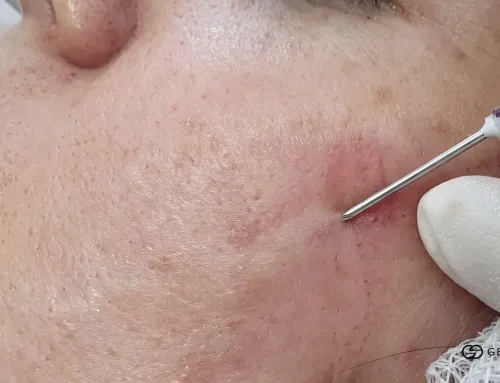
Sylfirm X is a radiofrequency (RF) microneedling system that delivers energy through fine needles and offers pulsed-wave and continuous-wave modes3. This doctor’s review explains its benefits and evidence, published prices in Singapore, downtime and how to assess before-and-after results.
My verdict is that Sylfirm X is underpowered for depressed acne scars, as set out in why Sylfirm X gives no results on acne scars. That verdict concerns depth alone, because Sylfirm X remains one of the better devices for the concerns it was designed around. Sound judgement is not a matter of ranking a machine as good or bad. It is a matter of matching a device to the problem it was built to treat.
This page is one part of my acne scar treatment guide for Singapore, which covers every scar type and every treatment option.
I provide Secret RF and Infini at The Clifford Clinic. I do not provide Sylfirm X. Patients ask about it when comparing treatments in Singapore or seeking another opinion after a course elsewhere.
In this guide: Sessions and results · Downtime and side effects · Before-and-after photos and reviews · Singapore prices
What Sylfirm X is good for
Sylfirm X is a radiofrequency microneedling device best suited to melasma, post-inflammatory hyperpigmentation, redness and enlarged pores. Its 16 W maximum is matched to superficial pigment and vascular work, not to deep acne scars. I do not provide Sylfirm X. For acne scar removal I use Infini, Secret RF, subcision, TCA CROSS and fractional CO2, matched to scar type.
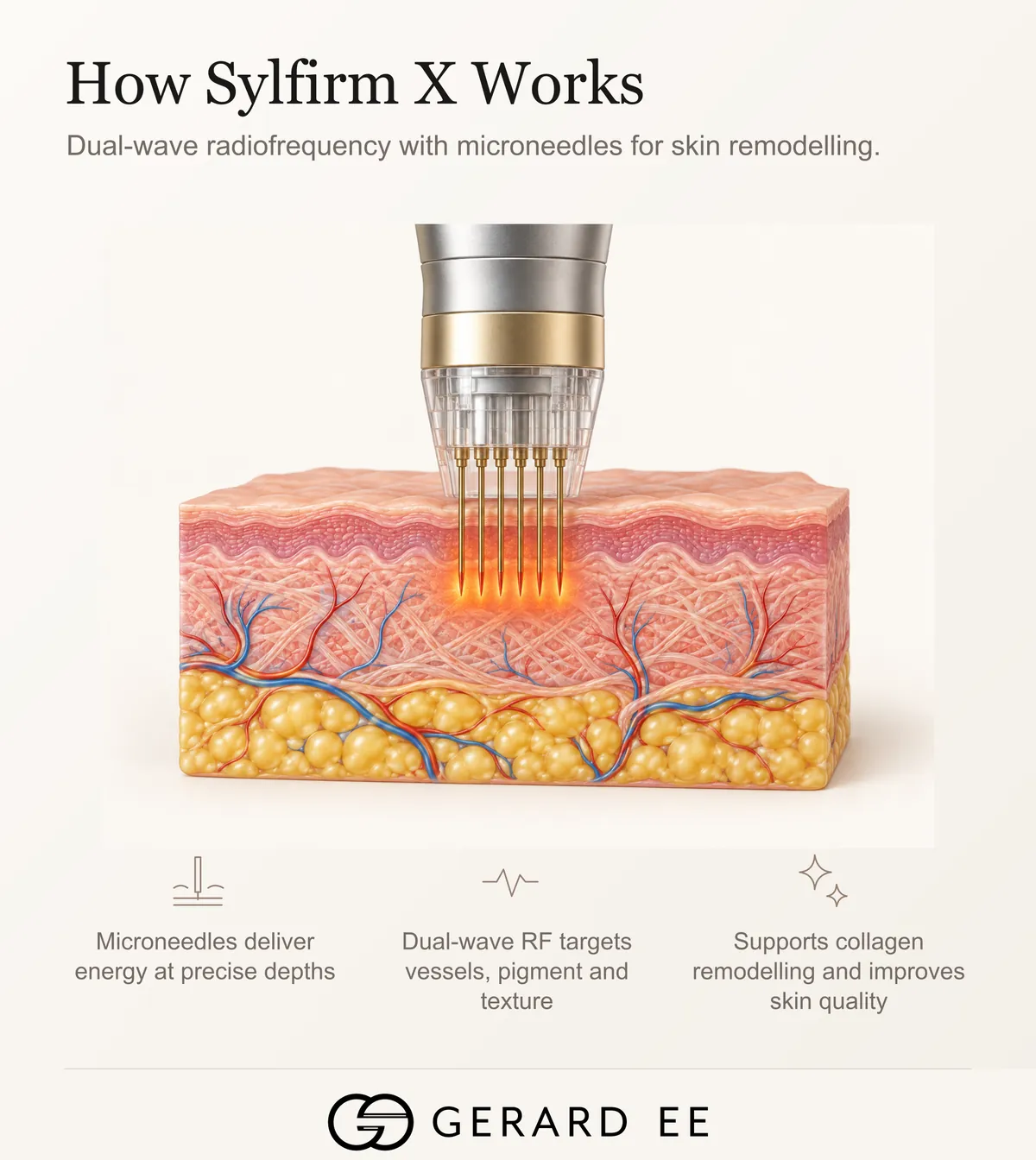
Its defining feature is a dual-wave system, in particular a pulsed mode targeting pigment and vessels with precision at low energy3. That makes it a strong option across several concerns, each requiring precise energy at a low dose rather than bulk thermal power:
- Melasma, which responds poorly to aggressive heat and is easily worsened by it. This is one of the few indications for which I would recommend the device, though what patients obtain is substantial reduction rather than clearance, and recurrence is common.
- Post-inflammatory hyperpigmentation, the brown marks left after acne, which responds to the pigment-targeting mode, with improvement accumulating over a course rather than after a single treatment.
- Redness and rosacea, where the pulsed mode settles persistent facial redness over a course of sessions.
- Pores and fine lines, which respond to lower-energy, superficial stimulation, the appropriate dose for these concerns rather than an underdose.
- Overall skin quality, tone and smoothness, with minimal downtime, which suits periodic maintenance.
Sylfirm X for melasma: why gentle energy suits it
Melasma is a chronic, relapsing pigmentary disorder driven by hormonal influences, ultraviolet and visible light and heat, in which melanocytes are persistently overactive and a vascular component is often present. Aggressive heat or inflammation can provoke a rebound that leaves the pigmentation darker than before, so the preferred approach is controlled, lower-energy, pigment-directed treatment rather than forceful resurfacing. The pulsed mode of Sylfirm X delivers energy that selectively affects pigment-laden cells and abnormal vessels while limiting thermal spread, which addresses both components. Judged against that requirement, its lower-energy design is a feature rather than a limitation.
A small randomised study used Sylfirm X as part of melasma care. Fifteen people enrolled and eleven completed follow-up. After an initial phase of conventional treatment, the side receiving continued RF better maintained improvement in the study’s colour measurement1. That supports an adjunctive maintenance role. It does not show that RF alone cures melasma or that one course prevents recurrence. Because the disorder relapses, the accurate account is substantial reduction rather than clearance, and the patients given that account at the outset are the ones who hold their result. I cannot establish at a first consultation how much of a patient’s melasma is pigmentary and how much vascular, which is one reason outcomes vary.
Brown marks after acne are not automatically melasma. The pigmentation guide explains why establishing the diagnosis comes before choosing a procedure.
Sylfirm X for redness, rosacea and post-inflammatory erythema
Persistent facial redness, whether from rosacea or the post-inflammatory erythema left after acne, arises from dilated and reactive superficial blood vessels. The vascular targeting of Sylfirm X may settle that redness over a course of gentle sessions, which makes it reasonable for sensitive or easily flushing skin. The emphasis falls on repeated, controlled treatment rather than a single aggressive session. The redness is persistent for a reason, so a course may reduce and control it rather than remove it. Redness, pigment and pores can coexist, but each needs its own goal: a study of melasma maintenance does not, by itself, prove treatment of rosacea or permanent pore reduction.
Sylfirm X for enlarged pores and skin quality
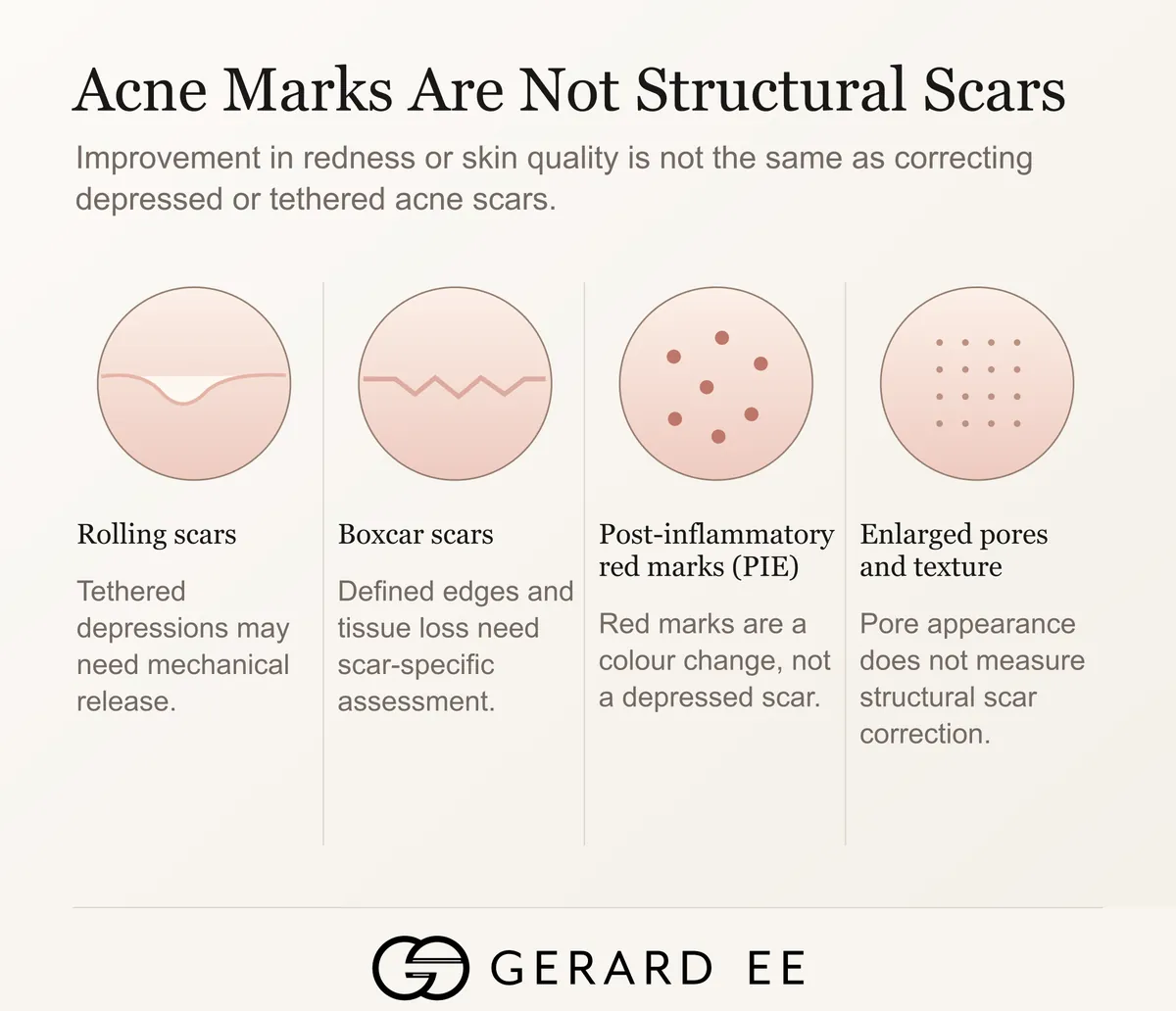
Enlarged pores result from a combination of excess oil, loss of skin firmness and cumulative sun damage. Lower-energy dermal stimulation produces a modest tightening that reduces their appearance and improves overall texture and tone, with minimal downtime, and the restrained treatment lends itself to periodic maintenance. The improvement is modest by design, and a pore visible under close inspection before treatment will usually remain visible afterwards. Of the patients who consult me about pore size, the ones who report satisfaction came expecting refinement rather than removal.
Why Sylfirm X does not reach deep acne scars
The same restraint that makes Sylfirm X safe for melasma is what limits it for atrophic scars. Its FDA-cleared maximum of 16 W (K213612) is well matched to superficial pigment work and to vascular targets near the surface. Depressed scars sit deep in the dermis and need the higher output of Infini (around 50 W, K121481) and Secret RF (25 W, K170325). A device optimised for the first task is not optimised for the second, which is a specialisation rather than a defect. The full specification table is on Infini vs Secret RF for acne scars.
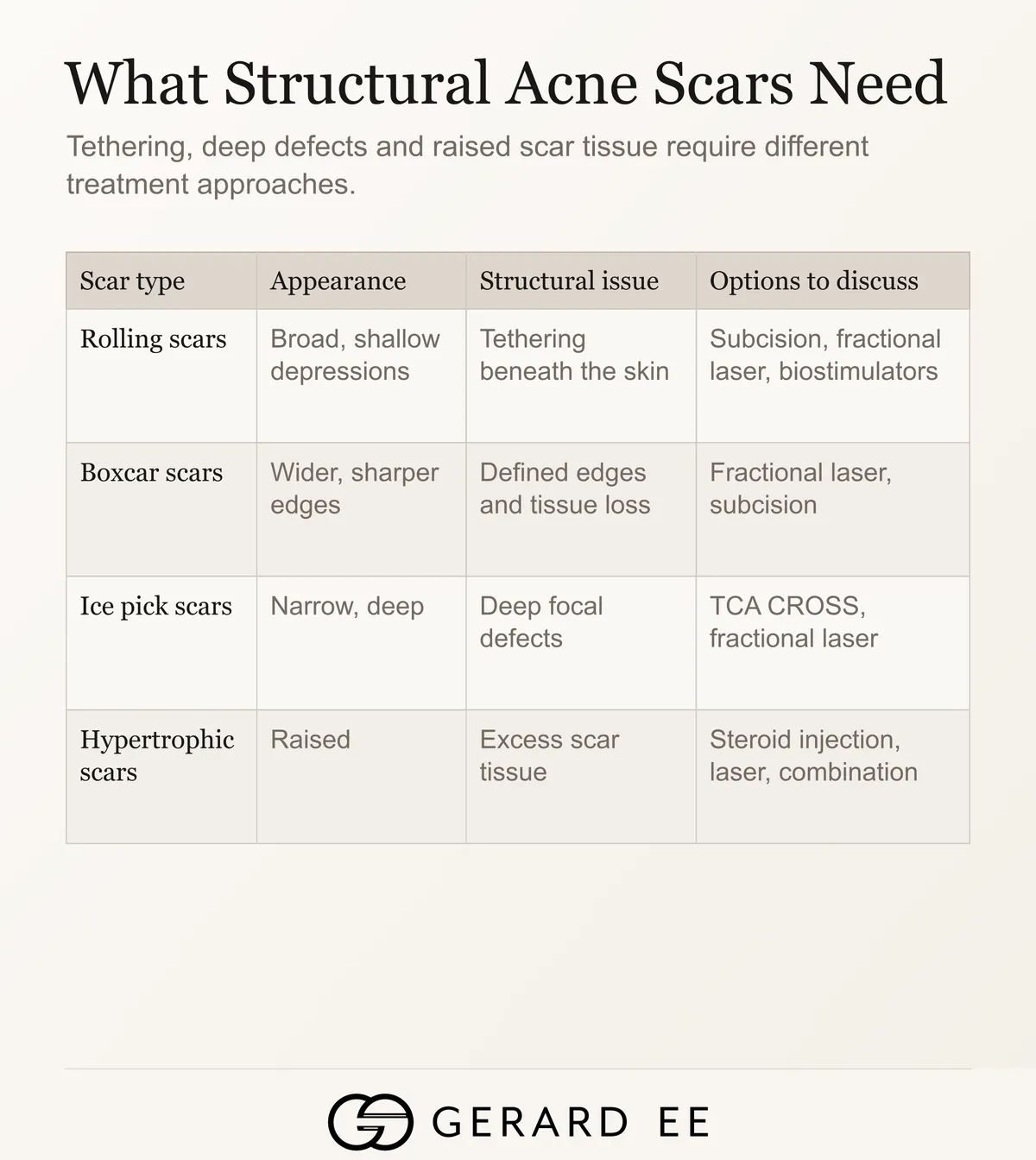
A small split-face study found that adding Sylfirm X to fractional CO2 improved acne and scar grading over the laser alone2. It tested Sylfirm X as an add-on to fractional CO2, not on its own, and not against Infini or Secret RF. When a patient tells me a course of Sylfirm X changed nothing, the explanation is usually that the device was being judged on scar depth. The four reasons are set out in Sylfirm X no results on acne scars.
When acne is active: Secret RF with AGNES
Many patients seeking texture improvement still present with active acne. Where the acne is not yet stable, non-insulated Secret RF is preferred, because it settles oil-gland activity while treating texture, and where control is poor, AGNES is added the same day. That goal differs from the one Sylfirm X was built for, since it is a pigment-and-vessel device rather than an acne-control or deep-scar device. The commonest sequencing error I see in a previous plan is scar treatment begun before the acne is stable.
Combining Sylfirm X with topicals, skincare and Rejuran
The best pigment results rarely follow from a device used alone. They follow from combining treatment with diligent sun protection and topicals such as tranexamic acid, azelaic acid and retinoids, which reduce melanin production. A home regimen built around a topical retinoid with tranexamic acid, azelaic acid, niacinamide and vitamin C steadily reduces melanin production between treatments, and tinted sunscreens with iron oxides add defence against visible light. Harsh scrubbing, over-exfoliation, heat and picking all provoke the inflammation that darkens marks. In my experience the difference between a result that holds and one that fades is more often the home routine than the device chosen.
PDRN (Rejuran) reduces downtime, potentiates results and has documented anti-melanogenic effects6, which makes it a reasonable companion to pigment treatment. For scars, biostimulators are matched to the problem: PCL for volume loss, Juvelook for ice pick and boxcar scars, PLLA or Juvelook Volume for rolling scars, and an ECM booster for very mild scarring. Sylfirm X is not the component of a scar plan that performs that structural work. More components do not automatically produce a better result, so each addition needs its own purpose.
What the evidence shows for Sylfirm X indications
Matched to the right concern, lower-energy devices are well supported. The skin-of-colour literature supports cautious energy and pigment-focused strategies in pigment-prone skin5, and PDRN improves facial hyperpigmentation6. A picosecond laser with intense pulsed light reduced atrophic scarring and post-inflammatory erythema, cutting ECCA scores by 28% over three sessions9, and picosecond lasers cause fewer adverse effects than ablative resurfacing10. A 28% reduction is meaningful and also partial, which is the scale of change to describe to a patient.
Where the target is deep atrophic scarring, the evidence sits with higher-energy tools such as fractional CO27 and fractional RF microneedling8. The difference is one of energy rather than frequency, and additional sessions of a lower-energy device do not convert it into a deep-scar treatment. A favourable result for one protocol should not be transferred automatically to another device or indication, and these studies report group averages rather than what any individual face will achieve.
How many Sylfirm X sessions are needed, and when are results assessed?
The course depends on the concern and protocol. One study combined Sylfirm X with fractional CO₂ laser in three sessions four weeks apart, with assessment four and twelve weeks after the final session2. That research schedule is not a universal prescription for Sylfirm X alone.
Before starting, agree on the concern being treated, the proposed course and the point at which progress will be reviewed. Further sessions should follow the response and recovery, not just the number in a package. After a disappointing course, read what to review when Sylfirm X has produced little improvement.
Sylfirm X downtime and side effects
Temporary redness, swelling and crusting were reported in the small Sylfirm X and fractional CO₂ combination trial, resolving within hours to a few days2. This finding does not establish one recovery time for every Sylfirm treatment. Ask about visible recovery for the actual area, settings and any additional procedure rather than assume there will be no downtime.
The FDA has received reports of serious complications with certain uses of RF microneedling, including burns, scarring, fat loss and nerve damage4. This is a category-level safety notice, not a Sylfirm-specific complication rate or evidence that another brand is safer. Seek clinical advice about unexpected or worsening symptoms before proceeding with further treatment.
Sylfirm X before and after: how to judge results
Before-and-after photographs are most useful when they show a comparable view of the same concern. Check the treatment details and follow-up date as carefully as the visual difference. This section explains how to assess results. It is not a gallery of Sylfirm X treatments performed at my clinic.
| What to check | How it helps you judge the comparison |
|---|---|
| Lighting and camera exposure | Look for comparable conditions rather than a brighter or more flattering after photograph. |
| Angle, expression and camera distance | Changes in position can alter the visibility of texture and depressions. |
| Time since the final treatment | An immediate photograph is not the same assessment as a later follow-up. |
| Number of sessions | A photograph after a course should not be described as a one-session result. |
| Other procedures and skincare | Ask whether laser treatment, injectables or other care also contributed. |
| The original treatment goal | Assess the concern being treated, rather than assume improvement in colour establishes improvement in scar depth. |
How to read a Sylfirm X review
A useful review explains the starting concern, treatment course, recovery and follow-up. A patient’s account describes that person’s experience. A clinical study answers a narrower research question. Neither should be treated as a guarantee of your result.
This article is a review of evidence and treatment considerations, not an account of receiving Sylfirm X. I provide alternative treatments commercially and do not provide Sylfirm X. For little improvement after a course, see the separate Sylfirm X no-results review guide.
Choosing between Sylfirm X and other pigment treatments
For pigment, redness and pores, Sylfirm X is one of several reasonable options, and the best choice depends on the specific problem. For melasma, controlled lower-energy approaches are preferred, with topical tranexamic acid, azelaic acid and retinoids and strict sun protection remaining the foundation of care. For brown post-inflammatory hyperpigmentation, a picosecond laser may break up pigment with minimal downtime, while chemical peels are used cautiously in darker skin. For red post-inflammatory erythema and rosacea, a pulsed dye laser or intense pulsed light targets the vessels directly and may outperform a microneedle device. For enlarged pores, lower-energy microneedle radiofrequency and picosecond devices are both of use. These are layered more often than set against one another, chosen by the dominant concern and the skin tone. What unites them is that they are all lower-energy and pigment-directed, which is why none of them is the answer for a deep depressed scar.
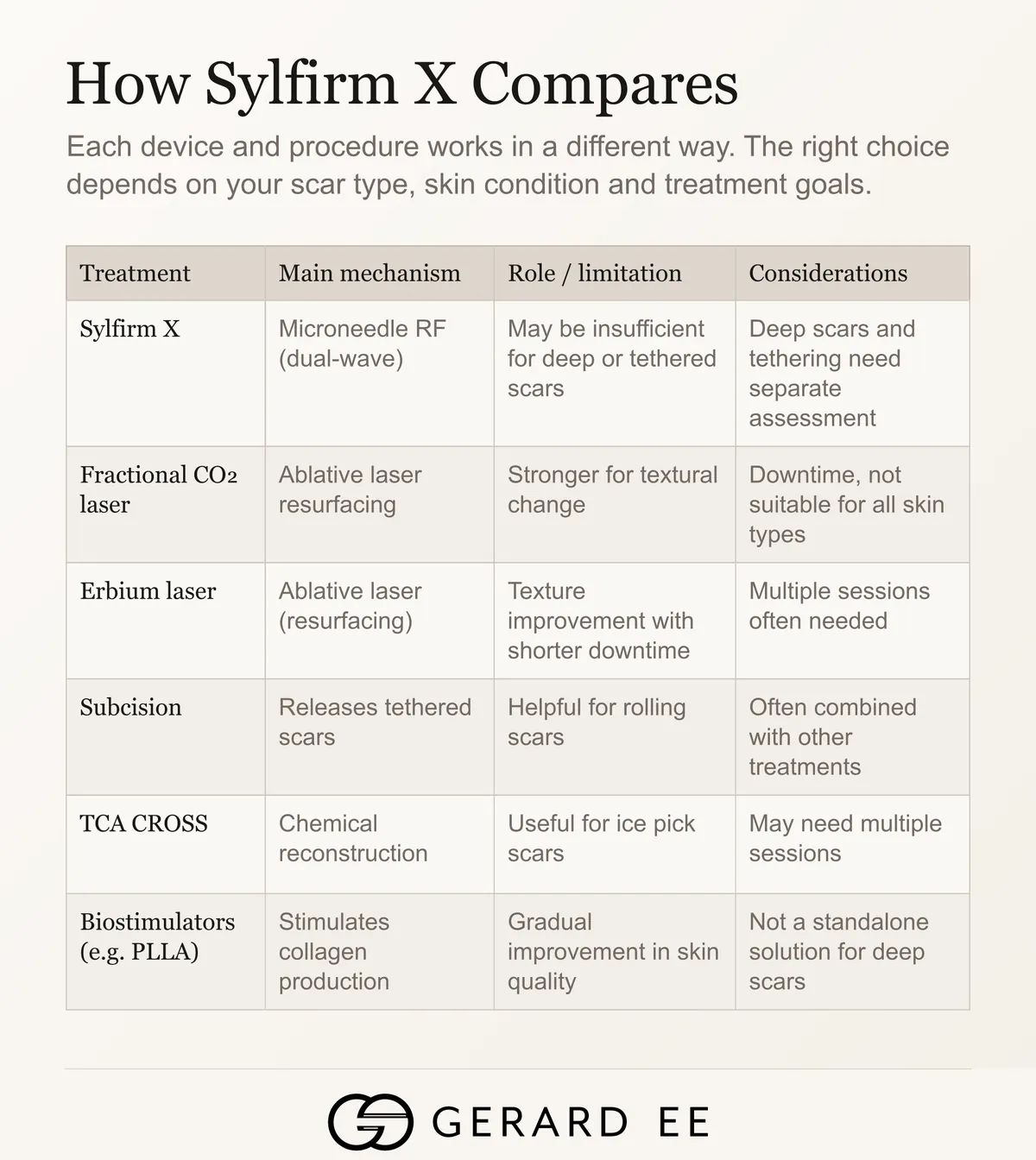
Is Sylfirm X worth it?
Its value depends on whether the proposed treatment matches your diagnosis, the likely degree of improvement and the complete course cost. A less expensive session is not necessarily better value if it does not address the main problem. A more expensive device does not guarantee a better outcome.

For melasma, ask how RF fits alongside pigment care and maintenance. For scars, ask whether tethering or narrow pits need a different technique. Agree on how and when progress will be reviewed before committing to repeated sessions. If you have already had a disappointing course, read what to review after little improvement with Sylfirm X.
Sylfirm X price in Singapore
Published Singapore prices for Sylfirm X vary widely, and advertised figures are rarely comparable with one another. A first-trial rate, a single session and a prepaid course are three different purchases, and a quoted figure may or may not include GST, the consultation, anaesthetic and aftercare.
Ask for the total payable amount in writing before booking, covering the treatment area, the number of sessions, what is included and any conditions attached to a package. A low headline price usually describes a trial or a restricted area rather than the course actually being proposed.
I do not provide Sylfirm X, so I do not offer a Sylfirm X price or package. My Secret RF fee is not a substitute for a Sylfirm quotation. The appropriate course should follow assessment rather than the package size alone.
The bottom line on Sylfirm X
The correct choice is the device that fits the problem rather than the one with the loudest marketing. For pigment and skin quality, Sylfirm X is a sound choice. For depressed scars, the priorities are power, the right adjuncts and a combination strategy, explained in why Sylfirm X gives no results on acne scars. The RF microneedling guide explains the Secret RF and Infini services I provide, and the acne scar treatment guide is the place to start for planning around an individual skin type. Outcomes vary between patients whichever device is selected, and the assessment that settles the plan is made in person.

Dr Gerard Ee, Aesthetic Doctor in Singapore
Dr Gerard Ee is an aesthetic doctor in Singapore and the Medical Director of his practice at 50 Raffles Place. He graduated from St George’s, University of London, trained in surgery at Singapore General Hospital and the National University Hospital, and holds the MRCS (Edinburgh) and a postgraduate diploma in practical dermatology from Cardiff University.
He has practised aesthetic medicine since 2012, is the author of sixteen peer-reviewed papers, and writes and medically reviews every article on this site. Read more about Dr Gerard Ee.

Book a consultation with Dr Gerard Ee at The Clifford Clinic
Dr Gerard Ee consults at The Clifford Clinic, 50 Raffles Place, Singapore. Consultations are by appointment. Message the clinic on WhatsApp, or call 6532 2048.
Sylfirm X FAQs
What is Sylfirm X best for?
Sylfirm X is best suited to melasma, post-inflammatory hyperpigmentation, redness and rosacea, enlarged pores and fine lines. Its dual-wave, lower-energy approach targets pigment and vascular concerns without aggressive heat. It is not suited to deep depressed acne scars, which require a higher-energy device within a combination plan.
Is Sylfirm X good for melasma?
Melasma is one of the strongest indications for Sylfirm X, because the controlled, lower-energy pulsed mode targets pigment without the aggressive heat that often worsens the condition. Melasma is also relapsing, so the realistic expectation is substantial reduction rather than clearance, with recurrence common.
What is best for acne scars if acne is still active?
Non-insulated Secret RF is preferred, with AGNES on the same day where acne control is poor, because it settles oil-gland activity while improving texture. The acne is brought under control before deeper scar remodelling begins.
Does Rejuran help with acne scar treatment?
PDRN (Rejuran) reduces downtime and potentiates results, and it pairs with microneedle RF. Biostimulators are then chosen by scar type: PCL for volume, Juvelook for ice pick and boxcar scars, PLLA or Juvelook Volume for rolling scars, and an ECM booster for mild scarring.
References
Sources cited on this page
- Han HJ, Kim JC, Park YJ, Kang HY. Targeting the dermis for melasma maintenance treatment. Scientific Reports. 2024;14:949. PubMed 38200171.
- Kim J, Lee SG, Choi S, et al. Combination of fractional microneedling radiofrequency and ablative fractional laser versus ablative fractional laser alone for acne and acne scars. Yonsei Medical Journal. 2023;64(12):721–729. PubMed 37992744.
- Sylfirm X / Elogio Asia. Product information on device modes. Accessed 11 September 2026. Commercial product information, cited for features rather than comparative clinical superiority.
- U.S. Food and Drug Administration. Potential risks with certain uses of radiofrequency (RF) microneedling. Safety communication, 15 October 2025.
- Arsiwala SZ, et al. Fractional carbon dioxide laser: optimizing treatment outcomes for pigmented atrophic acne scars in skin of color. J Cutan Aesthet Surg. 2019. PubMed 31413476.
- Noh TK, et al. Novel anti-melanogenesis properties of polydeoxyribonucleotide, a popular wound healing booster. Int J Mol Sci. 2016. PubMed 27598132.
- Majid I, et al. Fractional CO2 laser resurfacing as monotherapy in the treatment of atrophic facial acne scars. J Cutan Aesthet Surg. 2014. PubMed 25136208.
- Niaz G, Ajeebi Y, et al. Fractional radiofrequency microneedling as a monotherapy in acne scar management: a systematic review of current evidence. Clin Cosmet Investig Dermatol. 2025;18:19-29. PubMed 39781098.
- Feng H, Wu Y, Jiang M, et al. Fractional 1064 nm Nd:YAG picosecond laser combined with intense pulsed light for atrophic acne scars: split-face study. Lasers Surg Med. 2021;53:1356-1363. PubMed 34082477.
- Yuan Y, He Y, Fang J, et al. Comparison of the fractionated Nd:YAG 1064-nm picosecond laser with holographic optics and the fractional CO2 laser for atrophic acne scars. Int J Dermatol. 2025;64:85-91. PubMed 38924534.
Device specifications
- U.S. FDA 510(k) Summary K213612 (SYLFIRM X, ViOL Co., Ltd.): output power max 16 W at 50 Ω, 2 MHz, bipolar RF.
- U.S. FDA 510(k) Summary K170325 (Secret RF, Ilooda Co., Ltd.): max power 25 W at 500 Ω, 2 MHz, needle depth 0.5–3.5 mm.
- U.S. FDA 510(k) K121481 (INFINI, Lutronic Inc.): insulated RF microneedling, 49-pin handpiece, maximum RF generator output approximately 50 W.
This page is written from published research and from clinical experience in Singapore since 2012. It is for general education, not medical advice. Whether a treatment suits you, what it may achieve and what it may risk can only be established at a consultation. Dr Gerard Ee is the Medical Director of The Clifford Clinic, a private clinic in Singapore, and treatments discussed on this site are provided commercially.