Written by Dr Gerard Ee | Medically reviewed by Dr Gerard Ee | Expert opinion by Dr Gerard Ee
Dr Gerard Ee is an aesthetic doctor and the founder and medical director of The Clifford Clinic, which he established 14 years ago. He has treated acne scars for 16 years and more than 2,000 acne-scar patients, and is one of Singapore’s longest-standing users of the Infini RF microneedling system (16 years). He holds a Diploma in Dermatology (Cardiff) and is a Member of the Royal College of Surgeons (MRCS). More on Dr Gerard Ee.
Cost is often the deciding factor in acne scar treatment, and it is also where patients most often waste money, not by spending too little, but by spending it the wrong way. What follows sets out what a sensible programme costs in Singapore, why neither the cheapest nor the most expensive option produces the best result, and how a clinic can be assessed before any commitment. The pattern I see most often is not the patient who spent too little, but the patient who spent steadily on sessions too weak and too closely spaced to build collagen.
What it costs
Cost depends on which treatments are selected and on how many sessions the scarring requires, so any published figure is a guide rather than a quote. Individual treatments can be accessible, and a single fractional CO2 session may start from as low as S$390, whereas a six-month custom scar package that combines Infini, Secret RF, fractional CO2 and Pico MLA, a picosecond laser used to refine pores and pigment, comes to around S$4,000, with biostimulators or PDRN added where the scar type requires them. A single session of one treatment costs less but rarely transforms established scarring, so the meaningful figure is the price of a complete programme rather than the price of a visit. A quotation produced before examination is usually wrong in one direction or the other.
Why the most expensive option is not the most effective
The most important point for anyone budgeting for scar treatment concerns the relationship between the sum paid and the result obtained. A common assumption is that stacking treatments into a single visit, or buying the most expensive treatment and repeating it many times, produces the best outcome. Neither approach reliably produces a better result than a slower and considerably less costly programme. Collagen forms slowly, and the best results follow treatments delivered gradually, at a sufficient energy and with adequate recovery between one session and the next. The expensive and intensive approach frequently achieves less than a well-judged combination delivered patiently, at a fraction of the outlay. When a patient tells me that a costly and intensive course produced very little, the explanation is usually that treatments were compressed into too few visits, without the recovery interval collagen remodelling requires.
Why cheap and over-frequent treatment also wastes money
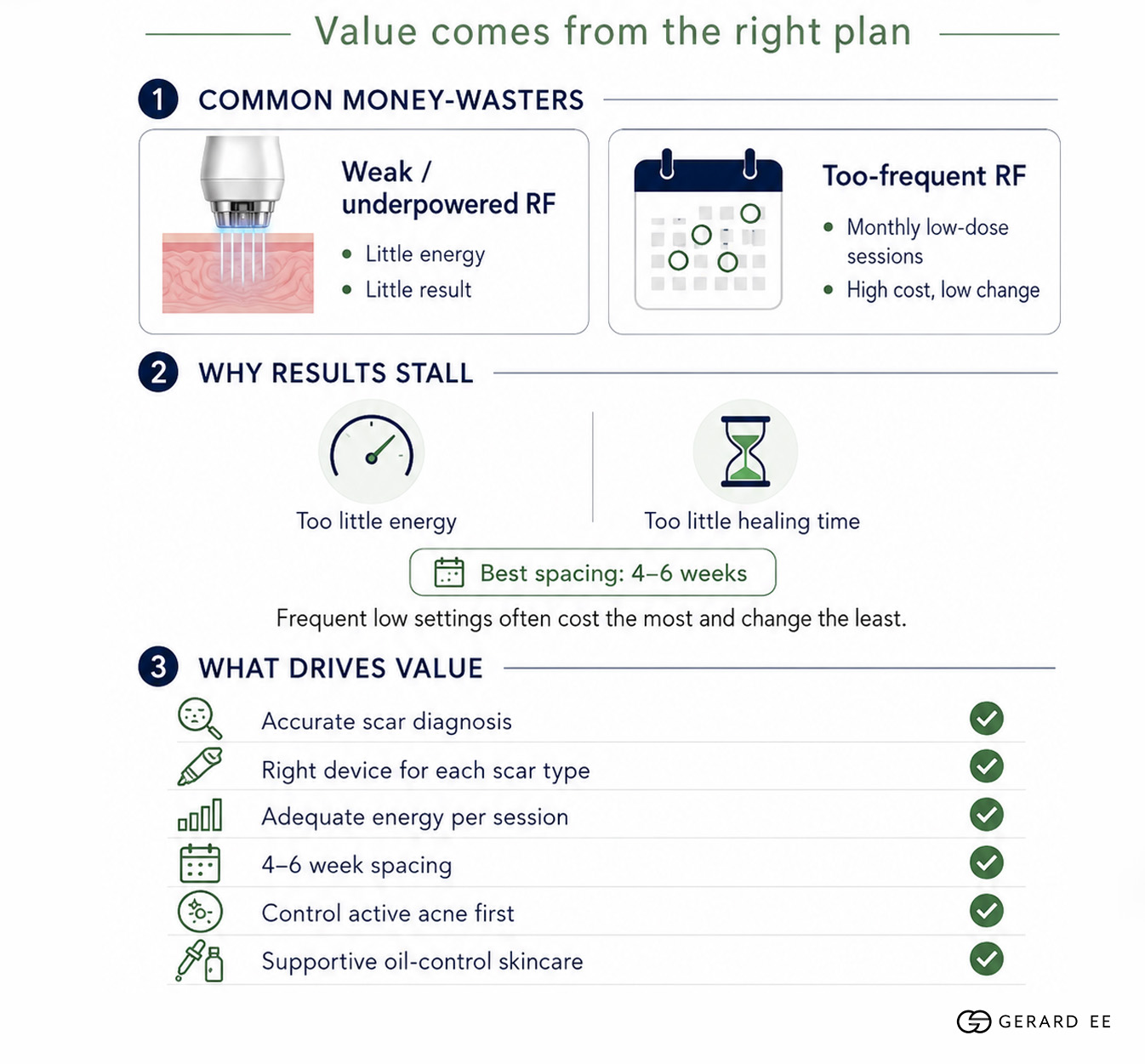
Two patterns at the lower end of the market account for most disappointed patients, an underpowered or weak microneedle RF device that produced little or no result, and monthly repeated RF that delivered very little while costing a great deal across many sessions. Both waste money for the same two reasons, too little energy delivered in each session, and too little time for the body to build collagen before the next one. The candid six things your doctor isn’t telling you expands on this. Of the patients who consult me after a course elsewhere that produced nothing, a substantial share have had frequent treatment at a low setting, the pattern that costs the most and changes the least.
What actually drives value
The factors that make scar treatment cost-effective are unglamorous ones, an accurate diagnosis of the scar types, the right device matched to each of them, adequate energy per session, sensible spacing of four to six weeks, and control of the active acne first, so that new scars are not created while the old ones are treated. Skincare that reduces the activity of the oil gland contributes to the value as well. Having treated acne scars for sixteen years, I have found the step most often omitted to be control of the active acne, since a plan that resurfaces scars while new lesions form produces work that must be repeated.
A worked example
A representative six-month custom scar package combines Infini, Secret RF, fractional CO2 and Pico MLA, adds subcision for tethered rolling scars, and includes PDRN or a biostimulator where the scar type calls for it, with sessions spaced four to six weeks apart and a total of around S$4,000. Individual sessions are far more accessible, with fractional CO2 from as low as S$390, but the package exists because several complementary treatments, properly dosed and sensibly spaced, achieve more than one treatment repeated until the budget runs out.
How to choose a clinic
A doctor who assesses the specific scar types in person, and who owns a range of technologies rather than one device used for everything, is the reasonable starting point. It is reasonable to ask what the maximum power of the RF device is and how far apart sessions are spaced. A specific answer to both questions indicates a clinic that measures what it delivers. Pressure to buy large packages in advance, a push toward weekly or monthly visits, and promises of total scar removal all warrant caution. Candour about limitations, including the fact that RF cannot treat keloids or temple scars and that improvement is gradual, marks a trustworthy clinic. More detail is available on Dr Gerard Ee. The commonest error I see in a plan brought for a second opinion is one device applied to every scar type, which leaves the tethered and the deepest scars untouched.
Realistic expectations
Value can only be assessed against a result that is realistic, and that result is substantial improvement rather than clearance. A rotation of modalities without injectables typically delivers around twenty to thirty per cent improvement across six months, and more when biostimulators and PDRN are included, with most of the change appearing between three and six months. Acne scars can be significantly improved but rarely erased. The journey is a gradual one, and with patience the skin can become markedly smoother over time. Twenty to thirty per cent is an average rather than a promise, and a minority of patients improve less than that despite correct dosing and spacing, which is not something I can predict reliably at the first consultation.
Why a combination is the better-value choice
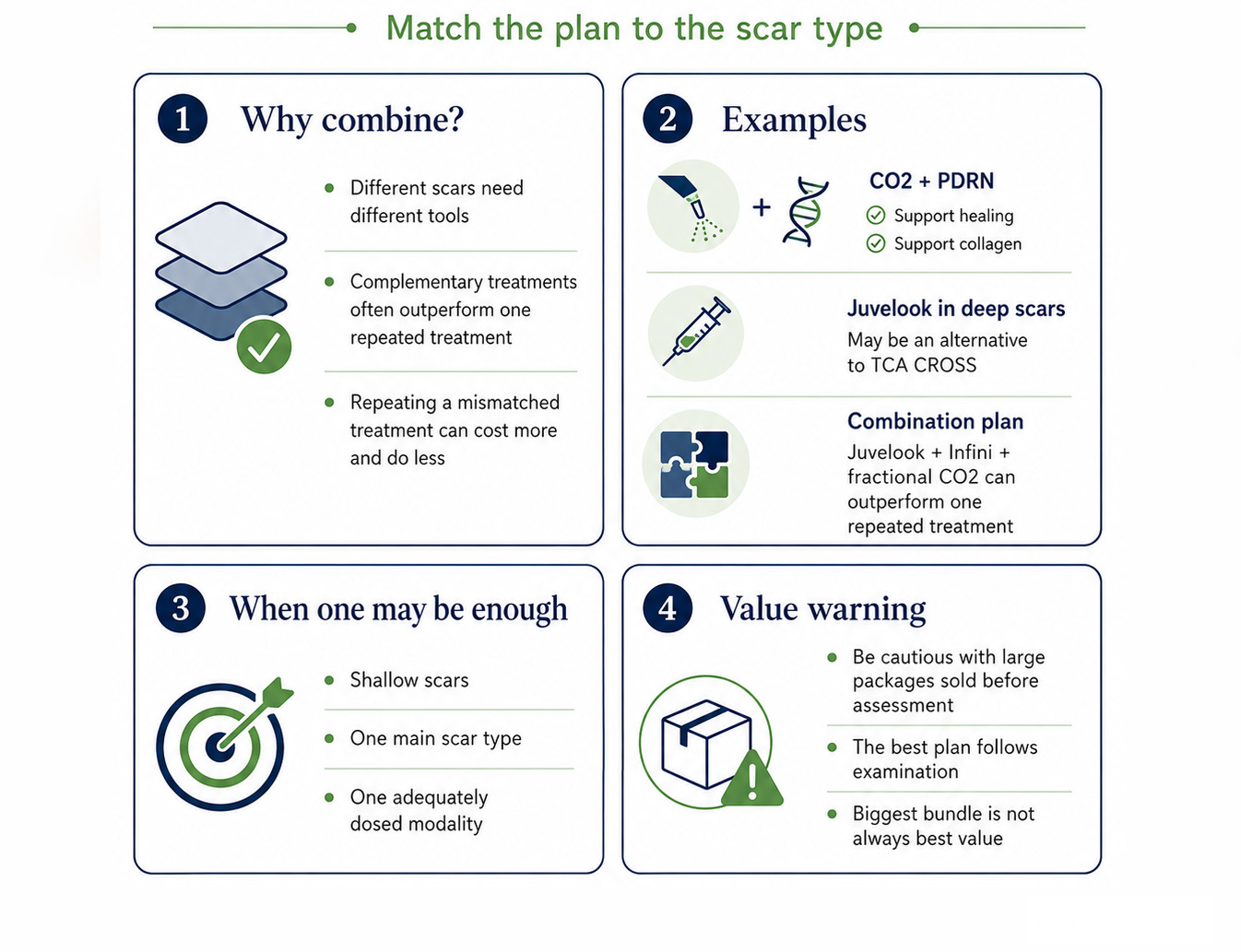
Adding treatments appears to add cost, but for value the opposite generally holds. Combination approaches consistently outperform single treatments. Healing improves and recovery shortens when fractional CO2 is combined with a PDRN preparation such as Rejuran, because PDRN promotes fibroblast activity and collagen synthesis (PDRN scar prevention). For deep boxcar and ice pick scars, Juvelook placed directly into the scar is, in my clinical experience, an excellent alternative to TCA CROSS, and both a safer and a more effective one, while Juvelook combined with Infini and fractional CO2 tends to deliver considerably better outcomes than subcision paired with TCA CROSS. Because a single underpowered or mismatched treatment often fails to move a scar at all, paying for several well-chosen, complementary treatments that work is usually more cost-effective than repeating one that does not. Combination is not automatically superior for every patient, and where the scarring is shallow and of a single type, one adequately dosed modality may be sufficient.
Large packages sold before a proper assessment warrant caution for the same reason, since a bundle bought in advance fixes the plan at the moment of least information. The cost-effective plan is the one matched to the scar types after examination, rather than the largest bundle or the single most expensive device used over and over.
What the research shows
Several of the approaches described above have been studied specifically for cost-effectiveness. Fractional CO2 laser has been evaluated as clinically effective and cost-effective for acne scars in a meta-analysis and economic evaluation (cost-effectiveness analysis). Subcision combined with TCA CROSS has been described as a cost-effective therapy for atrophic scarring (subcision plus CROSS), while TCA CROSS on its own is described as a cost-effective option for ice pick scars that have resisted other treatment (CROSS with 100% TCA). The theme running through this evidence is consistent, since combined treatment that has been well chosen delivers better value than the most expensive single option used repeatedly. Economic evaluations of this kind describe groups rather than individuals, and may support a choice of treatment without predicting one patient’s total.
What the combination evidence means for value
The combination-first evidence carries the same implication for the way money is best spent. The trials in which combined treatment outperformed single modalities, subcision plus laser over subcision alone, and laser plus subcision over laser alone (subcision combination trial, 413-patient analysis), indicate that a well-chosen combination is more likely to produce a measurable change than one treatment repeated when it underdelivers. The 2022 international consensus similarly frames acne-scar treatment as an individualised, often multi-modal process rather than a single product (consensus recommendations). Trial populations are selected and treated to protocol, so a reported improvement is a reference point rather than an expectation for an individual course.
What determines the total cost
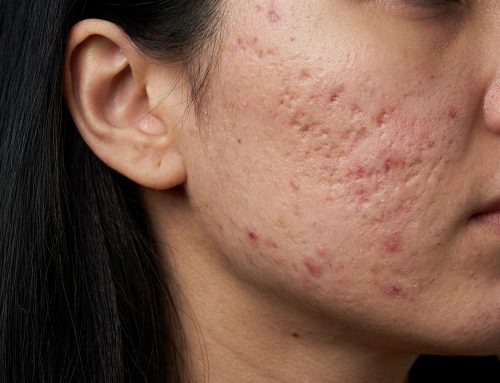
The final cost of treating acne scars is driven by a handful of variables, the severity of the scarring, the number of distinct scar types present, the number of sessions required, the modalities selected, and whether injectable adjuncts such as biostimulators or PDRN are included. A face carrying mainly shallow rolling scars requires a different and usually shorter plan than one carrying deep ice pick, boxcar and rolling scars together, so two patients may be quoted very different totals for what appears superficially to be the same problem. In my experience the factor that most often separates two similar-looking quotations is the number of distinct scar types, rather than the area of the face involved.
Indicative costs by treatment
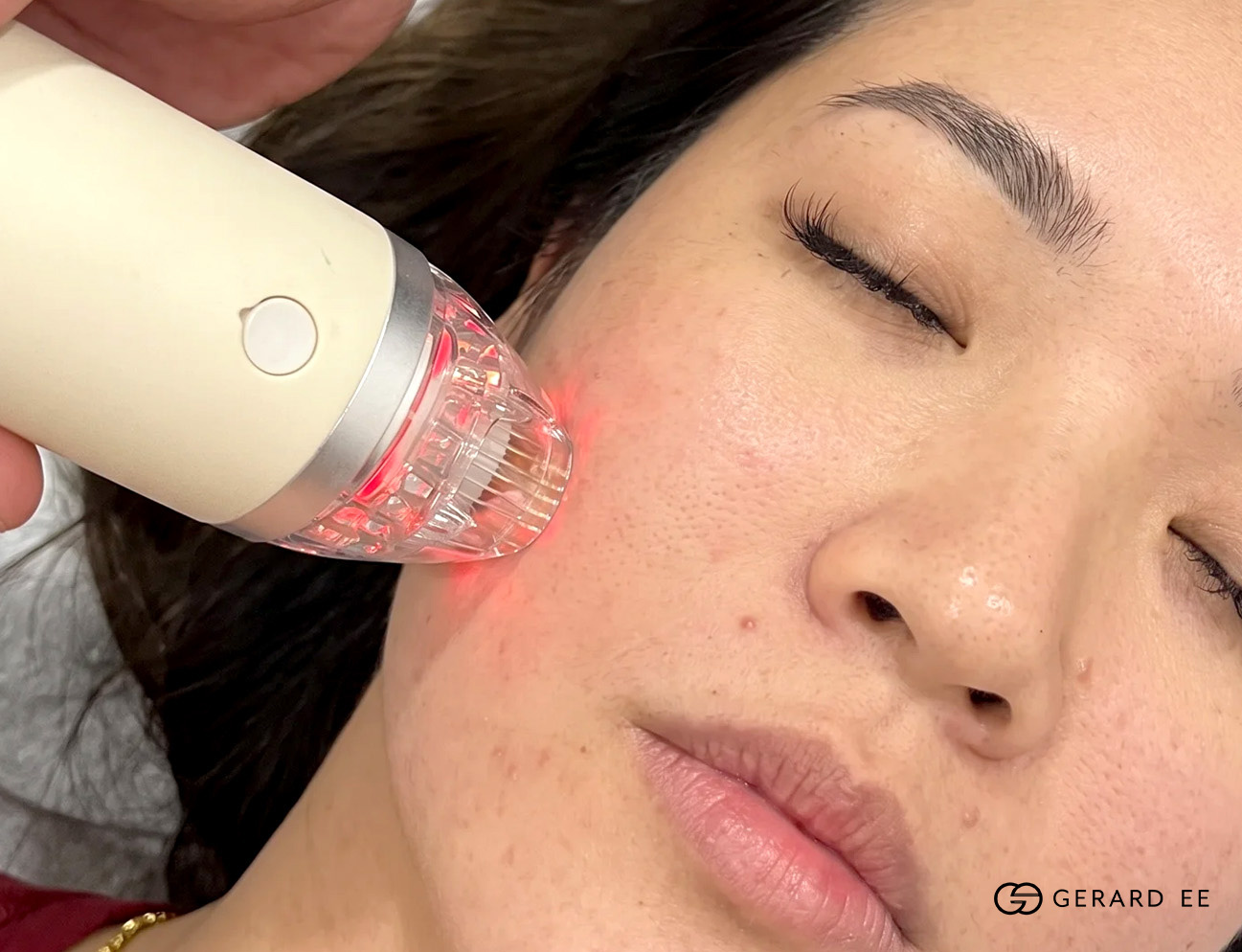
In Singapore, prices for individual treatments vary considerably between clinics, so a published figure is indicative rather than a quotation for a particular patient. A single fractional CO2 session, to take the most widely published example, can start from around S$390. Sessions of RF microneedling, subcision and TCA CROSS typically fall within the low-to-mid hundreds of dollars each, whereas biostimulators and PDRN are priced by the vial or by the session and add further cost according to the quantity used. Widely available options include fractional CO2 laser and RF microneedling. Because a full plan combines several of these over months, the meaningful figure is the cost of the overall course, and a headline price is of limited use in isolation, since the same named treatment may be delivered at very different energies and intervals.
Why packages exist and how to read one
Effective scar treatment usually requires several complementary treatments spaced across months, and many clinics therefore bundle them into a package, which generally represents better value than paying for each session individually. A package is best compared on what it actually contains, the number of sessions, the modalities covered, and whether adjuncts such as biostimulators or PDRN are charged separately. A package is also a commitment made in advance, and where the scars respond differently from expectation, the modalities within it may need to change, which is a question better raised before payment than after it.
The consultation comes first
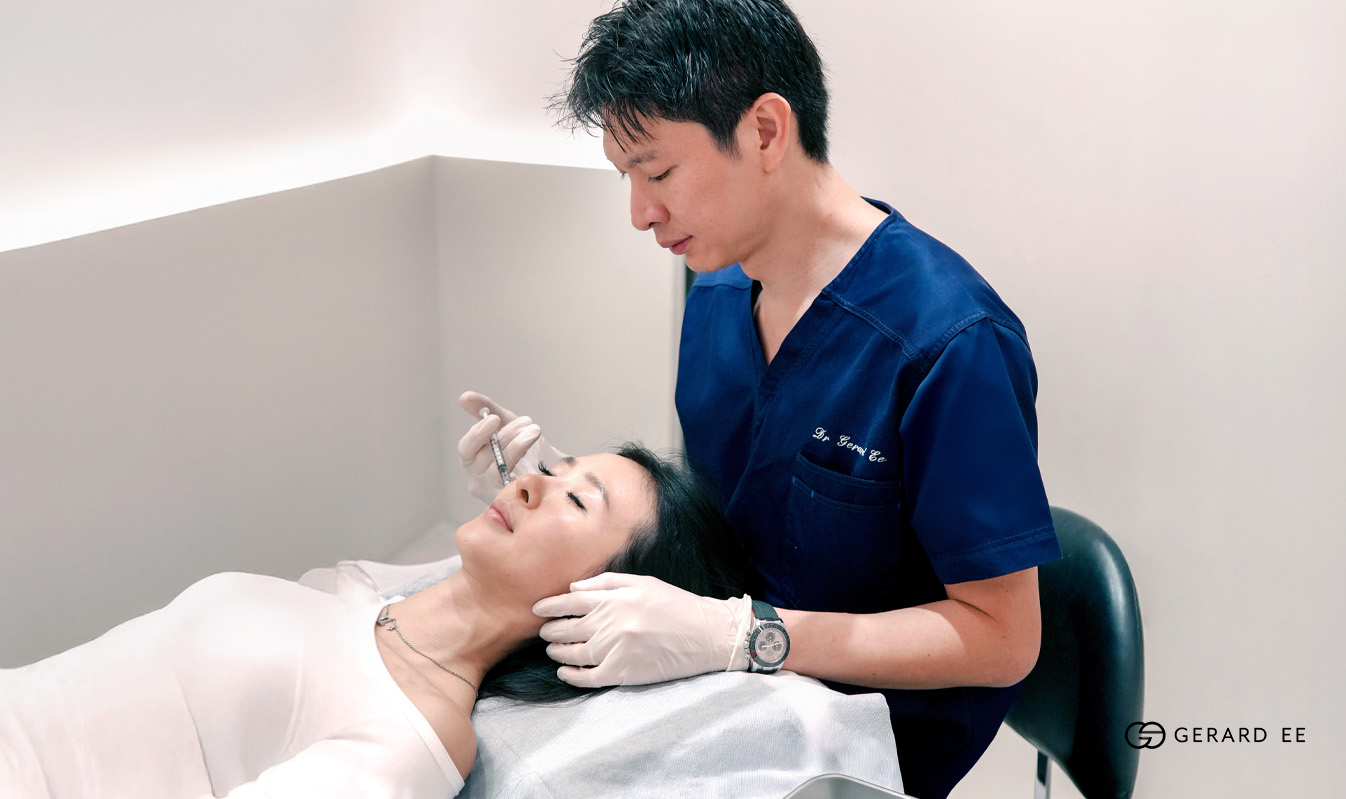
An in-person consultation is the step that makes cost meaningful. Mapping the scar types and the skin tone at the chairside produces a realistic plan, an honest estimate of how many sessions are likely, and a quotation that reflects the problem actually present. Assessment of this kind is also what prevents money going to the wrong treatment, which remains the most common way patients overspend. When a patient concludes that a course has failed, the explanation I find most often is that the plan was judged against an expectation formed before the scars were examined.
Spending wisely, not simply less
The aim is accuracy in spending rather than economy or extravagance for its own sake. A low per-visit price is no saving when the treatment achieves nothing, and the most expensive option is not automatically the best, since collagen building answers to energy and spacing rather than to price. Even a correctly chosen combination, properly dosed and sensibly spaced, carries no guarantee of the result a patient hopes for, and outcomes vary between individuals treated to the same protocol.
Questions worth asking about price
A few direct questions will usually make pricing transparent before any commitment is made. It is fair to ask exactly what a quoted figure covers, how many sessions it includes, what happens if further sessions prove necessary, whether adjuncts such as biostimulators or PDRN are charged separately, whether a consultation fee applies, and what degree of improvement is realistic for the sum proposed. Clear and specific answers to those questions are a reliable indicator, whereas vague pricing or pressure to commit quickly is not. A clinic that declines to promise an exact number of sessions is not necessarily being evasive, since that number depends on how the scars respond, but the uncertainty should be stated openly.
Treating scars as a considered investment
Acne scar treatment is best approached as a planned expenditure spread over months rather than as a single purchase. In Singapore, aesthetic scar treatments are generally not covered by medical insurance or MediSave, because they are classed as elective, so the cost is met out of pocket and is best budgeted across the full length of the plan rather than committed at the outset. Because the best results come from sessions spaced four to six weeks apart across roughly six months, payment can usually be distributed over that same period, which also leaves room for the plan to be revised as the skin responds. Across more than two thousand acne-scar patients, I have found that the expenditure most often regretted is the one committed before the scarring had been examined.
The bottom line
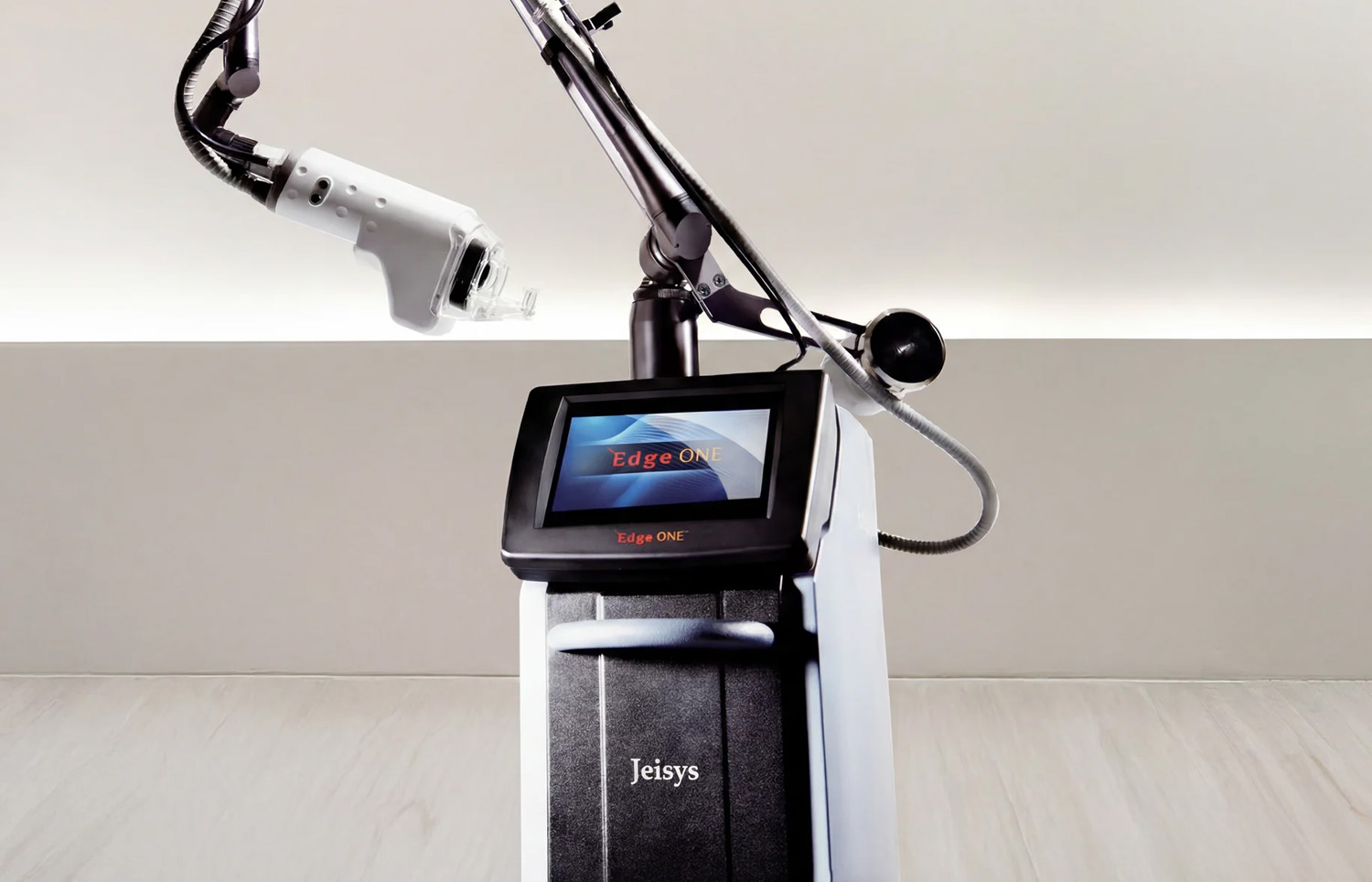
A six-month custom scar package in Singapore is often around S$4,000, and individual fractional CO2 sessions can start from S$390, but the figure itself matters less than the way the money is directed. Neither figure predicts an individual total, since the sessions and modalities required are determined by the scar types present. The most expensive, intensive route is not the most effective, and cheap or over-frequent treatment wastes money on under-dosed, poorly-spaced sessions. To revisit the foundations, start with the complete treatment guide.
Frequently Asked Questions
How much does acne scar treatment cost in Singapore?
Individual sessions can be accessible, and a single fractional CO2 session may start from as low as S$390, whereas a six-month custom scar package that combines Infini, Secret RF, fractional CO2 and Pico MLA comes to around S$4,000. The total depends on the scar types present and the number of sessions required, so both figures are indicative.
How are acne scars removed in Singapore?
Acne scars in Singapore are removed by a combination matched to the scar types, drawing on RF microneedling (Infini or Secret RF), subcision, fractional CO2, Pico MLA and biostimulators over a series of months, with the active acne controlled first. No single treatment suits every scar. Scarring treated this way is significantly improved in most patients but rarely erased.
Which country is best for acne scar treatment?
Results depend on the doctor and on the plan rather than on the country in which treatment is carried out. Singapore offers the full range of modern, FDA-cleared modalities. The determining factors are accurate diagnosis, the right device used at an adequate energy, and sensible spacing between sessions.
Is the most expensive acne scar treatment the best?
The most expensive acne scar treatment is not the most effective one. Spending more, whether by stacking treatments into a single visit or by repeating the priciest of them, is not the most cost-effective route. Collagen building takes time, and gradual, well-spaced treatment with the right energy gives better value. A degree of improvement short of complete clearance remains the realistic outcome at any price.
Key references
- Clinical effectiveness and cost-effectiveness of fractional CO2 in acne scars: meta-analysis and economic evaluation. PubMed.
- Subcision plus 50% TCA CROSS for atrophic acne scars: a cost-effective therapy. PubMed.
- CROSS technique with 100% TCA for ice pick acne scars: efficacy, safety and cost-effectiveness. PubMed.
Comparative trials cited
- Abdelwahab AA, Omar GAB, Hamdino M. Combined subcision with fractional CO2 laser or cross-linked hyaluronic acid versus subcision alone in atrophic post-acne scars. Lasers Med Sci. 2022;38:20. PubMed.
- Li X, Fan H, Wang Y, et al. Fractional CO2 laser combined with subcision for three subtypes of atrophic acne scars: retrospective analysis of 413 patients. Lasers Med Sci. 2023;38:195. PubMed.
- Salameh F, Shumaker PR, Goodman GJ, et al. Energy-based devices for the treatment of acne scars: 2022 international consensus recommendations. Lasers Surg Med. 2022;54:10-26. Journal.
Device specifications & sources
- S. FDA 510(k) Summary K213612 (SYLFIRM X, ViOL Co., Ltd.): Output power Max 16 W at 50 Ω. 2 MHz. Bi-polar RF.
- S. FDA 510(k) Summary K170325 (Secret RF, Ilooda Co., Ltd.): Max power Max 25 W at 500 Ω. 2 MHz. Needle depth 0.5-3.5 mm.
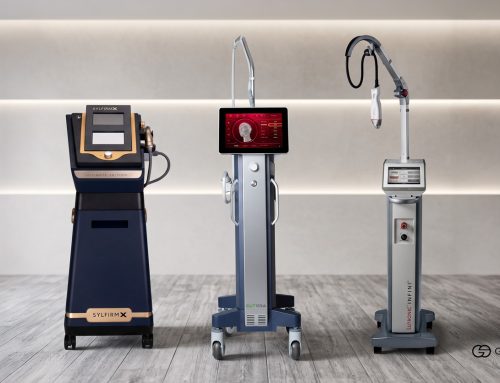
- S. FDA 510(k) K121481 (INFINI, Lutronic Inc.): insulated RF microneedling system, 49-pin handpiece, maximum RF generator output approximately 50 W.

Dr Gerard Ee
Written, medically reviewed and expert opinion by Dr Gerard Ee, aesthetic doctor and Founder & Medical Director of The Clifford Clinic. This article reflects my clinical experience treating acne scars in Singapore and is intended for general education, not medical advice. Treatment suitability, results, downtime and cost vary from person to person. Please arrange a consultation for advice specific to your skin.