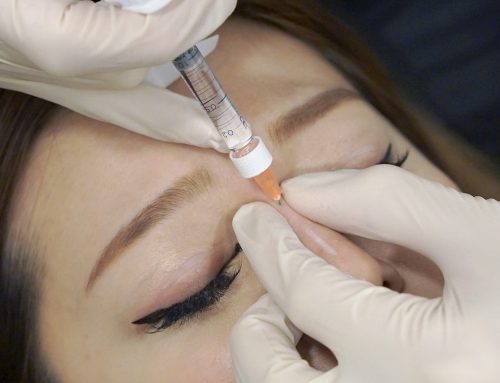
By Dr Gerard Ee
An eye bag is a convexity produced by lower eyelid fat pushing forward, whereas a tear trough is a concavity produced by a groove tethered at the rim of the eye socket. The two require opposite treatments. Fat reduction with AGNES and Secret RF suits mild Grade 1 to 2 bags with firm skin, whereas an isolated trough is treated with a small volume of filler. In roughly half of consultations the requested treatment does not match the finding on examination.
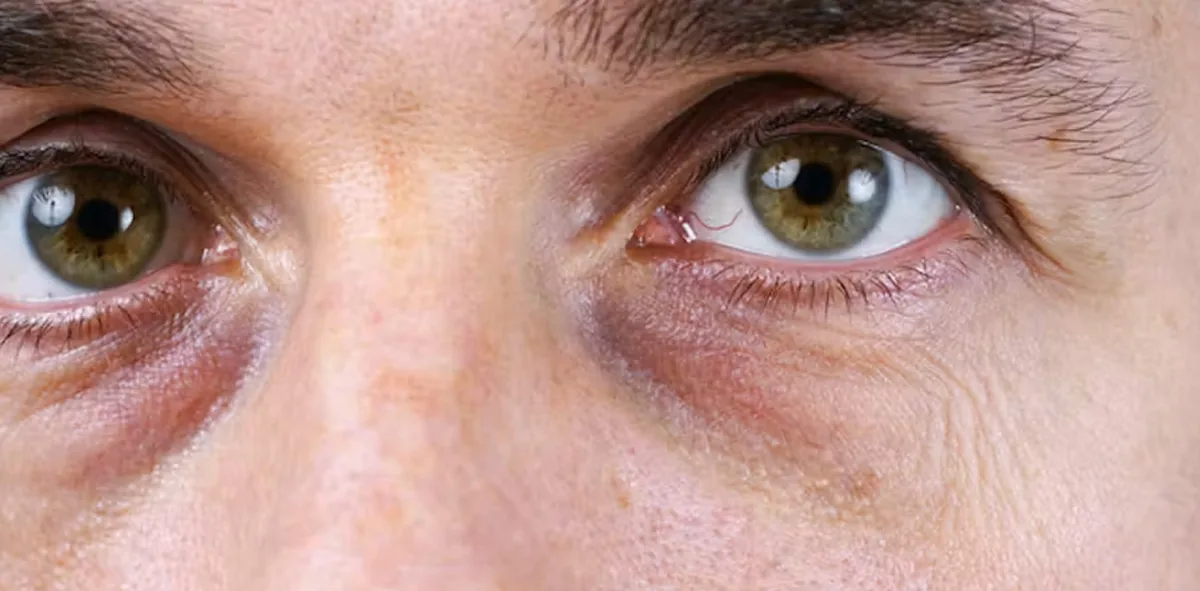
In more than 10 years of treating the under eye area, the most common problem I encounter is not eye bags, tear troughs, or dark circles. It is misdiagnosis, and most often self diagnosis. A patient studies the mirror, searches online, and arrives requesting a specific treatment. In roughly half of these consultations, the requested treatment does not match the problem the patient actually has. Such errors are poorly tolerated in this area, because the lower eyelid carries the thinnest skin on the body and any change in contour immediately alters the way light falls across it. A treatment directed at the wrong structure adds volume, weight or pigment where none was required, so the patient leaves with a second problem that must be reversed before the original one can be corrected.
Each of the five conditions described below is separated from the others by a specific physical sign, and the reasoning behind each sign is stated so that patients can follow it before committing to treatment anywhere. These signs can be checked at home, although they are indicative rather than diagnostic, since several of them depend on the direction of the light and on the tension applied to the skin, neither of which is controlled at a bathroom mirror. In my experience of reviewing the conclusions patients have reached before arriving, I have found that the initial impression is revised at examination about as often as it is confirmed, most commonly where a bag and a trough are present together and only the more prominent of the two has been noticed.
Five under eye conditions that are mistaken for one another
When a patient reports eye bags, the true diagnosis is usually one of the following, or a combination.
- True eye bags, meaning protruding lower eyelid fat
- Tear trough hollowing, meaning a groove between eyelid and cheek
- Mid cheek deficiency, meaning loss of cheek support below the eye
- Skin laxity, meaning loose and crepey lower eyelid skin
- Dark circles, meaning pigmentation or visible vessels
These conditions can resemble one another in a photograph. On examination they separate cleanly, because each arises from a different structure and each responds to a different treatment.
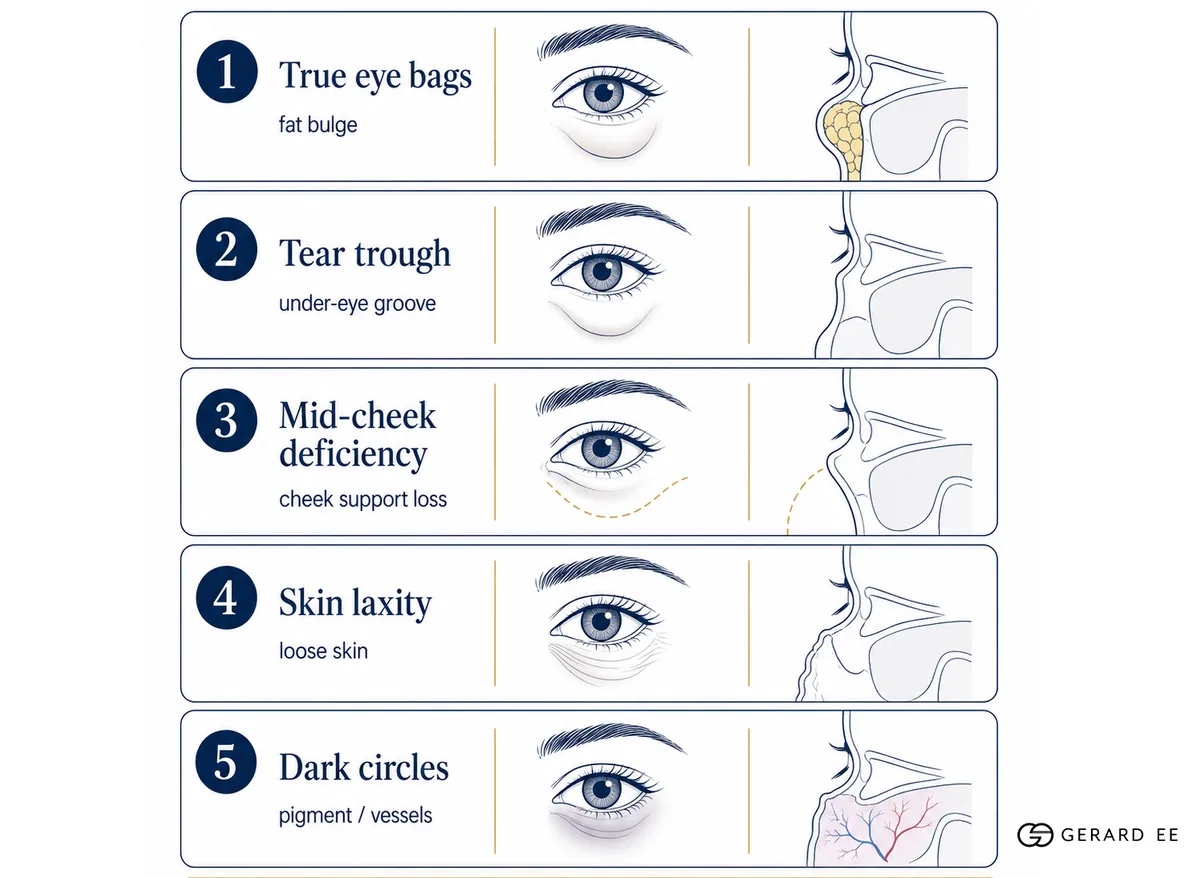
They can look superficially similar in a photo. Under examination, they are completely different problems with completely different solutions.
True eye bags. The fat is pushing forward
A true eye bag is a convexity, a soft bulge below the lash line. Three small fat pads lie behind the lower eyelid, held in place by a thin membrane called the orbital septum. When the membrane weakens through age or hereditary predisposition, the fat pushes forward and the bag becomes visible. The quantity of fat does not usually increase. What changes is the membrane restraining it, which is why a true eye bag does not resolve with weight loss.
The identifying features are consistent. The bulge is present every day whether the patient is rested or tired, and it does not settle with sleep or with reduced salt intake. On upward gaze the bulge typically becomes more prominent because the eyeball rotates and presses the fat pads forward against the weakened membrane. The contour is one of fullness with a shadow beneath it, rather than a hollow.
Where the primary problem is protruding fat, the only effective treatments are those that reduce or reposition the fat. In my practice, this means AGNES with Secret RF for mild Grade 1 to 2 bags with firm skin, and surgery for Grade 3 to 4 bags or where the skin is already loose. AGNES delivers radiofrequency energy through micro-insulated needles that melt the fat from the outside in, compartment by compartment, so each fat pad can be reduced to a different degree. Secret RF is not used as a fractional microneedling device in this application. It is a single insulated cannula with a radiofrequency tip that ablates the fat at a greater depth than AGNES, and the same heat tightens the overlying skin. No cream, no skin tightening device, and no filler removes protruding fat. The correction achieved is one of contour alone. Neither device lightens pigment, and neither restores recoil to skin that has already lost it, so a patient whose darkness is largely melanin can expect the bulge to flatten while the colour remains. In my experience treating patients who arrive requesting AGNES by name, I have found that a proportion of them are unsuitable for it, most often because the skin over the bag no longer retracts, and reducing the fat beneath such skin tends to leave the lid deflated rather than smooth.
Tear trough hollowing. A groove rather than a bulge
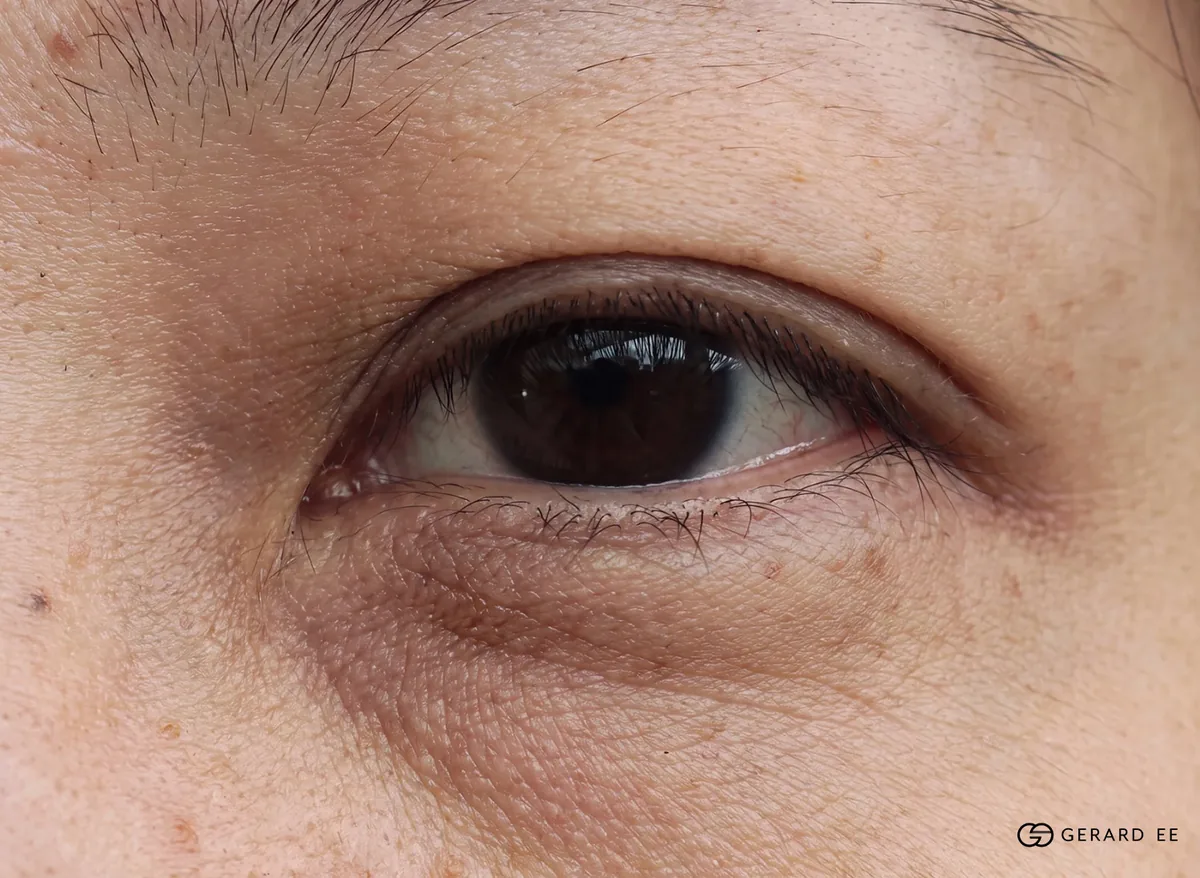
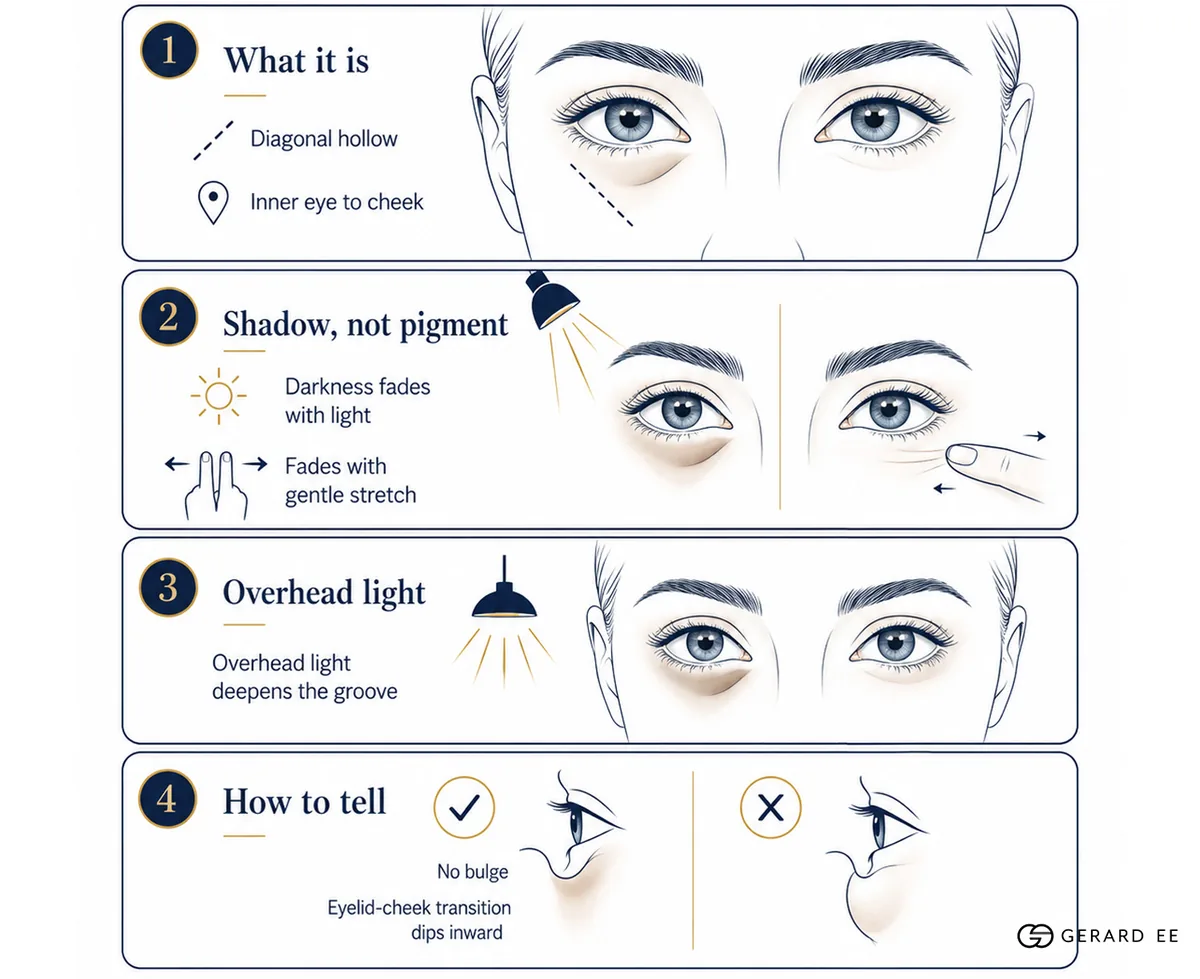
A tear trough is the opposite problem, a concavity. It is a groove running diagonally from the inner corner of the eye toward the cheek. The groove follows the line at which the skin is tethered to the bone of the eye socket rim, so the tissue on either side can descend or deflate while the groove itself stays fixed and deepens by contrast. The shadow cast within it is commonly interpreted as tiredness and is mistaken for a dark circle.
The identifying features are equally consistent. The darkness largely disappears when light strikes the area directly or when the skin is gently stretched, because the appearance arises from a shadow rather than from pigment. Under overhead lighting the shadow deepens, since the light falls from above and the ridge in front of the groove casts into it. There is no bulge, and the contour dips inward as it passes from eyelid to cheek.
A genuine isolated tear trough is one of the few indications for filler in this region. A small volume placed accurately within the groove softens the shadow. This is also the point at which misdiagnosis is most consequential, because many patients with true eye bags also show a groove below the bag, and filler placed there sits beneath an already protruding fat pad and increases the total projection, so the area looks heavier rather than smoother. Hyaluronic acid filler also draws water into the tissue, so a small overcorrection in skin this thin presents as visible swelling. That error is addressed separately in an article on tear trough fillers compared with eye bag removal. In my experience treating patients who request filler for a tear trough by name, I have found that the groove is the only finding in a minority of them, and that in the remainder a fat pad sits above the groove and dictates that the fat is addressed first. Published follow up for hyaluronic acid filler is drawn largely from the mid face rather than the lower eyelid, so the duration of correction at this site is not firmly established and the interval before repeat treatment varies between patients.
Mid cheek deficiency. The shadow under the eye originates in the cheek
In some patients, the under eye area looks hollow and shadowed not because of the eyelid but because the cheek beneath it has lost volume or forward projection. The loss is both soft tissue and skeletal, since the fat compartments of the mid face descend with age while the bone of the upper jaw behind them recedes slightly. Where the cheek no longer supports the lid, the junction between the two lengthens and the shadow above it extends downward.
The identifying features differ from a classic trough. The shadowing extends further down the cheek rather than stopping at the rim of the eye socket. Viewed in profile, the mid cheek is flattened rather than convex. Restoring cheek support with filler placed in the cheek rather than the eyelid visibly improves the under eye area, because raising the junction between lid and cheek shortens the shadow it casts, and this is often achieved without any injection near the eye itself. The improvement is partial rather than complete, and where a fat bulge is also present the cheek correction does not address the bulge, which may become the dominant feature once the shadow beneath it is lifted.
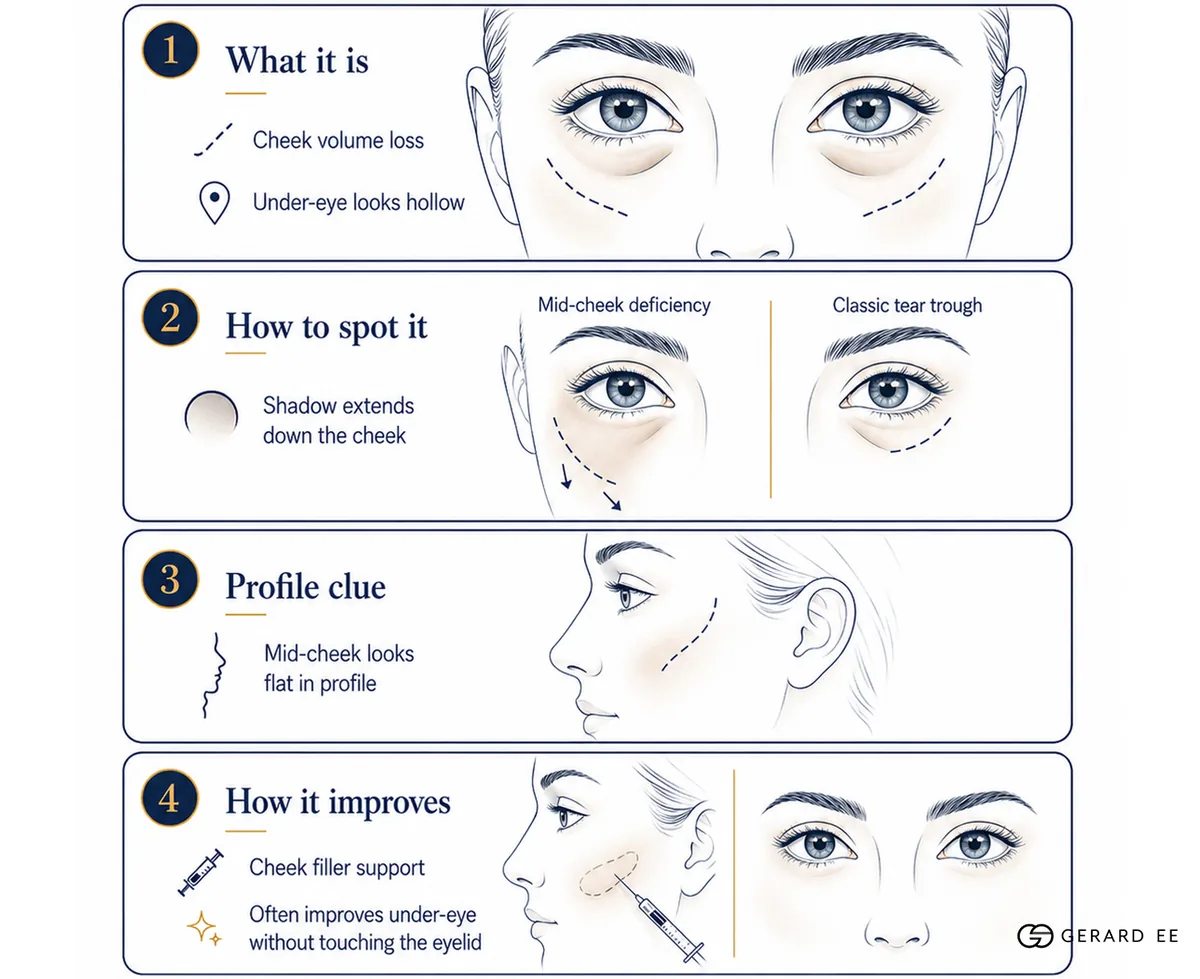
This is one of my favourite diagnoses to explain, because the treatment surprises patients: we improve the under-eye by treating the cheek.
Skin laxity. The skin has lost its recoil
In older patients, the dominant problem is often neither fat nor hollowing but loose, crepey lower eyelid skin with fine horizontal wrinkles and slow recoil when gently pinched. In the pinch test the skin of the lower lid is lifted between finger and thumb and released. Skin with adequate elasticity returns immediately, whereas lax skin remains tented for a moment before settling back.
This finding changes treatment selection entirely. Loose skin cannot be corrected with filler, which adds weight the skin cannot support. Firming it is a job for a skin-tightening treatment, and the gentle Sygmalift HIFU is the one used around the eyes here. It cannot be adequately corrected by fat reduction alone, because removing fat beneath loose skin produces deflation and wrinkling. Laxity of this degree usually requires surgical management, most commonly a pinch blepharoplasty that removes a fine strip of excess skin at the lash line, often combined with fat removal. The excision is confined to skin, so the muscle beneath is not disturbed and the resulting scar falls within the lash line.
Older patients at our centre are advised that non-surgical eye bag treatment is frequently not the appropriate option. A non-surgical result depends on the skin retracting smoothly over the reduced fat, which requires the skin to retain reasonable firmness. In my experience treating patients past their mid fifties who ask specifically for a non-surgical option, I have found that the skin rather than the fat is the limiting factor in most of them, and that a device based treatment in that group produces a change too small to satisfy the patient who requested it. Both of the surgical procedures involved, scarless eye bag removal and pinch blepharoplasty, are performed at The Clifford Surgery, so the advice can be given without redirecting the patient elsewhere. Pinch blepharoplasty carries its own limits. It removes skin and leaves a fine scar along the lash line that becomes inconspicuous in most patients but remains faintly visible in a minority, and it corrects neither pigmentation nor a tear trough.
Dark circles. Pigment and vessels
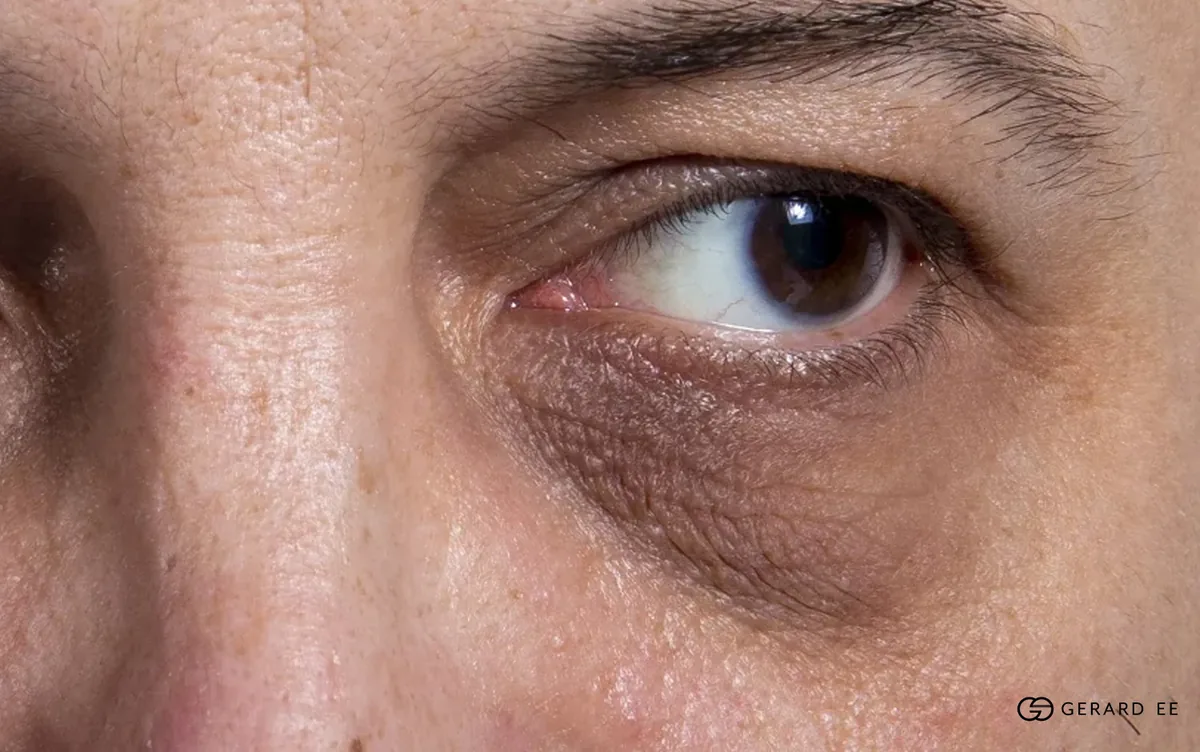
True dark circles involve actual discolouration of the under eye skin. The colour comes either from melanin within the skin or from blood vessels visible through it. Melanin driven pigmentation is common in our region and is frequently hereditary, and it is aggravated by rubbing and by eczema.
The identifying test is simple. The skin is stretched gently, or the area is illuminated directly. Darkness that persists indicates pigment or blood vessels. Darkness that disappears was a shadow cast by a trough or a bag.
Allergic rhinitis is a frequent cause of dark circles in Singapore and is regularly missed. The discolouration arises because chronic nasal congestion impairs venous drainage under the eyes and because years of rubbing itchy eyes darken the thin skin. These patients require the allergy to be treated rather than the colour alone. My pathway confirms the allergy with an allergy blood test and a skin prick test, and the panel must include Blomia tropicalis, a house dust mite that dominates in our climate and is omitted from some imported panels. The allergy is then resolved with sublingual immunotherapy known as SLIT, taken over 3 to 5 years, with the aim of reducing congestion, itch and rubbing; no controlled trial has shown that treating the allergy clears established pigmentation. The circles are treated in parallel with V Beam Eyes, a vascular laser, and Juvelook Eyes for collagen stimulation. Where the colour is treated while the rhinitis continues, the circles recur, which is the usual reason patients report that treatment obtained elsewhere did not hold. In my experience treating dark circles in patients with confirmed allergic rhinitis, I have found that the colour improves only partially while the nasal symptoms continue, and that the results which hold are those in patients who complete the immunotherapy course rather than stopping once the circles begin to lighten. Immunotherapy is measured in years rather than months, and it does not remove pigment already deposited in the skin, which is why the vascular laser and the collagen stimulating injections run alongside it rather than after it.
Where the pigmentation is unrelated to allergy, treatment must be directed at the melanin itself. Neither fat reduction nor filler lightens melanin, since neither acts on the cells that produce it. Response to pigment directed treatment under the eye is commonly partial, and hereditary periorbital pigmentation in particular is controlled with maintenance rather than eliminated.
For other pigment problems like pigment treatments and no amount of fat removal or filler will lighten melanin.
The quick self-check table
Under-Eye Concern Guide: What You See and What It May Mean
| What You Observe | Most Likely Problem | Direction of Treatment |
|---|---|---|
| A Soft Bulge Present Every Day, Worse Looking Up | True eye bags | Fat reduction. AGNES with Secret RF for mild cases, surgery for advanced cases. Filler placed under the bulge makes it heavier. |
| A Groove or Shadow That Vanishes in Direct Light | Tear trough | A small, accurately placed volume of filler. Appropriate only where no fat bulge sits above the groove. |
| Shadowing Extending Down a Flattened Cheek | Mid-cheek deficiency | Cheek support with filler placed in the cheek, not the eyelid. Injecting the lid alone does not correct it. |
| Crepey, Loose Skin with Fine Wrinkles | Skin laxity | Usually surgical, commonly pinch blepharoplasty. Fat reduction alone beneath lax skin leaves the lid deflated and wrinkled. |
| Darkness That Persists When Skin Is Stretched | Pigmentation or vasculature; check for allergic rhinitis | Allergy testing, then SLIT where allergy driven, with V Beam Eyes and Juvelook Eyes. Fat reduction and filler do not lighten pigment. |
| Puffiness That Varies Day to Day | Fluid retention | Lifestyle measures and allergy management. No procedure is indicated. |
Most patients present with combinations. A mild bag with a mild trough, a trough with pigment, and loose skin with fat protrusion are the usual pairings. Combination problems require treatment to be sequenced, and the order is not arbitrary. The fat is reduced first, because reducing the bulge changes the depth of the groove that remains and often reduces the volume of filler subsequently required. Pigment is treated last, once the shadows that exaggerate it have been removed. That sequence is established by examination and cannot be determined from a photograph.
Why I examine before recommending
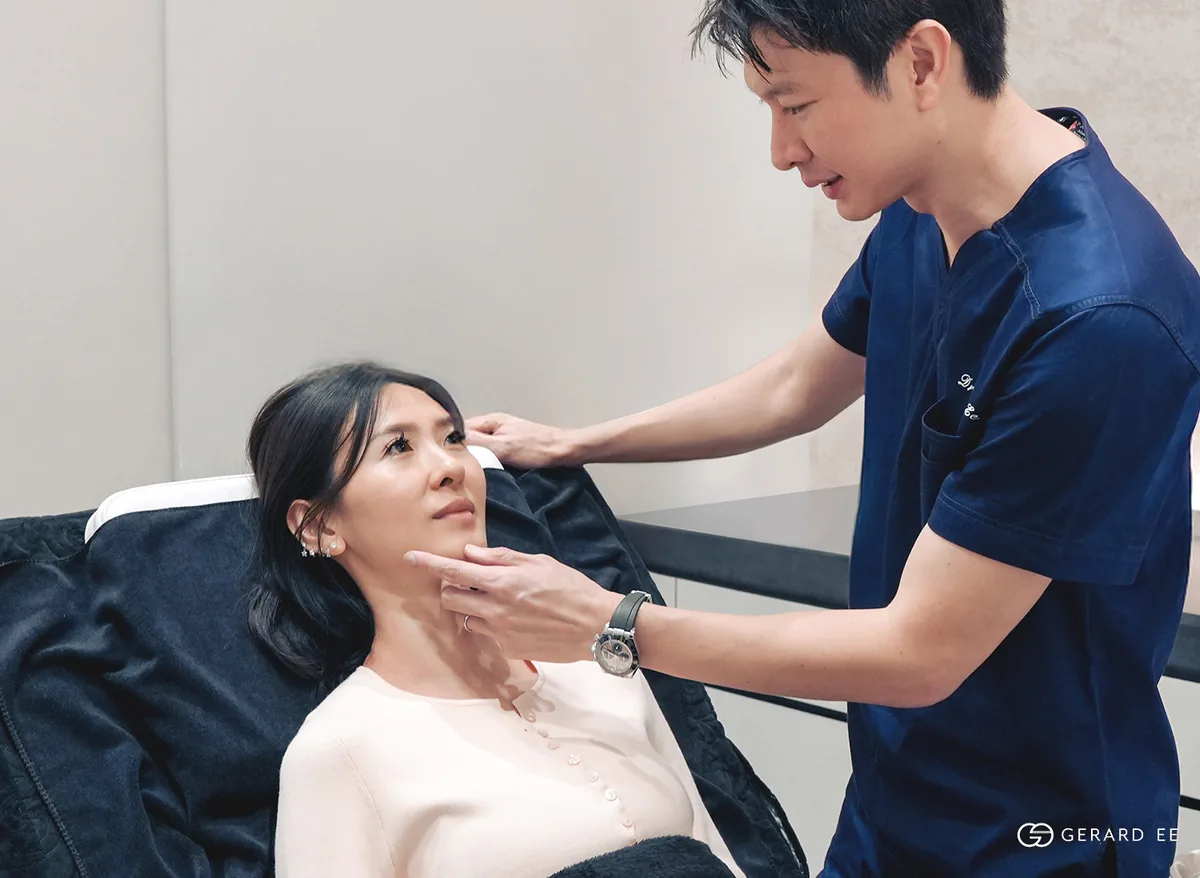
A fat pad can be graded, skin recoil tested, and the effect of light and pressure assessed in about five minutes of physical examination. Those five minutes determine whether the correct treatment is radiofrequency fat reduction, filler, surgery, pigment directed treatment, or no procedure at all beyond improved sleep and reduced salt intake. In my experience of examining the under eye area, I have found that upward gaze and the pinch test separate most single condition cases within the first minute, and that the remaining time is spent establishing which of two or three coexisting problems is dominant. Examination establishes the diagnosis and the order of treatment. It does not predict the magnitude of the result in an individual patient, which depends on tissue quality and is estimated rather than measured.
The centre I lead can give that answer without commercial distortion, because every pathway is available in house and no single treatment has to be recommended in order to retain the patient. The Clifford Clinic and The Clifford Surgery together offer every pathway discussed on this page, from non-surgical fat reduction to scarless eye bag removal and pinch blepharoplasty, and remain the only centre among the commonly compared aesthetic clinics to do so. Dissatisfaction after under eye treatment, at any clinic, follows far more often from an incorrect diagnosis than from a limitation of the device used. This article establishes which problem is present, whereas the relative merits of the individual treatments are set out in my comparison of the eye bag treatments available in Singapore
Related reading on eye bags and under-eye concerns
- Non-surgical eye bag removal: price, what happens and FAQ
- Which eye bag treatment is right for you
- Non-surgical eye bag removal: what it can and cannot do
- Eye bag surgery in Singapore, and when it is the better answer
- Do eye bags come back after treatment?
- Why tear trough fillers make true eye bags worse
- What home remedies for eye bags actually do
- Allergy-related dark eye circles
- Treatment options for dark eye circles
- Emface Eyes explained
- Under eye fillers in Singapore
- Eye bag removal cost in Singapore
Frequently asked questions
Can I have both eye bags and a tear trough?
The combination is common because the bulge of a bag deepens the appearance of the groove beneath it. Treatment usually addresses the fat first, and the trough is reassessed at 8 weeks, by which point the groove is frequently shallower and requires less filler than it appeared to at the outset.
How do I tell eye bags from dark circles at home?
The skin is stretched gently in a mirror under good light. Darkness that persists suggests pigment. Darkness that disappears suggests a shadow cast by a trough or a bag. The test is indicative rather than conclusive, and a clinical examination remains more reliable.
Is morning puffiness the same as eye bags?
Morning puffiness is a different finding. Puffiness that improves through the day reflects fluid that has pooled overnight and redistributes once the patient is upright. A true eye bag is present on waking and unchanged by evening.
Do tear troughs require surgery?
Surgery is usually not required. An isolated tear trough is typically treated with a small, accurately placed volume of filler. Surgery becomes relevant where there is significant fat protrusion or loose skin.
What happens if a tear trough is filled when the real problem is an eye bag?
The area typically looks heavier and puffier, and a lump may appear on smiling. The filler often requires dissolving with hyaluronidase, an enzyme that breaks the filler down, and the area is then allowed to settle before the correct treatment is planned.
Who should I see for a proper diagnosis?
Diagnosis should be made by a doctor experienced in the anatomy around the eye who offers the full range of options, since a clinic that provides only one of them can only recommend that one. My team at The Clifford Clinic provides a dedicated eye bag assessment including non-surgical eye bag removal in Singapore with AGNES and Secret RF where appropriate, alongside surgical options at The Clifford Surgery.

Dr Gerard Ee is the founder and medical director of The Clifford Clinic, Singapore, where he has performed AGNES and Secret RF eye bag treatments for more than 10 years across over 500 eye bag patients. This article reflects his clinical opinion and is for general information; it does not replace a medical consultation.

This page is written from published research and from clinical experience in Singapore since 2012. It is for general education, not medical advice. Whether a treatment suits you, what it may achieve and what it may risk can only be established at a consultation. Dr Gerard Ee is the Medical Director of The Clifford Clinic, a private clinic in Singapore, and treatments discussed on this site are provided commercially.