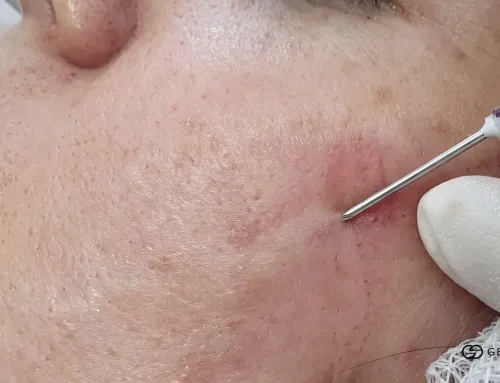
Dr Gerard Ee consults, prescribes and personally performs the procedures described on this page at The Clifford Clinic, 50 Raffles Place, Singapore.
Hormonal acne treatment starts with working out what is actually driving the breakouts, how severe they are, and what has already been tried properly. The options are topical medicines, oral treatments including spironolactone and the combined contraceptive pill, and procedures for selected patients. The aim is to control recurring inflammation, reduce the risk of scarring, and arrive at a plan you can keep to.
Breakouts around the chin or jawline, particularly before a period, can point to a hormonal driver. On their own they do not establish a hormone imbalance or polycystic ovary syndrome. For how to recognise the pattern, read my guide to hormonal acne in women.
What happens at a hormonal acne consultation
An assessment considers more than where the spots appear. I need to understand how the acne behaves and what has made it difficult to control.
What is useful to bring:
- When the acne started, whether it fluctuates with your cycle, and photographs of previous flares
- The names of the skincare and medicines you have used, how long for, and any side effects
- Any change in your periods, in facial or body hair, or in scalp hair
- Your medical history, current medicines and supplements, contraception, and any pregnancy plans
- Whether the acne is causing pain, scarring, distress or difficulty in daily life
On examination I am separating blocked pores from inflamed lesions from deeper nodules, and identifying marks and existing scars. That distinction decides the conversation. Occasional mild breakouts and painful acne that is actively scarring are not the same problem.
Will I need hormone tests?
That depends on what the assessment finds. Irregular periods, excess hair growth, scalp hair thinning or symptoms developing quickly make further investigation more relevant. Where androgen excess is suspected, evaluation may include blood tests and referral to the appropriate specialist. [3]
Acne on its own does not diagnose polycystic ovary syndrome. See PCOS and acne for the background.
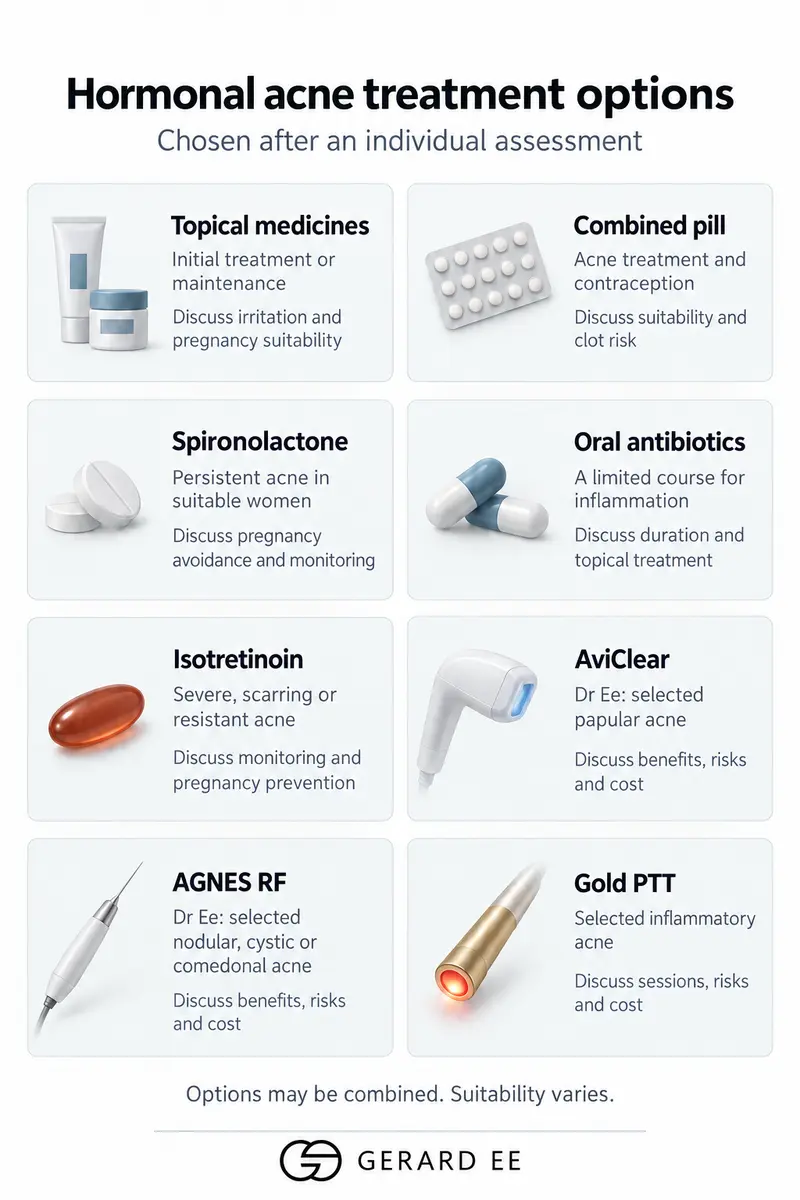
Hormonal acne treatment options compared
These have different jobs and are often used together. A hormonal pattern does not automatically mean an oral hormonal medicine is required.
| Option | Where it fits | What to discuss |
|---|---|---|
| Topical medicines | Initial treatment or maintenance, alone or combined with other treatments | Irritation, using them consistently, pregnancy suitability |
| Combined contraceptive pill | Suitable women, particularly where contraception is also wanted | Medical history, clot risk, whether the formulation suits |
| Spironolactone | Persistent acne in suitable women | Pregnancy avoidance, side effects, other medicines, monitoring |
| Oral antibiotics | A time-limited course for inflammatory acne | Duration, the topical alongside it, what happens after |
| Isotretinoin | Severe, nodular, scarring or unresponsive acne | Monitoring, pregnancy prevention, other risks |
| AviClear | In my practice, selected papular acne with small raised inflammatory bumps | Expected benefit, discomfort, redness, pigment changes, cost and alternatives |
| AGNES RF | In my practice, selected nodular, cystic or comedonal acne | Why focal treatment fits; discomfort, swelling, pigment changes and other procedural risks |
| Gold PTT | Selected inflammatory acne where sebaceous gland targeting suits the pattern | Number of sessions, discomfort, aftercare, cost and alternatives |
Where hormonal treatment becomes the rational choice
When the history suggests a hormonal contribution, I consider whether hormonal treatment would offer a useful alternative to repeated antibiotics. Combined oral contraceptives reduce androgen activity, while spironolactone blocks androgen effects on the skin. Suitability depends on the person as well as the acne pattern. [1,4]
Some women have persistent acne despite an adequate topical regimen. Adding hormonal treatment may help; it does not mean topical medicines have no role.
Topical treatment still matters
Topical retinoids help prevent blocked pores. Benzoyl peroxide and other topicals help control inflammatory acne, and azelaic acid is worth considering where acne and pigmentation coexist. A hormonal pattern does not make any of these ineffective. [1]
Clascoterone is a topical androgen-receptor inhibitor. Two phase 3 trials involving male and female participants found that 1% cream applied twice daily improved facial acne compared with its vehicle, the cream base without the active drug. Adverse events were uncommon and mostly mild, although local skin reactions occurred. These trials do not establish superiority over spironolactone or isotretinoin. [7]
The clinic carries clascoterone. It is a topical option I can consider when an oral hormonal medicine is unsuitable or not preferred, subject to its own suitability assessment.
Oral contraceptive pills: which type, and what risks?
A combined oral contraceptive pill contains an oestrogen and a progestogen. It can be useful for acne in suitable women, especially when contraception is also wanted. Improvement usually takes around two to three months; I review both the skin response and tolerability rather than judge it after a few days. [6]
Pills differ in their ingredients and risk profile. No single formulation is consistently best for everyone’s acne. [6]
Pill types differ mainly in their progestogen, and that affects both the likely skin response and the estimated venous clot risk. Cyproterone acetate with ethinylestradiol is restricted in Singapore to acne that has not responded to topical therapy or systemic antibiotics, and a progestogen-only pill is a contraceptive option rather than an acne treatment. For the types, the clot-risk estimates and the Singapore restrictions, read contraceptive pills for acne. [6,12,13,15]
Before prescribing, I assess blood pressure, smoking, migraine, clot history, relevant family history and other medicines. Migraine with aura, previous clots, significant cardiovascular risks, current breast cancer and some liver conditions may rule out a combined pill; smoking at age 35 or older is another important concern. [14]
Possible side effects include changes in bleeding, nausea, breast tenderness and headaches. Sudden breathlessness, chest pain or one-sided leg swelling needs urgent medical assessment. [12,14,15]
Spironolactone
In the SAFA randomised trial, women taking spironolactone did better than those on placebo, and the difference was larger at 24 weeks than at 12. That is the reason to give it time rather than expect a quick answer. [4,5]
Side effects include menstrual changes, breast tenderness, dizziness and increased urination. It is not used for acne in pregnancy. Monitoring depends on age, kidney function and other medicines. A 2026 study enrolled women aged 45 and older taking spironolactone for dermatological conditions, not acne alone; risk varied with age and accompanying conditions. It had no younger comparator group. Separate research in healthy young women found limited usefulness from routine potassium testing. These findings inform individual assessment rather than one testing schedule for everyone. [10,11]
The dose, any gradual increase and the monitoring plan are discussed individually. Blood pressure and symptoms such as light-headedness also matter when treatment is started or adjusted. Read about dosing, follow-up and monitoring in my spironolactone guide.
Spironolactone is sometimes prescribed alongside a combined contraceptive pill in women for whom the pill is suitable. This provides contraception and may reduce menstrual irregularity associated with spironolactone. The pill requires its own assessment of risks and suitability; the combination is not appropriate for everyone. [17]
Antibiotics and isotretinoin
An oral antibiotic can help control inflammatory acne, but the plan needs a review point and a strategy beyond the course. Guidelines advise limiting systemic antibiotic use and combining it with appropriate topical treatment, including benzoyl peroxide to help limit antibiotic resistance. [1,2]
Isotretinoin is for severe acne, acne that is scarring, acne carrying a substantial psychological burden, or acne that has not responded adequately. It needs proper counselling, monitoring and strict pregnancy precautions. [1]
More on isotretinoin and its side effects.
Where AviClear, AGNES RF and Gold PTT fit
I personally perform these procedures. Which one I suggest depends on the lesions present, previous treatment and whether a procedure offers a useful role in the overall plan.
AGNES RF: insulated microneedles deliver radiofrequency into the deep dermis, which suits lesions that can be targeted individually. I tend to choose it for selected nodular, cystic or comedonal acne — see AGNES acne treatment.
AviClear: I tend to choose AviClear for papular acne, meaning small raised inflammatory bumps. It uses a laser to target oil glands across the treated area. A prospective study reported improvement continuing through 26 weeks after treatment, but had no control group and cannot show that it is better than medication. Discomfort, redness, swelling, dryness or a temporary flare can occur; blistering, pigment changes, infection and scarring are also possible. [8,16]
Gold PTT: gold microparticles are worked into the follicle and then heated by laser. I discuss it where the pattern suits it — see gold photothermal therapy for acne.
Using more than one: I sometimes combine AGNES RF and AviClear when different lesion types coexist. I explain the purpose of each procedure and the additional cost and recovery considerations. The studies cited here do not establish that the combination is superior to either procedure alone.
Topical treatment remains an option for comedonal acne. Widespread nodular or cystic acne, particularly when scarring, may need systemic treatment such as isotretinoin. Procedures do not replace assessment for an underlying endocrine condition. [1]
How I choose the treatment plan
For comedonal acne, I discuss a topical retinoid and consider AGNES RF for selected lesions. For papular inflammatory acne, I discuss topical or oral treatment and whether AviClear has a useful role. If a hormonal contribution is likely, I consider hormonal treatment earlier. Nodular, cystic or scarring acne requires particular care: focal lesions may suit AGNES, while more extensive or treatment-resistant disease may require isotretinoin. Some patients have a mixed pattern, for which I may combine approaches.
These are individual decisions, informed by guideline-supported medication options and a discussion of the evidence and limitations of procedures. [1,2]
The unifying principle has not changed: treat the biology that is actually present. Do not undertreat scar-prone inflammation. Do not overcomplicate mild acne. Do not use devices as decoration around an untreated endocrine problem.
Questions worth working through together:
- How urgent is control? Painful nodules and new scars are a different conversation from a few occasional spots.
- What has been tried properly? How long, how consistently, and how well tolerated — that separates a drug that failed from a plan that was hard to follow.
- What health considerations apply? Pregnancy plans, other conditions and current medicines change the options.
- What can you maintain? Daily treatment, review visits, procedure appointments and total cost.
- What is the next step if it is not enough? Agreeing the review point in advance makes changing course straightforward rather than disappointing.
How long improvement takes, and what follow-up involves
It can be frustrating to continue treatment before the improvement is obvious. Topical treatment and oral antibiotics need time to show benefit. Hormonal treatment may need several months for a fair assessment. Isotretinoin is prescribed as a course, and procedures also require follow-up to assess response and side effects. Improvement after AviClear may continue beyond the final session. [1,4,8,9]
A meta-analysis comparing oral antibiotics with combined contraceptive pills found a greater reduction in total acne lesions with antibiotics at three months, while results were similar at six months. Differences between the included trials and possible publication bias limit how precisely these findings predict an individual response. This helps explain why an early response and longer-term control are different considerations. [18]
NICE advises explaining that noticeable benefit can take six to eight weeks and recommends reviewing an initial course at twelve weeks. That is general guidance rather than a fixed schedule. The larger benefit at 24 weeks in SAFA shows why an early review and a final judgment on response are different things. [4,13]
At follow-up what matters is the frequency of new breakouts, the number of painful lesions, side effects, and how consistently the plan has actually been used. Photographs in similar lighting make gradual change easier to see.
If a plan is difficult to follow, tell me. Adjusting the regimen or addressing side effects can make it easier to use consistently.
Contact the clinic sooner if treatment is causing troublesome side effects or the acne is worsening. There is no need to wait for a planned review.
Hormonal acne treatment cost in Singapore
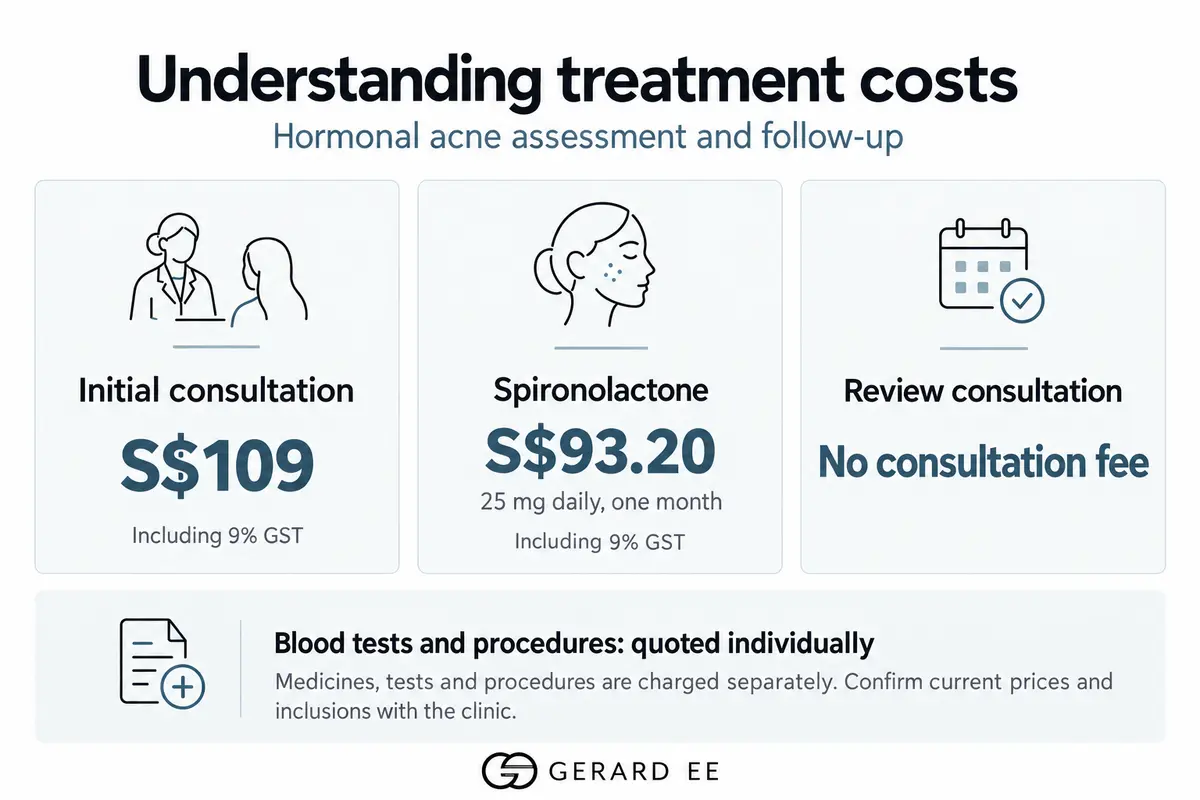
Total cost depends on the assessment, what is prescribed and how much follow-up is needed. A monthly medicine price on its own does not show the cost of a plan.
| Component | Fee | Inclusions |
|---|---|---|
| Initial consultation | S$109 including 9% GST | The assessment, diagnosis and treatment plan. Medicines and tests are charged separately |
| Spironolactone, 25 mg daily | S$93.20 including 9% GST for one month | The medicine only |
| Review consultation | Nil | Reviews are not charged |
| Blood tests, where indicated | Quoted at the clinic | Depends on which tests the assessment calls for |
| Procedures, if recommended | Quoted at the clinic | Depends on the procedure — see AGNES RF, AviClear and Gold PTT |
Review consultations are not charged. Medicines, blood tests and procedures, where required, are charged separately. If the plan changes, ask how that changes the cost.
Arrange a hormonal acne assessment

If acne keeps returning, has become hard to manage, or you are worried about scarring, an assessment can help clarify the next step.
For additional clinic information, see The Clifford Clinic’s acne treatment guide.

Dr Gerard Ee, Aesthetic Doctor in Singapore
Dr Gerard Ee is an aesthetic doctor in Singapore and the Medical Director of his practice at 50 Raffles Place. He graduated from St George’s, University of London, trained in surgery at Singapore General Hospital and the National University Hospital, and holds the MRCS (Edinburgh) and a postgraduate diploma in practical dermatology from Cardiff University.
He has practised aesthetic medicine since 2012, is the author of sixteen peer-reviewed papers, and writes and medically reviews every article on this site. Read more about Dr Gerard Ee.

Book a consultation with Dr Gerard Ee at The Clifford Clinic
Dr Gerard Ee consults and treats hormonal acne at The Clifford Clinic, 50 Raffles Place, Singapore. Consultations are by appointment. Message the clinic on WhatsApp, or call 6532 2048.
Frequently asked questions
Can I have hormonal acne with normal hormone levels?
Yes. Normal hormone results do not rule out benefit from hormonal treatment. Assessment considers the acne alongside menstrual history and other symptoms rather than relying on where a breakout sits. [1,3]
Do I have to take a hormonal medicine?
No. Topical treatment and other options may be right. The choice depends on severity, what has been tried, your health and your preferences. [1]
What if I am trying to become pregnant?
Tell me before treatment is chosen or changed. Pregnancy plans materially change acne prescribing — spironolactone, isotretinoin and topical retinoids all require avoidance or specific precautions. There are suitable alternatives. [1,13]
Will controlling the acne remove existing scars?
No. Controlling new breakouts and treating existing scars are separate goals with separate treatments. Flat colour change and true change in skin texture are different problems — see acne scar treatment in Singapore.
Show the 18 references
- Reynolds RV, Yeung H, Cheng CE, et al. Guidelines of care for the management of acne vulgaris. J Am Acad Dermatol. 2024;90(5):1006.e1-1006.e30. PubMed 38300170
- Nast A, Al Wattar BH, Beylot Barry M, et al. Update of the EuroGuiDerm evidence-based guideline for the treatment of acne — short version. J Eur Acad Dermatol Venereol. 2026;40(7):1162-1172. PubMed 41847993
- Elhassan YS, et al. Society for Endocrinology Clinical Practice Guideline for the Evaluation of Androgen Excess in Women. Clin Endocrinol (Oxf). 2025;103(4):540-566. PubMed 40364581
- Santer M, Lawrence M, Renz S, et al. Effectiveness of spironolactone for women with acne vulgaris (SAFA) in England and Wales: pragmatic, multicentre, phase 3, double blind, randomised controlled trial. BMJ. 2023;381:e074349. PubMed 37192767
- Santer M, Lawrence M, Pyne S, et al. Clinical and cost-effectiveness of spironolactone in treating persistent facial acne in women: SAFA double-blinded RCT. Health Technol Assess. 2024;28(56):1-86. PubMed 39268864
- Arowojolu AO, Gallo MF, Lopez LM, Grimes DA. Combined oral contraceptive pills for treatment of acne. Cochrane Database Syst Rev. 2012;2012(7):CD004425. PubMed 22786490
- Hebert A, Thiboutot D, Stein Gold L, et al. Efficacy and safety of topical clascoterone cream, 1%, for treatment in patients with facial acne: two phase 3 randomized clinical trials. JAMA Dermatol. 2020;156(6):621-630. PubMed 32320027
- Alexiades M, Kothare A, Goldberg D, et al. Novel 1726 nm laser demonstrates durable therapeutic outcomes and tolerability for moderate-to-severe acne across skin types. J Am Acad Dermatol. 2023;89(4):703-710. PubMed 37328000
- Ahn GR, Kim JM, Park SJ, et al. Selective sebaceous gland electrothermolysis using a single microneedle radiofrequency device for acne patients: a prospective randomized controlled study. Lasers Surg Med. 2020;52(5):396-401. PubMed 31502662
- Gregoire S, Dewey E, Sanchez K, et al. Hyperkalemia incidence in females over 45 years old on spironolactone for dermatologic conditions: a retrospective cohort study. J Am Acad Dermatol. 2026;94(6):1671-1678. PubMed 41655839
- Plovanich M, Weng QY, Mostaghimi A. Low usefulness of potassium monitoring among healthy young women taking spironolactone for acne. JAMA Dermatol. 2015;151(9):941-944. PubMed 25796182
- European Medicines Agency. Combined hormonal contraceptives: benefit-risk review and estimated venous clot risk. Population estimates for the formulations reviewed; not individual risk predictions or Singapore product availability.
- National Institute for Health and Care Excellence. Acne vulgaris: management. NICE guideline NG198.
- NHS. Who can take the combined pill.
- Singapore National Drug Formulary. Diane-35 tablet: product information.
- Cutera. AviClear important safety information. Manufacturer safety information, not comparative efficacy evidence.
- American Academy of Dermatology. Stubborn acne? Hormonal therapy may help.
- Koo EB, Petersen TD, Kimball AB. Meta-analysis comparing efficacy of antibiotics versus oral contraceptives in acne vulgaris. J Am Acad Dermatol. 2014;71(3):450-459. PubMed 24880665
This page is written from published research and from clinical experience in Singapore since 2012. It is for general education, not medical advice. Whether a treatment suits you, what it may achieve and what it may risk can only be established at a consultation. Dr Gerard Ee is the Medical Director of The Clifford Clinic, a private clinic in Singapore, and treatments discussed on this site are provided commercially.