

Patients ask me this almost every week, usually after reading that the pico laser is the newer and therefore better machine, or that PicoSure is the one to ask for. The honest answer is narrower than that. On pigment arising in your own skin, picosecond and Q-switched lasers clear it about equally well. Where the picosecond laser wins is comfort and side effects, and in Asian skin that is not a small thing.
What follows is the comparison as the published evidence has it, and how I choose between the two in practice. The full treatment page is pico laser in Singapore, and the Q-switch laser page carries that protocol.
The difference is pulse width, not power
Both are cleared by the United States FDA and both work by selective photothermolysis: pigment absorbs a wavelength of light, heats faster than it can cool, and breaks apart. What separates them is how long the pulse lasts.
A Q-switched laser fires in nanoseconds, billionths of a second. A picosecond laser fires in trillionths, roughly a thousand times shorter. Because the pulse is shorter than the time the particle takes to shed heat, more of the energy goes into shattering the pigment mechanically and less into heating the tissue around it.
That is the whole mechanism, and the consequence is specific. Less heat spread means less of the inflammation that makes melanin-rich skin respond by producing more pigment. It does not mean the laser is stronger.
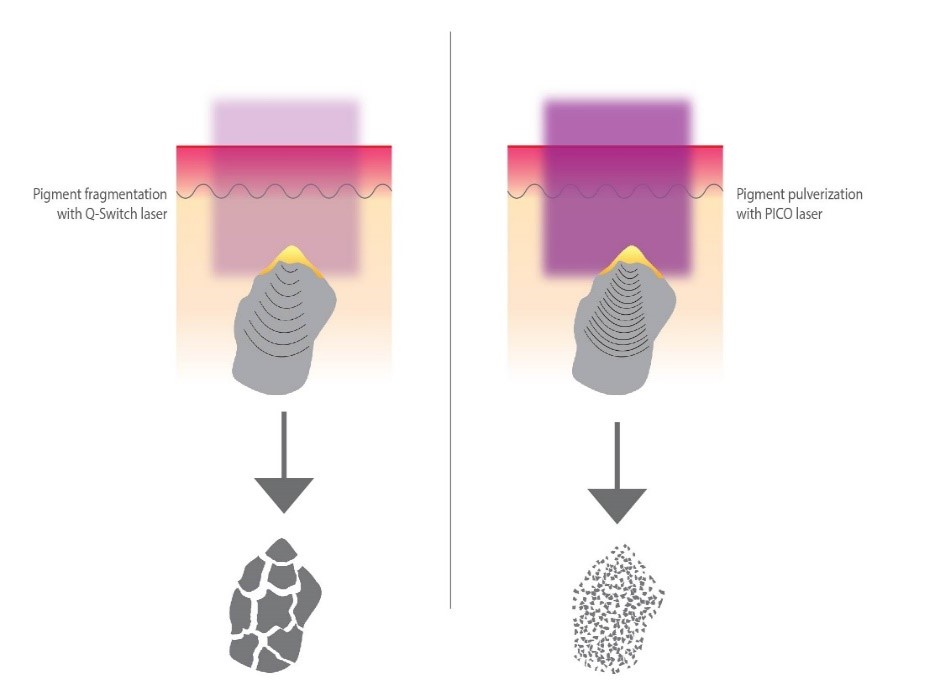
What the evidence says about pico versus Q-switch
A 2025 systematic review and meta-analysis pooled 21 studies and 971 patients comparing picosecond with nanosecond lasers. For endogenous hyperpigmentation, the pigment your own skin produces, clearance was comparable between the two, with a risk ratio of 1.06 and a confidence interval spanning 0.85 to 1.31 [1].
The differences appeared elsewhere. Picosecond lasers caused less pain, and significantly lower rates of both post-inflammatory hyperpigmentation and post-inflammatory hypopigmentation. The authors also recorded that adverse events were markedly more pronounced in Asian than in European patients, which is the population I treat [1].
For tattoo ink, an exogenous pigment, picosecond lasers trended better with a risk ratio of 1.39, although the confidence interval touched 1.00 and the result sat on the edge of significance [1]. That is a real signal, and it is weaker than “gold standard” advertising suggests.
Pico laser vs Q-switch laser compared
| Pico laser | Q-switch laser | |
|---|---|---|
| Pulse width | Picoseconds, about a thousand times shorter | Nanoseconds |
| How pigment breaks | More photomechanical, less heat spread | More photothermal |
| Clearance of skin pigment | Comparable to Q-switch on pooled evidence | Comparable to pico on pooled evidence |
| Tattoo ink | Trends better, borderline significance | Effective, longer established |
| Post-inflammatory pigment change | Significantly less | More |
| Discomfort | Less | More |
| Active acne | No specific antibacterial effect | 1064 nm has an additional effect on Cutibacterium acnes |
| Cost per session | Higher | Lower |
| Evidence base | Growing since 2012 | Established since the 1990s |
Read down that table and the pattern is clear. You are not buying more clearance. You are buying a gentler route to the same clearance, and in skin that scars with pigment rather than with texture, that is often worth paying for.
Pigmentation and tattoos

Sun spots, age spots and freckles sit in the epidermis and respond quickly to either laser. A randomised split-face trial of 84 Chinese patients treated freckles with a single session of a 532 nm picosecond laser and reported a response rate of 97.6%, with complete clearance in only about one in eight [2]. Responding and clearing are not the same thing, and that gap is worth knowing before the first session.
Deeper pigment behaves differently. Hori’s naevus sits in the dermis and needs a longer wavelength across an extended course; a retrospective series of the 755 nm picosecond alexandrite supports its use for dermal pigment in Asian patients [3]. Post-acne brown marks respond well to either laser once the acne itself is controlled, which I cover in brown acne marks in Asian skin.
Melasma is the exception to everything above. It is an active process rather than a deposit, and both lasers can worsen it at confident settings. A systematic review of 42 articles on low-fluence Q-switched toning found it generally effective but reported mottled hypopigmentation that can persist, related to accumulated energy, along with rebound hyperpigmentation in darker skin and considerable recurrence within three months [4]. For melasma I use low energy sparingly and always alongside sun protection and topical treatment, as set out on the pigmentation treatment page.
Active acne

Acne begins when the pilosebaceous unit is obstructed by sebum, dead keratinocytes and Cutibacterium acnes. Both lasers reduce surface debris and have some effect on sebaceous activity, and breakouts are often less inflamed after laser acne treatment.
Here the Q-switched laser has a specific advantage. At 1064 nm it has an additional effect on C. acnes itself, which the picosecond laser does not claim. For active inflammatory acne, that makes it the more logical of the two, although neither is my first choice when the acne is the main problem.
Acne scars, wrinkles and skin texture
For the pigment left behind by a scar, the picosecond laser has the edge, for the same reason it does elsewhere. For the indentation itself, the two are comparable, and neither is the right instrument alone.

Atrophic scars, whether boxcar, ice-pick or rolling, are a loss of collagen. Heat from either laser breaks down scarred tissue and stimulates fibroblasts, and new collagen is laid down over the following weeks. That helps shallow scarring and pore size. Deep indented scars need subcision or fractional resurfacing, which is a different conversation and is covered in my acne scar treatment guide.
PicoSure vs Q-switch and other pico lasers
What PicoSure is
PicoSure is a 755 nm picosecond alexandrite laser, and PicoSure Pro is the newer version of the same platform. That single wavelength is the thing to understand about it, because most machines sold in Singapore as a “pico laser” are a different design: a picosecond Nd:YAG running at 1064 nm with a frequency-doubled 532 nm option, and often a fractional lens array on top.
PicoSure vs Q-switch laser
PicoSure is a picosecond laser, so everything above applies to it. Against a Q-switched laser it offers the picosecond advantage, less pain and significantly less post-inflammatory pigment change, without a corresponding advantage in how much pigment actually clears [1]. Where the 755 nm wavelength earns its place is dermal pigment and tattoo ink: a retrospective series of the 755 nm picosecond alexandrite supports its use for dermal pigment in Asian patients [3].
PicoSure vs other pico lasers, and why I do not use it
I have used PicoSure. My honest view, from practice rather than from a brochure, is that it was not superior for melasma, and that it is not superior to the 532 nm settings found on most other pico lasers.
The published work points the same way on melasma. A randomised controlled trial comparing the picosecond alexandrite with a diffractive lens array against triple combination cream in Asian women with melasma found the laser comparable to the cream rather than better than it [5], and a 2026 meta-analysis of randomised trials of the 755 nm picosecond alexandrite in melasma reached a similarly cautious position [6].
On superficial pigment the wavelength argument is straightforward. Freckles and sun spots sit in the epidermis, and 532 nm is the wavelength most used for them; the randomised freckle trial cited above was run at 532 nm [2]. A 755 nm-only platform does not offer that setting, so a machine with 1064 and 532 nm covers more of what walks through my door.
| PicoSure | Most other pico lasers | |
|---|---|---|
| Type | 755 nm picosecond alexandrite | Picosecond Nd:YAG |
| Wavelengths | 755 nm | 1064 nm, with 532 nm frequency-doubled |
| Superficial pigment such as freckles | Treated at 755 nm | 532 nm is the usual setting |
| Dermal pigment and tattoo ink | A genuine strength of 755 nm | 1064 nm, and a 755 nm platform where available |
| Melasma | Trials find it comparable to topical treatment, not better | Low-fluence 1064 nm toning, used cautiously |
| Fractional handpiece | Available | Available on most platforms |
This is a clinical judgement about which tool suits the pigment I see, not a claim that the device is a poor one. It is well made and widely used. At my clinic the platforms are the Picocare, the PicoPlus, the Helios 785 and a separate 755 nm picosecond alexandrite, and my page on pico laser treatment in Singapore sets out which pigment goes to which.
Which one I would use on your face
| What you have | What I would reach for | Why |
|---|---|---|
| Freckles and sun spots | Either; pico if your skin pigments easily | Both clear surface pigment well. The choice is about the recovery, not the result |
| Post-acne brown marks | Pico | Lower risk of adding new pigment while treating old pigment |
| Hori’s naevus and dermal pigment | Pico, longer wavelength, extended course | Depth requires wavelength, and the course is long enough that side effects accumulate |
| Melasma | Low energy, cautiously, either | The laser is a component. Sun protection and topical treatment do most of the work |
| Active inflammatory acne | Q-switch at 1064 nm | It has an effect on the bacteria that the pico laser does not |
| Tattoo ink | Pico | The one indication where the evidence trends in its favour |
| A new or changing pigmented spot | Neither, until it is examined | A laser removes the evidence a diagnosis depends on |
What a course involves
Cleansing, protective goggles, then the laser passed over the target. Most sessions are short. Redness settles within a few hours, treated spots darken and crust lightly in the first week, then flake. Expect three to six sessions for most pigment, more for dermal pigment, spaced several weeks apart so the body can clear what has been fragmented.
Taking isotretinoin is no longer a reason to postpone either laser. Current guidance finds pigment lasers safe during and after a course, and only fully ablative laser and mechanical dermabrasion remain off the table.
Pico laser at my clinic is from S$280 a session and the Q-switch laser from S$1,100 for five sessions, both before GST. The cheaper course is the expensive one if it is the wrong laser for the pigment. The Clifford Clinic pico laser page lists the platforms in full.

Dr Gerard Ee, Aesthetic Doctor in Singapore
Dr Gerard Ee is an aesthetic doctor in Singapore and the Medical Director of his practice at 50 Raffles Place. He graduated from St George’s, University of London, trained in surgery at Singapore General Hospital and the National University Hospital, and holds the MRCS (Edinburgh) and a postgraduate diploma in practical dermatology from Cardiff University.
He has practised aesthetic medicine since 2012, is the author of sixteen peer-reviewed papers, and writes and medically reviews every article on this site. Read more about Dr Gerard Ee.

Discuss which laser suits your pigmentation
Dr Gerard Ee consults and performs pico and Q-Switch laser treatment at The Clifford Clinic, 50 Raffles Place, Singapore. Consultations are by appointment. Message the clinic on WhatsApp, or call 6532 2048.
Book a consultation to have the pigment diagnosed before a machine is chosen. The examination establishes the type and depth of pigment, your skin type and what has already been tried, and from that follows the wavelength, the settings and the number of sessions to expect.
Frequently asked questions
Is pico laser better than Q-switch laser?
For pigment arising in the skin, the pooled evidence shows comparable clearance between the two. The picosecond laser is better tolerated and causes significantly less post-inflammatory hyperpigmentation and hypopigmentation, and that advantage matters most in Asian skin. For tattoo ink it trends better. It is not a stronger laser.
What is the difference between pico laser and Q-switch laser?
Pulse width. A Q-switched laser fires in nanoseconds and a picosecond laser about a thousand times faster, so more of the energy shatters the pigment mechanically and less of it heats the surrounding skin. Everything else follows from that one difference.
Is Q-switch or pico laser better for melasma?
Neither is a solution for melasma, and both can worsen it at high energy. Low-fluence toning with either has evidence behind it and also carries reported risks of mottled hypopigmentation and rebound. Melasma is controlled with sun protection and topical treatment first, with a laser added cautiously if the response plateaus.
Which laser is better for tattoo removal?
The picosecond laser. In the pooled analysis it trended better than nanosecond lasers for exogenous pigment, with a risk ratio of 1.39, though the result sat at the edge of statistical significance rather than beyond it.
Is PicoSure better than other pico lasers?
Not in my hands. I have used it, and it was not superior for melasma or superior to the 532 nm settings on other pico lasers. PicoSure runs a single 755 nm wavelength, which is genuinely good for dermal pigment and tattoo ink, while most other pico lasers offer 1064 nm with a 532 nm option that suits superficial pigment such as freckles. Which is better depends on the pigment in front of you.
Is PicoSure better than a Q-switch laser?
It carries the picosecond advantage, less discomfort and significantly less post-inflammatory pigment change, without clearing endogenous pigment any better on the pooled evidence. That is the same trade as any picosecond laser against a Q-switched one, and it is a safety advantage rather than an efficacy one.
Is pico laser worth the extra cost?
It depends on your skin. If you pigment easily after inflammation, paying for the gentler laser buys a lower chance of trading one mark for another, which is worth it. If your concern is a few surface freckles on skin that recovers cleanly, the Q-switch laser will do the same job for less.
How many sessions will I need?
Freckles and sun spots, one to three. Post-inflammatory hyperpigmentation, three to six. Melasma, five to ten and then maintenance. Dermal pigment such as Hori’s naevus, six to ten or more. The diagnosis sets the number, not the machine.
Dr Gerard Ee consults and performs this treatment at The Clifford Clinic, 50 Raffles Place, Singapore.
Show the 6 references
1. Wu W, Du Y, Zhang Y, Su Q, Wang F. Comparative appraisal with meta-analysis of picosecond versus nanosecond lasers for hyperpigmented disorders and tattoos. Lasers Med Sci. 2025;40(1):465. doi:10.1007/s10103-025-04721-3. PubMed 41184656
2. Zhou Y, Bao Y, Fu Y. Efficacy and safety of a novel 532-nm picosecond Nd:YAG laser for the treatment of freckles in Chinese patients: a randomized, split-face, multicenter, noninferiority trial. J Dermatolog Treat. 2026;37(1):2702775. doi:10.1080/09546634.2026.2702775. PubMed 42473883
3. Hu S, Yang CS, Chang SL, Huang YL, Lin YF, Lee MC. Efficacy and safety of the picosecond 755-nm alexandrite laser for treatment of dermal pigmentation in Asians: a retrospective study. Lasers Med Sci. 2020;35(6):1377-1383. doi:10.1007/s10103-020-02959-7. PubMed 31965352
4. Lee YS, Lee YJ, Lee JM, Han TY, Lee JH, Choi JE. The Low-Fluence Q-Switched Nd:YAG Laser Treatment for Melasma: A Systematic Review. Medicina (Kaunas). 2022;58(7):936. doi:10.3390/medicina58070936. PubMed 35888655
5. Wang YJ, Lin ET, Chen YT, et al. Prospective randomized controlled trial comparing treatment efficacy and tolerance of picosecond alexandrite laser with a diffractive lens array and triple combination cream in female Asian patients with melasma. J Eur Acad Dermatol Venereol. 2020;34(3):624-632. doi:10.1111/jdv.15934. PubMed 31494973
6. Chua KR, Vankayalapati DK, Shami MZ, et al. Assessing the Safety and Efficacy of Picosecond Alexandrite Lasers in the Management of Melasma: A Systematic Review and Meta-Analysis of Randomised Control Trials. Australas J Dermatol. 2026;67(3):140-150. doi:10.1111/ajd.70051. PubMed 41589005
Related Posts





One Comment
Comments are closed.


[…] A detailed review of PicoSure Laser VS Q-Switch Laser … […]