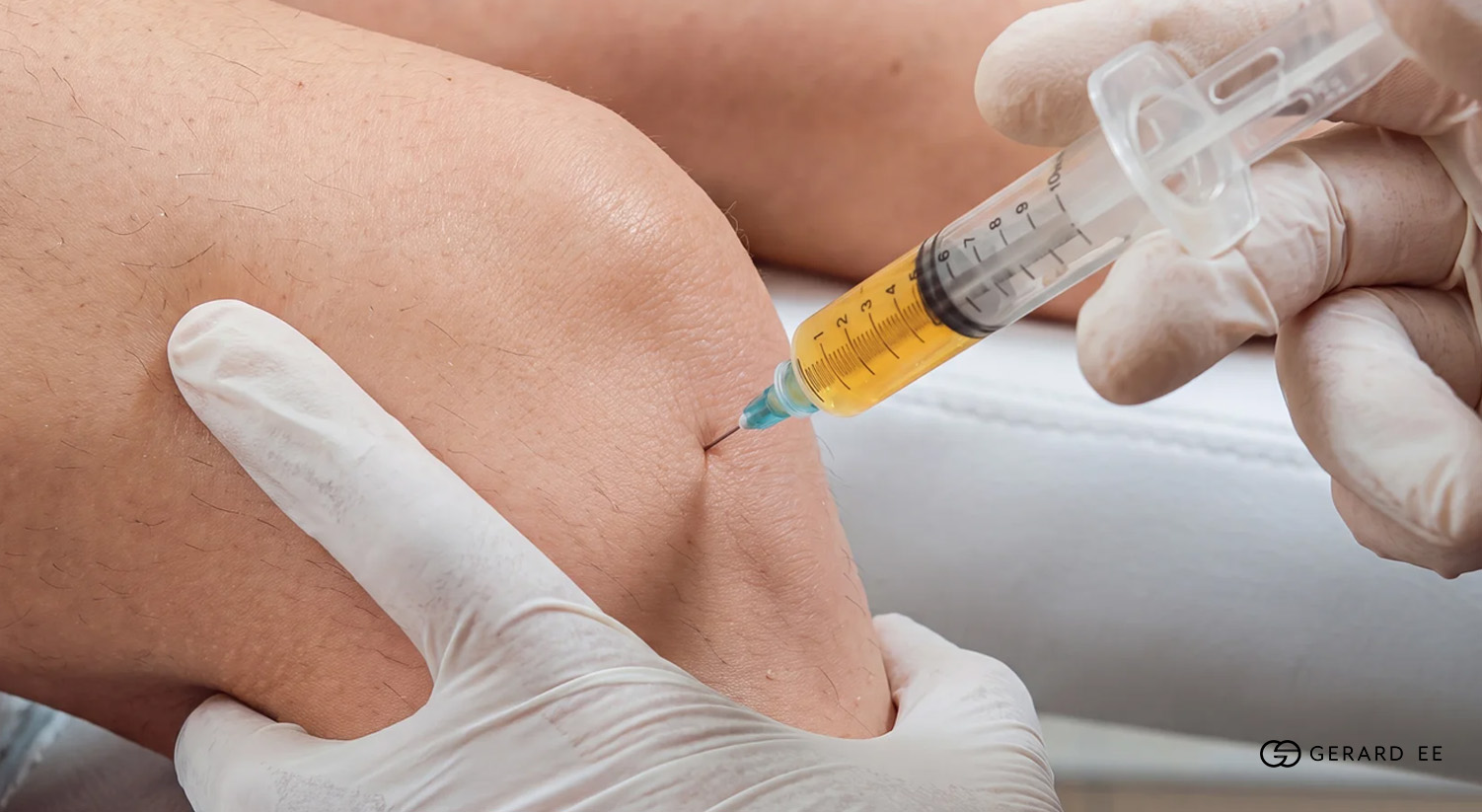
Dr Gerard Ee consults and performs knee joint injections at The Clifford Clinic, 50 Raffles Place, Singapore, with the type of knee joint injection customised to the knee pathology and severity.
For patients whose knee pain has not settled despite physiotherapy and load management, knee injections are usually the sensible next step. The question is thus not if the patient should get a knee injection, but which one they should get. In Singapore, options include steroid, platelet-rich plasma (PRP), hyaluronic acid (HA), Conjuran, and Guna Collagen MD.
The options listed above are not interchangeable, work different ways, and are suitable for use in different situations depending on the condition of the knee being treating. Due to their unique qualities, I do not consider any one to be better than the rest. Each type of injection can be used at different points in a sensible treatment plan.
In this article, I will go through the clinical reasoning behind why and when I choose to use each type of injection.
There Is No Universal Best Knee Injection
The five most commonly used knee injections perform different jobs.
- Steroid (cortisone)is a strong local anti-inflammatory. It excels at rapidly calming acute knee flares.
- Platelet-rich plasma (PRP)is a biological treatment that uses growth factors from the patient’s own blood to improve the knee joint environment.
- Hyaluronic acid (HA)is a viscosupplement. It restores the lubricating and shock-absorbing qualities of the joint fluid.
- Conjuranis a polynucleotide injection. In clinical practice it is used as a viscosupplement alternative to HA, but it is not a PRP equivalent.
- Guna Collagen MDis a Class III type-I collagen medical device that is used as an extracellular-matrix bioscaffold. As it has a smaller clinical evidence base compared to the other four options, I only offer it with informed consent.
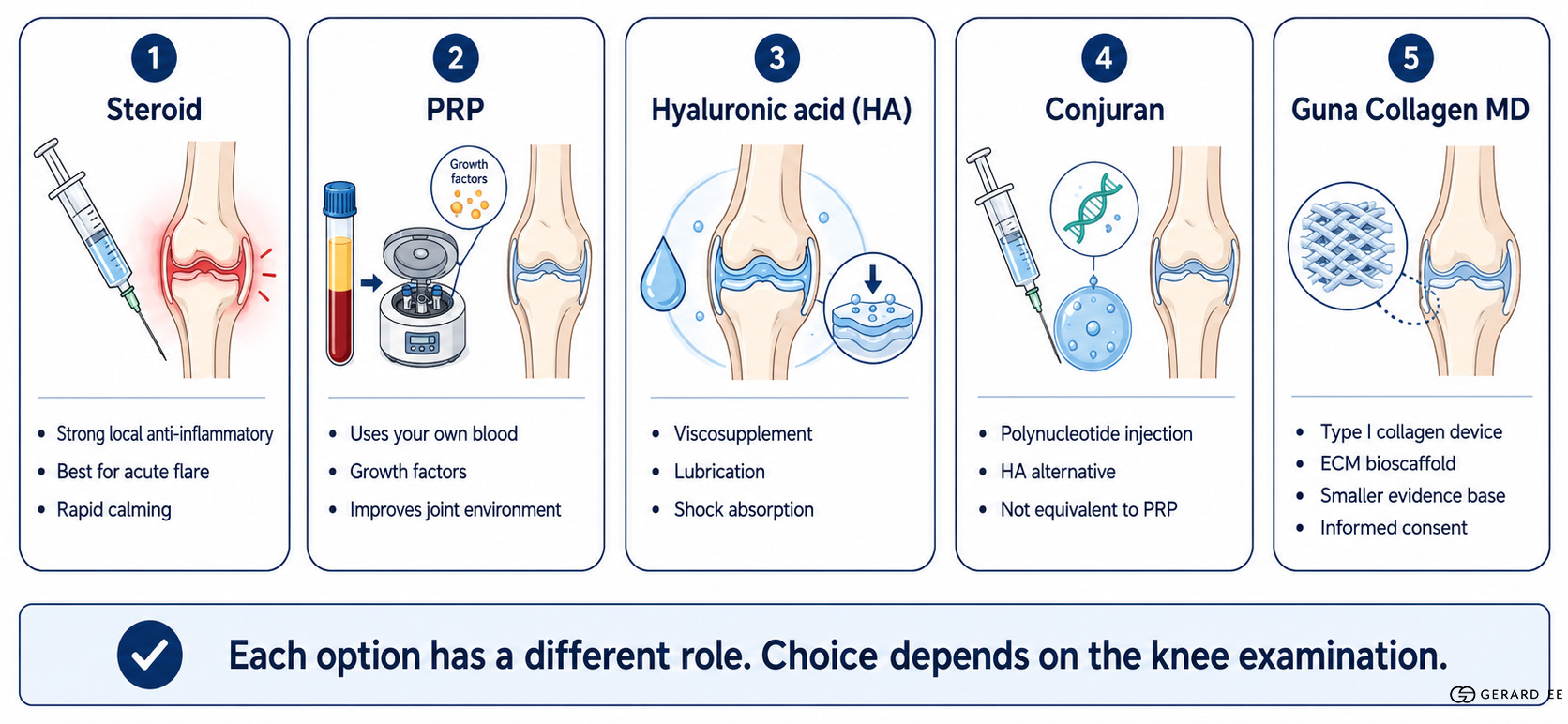
No treatment is automatically the best. The treatment should be matched to the patient’s needs and situation. The best option for any particular patient thus depends on the condition of the patient’s knee, their pain pattern, the stage of knee osteoarthritis (OA), and the patient’s treatment goals.
A Closer Look at Each Option
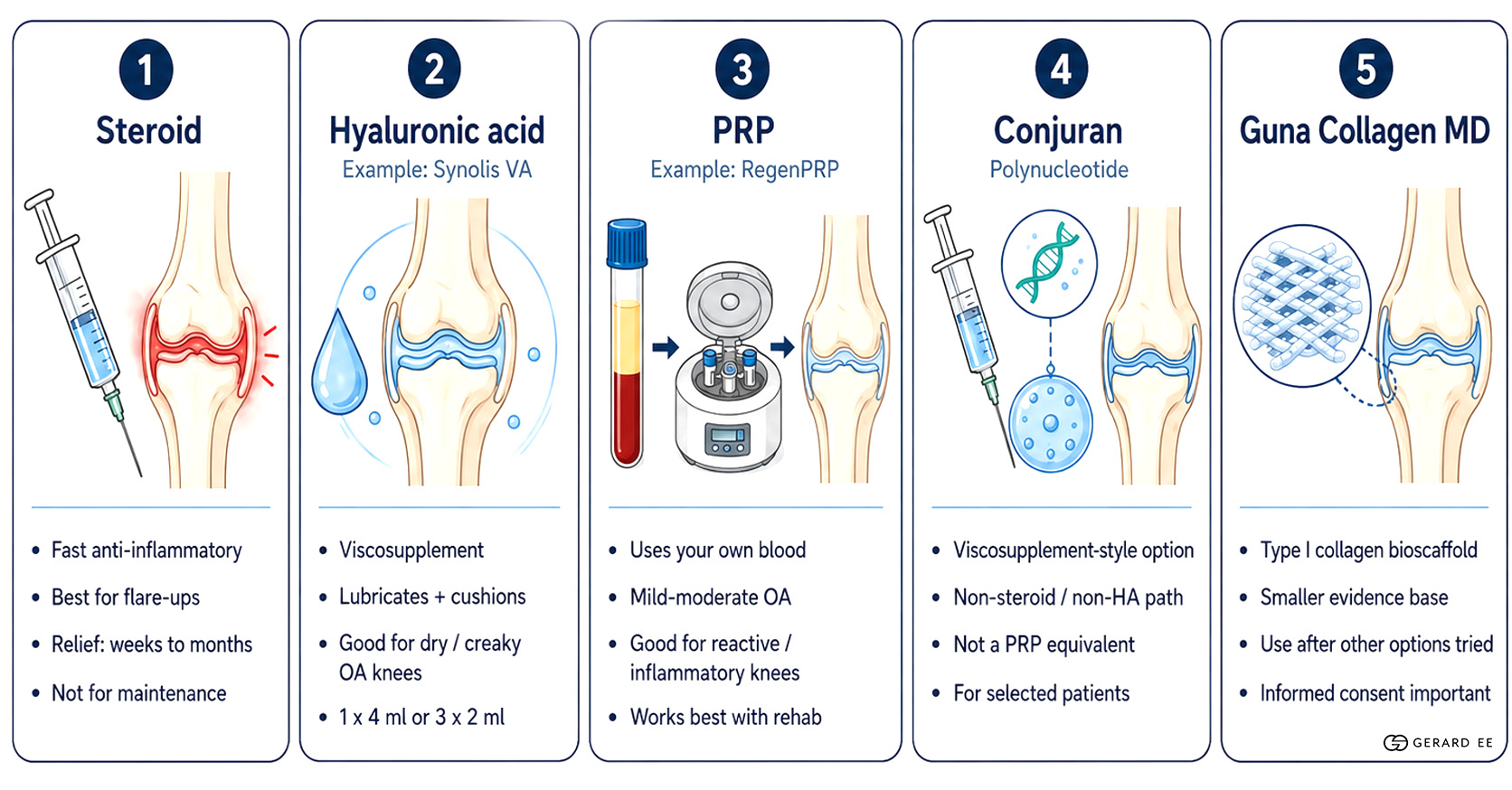
Steroid (cortisone). Steroid injections are strongly anti-inflammatory with a fast onset but have a short-term effect that lasts typically weeks to a few months. They are best suited for treating acute, inflamed flare ups. However, repeated steroid injections into the same knee are discouraged for cartilage-health reasons and diminishing returns, making them not suitable for use as a maintenance strategy.
Hyaluronic acid. Synolis VA is an example of a HA injection, it is a 2% non-crosslinked sodium hyaluronate of 2 MDa, biofermentative origin, combined with 4% sorbitol as an antioxidant. Synolis VA can be delivered as a single 4 ml injection or as a short course of three 2 ml injections. HA injections are suitable when viscosupplement is preferred and are effective when used to treat dry and creaky osteoarthritic knees.
Platelet-rich plasma. RegenLab RegenPRP is used in many Singapore practices. PRP is made using concentrated platelets from the patient’s own blood via a leukocyte-poor preparation in a CE-certified closed-circuit kit. PRP is suitable for treating mild to moderate knee OA and is particularly effective for treating knees with a more reactive or inflammatory pattern. In my experience, knee injections of any kind work best in patients who are prepared to pair the injection with structured rehabilitation.
Conjuran (polynucleotide alternative to HA). Conjuran is composed of PDRN-class sodium polynucleotide purified DNA fragments. It is used as a viscosupplement-style option, but it is not a PRP equivalent. Conjuran is suitable for patients who want a non-steroid or non-HA viscosupplement strategy.
Guna Collagen MD. A class III injectable type-I collagen that is used as an extracellular-matrix bioscaffold. As mentioned, it has a smaller evidence base than HA or PRP, thus it should only be given with informed consent and should be used after other options have been tried.
My opinion
“Generally, my usual treatment decision flow would be to use a steroid injection for a flared knee, and for mild to moderate knee OA a knee injection with the type customised to the knee pathology and severity, and to the duration of relief the patient wants, with HA or Conjuran when a viscosupplement strategy is preferred. I would only use Guna Collagen MD after the other options have been tried.”
When and Why to Combine Treatments
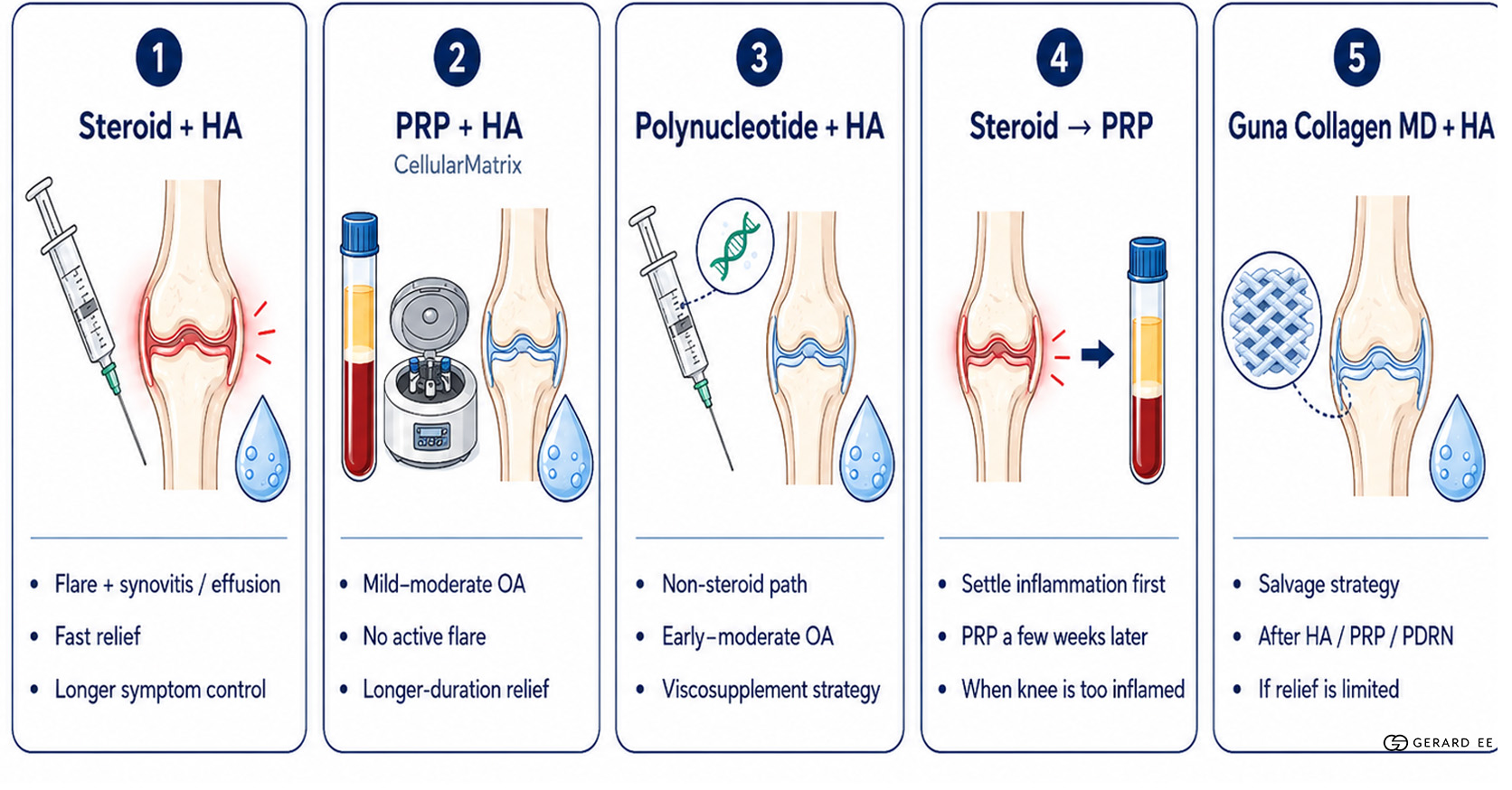
Combining different treatments is not always necessary or appropriate. But below are some common scenarios that I have encountered where combining different treatments is beneficial for the patient.
Steroid plus HA for an OA flare with synovitis and effusion. This combination is effective for when the patient wants fast relief and longer symptom control. The steroid handles the inflammation and HA provides longer term comfort and symptom control.
PRP plus HA via CellularMatrix for mild to moderate OA without an active flare where longer-duration relief is the goal. PRP delivers the biological signal that reduces joint pain and inflammation, and HA provides the viscosupplementation.
Polynucleotide-class plus HA for patients who prefer a non-steroid treatment path and want a viscosupplement strategy. This combination is effective for patients with early to moderate knee OA where the viscosupplement effect is extended or amplified.
Steroid first, followed by PRP. This combination is effective when PRP is the preferred treatment but the knee is too inflamed for a PRP injection. The joint is settled first with steroid, then revisit with PRP a few weeks later once the synovitis has calmed down.
Guna Collagen MD plus HA. This serves as a salvage strategy when HA, PRP and PDRN injections have all been tried but do not provide enough relief.
My opinion
“PRP would be wasted if given during an active inflammation. If the knee is hot and swollen, I settle it with a steroid injection first and revisit the definitive injection a few weeks later. The sequence of the injections matters as much as the treatment agent. Giving the patient the right injection at the right time is a bigger factor in determining the treatment outcome than the treatment brand or product used.”
Comparative Clinical Decision Flow
Below is a brief summary of the specific set of conditions I look out for to quickly determine what type of injection to use.
- A flared, swollen, and hot knee → Steroid is chosen because of its speed of action.
- Mild to moderate knee OA with no flare and longer treatment effect is wanted → PRP is chosen because of its effect durability.
- Stiff, dry, or creaky knee, and the patient prefers a non-steroid and non-PRP approach → HA or Conjuran as both are non-steroid and non-PRP injections.
- A single shot treatment wanted → HA is chosen as it can be administered as a single 4 ml injection. PRP is usually requires a short course.
- HA / PRP / PDRN have been tired but did not deliver enough results → Guna Collagen MD plus HA as a last resort.
Knee Injections Compared at a Glance
Knee Injection Options Compared
| Feature | Steroid, Cortisone | Hyaluronic Acid | PRP | Conjuran | Guna Collagen MD |
|---|---|---|---|---|---|
| Category | Anti-inflammatory | Viscosupplement | Biological / regenerative | Polynucleotide, viscosupplement-style | Type-I collagen bioscaffold |
| Source | Corticosteroid medication | Manufactured HA gel + sorbitol | Patient’s own blood | Sodium polynucleotide | Porcine type-I collagen |
| Onset | Fast, days | Gradual, weeks | Gradual, weeks | Gradual, weeks | Gradual, weeks |
| Best For | Acute, inflamed flare-ups | Stiff, dry and creaky OA knee | Mild to moderate knee OA | Non-steroid viscosupplement strategy | Salvage option after other treatments have been tried |
| Evidence Base | Strong evidence for short-term flare relief | Strong evidence base | Strong meta-analytic evidence | Smaller evidence base than HA or PRP | Smallest evidence base among the five options |
Mistakes And Misconceptions That I See In My Practice

Most of the patients I see for knee injections are in the 40 to 60 year old age bracket, with mild to moderate knee OA. I see both male and female patients. Some are completely new to getting knee injections, while others have had them before with mixed results and want a more carefully structured treatment plan.
The most common mistakes that I see patients make are picking treatments based on what is trendy rather than based on their diagnosis, treating the injection as the full treatment as opposed to a part of a treatment plan, and skipping rehabilitation.
Some of the more common misconceptions that patients have include expecting a steroid injection to last for years, and expecting PRP to work instantly. Patients also tend to confuse Conjuran with PRP.
When Injection Is Not the Right Move
A knee injection the wrong move in the situations listed below.
- The diagnosis is not confidently established. Reassessment and re-imaging should be done first.
- The imaging shows end-stage knee OA with major function loss. Surgical referral is the best course of action in this case.
- The patient is suffering from active local or systemic infection, has recent skin infection over the knee, or has certain blood disorders or uncontrolled anticoagulation.
Managing Non-Responders
Using PRP as an example, if the patient does not see results at twelve weeks, the next step should not be immediately getting another injection. The first course action should be to re-confirm the diagnosis, review the X-ray, and order an MRI if the diagnosis is still unclear. An MRI should also be ordered to look for a focal cartilage defect if it is suspected that a cartilage defect is driving the pain rather than knee OA.
Secondly, review the patient’s rehabilitation plan and activity load. In my experience, most non-responders are patients who skip rehabilitation.
Thirdly, consider a combination of treatments or a different treatment agent. For example, CellularMatrix, which is PRP plus HA, can be considered. A shift to HA, Conjuran or Guna Collagen MD can also be considered.
Finally, counselling regarding the patient’s treatment ceiling should be given. Some knees will not respond to injections due to the severity of their OA. Surgical referral should always be considered when appropriate.

Costs and Insurance
At my practice, The Clifford Clinic and Surgery, a single-agent knee injection of PRP, HA or Conjuran is priced from SGD 1,500. The prices of combination treatments are quoted separately. As The Clifford Clinic and Surgery is a MOH-approved day surgery centre, knee injections performed here are claimable through Medisave and hospitalisation insurance, significantly reducing the out-of-pocket cost.
My opinion
“The cheapest treatment may not always really be the most cost-effective treatment once Medisave and insurance are accounted for. When comparing cost, patients should consider the price, if the treatment is covered by their Medisave or insurance, and what additional out-of-pocket costs are not included in the price. Patients should also consider the treatment agent, how many treatment sessions are needed, and whether imaging guidance is used before committing to a treatment.”
Summary

There is no universal best knee injection as the right injection for each patient depends on whether their knee is experiencing a flare up, their OA grade, their prior treatment response, their treatment goals and their preferences.
In general, my treatment selection is steroid for flare ups, and for mild to moderate OA a knee injection with the type customised to the knee pathology and severity, with HA or Conjuran where a viscosupplement based strategy is preferred and Guna Collagen MD as a salvage option with informed consent. Combination treatments are not always needed and should be used only when the situation justifies them. Surgery is reserved for end-stage disease where non-surgical care is not longer viable.
The most important thing that I would like to stress is that all treatments should be paired with proper rehabilitation.
Related Reading
Speak to Dr Gerard Ee About Your Knee Pain
A proper assessment is needed to match the right injection to your knee. Knee joint injections at Dr Gerard Ee’s practice are performed in an MOH approved day surgery centre and are claimable through Medisave and hospitalisation insurance. The clinic’s team will advise on eligibility during consultation.
The Clifford Clinic and Surgery, 50 Raffles Place, #01-01 Singapore Land Tower, Singapore 048623 (Exit B, Raffles Place MRT) Phone: (65) 6532 2048 | WhatsApp: (65) 8318 6332

Dr Gerard Ee, Aesthetic Doctor in Singapore
Dr Gerard Ee is an aesthetic doctor in Singapore and the Medical Director of his practice at 50 Raffles Place. He graduated from St George’s, University of London, trained in surgery at Singapore General Hospital and the National University Hospital, and holds the MRCS (Edinburgh) and a postgraduate diploma in practical dermatology from Cardiff University.
He has practised aesthetic medicine since 2012, is the author of sixteen peer-reviewed papers, and writes and medically reviews every article on this site. Read more about Dr Gerard Ee.

Knee injections in Singapore: book a consultation with Dr Gerard Ee
Dr Gerard Ee consults and performs knee joint injections, with the type of knee joint injection customised to the knee pathology and severity, at The Clifford Clinic, 50 Raffles Place, Singapore. Consultations are by appointment. Message the clinic on WhatsApp, or call 6532 2048.
Frequently Asked Questions
Which knee injection works fastest? Steroid injections typically work fastest. Their effect is seen within a few days, but their effect is short-term. PRP, hyaluronic acid and Conjuran work more gradually with benefit building over weeks.
Which knee injection lasts longest? PRP, hyaluronic acid and Conjuran have longer effect durations. For mild to moderate knee OA, PRP usually outperforms hyaluronic acid in pain and function at six to twelve months.
Is Conjuran the same as PRP? No. In clinical practice Conjuran is treated as a polynucleotide viscosupplement alternative to HA, but it is not a PRP equivalent. PRP uses concentrated platelets from the patient’s own blood. Conjuran uses sodium polynucleotide.
Can knee injections be combined? Yes. Steroid plus HA for an OA flare up, polynucleotide plus HA when a non-steroid viscosupplement strategy is preferred, and PRP plus HA via CellularMatrix for non-flared mild-moderate OA are examples of combinations treatments.
Are knee injections claimable through Medisave or insurance in Singapore? Knee joint injections performed in an MOH-approved day surgery centre are claimable through Medisave and hospitalisation insurance. Coverage depends on your specific plan.
Is rehabilitation needed after a knee injection? Yes. Injections work best when paired with structured strengthening, weight management and load adjustment. Without proper rehabilitation, even the best injection for the patient tends to give a short-lived result.
About Dr Gerard Ee

Dr Gerard Ee
Dr Gerard Ee, MBBS (UK), MRCS (Edinburgh), PGDip Practical Dermatology (Cardiff) is a Member of the Royal College of Surgeons and a senior physician in Singapore. He is trained as an orthopaedic doctor and has years of experience in both operative and non-operative care of knee osteoarthritis. His peer-reviewed orthopaedic research has been published in top-tier journals including The Knee, Knee Surgery, Sports Traumatology, Arthroscopy (KSSTA), the Journal of Bone and Joint Surgery (British) and Clinical Orthopaedics and Related Research. He now works as a senior aesthetic doctor and continues to provide evidence-driven, non-surgical knee care for mild to moderate knee osteoarthritis with a clinical philosophy of using non-invasive treatments first and surgery as a last resort. He believes that treatment should be matched to evidence and to the individual patient.
Show the 7 references
- Borg-Stein J, Jayaram P, Colorado BS, et al. AAPM&R guidance statement on platelet rich plasma for knee osteoarthritis. PM R. 2026;18(Suppl 2):S20-S35. PubMed 41989317
- Dubin J, Leucht P, Murray M, et al. American Academy of Orthopaedic Surgeons Technology Overview Summary: Platelet-Rich Plasma (PRP) for Knee Osteoarthritis. J Am Acad Orthop Surg. 2024;32(7):296-301. PubMed 38295392
- Bensa A, Previtali D, Sangiorgio A, et al. PRP injections for the treatment of knee osteoarthritis: the improvement is clinically significant and influenced by platelet concentration. A meta-analysis of randomized controlled trials. Am J Sports Med. 2025;53(3):745-754. PubMed 39751394
- Jawanda H, Khan ZA, Warrier AA, et al. Platelet-rich plasma, bone marrow aspirate concentrate, and hyaluronic acid injections outperform corticosteroids in pain and function scores at a minimum of 6 months as intra-articular injections for knee osteoarthritis: a systematic review and network meta-analysis. Arthroscopy. 2024;40(5):1623-1636. PubMed 38331363
- Wang C, Yao B. Efficacy and safety of platelet-rich plasma injections for the treatment of knee osteoarthritis: a systematic review and meta-analysis of randomized controlled trials. Eur J Med Res. 2025;30(1):992. PubMed 41107915
- Chiari Gaggia GMM, Conte P, Anzillotti G, et al. Platelet-based injections for knee osteoarthritis: do they work, are they safe? Clin Sports Med. 2025;44(4):659-674. PubMed 41101902
- Whittle SL, Johnston RV, McDonald S, et al. Stem cell injections for osteoarthritis of the knee. Cochrane Database Syst Rev. 2025;4:CD013342. PubMed 40169165
This page is written from published research and from clinical experience in Singapore since 2012. It is for general education, not medical advice. Whether a treatment suits you, what it may achieve and what it may risk can only be established at a consultation. Dr Gerard Ee is the Medical Director of The Clifford Clinic. The Clifford Clinic is a private clinic in Singapore and provides knee joint injections commercially, including platelet-rich plasma for knee osteoarthritis.