Home›Blog›Face›Which Filler Is Best for the Nose? Hyaluronic Acid Nose Fillers Compared
Written by Dr Gerard Ee, MBBS (UK), MRCS (Edinburgh), PGDip Practical Dermatology (Cardiff). Founder and Medical Director, The Clifford Clinic and The Clifford Surgery, Singapore. Last medically reviewed and updated September 2026.
Key points
- About three quarters of published nose filler cases use hyaluronic acid (HA).
- HA is the only nose filler that can be dissolved, with hyaluronidase acting within hours if a complication occurs.
- Firm, cohesive HA gels hold height on the bridge, and smaller amounts of a similar gel support the tip.
- Restylane Lyft and Juvederm Volux are the two HA products with nose-specific studies.
- HA nose filler costs $1,200 per syringe before GST.
Which filler is best for the nose
For most noses, and every first nose filler, the best filler is a firm, cohesive HA. Radiesse (calcium hydroxylapatite) lasts longer and holds a firmer line, but it cannot be dissolved, and I therefore reserve it for patients who have had HA before and liked the shape. Polycaprolactone (PCL) and poly-L-lactic acid (PLLA) fillers are not designed for the nose, as they stimulate collagen across broad areas rather than holding a narrow line. The longer-lasting option is covered on Radiesse nose filler.
Why hyaluronic acid is the standard nose filler
Across 23 studies of non-surgical rhinoplasty, HA was used in 73.4% of cases and calcium hydroxylapatite in 12.4%. HA is the standard for three reasons. It gives its full effect on the day of injection, which allows the shape to be judged during the treatment. It is cohesive enough to stay in a narrow line. It can be dissolved by hyaluronidase, which matters more in the nose than anywhere else in the face because of the vulnerable blood supply of the nose.
What makes one HA nose filler different from another
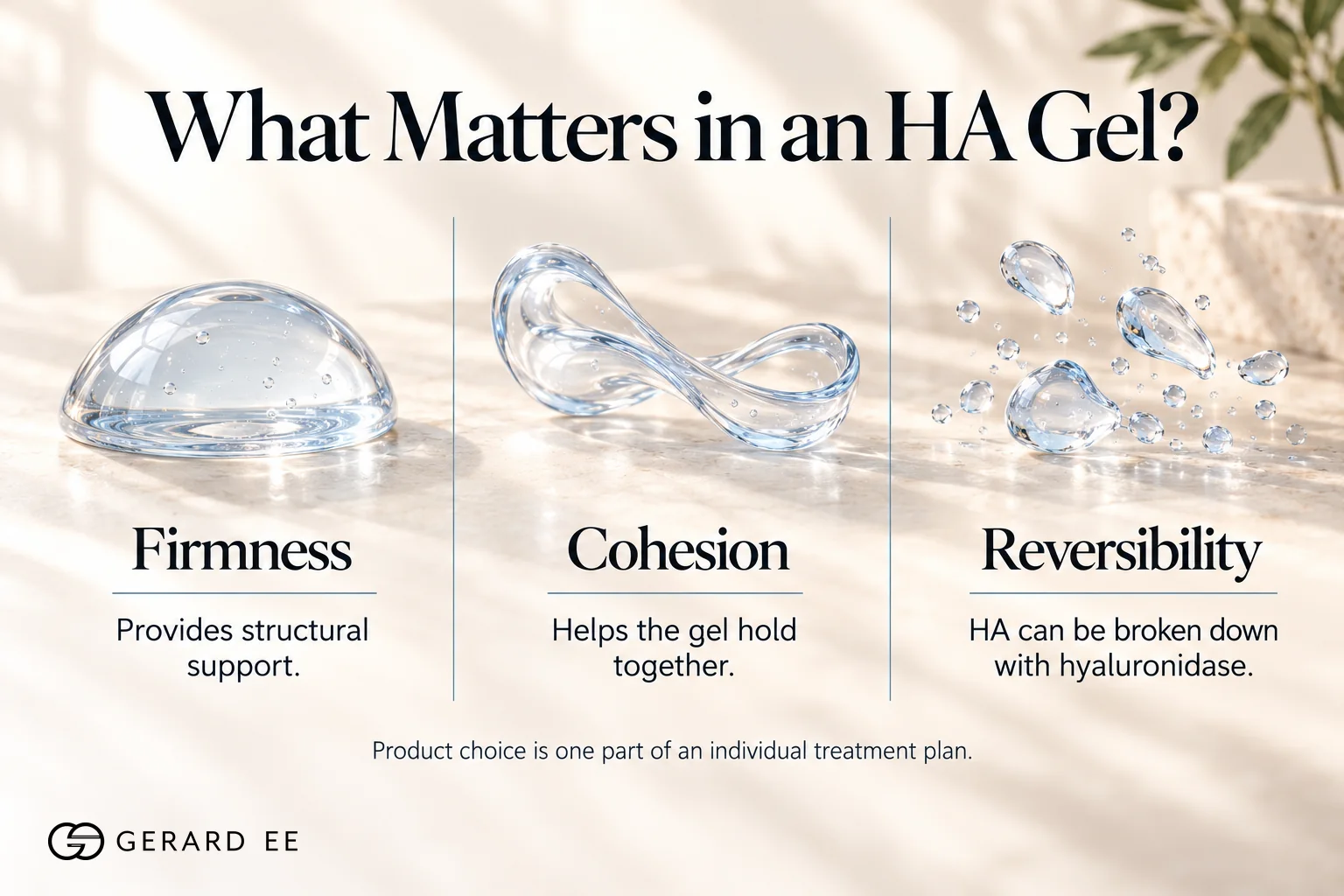
HA fillers differ in firmness and in cohesivity, the degree to which the gel holds together. A firm gel with high lift resists compression by the skin and maintains height on the bridge. A cohesive gel stays where it is placed rather than spreading sideways. Both properties are necessary in the nose, whereas a soft gel designed for lips or fine lines spreads and widens the bridge. International consensus recommends highly cohesive, elastic HA fillers for nasal augmentation in Asian patients.
Restylane Lyft for the nose
Restylane Lyft is a firm, high-lift HA. In a randomised, no-treatment-controlled trial of 132 Chinese patients, up to 1 ml placed in the bridge and radix (the root of the nose between the eyes) increased volume by a mean of 0.71 ml more than in controls at six months, and the lift was maintained to twelve months. On current evidence, Restylane Lyft is the most rigorously studied HA product in the nose.
Juvederm Volux for the nose
Juvederm Volux (VYC-25L) is one of the firmest HA fillers in the Juvederm range, designed for structural support of the chin and jaw. In a study of 61 patients treated for nasal shape with a grid approach, Juvederm Volux achieved high correction scores that were maintained to six months, with bruising as the main side effect and no cases of skin necrosis, the tissue death caused by a blocked vessel.
Other HA fillers used in the nose
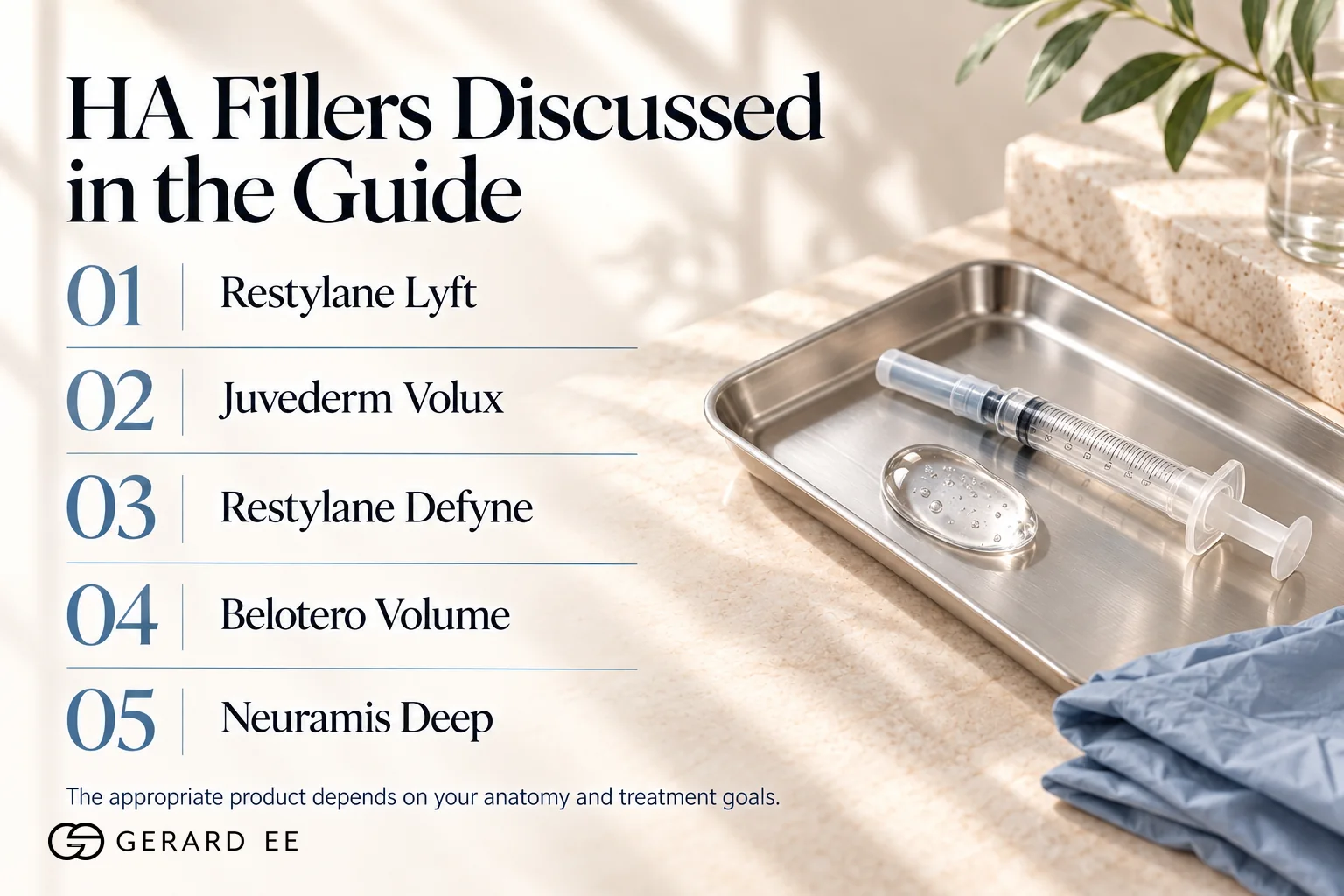
Restylane Defyne, Belotero Volume and Neuramis Deep are other firm HA fillers used in the nose, and all can be dissolved with hyaluronidase. The placement depth and technique affect the result more than the choice between firm HA products.
Choosing HA filler for the nose bridge and the nose tip

- The bridge requires a firm, high-lift gel placed deep on the bone and cartilage, where it holds a straight line.
- The tip requires very small amounts, around 0.05 to 0.1 ml at each point, of a gel that provides support without adding bulk.
I place HA with a needle rather than a cannula, down to the periosteum (the lining of the bone) on the bridge, in small deposits of about 0.05 ml. A needle allows more accurate placement at this depth, where the filler lies below the main blood vessels.
How long HA nose filler lasts
The visible result usually lasts about a year. The filler can remain in the nose longer than the result is visible, and a top-up is therefore placed only after the remaining filler has been assessed, as layering new filler on old can widen the bridge. Old HA that has spread can be dissolved, as described on dissolve nose filler.
Hyaluronic acid nose filler cost in Singapore
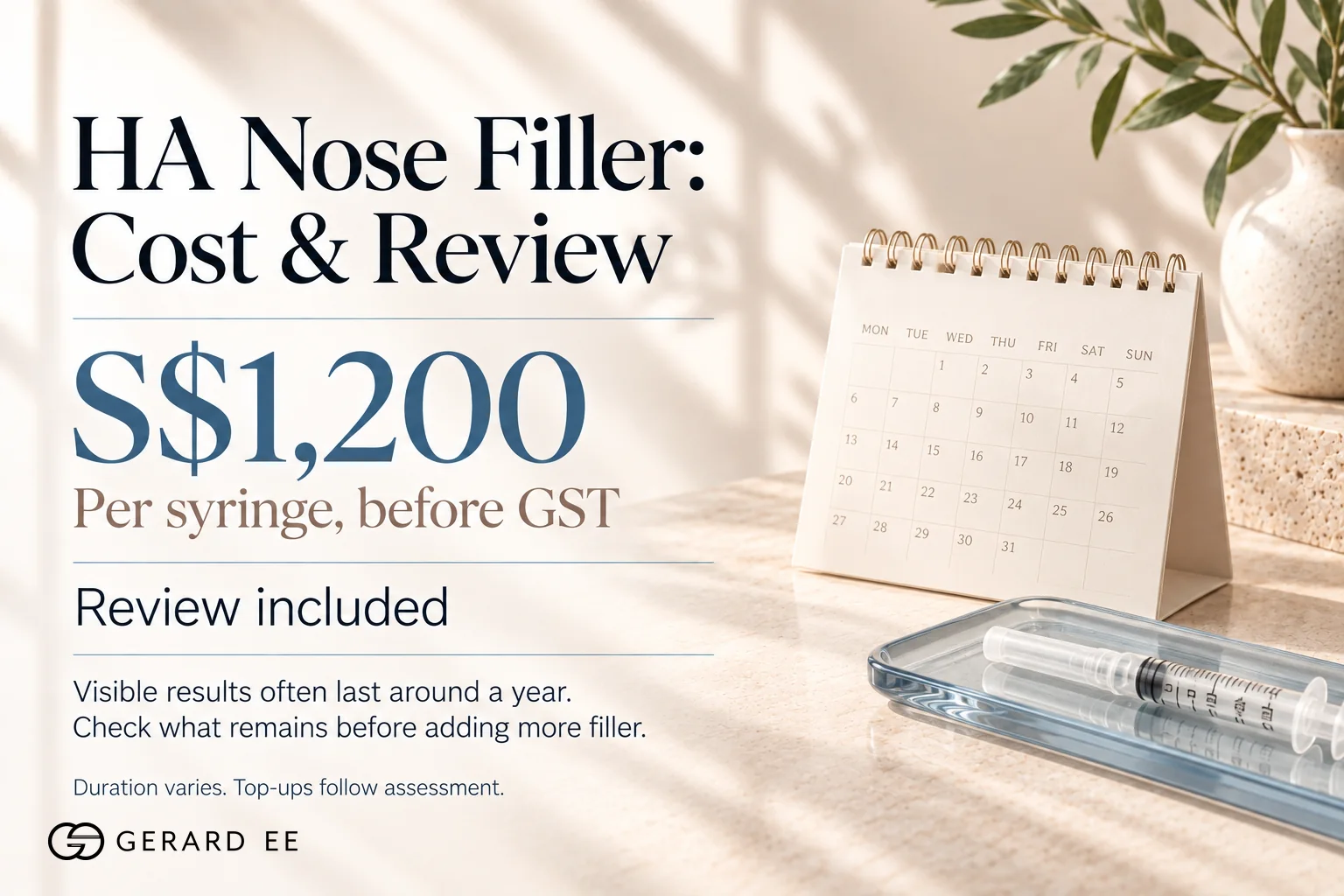
HA nose filler costs $1,200 per syringe before GST, including the review. Most noses require one syringe. The treatment is described on nose fillers in Singapore, and a longer-lasting option that cannot be reversed is described on Radiesse nose filler.

Dr Gerard Ee, Aesthetic Doctor in Singapore
Dr Gerard Ee is an aesthetic doctor in Singapore and the Medical Director of his practice at 50 Raffles Place. He graduated from St George’s, University of London, trained in surgery at Singapore General Hospital and the National University Hospital, and holds the MRCS (Edinburgh) and a postgraduate diploma in practical dermatology from Cardiff University.
He has practised aesthetic medicine since 2012, is the author of sixteen peer-reviewed papers, and writes and medically reviews every article on this site. Read more about Dr Gerard Ee.

Book a consultation with Dr Gerard Ee
Dr Gerard Ee consults and performs hyaluronic acid nose filler at his practice at 50 Raffles Place, Singapore. Consultations are by appointment. Message the clinic on WhatsApp, or call 6532 2048.
Hyaluronic acid nose filler, frequently asked questions
What is the best filler for the nose?
For most noses, the best filler is a firm, cohesive hyaluronic acid, because it gives shape on the day and can be dissolved.
What is the best hyaluronic acid filler for the nose?
The best choice is a firm, cohesive HA designed for structural support. Restylane Lyft and Juvederm Volux are the two with published nose studies.
Can hyaluronic acid nose filler be dissolved?
Hyaluronic acid nose filler can be dissolved. Hyaluronidase begins to break it down within hours, and most of the filler softens within 24 to 48 hours.
Is a soft lip filler suitable for the nose?
A soft lip filler is not suitable for the nose, as a soft gel spreads and widens the bridge.
Why not use a longer-lasting filler instead of HA?
Longer-lasting fillers in the nose cannot be dissolved if a complication occurs, as explained on Radiesse nose filler.
Selected References
- Williams LC, Kidwai SM, Mehta K, et al. Nonsurgical rhinoplasty, a systematic review of technique, outcomes, and complications. Plast Reconstr Surg. 2020. PMID 32590640.
- Trevidic P, Kim HJ, Harb A, et al. Consensus recommendations on the use of hyaluronic acid-based fillers for nonsurgical nasal augmentation in Asian patients. Plast Reconstr Surg. 2022. PMID 35077414.
- Wang X, Li B, Li Q. Restylane Lyft for aesthetic shaping of the nasal dorsum and radix, a randomized, no-treatment control, multicenter study. Plast Reconstr Surg. 2022. PMID 36103665.
- Bertossi D, Malchiodi L, Albanese M, et al. Nonsurgical rhinoplasty with the novel hyaluronic acid filler VYC-25L, results using a nasal grid approach. Aesthet Surg J. 2021. PMID 32628267.
- Betti E, Catarzi L, Consorti G. Nonsurgical rhinoplasty, diamond injection technique for nasal tip contouring. Facial Plast Surg Aesthet Med. 2024. PMID 37267216.
Dr Gerard Ee consults and performs hyaluronic acid nose filler at 50 Raffles Place, Singapore.
This page is written from published research and clinical experience in Singapore since 2012. It is for general education, not medical advice. Suitability, results, downtime and cost vary from person to person. Please arrange a consultation for advice specific to your nose.