Written by Dr Gerard Ee | Medically reviewed by Dr Gerard Ee | Expert opinion by Dr Gerard Ee
Dr Gerard Ee is an aesthetic doctor and the founder and medical director of The Clifford Clinic, which he established 14 years ago. He has treated acne scars for 16 years and more than 2,000 acne-scar patients, and is one of Singapore’s longest-standing users of the Infini RF microneedling system (16 years). He holds a Diploma in Dermatology (Cardiff) and is a Member of the Royal College of Surgeons (MRCS). More on Dr Gerard Ee.
Treating acne scars in darker skin is not the same treatment at a lower setting. It is a different set of judgements, most of them made before any energy reaches the skin. The overriding priority is avoiding post-inflammatory hyperpigmentation, the brown marks that follow over-aggressive treatment, while still delivering the energy a scar needs at depth. Holding those two requirements together is where experience counts, because they pull against each other. In my experience the outcome in darker skin turns less on which device is chosen than on how much energy that skin will accept before the surface is at risk.

Why darker skin needs a different approach
Deeper skin tones present with more active melanocytes, the pigment-producing cells, which answer to inflammation and heat by making more melanin. A treatment that passes unremarked in lighter skin can therefore leave brown marks that persist for months in a higher Fitzpatrick type. The objective is unchanged, since collagen still has to be remodelled at depth, but the route must protect the surface and avoid provoking pigment.
Why insulated Infini is the first choice
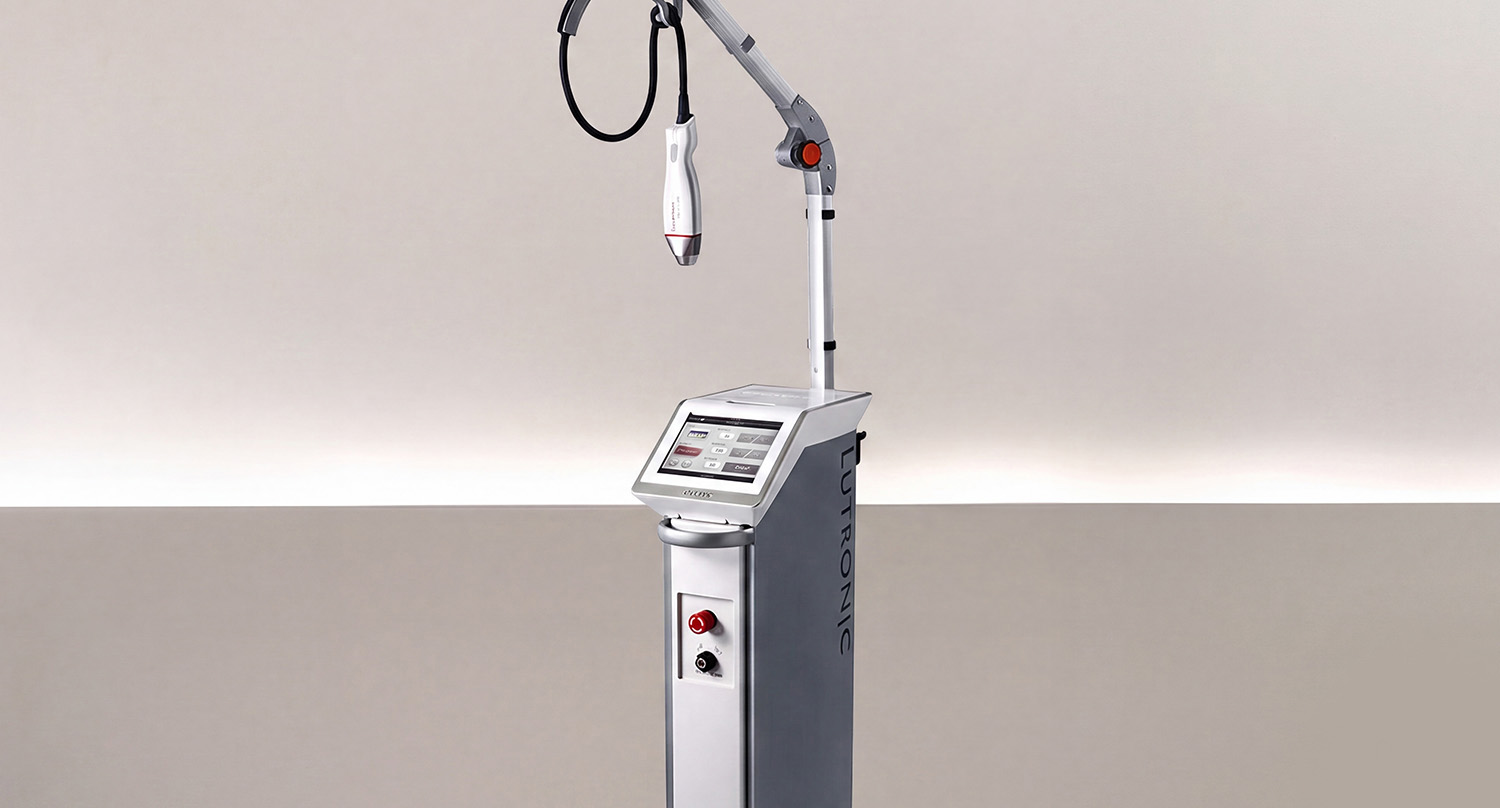
For darker skin, Infini is generally safer than non-insulated devices and carries most of the deep work. Its insulated needles concentrate energy at the tip deep in the dermis while sparing the epidermis, so the high energy a scar requires, up to around 50 W, reaches the collagen without heating the surface where pigment problems begin. Non-insulated Secret RF and fractional CO2 deposit more energy at or near the surface, which is why they are used more cautiously here rather than excluded. Having worked with Infini for sixteen years, I have found the difference in darker skin shows in what does not appear afterwards. The full device comparison, with FDA figures, is in Infini vs Secret RF.
Using laser carefully, not avoiding it
Fractional CO2 is not excluded in darker skin, but the settings must suit the skin type rather than the scar alone. Lower energy is used, and gentler sessions repeated more often may be needed. Where pores and pigment are the complaint, Pico MLA is useful and well tolerated, though it may not always be the most clinically appropriate option for a depression. Overtreating a higher Fitzpatrick type costs the patient months of pigmentation, so building up from a low starting point is the safer course. When a patient tells me a previous laser course left months of darkening, the explanation is usually energy suited to lighter skin applied unchanged to a darker tone. The CO2 laser article covers the settings logic.
Keloid tendency is not a contraindication
A common concern is that a tendency to keloids rules out treatment. That assumption does not hold once the difference between a raised keloid and a depressed scar is taken into account. A keloid tendency calls for careful patient selection and technique, but it is not by itself a contraindication to RF microneedling for atrophic scars. What RF cannot do is resurface an established keloid, a separate problem, and that limit does not extend to the depressed scars around it. The commonest misconception I encounter here is that a keloid history closes off scar treatment entirely.
PDRN and biostimulators
In darker skin, adjuncts that support healing and reduce inflammation carry particular value, since the period straight after treatment is when pigment is most readily provoked. PDRN, Rejuran, improves recovery, potentiates results and combines well with Infini. Biostimulators are selected by scar type, with PCL for volume loss, PDLLA skin booster for ice pick and boxcar scars, and PLLA or PDLLA Volume for rolling scars. Across more than two thousand acne-scar patients I have found the combination that serves darker skin best is Infini paired with Rejuran, PLLA, PDLLA skin booster or ECM booster, which holds the pigmentation risk low while remodelling proceeds, the same logic as the subcision and biostimulators guide.
Sun protection, with one important caveat
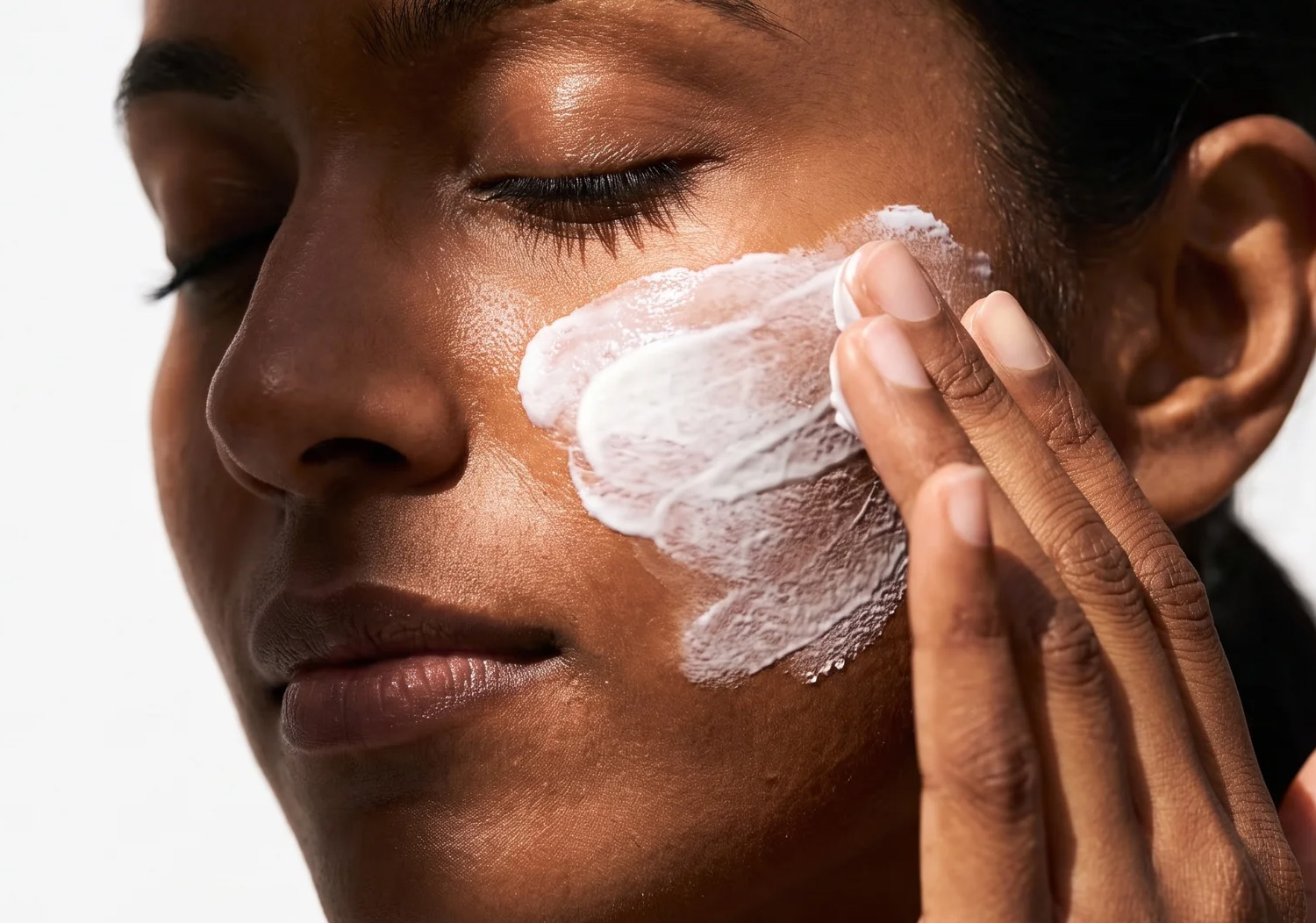
Sun protection matters in darker skin because ultraviolet light provokes pigmentation, and once the acne is controlled, daily broad-spectrum sunscreen and careful sun avoidance after treatment are important. One caveat applies, in that heavy sunblocks congest the skin while the acne is still active and can cause more breakouts, so light non-comedogenic options or a hat and shade are preferable during that phase. Breakouts that worsen a few weeks into a scar course are often traced to a heavy sunscreen applied when the acne had not yet settled. Once the skin is calm, sun protection becomes one of the most valuable measures available.
What is seen in practice
The cases that present to me for correction are often patients who had aggressive treatment, usually a high-energy laser, in darker skin and developed pigmentation that took months to settle. Outcomes of that kind are largely avoidable with the right device choice, restrained energy and good aftercare, though a minority of patients develop pigmentation despite every precaution. Treated with appropriate restraint, darker skin responds as well to remodelling as any other skin type. The melanin that makes pigment a risk does not make the scar any harder to remodel.
Proven ways to prevent pigmentation in darker skin
Because pigmentation is the main risk, the literature offers concrete ways to lower it, and these are applied routinely. Lower fluence and density, priming the skin beforehand, and pigment prophylaxis, including topical corticosteroids after ablative CO2, all measurably reduce post-inflammatory hyperpigmentation in Asian and skin-of-colour patients (PIH prevention in Asians, skin-of-colour optimisation). Modalities with the best safety record in dark skin are favoured where possible, and non-ablative fractional lasers and fractional radiofrequency are both reported as effective with acceptable safety in Fitzpatrick IV to VI (non-ablative FST IV-VI, type VI RF).
None of this means darker skin should be treated so cautiously that the treatment achieves nothing, since an ineffective course still costs the patient months and money. The requirement is careful sequencing, a gradual build in energy, and protection afterwards, an approach the evidence supports and one that allows comparable improvement at considerably lower risk.
What the research shows
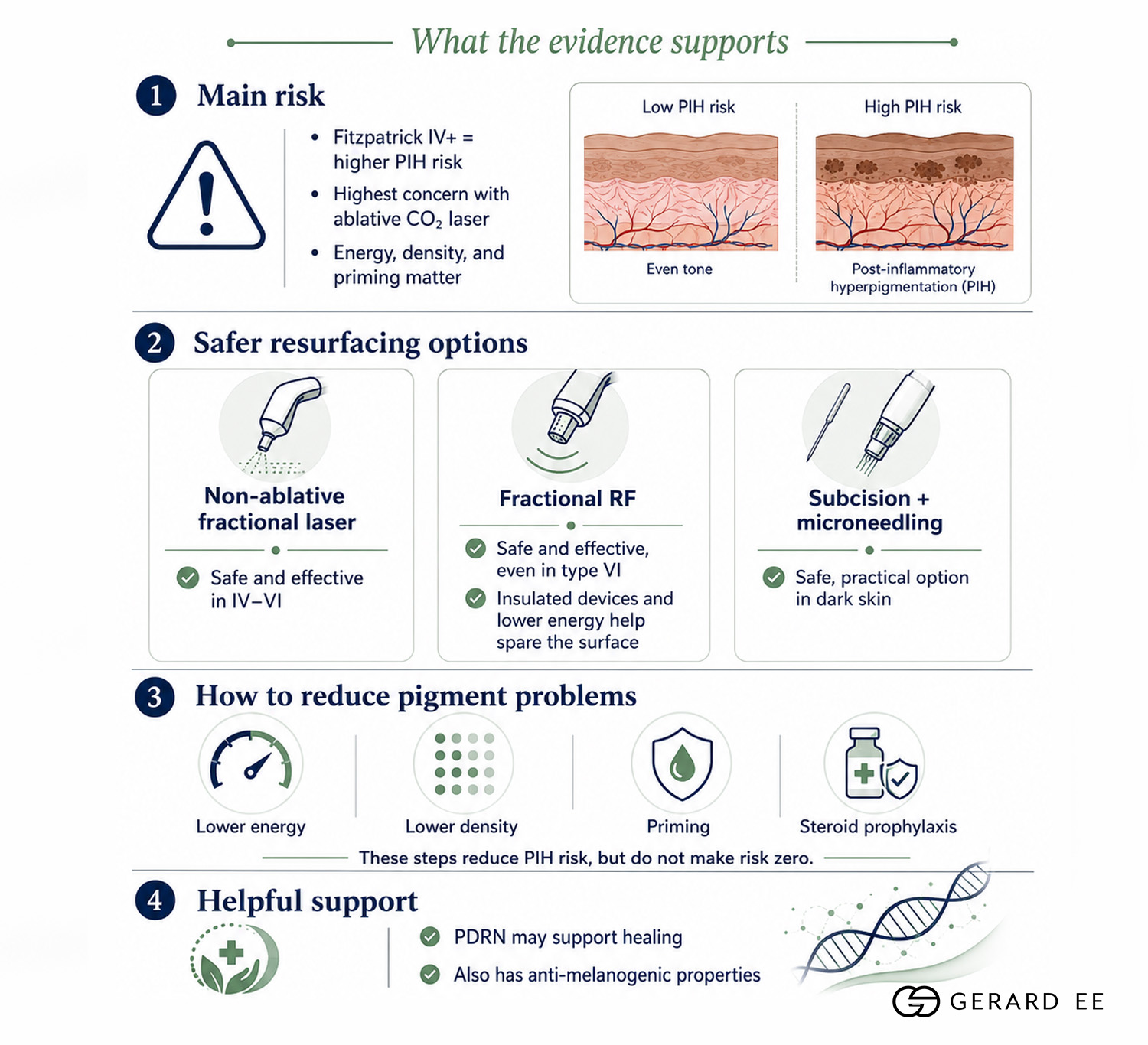
The literature is explicit about the central risk in darker skin, in that the great majority of patients at Fitzpatrick IV and above can develop transient post-inflammatory hyperpigmentation after ablative CO2 laser, which is why energy, density and priming matter so much (skin-of-colour optimisation, ethnic-skin guidelines). Non-ablative fractional lasers are reported as safe and effective for acne scarring in skin types IV to VI (non-ablative FST IV-VI study), and topical corticosteroid prophylaxis reduces PIH after ablative CO2 in Asian skin (PIH prevention).
That evidence underpins the preference for insulated devices and for lower energy, since the surface is not the part being treated. Fractional radiofrequency has been found safe and effective even in skin type VI (type VI RF study). Subcision with microneedling is a safe and inexpensive option in dark skin (subcision plus microneedling), and PDRN, useful for healing, also has anti-melanogenic properties that suit pigment-prone skin (PDRN anti-melanogenesis). Safe and effective here describes an average across a treated group rather than a guarantee for one patient.
Comparative-trial evidence in darker skin
For darker skin the comparative trials are consistent about device choice, since they compare the devices on the same face rather than across separate studies. In a split-face study, non-insulated microneedle fractional radiofrequency caused significantly less post-inflammatory hyperpigmentation than ablative CO2 laser, which raised the melanin and erythema indices at one and two months (radiofrequency versus CO2 study). Picosecond lasers similarly produce far fewer pigment-related adverse effects than ablative resurfacing (picosecond versus CO2 trial). That evidence sits behind the preference for insulated RF and gentle, lower-pigment-risk devices in Fitzpatrick IV to VI skin, though each comparison is between a higher and a lower risk rather than between risk and safety.
The 2022 international consensus on energy-based devices for acne scars factors skin type into device and setting selection, recommending more cautious, lower-risk approaches in darker skin (consensus recommendations), which matches the conservative strategy of building energy up gradually used here, though such a consensus sets boundaries rather than prescribing settings for one face.
Understanding Fitzpatrick skin types
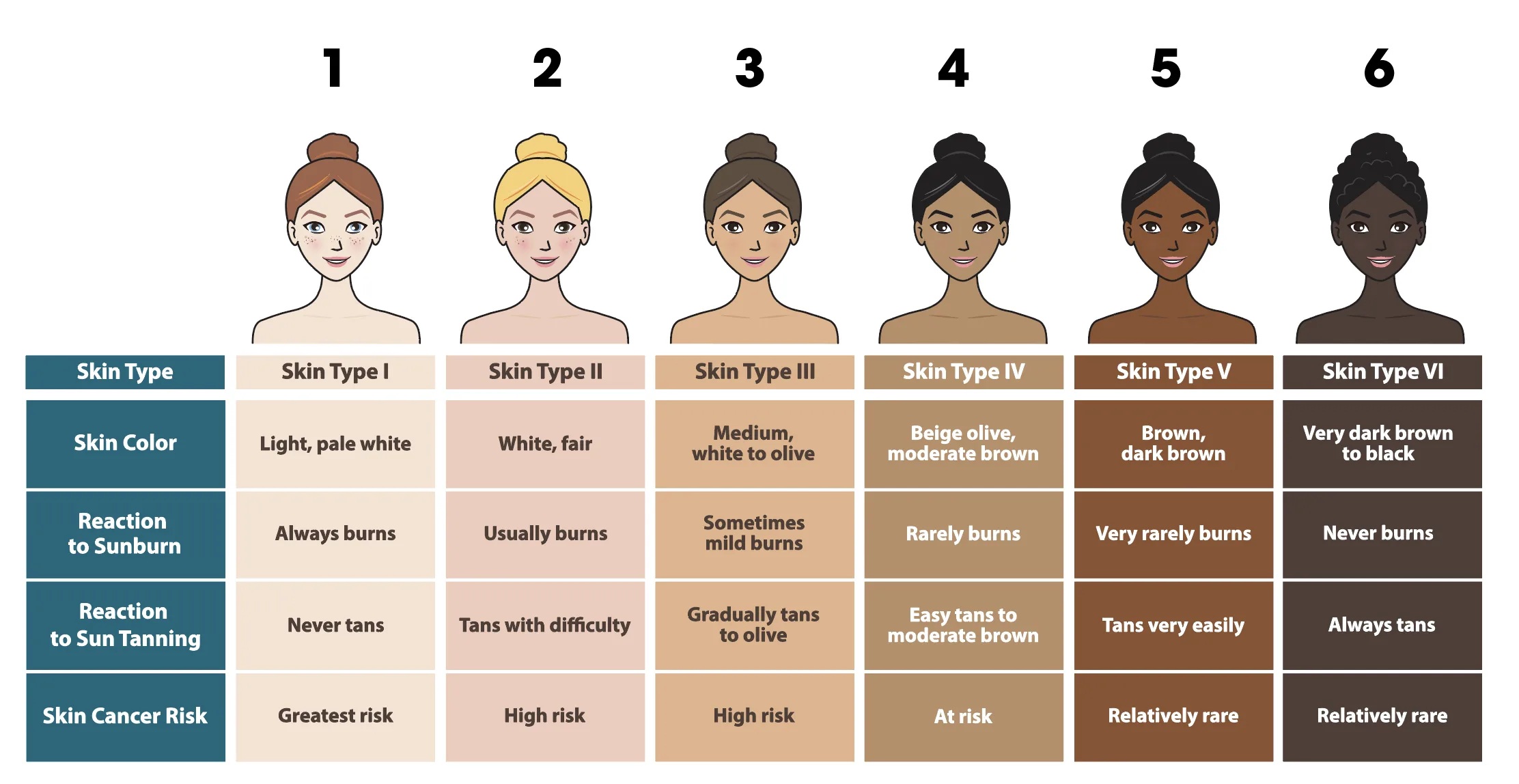
The Fitzpatrick scale classifies skin from type I to type VI by its response to sun exposure, from very fair skin that always burns to deeply pigmented skin that rarely does. Types IV to VI, running from olive through mid-brown to deep brown and black, are common across Asian and Southeast Asian populations and therefore very common in Singapore. These higher types carry more reactive melanocytes and a correspondingly greater tendency to post-inflammatory hyperpigmentation. Where a patient sits on the scale is the starting point for choosing devices and energy, though two patients of the same type may still respond differently to identical settings.
Why pigmentation is the central risk
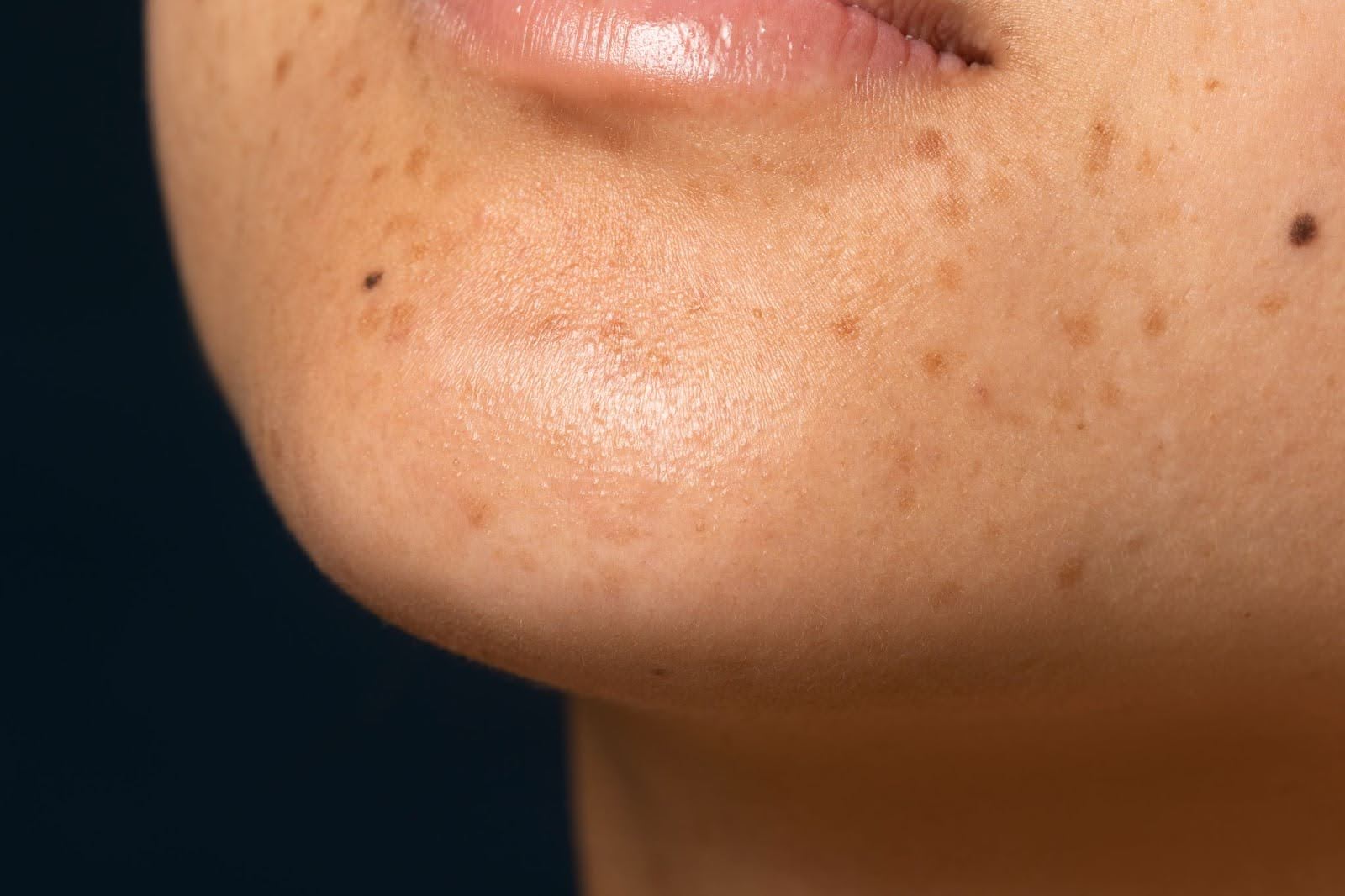
The reason darker skin needs a distinct approach is biological rather than a matter of caution for its own sake. Its melanocytes are more readily activated by heat and inflammation to overproduce melanin, so a treatment that heals cleanly in fair skin can leave months of brown discolouration in a higher Fitzpatrick type. Controlling the energy delivered and the inflammation provoked is therefore the priority, since those two factors determine whether pigment is triggered.
Test patches and building up gradually
A safe strategy in darker skin is to begin conservatively rather than at the settings the scar alone would justify. A first session at lower settings, or a small test area, allows the skin’s response to be judged before fuller strength is committed to. Energy and density are then titrated upward across later sessions only as the skin tolerates them. I cannot reliably predict at a first consultation how a patient’s skin will respond to full strength, so the first session establishes that rather than assuming it. The staged approach requires more sessions than one aggressive treatment, and a slower course should be expected, but it substantially reduces the risk of a pigmentary setback that could take many months to resolve.
Pigment prophylaxis before and after treatment
Prevention of pigmentation is built into the plan from the outset rather than added once a problem appears. Before more aggressive procedures, the skin may be primed with topical agents that reduce melanocyte activity, and strict sun protection is emphasised throughout. Emerging pigmentation is addressed promptly afterwards, and short courses of topical agents, including corticosteroids after ablative CO2 in some protocols, reduce post-inflammatory hyperpigmentation in Asian skin. Low risk is not the same as no risk, and outcomes vary between patients whose skin looks much the same at consultation.
Which treatments are safest in darker skin
Certain modalities have a better safety record in higher Fitzpatrick types, and that record drives the selection. Insulated RF microneedling is a first-line choice because the insulation delivers energy to the dermis while sparing the surface. Non-ablative fractional lasers are generally well tolerated, and fractional CO2, where used, is held to lower fluence and density. Pico devices suit pigment with minimal downtime, though a device directed at pigment does not remodel a depression, and PDRN supports healing. Of the treatments used in these skin types, the one I see produce a pigmentary setback most often is high-density ablative resurfacing, which is why it is approached with particular caution or avoided.
Managing keloid risk safely
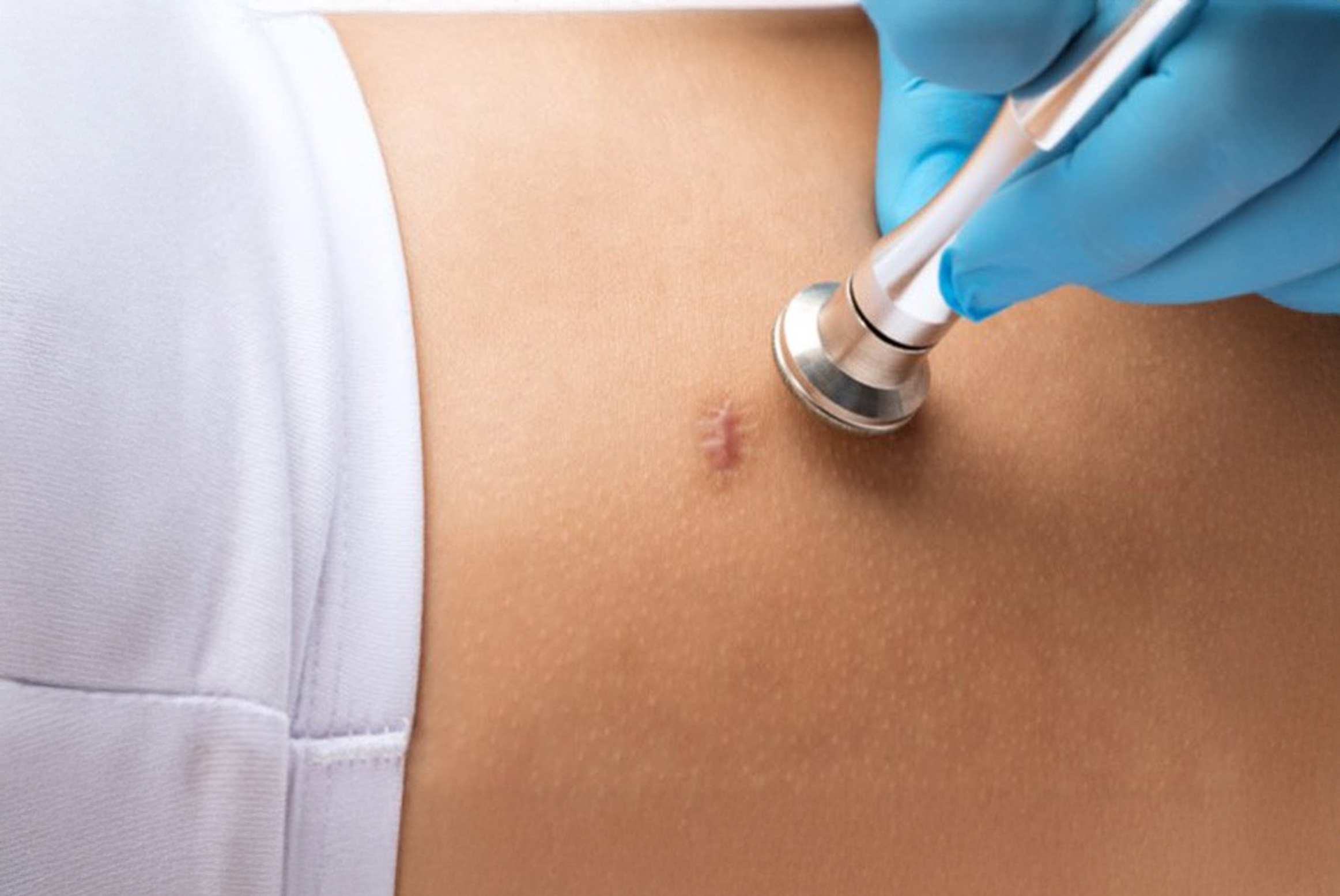
A personal or strong family history of keloids calls for extra caution, an open discussion of risk, and sometimes a small test treatment before proceeding. An established keloid is managed with dedicated therapies of its own, not with the resurfacing and remodelling that improve a depressed scar. Where the history is strong, that discussion should include the possibility of not proceeding, since a test response giving cause for concern is a reason to stop rather than to continue more slowly.
Aftercare tailored to darker skin
Aftercare in darker skin places particular emphasis on preventing pigmentation, because the period following any energy treatment is when post-inflammatory hyperpigmentation is most likely to arise. Diligent daily broad-spectrum sun protection, once the acne allows, is central, and tinted sunscreens containing iron oxides add protection against the visible light that drives pigment in higher Fitzpatrick types. Gentle, non-irritating skincare supports the barrier while it heals, and harsh actives are reintroduced gradually. Any early sign of darkening is addressed promptly with pigment-directed measures rather than left to deepen. The request I decline most often in darker skin is to shorten the interval between sessions, since that spacing is doing part of the work of preventing pigmentation. Handled this way, darker skin heals well and achieves genuine scar improvement.
The bottom line
Acne scars in darker skin are very treatable, but the priority is avoiding pigmentation while still remodelling collagen, so the plan rests on insulated Infini for the deep work, fractional CO2 only at lower energy, PDRN and biostimulators to support healing, and sun protection once the acne is calm. A keloid tendency does not rule treatment out, though it does change how cautiously the first session is approached. Sixteen years of treating acne scars has persuaded me that in darker skin the restraint applied in the early sessions is what makes the eventual result possible. Continue with RF microneedling: Infini vs Secret RF or the cost of treatment.

Frequently Asked Questions
What is the best acne scar treatment for dark skin?
Insulated Infini RF microneedling is the safest foundation for darker skin, because it spares the epidermis while delivering energy at the depth the scar occupies. It is usually combined with carefully dosed laser, PDRN (Rejuran) and biostimulators, and improvement is measured across a course of sessions rather than after one.
Is laser safe for acne scars on dark skin?
Laser may be used safely on darker skin provided the settings suit the skin type. Fractional CO2 is used at lower energy to reduce the risk of post-inflammatory hyperpigmentation, and insulated RF microneedling is often preferred as the deeper-working option. A minority of patients still develop transient pigmentation after a carefully dosed session, so energy is built up gradually.
Does a keloid tendency mean acne scars cannot be treated?
A keloid tendency does not prevent acne scars from being treated, though it does change how the treatment is planned. It calls for careful technique and an open discussion of risk, but it is not by itself a contraindication to RF microneedling for atrophic scars. Established keloid scars, however, cannot be improved by RF or resurfacing.
How can dark marks after treatment be avoided?
Dark marks are avoided by choosing a device suited to the skin tone, often insulated Infini, keeping laser energy conservative, supporting healing with PDRN, and protecting the skin from the sun once the acne is controlled. None of these measures removes the risk entirely, and any darkening that appears is treated promptly.
Key references
Show the key references (5)
- Optimizing fractional CO2 outcomes for pigmented atrophic acne scars in skin of colour. PubMed.
- Acne scars in ethnic skin treated with non-ablative 1550 nm and ablative fractional CO2: guidelines. PubMed.
- Non-ablative fractional laser resurfacing for acne scarring in Fitzpatrick IV-VI. PubMed.
- Topical corticosteroids minimise PIH after ablative fractional CO2 in Asians. PubMed.
- Safety and efficacy of fractional radiofrequency facial treatment in skin type VI. PubMed.
Comparative trials cited
- Qu L, Sha S, He C, et al. Non-insulated microneedle fractional radiofrequency versus ablative fractional CO2 laser for facial atrophic acne scars: pilot randomised split-face study. Acta Derm Venereol. 2025. PubMed.
- Yuan Y, He Y, Fang J, et al. Fractionated 1064 nm picosecond laser with holographic optics versus fractional CO2 laser for atrophic acne scars: randomised split-face study. Int J Dermatol. 2025;64:85-91. PubMed.
- Salameh F, Shumaker PR, Goodman GJ, et al. Energy-based devices for the treatment of acne scars: 2022 international consensus recommendations. Lasers Surg Med. 2022;54:10-26. Journal.
Device specifications & sources
Show device specifications and sources (2)
- S. FDA 510(k) Summary K170325 (Secret RF, Ilooda Co., Ltd.): Max power Max 25 W at 500 Ω. 2 MHz. Needle depth 0.5-3.5 mm.
- S. FDA 510(k) K121481 (INFINI, Lutronic Inc.): insulated RF microneedling system, 49-pin handpiece, maximum RF generator output approximately 50 W.

Dr Gerard Ee
Written, medically reviewed and expert opinion by Dr Gerard Ee, aesthetic doctor and Founder & Medical Director of The Clifford Clinic. This article reflects my clinical experience treating acne scars in Singapore and is intended for general education, not medical advice. Treatment suitability, results, downtime and cost vary from person to person. Please arrange a consultation for advice specific to your skin.