Written by Dr Gerard Ee | Medically reviewed by Dr Gerard Ee | Expert opinion by Dr Gerard Ee
Dr Gerard Ee is an aesthetic doctor and the founder and medical director of The Clifford Clinic, which he established 14 years ago. He has treated acne scars for 16 years and more than 2,000 acne-scar patients, and is one of Singapore’s longest-standing users of the Infini RF microneedling system (16 years). He holds a Diploma in Dermatology (Cardiff) and is a Member of the Royal College of Surgeons (MRCS). More on Dr Gerard Ee.
Rolling acne scars disappoint patients because they so often fail to respond to lasers and microneedling, and the reason is mechanical, since they are tethered. Until the fibrous bands that pull the skin downward are divided, surface resurfacing will not lift them. Subcision divides those bands, and paired with a suitable biostimulator it is among the most effective treatments for this scar type. The account below covers how subcision acts and why biostimulators are preferred over ordinary fillers. Across sixteen years and more than two thousand acne-scar patients, I have found that rolling scars described to me as untreatable are almost always scars nobody released first.
Why rolling scars are different
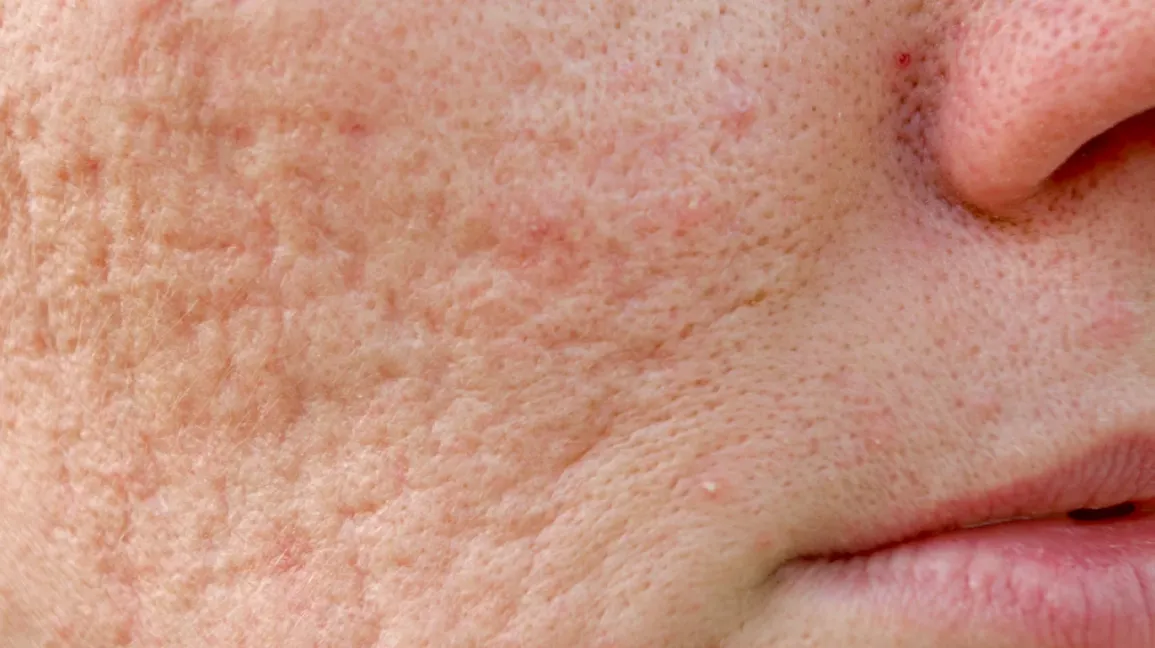
A rolling scar is not simply a dent. It is skin anchored to deeper tissue by fibrous bands, and that tethering produces the broad, wavy contour. Because the problem is mechanical, the correction must be mechanical. The band holding the scar down is untouched by resurfacing or collagen stimulation, which is the commonest reason rolling scars disappoint under the wrong tool. The types of acne scars guide places rolling scars alongside the other atrophic types. When a patient reports that a full course of laser refined the surrounding texture and left the rolling scars unchanged, the tether was usually never divided.
How subcision works
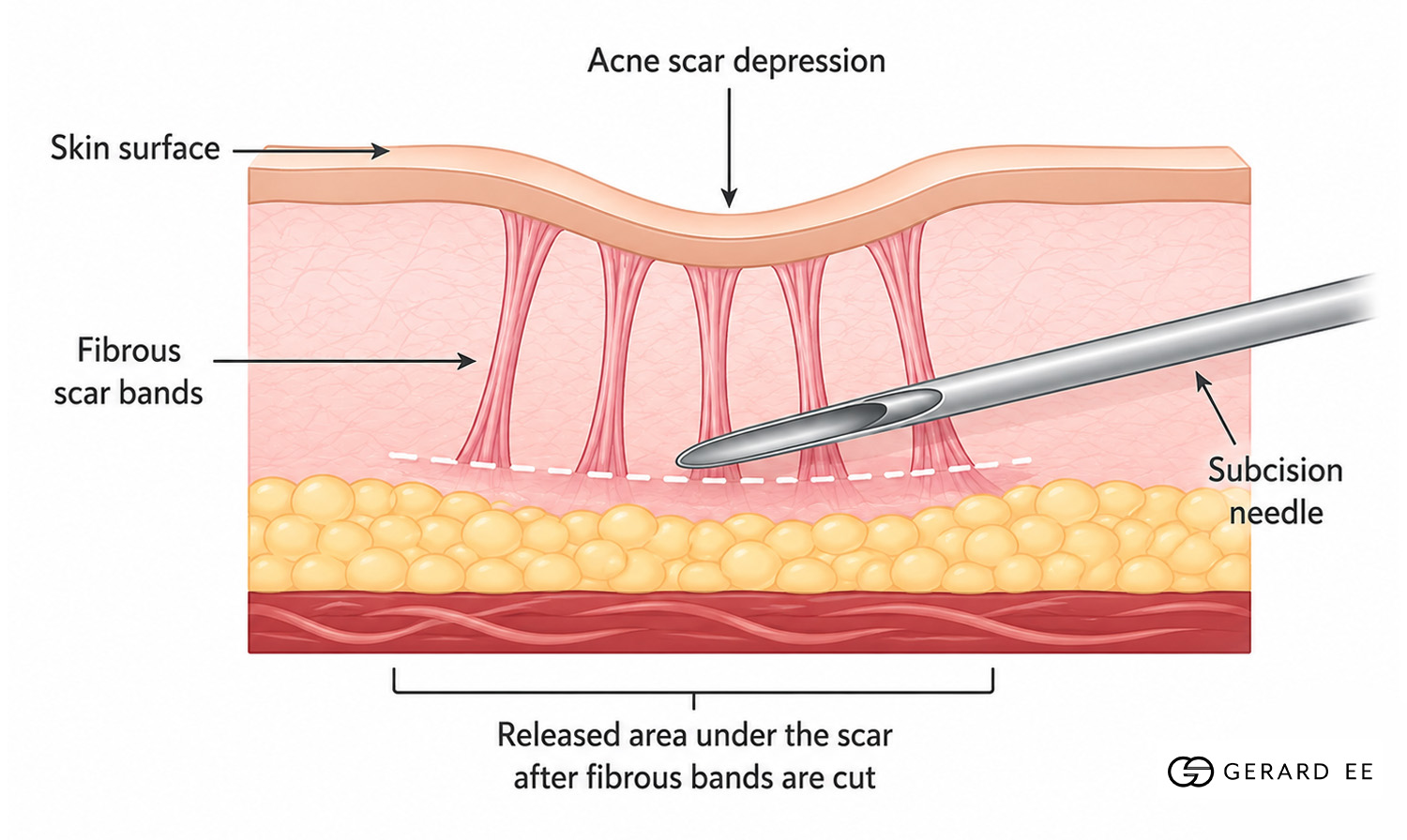
In subcision, a fine needle or blunt cannula passes beneath the scar and sweeps in controlled arcs to divide the fibrous bands. Once they are divided, the depressed skin lifts, and the controlled micro-injury stimulates fresh collagen into the space. The procedure is minor, carried out in clinic under local anaesthesia and well tolerated, with a few days of bruising and swelling afterwards. The lift visible in the first days is partly swelling, and the durable part of it depends on the collagen formed over the following months.
Why biostimulators are preferred over HA fillers
Acne scars are generally not treated with hyaluronic acid fillers in this practice. Biostimulators suit the problem better, prompting the skin to build its own collagen rather than occupying space, and integrating more naturally with a released scar. Product selection follows the scar type, with PCL for significant volume loss, PDLLA skin booster for ice pick and boxcar scars, PLLA or PDLLA Volume for rolling scars with loose skin, and ECM booster where the scarring is very mild. No biostimulator used on its own lifts a scar that remains tethered.
PLLA and the cannula technique
Subcision is often paired with PLLA for a practical reason. PLLA is best placed with a cannula, and passing that cannula beneath the scar produces a subcision effect in itself, releasing tethers while the PLLA stimulates the collagen that holds the lift. One delivery therefore performs two functions, and rolling scars hold a more durable result than either step alone. Combining subcision, Rejuran and biostimulators is a frequent approach. The technique suits broad, tethered rolling scars and does not replace the focal reconstruction a deep ice pick scar requires.
Combining subcision with RF and PDRN
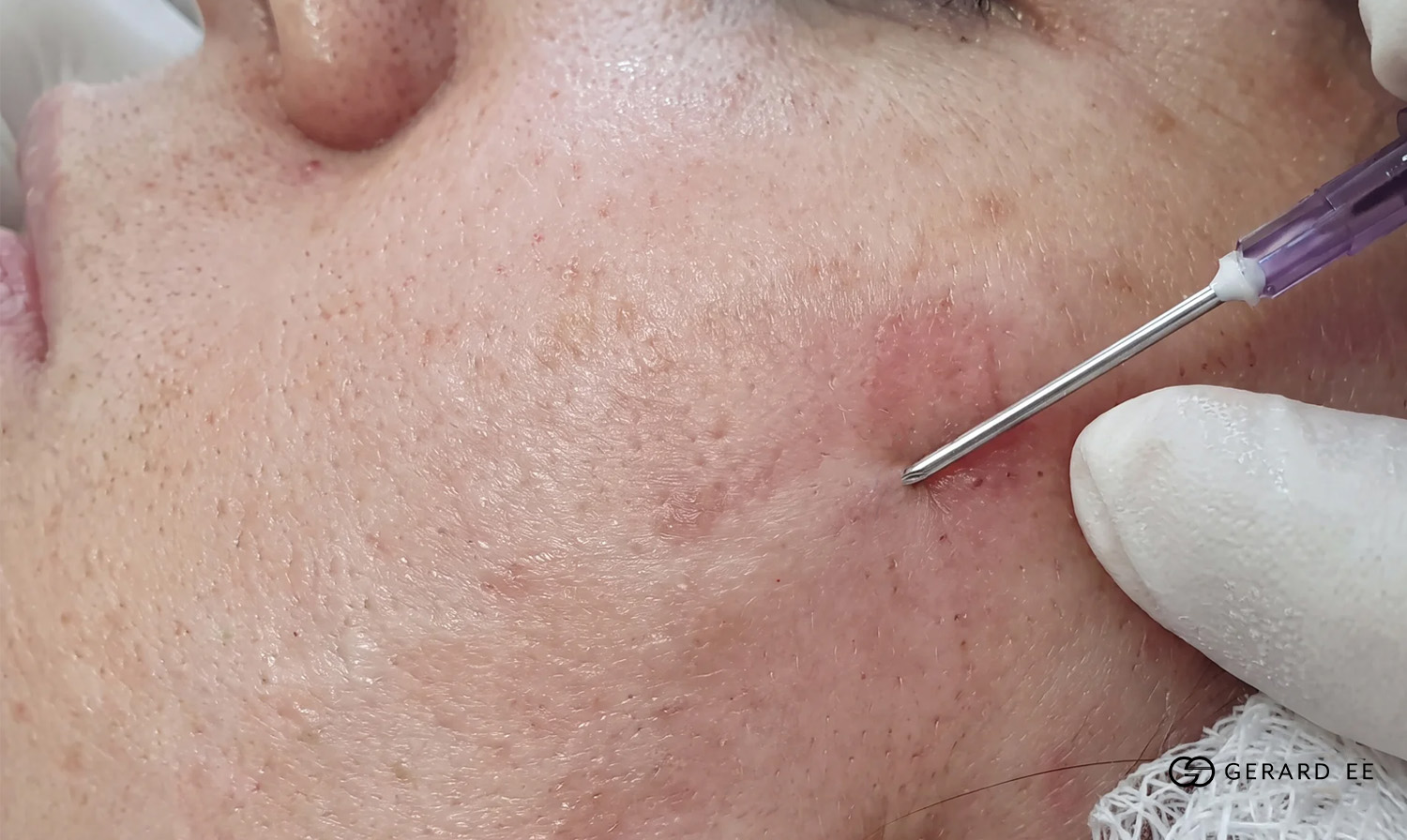
Subcision is rarely the whole plan and rarely used in isolation. Secret RF is often included in the same programme to begin remodelling, with fractional CO2 following about a month later to resurface. PDRN, Rejuran, improves healing and potentiates results, and it may be performed alongside microneedle RF. Adequate spacing between the steps is what allows each of them to work, as set out in the complete treatment guide and CO2 laser article. The commonest error I see in a previous treatment plan is a sensible set of treatments delivered too close together.
What to expect, and the limits
Subcision suits tethered rolling scars and certain atrophic scars. It is not appropriate for every scar type. Focal reconstruction such as PDLLA skin booster serves deep ice pick scars better, and I have found it safer and more effective than TCA CROSS, while keloid scars cannot be improved by subcision or resurfacing at all. A few days of bruising and swelling are usual, settling across the week, with the result developing gradually over the following months. The treatment performs best once active acne is controlled, the principle running through what causes acne scars. A patient presenting with keloid scarring is told plainly that release and rebuilding are not what those scars need.
Maintaining the results
After a course of subcision and biostimulator treatment the result is durable but not entirely static, because skin continues to age. Periodic review, with a maintenance treatment where that is helpful, preserves and builds on the result, and good skincare protects it between visits. This is part of the rationale for preferring biostimulators to simple fillers, since collagen the skin has built itself ages more naturally than a product that merely fills. Durability is not permanence, and a result held over years usually reflects periodic review rather than one course that never needs revisiting.
Why combinations achieve more than subcision alone
The strongest argument for combining subcision with other treatments lies in the comparative figures. A split-face study recorded roughly 32% improvement where subcision was augmented with PRP, against about 8% for subcision alone (subcision plus PRP), a gap that reflects a known limitation, since released tethers can re-form unless something builds collagen in the freed space. The collagen may come from a biostimulator, from RF energy, or from PDRN, which promotes fibroblast activity and collagen synthesis in healing models (PDRN scar prevention). The 8% figure describes what release achieves when nothing follows it.
In a randomised split-face trial, radiofrequency-assisted subcision, which pairs mechanical release with collagen-stimulating heat, outperformed conventional subcision (RF-assisted subcision RCT), supporting the principle that release with rebuilding achieves more than release alone. Subcision is therefore paired with Secret RF or a biostimulator rather than performed on its own. These are group averages rather than predictions for one face, and outcomes vary with the depth and extent of the scarring.
What the research shows
Subcision is long established for rolling scars, and the evidence is strongest where it is combined. The platelet-rich plasma work described above found rolling scars the best responders among the atrophic types (subcision plus PRP study). Pairing subcision with TCA CROSS is reported to be cost-effective in moderate-to-severe scarring (subcision plus CROSS), and a split-face randomised trial placed radiofrequency-assisted subcision above conventional subcision (RF-assisted subcision RCT).
The preference for biostimulators over plain fillers has trial support. Poly-lactic acid stimulates collagen, and one series reported improvement in 95% of scars where it was delivered with fractional CO2 (PLLA plus CO2, PLLA jet injection), while PDRN raises fibroblast activity and collagen synthesis and reduces scarring in healing models (PDRN scar prevention). For darker skin, a prospective study found subcision with microneedling both safe and inexpensive (subcision plus microneedling in dark skin). Improvement in 95% of scars describes how many scars changed rather than how much any one of them changed.
The trial evidence for combining subcision
The case for combining subcision rather than using it alone now rests on several trials. In one randomised study, both subcision with fractional CO2 and subcision with cross-linked hyaluronic acid proved significantly better than subcision alone, with no meaningful difference between the add-ons, which points to pairing release with rebuilding as the decisive step (subcision combination trial). An analysis of 413 patients confirmed that adding subcision to CO2 achieves more than CO2 alone in boxcar and rolling scars, whereas ice pick scars gained nothing from it (413-patient analysis). That last finding marks the scar type for which neither release nor resurfacing is the answer.
Newer work compares the add-ons themselves. Where subcision was followed by either PDO screw threads or fractional CO2, a randomised comparison found the greater reduction in scar severity and depth on the laser side, and faster recovery on the thread side (PDO threads versus CO2 after subcision). Across these trials the tether is released by the subcision, while the collagen that holds the lift is rebuilt by the partner treatment, whether RF, laser, biostimulator or thread. A patient who cannot accommodate visible downtime may be considered for the gentler pairing.
Subcision techniques, needle and cannula
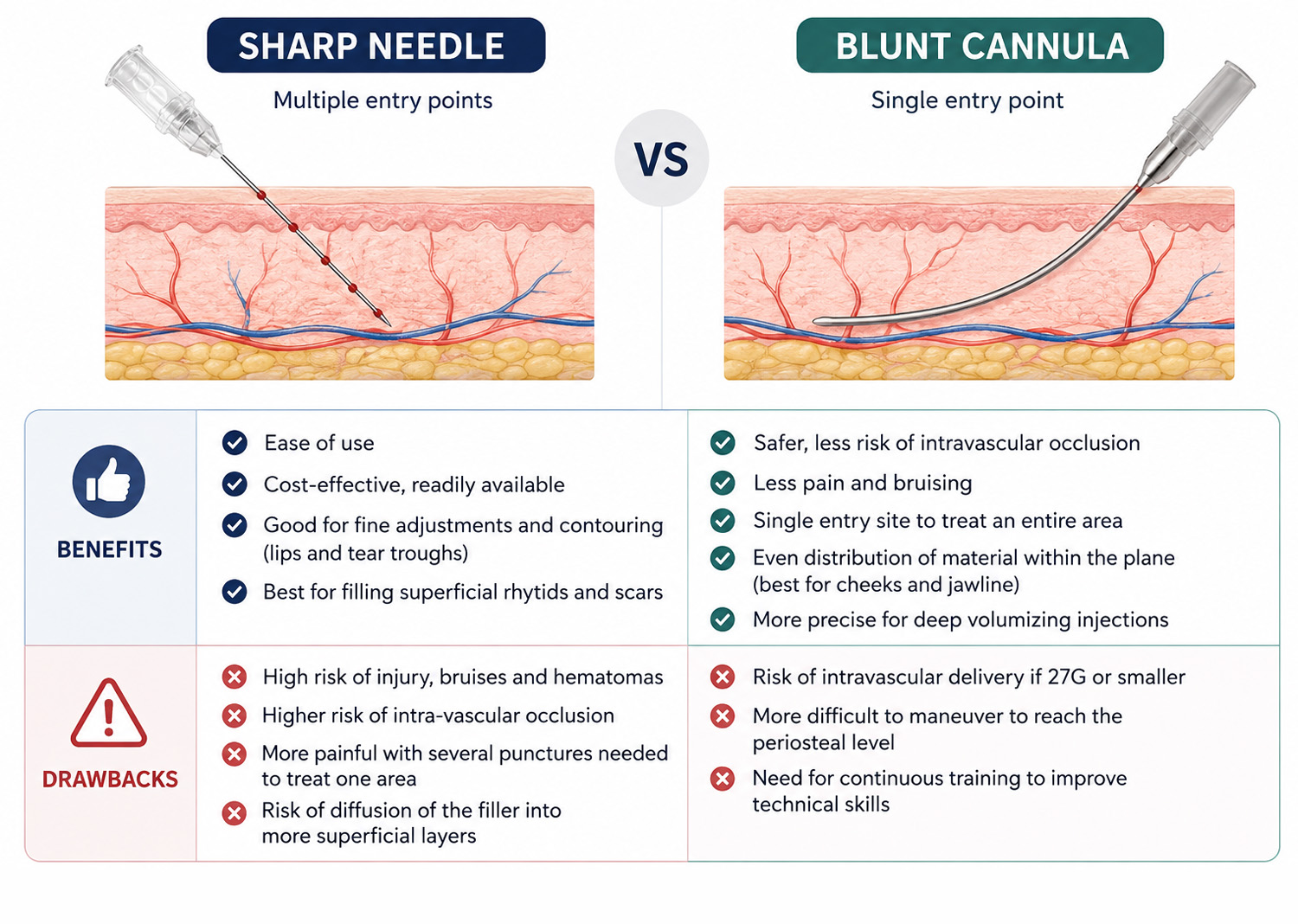
Subcision may be performed with different instruments, and the choice affects both reach and recovery. Fibrous bands are divided precisely by a sharp hypodermic or purpose-designed Nokor needle, which suits focal, tethered scars. A blunt-tipped cannula enters through a single point and sweeps beneath a broader area, releasing multiple bands with less bruising and less injury to blood vessels, which suits widespread rolling scars. Energy may also be added, as in radiofrequency-assisted subcision, where mechanical release is combined with collagen-stimulating heat. The extent and location of the scarring determine which technique is chosen. In my experience, the instrument decides how much of a face one session can release, since a needle covers less ground than a cannula.
What to expect during and after subcision
The procedure is carried out under local anaesthesia and is generally well tolerated. Patients often report a snapping or tearing sensation as the bands divide, which is normal. The treated area may look fuller immediately afterwards from temporary swelling, and once that settles the genuine improvement develops as collagen fills the released space. Several days of bruising and swelling are usual, sometimes up to a week, and the final result builds across the months that follow rather than appearing at once. In my experience, the commonest reason a patient reaches an early verdict on subcision is that temporary fullness, which disappears before the collagen has formed.
The biostimulators and how they differ
Biostimulators act through prompting the skin to build its own collagen, and the main options differ in material and behaviour. Poly-L-lactic acid, the material in PLLA, produces a gradual and diffuse increase in collagen, which suits generalised volume loss and rolling scars. Polycaprolactone, the material in PCL, gives longer-lasting collagen alongside some immediate structural support. Microsphere products based on poly-D,L-lactic acid, such as PDLLA skin booster, generate a finer collagen that suits pitted ice pick and boxcar scars. Because the behaviour differs, the product is selected against the scar type and the degree of volume loss rather than used interchangeably. None of them releases a tether, so a biostimulator placed under a scar still anchored down adds collagen without lifting it.
Why biostimulators rather than HA fillers
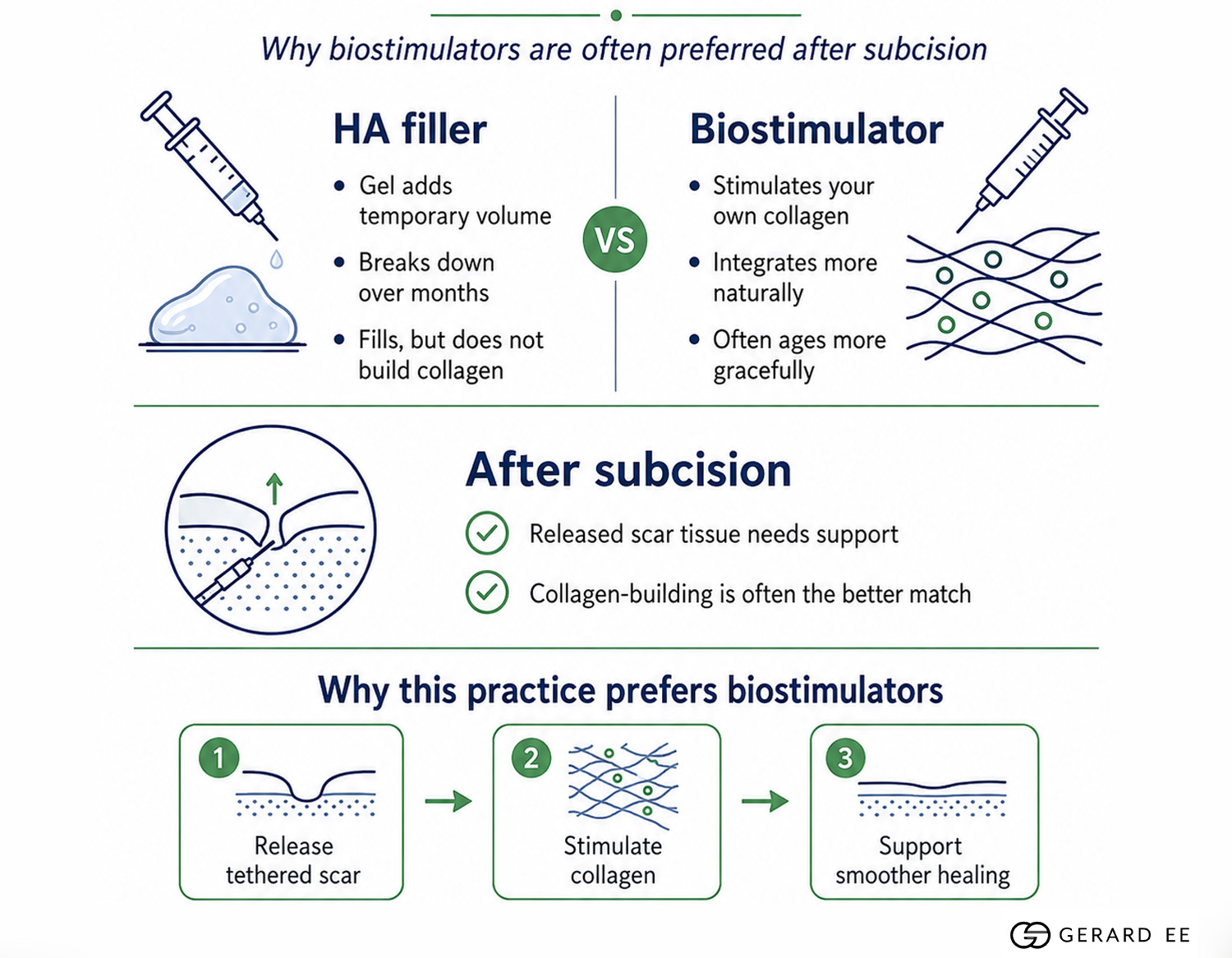
A hyaluronic acid filler sits in the tissue as a gel, supplying temporary volume that is broken down over months without adding to the skin’s own structure. A biostimulator recruits the body’s collagen instead, which integrates more naturally with released scar tissue and ages more gracefully than a product that merely fills. Where subcision has already freed the scarred skin, that collagen-building action is the better match, and this is why biostimulators are preferred over HA fillers for acne scars in this practice. The same collagen-building principle underlies regenerative skinboosters. The preference is considered rather than absolute, since cross-linked hyaluronic acid performed as well as fractional CO2 as an add-on to subcision.
Who benefits most from subcision
Subcision is most valuable for tethered rolling scars and broad, shallow depressions, where the underlying problem is mechanical. Used alone it is less useful for deep ice pick scars, which require focal reconstruction such as TCA CROSS, and it cannot improve keloid or hypertrophic scars. The candidate who does best has active acne under control and expects gradual, meaningful improvement rather than complete erasure, the honest outcome of subcision with a biostimulator. In my experience the patients most satisfied at the end of a course are those who arrived expecting improvement rather than erasure.
Sessions, spacing and aftercare
Treatment with subcision and a biostimulator is usually delivered as a small series of sessions several weeks apart, which allows the collagen response to develop between visits. Gentle massage of the area may be advised with some biostimulators, to distribute the product evenly. Aftercare is otherwise straightforward, and the main results mature across the months that follow. Because the skin continues to age, a maintenance treatment at a later stage may preserve and build on the improvement. The spacing is not a scheduling convenience, since a session delivered before the previous collagen has matured adds injury without adding correction.
Managing recovery after subcision
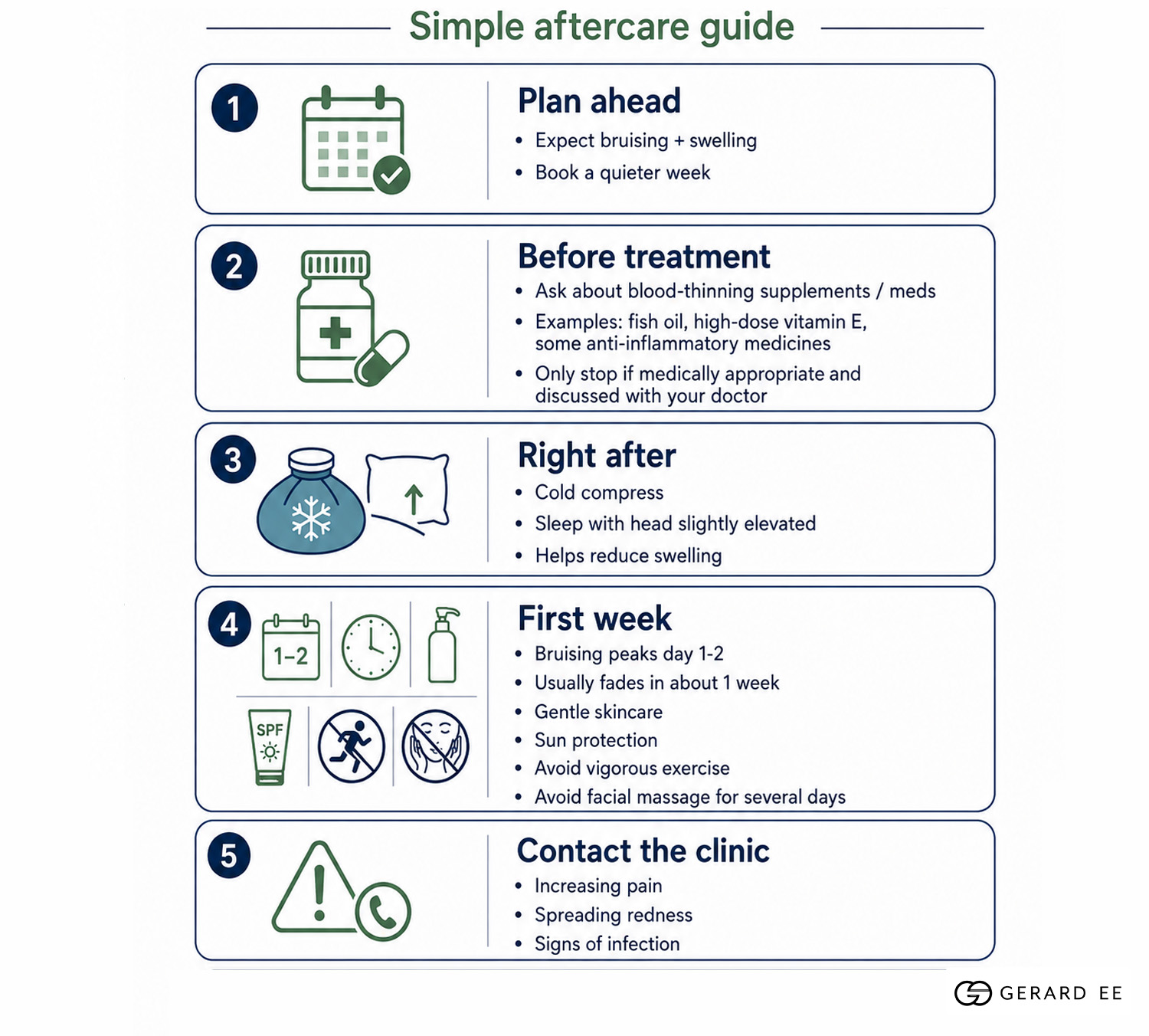
Recovery from subcision is straightforward but benefits from planning, since bruising and swelling are expected. Scheduling the procedure when a few quieter days are available is sensible, as is avoiding, where medically appropriate and always in discussion with the treating doctor, substances that thin the blood and increase bruising in the days beforehand, such as fish oil, high-dose vitamin E and certain anti-inflammatory medications. A cold compress applied immediately afterwards limits swelling, and keeping the head slightly elevated through the first night reduces puffiness. Bruising usually peaks across the first day or two and fades over roughly a week, and gentle skincare with sun protection is all that is generally required. Vigorous exercise and facial massage are better deferred for several days. Increasing pain, spreading redness or signs of infection are uncommon, and they warrant prompt contact with the clinic. In my experience the patients who find recovery difficult are usually those who booked the procedure into a week that could not accommodate visible bruising.
The bottom line
Rolling scars are tethered, so release must precede rebuilding, and subcision divides the bands while a biostimulator matched to the scar type holds and builds the lift. Biostimulators are chosen ahead of HA fillers, and the PLLA cannula technique releases and stimulates in a single step. Sequenced with RF, PDRN and resurfacing, this approach gives rolling scars their best prospect of correction. What the sequence does not offer is erasure, and I have found that the patients satisfied years later understood that a tethered scar is improved rather than removed. Continue with acne scars on dark skin or the cost of treatment.
Frequently Asked Questions
Are biostimulators like PLLA, PCL or ECM booster good for acne scars?
Biostimulators are well suited to acne scars and are preferred over HA fillers because they build the skin’s own collagen. The product follows the scar type, with PCL for volume loss, PDLLA skin booster for ice pick and boxcar scars, PLLA or PDLLA Volume for rolling scars, and ECM booster for very mild scarring. None of them lifts a scar that has not first been released.
Is subcision more effective with fillers?
Subcision is usually more effective combined with a biostimulator than performed alone. Release of the tether comes from the subcision, and the biostimulator then stimulates the collagen that holds the lift. PLLA is commonly placed with a cannula, and the cannula itself produces a subcision effect.
Does subcision hurt, and what is the downtime?
The procedure is performed under local anaesthesia and is generally well tolerated. A few days of bruising and swelling are usual and then settle. Results develop gradually, and a small series of sessions is usually required. A patient needing to be free of visible bruising should allow a week rather than a weekend.
Why not use HA fillers for acne scars?
Hyaluronic acid fillers are set aside for scars in favour of biostimulators, which build the skin’s own collagen, integrate more naturally with a released scar and are matched to the specific scar type. Hyaluronic acid supplies volume that is broken down over months rather than structure the skin has built for itself.
Key references
What the published evidence on PDLLA skin booster and hybrid HA with subcision shows
Only papers whose article title itself contains the requested brand name are included below. Product names mentioned only in the abstract, keywords or methods were excluded.
PDLLA skin booster has been paired with carbon dioxide gas subcision for atrophic acne scars in a published series, the fibrotic release from the gas combined with PDLLA-driven fibroblast stimulation, which is the same logic as placing a biostimulator into a freshly released rolling scar. [7]
A split-face randomised trial of subcision alone against subcision plus hybrid HA in 12 patients found no significant difference in scar depth on ultrasound at three months, but significantly higher patient satisfaction on the hybrid HA side, with rolling scars responding best in both arms. [8]
Show the key references (6)
Comparative trials cited
- Abdelwahab AA, Omar GAB, Hamdino M. Combined subcision with fractional CO2 laser or cross-linked hyaluronic acid versus subcision alone in atrophic post-acne scars. Lasers Med Sci. 2022;38:20. PubMed.
- Li X, Fan H, Wang Y, et al. Fractional CO2 laser combined with subcision for three subtypes of atrophic acne scars: retrospective analysis of 413 patients. Lasers Med Sci. 2023;38:195. PubMed.
- Abdo H, Shawky A, Elkholy MS, Nasr MI. PDO screw threads versus fractional CO2 laser after subcision for atrophic acne scars: randomised comparative study. Arch Dermatol Res. 2025;317:236. PubMed.

Dr Gerard Ee
Written, medically reviewed and expert opinion by Dr Gerard Ee, aesthetic doctor and Founder & Medical Director of The Clifford Clinic. This article reflects my clinical experience treating acne scars in Singapore and is intended for general education, not medical advice. Treatment suitability, results, downtime and cost vary from person to person. Please arrange a consultation for advice specific to your skin.