Written by Dr Gerard Ee | Medically reviewed by Dr Gerard Ee | Expert opinion by Dr Gerard Ee
Dr Gerard Ee is an aesthetic doctor and the founder and medical director of The Clifford Clinic, which he established 14 years ago. He has treated acne scars for 16 years and more than 2,000 acne-scar patients, and is one of Singapore’s longest-standing users of the Infini RF microneedling system (16 years). He holds a Diploma in Dermatology (Cardiff) and is a Member of the Royal College of Surgeons (MRCS). More on Dr Gerard Ee.
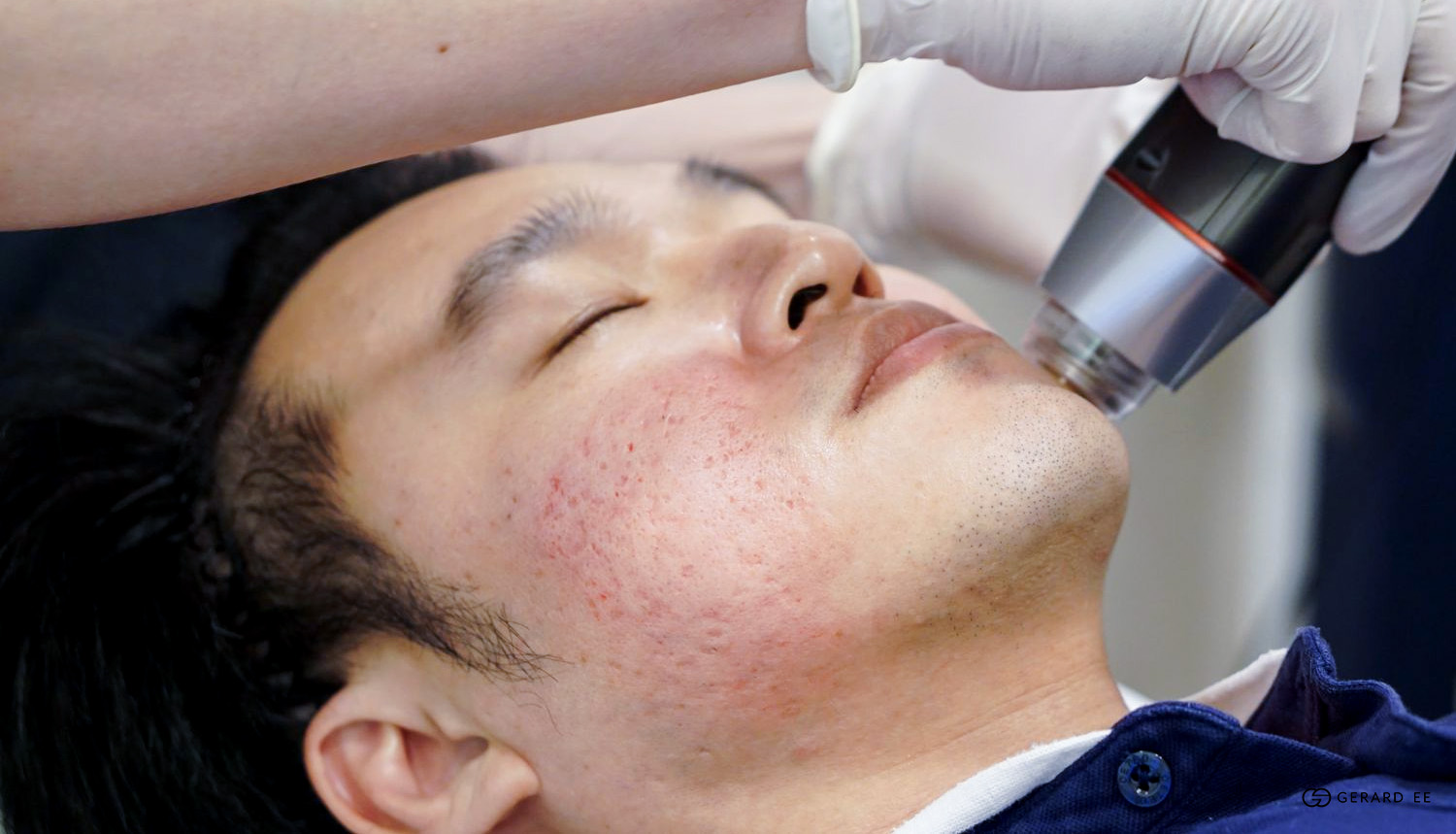
Across more than two thousand acne-scar patients, the most common reason I have seen a treatment disappoint is that it was aimed at the wrong type of scar. Acne scars are not one condition but several, and each type responds to a different tool. Learning to recognise which types are present therefore precedes treatment, because matching the treatment to the scar type is the step that most decides the result. Identification also sets the limits of the plan, since outcomes vary from person to person and a face carrying several types rarely improves evenly.
Atrophic scars, the depressed majority
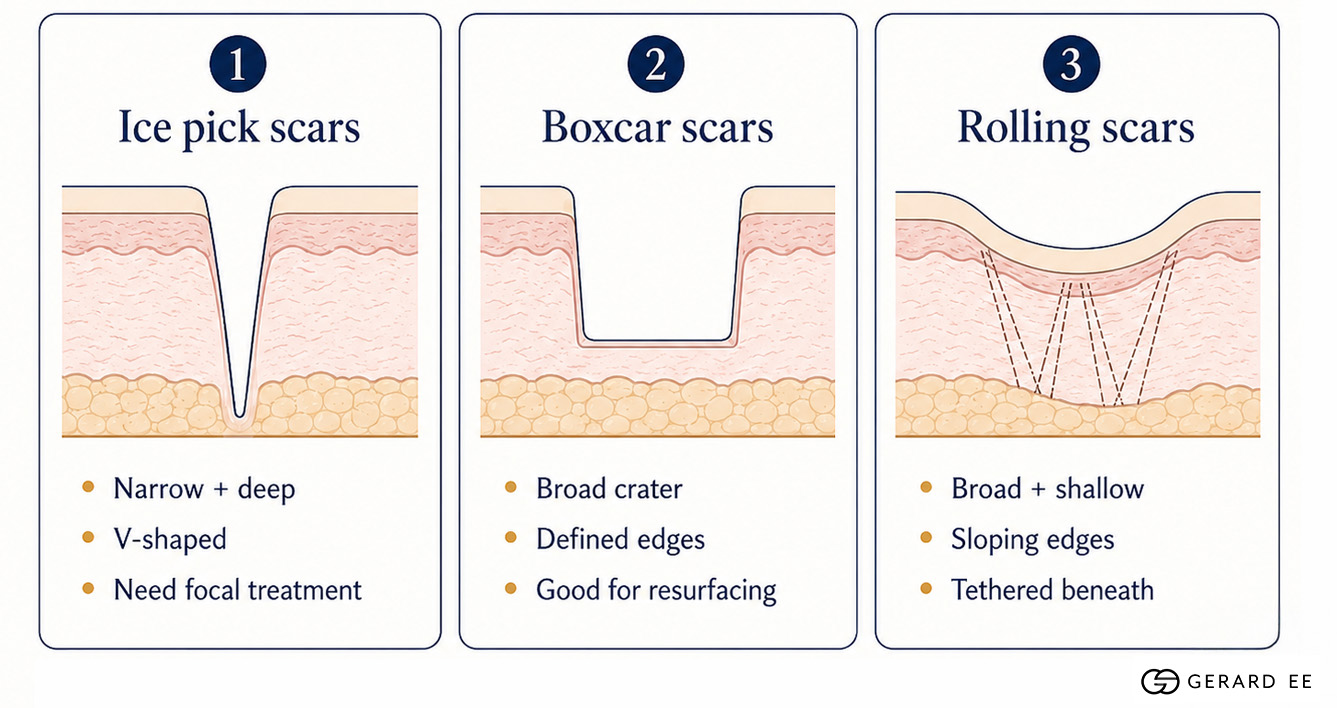
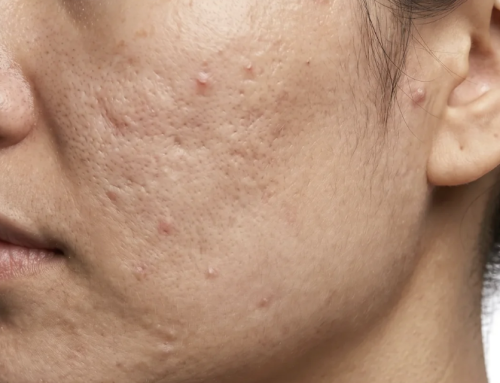
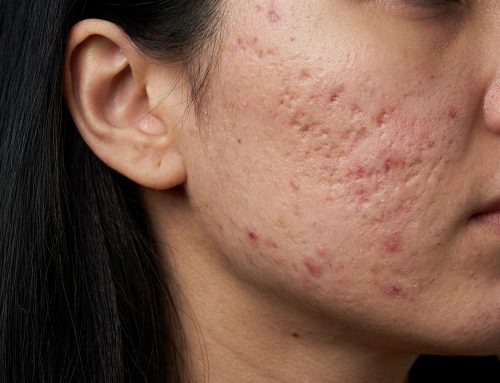
Eight or nine in ten acne scars are atrophic, which means they sit below the level of the surrounding skin. Under angled light, which throws shadows that reveal their shape, they sort into three types, and most faces carry a mixture. The proportions of that mixture determine what a plan must contain.
Ice pick scars
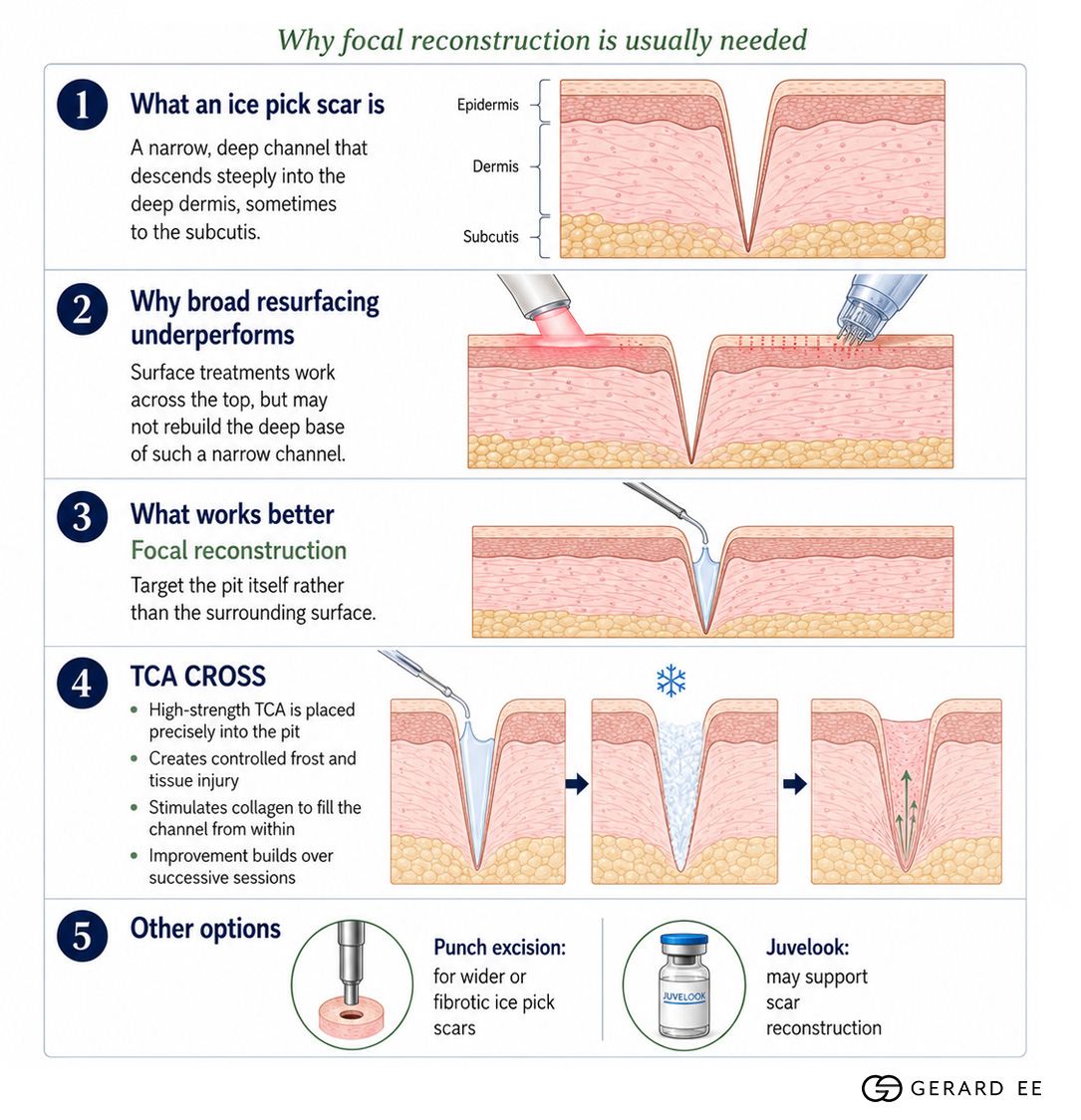
Ice pick scars are narrow, deep and V-shaped, resembling a fine puncture. They reach far into the dermis, which makes them the most resistant of the atrophic types, and they rarely respond to resurfacing or microneedling alone. They require a reconstructive approach, either TCA CROSS, in which acid is applied precisely into the scar to rebuild it from its base, or, in my clinical experience the safer and more effective option, Juvelook placed into the pit. They are also the type where expectations need setting most carefully, because the improvement available is genuine but partial.
Boxcar scars
Boxcar scars are round or oval with sharp edges, and they are common on the cheeks and temples. They respond well to resurfacing, to energy-based collagen remodelling such as fractional CO2 and RF microneedling, and to biostimulators such as Juvelook. Depth divides them, since a shallow boxcar scar softens with resurfacing while a deep one with rigid walls needs its base released first.
Rolling scars
Rolling scars are broad and wavy, caused by fibrous bands tethering the skin down. The defining feature is the tether, and resurfacing will not lift the scar until that tether is released with subcision. Subcision is usually paired with a biostimulator such as Sculptra, particularly where the skin is also somewhat lax, as covered in the guide to subcision and biostimulators for rolling scars. When a patient reports that a previous course of resurfacing did nothing for the wavy areas of a cheek, an unreleased tether is usually the reason.
Raised scars, a different problem
A minority of acne scars are raised, whether hypertrophic or keloid, and these represent an excess of collagen rather than a deficit. The distinction matters because RF microneedling and resurfacing cannot improve a keloid, and using the wrong tool on one wastes both time and money. Raised scars need a different approach entirely. The commonest error I see in a previous plan is a device chosen for depressed scars then applied to a raised one, which it cannot improve.
Matching biostimulators to the scar
Where volume and collagen support are needed, the biostimulator is chosen to fit the scar rather than one product being used for everything. Ellanse suits significant volume loss, Juvelook suits ice pick and boxcar scars, Sculptra or Lenisna suit rolling scars with loose skin, and RE20 suits very mild scarring. PDRN, Rejuran, may be added across the board because it improves healing and supports the wider result, and it can be performed alongside microneedle RF. No biostimulator used on its own releases a tether or rebuilds an ice pick scar, so each belongs within a plan rather than in place of release and resurfacing.
Why almost everyone needs a combination
Because a single face usually carries rolling, boxcar and a few ice pick scars together, treating all of them with one machine inevitably leaves part of the problem behind. Mapping the mix and building a layered plan follows from that, with subcision for the tethers, TCA CROSS or Juvelook for the ice pick scars, and resurfacing and RF for the boxcar scars and overall texture. Of the patients who consult me after a course they judged to have failed, a substantial share had received one modality across a mixed face. The proportions are the foundation of the complete treatment guide.
Confirm it is a scar, not a mark
Confirming that what is present is a true scar, and not a flat brown or red mark that fades differently, comes before any commitment to scar treatment. The guide to acne scars versus pigmentation explains the quick stretch-and-light test, and what causes acne scars describes how they form in the first place. A flat mark treated as a scar absorbs resurfacing it never needed, and a scar dismissed as a mark waits for a fading that never comes.
How each scar type responds, and why combinations outperform single devices
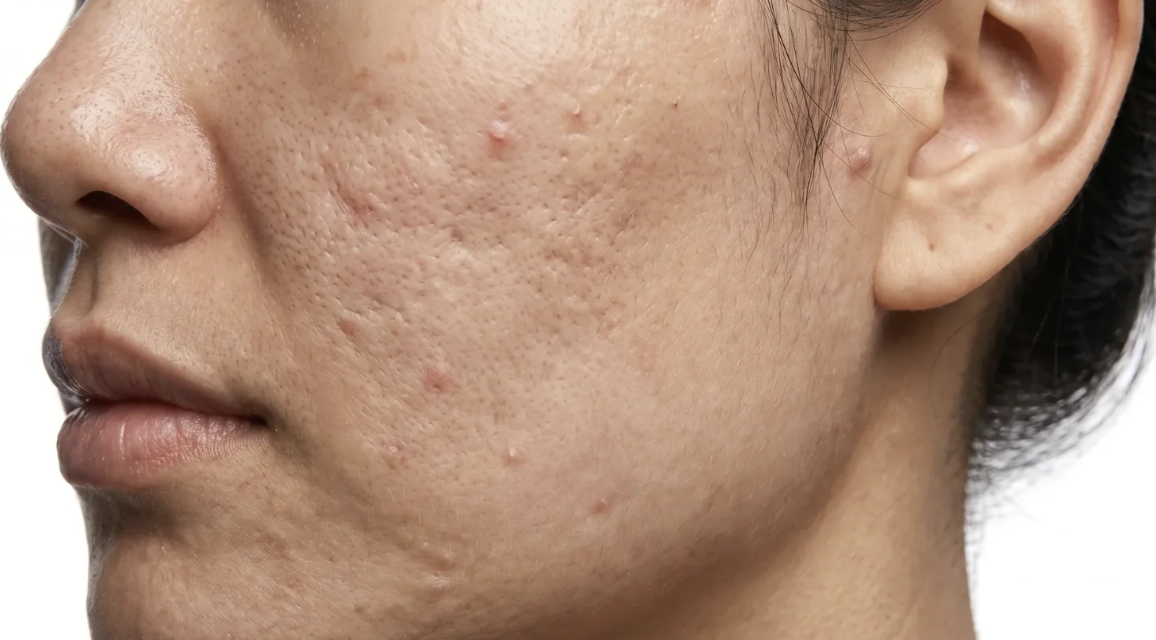
Ice pick scars, the most resistant, respond best to focal reconstruction with TCA CROSS (CROSS review). Boxcar scars respond to resurfacing and energy-based remodelling, and rolling scars to release with subcision, where studies place them among the best responders (subcision study). The literature increasingly favours combinations, with microneedling plus CO2 laser, or subcision plus other modalities, outperforming monotherapy (microneedling and CO2 review). That evidence is firmer on which type responds to which modality than on how much any one patient will improve.
Two faces given the same severity grade can still need different plans. A face that is mostly rolling needs a different sequence from one that is mostly ice pick, and matching the plan to that mix is what the evidence, and my own clinical experience, indicate drives the best result.
What the research shows
The literature supports the principle that scar type should drive treatment. For ice pick scars, which are notoriously resistant, TCA CROSS is repeatedly reported as safe, effective and cost-effective (CROSS with 100% TCA, CROSS comprehensive review). A systematic review of randomised trials found microneedling to be efficacious and well tolerated for atrophic scars (microneedling RCT review), and subcision studies show rolling scars among the best responders (subcision split-face study). The same literature is quieter about the scars that respond least, and a resistant ice pick scar may need several sessions of focal reconstruction before change is visible.
What the comparative trials show, by scar type
The trial evidence divides along the same subtypes. In a retrospective analysis of 413 patients, fractional CO2 laser combined with subcision proved significantly more effective than laser alone for boxcar and rolling scars, while making no significant difference for ice pick scars (413-patient analysis). A randomised study likewise found that subcision combined with either fractional CO2 or cross-linked hyaluronic acid outperformed subcision alone, with no significant difference between the two add-ons, which confirms that subcision acts best when paired with something that rebuilds collagen or volume (subcision combination trial). The null result for ice pick scars in that series is its most useful finding, marking a subtype the standard combination may not suit.
Rolling and boxcar scars respond to subcision-plus-energy combinations, while ice pick scars need targeted reconstruction such as TCA CROSS or punch techniques. The 2022 international consensus on energy-based devices reaches the same subtype-specific conclusion (consensus).
How doctors grade acne scars
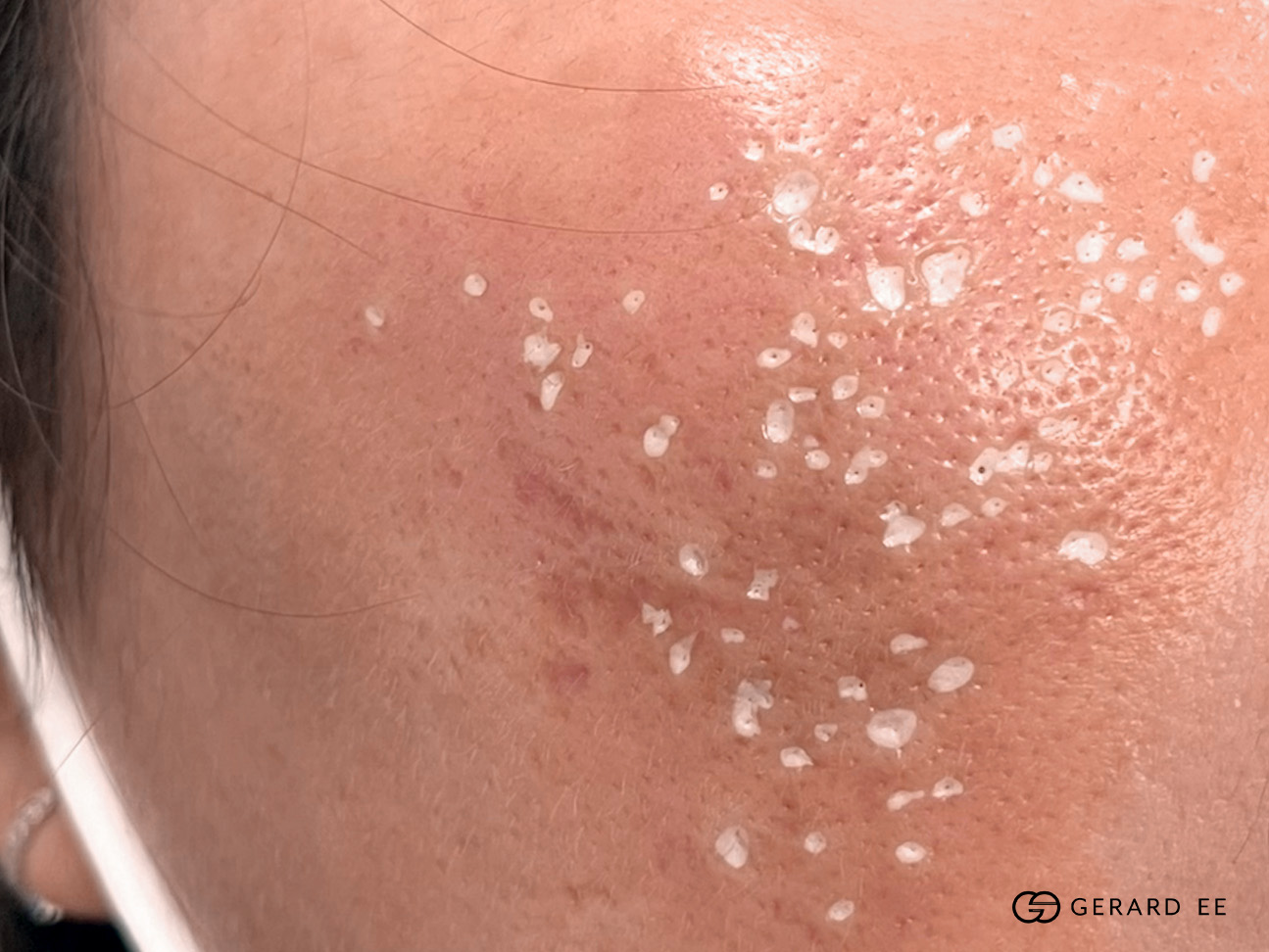
Beyond naming the type, clinicians grade scarring to guide treatment and to track progress. The Goodman and Baron qualitative scale sorts scarring into macular (flat, only colour), mild, moderate and severe grades, while their quantitative scale assigns a numerical score from the number and severity of lesions. The ECCA grading scale (Echelle d’Evaluation Clinique des Cicatrices d’acne) weights each scar type instead, scoring deeper and more visible scars more heavily, and is widely used in clinical studies to quantify improvement. A grading system matters because it converts a subjective impression into a consistent baseline, against which it becomes possible to judge whether a course of treatment is genuinely working. A grade measures severity rather than composition, however, and the plan follows the composition.
How scar type is assessed in person
Accurate assessment requires more than a glance in a mirror. Examination under angled light throws shadows that reveal the depth and edges of each scar. Stretching the skin gently shows whether a depression flattens, indicating a shallow or tethered scar, or holds, indicating a fixed structural defect. Palpation detects the firmness of a raised scar and the fibrous tethering beneath a rolling scar. Standardised, well-lit photographs taken at each visit then permit an accurate comparison over time, since gradual collagen remodelling is difficult to judge day to day. I photograph at every review for that reason, because patients judging their skin from memory routinely misjudge how far it has moved.
Ice pick scars in more detail
Histologically, an ice pick scar is a narrow epithelial tract descending steeply into the deep dermis, and sometimes into the subcutis, tapering to a point. That shape is the reason broad resurfacing underperforms, since a laser or microneedle acting across the surface cannot rebuild the base of so narrow and deep a channel. Focal reconstruction is required instead of surface treatment. TCA CROSS applies a high concentration of trichloroacetic acid precisely into the pit, producing controlled tissue necrosis and a frost, which prompts new collagen to fill the channel from within across successive sessions. Wider or fibrotic ice pick scars may instead be treated with punch excision, and Juvelook placed into the scar can support the reconstruction. Because the channel fills from its base upwards, the change after any one session is usually slight.
focal reconstruction acne scar
Boxcar scars in more detail
Boxcar scars are round to oval depressions with sharply defined, near-vertical walls, and they resemble the marks of chickenpox. They are classified by depth, shallow at around 0.1 to 0.5 mm and deep at greater than 0.5 mm. Shallow boxcar scars respond well to fractional resurfacing and RF microneedling, both of which remodel collagen and soften the sharp edges. Deeper boxcar scars with rigid walls may need punch elevation, in which the base of the scar is released and raised to sit level with the surrounding skin, then combined with resurfacing and energy-based remodelling. Where resurfacing has softened the shallow boxcar scars on a cheek and left the deep ones unchanged, wall depth is the explanation.
Rolling scars in more detail
Rolling scars are broad, shallow depressions, often 4 to 5 mm across or wider, produced by fibrous bands that tether the skin to the deeper tissue beneath. The surface itself remains relatively intact, so the defining problem is the tethering rather than a loss of surface tissue. Their appearance worsens with facial movement and becomes more noticeable with age as the face loses volume and the tethering grows more prominent. Subcision to divide the bands is essential, after which a biostimulator or energy device builds collagen in the released space and holds the lift. Release is therefore only half the treatment, since the collagen built into that space is what holds the correction over the following months.
Why most faces show a mixture of types
Acne affects many follicles at different depths and over an extended period, which is why a single face usually carries ice pick, boxcar and rolling scars together, often alongside flat marks. No single device therefore suits everyone. The dominant scar type guides the lead treatment, while the rest of the mixture determines what else the plan must contain. In my experience the mixture is also why two patients with similar-looking scarring report very different satisfaction after the same treatment.
Hypertrophic and keloid scars, how they differ
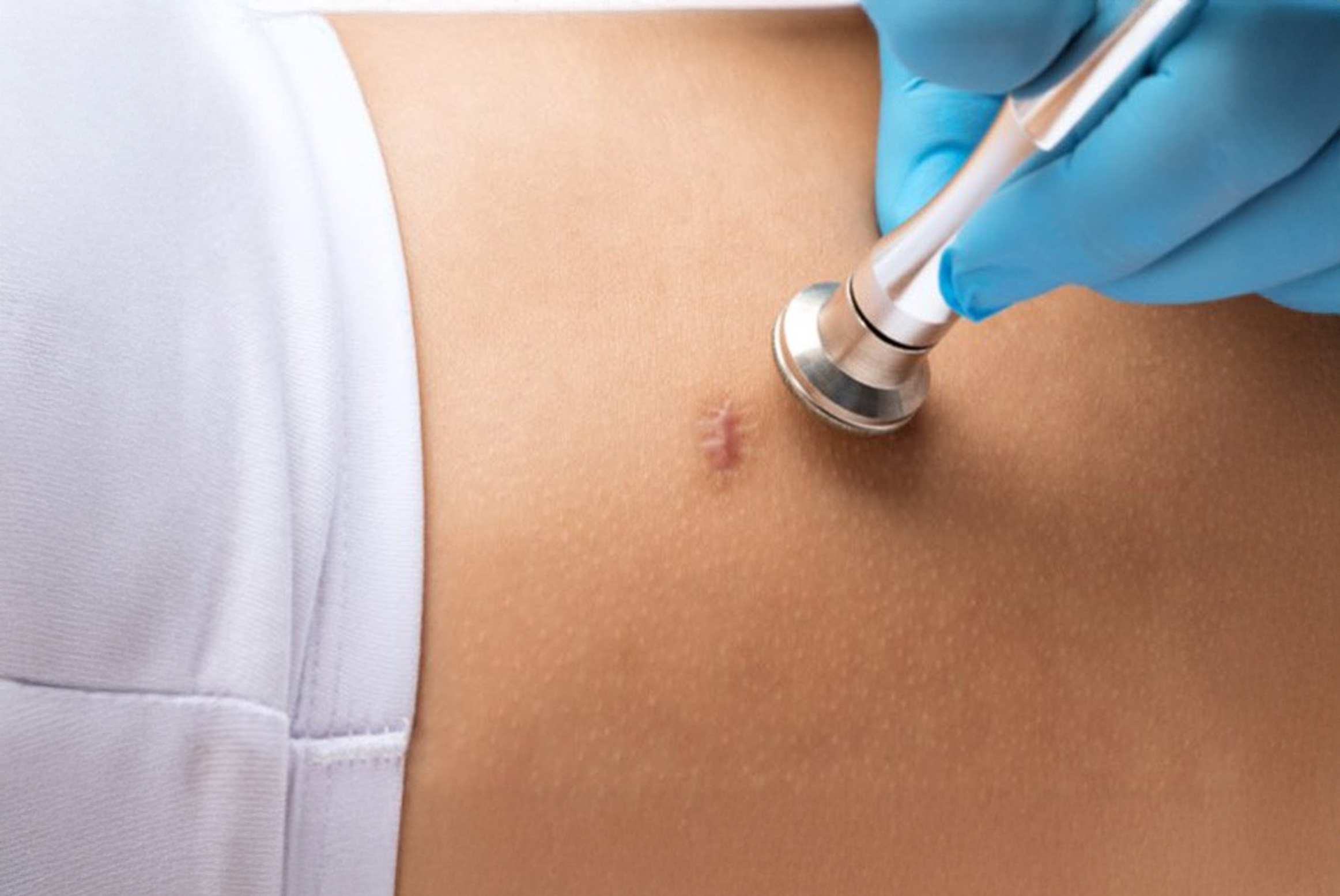
Raised acne scars fall into two categories that are frequently confused with one another. A hypertrophic scar is raised but remains within the boundary of the original lesion, and it may flatten gradually over time. A keloid extends beyond the original wound, may continue to grow, and rarely regresses on its own. Both are more common on the jawline, chest, shoulders and back. Neither responds to the resurfacing and microneedling used on depressed scars. They are managed instead with intralesional corticosteroid injections, silicone therapy, pressure and, in selected cases, other specialist treatments. The distinction determines what is realistic, since a hypertrophic scar may flatten while a keloid is managed rather than removed.
Punch techniques for resistant scars
Some deep or sharply defined scars respond best to small surgical techniques that reshape the scar directly rather than to any device applied across the surface. Punch excision removes a narrow, deep ice pick or steep boxcar scar entirely with a tiny circular tool, and the edges are then closed to heal as a much finer line that can later be resurfaced. Punch elevation raises the base of a deep boxcar scar with intact walls to the level of the surrounding skin, which preserves the patient’s own tissue and colour while removing the shadow that made the scar visible. Punch grafting fills a scar with a small graft of skin taken from another site. These techniques are precise, and they are usually followed by resurfacing or energy-based treatment to blend the result into the surrounding skin. Each substitutes a smaller and more regular mark for an irregular one rather than removing the scar without trace.
The bottom line
Ice pick, boxcar, rolling or raised, each acne scar type needs a different approach, and most patients present with a mixture. Accurate identification, ideally in person and under angled light, is the foundation of a plan that works. Improvement across a mixed face is usually substantial rather than complete, and outcomes vary from person to person. Continue with subcision for rolling scars or CO2 laser for acne scars.
Frequently Asked Questions
Which treatment is most effective for depressed acne scars?
The most effective treatment depends on the sub-type. Rolling scars need subcision, ice pick scars usually need TCA CROSS or Juvelook, and boxcar scars respond to resurfacing and RF microneedling. Most patients need a combination, because one modality leaves part of a mixed face untreated.
Can boxcar and ice pick scars be improved with biostimulators?
Both can be improved with biostimulators when the product is matched to the scar. Juvelook suits boxcar and ice pick scars particularly well, whereas Ellanse is used for volume loss and Sculptra or Lenisna for rolling scars. Biostimulators are matched to the scar type, and outcomes vary between patients.
How do I know what type of acne scar I have?
A light shone across the skin from the side reveals the shape of each scar. Narrow deep pits are ice pick scars, sharp-edged round depressions are boxcar scars, broad wavy depressions are rolling scars, and raised firm lumps are hypertrophic or keloid. A doctor confirms this in person, and self-assessment is unreliable for shallow scars.
Can raised acne scars be treated with microneedling?
Raised scars are not treatable with microneedling. RF microneedling and resurfacing cannot improve keloid or hypertrophic scars, which represent an excess of collagen rather than a deficit. These need a different approach.
Key references
- CROSS technique with 100% TCA for ice pick acne scars: efficacy and safety. PubMed.
- Chemical reconstruction of skin scars (CROSS) for atrophic scars: a comprehensive review. PubMed.
- Microneedling in the treatment of atrophic scars: systematic review of randomised controlled trials. PubMed.
- Platelet-rich plasma augments subcision in atrophic acne scars: split-face comparative study. PubMed.
Comparative trials cited
- Li X, Fan H, Wang Y, et al. Fractional CO2 laser combined with subcision for three subtypes of atrophic acne scars: retrospective analysis of 413 patients. Lasers Med Sci. 2023;38:195. PubMed.
- Abdelwahab AA, Omar GAB, Hamdino M. Combined subcision with fractional CO2 laser or cross-linked hyaluronic acid versus subcision alone in atrophic post-acne scars. Lasers Med Sci. 2022;38:20. PubMed.
- Salameh F, Shumaker PR, Goodman GJ, et al. Energy-based devices for the treatment of acne scars: 2022 international consensus recommendations. Lasers Surg Med. 2022;54:10-26. Journal.

Dr Gerard Ee
Written, medically reviewed and expert opinion by Dr Gerard Ee, aesthetic doctor and Founder & Medical Director of The Clifford Clinic. This article reflects my clinical experience treating acne scars in Singapore and is intended for general education, not medical advice. Treatment suitability, results, downtime and cost vary from person to person. Please arrange a consultation for advice specific to your skin.