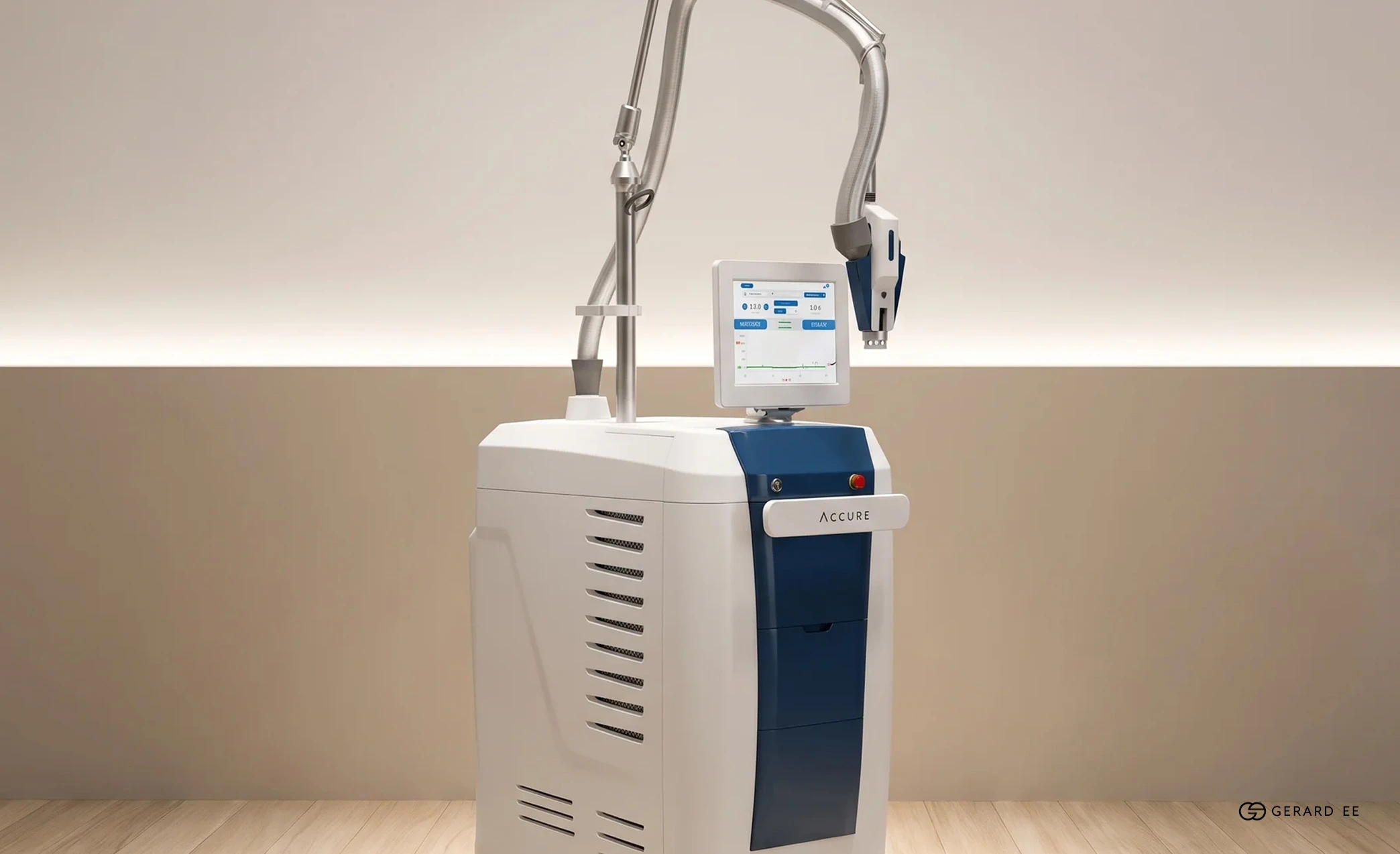
Accure laser in Singapore is a 1726 nm sebaceous-gland laser for acne, the same target as AviClear. This page sets out how it works, its published results, and how it compares with AviClear and AGNES RF, so that a patient weighing the three can decide on the evidence.
Dr Gerard Ee consults at The Clifford Clinic, 50 Raffles Place, Singapore.
The Clifford Clinic does not offer Accure. This article explains Dr Gerard Ee’s assessment of the technology and its comparison with other approaches.
My quick answer
Accure and AviClear are both 1726 nm lasers that treat acne by the same mechanism, selectively heating the oil glands using sebum as the target. The main practical difference is in cooling and comfort. AviClear uses a contact-cooling system that makes treatment well tolerated without anaesthetic, while Accure has been reported as considerably more painful, which affected how well patients tolerated and completed it. AGNES takes a different route entirely, delivering radiofrequency through fine microneedles directly to the gland. Among the 1726 nm options I prefer to use the AviClear, saving the AGNES RF where a targeted approach is more appropriate.
What I look for during the consultation

When someone comes to me after a disappointing experience with an acne laser, I want to understand what was done and how their skin responded. I look at the type and severity of their acne, whether it is oily and diffuse or recurring in one spot and how much discomfort or downtime they can accept. I also ask whether a previous treatment was completed or abandoned, because a painful treatment that was stopped early was never given a fair chance. This picture guides which oil-targeting approach is likely to suit them best.
How a 1726 nm laser treats acne
The oil gland is central to acne and the 1726 nm wavelength was chosen because it is absorbed particularly well by sebum. When the laser light is absorbed, it heats and selectively damages the oil glands while sparing the surface of the skin, a process known as selective photothermolysis. By reducing the activity of the glands, the laser lowers oil production at its source, which is why this class of treatment can produce lasting improvement rather than just a temporary effect. Both Accure and AviClear rely on exactly this mechanism, which is why their underlying approach to acne is essentially the same.
Accure and AviClear: same wavelength, different engineering
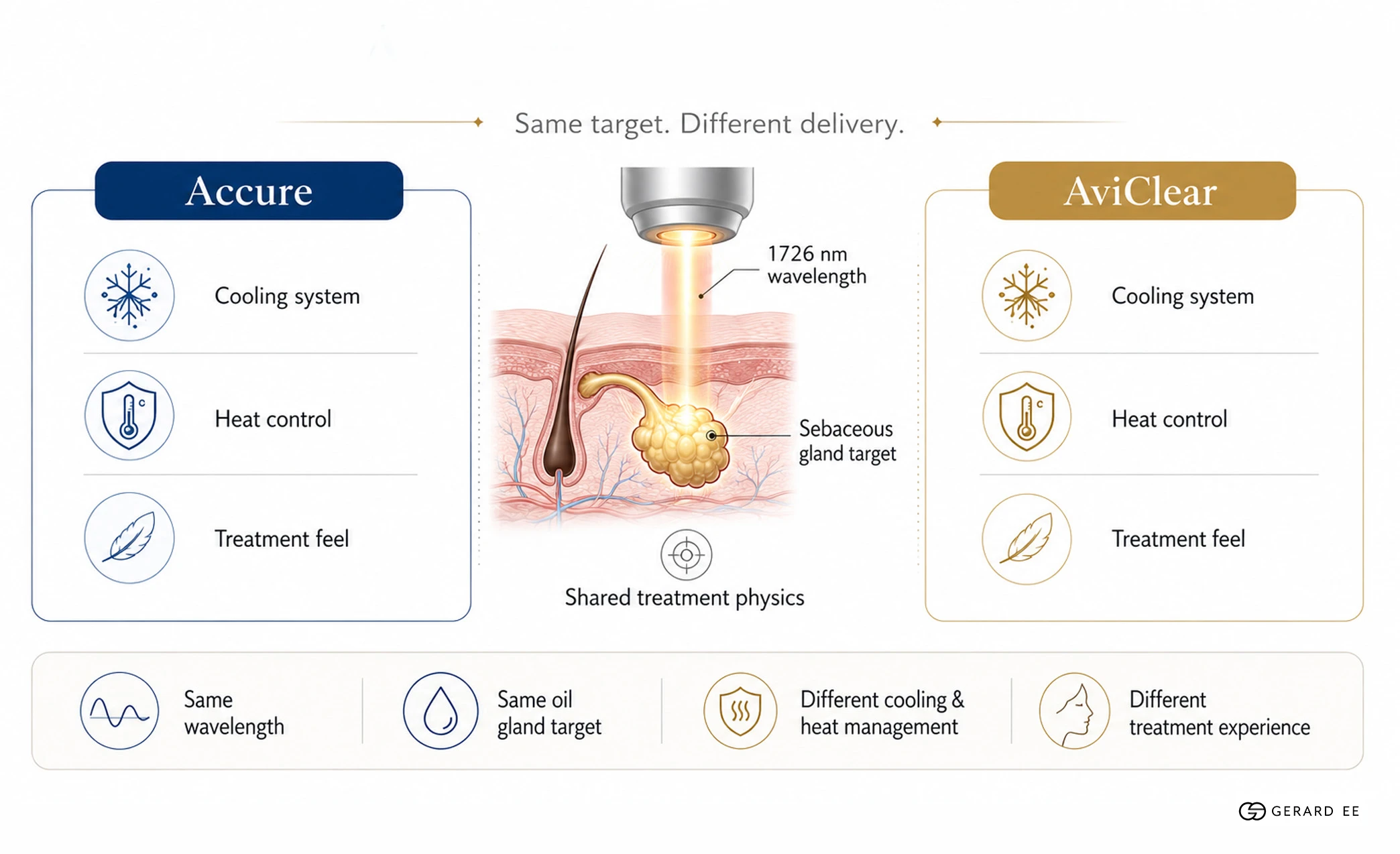
Because Accure and AviClear share the 1726 nm wavelength and the same oil gland as the target, the physics behind both technology that allows both these lasers to treat the acne is common to both. Where they differ is in the technology built around the laser, especially the cooling and the way heat is managed and monitored during treatment. This might sound like a technical detail, but it is the part that decides how a treatment feels and how safely the necessary heat can be delivered. Two devices can use the same physics and still offer very different experiences and that is exactly what has been reported with these two systems.
The lesson I take from these two lasers is that the wavelength alone does not make the treatment. The engineering around it, the cooling, the comfort and the way the heat is controlled, matters just as much. A treatment that is too painful to sit through is one a patient is far less likely to finish, and an unfinished course is one of the surest routes to a disappointing result.
Why cooling and comfort matter
Delivering enough heat to the oil glands to reduce their activity, while protecting the surface of the skin, is a fine balance and cooling is what makes it possible to do comfortably.
AviClear’s contact-cooling system is designed to protect and soothe the skin surface as the deeper glands are heated and in practice its treatments are generally well tolerated without the need for anaesthetic, with only mild, short-lived redness. Accure by contrast, has been reported by many patients as significantly more painful. In the end, physicians end up decreasing the power or energy delivered sacrificing comfort for pain at the expense of results.
Why Accure saw limited adoption
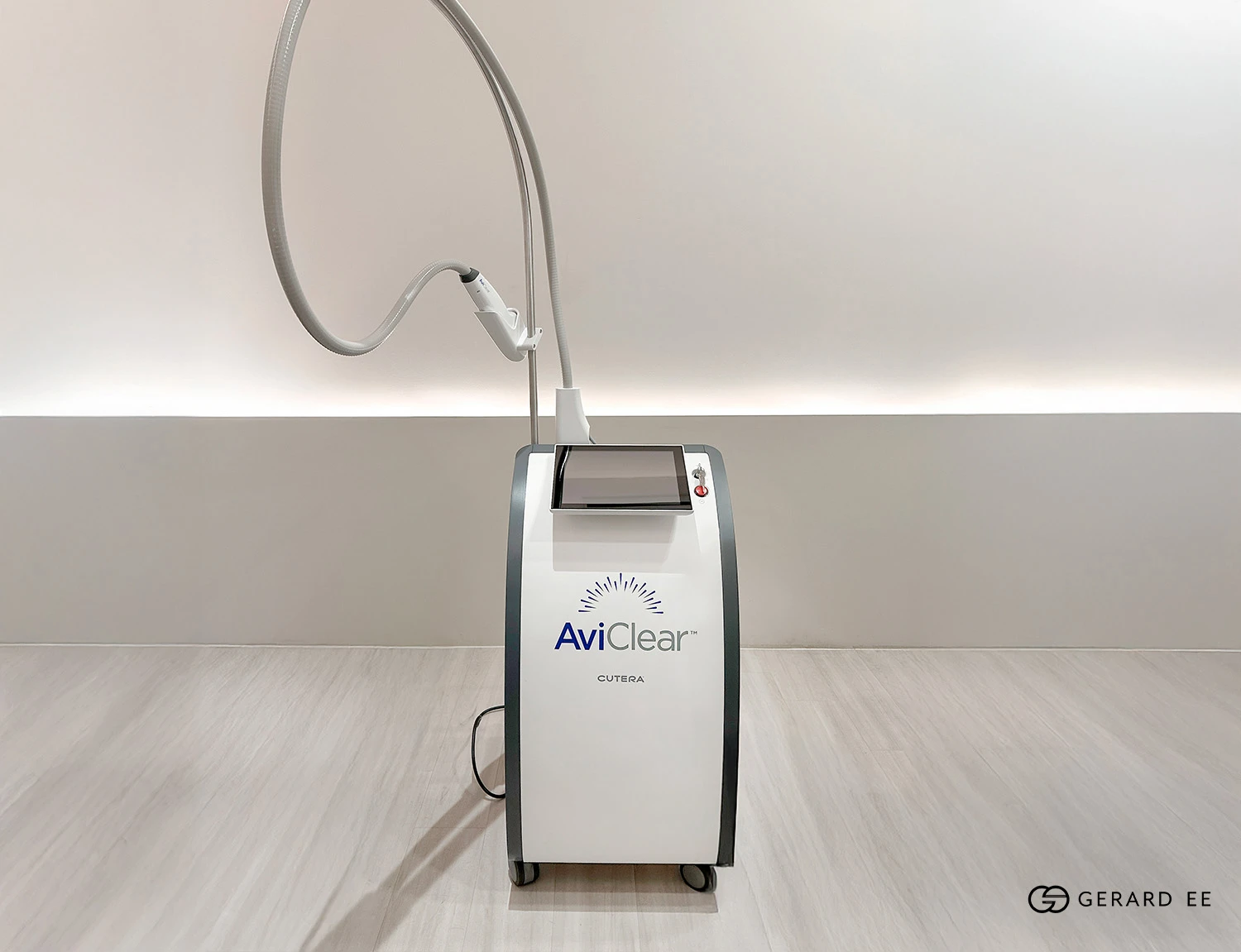 Accure showed encouraging early results and proven technology based on science, but it has not become as widely used as AviClear. This is due to several factors. Its published evidence base is smaller and shorter, whereas AviClear has more substantial data including longer follow-up. The reported discomfort affected how well patients accepted and completed treatment. Beyond the clinical picture, commercial factors, company resources and market competition all play a part in which devices become established. None of this means the underlying idea is unsound, only that a good wavelength on its own is not enough without the engineering and the patient experience to match.
How AGNES works differently
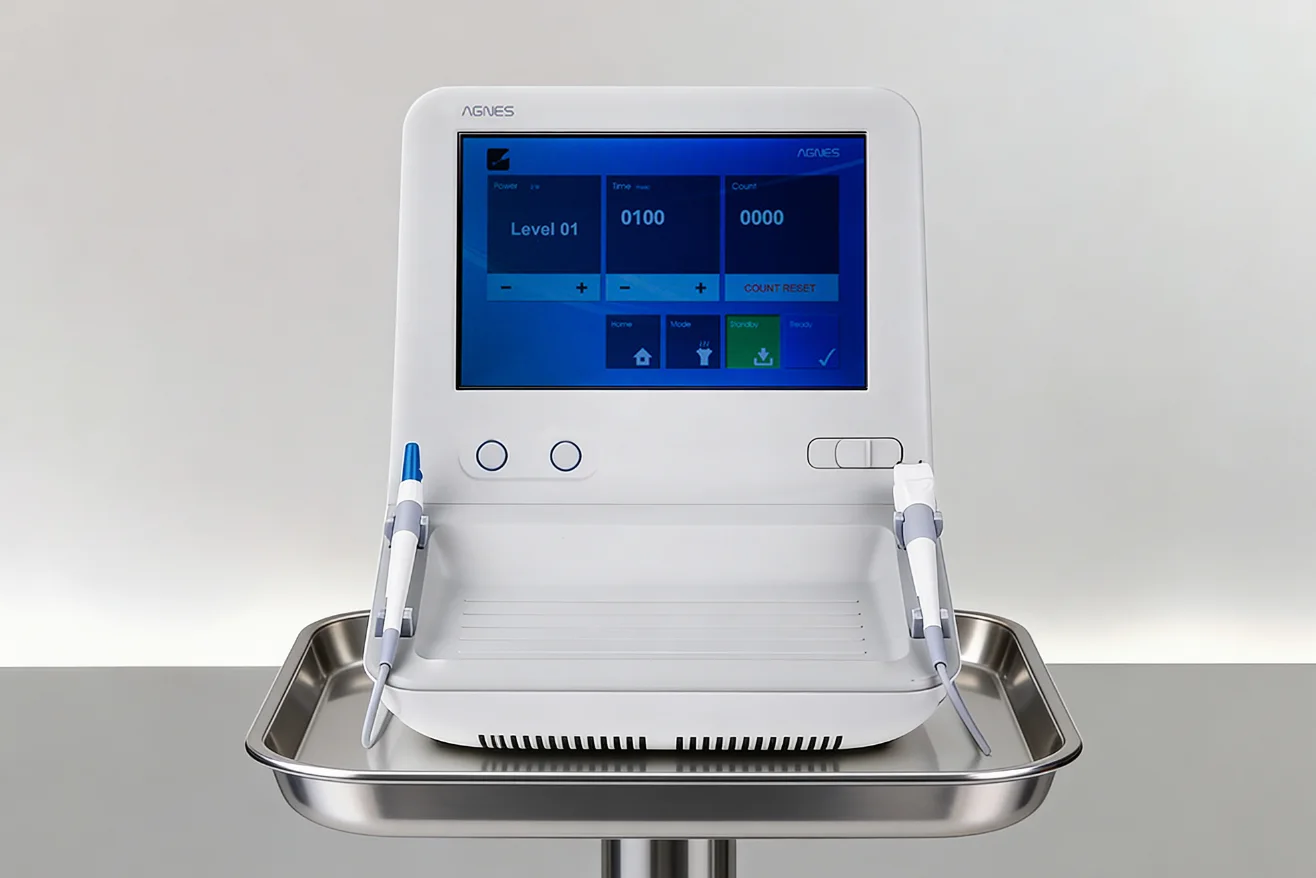
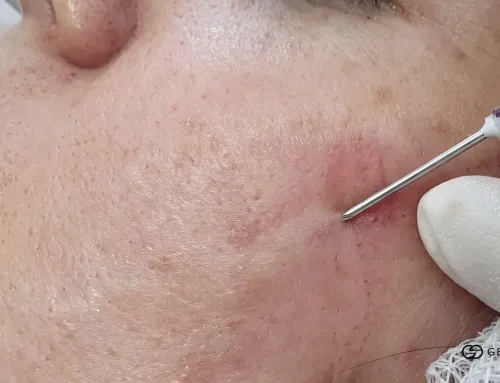
AGNES acne is worth mentioning because it targets the same oil glands but by a completely different route. Instead of a laser, it uses fine, insulated microneedles to deliver radiofrequency energy directly into an individual gland, heating and shrinking it while the insulation protects the surface layers of the skin. This precise, needle-based delivery makes AGNES particularly suited to acne that keeps returning to the same spot, where treating one gland at a time is exactly what is needed. Its discomfort is of a different kind, the brief sharp sensation of a needle rather than the sustained heat of a laser, and it is done with local anaesthetic. For the right pattern of acne, it is a very effective alternative to a laser.
Managing discomfort in laser acne treatment
Discomfort during acne laser treatment can be managed in several ways. Effective surface cooling, as built into AviClear, does much of the work, and a topical anaesthetic cream can be applied beforehand where extra comfort is wanted. The way a treatment is delivered, including how the energy is spaced and monitored, also affects how it feels. The point is that comfort should be planned for rather than simply endured, because a comfortable treatment is one a patient will actually complete, and completing the course is what delivers the result.
What the evidence shows
The science behind these treatments is well supported. Research confirms that the 1726 nm wavelength selectively heats and damages the oil glands while sparing the surface of the skin, which is the basis for its lasting effect on acne. Studies of AviClear show durable improvement in inflammatory acne that builds over months and holds up across a range of skin types, with good tolerability and no need for anaesthesia.
Radiofrequency approaches such as AGNES RF are supported by clinical research showing reduced inflammation around the follicles and shrinkage of the oil glands, with improvement sustained over the following months. The common thread is that treating the oil gland at its source, by whichever route suits the patient, produces meaningful, lasting results.
Which I use and why
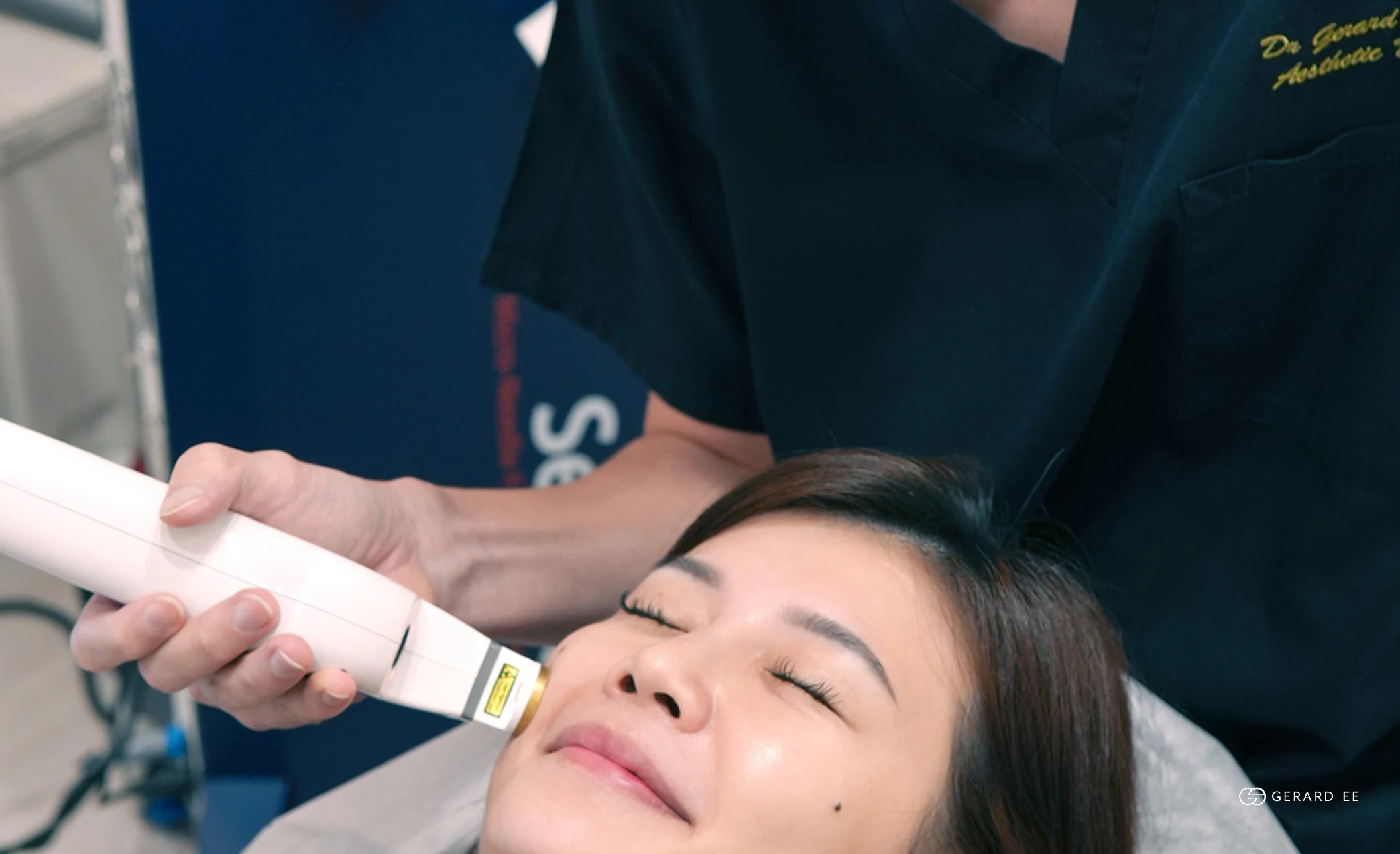
Among the 1726 nm lasers, AviClear is the option I use, because it combines the strongest and longest evidence with a level of comfort that lets patients actually complete their course. Where the acne keeps returning to one spot, I reach for AGNES instead, because its targeted, gland-by-gland approach suits that pattern better than any broad laser. This is the same principle I apply to all acne treatment. To choose a treatment for the acne and the patient and choose the option a person can realistically tolerate and finish.
Common mistakes I see
The commonest mistake around these treatments is judging a whole approach by one bad experience with a particular device. A painful, abandoned course does not mean laser treatment cannot help. Another is assuming that because two lasers share a wavelength they are interchangeable, when the engineering around the laser makes a real difference to comfort and completion. And, as with all acne treatment, expecting an instant result from something that works gradually over months leads people to give up too soon.
What you can realistically expect

A well-tolerated 1726 nm laser reduces oil and breakouts gradually over a series of sessions, with the improvement continuing to build over the following months, and the results holding across different skin types. AGNES acne can settle a recurrent stubborn sebaceous gland more quickly for a focused area. Regardless of the treatment, neither replaces a plan that includes good prescription skincare that can help to completement the treatments prescribed. The realistic expectation is steady, lasting improvement from a treatment you can comfortably complete, rather than a dramatic single session.
When to see a doctor
If you are considering a 1726 nm laser for acne, if a previous laser was too painful to continue or did not produce any results because it was not treating the root cause, do seek out a professional opinion from a doctor that is experience in treating acne.
Related reading
- Acne Treatment Singapore: How I Choose (Dr Gerard Ee)
- AviClear (Dr Gerard Ee)
- AGNES Acne Treatment (Dr Gerard Ee)
- Isotretinoin: How It Works (Dr Gerard Ee)
- Gold PTT for Acne (Dr Gerard Ee)

Dr Gerard Ee, Aesthetic Doctor in Singapore
Dr Gerard Ee is an aesthetic doctor in Singapore and the Medical Director of his practice at 50 Raffles Place. He graduated from St George’s, University of London, trained in surgery at Singapore General Hospital and the National University Hospital, and holds the MRCS (Edinburgh) and a postgraduate diploma in practical dermatology from Cardiff University.
He has practised aesthetic medicine since 2012, is the author of sixteen peer-reviewed papers, and writes and medically reviews every article on this site. Read more about Dr Gerard Ee.

Book a consultation with Dr Gerard Ee at The Clifford Clinic
Dr Gerard Ee consults at The Clifford Clinic, 50 Raffles Place, Singapore. Consultations are by appointment. Message the clinic on WhatsApp, or call 6532 2048.
Frequently asked questions
Are Accure and AviClear the same?
They share the same wavelength and mechanism, the 1726 nm laser targeting the oil glands, but they differ in the cooling and comfort technology built around the laser, which is why the experience can differ considerably.
Why is Accure so painful?
Reaching the oil glands requires significant heat, and reports suggest Accure’s cooling was less effective at keeping the surface comfortable, so treatments were often described as considerably more painful than AviClear.
Which acne laser is best?
Among 1726 nm lasers, AviClear has the strongest evidence and best tolerability. AGNES is a different, needle-based approach that suits recurrent same-spot acne. The right choice depends on your acne and what you can comfortably tolerate.
Does laser acne treatment need anaesthetic?
A well-cooled laser such as AviClear is generally well tolerated without anaesthetic, though a topical numbing cream can be used for extra comfort. AGNES is done with local anaesthetic.
Considering an acne laser? Let us match the right one to you.
The Clifford Clinic, 50 Raffles Place, Singapore Land Tower. Call (65) 6532 2048 or WhatsApp (65) 8318 6332 to arrange a consultation.
References
Sources cited on this page
- HealthHub Singapore. Acne. https://www.healthhub.sg/a-z/diseases-and-conditions/acne
- American Academy of Dermatology. Guidelines of care for the management of acne vulgaris. https://www.aad.org/member/clinical-quality/guidelines/acne
- Acne vulgaris. https://dermnetnz.org/topics/acne
- A 1726 nm laser system for the treatment of acne vulgaris. PubMed. https://pubmed.ncbi.nlm.nih.gov/36197599/
- A sebum-selective 1726 nm laser for acne across skin types: multicentre study. J Am Acad Dermatol. https://www.jaad.org/article/S0190-9622(25)02900-7/fulltext
- Selective sebaceous gland electrothermolysis using an insulated microneedle radiofrequency device for acne: randomised controlled trial. PubMed. https://pubmed.ncbi.nlm.nih.gov/31502662/
- Effects of light and laser therapies on the sebaceous gland microecosystem in acne. Photodermatol Photoimmunol Photomed. https://onlinelibrary.wiley.com/doi/10.1111/phpp.70005
- Management of acne vulgaris: a review. JAMA. https://jamanetwork.com/journals/jama/fullarticle/10.1001/jama.2021.17633
- The Clifford Clinic. Why Accure laser did not work for you. https://cliffordclinic.com/why-accure-laser-did-not-work-for-you/
Medical disclaimer: This article is for general education and does not replace an in-person consultation. Treatment suitability, results and risks vary between individuals. Please speak with a qualified doctor before starting any acne treatment.
This page is written from published research and from clinical experience in Singapore since 2012. It is for general education, not medical advice. Whether a treatment suits you, what it may achieve and what it may risk can only be established at a consultation. Dr Gerard Ee is the Medical Director of The Clifford Clinic, a private clinic in Singapore, and treatments discussed on this site are provided commercially.