

Home›Blog›Acne›Acne Scars & Marks›Why Did Subcision Make My Acne Scars Worse?
Dr Gerard Ee assesses and treats acne scars at The Clifford Clinic, 50 Raffles Place, Singapore.
If you are searching for “Why did Subcision make my acne scars worse?” you are likely feeling anxious, frustrated, and uncertain about what to do next. You may have expected your acne scars to lift, soften and reflect light more evenly. Instead, you might be seeing deeper scars, hyperpigmentation of the skin, new hard lumps forming or a contour that looks less smooth than before after your last subcision.
My quick answer
Subcision for acne scars is not an ineffective procedure. However, subcision is a highly technique dependent procedure. It is designed to treat a specific scar mechanism and when it is applied to the wrong scars, performed in the wrong tissue plane or delivered without a structured plan for collagen rebuilding, the outcome can be disappointing. In certain cases, the skin can look temporarily worse during healing and in other cases, it can look persistently worse if key fundamentals were missed.
Read next: which acne scar treatment suits which scar, the subcision for acne scars page, and what acne scar treatment costs in Singapore.
What subcision is actually supposed to treat
DermNet describes subcision as a minor surgical procedure for depressed scars, performed by inserting a needle and breaking fibrotic strands that tether the scar to underlying tissue. Dermnet also explains that improvement occurs through release of tethering and new collagen deposition during wound healing.
Dr Gerard Ee has written this article here to explain the most common reasons patients feel worse after subcision, what a properly planned subcision program should look like and how to protect yourself from repeating the same mistake.
Subcision is primarily intended for depressed scars that are tethered by fibrous bands beneath the skin. These depressed scars are bound down scars due to acne and it specifically excludes deep ice pick scars from its typical indication list.
In practical terms, this means subcision is most relevant when the scar is held down by tethering. This is why rolling scars often respond best because rolling scars tend to flatten when the skin is stretched which suggests that tethering contributes to the visible depression. Rolling scars can often be seen as scars that are wide, covering a wide area and often having a sloping edge that can be smoothed out if stretched.
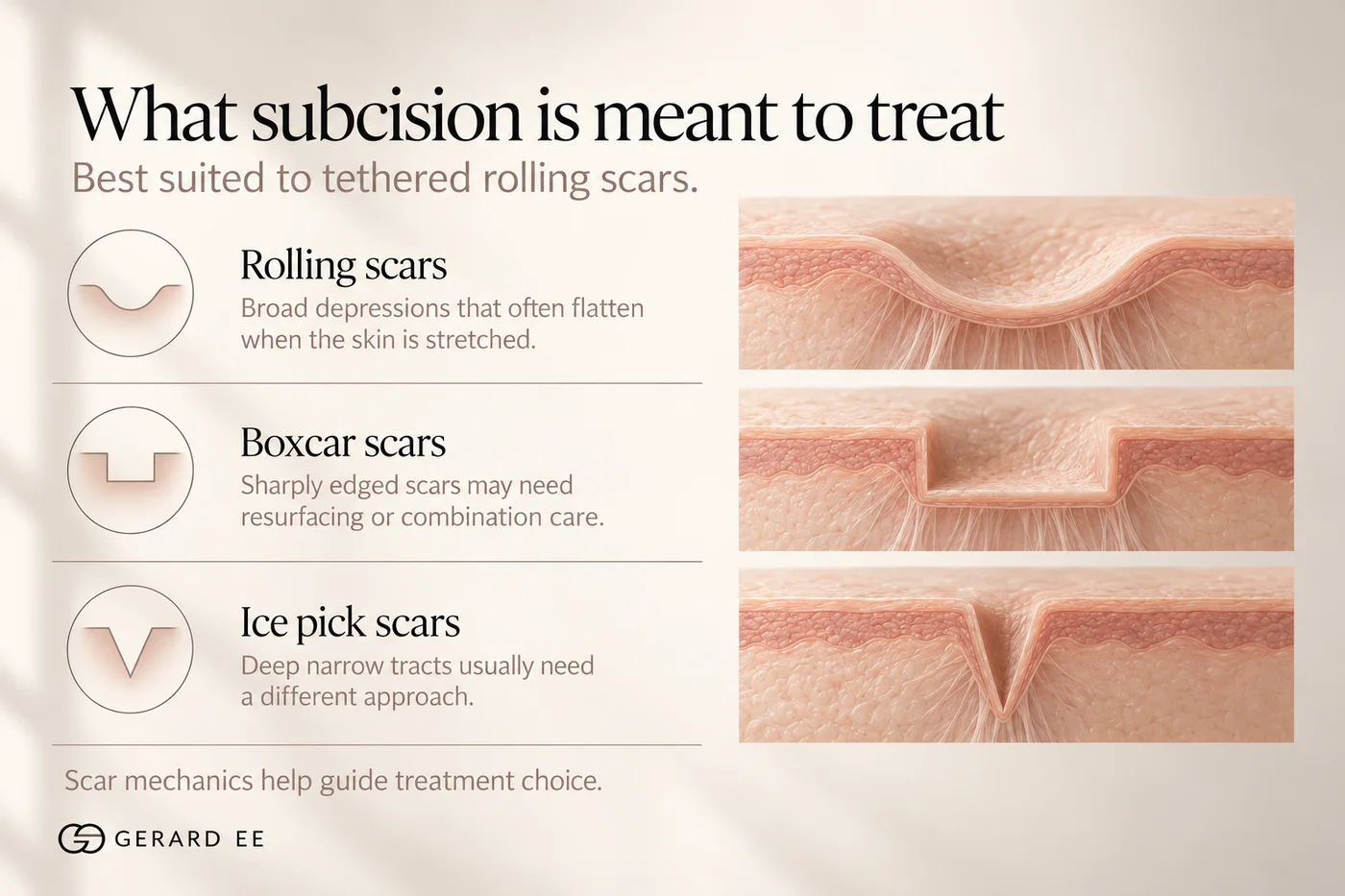
Clinical literature also supports that rolling scars are a key target for subcision. A study on subcision outcomes in rolling acne scars concluded that subcision appears safe and may provide significant long term improvement in selected patients with rolling scars. It also notes that combining subcision with other scar revision procedures or repeating subcision can be beneficial when complete resolution does not occur.
Patients often complaine that subcision either made them worse or subcision had no results. I have heard this exact statement from numerous patients. This is usually due to one underlying problem, the procedure was used as a default solution instead of being selected for the correct scar type and scar mechanics.
Why subcision can look worse at first, even when it was performed correctly

Before discussing technique failures, it is important to address something many patients experience. Subcision commonly causes swelling and bruising. Temporary unevenness and stronger looking shadows can occur during early healing, especially under harsh lighting or flash photography.
There are risks and complications that include hematoma from bleeding, pain or tenderness, infection, temporary post inflammatory hyperpigmentation, and suboptimal response or lack of improvement.
A 2024 review of subcision complications similarly reports that commonly described issues include pain or tenderness, bruising, infection, formation of subcutaneous lumps, and dyspigmentation. Fortunately, many of these complications often resolve spontaneously after the procedure.
If your skin looks worse only in the first days or weeks, you may be seeing the normal recovery phase. However, if the unevenness persists or if you notice new contour irregularity that does not improve as swelling settles, the next sections become highly relevant.
The most common reasons patients ask “Why Did Subcision Make My Acne Scars Worse?”
1. Subcision was performed on scars that were not primarily rolling or tethered scars
This is one of the most frequent causes of poor outcomes. If your scars are predominantly ice pick scars, sharply edged boxcar scars, or superficial textural irregularity, subcision may not be the procedure that creates visible improvement. In that scenario, you may still experience bruising and swelling but you may not see meaningful lift because tethering was not the primary issue.
An individualized approach is required for acne scarring and more than one type of treatment is often used as part of a multi modal approach to correct scar colour, texture, and volume. Where the midface has also deflated, cheek filler addresses the shadow that scar treatment alone leaves behind. It is important that active acne should be treated prior to commencing scar management.
Clinical data also supports differential response by scar type. My full guide to acne scar treatment in Singapore sets out how the modalities are matched and sequenced. In a prospective study of subcision combined with microneedling, rolling and boxcar scars showed more improvement than ice pick scars.
When subcision is used on scars that are not truly tethered, the procedure may create trauma without delivering the lift that patients expect. This mismatch alone can make patients feel worse, even if no serious complication occurred.
2. The release was incomplete because the procedure did not effectively cut through scar fibres
Subcision is not simply passing a cannula under the skin. The procedure must release fibrotic strands. When a proper subcision is done, it cuts through fibrous scar tissue, releasing any tethering the scar has to underlying tissue.
If the clinician does not apply sufficient technique, does not work in the correct plane or fails to cut through the scar fibres, tethering may remain. In that case, the patient experiences downtime but sees minimal lifting of the depression.
It has been well described that “sub optimal response or lack of improvement” as a recognized outcome of subcision.
When patients interpret a lack of improvement as “worse,” it is often because swelling and bruising temporarily exaggerate shadows and after recovery the scar looks essentially unchanged. This feels like time and money were lost.
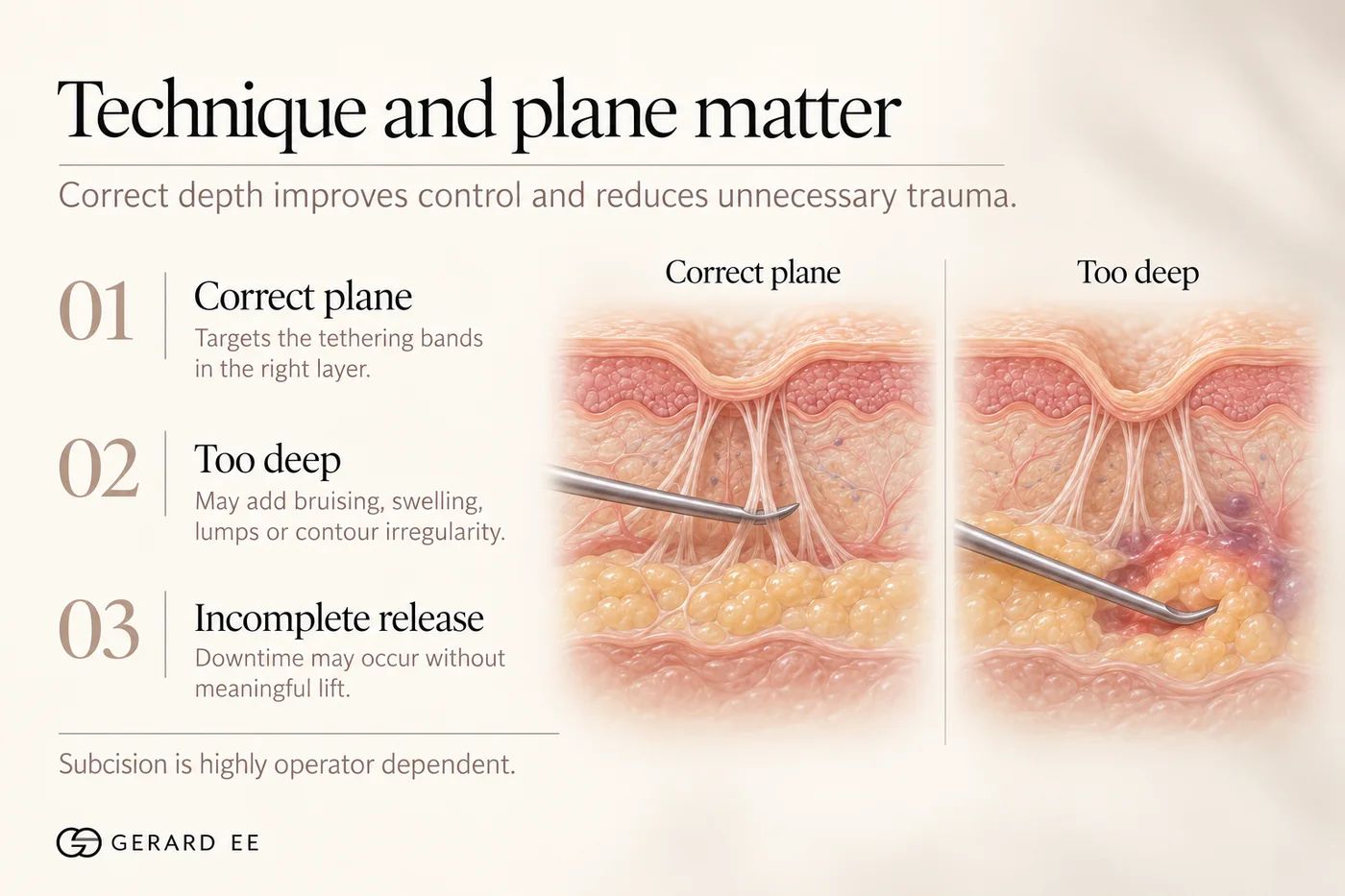
3. Subcision was performed with poor technique, including incorrect plane selection, which increased trauma and irregularity
Plane selection is not a minor detail. It is central to both safety and results.
A common pitfall in technique as fanning too deeply in a plane below the dermis.
When the procedure is performed in an inappropriate plane, the clinician may fail to release the correct tethering bands while still creating bruising, swelling and tissue disruption. That combination can lead to prolonged recovery, lumps or contour irregularity that makes scars look worse in real world lighting.
A 2024 complication review reports that subcutaneous lumps and dyspigmentation can occur after subcision. These issues are not proof that subcision is dangerous. They are proof that the procedure is operator dependent and should be performed by a clinician who understands scar anatomy and facial layers.
4. The procedure may have disrupted underlying soft tissue support, creating new unevenness
Patients sometimes describe this as “subcision destroyed my underlying soft tissue.” The more clinically accurate framing is that subcision can sometimes lead to contour irregularity or persistent firmness in the treated area particularly if there is bleeding, hematoma, or healing related fibrosis.
In the rolling scar outcomes study, the authors report that swelling, bruising, and pain were transient, but that patients may have persistent firm bumps at the treatment site.
It has been well described that hematoma is a risk. Injuries to nerve or blood vessel as a possible complication in certain anatomical areas.
The correct response to this concern is not to avoid subcision forever. The correct response is to have a detailed scar assessment and to ensure the next procedure is planned around anatomy, controlled technique and a structured strategy for post release collagen rebuilding.
5. The clinician used instruments that are not suitable your scar thickness and depth
Instrument choice influences control and effectiveness. A comprehensive review of subcision for atrophic acne scars reports four main categories of tools used in clinical studies: needles, cannulas, wires and blunt blade instruments. It states that usage varies by scar depth, clinician preference and combination of different treatment options.
Clinical trials have also compared technique variations. A PubMed indexed split face study reported that blunt cannula subcision was more efficient than needle subcision when considering complications and satisfaction rates and the authors suggested blunt cannula subcision as a good replacement in their context.
A separate review of clinical trials concludes that needle based and cannula based subcision offer comparable efficacy however cannula based subcision can cause fewer side effects and may result in greater patient satisfaction. These trials also mentioned that modifications and combination therapies can improve efficacy.
The message for patients is straightforward. If the instrument is too flexible, poorly selected for your scar depth, or used with inadequate control, the clinician may either fail to release the correct tethering or create excess trauma while chasing a release that never fully happens.
6. Subcision was performed without any structural support or biostimulation plan, so scars re depressed during healing
Subcision releases the tethering bands that pull rolling scars downward. However, many patients need a structured plan to both support the newly released plane and stimulate collagen remodelling, so that the lifted effect becomes stable rather than transient. A randomized study comparing subcision combined with either fractional carbon dioxide laser or cross-linked hyaluronic acid filler versus subcision alone found that both combined approaches produced superior improvement, while subcision alone delivered only modest change. A review of clinical trials similarly concludes that combining subcision with adjuncts such as fillers and threads can improve outcomes and reduce the risk of scars re depressing, with combination therapy generally improving efficacy. That said, cross linked hyaluronic acid fillers are only temporary. They can help prop up a released plane early on, but they are gradually resorbed and the apparent improvement may fade as swelling resolves and the filler dissipates. In acne scar remodelling, what most patients truly want is a result that looks and feels more permanent because the skin structure and collagen has been rebuilt and not merely a short term lift.
This is where biostimulator fillers become a more strategic partner to subcision. Instead of simply adding temporary volume, biostimulators drive collagen production within the dermis and subdermis, aiming to rebuild the scarred architecture so improvements can consolidate over time. Two commonly used options are Ellansé and Radiesse. Ellansé is a collagen stimulator suspended in a carrier gel that provides an immediate, subtle lift while the main benefit accrues gradually as the skin produces new collagen around the particles, improving texture, resilience, and contour in a more durable way. Radiesse is a calcium based biostimulator that can be used to support the released plane and trigger collagen remodelling. When appropriately placed and in some protocols, diluted for collagen stimulation rather than sheer volume, it can improve skin density and scar support over time. When a plan ends at release only the scar fibres, the patient may look swollen and lifted initially, then gradually settle back down as swelling subsides and no true structural rebuilding occurs. The patient may then conclude that subcision made the scars worse, when the real issue is that the plan did not include adequate reconstruction and stabilisation. When patients ask for biostimulators, they are often asking for precisely this missing step, collagen rebuilding that locks in texture gains rather than relying on temporary swelling or short lived volumisation.
7. Subcision was performed while acne was still active, and new scars continued to form
This factor is more common than most patients realize.
Active acne should be treated prior to commencing scar management. This is to ensure that active lesions do not continue to scar areas that are already being treated.
A 2025 Medicine Today feature article on acne scarring states that active acne should be under control before initiating scar treatment and that acne scarring often requires a comprehensive and multimodal approach.
If you had subcision while you were still breaking out in the same areas, you may have experienced two processes at the same time: healing from subcision and forming new inflammatory scars. That combination can easily be perceived as worsening, because the overall scar burden may increase even if the released scars improved slightly.
In a properly structured program, acne control is not a side note. Acne control is the foundation that protects every subsequent scar procedure.
8. The clinic had a limited scar toolkit, and subcision was used as the default procedure
Patients can sometimes sense this in the consultation. The plan feels identical for every person and subcision is presented as the only solution, regardless of scar type.
Modern acne scar care is rarely a single modality decision. A Dermatologic Surgery review states that combining acne scar treatment techniques can be performed safely and synergistically for optimal outcomes, based on the authors’ experience.
A multimodal approach is often necessary given the complexity of acne scarring.
A 2024 review on acne scarring education and prevention includes a key point that transparency of pricing is paramount when discussing treatment modalities.
In other words, it is not only about cost. It is about whether the clinic is truly selecting procedures based on your scars, or whether the clinic is selecting procedures based on what is readily available.
If a provider does not have resurfacing devices, does not offer collagen remodelling options, or does not have the experience to combine modalities, then subcision may be overused as a low overhead default. That approach often produces partial results at best, and it can create unnecessary downtime at worst.
The armoury available in the treatment of acne scars include insulated microneedle fractional RF machines like Infini, non-insulated microneedle fractional RF machines like the Secret RF and Potenza, fractional Co2 machines and Pico MLA machines. Very few clinics invest in a huge array of equipment and far too many single device clinics always propose subcision as the gold standard just because of a lack of resurfacing equipment available.
How I approach subcision so that it delivers predictable improvement
When patients come to me after a disappointing experience, I do not begin by repeating subcision. I begin by diagnosing why the first subcision failed.
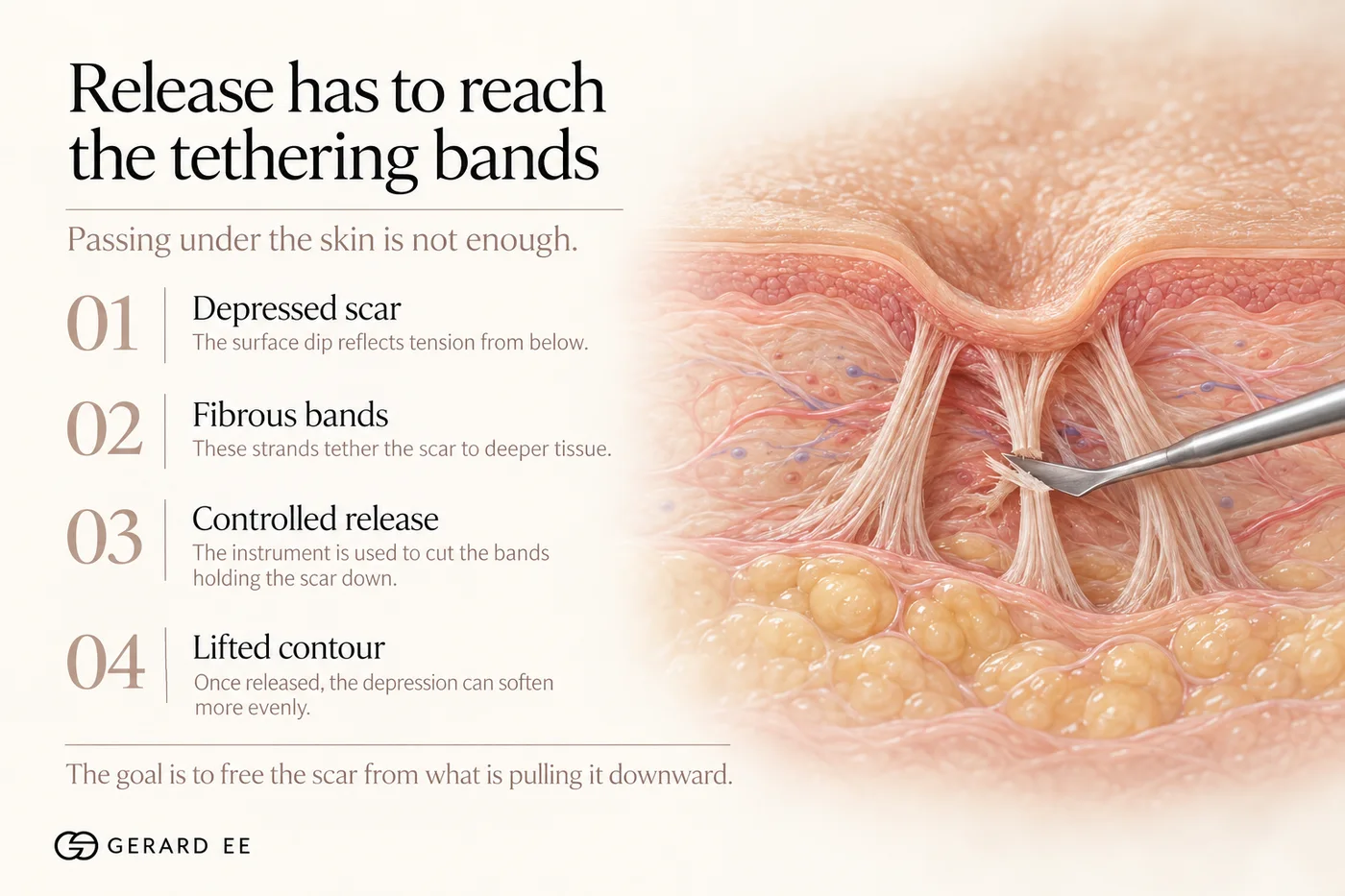
I perform a structured scar assessment to determine which scars are truly rolling and tethered, which scars are boxcar dominant, which scars are ice pick dominant, and which areas have volume loss versus surface texture problems. DermNet notes that scar severity can be graded using the Goodman and Baron qualitative grading system to allow objective comparisons before and after treatment.
I then design a plan that integrates three principles.
First, I ensure acne is controlled before serious scar revision begins, because ongoing inflammation creates new scars and undermines recovery.
Second, I use subcision only where scar mechanics justify it, and I treat subcision as one component of a comprehensive plan, not as a standalone event.
Third, I integrate collagen rebuilding strategies that stabilize improvement. Clinical evidence supports improved outcomes when subcision is combined with other modalities such as filler or fractional laser, compared with subcision alone.
This is how subcision becomes a disciplined, results driven procedure rather than an unpredictable gamble.
What you should ask before you undergo subcision again
You should treat your next consultation as a serious clinical evaluation. The following questions protect you:
- You should ask the clinician to identify which specific scars are rolling and tethered, and which scars are not appropriate for subcision.
- You should ask what the clinician will do differently if your previous subcision did not release scar fibres effectively.
- You should ask which subcision tool strategy is being used and why that strategy is appropriate for your scar depth and facial region.
- You should ask what the plan is to reduce the chance of scars re depressing after release, including collagen rebuilding options and combination treatments.
- You should ask how active acne will be managed before and during the scar program, because scar revision is best performed after acne remission.
- You should ask what complications are most common in that clinician’s practice, and how they are minimized and managed, because bruising, lumps, and dyspigmentation are recognized outcomes in published reviews.
- You should ask what alternative modalities the clinic can offer if your scars require resurfacing, lifting, or pigment management in addition to subcision, because acne scarring often requires a multi modal approach.
A formal consultation should provide direct answers to these questions. If the answers are vague, dismissive, or generic, you should view that as a warning sign.
Why public figures choose structured programmes rather than one off procedures
A one time procedure rarely transforms acne scarring because acne scarring is rarely one scar type.
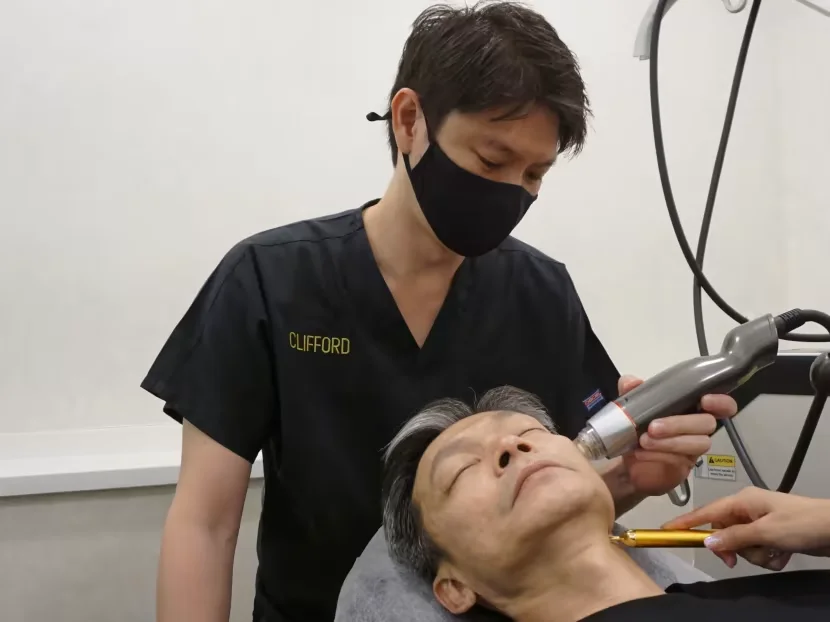
In a TODAY Brand Spotlight, actor and host Mark Lee shared that his complexion improved after undergoing treatments at Clifford Aesthetics, and the article states that he followed the clinic’s acne scar treatment programme and returned for maintenance. The article also explains that the programme uses a combination of treatments to stimulate collagen fibres that pad out depressions caused by acne scarring.
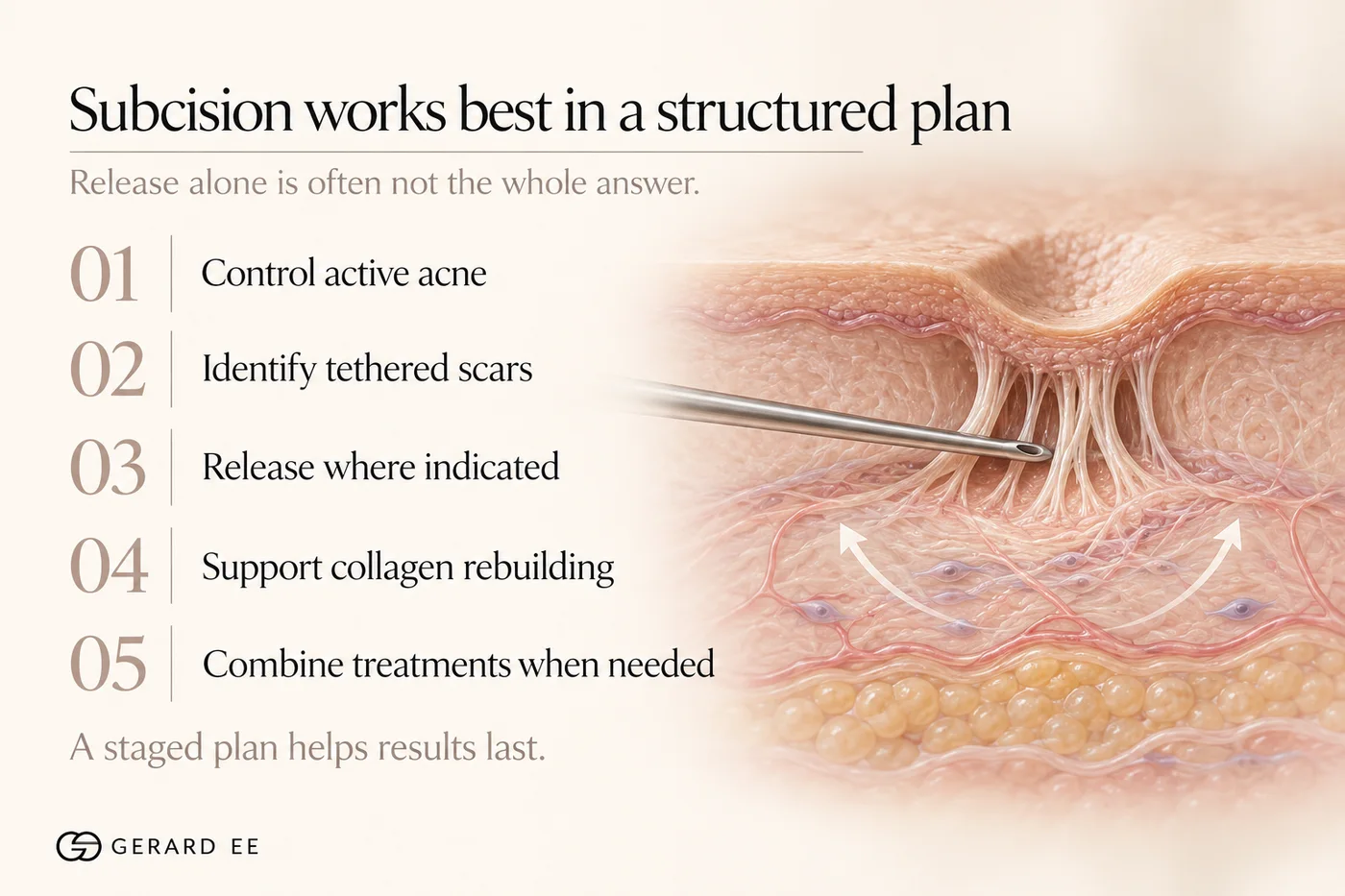
This is exactly the mindset that prevents disappointment. Subcision is not a single action. Subcision is one important step within a staged collagen remodelling plan.
The next step if you feel subcision made you worse
If you feel worse after subcision, the correct next step is not to panic and rush into another procedure without assessment. The correct next step is a detailed scar analysis that answers three questions.
- First, were your scars appropriate for subcision in the first place.
- Second, did the procedure release scar tethering effectively, or was the release incomplete.
- Third, was a long term collagen support plan implemented, or were you left with release only.
If you would like a comprehensive scar evaluation and a structured treatment plan in Singapore, The Clifford Clinic is located at 50 Raffles Place, unit 01 01, Singapore Land Tower, Singapore 048623, and the clinic lists contact details including phone (65) 6532 2048 and WhatsApp (65) 8318 6332.

Dr Gerard Ee, Aesthetic Doctor in Singapore
Dr Gerard Ee is an aesthetic doctor in Singapore and the Medical Director of his practice at 50 Raffles Place. He graduated from St George’s, University of London, trained in surgery at Singapore General Hospital and the National University Hospital, and holds the MRCS (Edinburgh) and a postgraduate diploma in practical dermatology from Cardiff University.
He has practised aesthetic medicine since 2012, is the author of sixteen peer-reviewed papers, and writes and medically reviews every article on this site. Read more about Dr Gerard Ee.

Book a consultation with Dr Gerard Ee at The Clifford Clinic
Dr Gerard Ee consults and performs subcision and acne scar treatment at The Clifford Clinic, 50 Raffles Place, Singapore. Consultations are by appointment. Message the clinic on WhatsApp, or call 6532 2048.
References
Published studies cited on this page
- DermNet. Subcision. Description of mechanism, indications, pitfalls, and complications including hematoma, infection, post inflammatory hyperpigmentation, and sub optimal response.
- DermNet. Acne scarring. Statement that active acne should be treated prior to scar management and that a multi modal approach may be used for colour, texture, and volume.
- Vempati A, Zhou C, Braunberger TL, et al. Subcision for atrophic acne scarring: a comprehensive review of surgical instruments and combinatorial treatments. Clinical, Cosmetic and Investigational Dermatology. 2023. Tool categories and practice variation by scar depth and combination choices.
- Abdelwahab AA, et al. A combined subcision approach with either fractional carbon dioxide laser or cross linked hyaluronic acid versus subcision alone in atrophic post acne scar treatment. Randomized comparative study reporting superior improvement in combined groups versus subcision alone.
- Sun C, et al. Complications of subcision for acne scarring: experience from clinical practice and review of the literature. 2024. Reported complications including bruising, infection, subcutaneous lumps, and dyspigmentation.
- Alam M, Omura N, Kaminer M. Subcision for acne scarring: technique and outcomes in 40 patients. Dermatologic Surgery. 2005. Findings focused on rolling scars, including potential for long term improvement and possible persistent firm bumps.
- Gheisari M, et al. Blunt cannula subcision is more effective than Nokor needle subcision for acne scars treatment. Journal of Cosmetic Dermatology. 2019. Comparison of satisfaction and complications favoring blunt cannula approach in their analysis.
- Ahramiyanpour N, et al. Subcision in acne scarring: a review of clinical trials. 2023. Conclusion that modifications reduce side effects and combination therapies improve efficacy, including statements on cannula versus needle experience.
- Bhargava S, et al. Subcision and microneedling combination study. Journal of Clinical and Aesthetic Dermatology. 2019. Statement that rolling and boxcar scars improved more than ice pick scars in their cohort.
- Connolly D, Vu HL, Mariwalla K, Saedi N. Acne scarring: pathogenesis, evaluation, and treatment options. 2017. Statement that active acne should be treated before scar treatment to avoid ongoing scarring in treated areas.
- See JA, Gupta M. Acne scarring: why it occurs and what can be done. Medicine Today. 2025. Statement that active acne should be under control before initiating scar treatment and that multimodal approaches are often needed.
- Jennings T, et al. Acne scarring: pathophysiology, diagnosis, prevention and education. Part I. Journal of the American Academy of Dermatology. 2024. Key points include treating acne scarring following complete remission of active acne and emphasizing transparency of pricing when discussing modalities.
This page is written from published research and from clinical experience in Singapore since 2012. It is for general education, not medical advice. Whether a treatment suits you, what it may achieve and what it may risk can only be established at a consultation. Dr Gerard Ee is the Medical Director of The Clifford Clinic, a private clinic in Singapore, and treatments discussed on this site are provided commercially.
Related Posts





2 Comments
Comments are closed.


sildenafil tadalafil onset comparison
sildenafil tadalafil onset comparison
tadalafil vs sildenafil
tadalafil vs sildenafil